Japan Healthcare Logistics Market Size & Growth Rate
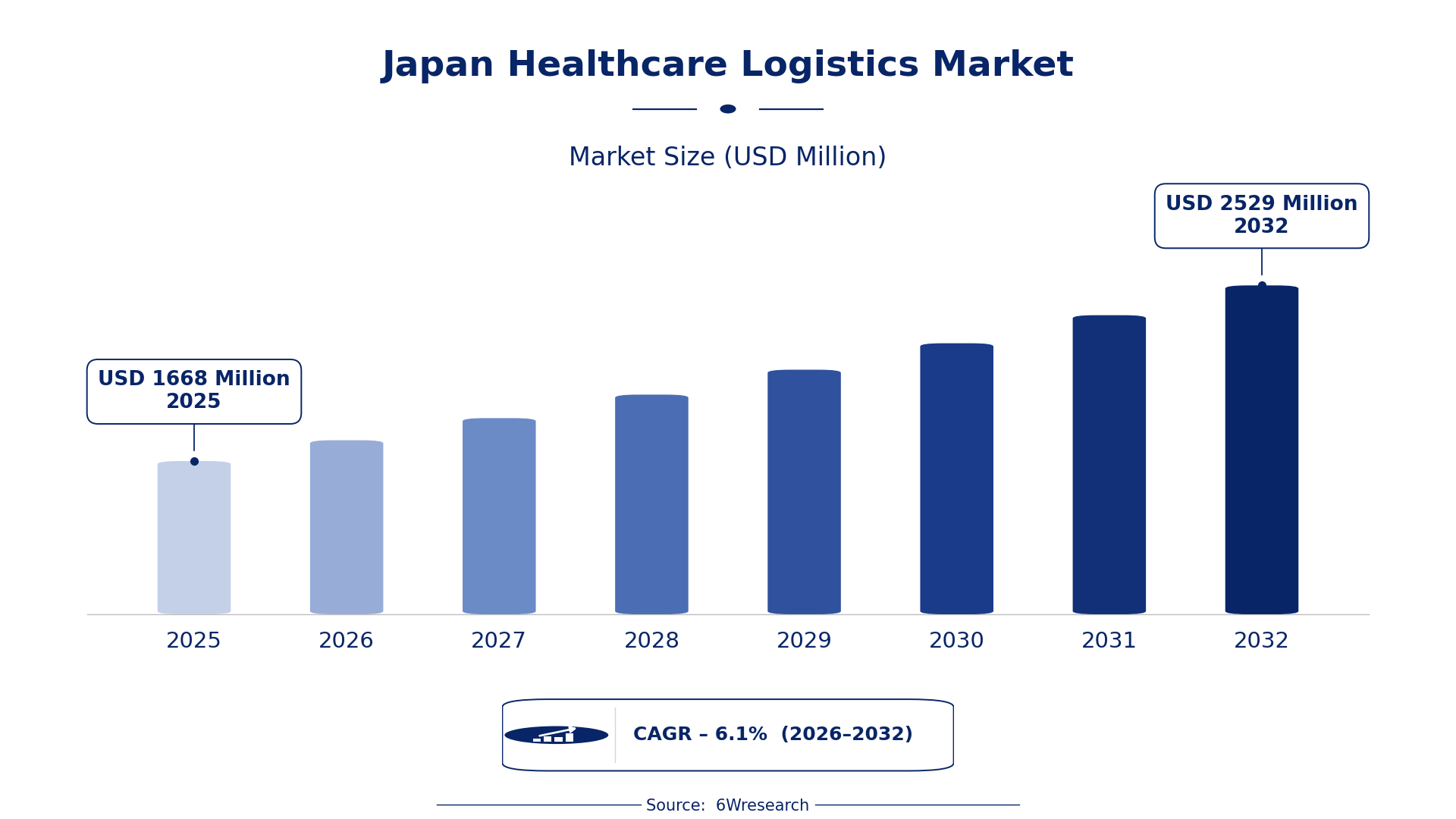
According to 6Wresearch internal database and industry insights, the Japan Healthcare Logistics Market was valued at USD 1,668 Million in 2025 and is projected to reach USD 2,529 Million by 2032, growing at a CAGR of approximately 6.1% during 2026–2032.
Japan Healthcare Logistics Market Highlights
| Report Metric | Details |
| Report Name | Japan Healthcare Logistics Market (2026-2032) |
| Market Size 2025 | USD 1,668 Million |
| Market Size 2032 | USD 2,529 Million |
| Absolute Growth 2025–2032 | USD 861 Million |
| CAGR 2026–2032 | 6.1% |
| Peak Annual Growth | 7.6% in 2032 |
| Forecast Period | 2026–2032 |
| Historical Data | 2022–2025 |
| Base Year | 2025 |
| Leading Type, 2025 | Non-Cold Chain (54% share) |
| Leading Components, 2025 | Hardware (51% share) |
| Leading Temperature Type, 2025 | Ambient (45% share) |
| Leading Logistics, 2025 | Transportation (48% share) |
| Leading Logistics Type, 2025 | Overland Logistics (44% share) |
| Fastest-Growing Type | Cold Chain (8.4% CAGR) |
| Fastest-Growing Components | Services (8.9% CAGR) |
| Fastest-Growing Temperature Type | Chilled/Refrigerated (8.8% CAGR) |
| Fastest-Growing Logistics | Packaging (7.9% CAGR) |
| Fastest-Growing Logistics Type | Sea Freight Logistics (8.6% CAGR) |
| Growing Sector | Healthcare logistics |
| Key End Users | Hospitals, Clinics, Pharmaceutical Companies |
Japan Healthcare Logistics Market Year-wise Growth Rate and Key Drivers (2022–2032)
This graph illustrates the annual growth rates of the market from 2022 to 2032, highlighting a steady upward trajectory and projected market expansion over the forecast period.
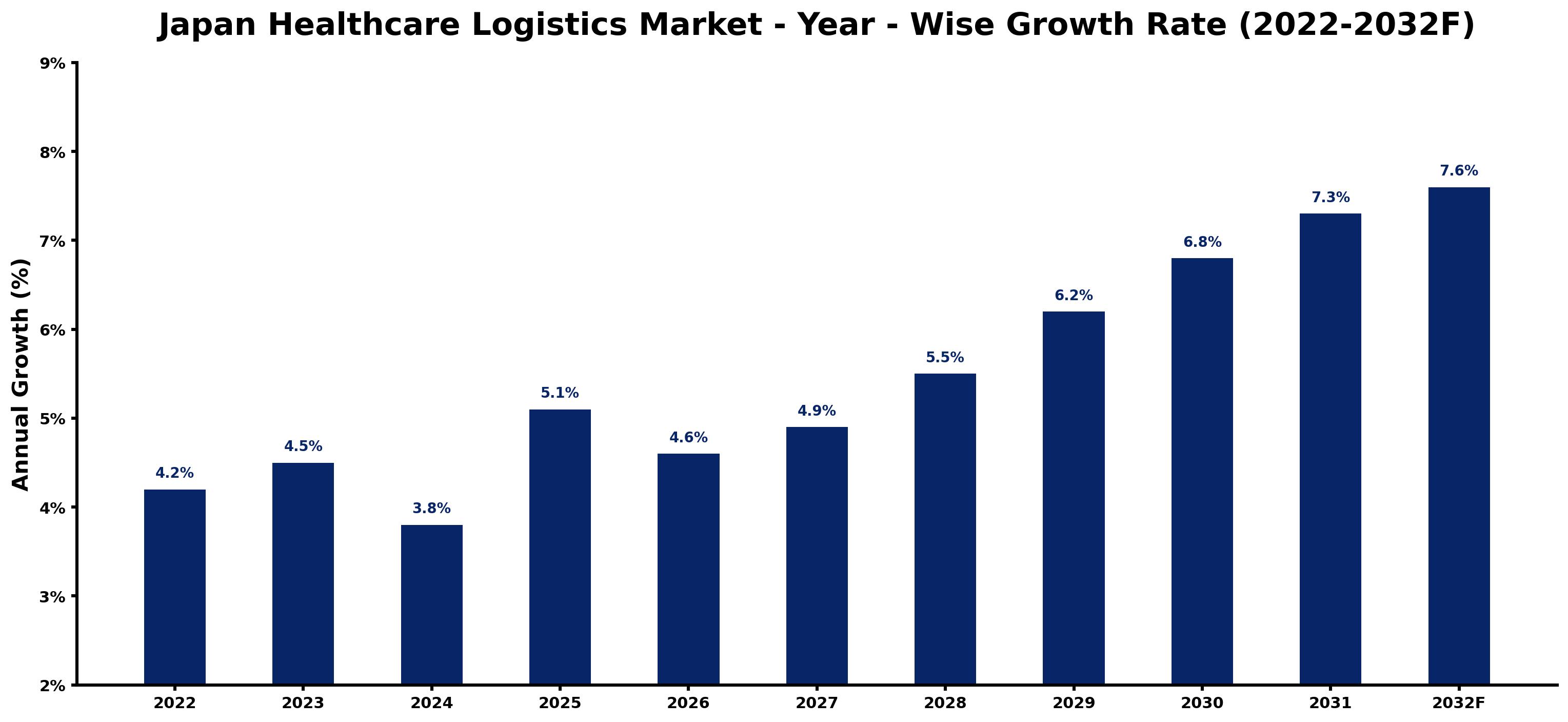
The following figures match every annual growth estimate with the main market development of that year, giving the reasoning behind each rise or slowdown.
| Year | Estimated Annual Growth (%) | Market Rationale |
| 2022 | 4.2 | The market experienced steady growth, driven by increasing healthcare demands. |
| 2023 | 4.5 | Growth accelerated due to rising investments in healthcare infrastructure. |
| 2024 | 3.8 | Market growth slowed slightly as logistics challenges emerged. |
| 2025 | 5.1 | The market rebounded with stronger demand from hospitals and clinics. |
| 2026 | 4.6 | Growth is expected to moderate as the market adjusts to new operational standards. |
| 2027 | 4.9 | Demand is anticipated to increase again, supported by technological advancements in logistics. |
| 2028 | 5.5 | The market is projected to continue expanding with rising healthcare expenditures. |
| 2029 | 6.2 | Growth is expected to remain strong, driven by the needs of an aging population. |
| 2030 | 6.8 | Demand is projected to surge as cold chain logistics expands for vaccines. |
| 2031 | 7.3 | Healthcare logistics demand is expected to rise due to efficiency improvements. |
| 2032 | 7.6 | The market is projected to peak, driven by innovations in logistics technology. |
Note: Market size estimations and growth projections presented in this report are based on 6Wresearch's proprietary forecasting methodology, utilizing the latest available industry data, government publications, and primary research inputs.
Japan Healthcare Logistics Market Synopsis
Healthcare logistics involves managing the flow of medical products and services, ensuring timely delivery and compliance with safety standards. This sector is essential for maintaining the integrity of pharmaceuticals, particularly those requiring temperature control. The Japan Healthcare Logistics Market is expanding due to increasing healthcare expenditures, driven by an aging population, which accounted for 29.3% of the population in 2024. The Tokyo region, representing 30% of logistics activities, is a key demand source, supporting the market's growth potential.
Market Dynamics Impact Analysis (2026–2032)
| Factor | Type | Impact | Primary Segment Affected |
| Increasing healthcare expenditures due to an aging population | Driver | High | Cold Chain |
| Technological advancements in logistics management | Driver | High | Services |
| Investment in cold chain infrastructure | Opportunity | High | Cold Chain |
| Growing demand for temperature-controlled logistics solutions | Opportunity | Medium | Chilled/Refrigerated |
| Logistics challenges in rural healthcare delivery | Restraint | High | Transportation |
| Regulatory compliance costs for logistics providers | Restraint | Medium | Services |
| Supply chain disruptions affecting timely deliveries | Challenge | High | Transportation |
| Competition among logistics providers leading to price pressures | Challenge | Medium | Cold Chain |
Evaluation of Drivers in Japan Healthcare Logistics Market (2026–2032)
These are the developments adding the most demand over the forecast period.
| Drivers | Primary Segment Affected | Why It Matters (Evidence) |
| Rising healthcare expenditures | Cold Chain | Japan's national medical care expenditure was about JPY 46.7 trillion in 2022, driving demand for cold chain logistics. |
| Technological advancements in logistics | Services | The logistics industry is expected to invest in automation technologies by 2025, enhancing service efficiency. |
| Aging population increasing healthcare needs | Transportation | 29.3% of Japan's population was aged 65 or older in September 2024, leading to higher demand for healthcare logistics. |
| Government initiatives to improve logistics infrastructure | Chilled/Refrigerated | In 2023, a new initiative was introduced to enhance cold chain logistics infrastructure across the country. |
| Growing number of healthcare facilities | Transportation | Japan had about 8,100 hospitals in 2023, increasing the need for efficient healthcare logistics solutions. |
Several shifts outside the market lift sales. The aging population, with 29.3% aged 65 or older, drives demand for healthcare logistics, particularly in transportation. Japan's national medical care expenditure reached approximately JPY 46.7 trillion in 2022, further increasing demand for logistics services. The logistics sector is set to invest in automation technologies by 2025, improving efficiency and service delivery for hospitals and clinics.
Evaluation of Restraints in Japan Healthcare Logistics Market
These are the pressures that could keep growth below its potential.
| Market Restraint | Primary Segment Affected | Why It Matters (Evidence) |
| Logistics challenges in rural areas | Transportation | Rural healthcare facilities face logistical difficulties, impacting timely delivery of medical supplies. |
| High regulatory compliance costs | Services | Logistics providers must meet stringent regulations, which increases operational costs. |
| Supply chain disruptions | Transportation | Disruptions can delay deliveries, affecting healthcare providers' ability to serve patients. |
| Competition leading to price pressures | Cold Chain | Intense competition among logistics providers can squeeze profit margins. |
| Limited cold chain infrastructure | Chilled/Refrigerated | Insufficient facilities for temperature-controlled logistics can hinder service capabilities. |
Japan Healthcare Logistics Market Challenges
Japan's strict regulatory environment complicates compliance for producers, leading to delays in product availability for hospitals. Rising logistics costs, driven by a national minimum wage of JPY 1,055 per hour, force clinics to divert funds from patient care to cover increased delivery expenses. Supply chain inefficiencies arise from outdated infrastructure, causing pharmacies to wait longer for essential medical supplies, which can hinder timely patient treatment. A lack of skilled workers in the logistics sector results in operational bottlenecks, extending lead times for hospitals that rely on prompt access to healthcare products.
Trends in the Japan Healthcare Logistics Market
Several trends are reshaping the Japan Healthcare Logistics Market; the most important are set out below.
- Expansion of Urban Logistics Networks: The Tokyo region, accounting for 30% of healthcare logistics activities, is developing urban logistics networks. This expansion is vital for meeting the growing demand for timely deliveries of medical supplies.
- Investment in Cold Chain Infrastructure: In 2023, Japan introduced a new initiative to improve cold chain logistics infrastructure, addressing the need for better temperature control. This shift is critical for ensuring the safe distribution of vaccines and pharmaceuticals.
- Rising Automation in Logistics: By 2025, the logistics industry in Japan is set to invest in automation technologies. This transition will improve operational efficiency and reduce delivery times, benefiting healthcare providers across the country.
- Increased Focus on Compliance Standards: Since the introduction of ISO 13485, logistics providers have prioritised compliance with medical device logistics standards. This focus ensures the integrity of healthcare products during transportation, appealing to hospitals and clinics.
Investment Opportunities in the Japan Healthcare Logistics Market
The following areas offer the clearest openings for investors and suppliers in the Japan Healthcare Logistics Market.
- Investment Gap in Cold Chain Infrastructure: With Japan's healthcare logistics market projected to grow, there is a gap in cold chain infrastructure. The government has allocated funds to improve transportation networks for medical supplies, creating opportunities for logistics providers.
- Rural Healthcare Logistics Improvement: The government has initiated programs to improve logistics efficiency in rural healthcare facilities. This creates an opportunity for logistics providers to partner with local healthcare systems to enhance service delivery.
- Growing Demand for Temperature-Controlled Solutions: The need for temperature-sensitive logistics solutions is rising, especially for vaccines. Hospitals and clinics are seeking reliable cold chain services, presenting an opportunity for providers to expand their offerings.
- Automation Technologies Adoption: The logistics sector is set to invest in automation technologies by 2025. Providers can enter this market by forming joint ventures with technology firms to improve service capabilities.
Government Initiatives in the Japan Healthcare Logistics Market
The Long-Term Care Insurance Act, established in 1997 and enforced in 2000, funds support services for older people. This law complements the Medical Care Act of 1948, which sets standards for hospitals and clinics, ensuring compliance in healthcare logistics operations.
In 2023, the government allocated JPY 10 billion to improve transportation networks for medical supplies, overseen by the Ministry of Health, Labour and Welfare. This funding aims to enhance logistics efficiency across the healthcare sector.
Future Insight of the Japan Healthcare Logistics Market
Investment in cold chain infrastructure will improve the distribution of temperature-sensitive medical supplies, responding to rising demand by 2032. The government's focus on improving transportation networks will ensure faster delivery of medical products, particularly in underserved rural areas. The introduction of new logistics standards will streamline compliance, benefiting both suppliers and buyers. As Japan's population ages, the need for efficient healthcare delivery systems will drive advancements in logistics practices, ensuring timely access to essential medical products.
Market Segmentation Analysis
Japan Healthcare Logistics Market report covers a detailed analysis of the following market segments:
By Type – Non-Cold Chain Leads, Cold Chain Expected to Grow Fastest
According to Sumit Sagar, AM at 6Wresearch, with 54% of type revenue in 2025, Non-Cold Chain was the largest category. The Non-Cold Chain segment holds the largest share due to its essential role in transporting non-perishable medical supplies, which are widely used across various healthcare facilities. For instance, over 8,100 hospitals in Japan rely heavily on these logistics for efficient operations. The quickest growth will come from Cold Chain, forecast to expand at a CAGR of 8.4% between 2026 and 2032. Cold Chain logistics is experiencing rapid growth, primarily driven by the increasing demand for temperature-sensitive pharmaceuticals, especially vaccines during flu season. The government's initiative to enhance cold chain logistics infrastructure further supports this segment's expansion. Suppliers should focus on improving cold chain capabilities to meet the rising demand for temperature-sensitive products.
By Components – Hardware Leads, Services Expected to Grow Fastest
The largest components category in 2025 was Hardware, at 51% of revenue. Hardware leads the Components segment as it underpins logistics operations, providing the necessary equipment for transportation and storage of healthcare products. The reliance on hardware is evident in the extensive logistics infrastructure supporting over 1,000 hospitals in Japan. Services are projected to grow fastest, at a CAGR of 8.9% during 2026–2032. Services are growing at the fastest rate, driven by the need for effective management of logistics processes and compliance with stringent healthcare regulations. The increasing complexity of logistics operations necessitates a greater emphasis on service-oriented solutions. Buyers will benefit from investing in comprehensive service solutions to ensure compliance and efficiency in logistics.
By Temperature Type – Ambient Leads, Chilled/Refrigerated Expected to Grow Fastest
In 2025, Ambient led the temperature type split with a 45% share. Ambient temperature logistics dominate the market as they are used for standard medical supplies that do not require special conditions, making them widely applicable across healthcare settings. This broad usage is supported by the high volume of non-sensitive medical supplies distributed daily. Over 2026–2032, Chilled/Refrigerated is expected to post the fastest growth, at a CAGR of 8.8%. Chilled/Refrigerated logistics are the fastest-growing due to the rising need for vaccines and certain medications that require strict temperature control. The emphasis on maintaining product integrity during transit is crucial for healthcare providers. Suppliers must prioritise chilled logistics solutions to accommodate the increasing demand for temperature-sensitive healthcare products.
By Logistics – Transportation Leads, Packaging Expected to Grow Fastest
Transportation accounted for 48% of the market by logistics in 2025. Transportation is the leading logistics method, fundamental for the movement of healthcare products across Japan's extensive healthcare network. The average delivery time of under 24 hours in urban areas underscores the importance of efficient transportation systems. Packaging is set to record the highest CAGR in this split, 7.9% over 2026–2032. Packaging is the fastest-growing segment, driven by the critical need to ensure product safety during transit, especially for sensitive medical supplies. As logistics operations expand, the focus on effective packaging solutions will continue to rise. Investing in advanced packaging technologies will be essential for suppliers to maintain product integrity during distribution.
By Logistics Type – Overland Logistics Leads, Sea Freight Logistics Expected to Grow Fastest
Overland Logistics took 44% of logistics type revenue in 2025, more than any other category. Overland Logistics is the primary method for domestic transportation of healthcare products, facilitating efficient distribution across Japan's vast network of healthcare facilities. This method is crucial for ensuring timely delivery of medical supplies to hospitals and clinics. The quickest growth will come from Sea Freight Logistics, forecast to expand at a CAGR of 8.6% between 2026 and 2032. Sea Freight Logistics is growing rapidly as it is increasingly used for international shipping of bulk medical supplies, reflecting the global nature of the healthcare supply chain. The expansion of international trade in healthcare products will further drive this segment's growth. Suppliers should consider enhancing their sea freight capabilities to capitalise on the growing demand for international logistics solutions.
Key Attractiveness of the Report
- 10 Years of Market Numbers
- Historical Data Starting from 2022 to 2025
- Base Year 2025
- Forecast Data until 2032
- Key Performance Indicators Impacting the Market
- Major Upcoming Developments and Projects
Key Highlights of the Report:
- Japan Healthcare Logistics Market Outlook
- Market Size of Japan Healthcare Logistics Market, 2025
- Forecast of Japan Healthcare Logistics Market, 2032
- Historical Data and Forecast of Japan Healthcare Logistics Revenues & Volume for the Period 2022-2032
- Japan Healthcare Logistics Market Trend Evolution
- Japan Healthcare Logistics Market Drivers and Challenges
- Japan Healthcare Logistics Price Trends
- Japan Healthcare Logistics Porter's Five Forces
- Japan Healthcare Logistics Industry Life Cycle
- Historical Data and Forecast of Japan Healthcare Logistics Market Revenues & Volume By Type for the Period 2022-2032
- Historical Data and Forecast of Japan Healthcare Logistics Market Revenues & Volume By Non-Cold Chain for the Period 2022-2032
- Historical Data and Forecast of Japan Healthcare Logistics Market Revenues & Volume By Cold Chain for the Period 2022-2032
- Historical Data and Forecast of Japan Healthcare Logistics Market Revenues & Volume By Components for the Period 2022-2032
- Historical Data and Forecast of Japan Healthcare Logistics Market Revenues & Volume By Hardware for the Period 2022-2032
- Historical Data and Forecast of Japan Healthcare Logistics Market Revenues & Volume By Services for the Period 2022-2032
- Historical Data and Forecast of Japan Healthcare Logistics Market Revenues & Volume By Software for the Period 2022-2032
- Historical Data and Forecast of Japan Healthcare Logistics Market Revenues & Volume By Temperature Type for the Period 2022-2032
- Historical Data and Forecast of Japan Healthcare Logistics Market Revenues & Volume By Ambient for the Period 2022-2032
- Historical Data and Forecast of Japan Healthcare Logistics Market Revenues & Volume By Chilled/Refrigerated for the Period 2022-2032
- Historical Data and Forecast of Japan Healthcare Logistics Market Revenues & Volume By Frozen for the Period 2022-2032
- Historical Data and Forecast of Japan Healthcare Logistics Market Revenues & Volume By Cryogenic for the Period 2022-2032
- Historical Data and Forecast of Japan Healthcare Logistics Market Revenues & Volume By Logistics for the Period 2022-2032
- Historical Data and Forecast of Japan Healthcare Logistics Market Revenues & Volume By Transportation for the Period 2022-2032
- Historical Data and Forecast of Japan Healthcare Logistics Market Revenues & Volume By Packaging for the Period 2022-2032
- Historical Data and Forecast of Japan Healthcare Logistics Market Revenues & Volume By Storage for the Period 2022-2032
- Historical Data and Forecast of Japan Healthcare Logistics Market Revenues & Volume By Others for the Period 2022-2032
- Historical Data and Forecast of Japan Healthcare Logistics Market Revenues & Volume By Logistics Type for the Period 2022-2032
- Historical Data and Forecast of Japan Healthcare Logistics Market Revenues & Volume By Overland Logistics for the Period 2022-2032
- Historical Data and Forecast of Japan Healthcare Logistics Market Revenues & Volume By Sea Freight Logistics for the Period 2022-2032
- Historical Data and Forecast of Japan Healthcare Logistics Market Revenues & Volume By Air Freight Logistics for the Period 2022-2032
- Historical Data and Forecast of Japan Healthcare Logistics Market Revenues & Volume By Contract Logistics for the Period 2022-2032
- Historical Data and Forecast of Japan Healthcare Logistics Market Revenues & Volume By Application for the Period 2022-2032
- Historical Data and Forecast of Japan Healthcare Logistics Market Revenues & Volume By Medicine for the Period 2022-2032
- Historical Data and Forecast of Japan Healthcare Logistics Market Revenues & Volume By Bulk Drug Handlers for the Period 2022-2032
- Historical Data and Forecast of Japan Healthcare Logistics Market Revenues & Volume By Vaccine for the Period 2022-2032
- Historical Data and Forecast of Japan Healthcare Logistics Market Revenues & Volume By Chemical & Other Raw Material for the Period 2022-2032
- Historical Data and Forecast of Japan Healthcare Logistics Market Revenues & Volume By Biological Material and Organs for the Period 2022-2032
- Historical Data and Forecast of Japan Healthcare Logistics Market Revenues & Volume By Hazardous Cargo for the Period 2022-2032
- Historical Data and Forecast of Japan Healthcare Logistics Market Revenues & Volume By Others for the Period 2022-2032
- Historical Data and Forecast of Japan Healthcare Logistics Market Revenues & Volume By End User for the Period 2022-2032
- Historical Data and Forecast of Japan Healthcare Logistics Market Revenues & Volume By Biopharmaceutical Companies for the Period 2022-2032
- Historical Data and Forecast of Japan Healthcare Logistics Market Revenues & Volume By Hospital & Clinics for the Period 2022-2032
- Historical Data and Forecast of Japan Healthcare Logistics Market Revenues & Volume By Research Institutes for the Period 2022-2032
- Historical Data and Forecast of Japan Healthcare Logistics Market Revenues & Volume By Others for the Period 2022-2032
- Japan Healthcare Logistics Import Export Trade Statistics
- Market Opportunity Assessment By Type
- Market Opportunity Assessment By Components
- Market Opportunity Assessment By Temperature Type
- Market Opportunity Assessment By Logistics
- Market Opportunity Assessment By Logistics Type
- Market Opportunity Assessment By Application
- Market Opportunity Assessment By End User
- Japan Healthcare Logistics Top Companies Market Share
- Japan Healthcare Logistics Competitive Benchmarking By Technical and Operational Parameters
- Japan Healthcare Logistics Company Profiles
- Japan Healthcare Logistics Key Strategic Recommendations
Market Covered
The report covers the following segments.
By Type
- Non-Cold Chain
- Cold Chain
By Components
- Hardware
- Services
- Software
By Temperature Type
- Ambient
- Chilled/Refrigerated
- Frozen
- Cryogenic
By Logistics
- Transportation
- Packaging
- Storage
- Others
By Logistics Type
- Overland Logistics
- Sea Freight Logistics
- Air Freight Logistics
- Contract Logistics































