Japan Healthcare Sensor AI Market Size & Growth Rate
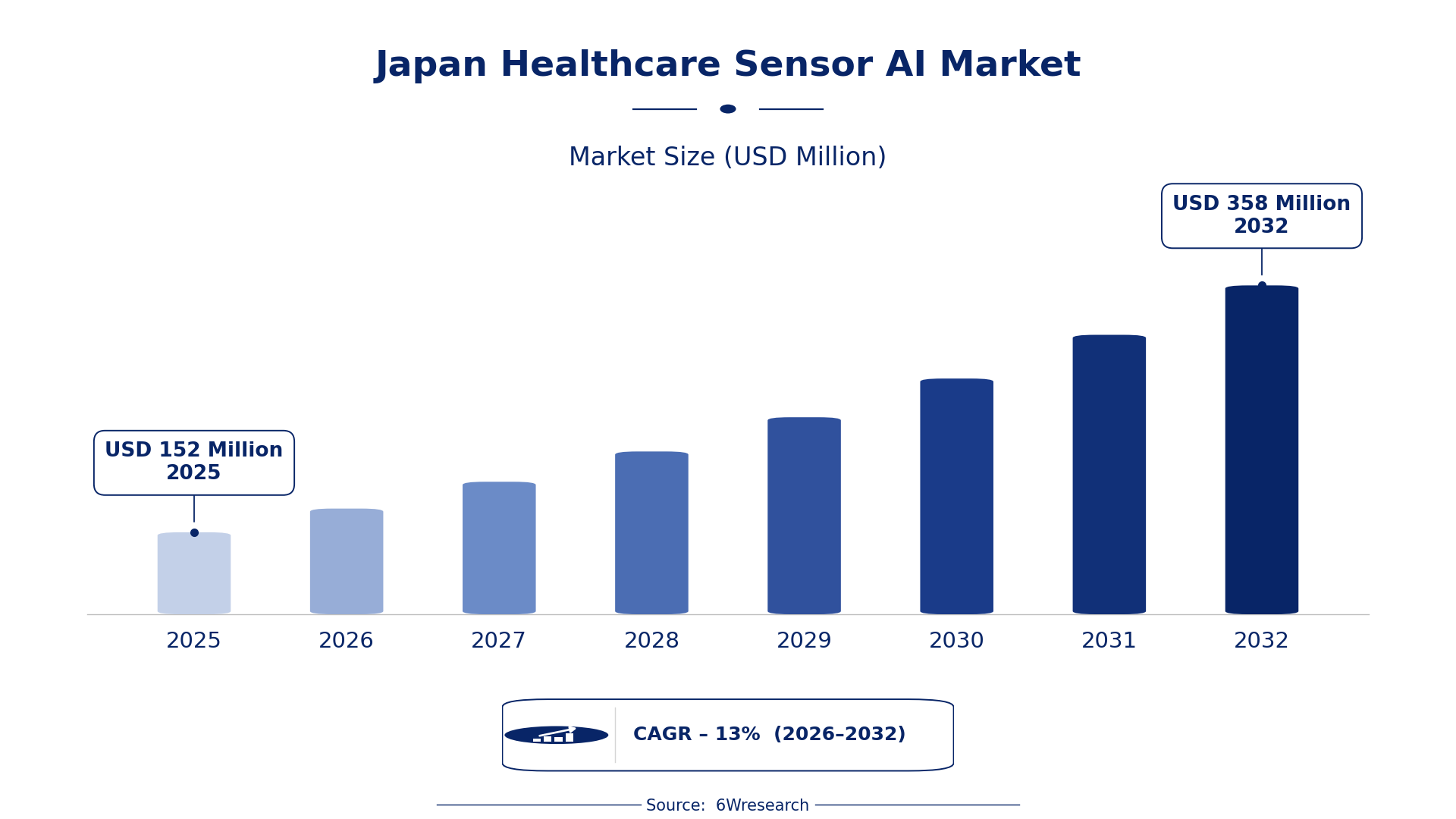
According to 6Wresearch internal database and industry insights, the Japan Healthcare Sensor AI Market was valued at USD 152 Million in 2025 and is projected to reach USD 358 Million by 2032, growing at a CAGR of approximately 13% during 2026–2032.
Japan Healthcare Sensor AI Market Highlights
| Report Metric | Details |
| Report Name | Japan Healthcare Sensor AI Market (2026-2032) |
| Market Size 2025 | USD 152 Million |
| Market Size 2032 | USD 358 Million |
| Absolute Growth 2025–2032 | USD 206 Million |
| CAGR 2026–2032 | 13% |
| Peak Annual Growth | 14.7% in 2026 |
| Forecast Period | 2026–2032 |
| Historical Data | 2022–2025 |
| Base Year | 2025 |
| Leading Sensor Type, 2025 | Wearable Health Sensors (52% share) |
| Leading AI Capability, 2025 | Predictive Algorithms (54% share) |
| Leading Deployment Mode, 2025 | IoT Integration (47% share) |
| Leading End User, 2025 | Health Wearable Startups (39% share) |
| Fastest-Growing Sensor Type | Implantable Sensors (18.8% CAGR) |
| Fastest-Growing AI Capability | Continuous Monitoring (17.2% CAGR) |
| Fastest-Growing Deployment Mode | Embedded Systems (19.3% CAGR) |
| Fastest-Growing End User | Medical Device Manufacturers (16.5% CAGR) |
| Growing Sector | Medical Device Manufacturers |
| Key End Users | Health Wearable Startups, Medical Device Manufacturers, Chronic Disease Management, Elderly Care Homes |
Japan Healthcare Sensor AI Market Year-wise Growth Rate and Key Drivers (2022–2032)
This graph illustrates the annual growth rates of the market from 2022 to 2032, highlighting a steady upward trajectory and projected market expansion over the forecast period.
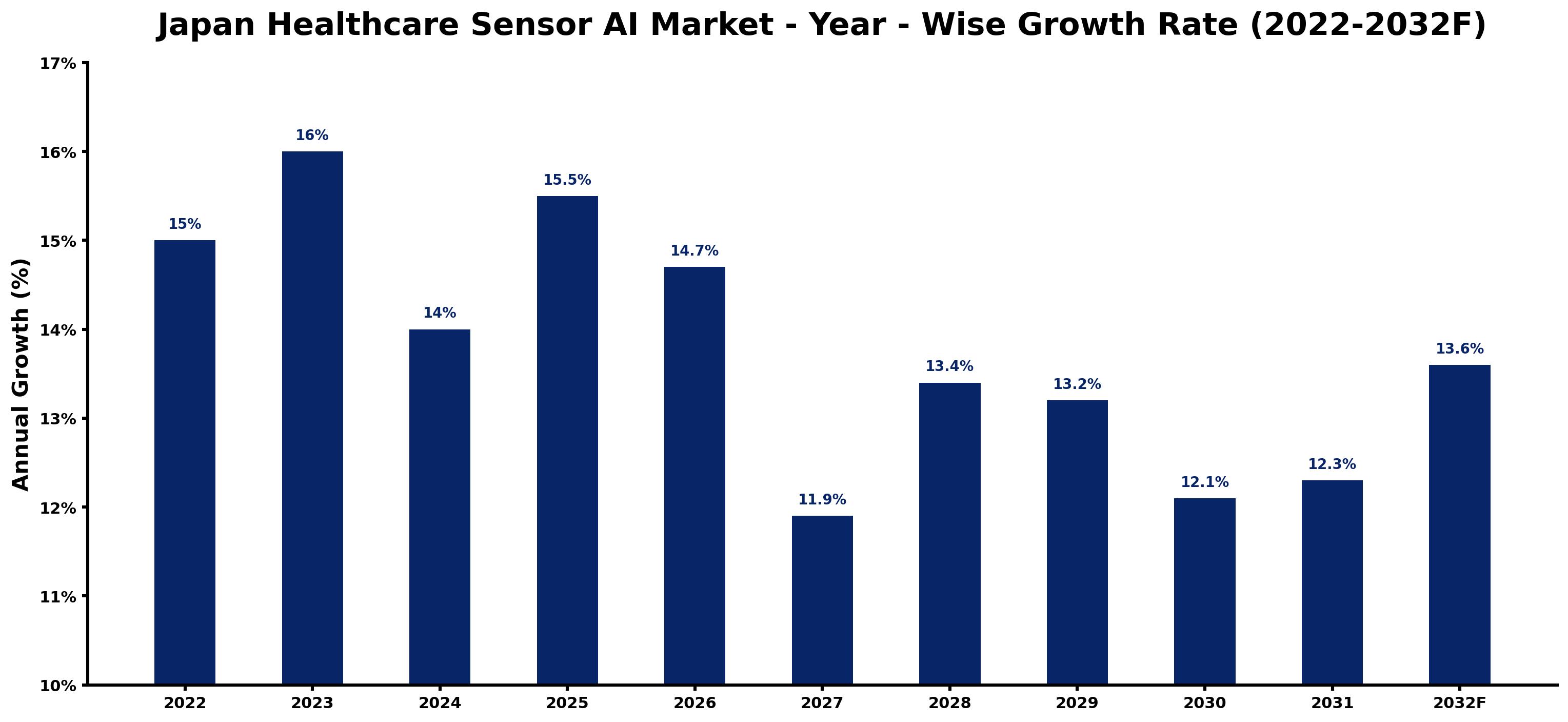
Each row of the following table gives one year's estimated growth and the event or demand shift that explains it.
| Year | Estimated Annual Growth (%) | Market Rationale |
| 2022 | 15.0 | The market experienced strong growth due to increased healthcare spending. |
| 2023 | 16.0 | Demand surged as the elderly population continued to expand. |
| 2024 | 14.0 | Growth slowed slightly as market saturation began to set in. |
| 2025 | 15.5 | New wearable technologies spurred faster growth in health monitoring. |
| 2026 | 14.7 | Growth is expected to decelerate as the market stabilises after rapid expansion. |
| 2027 | 11.9 | A decrease in growth rate is projected as competition intensifies in the sector. |
| 2028 | 13.4 | Demand is expected to pick up again due to advancements in sensor technology. |
| 2029 | 13.2 | Growth will slow as the market matures and adoption reaches a plateau. |
| 2030 | 12.1 | A further slowdown is anticipated as technology integration challenges arise. |
| 2031 | 12.3 | Growth is expected to accelerate again as new applications for healthcare sensors emerge. |
| 2032 | 13.6 | The market is projected to grow as demand for chronic disease management rises. |
Note: Market size estimations and growth projections presented in this report are based on 6Wresearch's proprietary forecasting methodology, utilizing the latest available industry data, government publications, and primary research inputs.
Japan Healthcare Sensor AI Market Synopsis
Healthcare Sensor AI merges advanced sensor technology with artificial intelligence to monitor health metrics and deliver insights. Its main applications encompass chronic disease management, remote patient monitoring, and elderly care. The Japan Healthcare Sensor AI Market is growing due to an increasing elderly population, rising healthcare expenditure, and technological progress. With over 127 million residents and a national medical care expenditure of approximately JPY 46.7 trillion in fiscal 2022, the demand for advanced healthcare solutions is escalating.
Market Dynamics Impact Analysis (2026–2032)
| Factor | Type | Impact | Primary Segment Affected |
| Growing elderly population driving demand for health monitoring solutions. | Driver | High | Wearable Health Sensors |
| Technological advancements in AI and sensor integration enhancing capabilities. | Driver | High | Predictive Algorithms |
| Expansion of chronic disease management programs in urban areas. | Opportunity | High | Chronic Disease Management |
| Increased adoption of wearable health technologies among the elderly. | Opportunity | High | Health Wearable Startups |
| High costs associated with developing and maintaining healthcare technologies. | Restraint | High | Medical Device Manufacturers |
| Regulatory challenges in obtaining approvals for new healthcare devices. | Restraint | Medium | Implantable Sensors |
| Intense competition among technology providers leading to price wars. | Challenge | Medium | Smart Patches |
| Supply chain disruptions affecting the availability of critical components. | Challenge | High | Wireless Data Transfer |
Evaluation of Drivers in Japan Healthcare Sensor AI Market (2026–2032)
The following drivers explain most of the expected growth.
| Drivers | Primary Segment Affected | Why It Matters (Evidence) |
| Increasing healthcare expenditure in Japan. | Wearable Health Sensors | Japan's national medical care expenditure reached about JPY 46.7 trillion in fiscal 2022, driving demand for health monitoring solutions. |
| Rising prevalence of chronic diseases among the elderly population. | Chronic Disease Management | With 29.3% of the population aged 65 or older, there is a growing need for effective management solutions. |
| Technological advancements in AI and sensor integration. | Predictive Algorithms | Integration of AI-assisted alerts into 50% of new medical devices by 2025 enhances patient care. |
| Government initiatives supporting healthcare technology development. | Health Wearable Startups | The Japanese government allocated ¥5 billion for healthcare technology development in 2023, fostering innovation. |
| Expansion of remote patient monitoring solutions. | Continuous Monitoring | The average age in Japan is 48.4 years, increasing the demand for continuous health monitoring. |
Volumes grow on the back of rising healthcare expenditure, which reached approximately JPY 46.7 trillion in fiscal 2022, prompting hospitals to invest in wearable health sensors. The prevalence of chronic diseases among the elderly drives demand for effective management solutions. Integration of AI-assisted alerts into new medical devices by 2025 improves patient care. Support for healthcare technology development in 2023 encourages innovation among health wearable startups. Continuous monitoring solutions are increasingly sought after as the average age in Japan rises, leading to a greater need for health tracking technologies.
Evaluation of Restraints in Japan Healthcare Sensor AI Market
The key brakes on demand, and where they bite hardest, are shown below.
| Market Restraint | Primary Segment Affected | Why It Matters (Evidence) |
| High development and maintenance costs for healthcare technologies. | Medical Device Manufacturers | The average costs for developing new medical devices can exceed JPY 1 billion, limiting market entry. |
| Regulatory hurdles in obtaining necessary approvals for new devices. | Implantable Sensors | Approval processes can take several years, delaying market entry for new solutions. |
| Limited availability of skilled professionals in AI and sensor technology. | Predictive Algorithms | A shortage of qualified personnel can hinder the development and deployment of advanced solutions. |
| Dependence on foreign suppliers for critical components. | Wireless Data Transfer | Supply chain disruptions can lead to delays and increased costs for manufacturers. |
| Market saturation in certain segments limiting growth potential. | Smart Patches | As the market matures, growth rates are expected to slow due to increased competition. |
Japan Healthcare Sensor AI Market Challenges
In 2023, 50% of new medical devices in Japan integrated AI-assisted alerts, yet many hospitals lack trained staff to utilise these systems effectively. This skills gap exists due to an ageing workforce, delaying the implementation of advanced health solutions for patients. Suppliers encounter high costs from developing compliant technologies, as the ISO 13485 standard mandates stringent quality management systems. This regulatory burden inflates prices, impacting hospitals' budgets. Japan's national medical care expenditure reached JPY 46.7 trillion in 2022, creating financial constraints that hinder investment in new health technologies.
Trends in the Japan Healthcare Sensor AI Market
These developments are changing demand patterns in the Japan Healthcare Sensor AI Market.
- Shift from Traditional to Smart Healthcare Solutions: Since 2023, Japan has experienced a shift towards smart healthcare solutions, with wearable health sensors expected to be used by 30% of the population by 2025. This trend reflects a move towards more integrated and efficient healthcare monitoring.
- Transition from Reactive to Proactive Health Management: Beginning in 2024, there has been a clear transition towards proactive health management strategies. The integration of predictive algorithms is projected to enhance decision-making in patient care, with a CAGR of 17.2% for Continuous Monitoring from 2026 to 2032.
- Emergence of AI-Driven Health Monitoring: In 2023, AI-assisted alerts were incorporated into new medical devices, signalling a trend towards AI-driven health monitoring solutions. This integration is anticipated to improve patient safety and care outcomes.
- Focus on Environmental Health Monitoring: Starting in 2023, Japan has prioritised environmental health monitoring, deploying sensors in urban areas to track air quality. This initiative aligns with public health goals and reflects a growing awareness of environmental impacts on health.
Investment Opportunities in the Japan Healthcare Sensor AI Market
The following areas offer the clearest openings for investors and suppliers in the Japan Healthcare Sensor AI Market.
- Partnerships with Health Tech Startups: By collaborating with health tech startups, suppliers can tap into the increasing adoption of wearable health technologies, projected to reach 30% by 2025. This partnership can facilitate market entry and innovation.
- Investment in AI-Driven Solutions: With the government allocating ¥5 billion for healthcare technology development in 2023, there is an opportunity to invest in AI-driven healthcare solutions, targeting health wearable startups looking to innovate.
- Expansion into Elderly Care Homes: Given the increasing number of elderly care homes in Japan, suppliers can focus on providing advanced monitoring technologies to enhance care for residents, aligning with the rising need for healthcare solutions.
- Development of Smart Facilities: The push for smart facilities in healthcare presents an opportunity for investment in integrated technologies that improve operational efficiency and patient care, particularly in urban areas.
Government Initiatives in the Japan Healthcare Sensor AI Market
The Long-Term Care Insurance Act promotes access to healthcare technologies for the elderly population, ensuring that advanced monitoring solutions are incorporated into elderly care homes across Japan. This policy framework supports the adoption of advanced healthcare sensor technologies, improving patient outcomes.
In 2023, ¥5 billion was allocated for healthcare technology development, administered by the Ministry of Health, Labour and Welfare. This funding encourages innovation in healthcare solutions, enabling the uptake of advanced technologies in hospitals and clinics.
Future Insight of the Japan Healthcare Sensor AI Market
By 2032, clinics will increasingly adopt advanced monitoring systems, leading to improved patient care outcomes. The Ministry of Health's backing for wearable health technologies will drive a 30% usage rate among the population by 2025, benefiting both buyers and suppliers. As the Japanese government aims to reduce healthcare costs by 10% through technology, suppliers will need to innovate continuously. The Tokyo region's emphasis on smart healthcare initiatives will create new opportunities for collaboration between technology developers and healthcare providers.
Market Segmentation Analysis
Japan Healthcare Sensor AI Market report covers a detailed analysis of the following market segments:
By Sensor Type – Wearable Health Sensors Lead, Implantable Sensors Expected to Grow Fastest
According to Saurav Kr Singh, Senior Research Analyst at 6Wresearch, Wearable Health Sensors accounted for 52% of the market by sensor type in 2025. Wearable health sensors dominate the market due to their widespread application in continuous health monitoring, particularly among Japan's elderly population. With over 30,000 elderly care homes, these sensors are essential for tracking health metrics effectively. The quickest growth will come from Implantable Sensors, forecast to expand at a CAGR of 18.8% between 2026 and 2032. The surge in implantable sensors is propelled by their critical function in real-time health tracking for patients with chronic conditions. As healthcare practices evolve, the adoption of these sensors will likely accelerate further. Suppliers should focus on enhancing wearable health sensors to cater to the growing demand from healthcare providers.
By AI Capability – Predictive Algorithms Lead, Continuous Monitoring Expected to Grow Fastest
The largest ai capability category in 2025 was Predictive Algorithms, at 54% of revenue. Predictive algorithms hold the largest market share as they significantly enhance decision-making in patient care through comprehensive data analysis. Their integration is vital for improving patient outcomes and operational efficiency in healthcare settings. Continuous Monitoring is projected to grow fastest, at a CAGR of 17.2% during 2026–2032. Continuous monitoring is witnessing the fastest growth due to its essential role in managing chronic conditions prevalent in Japan. This segment's expansion will underscore the ongoing importance of predictive algorithms in healthcare. Buyers will benefit from investing in AI capabilities that enhance predictive analytics for improved patient management.
By Deployment Mode – IoT Integration Leads, Embedded Systems Expected to Grow Fastest
IoT Integration took 47% of deployment mode revenue in 2025, more than any other category. IoT integration leads the deployment mode segment as it facilitates seamless data exchange among healthcare devices, crucial for effective patient monitoring. This integration is particularly significant in urban areas where healthcare technology is advancing rapidly. Over 2026–2032, Embedded Systems are expected to post the fastest growth, at a CAGR of 19.3%. Embedded systems are experiencing rapid growth because they are fundamental to the functionality of healthcare devices, ensuring reliable performance in critical health monitoring applications. Their relevance will continue to increase as technology becomes more integrated. Suppliers must prioritise IoT solutions to maintain competitiveness in the healthcare sensor market.
By End User – Health Wearable Startups Lead, Medical Device Manufacturers Expected to Grow Fastest
In 2025, Health Wearable Startups led the end user split with a 39% share. Health wearable startups are at the forefront of the market, driving innovation in personal health monitoring solutions tailored to consumer needs. Their agility enables them to swiftly develop and deploy new technologies that resonate with users. Medical Device Manufacturers are set to record the highest CAGR in this split, 16.5% over 2026–2032. Medical device manufacturers are seeing the fastest growth as they play a crucial role in developing advanced healthcare sensor technologies that adhere to regulatory standards. Their established presence will likely foster increased collaboration with startups. Buyers should seek partnerships with innovative startups to leverage new technologies in health monitoring.
Key Attractiveness of the Report
- 10 Years of Market Numbers
- Historical Data Starting from 2022 to 2025
- Base Year 2025
- Forecast Data until 2032
- Key Performance Indicators Impacting the Market
- Major Upcoming Developments and Projects
Key Highlights of the Report:
- Japan Healthcare Sensor AI Market Outlook
- Market Size of Japan Healthcare Sensor AI Market, 2025
- Forecast of Japan Healthcare Sensor AI Market, 2032
- Historical Data and Forecast of Japan Healthcare Sensor AI Revenues & Volume for the Period 2022-2032F
- Japan Healthcare Sensor AI Market Trend Evolution
- Japan Healthcare Sensor AI Market Drivers and Challenges
- Japan Healthcare Sensor AI Price Trends
- Japan Healthcare Sensor AI Porter's Five Forces
- Japan Healthcare Sensor AI Industry Life Cycle
- Historical Data and Forecast of Japan Healthcare Sensor AI Market Revenues & Volume By Sensor Type for the Period 2022-2032F
- Historical Data and Forecast of Japan Healthcare Sensor AI Market Revenues & Volume By Wearable Health Sensors for the Period 2022-2032F
- Historical Data and Forecast of Japan Healthcare Sensor AI Market Revenues & Volume By Implantable Sensors for the Period 2022-2032F
- Historical Data and Forecast of Japan Healthcare Sensor AI Market Revenues & Volume By Smart Patches for the Period 2022-2032F
- Historical Data and Forecast of Japan Healthcare Sensor AI Market Revenues & Volume By Environmental Health Sensors for the Period 2022-2032F
- Historical Data and Forecast of Japan Healthcare Sensor AI Market Revenues & Volume By AI Capability for the Period 2022-2032F
- Historical Data and Forecast of Japan Healthcare Sensor AI Market Revenues & Volume By Predictive Algorithms for the Period 2022-2032F
- Historical Data and Forecast of Japan Healthcare Sensor AI Market Revenues & Volume By Continuous Monitoring for the Period 2022-2032F
- Historical Data and Forecast of Japan Healthcare Sensor AI Market Revenues & Volume By Real-Time Analytics for the Period 2022-2032F
- Historical Data and Forecast of Japan Healthcare Sensor AI Market Revenues & Volume By AI-Assisted Alerts for the Period 2022-2032F
- Historical Data and Forecast of Japan Healthcare Sensor AI Market Revenues & Volume By Deployment Mode for the Period 2022-2032F
- Historical Data and Forecast of Japan Healthcare Sensor AI Market Revenues & Volume By IoT Integration for the Period 2022-2032F
- Historical Data and Forecast of Japan Healthcare Sensor AI Market Revenues & Volume By Embedded Systems for the Period 2022-2032F
- Historical Data and Forecast of Japan Healthcare Sensor AI Market Revenues & Volume By Wireless Data Transfer for the Period 2022-2032F
- Historical Data and Forecast of Japan Healthcare Sensor AI Market Revenues & Volume By Smart Facilities for the Period 2022-2032F
- Historical Data and Forecast of Japan Healthcare Sensor AI Market Revenues & Volume By End User for the Period 2022-2032F
- Historical Data and Forecast of Japan Healthcare Sensor AI Market Revenues & Volume By Health Wearable Startups for the Period 2022-2032F
- Historical Data and Forecast of Japan Healthcare Sensor AI Market Revenues & Volume By Medical Device Manufacturers for the Period 2022-2032F
- Historical Data and Forecast of Japan Healthcare Sensor AI Market Revenues & Volume By Chronic Disease Management for the Period 2022-2032F
- Historical Data and Forecast of Japan Healthcare Sensor AI Market Revenues & Volume By Elderly Care Homes for the Period 2022-2032F
- Japan Healthcare Sensor AI Import Export Trade Statistics
- Market Opportunity Assessment By Sensor Type
- Market Opportunity Assessment By AI Capability
- Market Opportunity Assessment By Deployment Mode
- Market Opportunity Assessment By End User
- Japan Healthcare Sensor AI Top Companies Market Share
- Japan Healthcare Sensor AI Competitive Benchmarking By Technical and Operational Parameters
- Japan Healthcare Sensor AI Company Profiles
- Japan Healthcare Sensor AI Key Strategic Recommendations
Market Covered
This report examines the market across the segments below.
By Sensor Type
- Wearable Health Sensors
- Implantable Sensors
- Smart Patches
- Environmental Health Sensors
By AI Capability
- Predictive Algorithms
- Continuous Monitoring
- Real-Time Analytics
- AI-Assisted Alerts
By Deployment Mode
- IoT Integration
- Embedded Systems
- Wireless Data Transfer
- Smart Facilities
By End User
- Health Wearable Startups
- Medical Device Manufacturers
- Chronic Disease Management
- Elderly Care Homes































