Japan Healthier Sweetening Agents Market Size & Growth Rate
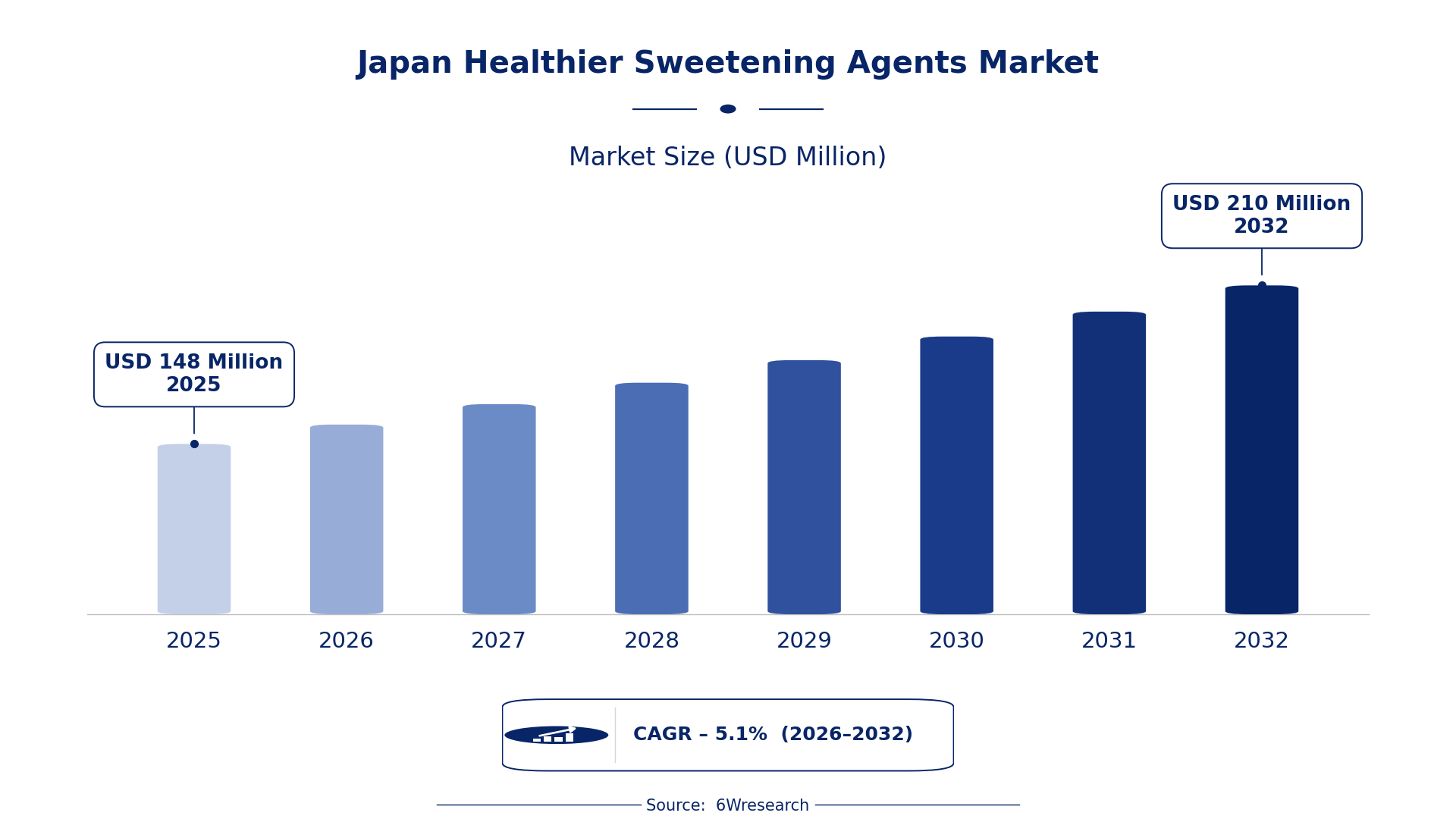
According to 6Wresearch internal database and industry insights, the Japan Healthier Sweetening Agents Market was valued at USD 148 Million in 2025 and is projected to reach USD 210 Million by 2032, growing at a CAGR of approximately 5.1% during 2026–2032.
Japan Healthier Sweetening Agents Market Highlights
| Report Metric | Details |
| Report Name | Japan Healthier Sweetening Agents Market (2026-2032) |
| Market Size 2025 | USD 148 Million |
| Market Size 2032 | USD 210 Million |
| Absolute Growth 2025–2032 | USD 62 Million |
| CAGR 2026–2032 | 5.1% |
| Peak Annual Growth | 5.8% in 2026 |
| Forecast Period | 2026–2032 |
| Historical Data | 2022–2025 |
| Base Year | 2025 |
| Leading Product Type, 2025 | Stevia (38% share) |
| Leading Source Type, 2025 | Natural (39% share) |
| Leading Application, 2025 | Beverages (44% share) |
| Leading Distribution Channel, 2025 | Supermarkets (47% share) |
| Fastest-Growing Product Type | Monk Fruit Extract (7.1% CAGR) |
| Fastest-Growing Source Type | Organic (7.4% CAGR) |
| Fastest-Growing Application | Packaged Foods (6.8% CAGR) |
| Fastest-Growing Distribution Channel | Online Platforms (6.7% CAGR) |
| Growing Sector | Health food and beverages |
| Key End Users | Food processing industry, health food stores, beverage manufacturers, consumers |
Japan Healthier Sweetening Agents Market Year-wise Growth Rate and Key Drivers (2022–2032)
This graph illustrates the annual growth rates of the market from 2022 to 2032, highlighting a steady upward trajectory and projected market expansion over the forecast period.
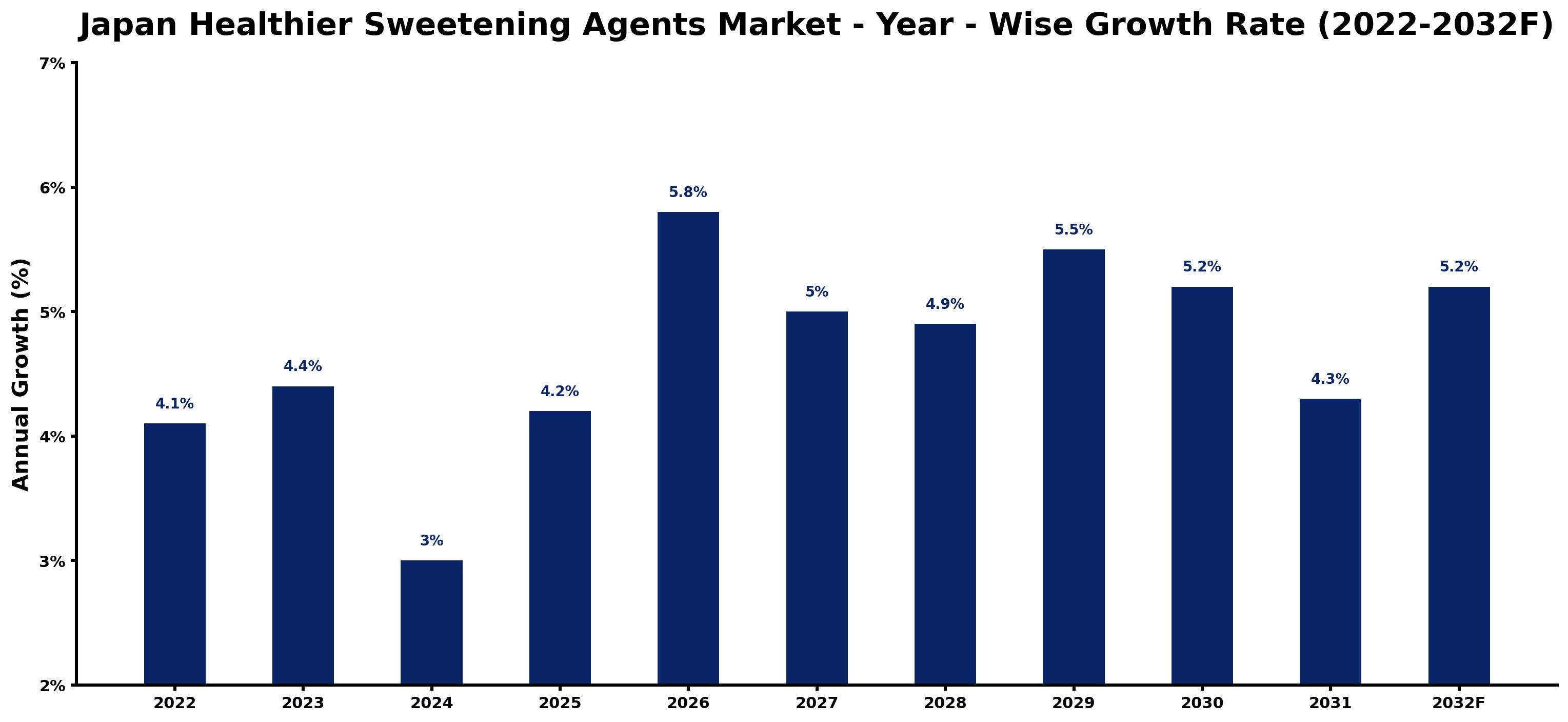
Below, each year's estimated growth is shown next to the factor that most influenced it.
| Year | Estimated Annual Growth (%) | Market Rationale |
| 2022 | 4.1 | The market showed strong consumer interest in healthier options in food products. |
| 2023 | 4.4 | Demand for natural sweeteners increased as consumers sought healthier alternatives. |
| 2024 | 3.0 | Growth slowed as market saturation began affecting new product launches. |
| 2025 | 4.2 | Consumer awareness of health benefits drove renewed interest in sweetening agents. |
| 2026 | 5.8 | The peak growth year saw a surge in demand for new sweetening solutions. |
| 2027 | 5.0 | Market growth is expected to slow as competition intensifies among sweetener types. |
| 2028 | 4.9 | Consumer preferences will shift slightly, impacting growth rates for some products. |
| 2029 | 5.5 | The market is projected to rebound with increased demand for sugar-free options. |
| 2030 | 5.2 | Growth is expected to moderate as established products dominate the market. |
| 2031 | 4.3 | The market will continue to grow, driven by health-conscious consumer behaviour. |
| 2032 | 5.2 | Renewed interest in organic products is projected to spur growth in the sweetening agents market. |
Note: Market size estimations and growth projections presented in this report are based on 6Wresearch's proprietary forecasting methodology, utilizing the latest available industry data, government publications, and primary research inputs.
Japan Healthier Sweetening Agents Market Synopsis
Healthier sweetening agents, including stevia, monk fruit extract, erythritol, and xylitol, are natural alternatives to sugar produced through extraction or fermentation. Their primary applications span beverages, baked goods, and packaged foods. The Japan Healthier Sweetening Agents Market is expanding due to rising health consciousness among consumers, particularly in the food processing industry, which is increasingly adopting these alternatives. With a significant portion of the population aged 65 or older, the demand for healthier options is expected to continue growing, driven by initiatives promoting healthy eating.
Market Dynamics Impact Analysis (2026–2032)
| Factor | Type | Impact | Primary Segment Affected |
| Rising health consciousness among consumers drives demand for natural sweeteners. | Driver | High | Stevia |
| The increasing prevalence of diabetes and obesity is pushing consumers towards low-calorie sweeteners. | Driver | High | Erythritol |
| The growing trend towards organic products presents opportunities for new entrants in the market. | Opportunity | High | Organic |
| The expansion of health food stores in urban areas opens new distribution channels for sweetening agents. | Opportunity | Medium | Natural |
| Market saturation may limit growth potential for new product launches. | Restraint | High | Xylitol |
| Consumer preferences may shift towards alternative sweetening solutions, impacting established products. | Restraint | Medium | Monk Fruit Extract |
| High competition among various sweetening agents can pressure pricing strategies. | Challenge | High | Sugar Alcohol |
| Regulatory hurdles in product approvals can delay market entry for new sweeteners. | Challenge | Medium | Plant-Based |
Evaluation of Drivers in Japan Healthier Sweetening Agents Market (2026–2032)
Key forces behind demand, with the segment each one moves most, are listed below.
| Drivers | Primary Segment Affected | Why It Matters (Evidence) |
| Increased health awareness among consumers leads to higher demand for natural sweeteners. | Stevia | In 2023, health food sales reached approximately 3 trillion yen, driving purchases of healthier sweeteners. |
| Rising rates of diabetes and obesity are pushing consumers towards low-calorie alternatives. | Erythritol | Erythritol is used in over 30% of sugar-free products, reflecting consumer demand for healthier options. |
| The trend towards organic products encourages investment in organic sweetening agents. | Organic | Organic agriculture in Japan receives government subsidies, promoting the growth of organic sweeteners. |
| Health initiatives by the Ministry of Health, Labour and Welfare support healthier eating habits. | Natural | These initiatives contribute to increased consumer awareness and demand for natural sweeteners. |
| The expansion of health food stores in urban areas increases access to healthier sweetening options. | Natural | Tokyo has a high concentration of health food stores, improving product availability. |
Spending rises because increased health awareness among consumers drives demand for natural sweeteners, with health food sales reaching approximately 3 trillion yen in 2023. The prevalence of diabetes and obesity pushes consumers towards low-calorie alternatives, with erythritol used in over 30% of sugar-free products. The growth of health food stores in urban areas improves access to these products, particularly in regions like Tokyo.
Evaluation of Restraints in Japan Healthier Sweetening Agents Market
The key brakes on demand, and where they bite hardest, are shown below.
| Market Restraint | Primary Segment Affected | Why It Matters (Evidence) |
| Market saturation may limit growth potential for new product launches. | Xylitol | With many established products, new entrants face challenges in gaining market share. |
| Shifting consumer preferences towards alternative sweeteners can impact established products. | Erythritol | As trends evolve, some consumers may favour newer sweetening options over traditional ones. |
| High competition among sweetening agents can pressure pricing strategies. | Sugar Alcohol | Intense rivalry may lead to price wars, affecting profitability for suppliers. |
| Regulatory hurdles in product approvals can delay market entry for new sweeteners. | Plant-Based | Strict regulations may slow down the introduction of new sweetening solutions. |
| Limited consumer awareness of certain sweetening agents can hinder their adoption. | Stevia | Despite its benefits, stevia may not be as well-known among all consumer segments. |
Japan Healthier Sweetening Agents Market Challenges
Japan's stringent regulations slow the approval process for new sweeteners, causing delays that limit options for health-conscious consumers and extend product launch timelines for suppliers. Technological advancements in extraction methods are not widely adopted, which restricts suppliers' ability to innovate and reduces variety for buyers. Supply chain disruptions lead to inconsistent availability of healthier sweeteners, compelling buyers to accept less desirable options or pay higher prices. In 2023, over 60% of healthier sweeteners were distributed through supermarkets, highlighting the reliance on a limited distribution network that can exacerbate availability issues for consumers.
Trends in the Japan Healthier Sweetening Agents Market
These developments are changing demand patterns in the Japan Healthier Sweetening Agents Market.
- Shift in Consumer Preferences Towards Natural Sweeteners: In Tokyo, health food stores are increasingly catering to consumer demand for natural sweeteners. In 2023, health food sales reached approximately 3 trillion yen, indicating a notable shift in purchasing behaviour.
- Emergence of Organic Sweetening Agents: Organic sweetening agents are gaining traction in Japan, with organic agriculture receiving government subsidies. In 2023, organic certifications governed by JAS have increased, supporting market growth.
- Growth of Health Initiatives Promoting Natural Ingredients: Since 2022, the Ministry of Health, Labour and Welfare has actively promoted healthy eating initiatives, contributing to the rising demand for natural sweeteners in food products.
- Expansion of Distribution Channels for Healthier Sweeteners: Supermarkets accounted for over 60% of the distribution of healthier sweeteners in 2023, improving consumer access to these products across Japan.
Investment Opportunities in the Japan Healthier Sweetening Agents Market
Several openings in the Japan Healthier Sweetening Agents Market merit attention from investors.
- Collaborate with Local Health Food Stores: Investing in partnerships with local health food stores is timely, as they are expanding rapidly in urban areas. These stores can effectively distribute healthier sweetening agents.
- Invest in Organic Sweetening Solutions: With organic certifications gaining traction, there is a strong opportunity to supply organic sweetening agents. The organic market's growth is supported by government subsidies.
- Capitalize on the Beverage Industry's Demand: The beverage sector is a key buyer of healthier sweetening agents, with a growing trend towards natural ingredients. Collaborating with beverage manufacturers can facilitate market entry.
- Target Urban Areas for Distribution: Urban regions, particularly Tokyo, present significant opportunities for distributing healthier sweetening agents. Establishing a presence in these areas can boost sales and brand visibility.
Government Initiatives in the Japan Healthier Sweetening Agents Market
The PMD Act, established in 2014, regulates the approval and quality of sweeteners, impacting their production and market entry. The Next-Generation Medical Infrastructure Act of 2017 allows for the anonymisation of medical data, supporting research and development in the health sector, which includes sweetening agents.
The Pharmaceuticals and Medical Devices Agency (PMDA), established in 2004, reviews products for safety and efficacy. The agency also monitors post-market safety, ensuring that sweetening agents meet health standards and are safe for consumer use.
Future Insight of the Japan Healthier Sweetening Agents Market
Health food stores will increasingly offer a wider range of healthier sweetening agents, reflecting changing consumer preferences. By 2032, the recognition of stevia under JIS standards will simplify market entry for new products, providing buyers with more choices. Government initiatives supporting organic agriculture will boost the production of plant-based sweeteners, allowing suppliers to meet the growing demand. As the health food market evolves, it is projected to reach approximately 3 trillion yen, leading to a broader selection of affordable sweetening options for consumers.
Market Segmentation Analysis
Japan Healthier Sweetening Agents Market report covers a detailed analysis of the following market segments:
By Product Type – Stevia Leads, Monk Fruit Extract Expected to Grow Fastest
According to Saurav Kr Singh, Senior Research Analyst at 6Wresearch, Stevia held 38% of the Japan Healthier Sweetening Agents Market by product type in 2025. Stevia holds the largest share due to its widespread acceptance as a natural sweetener in various food products, appealing to health-conscious consumers. Its recognition under JIS standards further solidifies its position in the market. The quickest growth will come from Monk Fruit Extract, forecast to expand at a CAGR of 7.1% between 2026 and 2032. Monk fruit extract is experiencing rapid growth as a natural sweetener alternative, particularly in the beverage industry, where consumer demand for healthier options is increasing. The trend towards natural ingredients is driving its adoption in new product formulations. Suppliers should focus on expanding their offerings of monk fruit extract to capitalise on its growing popularity.
By Source Type – Natural Leads, Organic Expected to Grow Fastest
Natural took 39% of source type revenue in 2025, more than any other category. Natural sweeteners dominate the market as they align with consumer preferences for clean label products, which are perceived as healthier choices. The support from health initiatives further encourages the use of natural ingredients in food products. Over 2026–2032, Organic is expected to post the fastest growth, at a CAGR of 7.4%. Organic sweeteners are gaining traction due to the rising trend of organic food consumption, with consumers increasingly seeking certified organic options. This shift reflects a broader movement towards sustainable and health-conscious eating habits. Buyers should consider sourcing organic sweeteners to meet the demands of health-conscious consumers.
By Application – Beverages Lead, Packaged Foods Expected to Grow Fastest
With 44% of application revenue in 2025, Beverages was the largest category. Beverages represent the largest share due to the significant use of stevia in soft drinks and health beverages, appealing to the health-conscious demographic. The increasing demand for low-calorie alternatives among Japanese consumers reinforces this segment's strong position. Packaged Foods are projected to grow fastest, at a CAGR of 6.8% during 2026–2032. Packaged foods are experiencing the highest growth as healthier sweeteners become integral in the formulation of healthy packaged snacks, catering to the convenience-seeking consumer. This trend aligns with a wider movement towards nutritious eating habits among busy lifestyles. Suppliers should prioritise the development of healthier sweetening solutions specifically for packaged foods to seize this growing market opportunity.
By Distribution Channel – Supermarkets Lead, Online Platforms Expected to Grow Fastest
In 2025, Supermarkets led the distribution channel split with a 47% share. Supermarkets lead the distribution of healthier sweeteners, accounting for over 60% of sales and offering consumers easy access to a variety of products. This established channel is crucial for effectively reaching a broad customer base across Japan. Online Platforms are set to record the highest CAGR in this split, 6.7% over 2026–2032. Online platforms are swiftly becoming a vital sales channel for health products, influenced by the increasing trend of e-commerce and consumer preferences for convenient shopping. This rapid growth indicates that suppliers should enhance their online marketing efforts. Suppliers need to adjust their distribution strategies to include online platforms in order to effectively engage a wider audience.
Key Attractiveness of the Report
- 10 Years of Market Numbers
- Historical Data Starting from 2022 to 2025
- Base Year 2025
- Forecast Data until 2032
- Key Performance Indicators Impacting the Market
- Major Upcoming Developments and Projects
Key Highlights of the Report:
- Japan Healthier Sweetening Agents Market Outlook
- Market Size of Japan Healthier Sweetening Agents Market, 2025
- Forecast of Japan Healthier Sweetening Agents Market, 2032
- Historical Data and Forecast of Japan Healthier Sweetening Agents Revenues & Volume for the Period 2022-2032F
- Japan Healthier Sweetening Agents Market Trend Evolution
- Japan Healthier Sweetening Agents Market Drivers and Challenges
- Japan Healthier Sweetening Agents Price Trends
- Japan Healthier Sweetening Agents Porter's Five Forces
- Japan Healthier Sweetening Agents Industry Life Cycle
- Historical Data and Forecast of Japan Healthier Sweetening Agents Market Revenues & Volume By Product Type for the Period 2022-2032F
- Historical Data and Forecast of Japan Healthier Sweetening Agents Market Revenues & Volume By Stevia for the Period 2022-2032F
- Historical Data and Forecast of Japan Healthier Sweetening Agents Market Revenues & Volume By Monk Fruit Extract for the Period 2022-2032F
- Historical Data and Forecast of Japan Healthier Sweetening Agents Market Revenues & Volume By Erythritol for the Period 2022-2032F
- Historical Data and Forecast of Japan Healthier Sweetening Agents Market Revenues & Volume By Xylitol for the Period 2022-2032F
- Historical Data and Forecast of Japan Healthier Sweetening Agents Market Revenues & Volume By Source Type for the Period 2022-2032F
- Historical Data and Forecast of Japan Healthier Sweetening Agents Market Revenues & Volume By Plant-Based for the Period 2022-2032F
- Historical Data and Forecast of Japan Healthier Sweetening Agents Market Revenues & Volume By Natural for the Period 2022-2032F
- Historical Data and Forecast of Japan Healthier Sweetening Agents Market Revenues & Volume By Sugar Alcohol for the Period 2022-2032F
- Historical Data and Forecast of Japan Healthier Sweetening Agents Market Revenues & Volume By Organic for the Period 2022-2032F
- Historical Data and Forecast of Japan Healthier Sweetening Agents Market Revenues & Volume By Application for the Period 2022-2032F
- Historical Data and Forecast of Japan Healthier Sweetening Agents Market Revenues & Volume By Beverages for the Period 2022-2032F
- Historical Data and Forecast of Japan Healthier Sweetening Agents Market Revenues & Volume By Bakery for the Period 2022-2032F
- Historical Data and Forecast of Japan Healthier Sweetening Agents Market Revenues & Volume By Packaged Foods for the Period 2022-2032F
- Historical Data and Forecast of Japan Healthier Sweetening Agents Market Revenues & Volume By Confectionery for the Period 2022-2032F
- Historical Data and Forecast of Japan Healthier Sweetening Agents Market Revenues & Volume By Distribution Channel for the Period 2022-2032F
- Historical Data and Forecast of Japan Healthier Sweetening Agents Market Revenues & Volume By Online Platforms for the Period 2022-2032F
- Historical Data and Forecast of Japan Healthier Sweetening Agents Market Revenues & Volume By Supermarkets for the Period 2022-2032F
- Historical Data and Forecast of Japan Healthier Sweetening Agents Market Revenues & Volume By Direct Sales for the Period 2022-2032F
- Historical Data and Forecast of Japan Healthier Sweetening Agents Market Revenues & Volume By Specialty Health Stores for the Period 2022-2032F
- Japan Healthier Sweetening Agents Import Export Trade Statistics
- Market Opportunity Assessment By Product Type
- Market Opportunity Assessment By Source Type
- Market Opportunity Assessment By Application
- Market Opportunity Assessment By Distribution Channel
- Japan Healthier Sweetening Agents Top Companies Market Share
- Japan Healthier Sweetening Agents Competitive Benchmarking By Technical and Operational Parameters
- Japan Healthier Sweetening Agents Company Profiles
- Japan Healthier Sweetening Agents Key Strategic Recommendations
Market Covered
The report covers the following segments.
By Product Type
- Stevia
- Monk Fruit Extract
- Erythritol
- Xylitol
By Source Type
- Plant-Based
- Natural
- Sugar Alcohol
- Organic
By Application
- Beverages
- Bakery
- Packaged Foods
- Confectionery
By Distribution Channel
- Online Platforms
- Supermarkets
- Direct Sales
- Specialty Health Stores































