Japan Heat Dissipation Components Market Size & Growth Rate
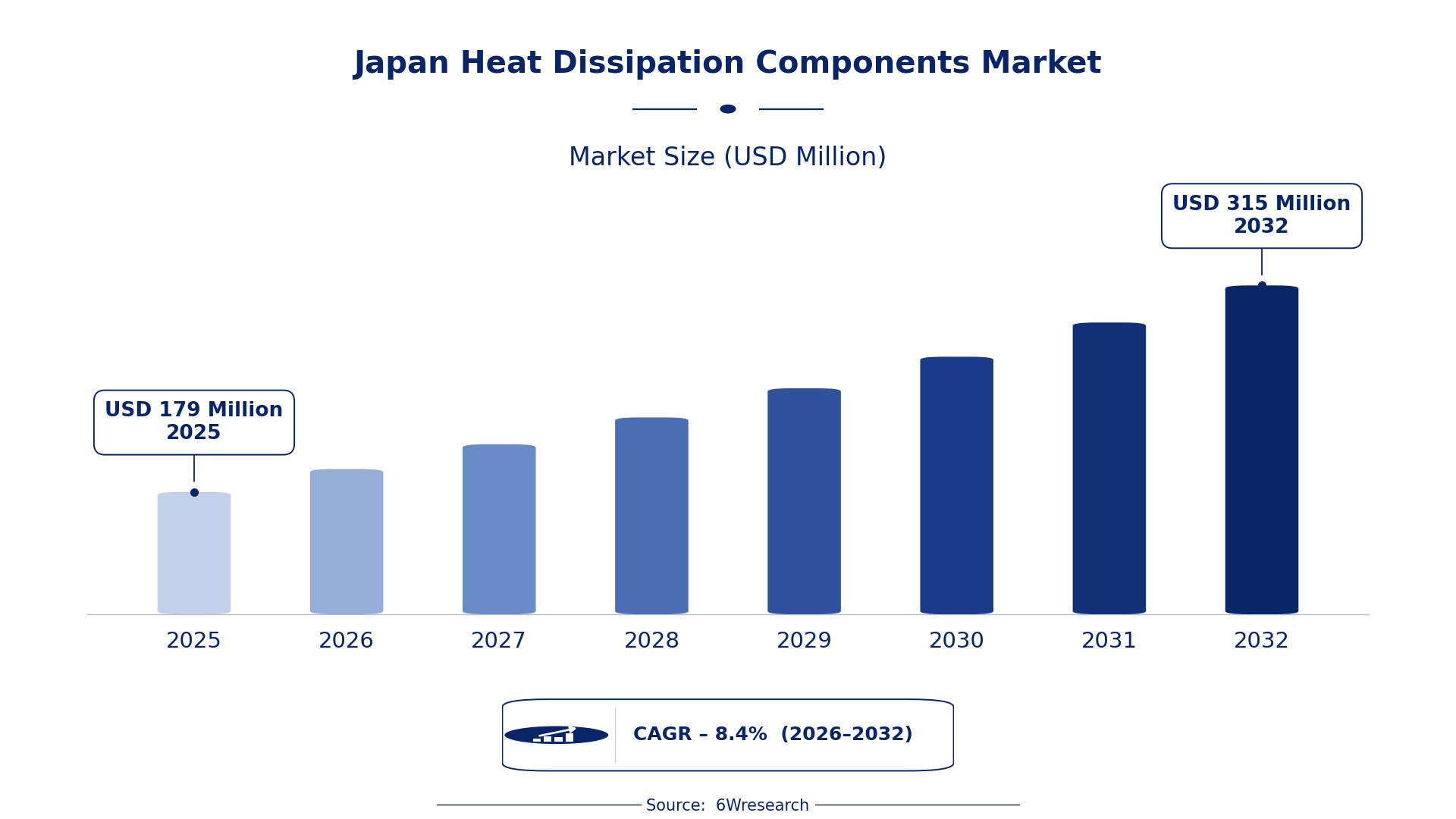
According to 6Wresearch internal database and industry insights, the Japan Heat Dissipation Components Market was valued at USD 179 Million in 2025 and is projected to reach USD 315 Million by 2032, growing at a CAGR of approximately 8.4% during 2026–2032.
Japan Heat Dissipation Components Market Highlights
| Report Metric | Details |
| Report Name | Japan Heat Dissipation Components Market (2026-2032) |
| Market Size 2025 | USD 179 Million |
| Market Size 2032 | USD 315 Million |
| Absolute Growth 2025–2032 | USD 136 Million |
| CAGR 2026–2032 | 8.4% |
| Peak Annual Growth | 9.6% in 2028 |
| Forecast Period | 2026–2032 |
| Historical Data | 2022–2025 |
| Base Year | 2025 |
| Leading Component Type, 2025 | Heat Sinks (40% share) |
| Leading Material Used, 2025 | Aluminum (33% share) |
| Leading Application Area, 2025 | Data Centers (55% share) |
| Leading Distribution Channel, 2025 | Industrial Suppliers (48% share) |
| Fastest-Growing Component Type | Thermal Pads (11.3% CAGR) |
| Fastest-Growing Material Used | Graphite (11.6% CAGR) |
| Fastest-Growing Application Area | Power Electronics (10.3% CAGR) |
| Fastest-Growing Distribution Channel | Direct Sales (10.7% CAGR) |
| Growing Sector | Electronics |
| Key End Users | Electronics manufacturers, Data center operators, Power electronics producers |
Japan Heat Dissipation Components Market Year-wise Growth Rate and Key Drivers (2022–2032)
This graph illustrates the annual growth rates of the market from 2022 to 2032, highlighting a steady upward trajectory and projected market expansion over the forecast period.
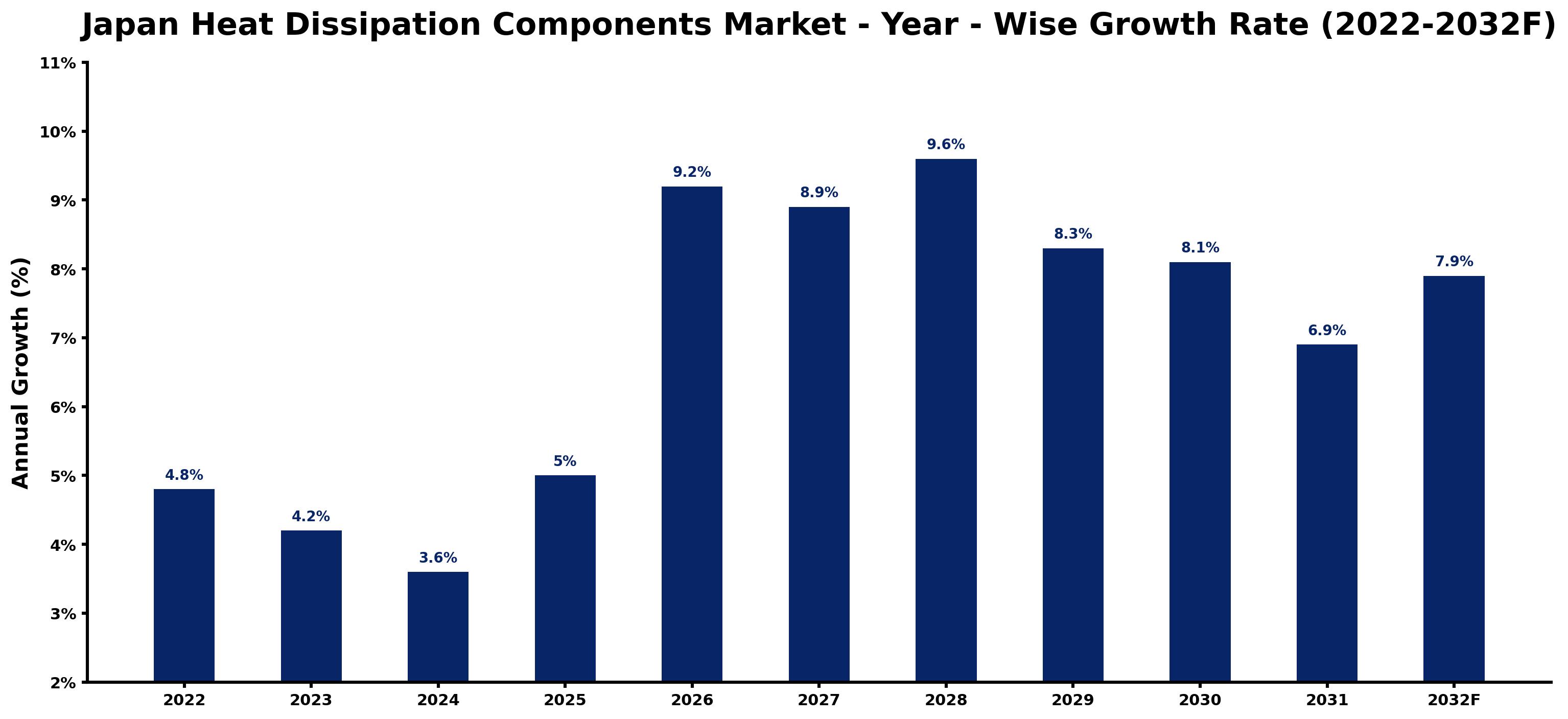
Each row of the following table gives one year's estimated growth and the event or demand shift that explains it.
| Year | Estimated Annual Growth (%) | Market Rationale |
| 2022 | 4.8 | The market experienced steady growth due to high demand for electronics. |
| 2023 | 4.2 | Growth slowed as manufacturers adjusted to supply chain challenges. |
| 2024 | 3.6 | Market growth continued to slow as competition intensified among suppliers. |
| 2025 | 5.0 | Demand increased as mobile device sales surged, driving component needs. |
| 2026 | 9.2 | Growth is expected to accelerate with rising investments in data center infrastructure. |
| 2027 | 8.9 | Market growth is projected to slow slightly as manufacturers face material shortages. |
| 2028 | 9.6 | Demand is expected to peak as technology adoption in power electronics surges. |
| 2029 | 8.3 | Growth will slow as market saturation begins to affect new orders. |
| 2030 | 8.1 | Market growth is projected to continue to decelerate amid increasing competition. |
| 2031 | 6.9 | Demand is expected to slow as manufacturers focus on cost efficiency. |
| 2032 | 7.9 | Growth will rebound with new innovations in thermal management technologies. |
Note: Market size estimations and growth projections presented in this report are based on 6Wresearch's proprietary forecasting methodology, utilizing the latest available industry data, government publications, and primary research inputs.
Japan Heat Dissipation Components Market Synopsis
Heat dissipation components are vital for managing thermal energy in electronic devices, primarily made from aluminum, copper, and silicone. The Japan Heat Dissipation Components Market is expanding due to the high volume of mobile devices sold annually, with over 100 million units. The electronics market, valued at approximately 30 trillion yen, drives demand for efficient cooling solutions, particularly in data centers and power electronics. Investment in energy-efficient technologies and adherence to standards like ISO 9001 further support market growth.
Market Dynamics Impact Analysis (2026–2032)
| Factor | Type | Impact | Primary Segment Affected |
| High demand for mobile devices drives the need for efficient heat sinks. | Driver | High | Heat Sinks |
| Increasing adoption of thermal management solutions in power electronics boosts demand. | Driver | High | Thermal Interface Materials |
| The growing data center sector presents opportunities for innovative cooling solutions. | Opportunity | High | Data Centers |
| Rising investments in energy-efficient technologies create a market gap. | Opportunity | High | Power Electronics |
| Material shortages constrain production capabilities for manufacturers. | Restraint | High | Thermal Pads |
| Intense competition among suppliers leads to pricing pressures. | Restraint | Medium | Heat Spreaders |
| High costs of raw materials affect profit margins for producers. | Challenge | High | Heat Sinks |
| Technological advancements require continuous investment in R&D. | Challenge | Medium | Thermal Interface Materials |
Evaluation of Drivers in Japan Heat Dissipation Components Market (2026–2032)
Key forces behind demand, with the segment each one moves most, are listed below.
| Drivers | Primary Segment Affected | Why It Matters (Evidence) |
| High sales of mobile devices increase demand for heat sinks. | Heat Sinks | Over 100 million mobile devices are sold annually in Japan, necessitating effective cooling solutions. |
| Growing data center infrastructure drives the need for thermal interface materials. | Thermal Interface Materials | Data centers consume about 10% of Japan's total electricity, requiring advanced thermal management. |
| Rising adoption of energy-efficient technologies boosts demand for thermal pads. | Thermal Pads | The average lifespan of thermal pads is around 5 years, leading to replacement needs. |
| Increased production of power electronics enhances demand for heat spreaders. | Heat Spreaders | The adoption rate of thermal management solutions in power electronics is increasing by 15% annually. |
| Standards like ISO 9001 encourage manufacturers to improve quality and efficiency. | Heat Sinks | Compliance with ISO 9001 leads to better manufacturing practices in the sector. |
Behind the steady rise in orders sits the increasing demand for heat sinks, driven by the sale of over 100 million mobile devices annually. Data centers, consuming about 10% of Japan's total electricity, are expanding, which boosts the need for thermal interface materials. The average lifespan of thermal pads is around 5 years, prompting regular replacements as technology evolves. Adoption rates for thermal management solutions in power electronics are increasing by 15% annually, which raises demand for heat spreaders. Compliance with standards like ISO 9001 encourages manufacturers to improve quality and operational efficiency, further stimulating market growth.
Evaluation of Restraints in Japan Heat Dissipation Components Market
The main factors holding the market back are set out below.
| Market Restraint | Primary Segment Affected | Why It Matters (Evidence) |
| Material shortages disrupt production schedules for thermal pads. | Thermal Pads | Manufacturers face delays due to limited availability of essential materials. |
| Intense competition results in reduced profit margins for heat sink producers. | Heat Sinks | Price wars among suppliers lead to lower profitability across the sector. |
| Rising costs of raw materials impact pricing strategies for thermal interface materials. | Thermal Interface Materials | Increased material costs force manufacturers to adjust pricing, affecting demand. |
| Technological advancements require ongoing R&D investment for heat spreaders. | Heat Spreaders | Continuous innovation demands financial resources that some smaller firms may lack. |
| Market saturation limits growth potential for thermal pads. | Thermal Pads | As the market matures, new entrants struggle to gain market share. |
Japan Heat Dissipation Components Market Challenges
High production costs for heat dissipation components limit profitability for producers. Japan's emphasis on premium materials and complex manufacturing techniques can inflate expenses to 30% of total production costs. A shortage of skilled workers in thermal technologies delays product development for manufacturers, potentially extending time-to-market by 20%. Stringent compliance with industry standards imposes additional operational costs, with producers facing up to 10 million yen annually in administrative expenses. Slow technology adoption restricts efficiency improvements for buyers, affecting their ability to meet the demand from over 100 million mobile devices sold each year.
Trends in the Japan Heat Dissipation Components Market
The following changes are redrawing the Japan Heat Dissipation Components Market.
- Shift from Traditional to Advanced Thermal Management Solutions: In 2023, the transition towards advanced thermal management solutions began, particularly in data centers. With data centers consuming about 10% of Japan's total electricity, the demand for efficient cooling technologies is increasing.
- Transition from Aluminum to Graphite in High-Performance Applications: Since 2022, graphite thermal interface materials have gained traction in high-performance applications, driven by their superior thermal conductivity. This shift is apparent as manufacturers aim to improve performance in power electronics.
- Emergence of Direct Sales Channels for Specialized Components: The rise of direct sales channels for thermal management components has been notable since 2025, with a CAGR of 10.7%. This trend allows manufacturers to engage directly with clients, improving service and responsiveness.
- Increased Focus on Energy Efficiency Standards: Beginning in 2022, there has been a growing emphasis on energy efficiency standards among manufacturers. The Economic Security Promotion Act supports this shift, promoting resilience in the supply chain.
Investment Opportunities in the Japan Heat Dissipation Components Market
Below are the investment opportunities with the strongest case in the Japan Heat Dissipation Components Market.
- Data Centers Seeking Advanced Cooling Solutions: Data centers in Japan are increasingly investing in advanced cooling solutions, with a market gap of 5 billion yen. Collaborating with industrial suppliers can facilitate entry into this expanding sector.
- Power Electronics Manufacturers Needing Efficient Thermal Management: Power electronics manufacturers are looking for effective thermal management solutions, with a projected growth of 10.3% in demand. Establishing partnerships with local firms can enhance market penetration.
- Growing Demand for Graphite Thermal Interface Materials: Graphite thermal interface materials are in demand for high-performance applications, with a growth rate of 11.6%. Suppliers can enter this market by focusing on quality and compliance with industry standards.
- Mobile Device Producers Requiring Reliable Heat Dissipation Components: Mobile device producers are increasingly seeking reliable heat dissipation components, driven by the sale of over 100 million units annually. Engaging in direct sales strategies can enhance supplier visibility.
Government Initiatives in the Japan Heat Dissipation Components Market
The Economic Security Promotion Act, enacted in 2022, supports supply-chain resilience for critical products, including heat dissipation components. This law mandates that manufacturers adopt measures to ensure consistent supply and quality, promoting innovation in thermal management technologies. The 5 billion yen allocated for energy-efficient technology development will encourage advancements in heat dissipation solutions.
Buyers in the electronics sector benefit from the PRTR Law, which requires businesses to report chemical substances used in production. This transparency helps buyers ensure compliance and safety in thermal management solutions, promoting responsible sourcing.
Future Insight of the Japan Heat Dissipation Components Market
Innovations in thermal management technologies will reshape demand by 2032, supported by government initiatives and evolving industry standards. The 5 billion yen allocated for energy-efficient technology development will accelerate progress in heat dissipation solutions. An annual 15% increase in the adoption of thermal management solutions will improve performance in various applications. As manufacturers incorporate new materials and processes, buyers can expect longer product lifespans and enhanced efficiency, leading to better thermal control in electronic devices.
Market Segmentation Analysis
Japan Heat Dissipation Components Market report covers a detailed analysis of the following market segments:
By Component Type – Heat Sinks Lead, Thermal Pads Expected to Grow Fastest
According to Saurav Kr Singh, Senior Research Analyst at 6Wresearch, the largest component type category in 2025 was Heat Sinks, at 40% of revenue. Heat sinks are the predominant choice for managing thermal energy in electronic devices, particularly due to their extensive use in over 100 million mobile devices sold each year. Their widespread application in consumer electronics within major industrial regions like Tokyo and Osaka solidifies their leading position in the market. Over 2026–2032, Thermal Pads are expected to post the fastest growth, at a CAGR of 11.3%. Thermal pads are experiencing rapid growth as they play a critical role in ensuring effective thermal conductivity between components and heat sinks, especially in high-performance applications. This trend is expected to continue as the demand for efficient thermal management solutions escalates. Suppliers should focus on increasing the production of thermal pads to meet the rising demand in high-performance applications.
By Material Used – Aluminum Leads, Graphite Expected to Grow Fastest
Aluminum held 33% of the Japan Heat Dissipation Components Market by material used in 2025. Aluminum holds the largest share in the market because of its lightweight nature and excellent thermal properties, making it the preferred choice for manufacturers. Its widespread application in consumer electronics further reinforces its dominance. Graphite is projected to grow fastest, at a CAGR of 11.6% during 2026–2032. Graphite is gaining traction as a fast-growing material due to its effectiveness in specialized thermal management applications, which are becoming increasingly important in high-performance devices. This growth indicates a shift towards advanced materials in the market. Buyers may need to consider incorporating graphite solutions for improved thermal management in specialized applications.
By Application Area – Data Centers Lead, Power Electronics Expected to Grow Fastest
Data Centers accounted for 55% of the market by application area in 2025. Data centers are the largest application area for heat dissipation components, utilising extensive cooling solutions to manage heat from servers, which consume about 10% of Japan's total electricity. This high energy consumption drives the need for effective thermal management solutions. The quickest growth will come from Power Electronics, forecast to expand at a CAGR of 10.3% between 2026 and 2032. Power electronics are the fastest-growing application area as they require effective heat management for reliability and efficiency, with an increasing adoption rate of thermal management solutions. This trend suggests a rising focus on energy-efficient technologies. Suppliers should prioritise developing tailored solutions for the power electronics sector to capture emerging opportunities.
By Distribution Channel – Industrial Suppliers Lead, Direct Sales Expected to Grow Fastest
Industrial Suppliers took 48% of distribution channel revenue in 2025, more than any other category. Industrial suppliers lead the distribution channel by providing essential components directly to manufacturers and assemblers, ensuring a consistent supply of heat dissipation components. Their strong presence in key industrial regions allows them to effectively meet the needs of the market. Direct Sales is set to record the highest CAGR in this split, 10.7% over 2026–2032. Direct sales are the fastest-growing distribution channel as manufacturers favour streamlined procurement processes for specialised components. This shift indicates a broader movement towards more efficient purchasing methods in the industry. Suppliers should strengthen their direct sales strategies to better serve the changing preferences of manufacturers.
Key Attractiveness of the Report
- 10 Years of Market Numbers
- Historical Data Starting from 2022 to 2025
- Base Year 2025
- Forecast Data until 2032
- Key Performance Indicators Impacting the Market
- Major Upcoming Developments and Projects
Key Highlights of the Report:
- Japan Heat Dissipation Components Market Outlook
- Market Size of Japan Heat Dissipation Components Market, 2025
- Forecast of Japan Heat Dissipation Components Market, 2032
- Historical Data and Forecast of Japan Heat Dissipation Components Revenues & Volume for the Period 2022-2032F
- Japan Heat Dissipation Components Market Trend Evolution
- Japan Heat Dissipation Components Market Drivers and Challenges
- Japan Heat Dissipation Components Price Trends
- Japan Heat Dissipation Components Porter's Five Forces
- Japan Heat Dissipation Components Industry Life Cycle
- Historical Data and Forecast of Japan Heat Dissipation Components Market Revenues & Volume By Component Type for the Period 2022-2032F
- Historical Data and Forecast of Japan Heat Dissipation Components Market Revenues & Volume By Heat Sinks for the Period 2022-2032F
- Historical Data and Forecast of Japan Heat Dissipation Components Market Revenues & Volume By Thermal Pads for the Period 2022-2032F
- Historical Data and Forecast of Japan Heat Dissipation Components Market Revenues & Volume By Heat Spreaders for the Period 2022-2032F
- Historical Data and Forecast of Japan Heat Dissipation Components Market Revenues & Volume By Thermal Interface Materials for the Period 2022-2032F
- Historical Data and Forecast of Japan Heat Dissipation Components Market Revenues & Volume By Material Used for the Period 2022-2032F
- Historical Data and Forecast of Japan Heat Dissipation Components Market Revenues & Volume By Aluminum for the Period 2022-2032F
- Historical Data and Forecast of Japan Heat Dissipation Components Market Revenues & Volume By Silicone for the Period 2022-2032F
- Historical Data and Forecast of Japan Heat Dissipation Components Market Revenues & Volume By Copper for the Period 2022-2032F
- Historical Data and Forecast of Japan Heat Dissipation Components Market Revenues & Volume By Graphite for the Period 2022-2032F
- Historical Data and Forecast of Japan Heat Dissipation Components Market Revenues & Volume By Application Area for the Period 2022-2032F
- Historical Data and Forecast of Japan Heat Dissipation Components Market Revenues & Volume By Processors & Chips for the Period 2022-2032F
- Historical Data and Forecast of Japan Heat Dissipation Components Market Revenues & Volume By Mobile Devices for the Period 2022-2032F
- Historical Data and Forecast of Japan Heat Dissipation Components Market Revenues & Volume By Data Centers for the Period 2022-2032F
- Historical Data and Forecast of Japan Heat Dissipation Components Market Revenues & Volume By Power Electronics for the Period 2022-2032F
- Historical Data and Forecast of Japan Heat Dissipation Components Market Revenues & Volume By Distribution Channel for the Period 2022-2032F
- Historical Data and Forecast of Japan Heat Dissipation Components Market Revenues & Volume By Online Platforms for the Period 2022-2032F
- Historical Data and Forecast of Japan Heat Dissipation Components Market Revenues & Volume By Industrial Suppliers for the Period 2022-2032F
- Historical Data and Forecast of Japan Heat Dissipation Components Market Revenues & Volume By Direct Sales for the Period 2022-2032F
- Historical Data and Forecast of Japan Heat Dissipation Components Market Revenues & Volume By Specialty Stores for the Period 2022-2032F
- Japan Heat Dissipation Components Import Export Trade Statistics
- Market Opportunity Assessment By Component Type
- Market Opportunity Assessment By Material Used
- Market Opportunity Assessment By Application Area
- Market Opportunity Assessment By Distribution Channel
- Japan Heat Dissipation Components Top Companies Market Share
- Japan Heat Dissipation Components Competitive Benchmarking By Technical and Operational Parameters
- Japan Heat Dissipation Components Company Profiles
- Japan Heat Dissipation Components Key Strategic Recommendations
Market Covered
Coverage by segment is as follows.
By Component Type
- Heat Sinks
- Thermal Pads
- Heat Spreaders
- Thermal Interface Materials
By Material Used
- Aluminum
- Silicone
- Copper
- Graphite
By Application Area
- Processors & Chips
- Mobile Devices
- Data Centers
- Power Electronics
By Distribution Channel
- Online Platforms
- Industrial Suppliers
- Direct Sales
- Specialty Stores































