Japan Heat Pump Water Market Size & Growth Rate
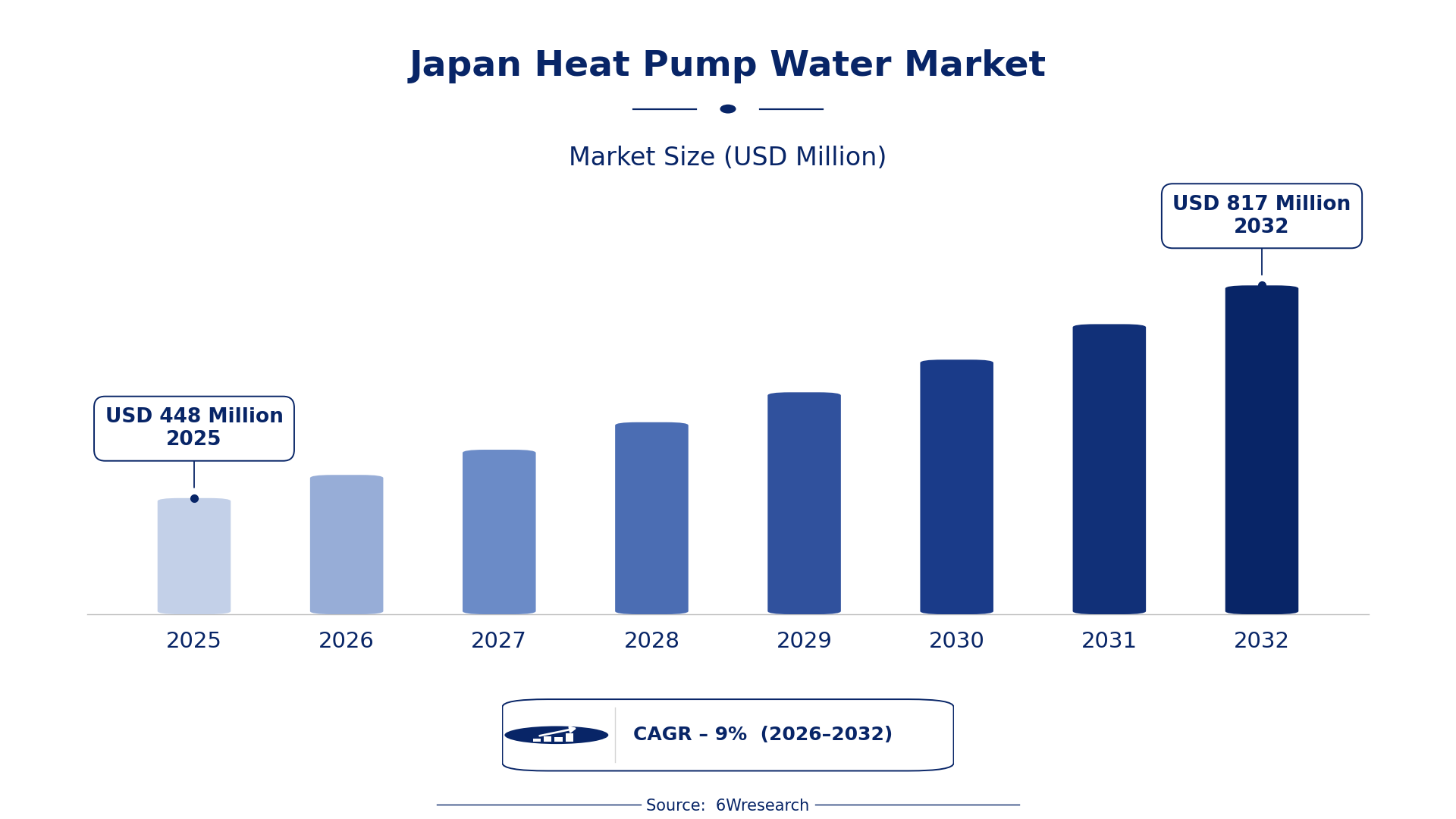
According to 6Wresearch internal database and industry insights, the Japan Heat Pump Water Market was valued at USD 448 Million in 2025 and is projected to reach USD 817 Million by 2032, growing at a CAGR of approximately 9% during 2026–2032.
Japan Heat Pump Water Market Highlights
| Report Metric | Details |
| Report Name | Japan Heat Pump Water Market (2026-2032) |
| Market Size 2025 | USD 448 Million |
| Market Size 2032 | USD 817 Million |
| Absolute Growth 2025–2032 | USD 369 Million |
| CAGR 2026–2032 | 9% |
| Peak Annual Growth | 9.6% in 2026 |
| Forecast Period | 2026–2032 |
| Historical Data | 2022–2025 |
| Base Year | 2025 |
| Leading Heat Source, 2025 | Air Source (41% share) |
| Leading Capacity, 2025 | 101-200 Liters (51% share) |
| Leading Type, 2025 | Split (57% share) |
| Leading Installation Location, 2025 | Indoor (55% share) |
| Leading Application, 2025 | Residential (43% share) |
| Fastest-Growing Heat Source | Water Source (11.9% CAGR) |
| Fastest-Growing Capacity | 51-100 Liters (10.1% CAGR) |
| Fastest-Growing Type | Integrated (11.7% CAGR) |
| Fastest-Growing Application | Commercial (11.4% CAGR) |
| Growing Sector | Residential |
| Key End Users | Households, commercial establishments, industrial facilities |
Japan Heat Pump Water Market Year-wise Growth Rate and Key Drivers (2022–2032)
This graph illustrates the annual growth rates of the market from 2022 to 2032, highlighting a steady upward trajectory and projected market expansion over the forecast period.
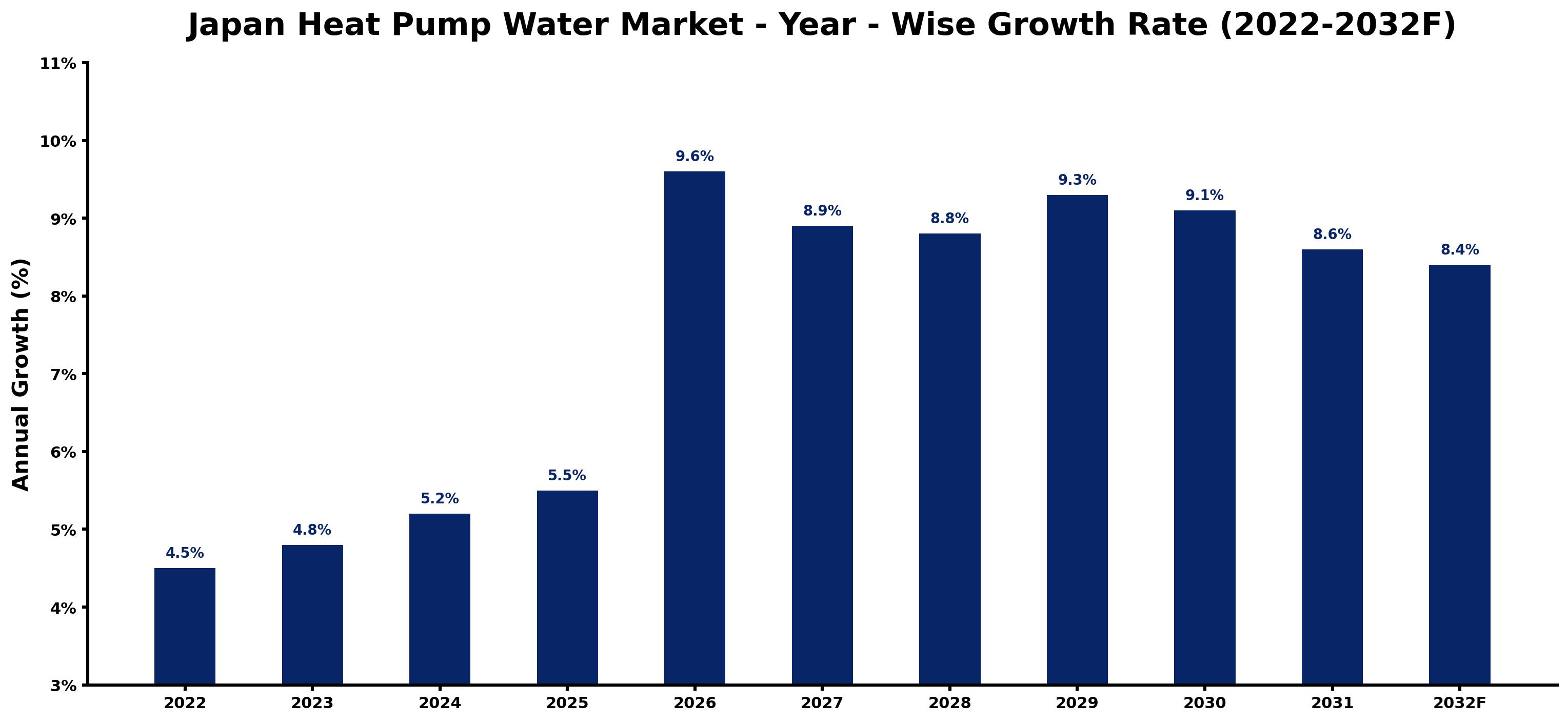
Year by year, the estimates below pair each growth rate with the development that shaped it.
| Year | Estimated Annual Growth (%) | Market Rationale |
| 2022 | 4.5 | The market experienced steady growth due to rising energy efficiency awareness. |
| 2023 | 4.8 | Demand increased as more households adopted energy-efficient technologies. |
| 2024 | 5.2 | The launch of new government incentives further stimulated market activity. |
| 2025 | 5.5 | Consumer interest in sustainable heating solutions continued to rise. |
| 2026 | 9.6 | The peak growth was driven by a surge in residential installations. |
| 2027 | 8.9 | Growth slowed slightly as the market began to stabilise after rapid expansion. |
| 2028 | 8.8 | Demand continued to grow, albeit at a slower pace than the previous year. |
| 2029 | 9.3 | Renewed interest in energy-efficient systems spurred market activity. |
| 2030 | 9.1 | Growth decelerated as the market matured and competition intensified. |
| 2031 | 8.6 | A further slowdown occurred as the market reached a saturation point. |
| 2032 | 8.4 | The market is expected to maintain steady growth as energy efficiency remains a priority. |
Note: Market size estimations and growth projections presented in this report are based on 6Wresearch's proprietary forecasting methodology, utilizing the latest available industry data, government publications, and primary research inputs.
Japan Heat Pump Water Market Synopsis
Heat pump water systems effectively heat water using thermodynamic principles, integrating components like compressors and condensers. These systems are primarily used for residential water heating, with commercial and industrial applications also notable. The Japan Heat Pump Water Market is expanding due to a strong residential sector, which accounted for approximately 70% of demand, and government initiatives promoting energy-efficient technologies. The Ministry of the Environment's 2023 programme aims to increase adoption by 30% by 2025, further driving market growth.
Market Dynamics Impact Analysis (2026–2032)
| Factor | Type | Impact | Primary Segment Affected |
| Rising energy efficiency awareness among consumers | Driver | High | Residential |
| Government incentives for renewable energy technologies | Driver | High | Residential |
| Growing investment in energy-efficient appliances | Opportunity | High | Residential |
| Increasing demand for sustainable heating solutions | Opportunity | High | Residential |
| High initial installation costs of heat pump systems | Restraint | Medium | Residential |
| Limited awareness of heat pump benefits among consumers | Restraint | Medium | Residential |
| Competition from alternative heating solutions | Challenge | High | Residential |
| Supply chain disruptions affecting component availability | Challenge | High | Residential |
Evaluation of Drivers in Japan Heat Pump Water Market (2026–2032)
The following drivers explain most of the expected growth.
| Drivers | Primary Segment Affected | Why It Matters (Evidence) |
| Increased consumer awareness of energy efficiency | Residential | In 2022, the average household size in Japan was 2.3 persons, influencing the need for efficient water heating. |
| Government subsidies for heat pump installations | Residential | In 2023, the Japanese government allocated ¥10 billion for renewable energy technology incentives. |
| Rising energy costs prompting upgrades | Residential | Heat pump water systems can reduce CO2 emissions by up to 50% compared to traditional systems. |
| Technological advancements in heat pump systems | Residential | The introduction of new standards has ensured higher efficiency and reliability. |
| Growing urbanisation leading to higher residential demand | Residential | Tokyo and Osaka are leading prefectures for heat pump water installations. |
Volumes grow on the back of rising energy costs, prompting consumers to seek efficient solutions. In 2022, the average household size in Japan was 2.3 persons, increasing the demand for effective water heating. Technological advancements ensure compliance with new performance standards, improving system performance. Urbanisation in regions like Tokyo and Osaka drives higher residential demand, further boosting market growth.
Evaluation of Restraints in Japan Heat Pump Water Market
The following restraints limit how fast demand can grow.
| Market Restraint | Primary Segment Affected | Why It Matters (Evidence) |
| High initial installation costs of heat pump systems | Residential | Many households hesitate to invest due to upfront costs, despite long-term savings. |
| Limited awareness of heat pump benefits among consumers | Residential | Many consumers lack knowledge about the efficiency and savings potential of heat pump systems. |
| Competition from alternative heating solutions | Residential | Traditional heating methods remain popular, making it challenging for heat pumps to gain market share. |
| Supply chain disruptions affecting component availability | Residential | Recent global supply chain issues have delayed the availability of critical components for heat pumps. |
| Regulatory hurdles for installation in certain areas | Residential | Local regulations may complicate the installation process, deterring potential buyers. |
Japan Heat Pump Water Market Challenges
Homeowners face rising costs as material prices for heat pump water systems increased by 15% in 2023, straining budgets for replacements. Installation delays plague suppliers, with lead times extending to six months, frustrating buyers eager for upgrades. A shortage of skilled labour complicates installation efforts, driving up labour costs and prolonging project timelines for contractors. Compliance with the JIS B 8616 standard requires additional testing, which can add up to ¥500,000 per project for producers, further squeezing profit margins.
Trends in the Japan Heat Pump Water Market
The shifts below are changing how Japan Heat Pump Water Market products are bought and supplied.
- Shift from Traditional Heating to Heat Pump Systems: Since 2023, more households are transitioning to heat pump systems for water heating, supported by government incentives. Approximately 30% of households are expected to adopt these systems by 2025.
- Emergence of Energy Efficiency Standards: The introduction of new performance standards in Japan has led to improved metrics for heat pump systems, encouraging manufacturers to innovate and comply with higher efficiency benchmarks.
- Growing Preference for Indoor Installations: Indoor installations have become increasingly popular, with 55% of installations in 2025. This trend is driven by space constraints in urban areas, particularly in Tokyo.
- Increased Focus on CO2 Emission Reduction: The government’s push for renewable technologies has resulted in heat pump systems contributing to a reduction of CO2 emissions by up to 50%, aligning with national climate goals.
Investment Opportunities in the Japan Heat Pump Water Market
The openings below show where demand in the Japan Heat Pump Water Market is visible and how suppliers can enter.
- Timing for Energy-Efficient Solutions: With the government aiming for a 30% increase in heat pump adoption by 2025, there is a strong opportunity for suppliers to meet growing demand in residential sectors.
- Partnerships for Local Installations: Collaborating with local contractors can facilitate entry into the market, especially in urban areas where demand for efficient heating solutions is rising.
- Investment in Urban Residential Projects: Tokyo and Osaka are prime locations for investment in heat pump installations, with urbanisation driving demand for sustainable heating solutions.
- Targeting Eco-Conscious Buyer Groups: Focusing on environmentally aware consumers in metropolitan areas can yield high returns, as these buyers are increasingly seeking energy-efficient appliances.
Government Initiatives in the Japan Heat Pump Water Market
The Water Supply Act (1957) sets standards for drinking-water quality and supply, ensuring that heat pump systems meet necessary safety and performance criteria. Following this, the Sewerage Act (1958) governs sewerage systems and wastewater treatment, which indirectly supports the installation of energy-efficient water heating solutions.
The GX Promotion Act (2023) provides a legal framework for promoting renewable energy technologies, including heat pumps. The Ministry of the Environment oversees the implementation of this act, funding initiatives to encourage the adoption of energy-efficient systems, allocating ¥10 billion for renewable energy technology incentives.
Future Insight of the Japan Heat Pump Water Market
The introduction of energy-efficient water heating systems will transform the market by 2032, driven by government initiatives. By 2025, a 30% increase in heat pump adoption is expected, contributing to a reduction of CO2 emissions by up to 50% compared to traditional systems. Advances in technology will enhance efficiency and reduce operational costs for buyers. Programmes aimed at promoting renewable energy will gain momentum, with a substantial government investment of ¥10 billion supporting this transition.
Market Segmentation Analysis
Japan Heat Pump Water Market report covers a detailed analysis of the following market segments:
By Heat Source – Air Source Leads, Water Source Expected to Grow Fastest
According to Shubham Deep, Research Manager at 6Wresearch, in 2025, Air Source led the heat source split with a 41% share. Air source heat pumps dominate the market due to their suitability for residential heating applications, making them the preferred choice among homeowners. Their effectiveness is particularly notable in urban areas like Tokyo, where energy efficiency is a priority for many households. The quickest growth will come from Water Source, forecast to expand at a CAGR of 11.9% between 2026 and 2032. Water source heat pumps are witnessing rapid growth as they are increasingly adopted in specific industrial applications that require efficient heating solutions. This segment's expansion is bolstered by government incentives promoting renewable energy technologies, making it an attractive option for industries. Suppliers should consider enhancing their product offerings in the water source segment to capitalise on its emerging growth potential.
By Capacity – 101-200 Liters Lead, 51-100 Liters Expected to Grow Fastest
101-200 Liters held 51% of the Japan Heat Pump Water Market by capacity in 2025. The 101-200 litres capacity segment leads the market as it is ideal for larger commercial settings that require a substantial hot water supply. Facilities in metropolitan areas like Osaka frequently opt for this capacity to meet their operational demands effectively. 51-100 Liters are projected to grow fastest, at a CAGR of 10.1% during 2026–2032. The 51-100 litres capacity segment is growing quickly as it caters to medium-sized households that are increasingly adopting energy-efficient systems. This trend is reinforced by government initiatives promoting the installation of heat pumps in residential areas, driving demand. Buyers in the residential market can expect a broader range of options tailored to their needs as suppliers expand offerings in the 51-100 litres capacity range.
By Type – Split Leads, Integrated Expected to Grow Fastest
With 57% of type revenue in 2025, Split was the largest category. Split systems are the leading type in the market due to their flexibility in residential installations, allowing easy integration into various home designs. This preference is particularly strong in urban environments where space constraints necessitate adaptable solutions for homeowners. Integrated is set to record the highest CAGR in this split, 11.7% over 2026–2032. Integrated systems are the fastest-growing type, primarily in commercial applications where space efficiency is critical. As businesses seek to optimise their operations, the demand for integrated solutions is projected to increase significantly, further driving market growth. Suppliers should consider expanding their integrated system offerings to meet the rising demand from commercial clients.
By Installation Location – Indoor Leads and Records the Fastest Growth
Indoor accounted for 55% of the market by installation location in 2025. Indoor installations dominate the market, particularly in residential settings where space and aesthetic considerations are crucial for homeowners. This trend is evident in the high number of installations in major metropolitan areas like Tokyo, where indoor solutions are preferred. The same category is also set to grow fastest, at a CAGR of 10.8% during 2026–2032. Indoor installations are also the fastest-growing segment as homeowners increasingly recognise the advantages of energy efficiency and space-saving designs. The government's emphasis on promoting energy-efficient solutions further accelerates this growth, solidifying indoor installations' market position. Suppliers should prioritise indoor solutions to align with the increasing preference for energy-efficient home installations.
By Application – Residential Leads, Commercial Expected to Grow Fastest
Residential took 43% of application revenue in 2025, more than any other category. The residential application leads the market, capturing a substantial share due to the high demand for energy-efficient water heating solutions in households. This is particularly noticeable in urban areas with a dense concentration of residential properties, driving significant adoption rates. The quickest growth will come from Commercial, forecast to expand at a CAGR of 11.4% between 2026 and 2032. The commercial application is rapidly growing as businesses adopt heat pump water systems to lower operational costs and achieve sustainability targets. Government incentives are further driving this shift in the commercial sector, making it a key area for future growth. Suppliers should enhance their focus on commercial applications to leverage the expanding market opportunities.
Key Attractiveness of the Report
- 10 Years of Market Numbers
- Historical Data Starting from 2022 to 2025
- Base Year 2025
- Forecast Data until 2032
- Key Performance Indicators Impacting the Market
- Major Upcoming Developments and Projects
Key Highlights of the Report:
- Japan Heat Pump Water Market Outlook
- Market Size of Japan Heat Pump Water Market,2025
- Forecast of Japan Heat Pump Water Market, 2032
- Historical Data and Forecast of Japan Heat Pump Water Revenues & Volume for the Period 2022-2032
- Japan Heat Pump Water Market Trend Evolution
- Japan Heat Pump Water Market Drivers and Challenges
- Japan Heat Pump Water Price Trends
- Japan Heat Pump Water Porter's Five Forces
- Japan Heat Pump Water Industry Life Cycle
- Historical Data and Forecast of Japan Heat Pump Water Market Revenues & Volume By Heat Source for the Period 2022-2032
- Historical Data and Forecast of Japan Heat Pump Water Market Revenues & Volume By Air Source for the Period 2022-2032
- Historical Data and Forecast of Japan Heat Pump Water Market Revenues & Volume By Water Source for the Period 2022-2032
- Historical Data and Forecast of Japan Heat Pump Water Market Revenues & Volume By Ground Source for the Period 2022-2032
- Historical Data and Forecast of Japan Heat Pump Water Market Revenues & Volume By Capacity for the Period 2022-2032
- Historical Data and Forecast of Japan Heat Pump Water Market Revenues & Volume By Up to 50 Liters for the Period 2022-2032
- Historical Data and Forecast of Japan Heat Pump Water Market Revenues & Volume By 51-100 Liters for the Period 2022-2032
- Historical Data and Forecast of Japan Heat Pump Water Market Revenues & Volume By 101-200 Liters for the Period 2022-2032
- Historical Data and Forecast of Japan Heat Pump Water Market Revenues & Volume By Type for the Period 2022-2032
- Historical Data and Forecast of Japan Heat Pump Water Market Revenues & Volume By Split for the Period 2022-2032
- Historical Data and Forecast of Japan Heat Pump Water Market Revenues & Volume By Integrated for the Period 2022-2032
- Historical Data and Forecast of Japan Heat Pump Water Market Revenues & Volume By Installation Location for the Period 2022-2032
- Historical Data and Forecast of Japan Heat Pump Water Market Revenues & Volume By Indoor for the Period 2022-2032
- Historical Data and Forecast of Japan Heat Pump Water Market Revenues & Volume By Outdoor for the Period 2022-2032
- Historical Data and Forecast of Japan Heat Pump Water Market Revenues & Volume By Application for the Period 2022-2032
- Historical Data and Forecast of Japan Heat Pump Water Market Revenues & Volume By Residential for the Period 2022-2032
- Historical Data and Forecast of Japan Heat Pump Water Market Revenues & Volume By Commercial for the Period 2022-2032
- Historical Data and Forecast of Japan Heat Pump Water Market Revenues & Volume By Industrial for the Period 2022-2032
- Japan Heat Pump Water Import Export Trade Statistics
- Market Opportunity Assessment By Heat Source
- Market Opportunity Assessment By Capacity
- Market Opportunity Assessment By Type
- Market Opportunity Assessment By Installation Location
- Market Opportunity Assessment By Application
- Japan Heat Pump Water Top Companies Market Share
- Japan Heat Pump Water Competitive Benchmarking By Technical and Operational Parameters
- Japan Heat Pump Water Company Profiles
- Japan Heat Pump Water Key Strategic Recommendations
Market Covered
The following segment groups are covered in the report.
By Heat Source
- Air Source
- Water Source
- Ground Source
By Capacity
- Up to 50 Liters
- 51-100 Liters
- 101-200 Liters
By Type
- Split
- Integrated
By Installation Location
- Indoor
- Outdoor
By Application
- Residential
- Commercial
- Industrial































