Japan Heat-Resistant Exhaust Duct Market Size & Growth Rate
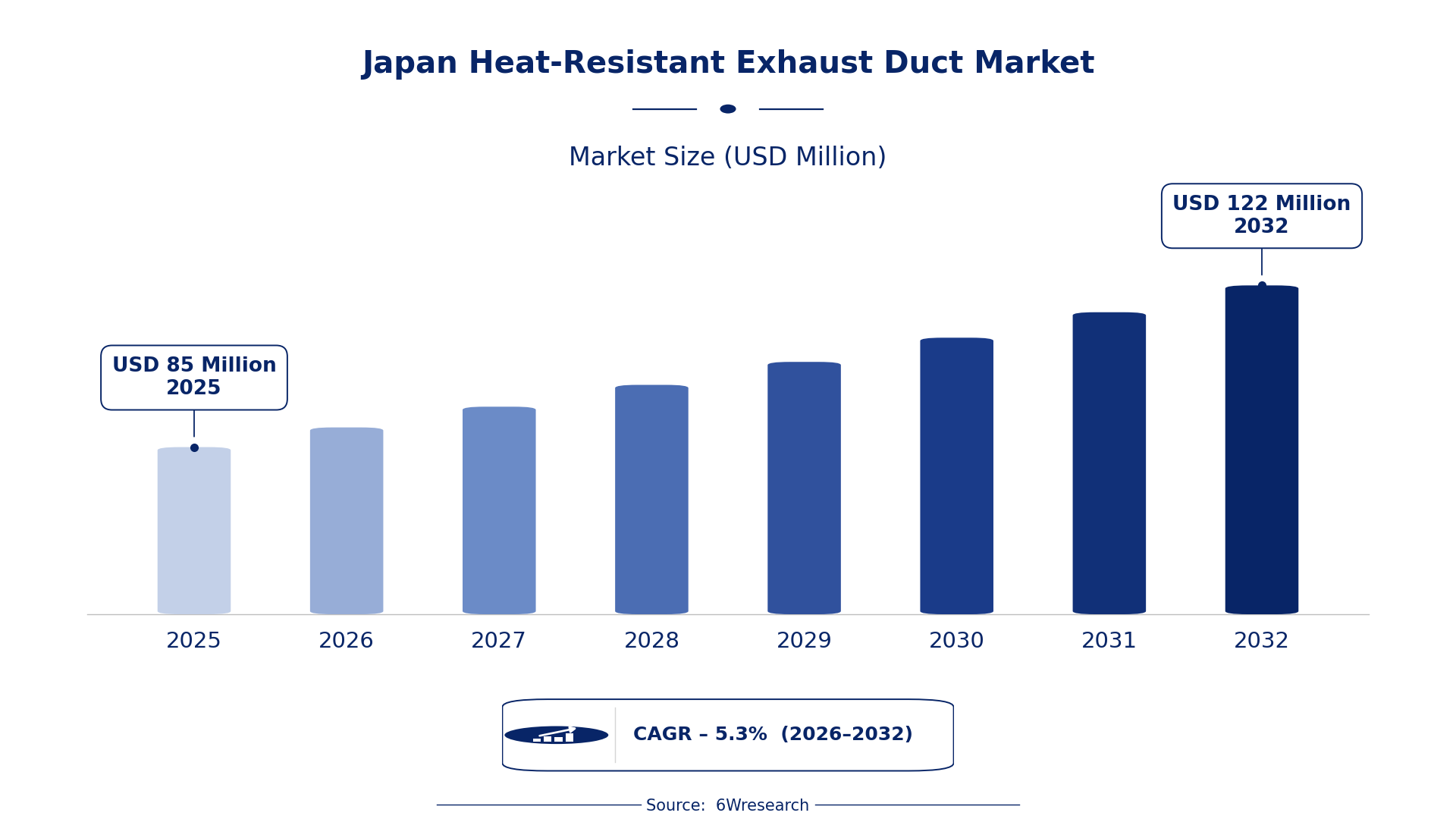
According to 6Wresearch internal database and industry insights, the Japan Heat-Resistant Exhaust Duct Market was valued at USD 85 Million in 2025 and is projected to reach USD 122 Million by 2032, growing at a CAGR of approximately 5.3% during 2026–2032.
Japan Heat-Resistant Exhaust Duct Market Highlights
| Report Metric | Details |
| Report Name | Japan Heat-Resistant Exhaust Duct Market (2026-2032) |
| Market Size 2025 | USD 85 Million |
| Market Size 2032 | USD 122 Million |
| Absolute Growth 2025–2032 | USD 37 Million |
| CAGR 2026–2032 | 5.3% |
| Peak Annual Growth | 6.5% in 2032 |
| Forecast Period | 2026–2032 |
| Historical Data | 2022–2025 |
| Base Year | 2025 |
| Leading Duct Type, 2025 | Flexible Exhaust Duct (45% share) |
| Leading Material Used, 2025 | Fiberglass (49% share) |
| Leading Application Segment, 2025 | Industrial Ventilation (48% share) |
| Leading Distribution Channel, 2025 | Online Platforms (49% share) |
| Fastest-Growing Duct Type | Rigid Exhaust Duct (7.5% CAGR) |
| Fastest-Growing Material Used | Stainless Steel (7.6% CAGR) |
| Fastest-Growing Application Segment | Power Plants (7.2% CAGR) |
| Fastest-Growing Distribution Channel | Direct Sales (7.1% CAGR) |
| Growing Sector | Power Plants |
| Key End Users | Industrial Ventilation, Power Plants, HVAC Systems, Chemical Plants |
Japan Heat-Resistant Exhaust Duct Market Year-wise Growth Rate and Key Drivers (2022–2032)
This graph illustrates the annual growth rates of the market from 2022 to 2032, highlighting a steady upward trajectory and projected market expansion over the forecast period.
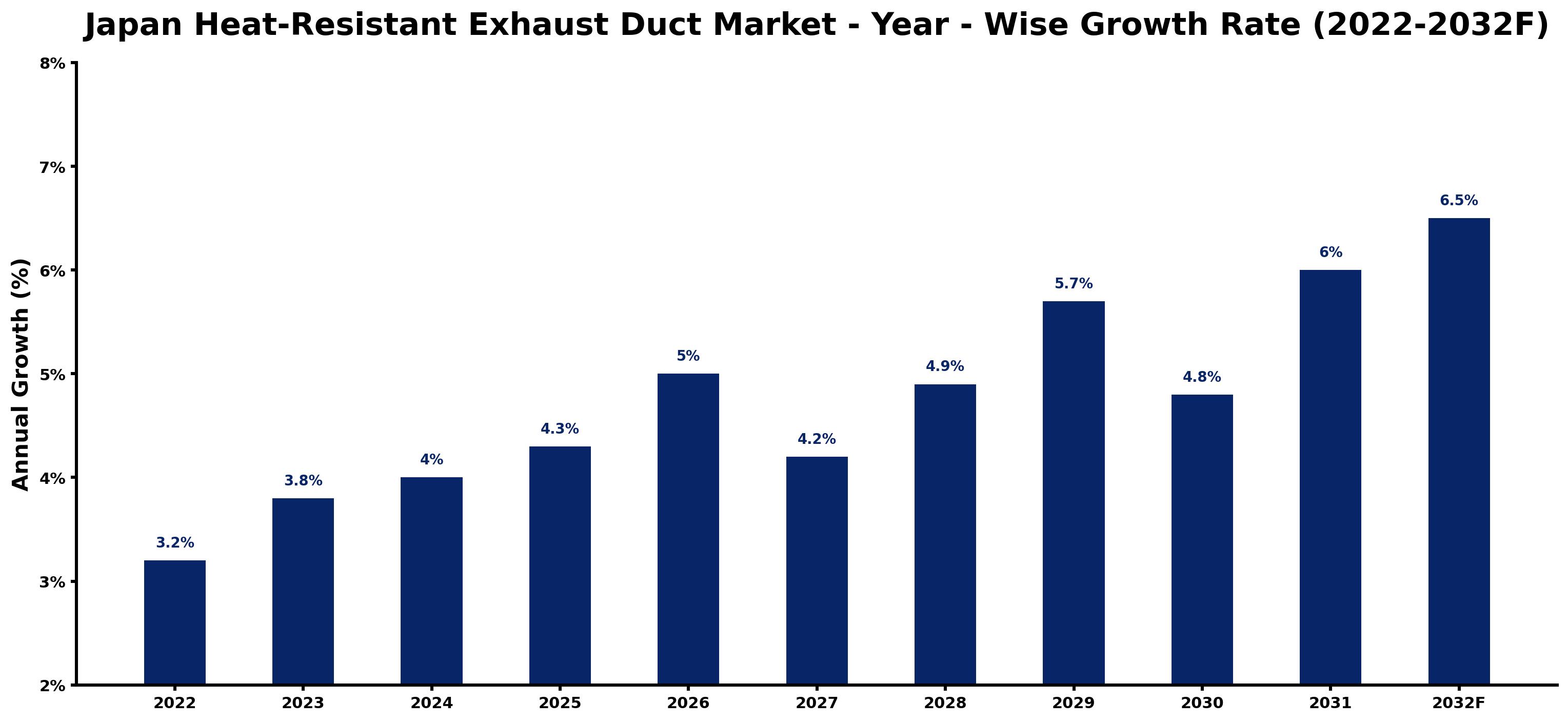
The table below sets out the estimated growth rate for each year and the main factor behind it.
| Year | Estimated Annual Growth (%) | Market Rationale |
| 2022 | 3.2 | The market experienced steady demand driven by ongoing industrial activities. |
| 2023 | 3.8 | Growth accelerated as the HVAC sector expanded in urban areas. |
| 2024 | 4.0 | Continued investments in industrial ventilation systems supported higher growth rates. |
| 2025 | 4.3 | Demand peaked as power generation capacity increased, boosting exhaust duct usage. |
| 2026 | 5.0 | The market is expected to grow as energy efficiency standards gain traction. |
| 2027 | 4.2 | Growth slows slightly as market stabilises after previous peaks in demand. |
| 2028 | 4.9 | A rebound in industrial activities leads to renewed interest in exhaust solutions. |
| 2029 | 5.7 | Increased power plant operations drive further demand for heat-resistant ducts. |
| 2030 | 4.8 | Growth slows again as the market adjusts to prior rapid expansions. |
| 2031 | 6.0 | Demand rises as construction regulations for high-rise buildings tighten. |
| 2032 | 6.5 | The market peaks with heightened focus on energy efficiency in industrial sectors. |
Note: Market size estimations and growth projections presented in this report are based on 6Wresearch's proprietary forecasting methodology, utilizing the latest available industry data, government publications, and primary research inputs.
Japan Heat-Resistant Exhaust Duct Market Synopsis
Heat-Resistant Exhaust Ducts are engineered products designed to withstand high temperatures, primarily made from fiberglass and stainless steel. In Japan, these ducts are essential for industrial ventilation systems, power plants, and chemical plants. The Japan Heat-Resistant Exhaust Duct Market is growing due to rising investments in energy-efficient systems, with the HVAC market valued at approximately 4 trillion JPY. Major industrial regions like Tokyo and Osaka are driving demand, alongside government initiatives promoting energy efficiency standards.
Market Dynamics Impact Analysis (2026–2032)
| Factor | Type | Impact | Primary Segment Affected |
| Increasing investments in industrial ventilation systems | Driver | High | Industrial Ventilation |
| Rising power generation capacity in Japan | Driver | High | Power Plants |
| Growing demand for fireproof ducts in urban high-rises | Opportunity | Medium | Fireproof Duct |
| Investment in energy efficiency upgrades for HVAC systems | Opportunity | High | HVAC Systems |
| High costs associated with advanced materials | Restraint | Medium | Fiberglass |
| Limited availability of certified suppliers | Restraint | High | Rigid Exhaust Duct |
| Competition from alternative ventilation solutions | Challenge | Medium | Flexible Exhaust Duct |
| Fluctuating raw material prices affecting production | Challenge | High | Stainless Steel |
Evaluation of Drivers in Japan Heat-Resistant Exhaust Duct Market (2026–2032)
Key forces behind demand, with the segment each one moves most, are listed below.
| Drivers | Primary Segment Affected | Why It Matters (Evidence) |
| Expansion of industrial facilities in Tokyo and Osaka | Industrial Ventilation | Over 70% of industrial ventilation systems in Japan utilise heat-resistant ducts, increasing demand. |
| Rising energy production needs in power plants | Power Plants | Japan's power generation capacity reached 1,000 GW in 2023, driving duct usage. |
| Implementation of energy efficiency standards for HVAC systems | HVAC Systems | The HVAC market is valued at approximately 4 trillion JPY, prompting upgrades. |
| Increased construction of high-rise buildings | Fireproof Duct | Fireproof ducts are mandated in all high-rise buildings in urban areas. |
| Growing chemical industry workforce | Chemical Plants | The chemical industry employs over 500,000 people, driving duct usage. |
Purchasing is picking up as industrial ventilation systems expand in Tokyo and Osaka, where over 70% of systems utilise heat-resistant ducts. The HVAC market, valued at approximately 4 trillion JPY, is prompting upgrades driven by energy efficiency standards. In 2023, Japan's power generation capacity reached 1,000 GW, increasing demand for exhaust solutions. Fireproof ducts are mandated in high-rise buildings, creating consistent demand. The chemical industry employs a significant workforce, further driving duct usage in hazardous environments.
Evaluation of Restraints in Japan Heat-Resistant Exhaust Duct Market
Below are the constraints most often cited by buyers and suppliers, with the segment each affects.
| Market Restraint | Primary Segment Affected | Why It Matters (Evidence) |
| High costs of advanced fiberglass materials | Fiberglass | The average lifespan of fiberglass ducts is around 15 years, leading to higher upfront costs. |
| Limited supplier base for certified ducts | Rigid Exhaust Duct | The need for ISO 9001 certification restricts the number of available suppliers. |
| Competition from alternative ventilation solutions | Flexible Exhaust Duct | Alternative materials may offer lower costs, affecting market share. |
| Fluctuating prices of raw materials | Stainless Steel | Price volatility impacts production costs and profit margins. |
| Regulatory compliance costs for manufacturers | Fireproof Duct | Compliance with safety standards increases production expenses. |
Japan Heat-Resistant Exhaust Duct Market Challenges
Producers face outdated manufacturing technology, limiting the production of heat-resistant ducts and causing delays in supply that can extend up to six months. Distributors encounter high logistical costs due to Japan's intricate transport network, leading to price increases of around 15% for buyers. Buyers experience rising costs from fluctuating supply as demand from the chemical industry, employing over 500,000 people, increases, creating potential shortages that can disrupt production processes. Skills shortages in advanced duct manufacturing hinder output, which may result in a 20% loss in market share for producers unable to adapt.
Trends in the Japan Heat-Resistant Exhaust Duct Market
Four trends stand out in the Japan Heat-Resistant Exhaust Duct Market.
- Shift from Fiberglass to Stainless Steel: Stainless steel is gaining traction in the heat-resistant duct market due to its durability and corrosion resistance. In 2026, the segment is expected to grow at a CAGR of 7.6%, reflecting changing preferences among industrial users.
- Transition from Rigid to Flexible Ducts: Flexible ducts are increasingly preferred for their adaptability in various applications. This trend is supported as the flexible duct segment held a 45% share in 2025, meeting diverse industrial needs.
- Emergence of Fireproof Ducts in Urban Areas: Fireproof ducts are becoming essential in urban high-rise buildings, driven by safety regulations. In 2023, the demand surged as fireproof ducts were mandated in all new constructions.
- Prioritisation of Energy Efficiency in HVAC Systems: Energy efficiency is a growing focus in HVAC systems, with the government promoting standards. By 2025, investment in energy-efficient upgrades is projected to exceed 500 billion JPY.
Investment Opportunities in the Japan Heat-Resistant Exhaust Duct Market
Investors looking at the Japan Heat-Resistant Exhaust Duct Market should consider the following areas.
- Investment Gap in Energy-Efficient Solutions: With investment in industrial ventilation systems projected to exceed 500 billion JPY by 2025, suppliers can focus on energy-efficient heat-resistant ducts to meet rising demand from manufacturers in Tokyo and Osaka.
- Demand for Fireproof Ducts in High-Rise Buildings: The shift towards stainless steel ducts, projected to grow at a CAGR of 7.6%, presents an opportunity for suppliers to invest in advanced manufacturing processes.
- Expansion of the Chemical Industry: With a large workforce in the chemical sector, suppliers can cater to the increasing demand for heat-resistant ducts in chemical plants, enhancing their product offerings.
- Growth in HVAC System Installations: Investment in HVAC systems is projected to exceed 4 trillion JPY, creating opportunities for suppliers to provide heat-resistant ducts to meet this demand.
Government Initiatives in the Japan Heat-Resistant Exhaust Duct Market
The Economic Security Promotion Act (2022) supports supply-chain resilience for designated critical products and materials, benefiting heat-resistant duct manufacturers by ensuring a stable supply of essential materials. This act aims to strengthen production capacity of critical products, which is important for meeting the growing demand in industrial sectors. The program is expected to improve the overall manufacturing environment by 2025, ensuring that manufacturers can meet the increasing needs of the market.
The Ministry of Economy, Trade and Industry (METI) oversees the approval of energy efficiency standards, which manufacturers must comply with to ensure their products meet national regulations. This compliance is crucial for buyers looking for reliable and efficient duct solutions, as it guarantees that products adhere to safety and performance standards. METI's initiatives aim to promote innovation and sustainability in duct manufacturing, supporting the industry's growth.
Future Insight of the Japan Heat-Resistant Exhaust Duct Market
By 2032, buyers will benefit from enhanced energy efficiency standards as the government tightens regulations, improving overall system performance. Investment in industrial ventilation systems is projected to exceed 500 billion JPY by 2025, driving the development of new duct technologies that reduce operational costs. The adoption of the JIS standard will ensure consistent quality, crucial for suppliers meeting strict market requirements. Innovations in materials will likely extend the lifespan of heat-resistant ducts, providing long-term reliability for users across various sectors.
Market Segmentation Analysis
Japan Heat-Resistant Exhaust Duct Market report covers a detailed analysis of the following market segments:
By Duct Type – Flexible Exhaust Duct Leads, Rigid Exhaust Duct Expected to Grow Fastest
According to Saurav Kr Singh, Senior Research Analyst at 6Wresearch, with 45% of duct type revenue in 2025, Flexible Exhaust Duct was the largest category. Flexible Exhaust Ducts dominate the market because of their adaptability, making them ideal for various applications in industrial ventilation systems. Their widespread use in key industrial regions such as Tokyo and Osaka illustrates their importance in meeting operational demands. Rigid Exhaust Duct is projected to grow fastest, at a CAGR of 7.5% during 2026–2032. The Rigid Exhaust Duct segment is experiencing rapid growth due to the increasing need for structural integrity in fixed installations, particularly in power generation facilities. This demand is further fuelled by Japan's power generation capacity reaching 1,000 GW in 2023, highlighting the necessity for robust exhaust solutions. Suppliers must ensure adequate availability of Rigid Exhaust Ducts to meet the escalating demand for fixed installations.
By Material Used – Fiberglass Leads, Stainless Steel Expected to Grow Fastest
Fiberglass accounted for 49% of the market by material used in 2025. Fiberglass holds the largest share in the market due to its excellent thermal insulation properties, making it a preferred choice for various high-temperature applications. Its widespread adoption in industrial ventilation systems highlights its critical role in maintaining operational efficiency. Over 2026–2032, Stainless Steel is expected to post the fastest growth, at a CAGR of 7.6%. Stainless Steel is the fastest-growing material segment, as its durability and corrosion resistance are increasingly valued in harsh environments, particularly in power plants. The ongoing investment in industrial ventilation systems projected to exceed 500 billion JPY by 2025 will further drive this growth. Buyers should consider the long-term benefits of Stainless Steel for applications requiring durability and resistance to harsh conditions.
By Application Segment – Industrial Ventilation Leads, Power Plants Expected to Grow Fastest
Industrial Ventilation held 48% of the Japan Heat-Resistant Exhaust Duct Market by application segment in 2025. Industrial Ventilation is the leading application segment, crucial for ensuring air quality across various facilities where heat-resistant ducts play an essential role. The extensive installed base of over 30 million HVAC systems in Japan reflects the reliance on these ducts for effective ventilation. Power Plants are set to record the highest CAGR in this split, 7.2% over 2026–2032. Power Plants are the fastest-growing application segment, spurred by the urgent requirement for efficient exhaust management in energy production. The increasing power generation capacity in Japan underscores the need for advanced exhaust solutions, driving growth in this segment. Suppliers should prioritise the development of solutions tailored for Power Plants to capitalise on the rising demand for efficient exhaust management.
By Distribution Channel – Online Platforms Lead, Direct Sales Expected to Grow Fastest
In 2025, Online Platforms led the distribution channel split with a 49% share. Online Platforms are the leading distribution channel, effectively connecting with a wide audience and facilitating duct sales across diverse sectors. The growing preference for this channel among buyers seeking convenience highlights its significance in the market. The quickest growth will come from Direct Sales, forecast to expand at a CAGR of 7.1% between 2026 and 2032. Direct Sales is the fastest-growing distribution channel as industries increasingly prefer this method for procurement, allowing for better communication and customised solutions. This trend is likely to strengthen supplier-buyer relationships, improving service delivery. Suppliers should enhance their direct sales strategies to better address the specific needs of industrial clients.
Key Attractiveness of the Report
- 10 Years of Market Numbers
- Historical Data Starting from 2022 to 2025
- Base Year 2025
- Forecast Data until 2032
- Key Performance Indicators Impacting the Market
- Major Upcoming Developments and Projects
Key Highlights of the Report:
- Japan Heat-Resistant Exhaust Duct Market Outlook
- Market Size of Japan Heat-Resistant Exhaust Duct Market, 2025
- Forecast of Japan Heat-Resistant Exhaust Duct Market, 2032
- Historical Data and Forecast of Japan Heat-Resistant Exhaust Duct Revenues & Volume for the Period 2022-2032F
- Japan Heat-Resistant Exhaust Duct Market Trend Evolution
- Japan Heat-Resistant Exhaust Duct Market Drivers and Challenges
- Japan Heat-Resistant Exhaust Duct Price Trends
- Japan Heat-Resistant Exhaust Duct Porter's Five Forces
- Japan Heat-Resistant Exhaust Duct Industry Life Cycle
- Historical Data and Forecast of Japan Heat-Resistant Exhaust Duct Market Revenues & Volume By Duct Type for the Period 2022-2032F
- Historical Data and Forecast of Japan Heat-Resistant Exhaust Duct Market Revenues & Volume By Flexible Exhaust Duct for the Period 2022-2032F
- Historical Data and Forecast of Japan Heat-Resistant Exhaust Duct Market Revenues & Volume By Rigid Exhaust Duct for the Period 2022-2032F
- Historical Data and Forecast of Japan Heat-Resistant Exhaust Duct Market Revenues & Volume By Corrugated Duct for the Period 2022-2032F
- Historical Data and Forecast of Japan Heat-Resistant Exhaust Duct Market Revenues & Volume By Fireproof Duct for the Period 2022-2032F
- Historical Data and Forecast of Japan Heat-Resistant Exhaust Duct Market Revenues & Volume By Material Used for the Period 2022-2032F
- Historical Data and Forecast of Japan Heat-Resistant Exhaust Duct Market Revenues & Volume By Fiberglass for the Period 2022-2032F
- Historical Data and Forecast of Japan Heat-Resistant Exhaust Duct Market Revenues & Volume By Stainless Steel for the Period 2022-2032F
- Historical Data and Forecast of Japan Heat-Resistant Exhaust Duct Market Revenues & Volume By Aluminum Foil for the Period 2022-2032F
- Historical Data and Forecast of Japan Heat-Resistant Exhaust Duct Market Revenues & Volume By Silicone Coated for the Period 2022-2032F
- Historical Data and Forecast of Japan Heat-Resistant Exhaust Duct Market Revenues & Volume By Application Segment for the Period 2022-2032F
- Historical Data and Forecast of Japan Heat-Resistant Exhaust Duct Market Revenues & Volume By Industrial Ventilation for the Period 2022-2032F
- Historical Data and Forecast of Japan Heat-Resistant Exhaust Duct Market Revenues & Volume By Power Plants for the Period 2022-2032F
- Historical Data and Forecast of Japan Heat-Resistant Exhaust Duct Market Revenues & Volume By HVAC Systems for the Period 2022-2032F
- Historical Data and Forecast of Japan Heat-Resistant Exhaust Duct Market Revenues & Volume By Chemical Plants for the Period 2022-2032F
- Historical Data and Forecast of Japan Heat-Resistant Exhaust Duct Market Revenues & Volume By Distribution Channel for the Period 2022-2032F
- Historical Data and Forecast of Japan Heat-Resistant Exhaust Duct Market Revenues & Volume By Online Platforms for the Period 2022-2032F
- Historical Data and Forecast of Japan Heat-Resistant Exhaust Duct Market Revenues & Volume By Direct Sales for the Period 2022-2032F
- Historical Data and Forecast of Japan Heat-Resistant Exhaust Duct Market Revenues & Volume By Industrial Suppliers for the Period 2022-2032F
- Historical Data and Forecast of Japan Heat-Resistant Exhaust Duct Market Revenues & Volume By Specialty Stores for the Period 2022-2032F
- Japan Heat-Resistant Exhaust Duct Import Export Trade Statistics
- Market Opportunity Assessment By Duct Type
- Market Opportunity Assessment By Material Used
- Market Opportunity Assessment By Application Segment
- Market Opportunity Assessment By Distribution Channel
- Japan Heat-Resistant Exhaust Duct Top Companies Market Share
- Japan Heat-Resistant Exhaust Duct Competitive Benchmarking By Technical and Operational Parameters
- Japan Heat-Resistant Exhaust Duct Company Profiles
- Japan Heat-Resistant Exhaust Duct Key Strategic Recommendations
Market Covered
This report examines the market across the segments below.
By Duct Type
- Flexible Exhaust Duct
- Rigid Exhaust Duct
- Corrugated Duct
- Fireproof Duct
By Material Used
- Fiberglass
- Stainless Steel
- Aluminum Foil
- Silicone Coated
By Application Segment
- Industrial Ventilation
- Power Plants
- HVAC Systems
- Chemical Plants
By Distribution Channel
- Online Platforms
- Direct Sales
- Industrial Suppliers
- Specialty Stores































