Japan Heavy Machinery Market Size & Growth Rate
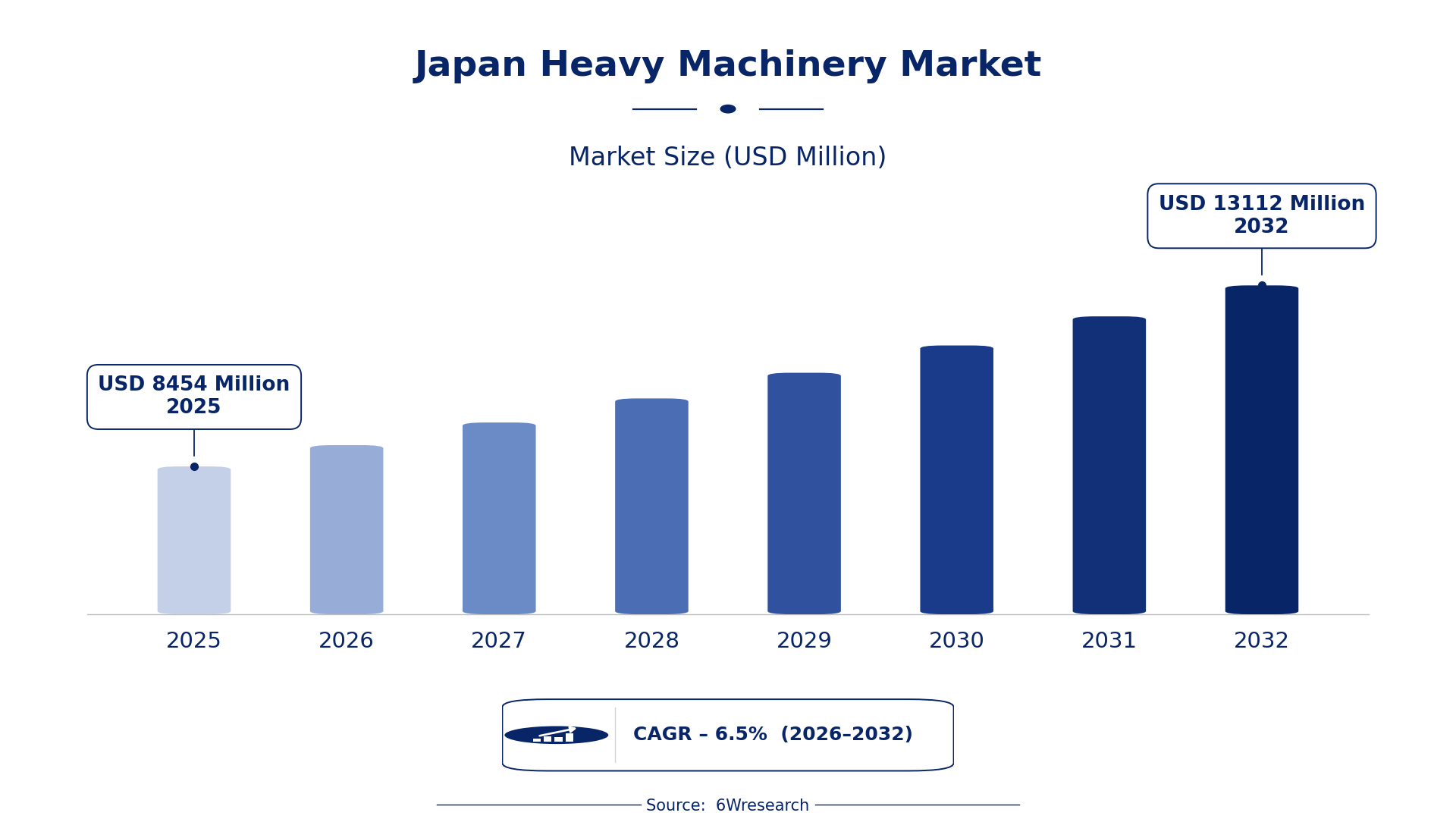
According to 6Wresearch internal database and industry insights, the Japan Heavy Machinery Market was valued at USD 8,454 Million in 2025 and is projected to reach USD 13,112 Million by 2032, growing at a CAGR of approximately 6.5% during 2026–2032.
Japan Heavy Machinery Market Highlights
| Report Metric | Details |
| Report Name | Japan Heavy Machinery Market (2026-2032) |
| Market Size 2025 | USD 8,454 Million |
| Market Size 2032 | USD 13,112 Million |
| Absolute Growth 2025–2032 | USD 4,658 Million |
| CAGR 2026–2032 | 6.5% |
| Peak Annual Growth | 8.0% in 2026 |
| Forecast Period | 2026–2032 |
| Historical Data | 2022–2025 |
| Base Year | 2025 |
| Leading Machinery Type, 2025 | Excavators (36% share) |
| Leading Power Source, 2025 | Diesel (38% share) |
| Leading Industry Use Case, 2025 | Construction (46% share) |
| Leading Distribution Channel, 2025 | Direct Sales (42% share) |
| Fastest-Growing Machinery Type | Bulldozers (8.8% CAGR) |
| Fastest-Growing Power Source | Hydraulic (9.1% CAGR) |
| Fastest-Growing Industry Use Case | Road Development (8.1% CAGR) |
| Fastest-Growing Distribution Channel | Online Platforms (8.3% CAGR) |
| Growing Sector | Construction |
| Key End Users | Construction companies, mining operations, industrial suppliers |
Japan Heavy Machinery Market Year-wise Growth Rate and Key Drivers (2022–2032)
This graph illustrates the annual growth rates of the market from 2022 to 2032, highlighting a steady upward trajectory and projected market expansion over the forecast period.
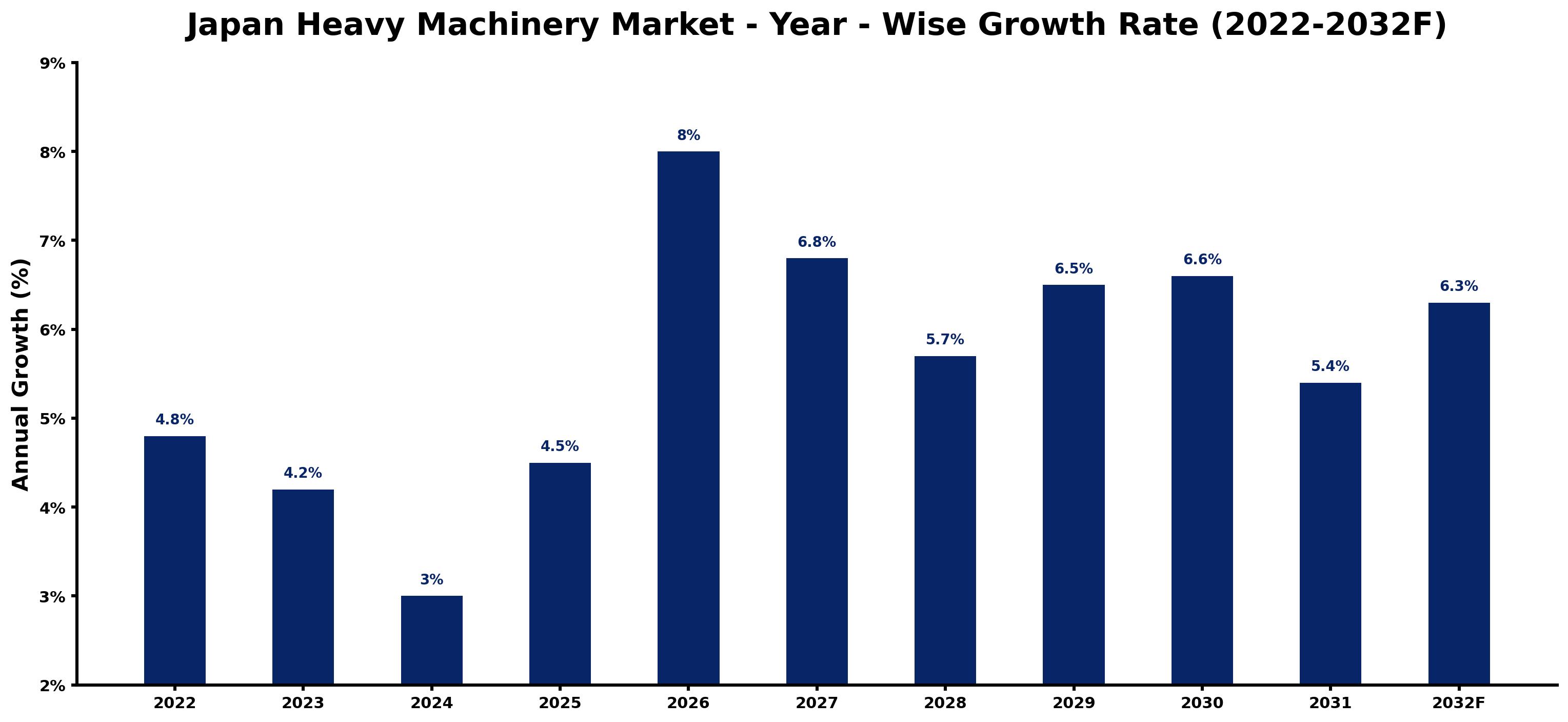
Annual growth estimates for each year appear below with the principal reason behind them, explaining the shifts that set the pace of the market.
| Year | Estimated Annual Growth (%) | Market Rationale |
| 2022 | 4.8 | The market experienced steady growth due to ongoing construction projects. |
| 2023 | 4.2 | Demand growth slowed as some infrastructure projects faced delays. |
| 2024 | 3.0 | The market continued to grow, but at a reduced pace amid economic adjustments. |
| 2025 | 4.5 | Demand picked up again as construction activity increased. |
| 2026 | 8.0 | Growth surged due to a major infrastructure investment plan announced in 2023. |
| 2027 | 6.8 | The market growth rate slowed as projects reached completion phases. |
| 2028 | 5.7 | Demand stabilised after rapid growth, leading to a slight decrease. |
| 2029 | 6.5 | Growth resumed with renewed investments in construction and mining sectors. |
| 2030 | 6.6 | The market continued to expand as new projects were initiated across regions. |
| 2031 | 5.4 | Growth slowed as the market adjusted to previous high levels of activity. |
| 2032 | 6.3 | Demand is expected to rise again as new regulations encourage eco-friendly machinery. |
Note: Market size estimations and growth projections presented in this report are based on 6Wresearch's proprietary forecasting methodology, utilizing the latest available industry data, government publications, and primary research inputs.
Japan Heavy Machinery Market Synopsis
Heavy machinery encompasses excavators, bulldozers, cranes, and mining drills, which are crucial for construction, mining, and road development. The Japan Heavy Machinery Market is valued at approximately 1 trillion yen, driven by a robust construction sector that employs over 4 million workers. The Kanto region leads in demand, while a 500 billion yen infrastructure investment plan announced in 2023 further stimulates growth. An increasing emphasis on eco-friendly machinery and advanced engineering techniques propels market activity, creating opportunities for suppliers.
Market Dynamics Impact Analysis (2026–2032)
| Factor | Type | Impact | Primary Segment Affected |
| Rising construction activity in the Kanto region | Driver | High | Construction |
| Increased demand for eco-friendly machinery | Driver | High | Excavators |
| Growing investment in infrastructure projects | Opportunity | High | Road Development |
| Expansion of online sales channels | Opportunity | Medium | Online Platforms |
| High costs of advanced machinery | Restraint | High | Cranes |
| Increasing average age of existing machinery | Restraint | Medium | Excavators |
| Supply chain disruptions affecting availability | Challenge | High | Mining Drills |
| Regulatory compliance costs for eco-friendly standards | Challenge | Medium | Excavators |
Evaluation of Drivers in Japan Heavy Machinery Market (2026–2032)
These are the developments adding the most demand over the forecast period.
| Drivers | Primary Segment Affected | Why It Matters (Evidence) |
| Increased construction projects in urban areas | Excavators | Excavators account for 40% of heavy machinery demand, driven by urban construction activities. |
| Infrastructure investment plan announced in 2023 | Road Development | The 500 billion yen investment boosts demand for road construction machinery. |
| Focus on sustainability | Bulldozers | Eco-friendly bulldozers are increasingly sought after due to environmental regulations. |
| Technological advancements in machinery | Cranes | Improved crane efficiency enhances demand in construction projects. |
| Expanding mining operations | Mining Drills | Mining drills are essential for resource extraction, particularly in expanding operations. |
The strongest pull on demand comes from increased construction projects in urban areas, with excavators accounting for 40% of heavy machinery demand. The 500 billion yen infrastructure investment plan announced in 2023 boosts demand for road construction machinery. Technological advancements improve crane efficiency, while expanding mining operations create strong demand for mining drills, further stimulating market growth.
Evaluation of Restraints in Japan Heavy Machinery Market
Below are the constraints most often cited by buyers and suppliers, with the segment each affects.
| Market Restraint | Primary Segment Affected | Why It Matters (Evidence) |
| High costs of advanced machinery limiting purchases | Cranes | The average cost of cranes remains high, making them less accessible for smaller construction firms. |
| Aging heavy machinery leading to replacement demand | Excavators | The average lifespan of heavy machinery is around 10-15 years, necessitating replacements. |
| Supply chain disruptions affecting machinery availability | Mining Drills | Recent supply chain issues have delayed the delivery of critical mining equipment. |
| Regulatory compliance costs for eco-friendly machinery | Excavators | Compliance with new environmental standards increases operational costs for manufacturers. |
| Limited access to financing for small firms | Bulldozers | Small construction companies struggle to secure financing for new bulldozers. |
Japan Heavy Machinery Market Challenges
In Japan, fierce competition among over 1,000 construction companies pressures suppliers to reduce prices, impacting their profit margins and limiting investment in new technologies. Compliance with regulations from the Ministry of Land, Infrastructure, Transport and Tourism incurs substantial costs, delaying project timelines for buyers and leading to budget overruns that can exceed 15%. Rising wages, with the national minimum wage reaching JPY 1,055 per hour, inflate operational costs for producers, potentially resulting in higher prices for buyers. Transitioning to eco-friendly machinery requires considerable capital from suppliers, disrupting production schedules and extending lead times by up to 20%.
Trends in the Japan Heavy Machinery Market
The shifts below are changing how Japan Heavy Machinery Market products are bought and supplied.
- Increase in Eco-friendly Machinery Adoption: In 2023, Japan announced a subsidy program for eco-friendly machinery, promoting sustainable practices in construction. This initiative aims for a 30% reduction in carbon emissions from heavy machinery by 2030.
- Shift Towards Advanced Automation in Heavy Machinery: The New Robot Strategy initiated in 2015 is driving the integration of robotics in heavy machinery. This shift is expected to see a 20% increase in automation adoption by 2025.
- Growth of Online Sales Channels for Heavy Machinery: The rise of online platforms for heavy machinery sales is changing distribution dynamics. By 2025, online sales are projected to account for 15% of total sales, reflecting changing buyer preferences.
- Focus on Safety Standards in Heavy Machinery: Updates to safety standards are being implemented to enhance safety in heavy machinery. Compliance with these standards is vital for manufacturers, impacting market competitiveness.
Investment Opportunities in the Japan Heavy Machinery Market
The following areas offer the clearest openings for investors and suppliers in the Japan Heavy Machinery Market.
- Gap in Eco-friendly Machinery Supply: With the demand for eco-friendly machinery increasing, manufacturers can capitalise on this trend. The construction sector, particularly in urban areas, is seeking sustainable solutions, creating a significant market opportunity.
- Investment in Road Development Machinery: The 500 billion yen investment in infrastructure presents an opportunity to supply advanced road development machinery. Construction firms are actively seeking reliable suppliers to meet project demands.
- Emerging Online Sales Channels: The shift towards online platforms for machinery sales is creating a gap in the market. Suppliers can enter this space by partnering with local distributors to reach a wider audience.
- Growing Demand for Mining Equipment in Hokkaido: With mining operations expanding in Hokkaido, there is a pressing need for advanced mining equipment. Suppliers can explore partnerships with local mining firms to meet this demand.
Government Initiatives in the Japan Heavy Machinery Market
The Industrial Safety and Health Act of 1972 mandates employer responsibilities regarding hazardous machinery, ensuring safety standards are met in heavy machinery operations. This law has shaped operational protocols within the industry, promoting safe practices among manufacturers and operators. The Act on the Rational Use of Energy, established in 1979, requires large energy users to enhance energy efficiency, directly impacting machinery design and usage.
The Ministry of Land, Infrastructure, Transport and Tourism oversees construction regulations, approving projects and ensuring compliance with safety standards. The Japan Construction Equipment Manufacturers Association promotes industry standards and supports manufacturers in meeting regulatory requirements, facilitating smoother market operations. Their initiatives include funding for research and development in machinery safety and efficiency.
Future Insight of the Japan Heavy Machinery Market
By 2032, urban development projects will increase, particularly in metropolitan areas, driving demand for modern construction equipment. The government's target to reduce carbon emissions by 30% by 2030 will compel suppliers to adopt electric machinery, reshaping their product lines. With the average age of heavy machinery climbing, replacement demand will surge, prompting buyers to seek more efficient options. The annual Heavy Machinery Expo will showcase emerging technologies, facilitating partnerships between buyers and suppliers and shaping future market trends.
Market Segmentation Analysis
Japan Heavy Machinery Market report covers a detailed analysis of the following market segments:
By Machinery Type – Excavators Lead, Bulldozers Expected to Grow Fastest
According to Saurav Kr Singh, Senior Research Analyst at 6Wresearch, the largest machinery type category in 2025 was Excavators, at 36% of revenue. Excavators hold the largest share in the market due to their essential role in construction and mining, being extensively used in major projects across Japan. Their dominance is particularly evident in the Kanto region, where demand is consistently high. Bulldozers are projected to grow fastest, at a CAGR of 8.8% during 2026–2032. Bulldozers are experiencing rapid growth, primarily due to their critical function in earthmoving for construction projects, especially with the recent 500 billion yen infrastructure investment plan. This increasing focus on construction activities will likely boost bulldozer demand further. Suppliers should focus on enhancing bulldozer offerings to align with the rising demand in construction.
By Power Source – Diesel Leads, Hydraulic Expected to Grow Fastest
Diesel held 38% of the Japan Heavy Machinery Market by power source in 2025. Diesel is the predominant power source for heavy machinery, widely used for its reliability and efficiency in various applications. Its established presence in the market is reinforced by the extensive installed base across construction and mining sectors. The quickest growth will come from Hydraulic, forecast to expand at a CAGR of 9.1% between 2026 and 2032. Hydraulic systems are rapidly gaining traction as they are vital for the efficient operation of various machinery functions, particularly in complex construction tasks. The increasing focus on performance and productivity in heavy machinery operations is driving this growth. Manufacturers should invest in hydraulic technology to align with the growing preference for efficient power sources in heavy machinery.
By Industry Use Case – Construction Leads, Road Development Expected to Grow Fastest
In 2025, Construction led the industry use case split with a 46% share. The construction industry is the largest user of heavy machinery, employing over 4 million workers and utilising these machines for diverse projects. This sector's continuous expansion ensures a steady demand for heavy machinery to support ongoing developments. Road Development is set to record the highest CAGR in this split, 8.1% over 2026–2032. Road development is currently the fastest-growing use case, driven by the urgent need for infrastructure upgrades and maintenance. The government's commitment to enhancing road networks will significantly propel this segment's growth. Suppliers must adjust their strategies to meet the increasing machinery demands in road development.
By Distribution Channel – Direct Sales Leads, Online Platforms Expected to Grow Fastest
With 42% of distribution channel revenue in 2025, Direct Sales was the largest category. Direct sales serve as the primary distribution method for heavy machinery, enabling manufacturers to maintain control over pricing and customer relationships. This approach is particularly effective in a market where personal interaction is crucial for high-value equipment transactions. Over 2026–2032, Online Platforms are expected to post the fastest growth, at a CAGR of 8.3%. Online platforms are rapidly gaining traction as a preferred sales channel, driven by the convenience they provide to buyers. As more customers shift towards digital solutions for purchasing decisions, this trend is expected to accelerate. Suppliers should strengthen their online presence to capture the growing number of buyers favouring digital purchasing options.
Key Attractiveness of the Report
- 10 Years of Market Numbers
- Historical Data Starting from 2022 to 2025
- Base Year 2025
- Forecast Data until 2032
- Key Performance Indicators Impacting the Market
- Major Upcoming Developments and Projects
Key Highlights of the Report:
- Japan Heavy Machinery Market Outlook
- Market Size of Japan Heavy Machinery Market, 2025
- Forecast of Japan Heavy Machinery Market, 2032
- Historical Data and Forecast of Japan Heavy Machinery Revenues & Volume for the Period 2022-2032F
- Japan Heavy Machinery Market Trend Evolution
- Japan Heavy Machinery Market Drivers and Challenges
- Japan Heavy Machinery Price Trends
- Japan Heavy Machinery Porter's Five Forces
- Japan Heavy Machinery Industry Life Cycle
- Historical Data and Forecast of Japan Heavy Machinery Market Revenues & Volume By Machinery Type for the Period 2022-2032F
- Historical Data and Forecast of Japan Heavy Machinery Market Revenues & Volume By Excavators for the Period 2022-2032F
- Historical Data and Forecast of Japan Heavy Machinery Market Revenues & Volume By Bulldozers for the Period 2022-2032F
- Historical Data and Forecast of Japan Heavy Machinery Market Revenues & Volume By Cranes for the Period 2022-2032F
- Historical Data and Forecast of Japan Heavy Machinery Market Revenues & Volume By Mining Drills for the Period 2022-2032F
- Historical Data and Forecast of Japan Heavy Machinery Market Revenues & Volume By Power Source for the Period 2022-2032F
- Historical Data and Forecast of Japan Heavy Machinery Market Revenues & Volume By Diesel for the Period 2022-2032F
- Historical Data and Forecast of Japan Heavy Machinery Market Revenues & Volume By Hydraulic for the Period 2022-2032F
- Historical Data and Forecast of Japan Heavy Machinery Market Revenues & Volume By Electric for the Period 2022-2032F
- Historical Data and Forecast of Japan Heavy Machinery Market Revenues & Volume By Pneumatic for the Period 2022-2032F
- Historical Data and Forecast of Japan Heavy Machinery Market Revenues & Volume By Industry Use Case for the Period 2022-2032F
- Historical Data and Forecast of Japan Heavy Machinery Market Revenues & Volume By Construction for the Period 2022-2032F
- Historical Data and Forecast of Japan Heavy Machinery Market Revenues & Volume By Road Development for the Period 2022-2032F
- Historical Data and Forecast of Japan Heavy Machinery Market Revenues & Volume By Industrial Warehouses for the Period 2022-2032F
- Historical Data and Forecast of Japan Heavy Machinery Market Revenues & Volume By Mining Operations for the Period 2022-2032F
- Historical Data and Forecast of Japan Heavy Machinery Market Revenues & Volume By Distribution Channel for the Period 2022-2032F
- Historical Data and Forecast of Japan Heavy Machinery Market Revenues & Volume By Direct Sales for the Period 2022-2032F
- Historical Data and Forecast of Japan Heavy Machinery Market Revenues & Volume By Online Platforms for the Period 2022-2032F
- Historical Data and Forecast of Japan Heavy Machinery Market Revenues & Volume By Industrial Suppliers for the Period 2022-2032F
- Historical Data and Forecast of Japan Heavy Machinery Market Revenues & Volume By Specialty Distributors for the Period 2022-2032F
- Japan Heavy Machinery Import Export Trade Statistics
- Market Opportunity Assessment By Machinery Type
- Market Opportunity Assessment By Power Source
- Market Opportunity Assessment By Industry Use Case
- Market Opportunity Assessment By Distribution Channel
- Japan Heavy Machinery Top Companies Market Share
- Japan Heavy Machinery Competitive Benchmarking By Technical and Operational Parameters
- Japan Heavy Machinery Company Profiles
- Japan Heavy Machinery Key Strategic Recommendations
Market Covered
This report examines the market across the segments below.
By Machinery Type
- Excavators
- Bulldozers
- Cranes
- Mining Drills
By Power Source
- Diesel
- Hydraulic
- Electric
- Pneumatic
By Industry Use Case
- Construction
- Road Development
- Industrial Warehouses
- Mining Operations
By Distribution Channel
- Direct Sales
- Online Platforms
- Industrial Suppliers
- Specialty Distributors































