Japan HEPA Cleanroom Systems Market Size & Growth Rate
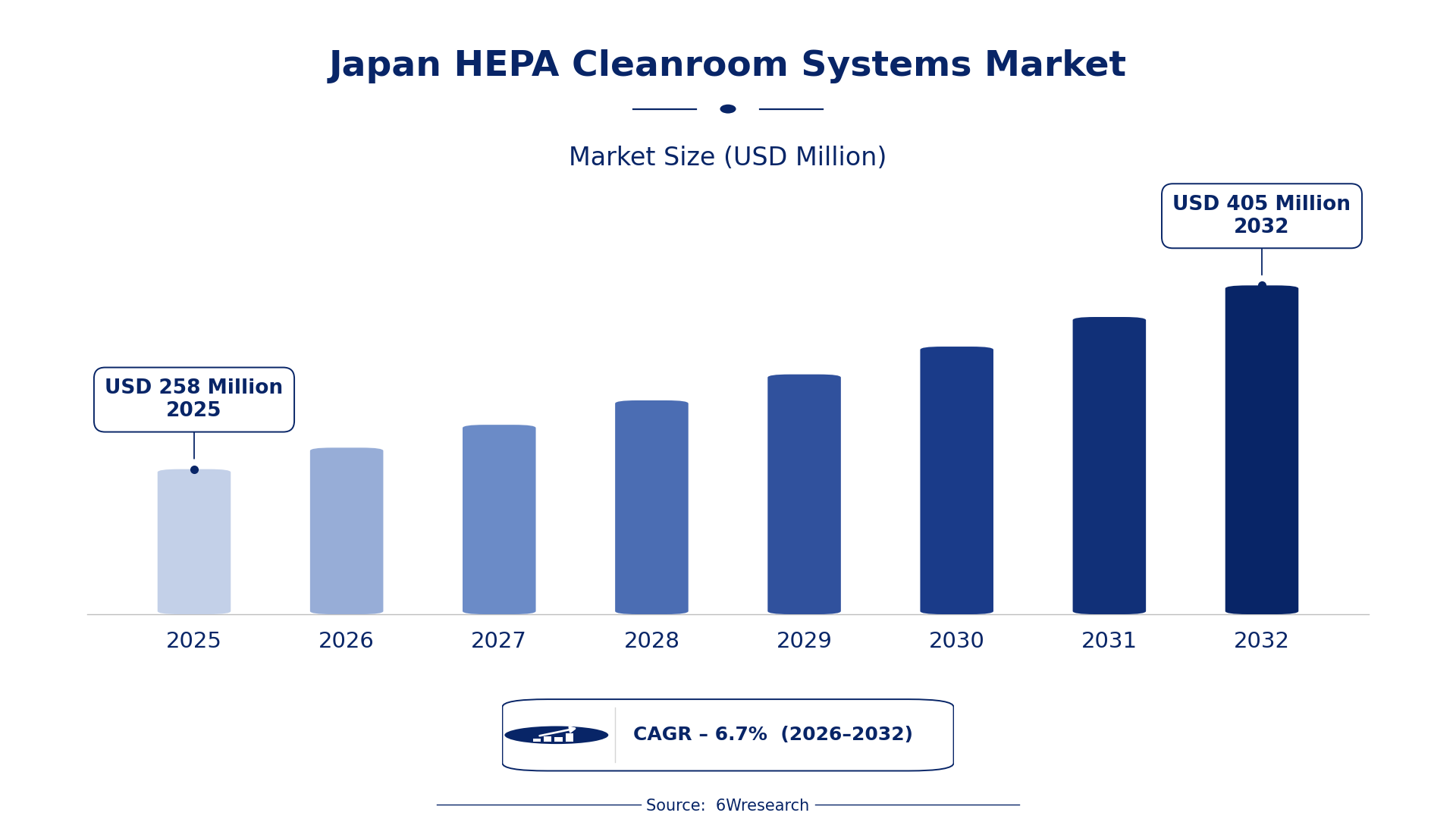
According to 6Wresearch internal database and industry insights, the Japan HEPA Cleanroom Systems Market was valued at USD 258 Million in 2025 and is projected to reach USD 405 Million by 2032, growing at a CAGR of approximately 6.7% during 2026–2032.
Japan HEPA Cleanroom Systems Market Highlights
| Report Metric | Details |
| Report Name | Japan HEPA Cleanroom Systems Market (2026-2032) |
| Market Size 2025 | USD 258 Million |
| Market Size 2032 | USD 405 Million |
| Absolute Growth 2025–2032 | USD 147 Million |
| CAGR 2026–2032 | 6.7% |
| Peak Annual Growth | 7.3% in 2027 |
| Forecast Period | 2026–2032 |
| Historical Data | 2022–2025 |
| Base Year | 2025 |
| Leading System Type, 2025 | Modular Cleanroom (42% share) |
| Leading Application Area, 2025 | Semiconductor Labs (42% share) |
| Leading Distribution Channel, 2025 | Direct Sales (36% share) |
| Leading End User, 2025 | Electronics Manufacturers (32% share) |
| Fastest-Growing Application Area | Microchip Production (8.2% CAGR) |
| Fastest-Growing Distribution Channel | OEM (8.7% CAGR) |
| Fastest-Growing End User | R&D Facilities (9.0% CAGR) |
| Growing Sector | Semiconductor Manufacturing |
| Key End Users | Electronics Manufacturers, R&D Facilities, Pharmaceuticals |
Japan HEPA Cleanroom Systems Market Year-wise Growth Rate and Key Drivers (2022–2032)
This graph illustrates the annual growth rates of the market from 2022 to 2032, highlighting a steady upward trajectory and projected market expansion over the forecast period.
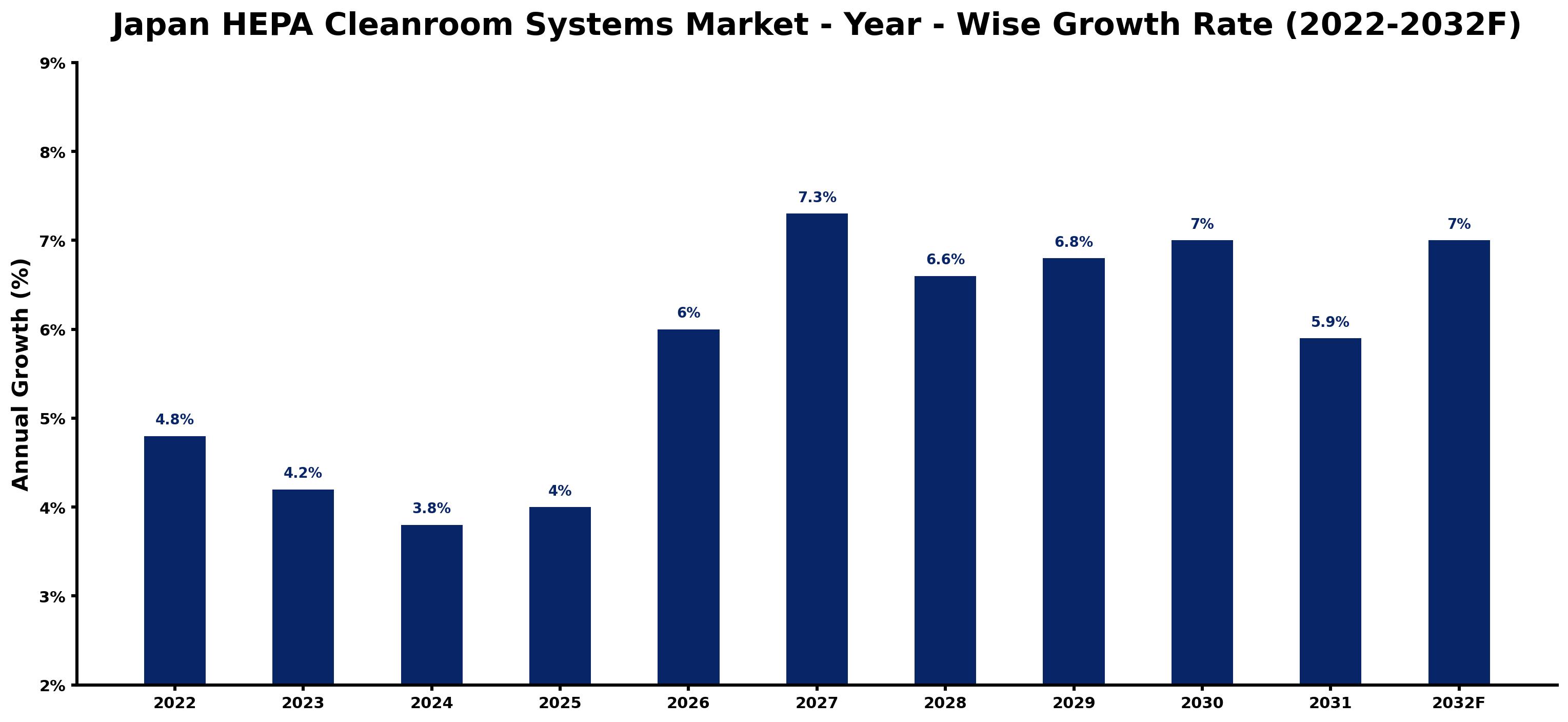
For each year, the table pairs the estimated growth rate with the leading influence on demand, showing how the drivers changed across the period.
| Year | Estimated Annual Growth (%) | Market Rationale |
| 2022 | 4.8 | The market experienced solid growth due to strong demand from semiconductor manufacturers. |
| 2023 | 4.2 | Growth slowed as the semiconductor sector faced temporary production challenges. |
| 2024 | 3.8 | Continued demand from electronics manufacturers contributed to a further slowdown in growth. |
| 2025 | 4.0 | Growth accelerated as investments in cleanroom technology increased across various sectors. |
| 2026 | 6.0 | Rising demand from R&D facilities will lead to a notable increase in growth rates. |
| 2027 | 7.3 | The peak growth year will see heightened investments in semiconductor manufacturing capabilities. |
| 2028 | 6.6 | Growth is projected to slow slightly as the market stabilises after the peak in 2027. |
| 2029 | 6.8 | Demand from healthcare facilities and semiconductor labs will drive growth higher again. |
| 2030 | 7.0 | Continued investments in cleanroom systems will support a strong growth rate. |
| 2031 | 5.9 | Growth is expected to moderate as the market adjusts to previous high levels of demand. |
| 2032 | 7.0 | A resurgence in semiconductor production is projected to drive growth higher. |
Note: Market size estimations and growth projections presented in this report are based on 6Wresearch's proprietary forecasting methodology, utilizing the latest available industry data, government publications, and primary research inputs.
Japan HEPA Cleanroom Systems Market Synopsis
HEPA Cleanroom Systems are advanced filtration systems essential for maintaining controlled environments in industries such as semiconductor manufacturing, pharmaceuticals, and biotechnology. The Japan HEPA Cleanroom Systems Market is growing due to increasing demand from electronics manufacturers and R&D facilities, alongside government support for semiconductor capabilities. With over 100 semiconductor fabs in the Kanto region and a budget of ¥1 trillion allocated for industry development by 2025, the market is set for strong growth as investments continue to rise.
Market Dynamics Impact Analysis (2026–2032)
| Factor | Type | Impact | Primary Segment Affected |
| Increasing investments in semiconductor manufacturing capabilities | Driver | High | Semiconductor Labs |
| Rising demand for cleanroom technology in pharmaceuticals | Driver | High | Contamination Control |
| Growing need for modular cleanrooms in various industries | Opportunity | Medium | Modular Cleanroom |
| Expansion of R&D facilities focusing on nanotechnology | Opportunity | Medium | R&D Facilities |
| High initial investment costs for cleanroom systems | Restraint | High | Integrated Cleanroom |
| Strict compliance with cleanroom standards and regulations | Restraint | Medium | Diagnostics |
| Limited availability of skilled technicians for installation | Challenge | High | Wall-Mounted Unit |
| Competition from alternative cleanroom technologies | Challenge | Medium | Portable Cleanroom |
Evaluation of Drivers in Japan HEPA Cleanroom Systems Market (2026–2032)
Demand rests on the following drivers, each shown with the segment it touches most.
| Drivers | Primary Segment Affected | Why It Matters (Evidence) |
| Rising investments in semiconductor manufacturing | Semiconductor Labs | Japan has over 100 semiconductor fabs, driving demand for cleanroom systems to maintain cleanliness. |
| Expansion of the pharmaceutical sector | Contamination Control | The healthcare sector has more than 8,000 hospitals, increasing the need for cleanroom technology. |
| Growing adoption of modular cleanrooms | Modular Cleanroom | The demand for modular cleanrooms is rising due to their adaptability in various industries. |
| Increased focus on R&D in nanotechnology | R&D Facilities | R&D facilities are concentrating on nanotechnology, requiring stringent cleanroom standards. |
| Support from government initiatives | Integrated Cleanroom | The government has allocated ¥1 trillion for semiconductor industry development by 2025. |
A wider customer base explains much of the growth, as investments in semiconductor manufacturing are reflected in Japan's over 100 semiconductor fabs, which drive demand for cleanroom systems. The healthcare sector, supported by over 8,000 hospitals, is increasing the need for contamination control systems. The rising adoption of modular cleanrooms is notable, attributed to their adaptability across various industries. R&D facilities focusing on nanotechnology require stringent cleanroom standards, further boosting demand.
Evaluation of Restraints in Japan HEPA Cleanroom Systems Market
The main factors holding the market back are set out below.
| Market Restraint | Primary Segment Affected | Why It Matters (Evidence) |
| High initial investment costs for cleanroom systems | Integrated Cleanroom | The average cost of implementing cleanroom technology can be prohibitive for smaller companies. |
| Strict compliance with cleanroom standards and regulations | Diagnostics | Meeting the JIS Z 8122 standard requires substantial investment in testing and certification. |
| Limited availability of skilled technicians for installation | Wall-Mounted Unit | The shortage of qualified personnel delays installation and increases operational costs. |
| Market saturation in established sectors | Modular Cleanroom | As more players enter, price competition can limit profitability for existing providers. |
| Emerging technologies may divert investment away from traditional HEPA systems | Portable Cleanroom | New technologies can shift focus and funding away from established cleanroom solutions. |
Japan HEPA Cleanroom Systems Market Challenges
Buyers in the semiconductor industry face production delays due to supply chain disruptions for critical components, which can extend lead times by up to three months. Producers encounter rising costs from increased tariffs on essential cleanroom materials, inflating overall prices by 15%, which forces them to pass these costs onto buyers. Distributors grapple with intensified competition as new entrants adopt advanced cleanroom technologies, potentially reducing established players' market share by 10%. Hospitals must invest in costly upgrades to comply with the updated JIS Z 8122 standard, straining their budgets and impacting service delivery.
Trends in the Japan HEPA Cleanroom Systems Market
The shifts below are changing how Japan HEPA Cleanroom Systems Market products are bought and supplied.
- Shift from Traditional to Modular Cleanrooms: Since 2022, the demand for modular cleanrooms has surged, driven by their flexibility in design. This trend is reflected in increasing installations in the pharmaceutical sector, with a notable rise in demand.
- Emergence of Portable Cleanrooms in Disaster Response: Portable cleanrooms are increasingly used in disaster response efforts, particularly after natural disasters in 2023. This trend highlights a growing need for mobile cleanroom solutions in affected regions.
- Growing Focus on Nanotechnology in R&D: In 2023, R&D facilities have intensified their focus on nanotechnology, leading to an increase in cleanroom installations. This shift underscores the need for stringent cleanliness standards in advanced research.
- Expansion of Cleanroom Standards and Guidelines: The introduction of updated cleanroom standards in 2023 has prompted a rise in compliance-related investments. This trend reflects the industry's commitment to maintaining high cleanliness levels.
Investment Opportunities in the Japan HEPA Cleanroom Systems Market
The following areas offer the clearest openings for investors and suppliers in the Japan HEPA Cleanroom Systems Market.
- Partner with Local Manufacturers: Now is an ideal time to invest in modular cleanrooms, as demand is rising. Collaborating with electronics manufacturers in the Kanto region can facilitate market entry and growth.
- Focus on R&D Facilities: With a 9% growth rate expected in R&D facilities, supplying advanced cleanroom systems is timely. Engaging with research institutions in Tokyo can strengthen market presence.
- Invest in Contamination Control Solutions: The expanding pharmaceutical sector presents an opportunity to supply contamination control systems. Targeting healthcare facilities can lead to substantial contracts and partnerships.
- Utilise Government Support for Semiconductor Development: The government's ¥1 trillion budget for semiconductor development creates opportunities for cleanroom system suppliers. Establishing joint ventures with local firms can improve market access.
Government Initiatives in the Japan HEPA Cleanroom Systems Market
The Semiconductor and Digital Industry Strategy, launched in June 2021, mandates compliance with the JIS Z 8122 standard, ensuring that cleanroom systems meet stringent cleanliness requirements. This measure directly impacts HEPA Cleanroom Systems by driving quality standards for producers and buyers alike.
In 2023, the government allocated ¥1 trillion for semiconductor industry development, overseen by the Ministry of Economy, Trade and Industry (METI). This funding supports advancements in cleanroom technology and encourages local manufacturers to improve their capabilities.
Future Insight of the Japan HEPA Cleanroom Systems Market
By 2032, hospitals will increasingly adopt modular cleanrooms to enhance flexibility and meet stringent contamination control standards. The semiconductor industry will benefit from government investments, with ¥1 trillion allocated to strengthen local manufacturing capabilities. R&D facilities will implement stricter compliance with ISO 14644, raising performance expectations for cleanroom environments. As the demand for portable cleanrooms rises in disaster response, suppliers will need to innovate their product offerings to meet the evolving needs of various sectors.
Market Segmentation Analysis
Japan HEPA Cleanroom Systems Market report covers a detailed analysis of the following market segments:
By System Type – Modular Cleanroom Leads and Records the Fastest Growth
According to Saurav Kr Singh, Senior Research Analyst at 6Wresearch, Modular Cleanroom held 42% of the Japan HEPA Cleanroom Systems Market by system type in 2025. Modular Cleanrooms hold the largest share due to their flexibility in design and installation, making them ideal for diverse applications. Their adaptability is particularly crucial in semiconductor manufacturing, where precise configurations are necessary for optimal operational efficiency. The same category is also set to grow fastest, at a CAGR of 9.9% during 2026–2032. The demand for Modular Cleanrooms is surging as industries increasingly seek adaptable solutions to meet stringent cleanroom requirements. This trend is reinforced by government initiatives aimed at enhancing semiconductor manufacturing capabilities, ensuring sustained growth in this segment. Suppliers should focus on developing modular solutions to meet the rising demand across various sectors.
By Application Area – Semiconductor Labs Lead, Microchip Production Expected to Grow Fastest
With 42% of application area revenue in 2025, Semiconductor Labs was the largest category. Semiconductor Labs dominate the market as they are vital for maintaining cleanliness in chip production, with over 100 semiconductor fabs situated in Japan. The substantial installed base of HEPA systems in these labs underscores their critical role in ensuring high product quality. The quickest growth will come from Microchip Production, forecast to expand at a CAGR of 8.2% between 2026 and 2032. Microchip Production is experiencing rapid growth, driven by the increasing demand for advanced chips that require stringent cleanliness measures. This area is essential for maintaining the integrity of semiconductor products, a priority that manufacturers are increasingly recognising. Buyers in the semiconductor sector must invest in advanced cleanroom technologies to ensure compliance with industry standards and uphold product quality.
By Distribution Channel – Direct Sales Leads, OEM Expected to Grow Fastest
Direct Sales accounted for 36% of the market by distribution channel in 2025. Direct Sales is the primary distribution method, allowing manufacturers to connect directly with customers and tailor solutions to their specific needs. This approach proves particularly effective in the cleanroom market, where precise requirements must be addressed. OEM is set to record the highest CAGR in this split, 8.7% over 2026–2032. The OEM channel is rapidly expanding as manufacturers increasingly collaborate to produce cleanroom systems for various brands. This trend reflects a growing reliance on specialised manufacturers to meet the unique demands of different industries. Suppliers should strengthen partnerships with OEMs to broaden their market presence and enhance product offerings.
By End User – Electronics Manufacturers Lead, R&D Facilities Expected to Grow Fastest
Electronics Manufacturers took 32% of end user revenue in 2025, more than any other category. Electronics Manufacturers are the largest end users of cleanroom systems, driven by Japan's extensive semiconductor production capabilities. Their significant investments in cleanroom technology highlight the necessity of maintaining high cleanliness standards in manufacturing processes. Over 2026–2032, R&D Facilities are expected to post the fastest growth, at a CAGR of 9.0%. R&D Facilities are experiencing rapid growth, necessitating clean environments for research, particularly in nanotechnology. This expansion is supported by government initiatives and funding aimed at advancing research capabilities in Japan. Buyers in R&D should prioritise investments in cleanroom technologies to facilitate their innovative research and development efforts.
Key Attractiveness of the Report
- 10 Years of Market Numbers
- Historical Data Starting from 2022 to 2025
- Base Year 2025
- Forecast Data until 2032
- Key Performance Indicators Impacting the Market
- Major Upcoming Developments and Projects
Key Highlights of the Report:
- Japan HEPA Cleanroom Systems Market Outlook
- Market Size of Japan HEPA Cleanroom Systems Market, 2025
- Forecast of Japan HEPA Cleanroom Systems Market, 2032
- Historical Data and Forecast of Japan HEPA Cleanroom Systems Revenues & Volume for the Period 2022-2032F
- Japan HEPA Cleanroom Systems Market Trend Evolution
- Japan HEPA Cleanroom Systems Market Drivers and Challenges
- Japan HEPA Cleanroom Systems Price Trends
- Japan HEPA Cleanroom Systems Porter's Five Forces
- Japan HEPA Cleanroom Systems Industry Life Cycle
- Historical Data and Forecast of Japan HEPA Cleanroom Systems Market Revenues & Volume By System Type for the Period 2022-2032F
- Historical Data and Forecast of Japan HEPA Cleanroom Systems Market Revenues & Volume By Ceiling-Mounted Unit for the Period 2022-2032F
- Historical Data and Forecast of Japan HEPA Cleanroom Systems Market Revenues & Volume By Modular Cleanroom for the Period 2022-2032F
- Historical Data and Forecast of Japan HEPA Cleanroom Systems Market Revenues & Volume By Wall-Mounted Unit for the Period 2022-2032F
- Historical Data and Forecast of Japan HEPA Cleanroom Systems Market Revenues & Volume By Portable Cleanroom for the Period 2022-2032F
- Historical Data and Forecast of Japan HEPA Cleanroom Systems Market Revenues & Volume By Integrated Cleanroom for the Period 2022-2032F
- Historical Data and Forecast of Japan HEPA Cleanroom Systems Market Revenues & Volume By Application Area for the Period 2022-2032F
- Historical Data and Forecast of Japan HEPA Cleanroom Systems Market Revenues & Volume By Semiconductor Labs for the Period 2022-2032F
- Historical Data and Forecast of Japan HEPA Cleanroom Systems Market Revenues & Volume By Microchip Production for the Period 2022-2032F
- Historical Data and Forecast of Japan HEPA Cleanroom Systems Market Revenues & Volume By Device Assembly for the Period 2022-2032F
- Historical Data and Forecast of Japan HEPA Cleanroom Systems Market Revenues & Volume By Diagnostics for the Period 2022-2032F
- Historical Data and Forecast of Japan HEPA Cleanroom Systems Market Revenues & Volume By Contamination Control for the Period 2022-2032F
- Historical Data and Forecast of Japan HEPA Cleanroom Systems Market Revenues & Volume By Distribution Channel for the Period 2022-2032F
- Historical Data and Forecast of Japan HEPA Cleanroom Systems Market Revenues & Volume By Direct Sales for the Period 2022-2032F
- Historical Data and Forecast of Japan HEPA Cleanroom Systems Market Revenues & Volume By Online Tenders for the Period 2022-2032F
- Historical Data and Forecast of Japan HEPA Cleanroom Systems Market Revenues & Volume By HVAC Distributors for the Period 2022-2032F
- Historical Data and Forecast of Japan HEPA Cleanroom Systems Market Revenues & Volume By Equipment Resellers for the Period 2022-2032F
- Historical Data and Forecast of Japan HEPA Cleanroom Systems Market Revenues & Volume By OEM for the Period 2022-2032F
- Historical Data and Forecast of Japan HEPA Cleanroom Systems Market Revenues & Volume By End User for the Period 2022-2032F
- Historical Data and Forecast of Japan HEPA Cleanroom Systems Market Revenues & Volume By Electronics Manufacturers for the Period 2022-2032F
- Historical Data and Forecast of Japan HEPA Cleanroom Systems Market Revenues & Volume By R&D Facilities for the Period 2022-2032F
- Historical Data and Forecast of Japan HEPA Cleanroom Systems Market Revenues & Volume By Precision Industries for the Period 2022-2032F
- Historical Data and Forecast of Japan HEPA Cleanroom Systems Market Revenues & Volume By Healthcare Facilities for the Period 2022-2032F
- Historical Data and Forecast of Japan HEPA Cleanroom Systems Market Revenues & Volume By Fabrication Units for the Period 2022-2032F
- Japan HEPA Cleanroom Systems Import Export Trade Statistics
- Market Opportunity Assessment By System Type
- Market Opportunity Assessment By Application Area
- Market Opportunity Assessment By Distribution Channel
- Market Opportunity Assessment By End User
- Japan HEPA Cleanroom Systems Top Companies Market Share
- Japan HEPA Cleanroom Systems Competitive Benchmarking By Technical and Operational Parameters
- Japan HEPA Cleanroom Systems Company Profiles
- Japan HEPA Cleanroom Systems Key Strategic Recommendations
Market Covered
Coverage by segment is as follows.
By System Type
- Ceiling-Mounted Unit
- Modular Cleanroom
- Wall-Mounted Unit
- Portable Cleanroom
- Integrated Cleanroom
By Application Area
- Semiconductor Labs
- Microchip Production
- Device Assembly
- Diagnostics
- Contamination Control
By Distribution Channel
- Direct Sales
- Online Tenders
- HVAC Distributors
- Equipment Resellers
- OEM
By End User
- Electronics Manufacturers
- R&D Facilities
- Precision Industries
- Healthcare Facilities
- Fabrication Units































