Japan Hepatobiliary Devices Market Size & Growth Rate
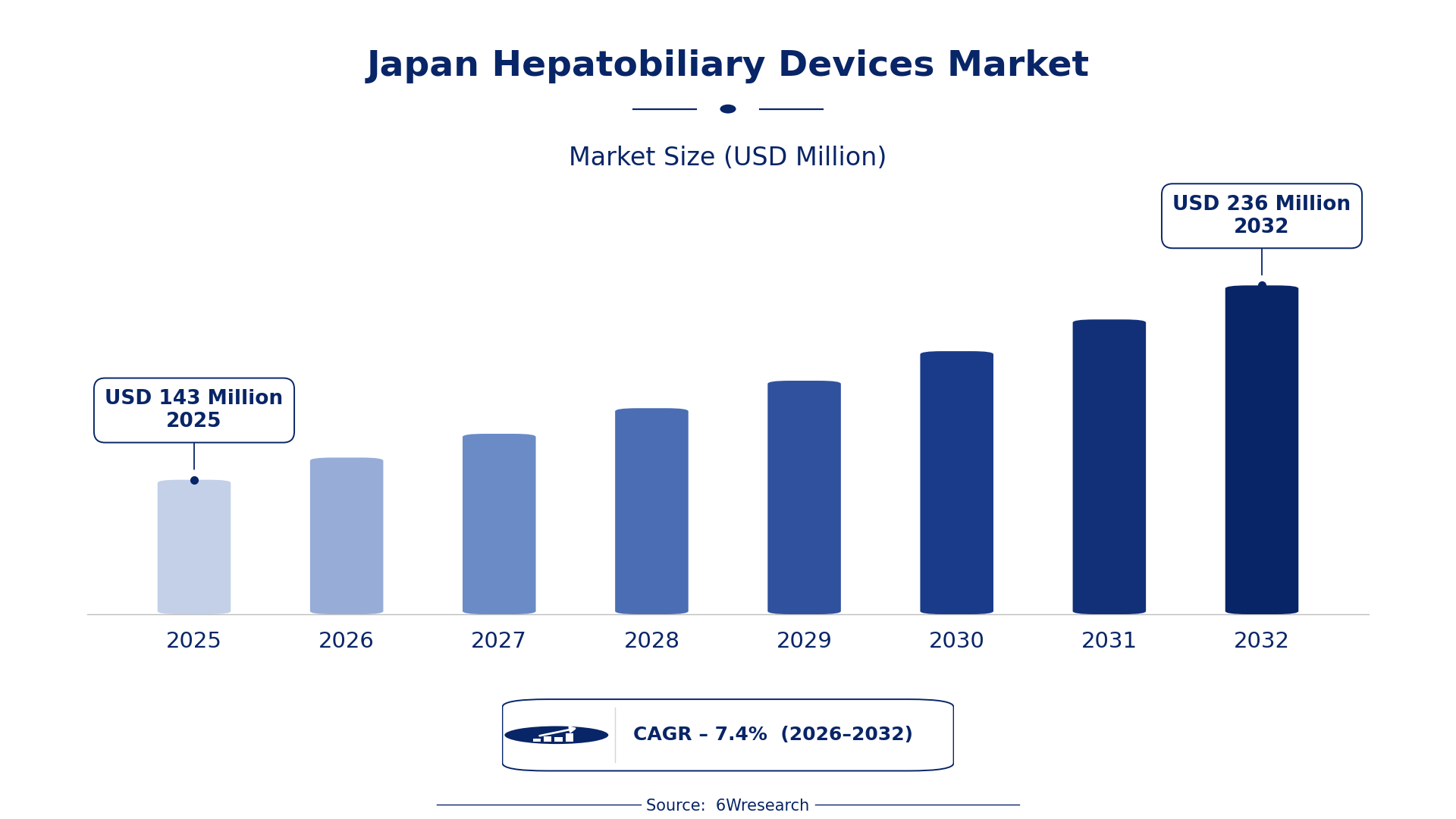
According to 6Wresearch internal database and industry insights, the Japan Hepatobiliary Devices Market was valued at USD 143 Million in 2025 and is projected to reach USD 236 Million by 2032, growing at a CAGR of approximately 7.4% during 2026–2032.
Japan Hepatobiliary Devices Market Highlights
| Report Metric | Details |
| Report Name | Japan Hepatobiliary Devices Market (2026-2032) |
| Market Size 2025 | USD 143 Million |
| Market Size 2032 | USD 236 Million |
| Absolute Growth 2025–2032 | USD 93 Million |
| CAGR 2026–2032 | 7.4% |
| Peak Annual Growth | 8.1% in 2028 |
| Forecast Period | 2026–2032 |
| Historical Data | 2022–2025 |
| Base Year | 2025 |
| Leading Device Type, 2025 | Liver Retractor (42% share) |
| Leading Usage Type, 2025 | Surgical Tool (35% share) |
| Leading Sales Channel, 2025 | Medical Equipment Vendors (46% share) |
| Leading End User, 2025 | Surgery Units (35% share) |
| Fastest-Growing Device Type | Biliary Stent (10.9% CAGR) |
| Fastest-Growing Usage Type | Drainage Support (9.9% CAGR) |
| Fastest-Growing Sales Channel | Hospital Distributors (10.2% CAGR) |
| Fastest-Growing End User | Gastro Clinics (9.6% CAGR) |
| Growing Sector | Gastro Clinics |
| Key End Users | Surgery Units, Gastro Clinics, Hepatobiliary Surgeons, Liver Treatment Centers |
Japan Hepatobiliary Devices Market Year-wise Growth Rate and Key Drivers (2022–2032)
This graph illustrates the annual growth rates of the market from 2022 to 2032, highlighting a steady upward trajectory and projected market expansion over the forecast period.
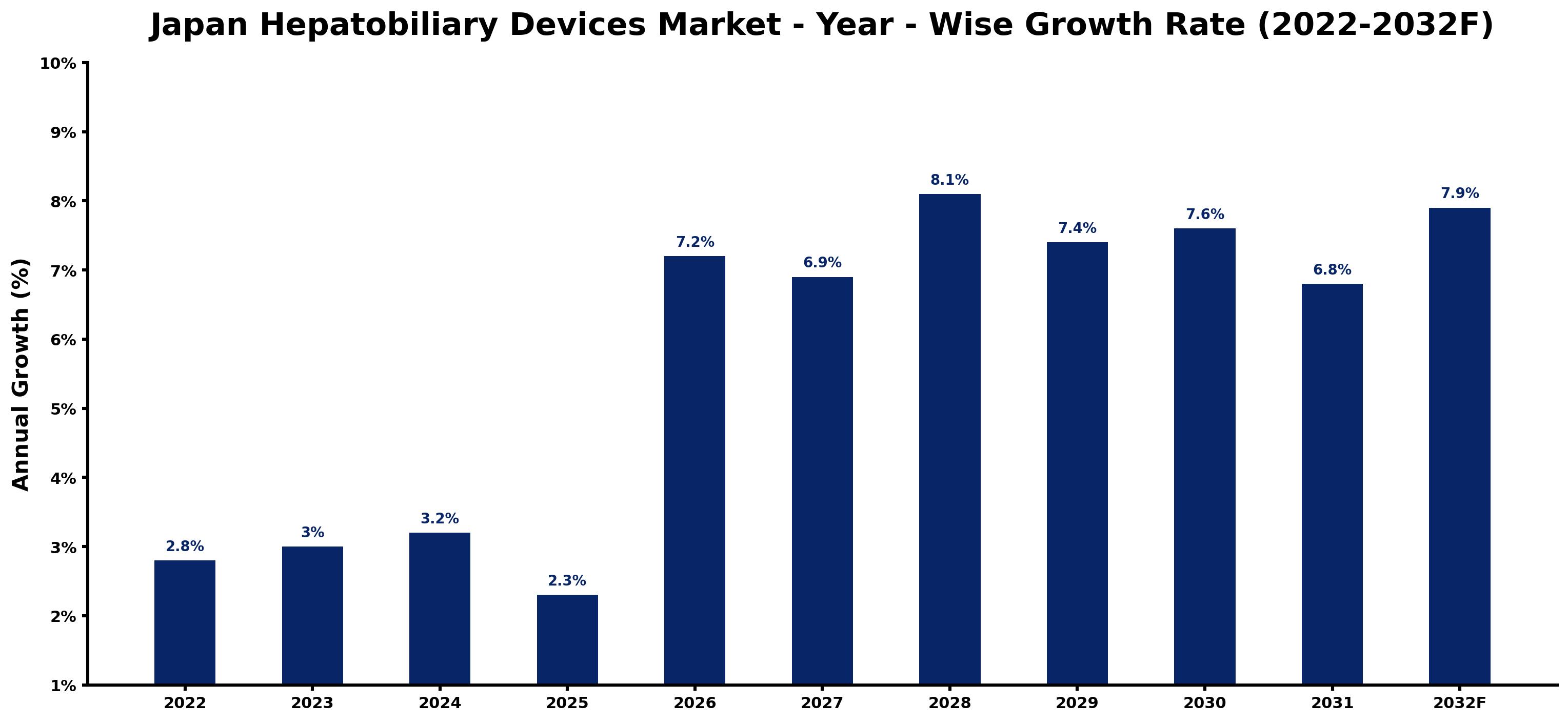
Annual growth estimates for each year appear below with the principal reason behind them, explaining the shifts that set the pace of the market.
| Year | Estimated Annual Growth (%) | Market Rationale |
| 2022 | 2.8 | The market showed steady growth with increasing healthcare expenditures. |
| 2023 | 3.0 | Growth was driven by rising demand for liver surgeries and treatment technologies. |
| 2024 | 3.2 | The market continued to expand as hospitals upgraded their surgical units. |
| 2025 | 2.3 | Growth slowed due to market saturation in certain device categories. |
| 2026 | 7.2 | Demand surged as new technologies for liver disease treatment are anticipated. |
| 2027 | 6.9 | A slight slowdown is projected as the market adjusts to new standards. |
| 2028 | 8.1 | The peak growth year will be driven by investments in medical technology. |
| 2029 | 7.4 | Growth is expected to slow as the market begins to stabilise after rapid expansion. |
| 2030 | 7.6 | Demand will increase again as healthcare providers adopt advanced devices. |
| 2031 | 6.8 | A slowdown is projected as competition intensifies among medical equipment vendors. |
| 2032 | 7.9 | Growth will accelerate due to advancements in surgical techniques and devices. |
Note: Market size estimations and growth projections presented in this report are based on 6Wresearch's proprietary forecasting methodology, utilizing the latest available industry data, government publications, and primary research inputs.
Japan Hepatobiliary Devices Market Synopsis
Hepatobiliary devices are specialized instruments for diagnosing and treating liver and biliary tract conditions, made from biocompatible materials for precision in surgical procedures. The Japan Hepatobiliary Devices Market is growing due to rising healthcare expenditures, with Japan's national medical care expenditure reaching about JPY 46.7 trillion in fiscal 2022. Major buyer groups include hospitals and surgery units, which are investing in advanced technologies for liver treatments, driving demand for these devices. The Tokyo region serves as a significant hub for liver treatment, further supporting market growth.
Market Dynamics Impact Analysis (2026–2032)
| Factor | Type | Impact | Primary Segment Affected |
| Rising healthcare expenditure | Driver | High | Surgical Tool |
| Increasing prevalence of liver diseases | Driver | High | Biliary Stent |
| Growing demand for innovative surgical technologies | Opportunity | High | Lithotripters |
| Expansion of liver treatment centers | Opportunity | Medium | Drainage Catheters |
| Regulatory compliance costs | Restraint | High | Liver Biopsy Needle |
| Market saturation in certain device categories | Restraint | Medium | Surgical Tool |
| High competition among medical equipment vendors | Challenge | High | Biliary Stent |
| Technological advancements requiring continuous investment | Challenge | Medium | Lithotripters |
Evaluation of Drivers in Japan Hepatobiliary Devices Market (2026–2032)
These are the developments adding the most demand over the forecast period.
| Drivers | Primary Segment Affected | Why It Matters (Evidence) |
| Increased healthcare spending | Surgical Tool | Japan's national medical care expenditure reached about JPY 46.7 trillion, boosting purchases by hospitals. |
| Rising liver disease prevalence | Biliary Stent | An estimated 5 million cases of liver diseases in Japan drive demand for effective treatments. |
| Technological advancements in surgery | Lithotripters | Growing adoption of lithotripters in 70% of gallstone removal procedures encourages purchasing by surgical units. |
| Expansion of liver treatment facilities | Drainage Catheters | With over 1,000 hospitals equipped with hepatobiliary surgical units, demand for drainage catheters increases. |
| Regulatory support for medical devices | Liver Biopsy Needle | The PMDA's oversight ensures quality, encouraging hospitals to invest in reliable diagnostic tools. |
Volumes increase alongside rising healthcare expenditures, with Japan's national medical care expenditure reaching about JPY 46.7 trillion in fiscal 2022. The prevalence of liver diseases, estimated at 5 million cases, fuels demand for effective treatments, particularly biliary stents, which are used in over 80% of obstruction cases. The growth of liver treatment facilities, with over 1,000 hospitals equipped with specialized surgical units, boosts the need for drainage catheters. Diagnostic labs conduct over 100,000 liver function tests monthly, reflecting strong demand for effective diagnostic tools.
Evaluation of Restraints in Japan Hepatobiliary Devices Market
These are the pressures that could keep growth below its potential.
| Market Restraint | Primary Segment Affected | Why It Matters (Evidence) |
| High compliance costs burden hospitals | Surgical Tool | Japan's stringent medical device regulations lead to delays in product approvals that can extend up to 12 months, impacting patient access to new technologies. |
| Skills gaps in specialized surgical techniques | Drainage Support | Training programmes at major universities struggle to keep pace with advancements, resulting in longer recovery times for patients. |
| Rising production costs for hepatobiliary devices | Liver Biopsy Needle | The need for biocompatible materials can inflate prices by 15%, placing financial strain on healthcare providers. |
| Supply chain disruptions | Lithotripters | Delays in critical component supply can force hospitals to reschedule surgeries, impacting patient outcomes. |
| Market saturation in certain device categories | Biliary Stent | As the market matures, growth opportunities become limited, affecting overall demand. |
Japan Hepatobiliary Devices Market Challenges
High compliance costs burden hospitals, as Japan's stringent medical device regulations can delay product approvals by up to 12 months, limiting patient access to new technologies. Skills gaps in specialized surgical techniques hinder the effectiveness of hepatobiliary surgeries, with training programmes at major universities unable to keep pace, resulting in longer recovery times for patients. Rising production costs for hepatobiliary devices, driven by the need for biocompatible materials, can inflate prices by 15%, placing financial strain on healthcare providers. Supply chain disruptions for critical components can delay surgeries, forcing hospitals to reschedule procedures and impacting patient outcomes.
Trends in the Japan Hepatobiliary Devices Market
Four trends stand out in the Japan Hepatobiliary Devices Market.
- Shift in Surgical Techniques: Surgery Units are increasingly adopting minimally invasive techniques, reducing recovery times. In 2023, approximately 30,000 liver surgeries were performed in Japan, indicating a shift towards advanced surgical practices.
- Growing Demand for Biliary Stents: In 2022, biliary stents were used in over 80% of biliary obstruction cases, reflecting a rising trend in their application. This shift is apparent in the Tokyo region, a hub for liver treatment.
- Expansion of Liver Treatment Facilities: The number of hospitals equipped with hepatobiliary surgical units is increasing, supporting improved patient access to specialized care. In 2023, there were about 8,100 hospitals in Japan.
- Technological Advancements in Liver Surgery: The introduction of new technologies is transforming liver surgeries. In 2023, a government program aimed to improve liver disease treatment technologies was launched, indicating a focus on innovation.
Investment Opportunities in the Japan Hepatobiliary Devices Market
The opportunities below stand out in the Japan Hepatobiliary Devices Market for new entrants and existing suppliers.
- Partnerships with Hospitals: Local partnerships with hospitals can facilitate entry into the hepatobiliary devices market. With over 1,000 hospitals equipped with surgical units, there is a strong demand for innovative tools.
- Investment in Training Programs: Investment in training programs for hepatobiliary surgeons is essential. With the average age of patients undergoing liver biopsies at 55 years, improving surgical skills can enhance patient outcomes.
- Supply of Biocompatible Materials: There is a growing need for biocompatible materials in device manufacturing. The Japanese government allocated ¥1 billion for liver disease research in 2023, highlighting the investment potential.
- Development of Diagnostic Tools: Developing advanced diagnostic tools is critical for addressing the high prevalence of liver diseases. Diagnostic labs in Japan conduct over 100,000 liver function tests monthly, indicating strong demand.
Government Initiatives in the Japan Hepatobiliary Devices Market
The PMDA oversees the approval and quality of pharmaceuticals and medical devices, ensuring compliance with safety standards. The PMD Act regulates the manufacture and distribution of hepatobiliary devices in Japan, impacting their availability and quality. This oversight is crucial for maintaining high-quality standards in healthcare.
The Japan Agency for Medical Research and Development (AMED) funds medical research and development initiatives. In 2023, AMED allocated resources to support liver disease treatment technologies, driving advancements in the hepatobiliary sector. This funding helps improve the development of medical devices and treatment options.
Future Insight of the Japan Hepatobiliary Devices Market
Investment in liver disease research will reach ¥1 billion in 2023, creating demand for hepatobiliary devices. By 2032, advancements in surgical technology will improve precision in liver surgeries, reducing average hospital stays from 10 days to 7 days. A government programme initiated in 2023 will stimulate demand for new treatment technologies, benefiting suppliers and hospitals. Enhanced training initiatives will elevate surgical skills, improving patient outcomes and efficiency in treatment centres.
Market Segmentation Analysis
Japan Hepatobiliary Devices Market report covers a detailed analysis of the following market segments:
By Device Type – Liver Retractor Leads, Biliary Stent Expected to Grow Fastest
According to Saurav Kr Singh, Senior Research Analyst at 6Wresearch, Liver Retractor accounted for 42% of the market by device type in 2025. The Liver Retractor commands the largest share because it is vital for providing visibility and access during liver surgeries. With around 30,000 liver surgeries performed annually, its necessity in surgical procedures ensures strong demand from healthcare facilities. Over 2026–2032, Biliary Stent is expected to post the fastest growth, at a CAGR of 10.9%. The Biliary Stent is growing rapidly as it is essential for maintaining bile duct patency in over 80% of biliary obstruction cases. The increasing prevalence of liver diseases, estimated at 5 million cases, is a key factor driving its adoption. Suppliers should focus on increasing the availability of biliary stents to meet the rising market demand.
By Usage Type – Surgical Tool Leads, Drainage Support Expected to Grow Fastest
With 35% of usage type revenue in 2025, Surgical Tool was the largest category. Surgical Tools hold the largest share as they are essential for various surgical procedures in hepatobiliary surgery. Their critical role in approximately 30,000 liver surgeries annually underscores their importance in operating rooms across Japan. Drainage Support is projected to grow fastest, at a CAGR of 9.9% during 2026–2032. Drainage Support is witnessing rapid growth due to its vital function in managing bile drainage for patients. With 60% of liver surgery patients requiring drainage support, this segment is set for swift expansion. Suppliers should focus on enhancing the availability of drainage support devices to meet the rising demand.
By Sales Channel – Medical Equipment Vendors Lead, Hospital Distributors Expected to Grow Fastest
In 2025, Medical Equipment Vendors led the sales channel split with a 46% share. Medical Equipment Vendors dominate the market by providing essential tools and devices to healthcare facilities, ensuring a reliable supply of hepatobiliary devices. Their established relationships with over 8,100 hospitals facilitate consistent demand for these products. Hospital Distributors are set to record the highest CAGR in this split, 10.2% over 2026–2032. Hospital Distributors are experiencing the fastest growth as they play a key role in supplying necessary devices directly to hospitals and clinics. Their agility in responding to hospital needs strengthens their market position. Suppliers must strengthen collaborations with hospital distributors to effectively reach healthcare providers.
By End User – Surgery Units Lead, Gastro Clinics Expected to Grow Fastest
Surgery Units took 35% of end user revenue in 2025, more than any other category. Surgery Units are the primary users of hepatobiliary devices, directly involved in surgical settings where these products are indispensable. Their crucial role in performing liver surgeries ensures a steady demand for these devices. The quickest growth will come from Gastro Clinics, forecast to expand at a CAGR of 9.6% between 2026 and 2032. Gastro Clinics are rapidly growing as they increasingly utilise devices for diagnostic and treatment purposes, driven by the rising prevalence of liver diseases. This trend towards outpatient care is likely to accelerate their adoption of hepatobiliary devices. Suppliers should strategically target gastro clinics to leverage the increasing trend of outpatient liver disease management.
Key Attractiveness of the Report
- 10 Years of Market Numbers
- Historical Data Starting from 2022 to 2025
- Base Year 2025
- Forecast Data until 2032
- Key Performance Indicators Impacting the Market
- Major Upcoming Developments and Projects
Key Highlights of the Report:
- Japan Hepatobiliary Devices Market Outlook
- Market Size of Japan Hepatobiliary Devices Market, 2025
- Forecast of Japan Hepatobiliary Devices Market, 2032
- Historical Data and Forecast of Japan Hepatobiliary Devices Revenues & Volume for the Period 2022-2032F
- Japan Hepatobiliary Devices Market Trend Evolution
- Japan Hepatobiliary Devices Market Drivers and Challenges
- Japan Hepatobiliary Devices Price Trends
- Japan Hepatobiliary Devices Porter's Five Forces
- Japan Hepatobiliary Devices Industry Life Cycle
- Historical Data and Forecast of Japan Hepatobiliary Devices Market Revenues & Volume By Device Type for the Period 2022-2032F
- Historical Data and Forecast of Japan Hepatobiliary Devices Market Revenues & Volume By Liver Retractor for the Period 2022-2032F
- Historical Data and Forecast of Japan Hepatobiliary Devices Market Revenues & Volume By Biliary Stent for the Period 2022-2032F
- Historical Data and Forecast of Japan Hepatobiliary Devices Market Revenues & Volume By Lithotripters for the Period 2022-2032F
- Historical Data and Forecast of Japan Hepatobiliary Devices Market Revenues & Volume By Drainage Catheters for the Period 2022-2032F
- Historical Data and Forecast of Japan Hepatobiliary Devices Market Revenues & Volume By Liver Biopsy Needle for the Period 2022-2032F
- Historical Data and Forecast of Japan Hepatobiliary Devices Market Revenues & Volume By Usage Type for the Period 2022-2032F
- Historical Data and Forecast of Japan Hepatobiliary Devices Market Revenues & Volume By Surgical Tool for the Period 2022-2032F
- Historical Data and Forecast of Japan Hepatobiliary Devices Market Revenues & Volume By Drainage Support for the Period 2022-2032F
- Historical Data and Forecast of Japan Hepatobiliary Devices Market Revenues & Volume By Stone Removal for the Period 2022-2032F
- Historical Data and Forecast of Japan Hepatobiliary Devices Market Revenues & Volume By Post-Op Care for the Period 2022-2032F
- Historical Data and Forecast of Japan Hepatobiliary Devices Market Revenues & Volume By Diagnosis for the Period 2022-2032F
- Historical Data and Forecast of Japan Hepatobiliary Devices Market Revenues & Volume By Sales Channel for the Period 2022-2032F
- Historical Data and Forecast of Japan Hepatobiliary Devices Market Revenues & Volume By Medical Equipment Vendors for the Period 2022-2032F
- Historical Data and Forecast of Japan Hepatobiliary Devices Market Revenues & Volume By Hospital Distributors for the Period 2022-2032F
- Historical Data and Forecast of Japan Hepatobiliary Devices Market Revenues & Volume By Online Portals for the Period 2022-2032F
- Historical Data and Forecast of Japan Hepatobiliary Devices Market Revenues & Volume By Direct Sales for the Period 2022-2032F
- Historical Data and Forecast of Japan Hepatobiliary Devices Market Revenues & Volume By Specialty Stores for the Period 2022-2032F
- Historical Data and Forecast of Japan Hepatobiliary Devices Market Revenues & Volume By End User for the Period 2022-2032F
- Historical Data and Forecast of Japan Hepatobiliary Devices Market Revenues & Volume By Surgery Units for the Period 2022-2032F
- Historical Data and Forecast of Japan Hepatobiliary Devices Market Revenues & Volume By Gastro Clinics for the Period 2022-2032F
- Historical Data and Forecast of Japan Hepatobiliary Devices Market Revenues & Volume By Hepatobiliary Surgeons for the Period 2022-2032F
- Historical Data and Forecast of Japan Hepatobiliary Devices Market Revenues & Volume By Liver Treatment Centers for the Period 2022-2032F
- Historical Data and Forecast of Japan Hepatobiliary Devices Market Revenues & Volume By Diagnostic Labs for the Period 2022-2032F
- Japan Hepatobiliary Devices Import Export Trade Statistics
- Market Opportunity Assessment By Device Type
- Market Opportunity Assessment By Usage Type
- Market Opportunity Assessment By Sales Channel
- Market Opportunity Assessment By End User
- Japan Hepatobiliary Devices Top Companies Market Share
- Japan Hepatobiliary Devices Competitive Benchmarking By Technical and Operational Parameters
- Japan Hepatobiliary Devices Company Profiles
- Japan Hepatobiliary Devices Key Strategic Recommendations
Market Covered
This report examines the market across the segments below.
By Device Type
- Liver Retractor
- Biliary Stent
- Lithotripters
- Drainage Catheters
- Liver Biopsy Needle
By Usage Type
- Surgical Tool
- Drainage Support
- Stone Removal
- Post-Op Care
- Diagnosis
By Sales Channel
- Medical Equipment Vendors
- Hospital Distributors
- Online Portals
- Direct Sales
- Specialty Stores
By End User
- Surgery Units
- Gastro Clinics
- Hepatobiliary Surgeons
- Liver Treatment Centers
- Diagnostic Labs































