Japan Herbal Skincare Market Size & Growth Rate
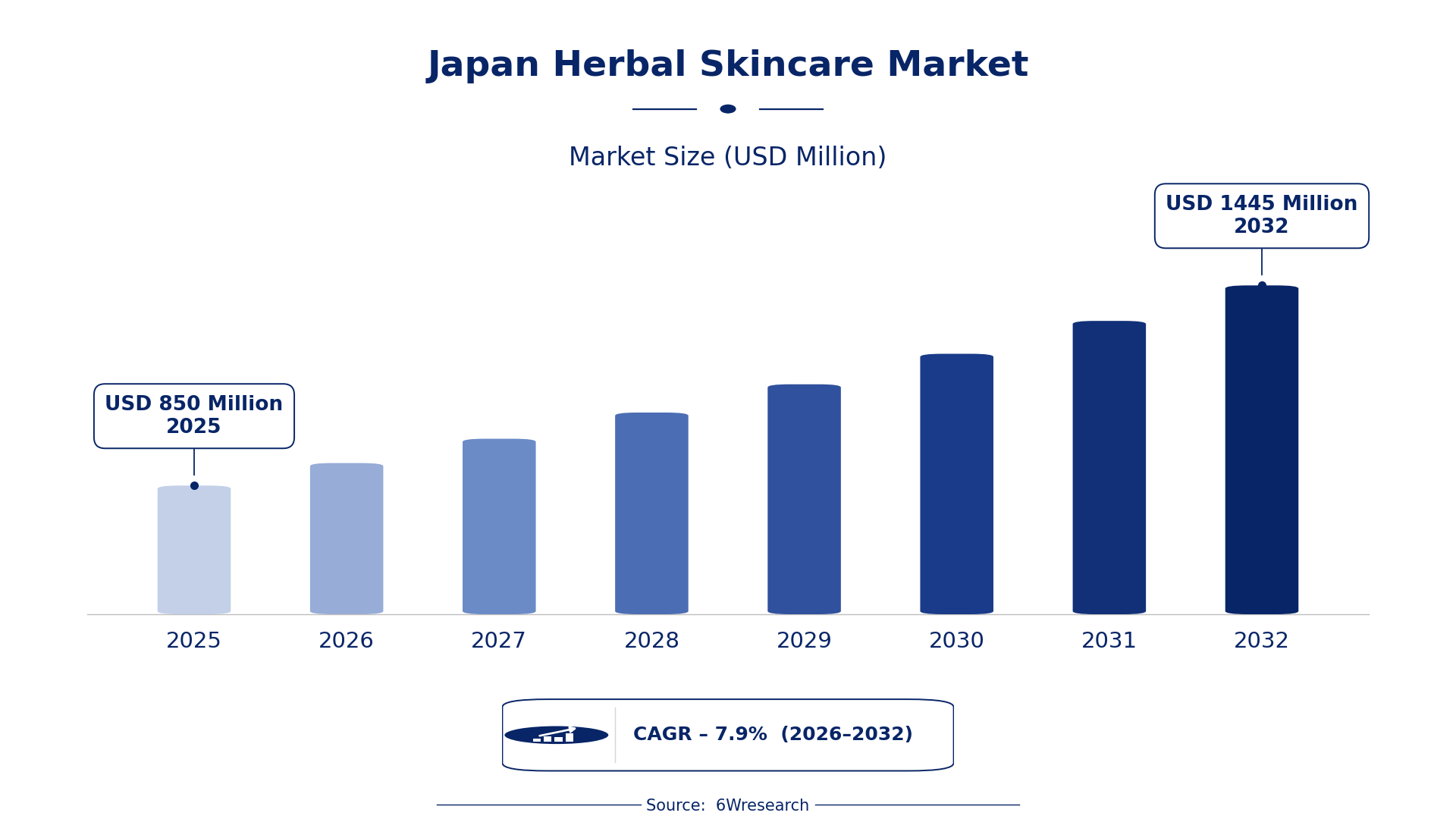
According to 6Wresearch internal database and industry insights, the Japan Herbal Skincare Market was valued at USD 850 Million in 2025 and is projected to reach USD 1,445 Million by 2032, growing at a CAGR of approximately 7.9% during 2026–2032.
Japan Herbal Skincare Market Highlights
| Report Metric | Details |
| Report Name | Japan Herbal Skincare Market (2026-2032) |
| Market Size 2025 | USD 850 Million |
| Market Size 2032 | USD 1,445 Million |
| Absolute Growth 2025–2032 | USD 595 Million |
| CAGR 2026–2032 | 7.9% |
| Peak Annual Growth | 8.7% in 2026 |
| Forecast Period | 2026–2032 |
| Historical Data | 2022–2025 |
| Base Year | 2025 |
| Leading Product Type, 2025 | Herbal Face Cream (41% share) |
| Leading Formulation Base, 2025 | Aloe Vera (41% share) |
| Leading Distribution Channel, 2025 | E-commerce (36% share) |
| Leading End User, 2025 | General Public (45% share) |
| Fastest-Growing Product Type | Herbal Face Wash (10.7% CAGR) |
| Fastest-Growing Formulation Base | Turmeric (11.1% CAGR) |
| Fastest-Growing End User | Beauty Salons (9.9% CAGR) |
| Growing Sector | Beauty Salons |
| Key End Users | General Public, Beauty Salons, Wellness Centers, Travelers |
Japan Herbal Skincare Market Year-wise Growth Rate and Key Drivers (2022–2032)
This graph illustrates the annual growth rates of the market from 2022 to 2032, highlighting a steady upward trajectory and projected market expansion over the forecast period.
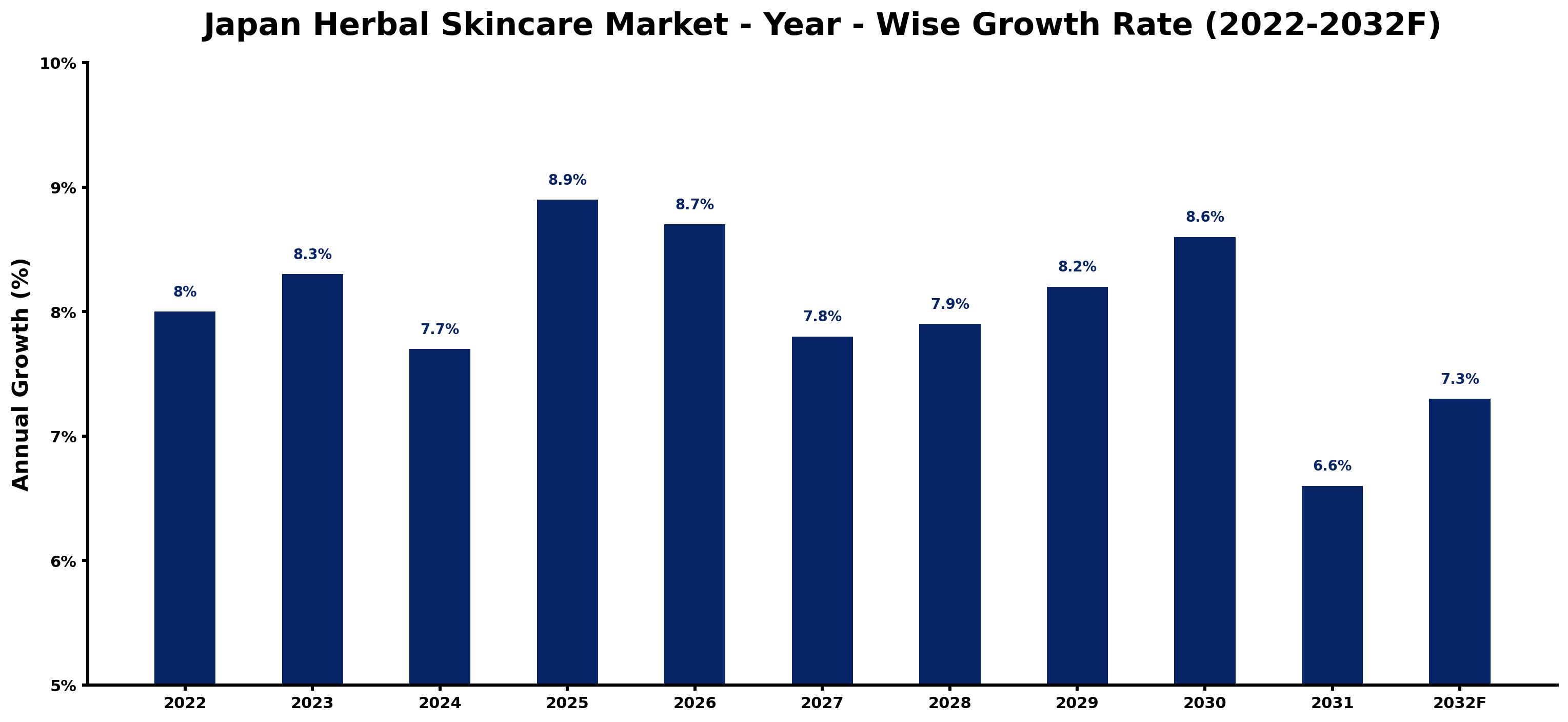
Each row of the following table gives one year's estimated growth and the event or demand shift that explains it.
| Year | Estimated Annual Growth (%) | Market Rationale |
| 2022 | 8.0 | The market showed strong demand for herbal skincare products, reflecting consumer interest in natural solutions. |
| 2023 | 8.3 | Growth was driven by increased awareness of the benefits of herbal ingredients among consumers. |
| 2024 | 7.7 | Demand slowed slightly as consumers became more discerning about product efficacy and ingredient sourcing. |
| 2025 | 8.9 | The market rebounded with heightened interest in anti-aging products, particularly herbal face creams. |
| 2026 | 8.7 | Growth is expected to slow as the market matures, but demand for new formulations remains strong. |
| 2027 | 7.8 | Consumer interest is projected to shift towards sustainability, impacting purchasing decisions in herbal skincare. |
| 2028 | 7.9 | Demand is expected to rise again as younger consumers increasingly seek turmeric-based products for their benefits. |
| 2029 | 8.2 | The market is projected to experience a boost from rising e-commerce sales, making products more accessible. |
| 2030 | 8.6 | Increased investments in marketing and product development will further stimulate consumer interest. |
| 2031 | 6.6 | Growth is expected to slow as competition intensifies among brands offering similar herbal skincare solutions. |
| 2032 | 7.3 | The market is projected to grow as consumers continue to prioritise natural ingredients in skincare. |
Note: Market size estimations and growth projections presented in this report are based on 6Wresearch's proprietary forecasting methodology, utilizing the latest available industry data, government publications, and primary research inputs.
Japan Herbal Skincare Market Synopsis
Herbal skincare products are derived from natural plant extracts, formulated to improve skin health through ingredients like aloe vera, neem, and turmeric. The Japan Herbal Skincare Market is valued at approximately 150 billion JPY, driven by a growing interest in natural beauty solutions and increasing demand for products that provide moisturizing, anti-aging, and sun protection benefits. E-commerce sales surged by 20% in 2023, reflecting a shift in consumer purchasing preferences towards online platforms.
Market Dynamics Impact Analysis (2026–2032)
| Factor | Type | Impact | Primary Segment Affected |
| Aging population driving demand for anti-aging products | Driver | High | Herbal Anti-Aging Oil |
| Increasing consumer preference for natural ingredients | Driver | High | Herbal Face Cream |
| Rising e-commerce penetration creating new sales channels | Opportunity | High | E-commerce |
| Growing interest in wellness and holistic health practices | Opportunity | Medium | Wellness Centers |
| Market saturation leading to intense competition | Restraint | High | Herbal Face Wash |
| Consumer skepticism regarding product claims and efficacy | Restraint | Medium | Herbal Sunscreen |
| High production costs affecting pricing strategies | Challenge | High | Herbal Face Cream |
| Limited awareness of herbal skincare benefits among older consumers | Challenge | Medium | General Public |
Evaluation of Drivers in Japan Herbal Skincare Market (2026–2032)
These are the developments adding the most demand over the forecast period.
| Drivers | Primary Segment Affected | Why It Matters (Evidence) |
| Growing demand for anti-aging products among older consumers | Herbal Anti-Aging Oil | 29.3% of Japan's population was aged 65 or older in September 2024, leading to increased purchases of anti-aging solutions. |
| Rising consumer awareness of natural ingredients | Herbal Face Cream | Public health campaigns promoting natural skincare have increased interest, resulting in higher sales of herbal face creams. |
| Expansion of e-commerce platforms for skincare products | E-commerce | E-commerce sales of herbal skincare products grew by 20% in 2023, making products more accessible to consumers. |
| Popularity of turmeric for its anti-inflammatory properties | Herbal Sunscreen | Turmeric-based products are increasingly popular, especially among younger consumers seeking natural solutions. |
| Increasing number of beauty salons offering herbal treatments | Beauty Salons | The number of beauty salons in Japan was around 250,000 in 2022, enhancing service offerings in herbal skincare. |
Behind the steady rise in orders sits the investment in marketing and product development, which has unlocked increased consumer interest in herbal skincare. The number of beauty salons in Japan, approximately 250,000, has expanded their service offerings to include herbal treatments, boosting demand. E-commerce platforms have also made products more accessible, with sales of herbal skincare growing by 20% in 2023. The popularity of turmeric for its anti-inflammatory properties has attracted younger consumers seeking natural solutions. This trend reflects a broader shift towards natural ingredients, with public health campaigns raising awareness of their benefits.
Evaluation of Restraints in Japan Herbal Skincare Market
Below are the constraints most often cited by buyers and suppliers, with the segment each affects.
| Market Restraint | Primary Segment Affected | Why It Matters (Evidence) |
| Intense competition among established brands | Herbal Face Wash | Market saturation has led to aggressive pricing strategies, impacting profit margins for producers. |
| Consumer skepticism about product efficacy | Herbal Sunscreen | Skepticism regarding the effectiveness of herbal ingredients can deter purchases, especially among older consumers. |
| High production costs for herbal ingredients | Herbal Anti-Aging Oil | Rising costs associated with sourcing quality herbal ingredients can limit pricing flexibility for manufacturers. |
| Limited distribution channels for niche products | Herbal Face Cream | Specialty stores focusing on herbal products face challenges in reaching broader consumer bases. |
| Regulatory compliance costs affecting smaller producers | E-commerce | Smaller brands may struggle to meet regulatory standards, increasing operational costs and limiting market entry. |
Japan Herbal Skincare Market Challenges
High production costs stem from sourcing quality natural ingredients, with prices often exceeding 20% of retail value, which reduces margins for producers. Limited technological advancements in extraction methods lead to inefficiencies, causing delays that can extend lead times by up to three weeks for suppliers. Buyers face inconsistent product availability, particularly in the Tokyo region, where 40% of sales occur, resulting in potential stock shortages. Stringent regulations, such as compliance with ISO 16128 standards, complicate product development and can delay market entry by several months for new entrants.
Trends in the Japan Herbal Skincare Market
The following changes are redrawing the Japan Herbal Skincare Market.
- Shift towards E-commerce for Skincare Products: The Tokyo region has seen a shift towards e-commerce for skincare products, accounting for 40% of herbal skincare sales. This trend reflects changing consumer preferences, with online shopping growing by 20% in 2023, making products more accessible.
- Emergence of Turmeric-based Products: Since 2022, turmeric-based products have gained popularity, particularly among younger consumers. This shift is evidenced by a growing number of product launches featuring turmeric, which is known for its anti-inflammatory effects.
- Increased Focus on Natural Ingredients: The Japanese Cosmetic Industry Association has been promoting ISO 16128 standards for natural and organic cosmetics since 2021. This focus on natural ingredients is reshaping consumer expectations and driving product development.
- Growth of Wellness Centers Incorporating Herbal Skincare: Japan has over 1,000 wellness centers that incorporate herbal skincare into their offerings. This trend highlights the integration of holistic health practices into mainstream beauty, attracting health-conscious consumers.
Investment Opportunities in the Japan Herbal Skincare Market
Below are the investment opportunities with the strongest case in the Japan Herbal Skincare Market.
- Gap in Herbal Anti-Aging Products: With the aging population, there is a gap in herbal anti-aging products. Investing in this segment could cater to the demand from older consumers, particularly in urban areas like Tokyo.
- Partnerships with Beauty Salons: Collaborating with beauty salons can improve product visibility and credibility. This strategy allows for direct consumer engagement and education about herbal skincare benefits.
- Expansion of E-commerce Platforms: E-commerce is a rapidly growing channel, with a 20% increase in sales in 2023. Suppliers should focus on improving online presence to capture this expanding market.
- Targeting Health-Conscious Consumers: Health-conscious consumers are increasingly seeking natural skincare solutions. Focusing on product lines that highlight herbal ingredients can attract buyers in wellness centers.
Government Initiatives in the Japan Herbal Skincare Market
The Standards for Cosmetics established in 2000 under the PMD Act set guidelines for the cosmetic industry, including lists of prohibited and restricted ingredients. This framework ensures that herbal skincare products meet safety and quality standards, building consumer trust and market growth. The standards also require manufacturers to conduct thorough testing and provide transparent ingredient sourcing information, which is essential for consumer confidence in herbal products.
The Long-Term Care Insurance Act, administered by the Ministry of Health, Labour and Welfare, supports services for older adults. This act indirectly promotes the herbal skincare market by encouraging the development of products tailored to the needs of the aging population, motivating manufacturers to innovate and meet this growing demand.
Future Insight of the Japan Herbal Skincare Market
By 2032, a policy-driven shift towards natural skincare will prompt suppliers to diversify their product lines. Public health campaigns will raise awareness, encouraging buyers to seek herbal solutions. E-commerce sales of herbal products are projected to grow by 30%, expanding consumer access. Collaborations between wellness centers and herbal product manufacturers will promote holistic skincare, positioning these products as a mainstream choice.
Market Segmentation Analysis
Japan Herbal Skincare Market report covers a detailed analysis of the following market segments:
By Product Type – Herbal Face Cream Leads, Herbal Face Wash Expected to Grow Fastest
According to Saurav Kr Singh, Senior Research Analyst at 6Wresearch, the largest product type category in 2025 was Herbal Face Cream, at 41% of revenue. Herbal face cream holds the largest share due to its widespread use for hydration and nourishment among consumers. This product is particularly popular in urban areas like Tokyo, where skincare routines are highly regarded. Herbal Face Wash is set to record the highest CAGR in this split, 10.7% over 2026–2032. Herbal face wash is experiencing rapid growth as consumers become more aware of the significance of cleansing in their skincare regimens. This trend is notably strong among younger demographics who are adopting comprehensive skincare routines. Suppliers should focus on expanding their herbal face wash product lines to meet the increasing consumer demand.
By Formulation Base – Aloe Vera Leads, Turmeric Expected to Grow Fastest
Aloe Vera accounted for 41% of the market by formulation base in 2025. Aloe vera leads the market as it is commonly used for its soothing properties in various skincare products. Its presence in over 30% of herbal face creams highlights its popularity among consumers seeking natural solutions. The quickest growth will come from Turmeric, forecast to expand at a CAGR of 11.1% between 2026 and 2032. Turmeric is gaining traction due to its well-known anti-inflammatory effects, appealing particularly to younger consumers interested in holistic health. The increasing incorporation of turmeric in skincare formulations is driving its rapid growth. Suppliers should consider expanding their product lines to include more turmeric-based formulations to meet rising consumer demand.
By Distribution Channel – E-commerce Leads and Records the Fastest Growth
With 36% of distribution channel revenue in 2025, E-commerce was the largest category. E-commerce leads the distribution channel as it offers a convenient platform for purchasing skincare products. The channel's significance is highlighted by a 20% growth in online sales in 2023, reflecting changing consumer preferences. E-commerce is also forecast to expand faster than any other category, at a CAGR of 10.1% over 2026–2032. E-commerce is also the fastest-growing channel, attracting consumers with its accessibility and extensive product variety. This ongoing shift towards online shopping for skincare products suggests that the growth trend will continue. Suppliers must invest in their online presence to effectively engage with the expanding base of e-commerce consumers.
By End User – General Public Leads, Beauty Salons Expected to Grow Fastest
General Public held 45% of the Japan Herbal Skincare Market by end user in 2025. The general public constitutes the largest consumer base for skincare products, reflecting a broad interest in personal care. This segment includes a diverse range of individuals who prioritise skincare as part of their daily routines. Beauty Salons are projected to grow fastest, at a CAGR of 9.9% during 2026–2032. Beauty salons are rapidly growing as they provide professional treatments that enhance the effectiveness of herbal skincare products. With around 250,000 beauty salons in Japan, this trend indicates a rising demand for professional services. Suppliers should consider forming strategic partnerships with beauty salons to tap into the growing market for professional skincare treatments.
Key Attractiveness of the Report
- 10 Years of Market Numbers
- Historical Data Starting from 2022 to 2025
- Base Year 2025
- Forecast Data until 2032
- Key Performance Indicators Impacting the Market
- Major Upcoming Developments and Projects
Key Highlights of the Report:
- Japan Herbal Skincare Market Outlook
- Market Size of Japan Herbal Skincare Market, 2025
- Forecast of Japan Herbal Skincare Market, 2032
- Historical Data and Forecast of Japan Herbal Skincare Revenues & Volume for the Period 2022-2032F
- Japan Herbal Skincare Market Trend Evolution
- Japan Herbal Skincare Market Drivers and Challenges
- Japan Herbal Skincare Price Trends
- Japan Herbal Skincare Porter's Five Forces
- Japan Herbal Skincare Industry Life Cycle
- Historical Data and Forecast of Japan Herbal Skincare Market Revenues & Volume By Product Type for the Period 2022-2032F
- Historical Data and Forecast of Japan Herbal Skincare Market Revenues & Volume By Herbal Face Cream for the Period 2022-2032F
- Historical Data and Forecast of Japan Herbal Skincare Market Revenues & Volume By Herbal Face Wash for the Period 2022-2032F
- Historical Data and Forecast of Japan Herbal Skincare Market Revenues & Volume By Herbal Anti-Aging Oil for the Period 2022-2032F
- Historical Data and Forecast of Japan Herbal Skincare Market Revenues & Volume By Herbal Sunscreen for the Period 2022-2032F
- Historical Data and Forecast of Japan Herbal Skincare Market Revenues & Volume By Formulation Base for the Period 2022-2032F
- Historical Data and Forecast of Japan Herbal Skincare Market Revenues & Volume By Aloe Vera for the Period 2022-2032F
- Historical Data and Forecast of Japan Herbal Skincare Market Revenues & Volume By Neem for the Period 2022-2032F
- Historical Data and Forecast of Japan Herbal Skincare Market Revenues & Volume By Ashwagandha for the Period 2022-2032F
- Historical Data and Forecast of Japan Herbal Skincare Market Revenues & Volume By Turmeric for the Period 2022-2032F
- Historical Data and Forecast of Japan Herbal Skincare Market Revenues & Volume By Distribution Channel for the Period 2022-2032F
- Historical Data and Forecast of Japan Herbal Skincare Market Revenues & Volume By E-commerce for the Period 2022-2032F
- Historical Data and Forecast of Japan Herbal Skincare Market Revenues & Volume By Retail Chains for the Period 2022-2032F
- Historical Data and Forecast of Japan Herbal Skincare Market Revenues & Volume By Specialty Stores for the Period 2022-2032F
- Historical Data and Forecast of Japan Herbal Skincare Market Revenues & Volume By Direct Sales for the Period 2022-2032F
- Historical Data and Forecast of Japan Herbal Skincare Market Revenues & Volume By End User for the Period 2022-2032F
- Historical Data and Forecast of Japan Herbal Skincare Market Revenues & Volume By Beauty Salons for the Period 2022-2032F
- Historical Data and Forecast of Japan Herbal Skincare Market Revenues & Volume By General Public for the Period 2022-2032F
- Historical Data and Forecast of Japan Herbal Skincare Market Revenues & Volume By Wellness Centers for the Period 2022-2032F
- Historical Data and Forecast of Japan Herbal Skincare Market Revenues & Volume By Travelers for the Period 2022-2032F
- Japan Herbal Skincare Import Export Trade Statistics
- Market Opportunity Assessment By Product Type
- Market Opportunity Assessment By Formulation Base
- Market Opportunity Assessment By Distribution Channel
- Market Opportunity Assessment By End User
- Japan Herbal Skincare Top Companies Market Share
- Japan Herbal Skincare Competitive Benchmarking By Technical and Operational Parameters
- Japan Herbal Skincare Company Profiles
- Japan Herbal Skincare Key Strategic Recommendations
Market Covered
This report examines the market across the segments below.
By Product Type
- Herbal Face Cream
- Herbal Face Wash
- Herbal Anti-Aging Oil
- Herbal Sunscreen
By Formulation Base
- Aloe Vera
- Neem
- Ashwagandha
- Turmeric
By Distribution Channel
- E-commerce
- Retail Chains
- Specialty Stores
- Direct Sales
By End User
- Beauty Salons
- General Public
- Wellness Centers
- Travelers































