Japan Herbicide Activators Market Size & Growth Rate
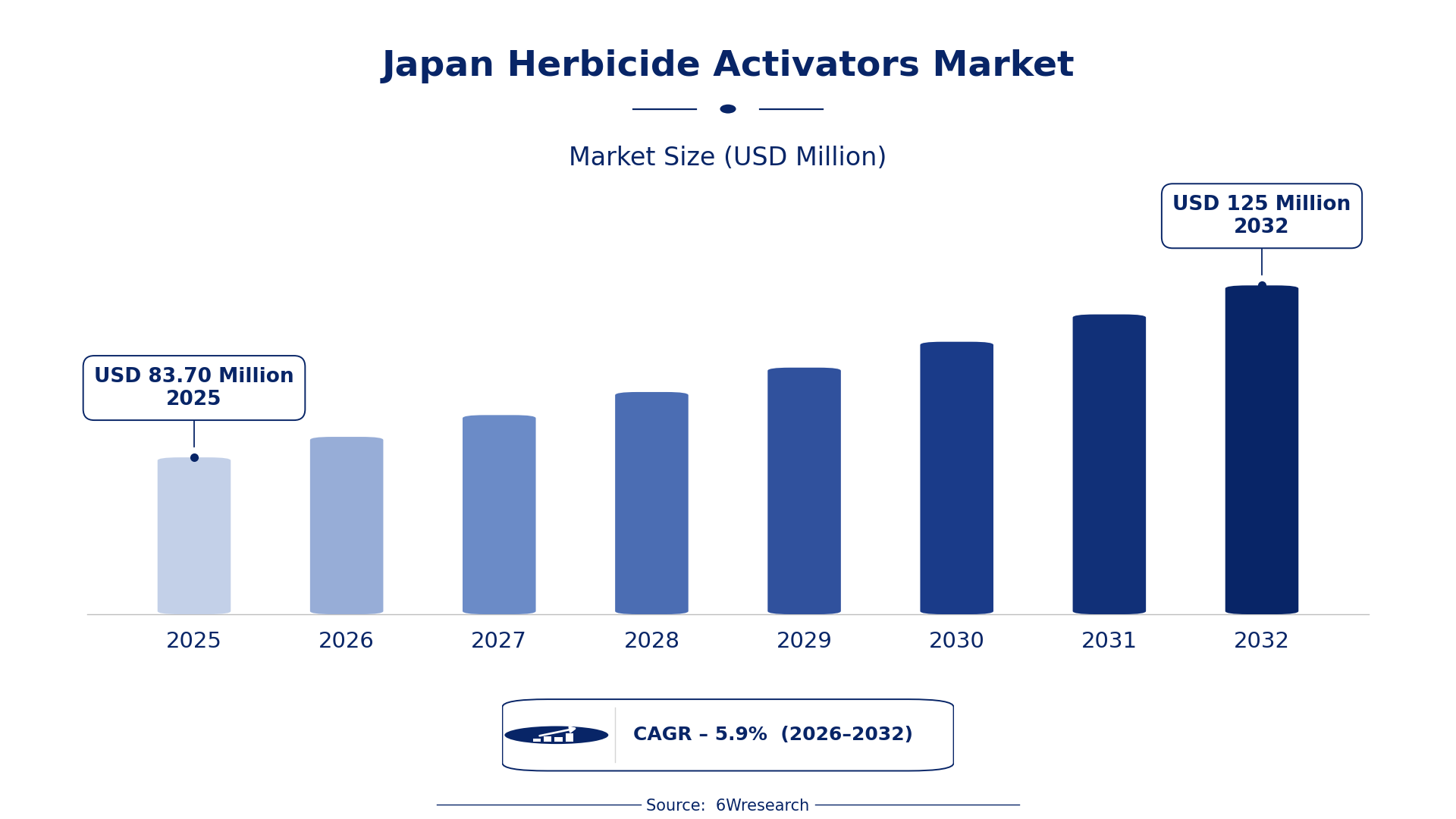
According to 6Wresearch internal database and industry insights, the Japan Herbicide Activators Market was valued at USD 83.70 Million in 2025 and is projected to reach USD 125 Million by 2032, growing at a CAGR of approximately 5.9% during 2026–2032.
Japan Herbicide Activators Market Highlights
| Report Metric | Details |
| Report Name | Japan Herbicide Activators Market (2026-2032) |
| Market Size 2025 | USD 83.70 Million |
| Market Size 2032 | USD 125 Million |
| Absolute Growth 2025–2032 | USD 41.30 Million |
| CAGR 2026–2032 | 5.9% |
| Peak Annual Growth | 7.3% in 2026 |
| Forecast Period | 2026–2032 |
| Historical Data | 2022–2025 |
| Base Year | 2025 |
| Leading Product Type, 2025 | Non-Ionic Surfactants (35% share) |
| Leading Chemical Class, 2025 | Alcohol Ethoxylates (46% share) |
| Leading Distribution Channel, 2025 | Agrochemical Suppliers (38% share) |
| Leading End User, 2025 | Farmers (44% share) |
| Fastest-Growing Product Type | Oil-Based Adjuvants (7.9% CAGR) |
| Fastest-Growing Chemical Class | Methylated Seed Oil (7.3% CAGR) |
| Fastest-Growing Distribution Channel | Direct Sales (7.5% CAGR) |
| Fastest-Growing End User | Agriculture Firms (7.4% CAGR) |
| Growing Sector | Agricultural sector |
| Key End Users | Farmers, Agriculture Firms, Crop Growers |
Japan Herbicide Activators Market Year-wise Growth Rate and Key Drivers (2022–2032)
This graph illustrates the annual growth rates of the market from 2022 to 2032, highlighting a steady upward trajectory and projected market expansion over the forecast period.
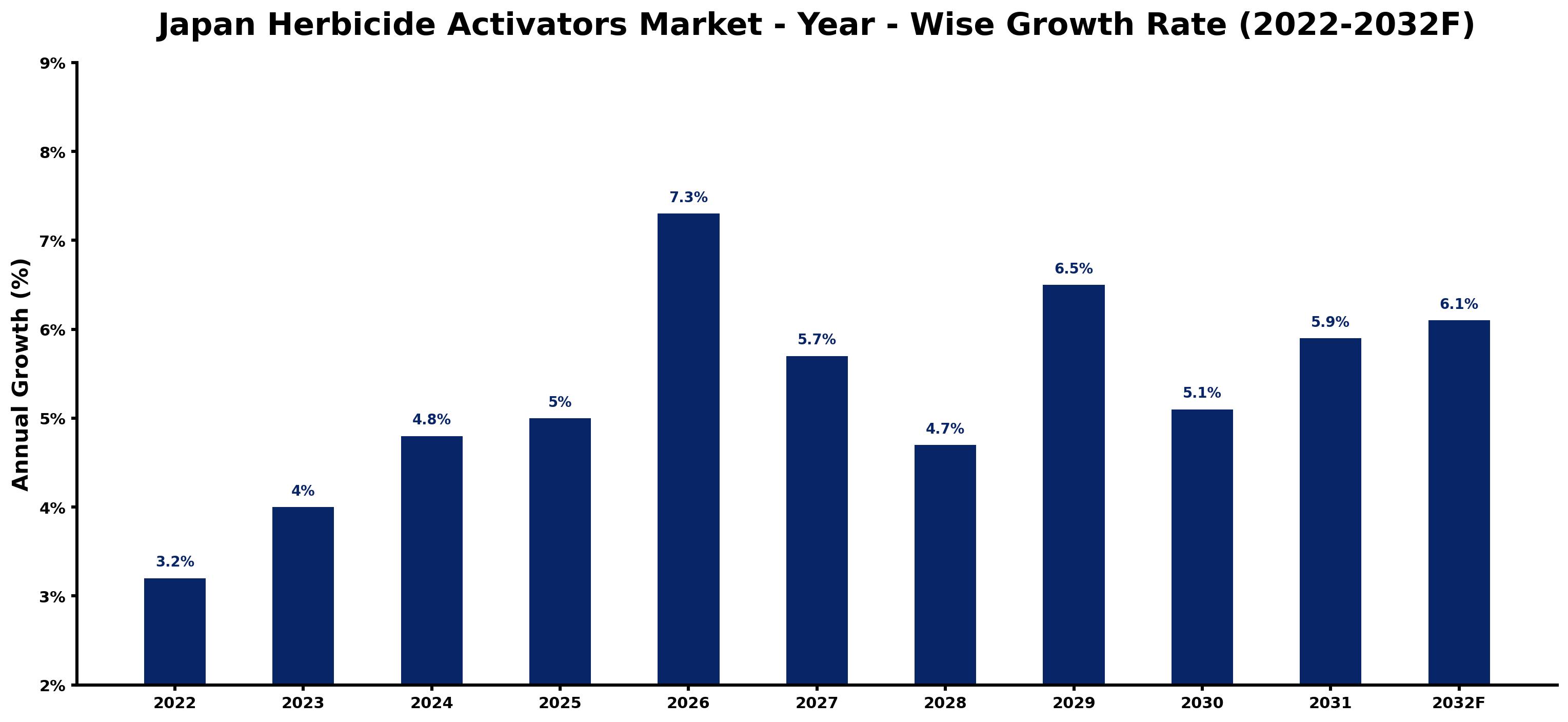
The yearly estimates that follow link every growth rate to its principal driver, so readers can see why the pace changed in each period.
| Year | Estimated Annual Growth (%) | Market Rationale |
| 2022 | 3.2 | The market experienced steady growth due to consistent agricultural practices. |
| 2023 | 4.0 | Demand increased as farmers sought effective weed management solutions. |
| 2024 | 4.8 | The adoption of herbicide activators rose with improved crop yields reported. |
| 2025 | 5.0 | Growth was driven by heightened awareness of herbicide effectiveness. |
| 2026 | 7.3 | The peak growth year is expected to reflect strong investments in agricultural technology. |
| 2027 | 5.7 | Growth is projected to slow as market saturation begins to influence purchasing decisions. |
| 2028 | 4.7 | Demand will continue to rise, albeit at a slower pace than previous years. |
| 2029 | 6.5 | A resurgence in growth is anticipated as new formulations gain popularity. |
| 2030 | 5.1 | Growth is expected to slow again as farmers face challenges in adopting new products. |
| 2031 | 5.9 | Demand will increase due to rising interest in sustainable farming practices. |
| 2032 | 6.1 | The market is projected to grow steadily as younger farmers adopt new technologies. |
Note: Market size estimations and growth projections presented in this report are based on 6Wresearch's proprietary forecasting methodology, utilizing the latest available industry data, government publications, and primary research inputs.
Japan Herbicide Activators Market Synopsis
Herbicide activators are chemical agents that improve the absorption and efficacy of herbicides, primarily made from surfactants and oils. The Japan Herbicide Activators Market is expanding, driven by over 4 million hectares of arable land and increasing agricultural activity. Key factors include the government's push for sustainable practices and the rising adoption of these products among younger farmers, which improves weed control effectiveness.
Market Dynamics Impact Analysis (2026–2032)
| Factor | Type | Impact | Primary Segment Affected |
| Increasing adoption of herbicide activators among younger farmers | Driver | High | Non-Ionic Surfactants |
| Rising demand for effective weed management solutions | Driver | High | Oil-Based Adjuvants |
| Growing interest in sustainable agricultural practices | Opportunity | High | Methylated Seed Oil |
| Expansion of e-commerce for agricultural products | Opportunity | Medium | Direct Sales |
| Aging farmer population affecting product adoption rates | Restraint | High | Farmers |
| Regulatory challenges in product approval processes | Restraint | Medium | Agrochemical Suppliers |
| High costs associated with sustainable farming practices | Challenge | High | Agriculture Firms |
| Limited awareness of new herbicide activator formulations | Challenge | Medium | Crop Growers |
Evaluation of Drivers in Japan Herbicide Activators Market (2026–2032)
These are the developments adding the most demand over the forecast period.
| Drivers | Primary Segment Affected | Why It Matters (Evidence) |
| Increased crop yields reported by farmers | Methylated Seed Oil | This oil is widely used in rice cultivation, improving herbicide performance and leading to higher demand among farmers. |
| Rising awareness of effective weed management | Non-Ionic Surfactants | These surfactants account for approximately 40% of the market, prompting farmers to seek better solutions. |
| Government initiatives promoting sustainable practices | Oil-Based Adjuvants | The Japanese government encourages the use of these adjuvants to reduce pesticide reliance, boosting sales. |
| Expansion of agricultural e-commerce platforms | Direct Sales | E-commerce sales of agricultural products increased by 15%, allowing farmers easier access to herbicide activators. |
| Growing interest in organic farming methods | Alcohol Ethoxylates | These surfactants are often used in organic formulations, appealing to environmentally conscious farmers. |
What keeps demand rising is the increasing adoption of herbicide activators among younger farmers, who prefer effective solutions. Approximately 40% of the market is driven by non-ionic surfactants, valued for their effectiveness. E-commerce sales of agricultural products surged by 15%, giving farmers easier access to these essential tools. The rising interest in organic farming methods also boosts the use of alcohol ethoxylates, frequently incorporated into formulations.
Evaluation of Restraints in Japan Herbicide Activators Market
The following restraints limit how fast demand can grow.
| Market Restraint | Primary Segment Affected | Why It Matters (Evidence) |
| Aging farmer population affecting product adoption rates | Farmers | With an average age of 67, older farmers may be reluctant to adopt new technologies, slowing market growth. |
| Regulatory challenges in product approval processes | Agrochemical Suppliers | Compliance with agricultural chemical regulations can delay product availability, impacting sales. |
| High costs associated with sustainable farming practices | Agriculture Firms | Investing in environmentally friendly practices can strain budgets, limiting the use of herbicide activators. |
| Limited awareness of new herbicide activator formulations | Crop Growers | Without sufficient education on new products, growers may hesitate to switch from traditional methods. |
| Market saturation leading to slower growth rates | Direct Sales | As more products enter the market, competition increases, making it harder for new entries to gain traction. |
Japan Herbicide Activators Market Challenges
Regulatory complexities slow the approval process for new herbicide activators, causing delays of up to six months for suppliers. Domestic competition drives prices down, which can threaten smaller producers and lead to reduced market diversity. Rising raw material costs can increase production expenses by 15% for manufacturers, ultimately pushing prices higher for buyers. Limited adoption of advanced formulation technologies restricts efficiency, delaying product availability and reducing effectiveness in weed control for farmers.
Trends in the Japan Herbicide Activators Market
These developments are changing demand patterns in the Japan Herbicide Activators Market.
- Shift towards Sustainable Agriculture Practices: A government initiative in 2023 aims for a 30% reduction in pesticide use by 2030, promoting herbicide activators and increasing demand for eco-friendly products.
- Increase in E-commerce for Agricultural Products: E-commerce sales of agricultural products have risen by 15% in the past year, allowing farmers to access herbicide activators more conveniently, reshaping agricultural input purchasing.
- Growing Popularity of Organic Herbicide Formulations: Since 2022, there has been a noticeable shift towards organic herbicide formulations, with lecithin being used in niche applications, reflecting consumer demand for environmentally friendly farming solutions.
- Expansion of Direct Sales Channels: The direct sales channel is projected to grow at a CAGR of 7.5% from 2026 to 2032, driven by the need for farmers to access herbicide activators directly, strengthening supplier relationships.
Investment Opportunities in the Japan Herbicide Activators Market
Investors looking at the Japan Herbicide Activators Market should consider the following areas.
- Supply of Eco-Friendly Herbicide Activators: With the government targeting a 30% reduction in pesticide use by 2030, there is a growing demand for eco-friendly herbicide activators. Agriculture firms are increasingly looking for sustainable solutions, presenting an opportunity for suppliers.
- Investment in E-commerce Platforms: The rise in e-commerce sales, which increased by 15% last year, highlights a gap in direct access to herbicide activators. Suppliers can invest in online platforms to reach farmers more effectively.
- Development of Organic Formulations: The growing interest in organic farming presents an opportunity. Suppliers can focus on developing organic herbicide activators to cater to the needs of environmentally conscious farmers.
- Expansion into the Kanto Region: The Kanto region is a major agricultural hub where herbicide activators are heavily utilized. Suppliers can establish partnerships with local agriculture firms to enhance distribution.
Government Initiatives in the Japan Herbicide Activators Market
The Waste Management and Public Cleansing Act regulates the treatment and disposal of industrial and municipal waste, ensuring that producers adhere to safety standards. This law mandates testing and certification of products before they can be marketed, providing assurance to buyers about product efficacy and safety. The PRTR Law requires businesses to report their use of specific chemical substances, enhancing transparency in chemical management.
In 2023, the Japanese government allocated funding for sustainable agriculture practices, overseen by the Ministry of Agriculture, Forestry and Fisheries. This initiative aims to support farmers in adopting environmentally friendly methods, promoting the use of herbicide activators.
Future Insight of the Japan Herbicide Activators Market
The launch of agricultural innovation centres will facilitate advancements in herbicide activator technologies by 2032, benefiting buyers and suppliers alike. A government initiative promoting sustainable agriculture will stimulate the creation of eco-friendly formulations. Increased investment in research will improve product performance, leading to better weed management outcomes. Enhanced distribution channels will expand supplier reach, allowing for a projected 20% increase in sales.
Market Segmentation Analysis
Japan Herbicide Activators Market report covers a detailed analysis of the following market segments:
By Product Type – Non-Ionic Surfactants Lead, Oil-Based Adjuvants Expected to Grow Fastest
According to Saurav Kr Singh, Senior Research Analyst at 6Wresearch, with 35% of product type revenue in 2025, Non-Ionic Surfactants was the largest category. Non-ionic surfactants hold the largest share due to their widespread use in enhancing the effectiveness of herbicides across various crops. Their critical role in rice cultivation, a major agricultural practice in Japan, underscores their importance for optimal weed control. The quickest growth will come from Oil-Based Adjuvants, forecast to expand at a CAGR of 7.9% between 2026 and 2032. Oil-based adjuvants are rapidly gaining popularity as they are recognised for their ability to improve herbicide absorption, particularly in challenging conditions. This trend is expected to continue as farmers seek more effective solutions for weed management. Suppliers should focus on developing oil-based adjuvants to meet the increasing market demand.
By Chemical Class – Alcohol Ethoxylates Lead, Methylated Seed Oil Expected to Grow Fastest
Alcohol Ethoxylates accounted for 46% of the market by chemical class in 2025. Alcohol ethoxylates lead the market as they are frequently used as surfactants in herbicide formulations, providing essential performance benefits. Their consistent application across various agricultural sectors reinforces their dominant market position. Over 2026–2032, Methylated Seed Oil is expected to post the fastest growth, at a CAGR of 7.3%. Methylated seed oil is experiencing the highest growth rate due to its proven effectiveness in enhancing herbicide performance, especially in rice and soybean cultivation. This trend indicates that farmers will increasingly depend on this chemical class for efficient weed control. Buyers should integrate methylated seed oil into their herbicide strategies to maximise effectiveness.
By Distribution Channel – Agrochemical Suppliers Lead, Direct Sales Expected to Grow Fastest
Agrochemical Suppliers took 38% of distribution channel revenue in 2025, more than any other category. Agrochemical suppliers dominate the distribution channel as they are the primary distributors of herbicide activators, ensuring reliable access for farmers. Their established networks and strong relationships with agricultural producers solidify their leading role in the market. Direct Sales is projected to grow fastest, at a CAGR of 7.5% during 2026–2032. Direct sales are on the rise as they provide farmers with immediate access to products, streamlining the purchasing process. This growth reflects a shift towards more direct interactions between suppliers and end-users, enhancing service delivery. Suppliers should enhance their direct sales strategies to better connect with farmers.
By End User – Farmers Lead, Agriculture Firms Expected to Grow Fastest
In 2025, Farmers led the end user split with a 44% share. Farmers represent the largest end-user group of herbicide activators, as they directly utilise these products for effective weed management in their fields. Their crucial role in agriculture drives the demand for reliable herbicide solutions tailored to their specific needs. Agriculture Firms are set to record the highest CAGR in this split, 7.4% over 2026–2032. Agriculture firms are witnessing the fastest growth as they increasingly incorporate herbicide activators into large-scale farming operations. This trend highlights a shift towards more professional agricultural practices that prioritise efficiency and effectiveness. Suppliers should tailor their offerings to specifically meet the requirements of agriculture firms.
Key Attractiveness of the Report
- 10 Years of Market Numbers
- Historical Data Starting from 2022 to 2025
- Base Year 2025
- Forecast Data until 2032
- Key Performance Indicators Impacting the Market
- Major Upcoming Developments and Projects
Key Highlights of the Report:
- Japan Herbicide Activators Market Outlook
- Market Size of Japan Herbicide Activators Market, 2025
- Forecast of Japan Herbicide Activators Market, 2032
- Historical Data and Forecast of Japan Herbicide Activators Revenues & Volume for the Period 2022-2032F
- Japan Herbicide Activators Market Trend Evolution
- Japan Herbicide Activators Market Drivers and Challenges
- Japan Herbicide Activators Price Trends
- Japan Herbicide Activators Porter's Five Forces
- Japan Herbicide Activators Industry Life Cycle
- Historical Data and Forecast of Japan Herbicide Activators Market Revenues & Volume By Product Type for the Period 2022-2032F
- Historical Data and Forecast of Japan Herbicide Activators Market Revenues & Volume By Non-Ionic Surfactants for the Period 2022-2032F
- Historical Data and Forecast of Japan Herbicide Activators Market Revenues & Volume By Oil-Based Adjuvants for the Period 2022-2032F
- Historical Data and Forecast of Japan Herbicide Activators Market Revenues & Volume By Amphoteric Surfactants for the Period 2022-2032F
- Historical Data and Forecast of Japan Herbicide Activators Market Revenues & Volume By Cationic Activators for the Period 2022-2032F
- Historical Data and Forecast of Japan Herbicide Activators Market Revenues & Volume By Chemical Class for the Period 2022-2032F
- Historical Data and Forecast of Japan Herbicide Activators Market Revenues & Volume By Alcohol Ethoxylates for the Period 2022-2032F
- Historical Data and Forecast of Japan Herbicide Activators Market Revenues & Volume By Methylated Seed Oil for the Period 2022-2032F
- Historical Data and Forecast of Japan Herbicide Activators Market Revenues & Volume By Lecithin for the Period 2022-2032F
- Historical Data and Forecast of Japan Herbicide Activators Market Revenues & Volume By Quaternary Ammonium for the Period 2022-2032F
- Historical Data and Forecast of Japan Herbicide Activators Market Revenues & Volume By Distribution Channel for the Period 2022-2032F
- Historical Data and Forecast of Japan Herbicide Activators Market Revenues & Volume By Agrochemical Suppliers for the Period 2022-2032F
- Historical Data and Forecast of Japan Herbicide Activators Market Revenues & Volume By Direct Sales for the Period 2022-2032F
- Historical Data and Forecast of Japan Herbicide Activators Market Revenues & Volume By Retail Stores for the Period 2022-2032F
- Historical Data and Forecast of Japan Herbicide Activators Market Revenues & Volume By E-commerce for the Period 2022-2032F
- Historical Data and Forecast of Japan Herbicide Activators Market Revenues & Volume By End User for the Period 2022-2032F
- Historical Data and Forecast of Japan Herbicide Activators Market Revenues & Volume By Farmers for the Period 2022-2032F
- Historical Data and Forecast of Japan Herbicide Activators Market Revenues & Volume By Agriculture Firms for the Period 2022-2032F
- Historical Data and Forecast of Japan Herbicide Activators Market Revenues & Volume By Crop Growers for the Period 2022-2032F
- Historical Data and Forecast of Japan Herbicide Activators Market Revenues & Volume By Agro Consultants for the Period 2022-2032F
- Japan Herbicide Activators Import Export Trade Statistics
- Market Opportunity Assessment By Product Type
- Market Opportunity Assessment By Chemical Class
- Market Opportunity Assessment By Distribution Channel
- Market Opportunity Assessment By End User
- Japan Herbicide Activators Top Companies Market Share
- Japan Herbicide Activators Competitive Benchmarking By Technical and Operational Parameters
- Japan Herbicide Activators Company Profiles
- Japan Herbicide Activators Key Strategic Recommendations
Market Covered
Segments analysed in this report are listed below.
By Product Type
- Non-Ionic Surfactants
- Oil-Based Adjuvants
- Amphoteric Surfactants
- Cationic Activators
By Chemical Class
- Alcohol Ethoxylates
- Methylated Seed Oil
- Lecithin
- Quaternary Ammonium
By Distribution Channel
- Agrochemical Suppliers
- Direct Sales
- Retail Stores
- E-commerce
By End User
- Farmers
- Agriculture Firms
- Crop Growers
- Agro Consultants































