Japan Heterogeneous Integration Market Size & Growth Rate
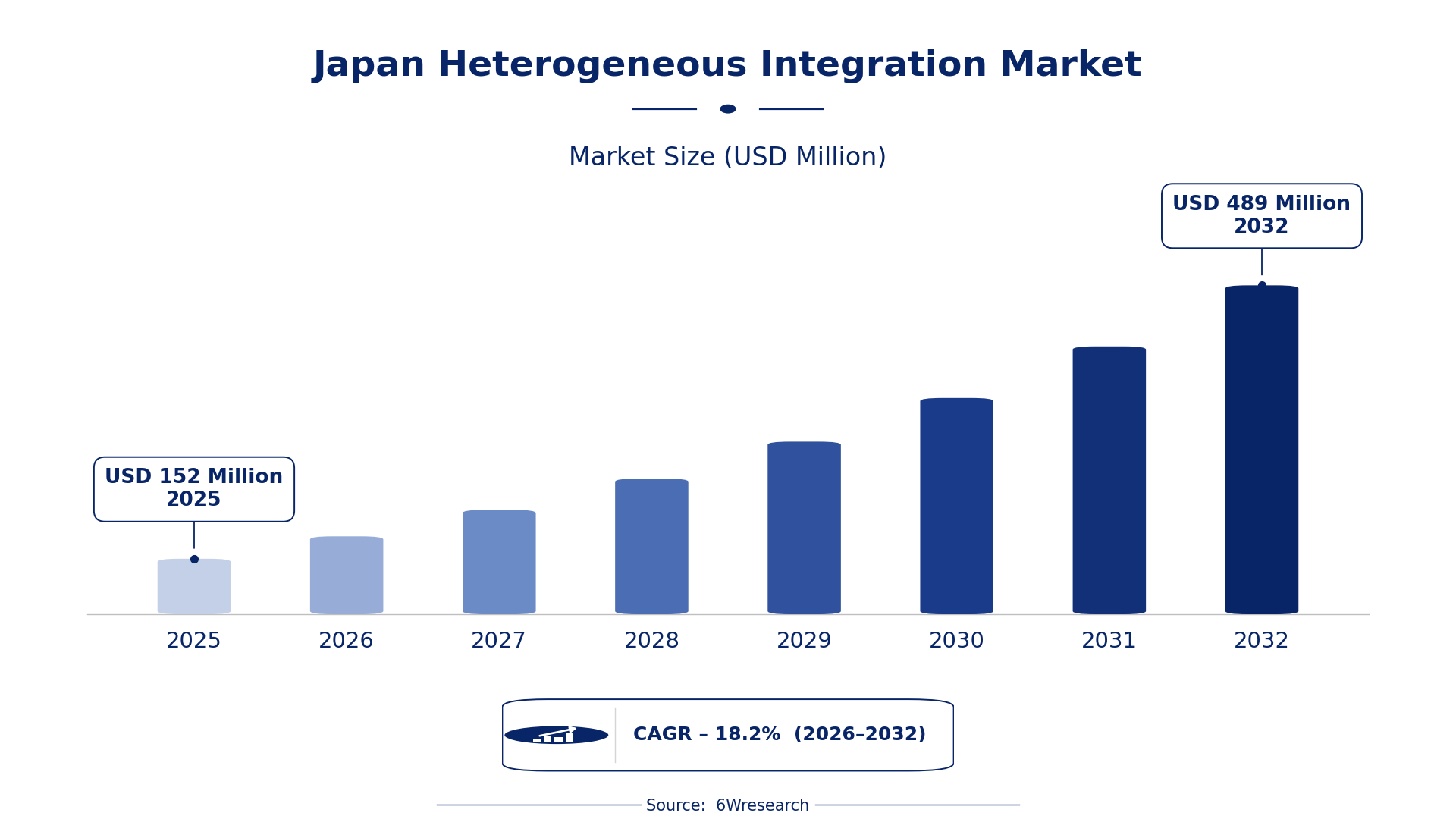
According to 6Wresearch internal database and industry insights, the Japan Heterogeneous Integration Market was valued at USD 152 Million in 2025 and is projected to reach USD 489 Million by 2032, growing at a CAGR of approximately 18.2% during 2026–2032.
Japan Heterogeneous Integration Market Highlights
| Report Metric | Details |
| Report Name | Japan Heterogeneous Integration Market (2026-2032) |
| Market Size 2025 | USD 152 Million |
| Market Size 2032 | USD 489 Million |
| Absolute Growth 2025–2032 | USD 337 Million |
| CAGR 2026–2032 | 18.2% |
| Peak Annual Growth | 20.9% in 2027 |
| Forecast Period | 2026–2032 |
| Historical Data | 2022–2025 |
| Base Year | 2025 |
| Leading Product Type, 2025 | 3D IC Packaging (39% share) |
| Leading Integration Method, 2025 | TSV Technology (45% share) |
| Leading Distribution Channel, 2025 | Semiconductor Distributors (39% share) |
| Leading End User, 2025 | IC Manufacturers (48% share) |
| Fastest-Growing Product Type | System-in-Package (26.3% CAGR) |
| Fastest-Growing Integration Method | Embedded Die (25.6% CAGR) |
| Fastest-Growing Distribution Channel | Online OEM Supply (24.3% CAGR) |
| Fastest-Growing End User | Data Centers (24.9% CAGR) |
| Growing Sector | semiconductor manufacturing |
| Key End Users | IC Manufacturers, Data Centers, OEMs, Foundries |
Japan Heterogeneous Integration Market Year-wise Growth Rate and Key Drivers (2022–2032)
This graph illustrates the annual growth rates of the market from 2022 to 2032, highlighting a steady upward trajectory and projected market expansion over the forecast period.
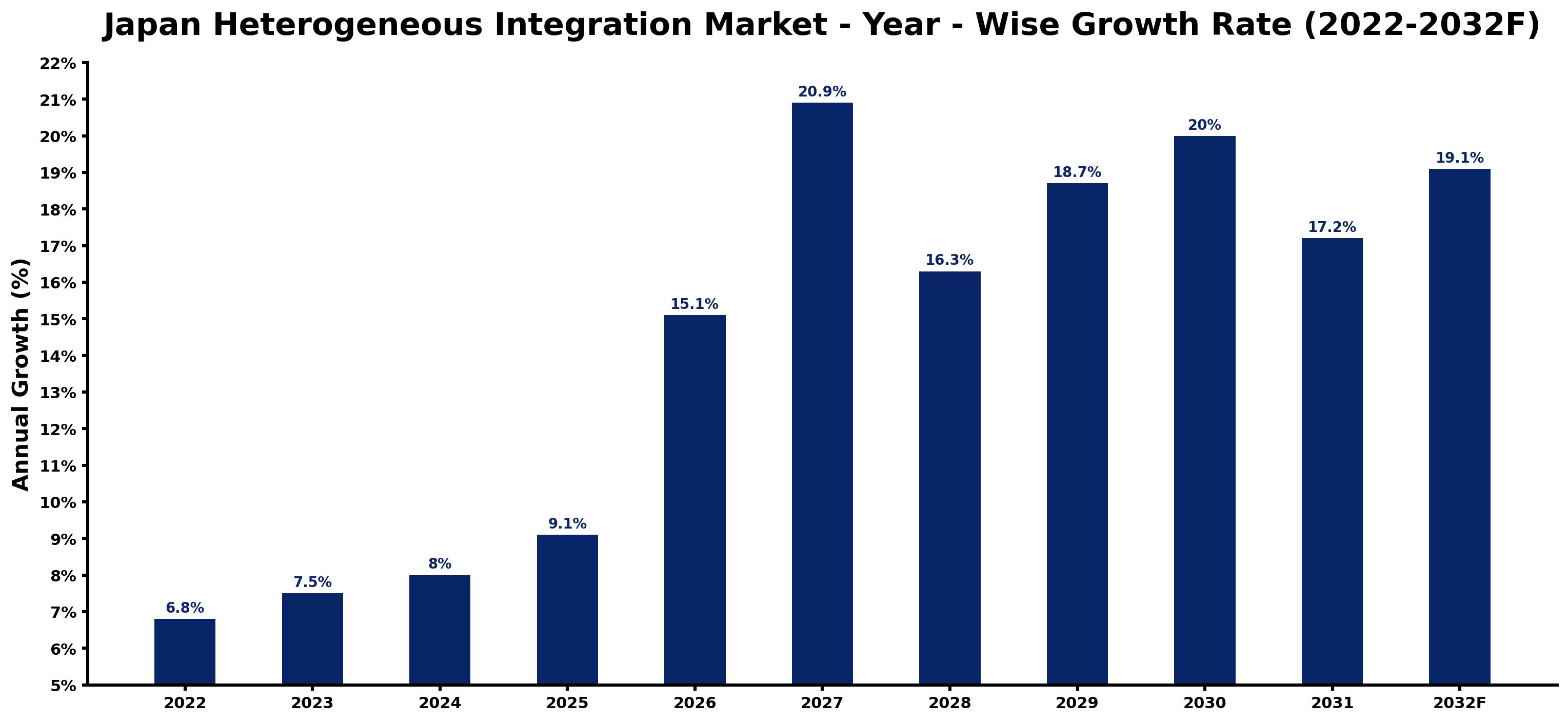
Annual growth estimates for each year appear below with the principal reason behind them, explaining the shifts that set the pace of the market.
| Year | Estimated Annual Growth (%) | Market Rationale |
| 2022 | 6.8 | The market experienced steady growth, driven by increasing demand from domestic manufacturers. |
| 2023 | 7.5 | Growth accelerated due to heightened investments in semiconductor technology and infrastructure. |
| 2024 | 8.0 | The market continued to expand as more companies adopted advanced packaging solutions. |
| 2025 | 9.1 | Demand surged as the semiconductor industry focused on improving production capabilities. |
| 2026 | 15.1 | Growth accelerated significantly as new technologies gained traction among manufacturers. |
| 2027 | 20.9 | The peak growth was driven by substantial investments in high-performance computing. |
| 2028 | 16.3 | Growth slowed slightly as market expansion began to stabilise after peak levels. |
| 2029 | 18.7 | The market rebounded with increased demand for advanced integration solutions. |
| 2030 | 20.0 | Growth remained strong as the industry adapted to emerging technological trends. |
| 2031 | 17.2 | A slowdown occurred as the market began to stabilise after rapid growth. |
| 2032 | 19.1 | Demand is projected to rise as new applications for heterogeneous integration emerge. |
Note: Market size estimations and growth projections presented in this report are based on 6Wresearch's proprietary forecasting methodology, utilizing the latest available industry data, government publications, and primary research inputs.
Japan Heterogeneous Integration Market Synopsis
Heterogeneous Integration is a technology that combines various semiconductor materials into a single package, utilising methods like 2.5D and 3D packaging. This integration improves performance in sectors such as high-performance computing and telecommunications. The Japan Heterogeneous Integration Market is expanding due to rising demand from domestic manufacturers, a semiconductor strategy launched by the Ministry of Economy, Trade and Industry in 2023, and increasing investments in data centers, projected to reach 500 by 2025.
Market Dynamics Impact Analysis (2026–2032)
| Factor | Type | Impact | Primary Segment Affected |
| Rising demand for high-performance computing applications | Driver | High | 3D IC Packaging |
| Increased adoption of advanced packaging techniques | Driver | High | 2.5D Packaging |
| Growing investment in semiconductor research and development | Opportunity | High | Silicon Interposer |
| Expansion of data centers requiring advanced integration | Opportunity | High | Data Centers |
| High costs associated with advanced packaging technologies | Restraint | Medium | Fan-Out Packaging |
| Limited availability of skilled workforce in semiconductor manufacturing | Restraint | Medium | Wafer-Level |
| Compliance with stringent industry standards and regulations | Challenge | High | TSV Technology |
| Capacity constraints in semiconductor manufacturing facilities | Challenge | Medium | System-in-Package |
Evaluation of Drivers in Japan Heterogeneous Integration Market (2026–2032)
The table below links each growth driver to the segment it affects and the evidence for it.
| Drivers | Primary Segment Affected | Why It Matters (Evidence) |
| Increased demand for high-performance computing | 3D IC Packaging | This demand is linked to advancements in AI and machine learning, requiring more efficient chip designs. |
| Adoption of 3D IC packaging techniques | 2.5D Packaging | The adoption rate of 3D IC packaging in Japan is around 30% as of 2023, improving integration capabilities. |
| Rising investments in semiconductor R&D | Silicon Interposer | The Japanese government allocated 300 billion JPY for semiconductor research and development in 2023. |
| Growth of data centers | Data Centers | The number of data centers in Japan is projected to reach 500 by 2025, increasing demand for advanced chips. |
| Emergence of new applications in consumer electronics | Fan-Out Packaging | Wafer-level packaging is widely used in consumer electronics, accounting for 25% of the market. |
Orders keep climbing as demand for high-performance computing applications rises, supported by advancements in AI and machine learning. The adoption of 3D IC packaging techniques is increasing, with a 30% adoption rate improving integration capabilities. Investments in semiconductor R&D, backed by a 300 billion JPY allocation for 2023, further stimulate the market. The growth of data centers, projected to reach 500 by 2025, fuels demand for advanced chips. New applications in consumer electronics are emerging, with wafer-level packaging accounting for 25% of the market.
Evaluation of Restraints in Japan Heterogeneous Integration Market
The table below lists the restraints and the evidence behind each.
| Market Restraint | Primary Segment Affected | Why It Matters (Evidence) |
| High costs of advanced packaging technologies | Fan-Out Packaging | These costs limit the adoption of advanced packaging solutions among smaller manufacturers. |
| Limited skilled workforce availability | Wafer-Level | The shortage of skilled professionals hampers production efficiency and innovation in semiconductor manufacturing. |
| Compliance with stringent industry standards | TSV Technology | Meeting these standards requires considerable investment in testing and certification processes. |
| Capacity constraints in manufacturing facilities | System-in-Package | Limited production capacity can delay the introduction of new products to the market. |
| Market volatility due to global supply chain issues | 2.5D Packaging | Supply chain disruptions can affect the timely availability of critical components. |
Japan Heterogeneous Integration Market Challenges
Producers in Japan face rising costs due to semiconductor material prices, which can inflate production expenses by 20%, significantly impacting profit margins. Regulatory complexities arise from compliance with standards like JIS Z 8401, causing delays of several months in product launches for manufacturers. Technological advancements are hampered by a slower adoption rate of heterogeneous integration methods, limiting innovation opportunities for suppliers. Buyers experience supply chain disruptions as the government's semiconductor strategy, initiated in 2023, requires time for implementation, resulting in delays in product availability and potential revenue loss.
Trends in the Japan Heterogeneous Integration Market
Below are the shifts with the largest effect on the Japan Heterogeneous Integration Market.
- Data Centers Prioritised over Traditional Facilities: Data centers are increasingly prioritising advanced integration technologies to improve performance. The projected number of data centers in Japan is set to reach 500 by 2025, reflecting this shift.
- Shift from 2D to 3D Packaging Techniques: The industry is transitioning from traditional 2D packaging to 3D techniques, which offer better performance. The adoption rate of 3D IC packaging in Japan is around 30% as of 2023.
- Emergence of Embedded Die Technology in Automotive: Embedded die technology is gaining traction in automotive applications, improving efficiency. This trend is clear as automotive manufacturers increasingly adopt advanced integration methods.
- Growing Focus on Sustainability in Semiconductor Production: Sustainability is becoming a key focus in semiconductor production, with initiatives promoting recycling. The Plastic Resource Circulation Act (2021) supports these efforts in Japan.
Investment Opportunities in the Japan Heterogeneous Integration Market
The following opportunities in the Japan Heterogeneous Integration Market pair current demand with a clear way in.
- Joint Ventures for Semiconductor Production: Local partnerships are essential for entering the semiconductor market, especially for foreign firms. Japanese foundries are seeking collaborations to improve production capabilities, backed by a 300 billion JPY investment.
- Investment in Data Center Infrastructure: With the number of data centers projected to reach 500 by 2025, there is a timely opportunity for investment. Data center operators are looking for advanced integration solutions to improve performance.
- Expansion of Advanced Packaging Solutions: The current demand for advanced packaging solutions presents a timely investment opportunity. Semiconductor distributors are actively seeking innovative products to meet market needs.
- Growth in Automotive Applications: The automotive sector is increasingly adopting embedded die technology, creating a demand gap. Suppliers can enter this market by partnering with automotive manufacturers.
Government Initiatives in the Japan Heterogeneous Integration Market
The Semiconductor and Digital Industry Strategy launched by the Ministry of Economy, Trade and Industry in June 2021 established measures to secure domestic semiconductor manufacturing. This strategy complements existing laws, providing support for local production and innovation in the semiconductor sector.
Buyers in the semiconductor industry benefit from funding and support through the 300 billion JPY allocated for semiconductor research and development in 2023. This funding aims to improve production capabilities and support innovation among local manufacturers.
Future Insight of the Japan Heterogeneous Integration Market
By 2032, a substantial shift will occur as the government's semiconductor strategy drives increased domestic production and innovation. The projected growth in the number of data centers to 500 by 2025 will create demand for advanced packaging solutions. The rise of embedded die technology in automotive applications will further push suppliers to enhance their offerings. As standards for IC packaging evolve, buyers will gain access to improved performance and efficiency in their electronic products, fostering a competitive market environment.
Market Segmentation Analysis
Japan Heterogeneous Integration Market report covers a detailed analysis of the following market segments:
By Product Type – 3D IC Packaging Leads, System-in-Package Expected to Grow Fastest
According to Saurav Kr Singh, Senior Research Analyst at 6Wresearch, with 39% of product type revenue in 2025, 3D IC Packaging was the largest category. 3D IC Packaging holds the largest share due to its essential role in compact designs for modern electronics, particularly in high-performance computing applications. Its adoption rate of 30% in Japan demonstrates its widespread use among major manufacturers in the region. System-in-Package is set to record the highest CAGR in this split, 26.3% over 2026–2032. The System-in-Package segment is growing rapidly as it integrates multiple functions into a single module, meeting the increasing demand for efficiency in electronic devices. This trend is driven by manufacturers aiming to optimise production processes and reduce space requirements. Suppliers should prioritise advancements in System-in-Package technologies to align with the rising market demands.
By Integration Method – TSV Technology Leads, Embedded Die Expected to Grow Fastest
TSV Technology took 45% of integration method revenue in 2025, more than any other category. TSV Technology leads the market as it is critical for establishing high-density interconnections in 3D ICs, which are essential for advanced semiconductor applications. This technology is widely adopted in Japan's semiconductor manufacturing facilities. Embedded Die is projected to grow fastest, at a CAGR of 25.6% during 2026–2032. Embedded Die technology is growing quickly, particularly in automotive applications, as manufacturers seek to optimise space and performance in their designs. This growth is supported by increasing automotive electronic requirements. Buyers should consider investing in Embedded Die solutions to remain competitive in the evolving automotive sector.
By Distribution Channel – Semiconductor Distributors Lead, Online OEM Supply Expected to Grow Fastest
In 2025, Semiconductor Distributors led the distribution channel split with a 39% share. Semiconductor Distributors lead the market as they are crucial for supplying components to manufacturers, ensuring a consistent flow of necessary materials for production. Their established networks across Japan facilitate the efficient distribution of semiconductor products. Over 2026–2032, Online OEM Supply is expected to post the fastest growth, at a CAGR of 24.3%. Online OEM Supply is experiencing rapid growth as digital transformation reshapes procurement processes, allowing manufacturers to source components more conveniently. This shift highlights a trend towards more accessible and efficient purchasing methods in the semiconductor sector. Suppliers must strengthen their online capabilities to effectively engage with the increasing demand for digital procurement solutions.
By End User – IC Manufacturers Lead, Data Centers Expected to Grow Fastest
IC Manufacturers held 48% of the Japan Heterogeneous Integration Market by end user in 2025. IC Manufacturers account for the largest share as they are the primary users in the semiconductor fabrication process, which drives demand for heterogeneous integration technologies. Their central role in the supply chain is essential for market stability and growth. The quickest growth will come from Data Centers, forecast to expand at a CAGR of 24.9% between 2026 and 2032. Data Centers are witnessing the fastest growth, driven by the rising demand for high-performance chips essential for advanced computing and storage solutions. This trend is largely influenced by the expansion of cloud services and the need for efficient data management. Suppliers should focus on creating tailored solutions for Data Centers to leverage the opportunities presented by this rapidly growing segment.
Key Attractiveness of the Report
- 10 Years of Market Numbers
- Historical Data Starting from 2022 to 2025
- Base Year 2025
- Forecast Data until 2032
- Key Performance Indicators Impacting the Market
- Major Upcoming Developments and Projects
Key Highlights of the Report:
- Japan Heterogeneous Integration Market Outlook
- Market Size of Japan Heterogeneous Integration Market, 2025
- Forecast of Japan Heterogeneous Integration Market, 2032
- Historical Data and Forecast of Japan Heterogeneous Integration Revenues & Volume for the Period 2022-2032F
- Japan Heterogeneous Integration Market Trend Evolution
- Japan Heterogeneous Integration Market Drivers and Challenges
- Japan Heterogeneous Integration Price Trends
- Japan Heterogeneous Integration Porter's Five Forces
- Japan Heterogeneous Integration Industry Life Cycle
- Historical Data and Forecast of Japan Heterogeneous Integration Market Revenues & Volume By Product Type for the Period 2022-2032F
- Historical Data and Forecast of Japan Heterogeneous Integration Market Revenues & Volume By 2.5D Packaging for the Period 2022-2032F
- Historical Data and Forecast of Japan Heterogeneous Integration Market Revenues & Volume By 3D IC Packaging for the Period 2022-2032F
- Historical Data and Forecast of Japan Heterogeneous Integration Market Revenues & Volume By System-in-Package for the Period 2022-2032F
- Historical Data and Forecast of Japan Heterogeneous Integration Market Revenues & Volume By Fan-Out Packaging for the Period 2022-2032F
- Historical Data and Forecast of Japan Heterogeneous Integration Market Revenues & Volume By Integration Method for the Period 2022-2032F
- Historical Data and Forecast of Japan Heterogeneous Integration Market Revenues & Volume By Silicon Interposer for the Period 2022-2032F
- Historical Data and Forecast of Japan Heterogeneous Integration Market Revenues & Volume By TSV Technology for the Period 2022-2032F
- Historical Data and Forecast of Japan Heterogeneous Integration Market Revenues & Volume By Embedded Die for the Period 2022-2032F
- Historical Data and Forecast of Japan Heterogeneous Integration Market Revenues & Volume By Wafer-Level for the Period 2022-2032F
- Historical Data and Forecast of Japan Heterogeneous Integration Market Revenues & Volume By Distribution Channel for the Period 2022-2032F
- Historical Data and Forecast of Japan Heterogeneous Integration Market Revenues & Volume By Semiconductor Distributors for the Period 2022-2032F
- Historical Data and Forecast of Japan Heterogeneous Integration Market Revenues & Volume By Online OEM Supply for the Period 2022-2032F
- Historical Data and Forecast of Japan Heterogeneous Integration Market Revenues & Volume By Direct Sales for the Period 2022-2032F
- Historical Data and Forecast of Japan Heterogeneous Integration Market Revenues & Volume By Specialty Distributors for the Period 2022-2032F
- Historical Data and Forecast of Japan Heterogeneous Integration Market Revenues & Volume By End User for the Period 2022-2032F
- Historical Data and Forecast of Japan Heterogeneous Integration Market Revenues & Volume By Foundries for the Period 2022-2032F
- Historical Data and Forecast of Japan Heterogeneous Integration Market Revenues & Volume By OEMs for the Period 2022-2032F
- Historical Data and Forecast of Japan Heterogeneous Integration Market Revenues & Volume By IC Manufacturers for the Period 2022-2032F
- Historical Data and Forecast of Japan Heterogeneous Integration Market Revenues & Volume By Data Centers for the Period 2022-2032F
- Japan Heterogeneous Integration Import Export Trade Statistics
- Market Opportunity Assessment By Product Type
- Market Opportunity Assessment By Integration Method
- Market Opportunity Assessment By Distribution Channel
- Market Opportunity Assessment By End User
- Japan Heterogeneous Integration Top Companies Market Share
- Japan Heterogeneous Integration Competitive Benchmarking By Technical and Operational Parameters
- Japan Heterogeneous Integration Company Profiles
- Japan Heterogeneous Integration Key Strategic Recommendations
Market Covered
Segments analysed in this report are listed below.
By Product Type
- 2.5D Packaging
- 3D IC Packaging
- System-in-Package
- Fan-Out Packaging
By Integration Method
- Silicon Interposer
- TSV Technology
- Embedded Die
- Wafer-Level
By Distribution Channel
- Semiconductor Distributors
- Online OEM Supply
- Direct Sales
- Specialty Distributors
By End User
- Foundries
- OEMs
- IC Manufacturers
- Data Centers































