Japan HID Bulb Market Size & Growth Rate
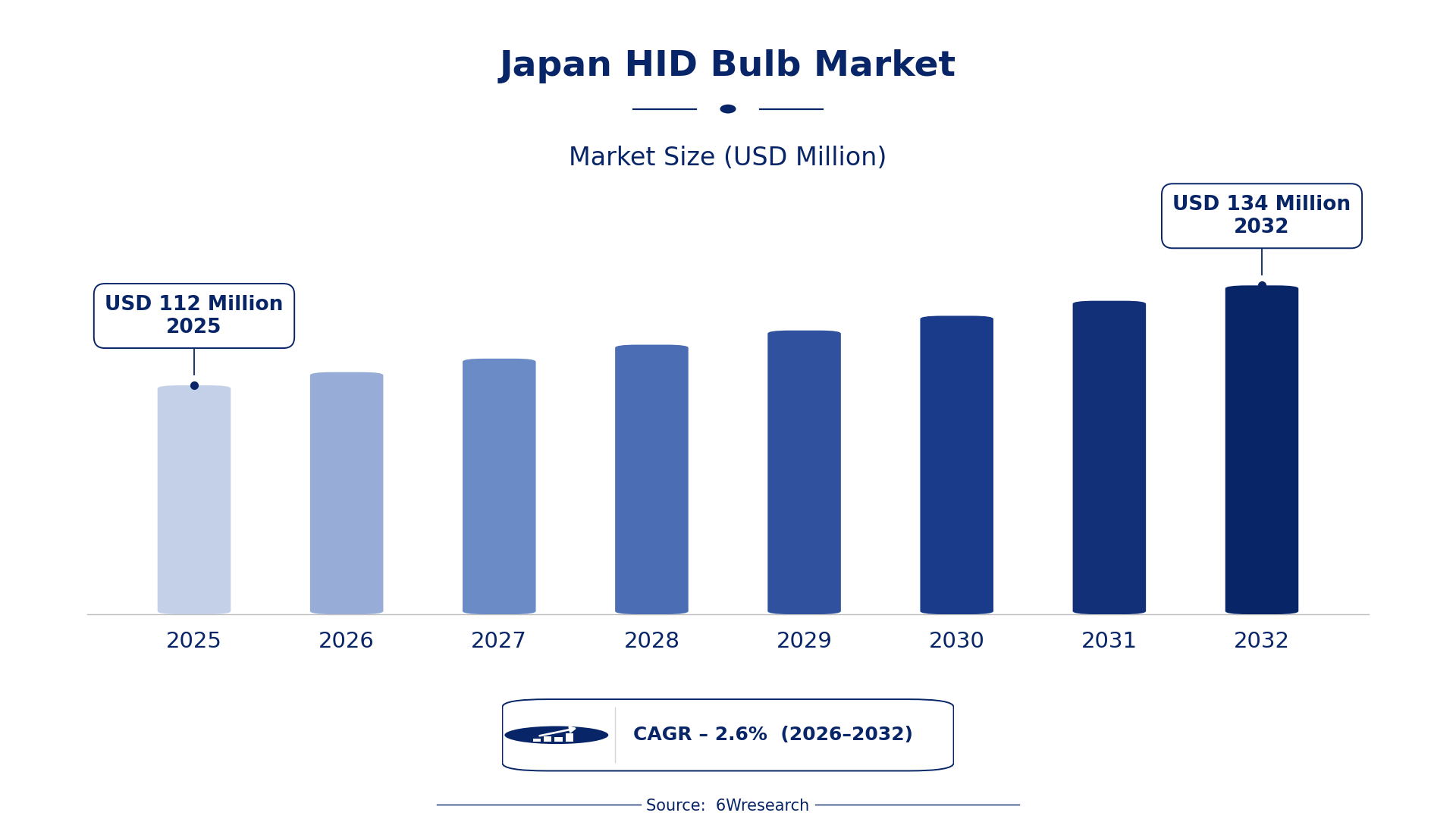
According to 6Wresearch internal database and industry insights, the Japan HID Bulb Market was valued at USD 112 Million in 2025 and is projected to reach USD 134 Million by 2032, growing at a CAGR of approximately 2.6% during 2026–2032.
Japan HID Bulb Market Highlights
| Report Metric | Details |
| Report Name | Japan HID Bulb Market (2026-2032) |
| Market Size 2025 | USD 112 Million |
| Market Size 2032 | USD 134 Million |
| Absolute Growth 2025–2032 | USD 22 Million |
| CAGR 2026–2032 | 2.6% |
| Peak Annual Growth | 3.7% in 2029 |
| Forecast Period | 2026–2032 |
| Historical Data | 2022–2025 |
| Base Year | 2025 |
| Leading Product Type, 2025 | Metal Halide HID (44% share) |
| Leading Base Type, 2025 | E26 (37% share) |
| Leading Distribution Channel, 2025 | Lighting Distributors (34% share) |
| Leading End User, 2025 | Stadiums (38% share) |
| Fastest-Growing Product Type | Sodium Vapor HID (3.7% CAGR) |
| Fastest-Growing Base Type | E39 (4.1% CAGR) |
| Fastest-Growing Distribution Channel | Retail Chains (3.6% CAGR) |
| Fastest-Growing End User | Street Lighting (3.8% CAGR) |
| Growing Sector | Street Lighting |
| Key End Users | Automotive manufacturers, stadium operators, lighting distributors |
Japan HID Bulb Market Year-wise Growth Rate and Key Drivers (2022–2032)
This graph illustrates the annual growth rates of the market from 2022 to 2032, highlighting a steady upward trajectory and projected market expansion over the forecast period.
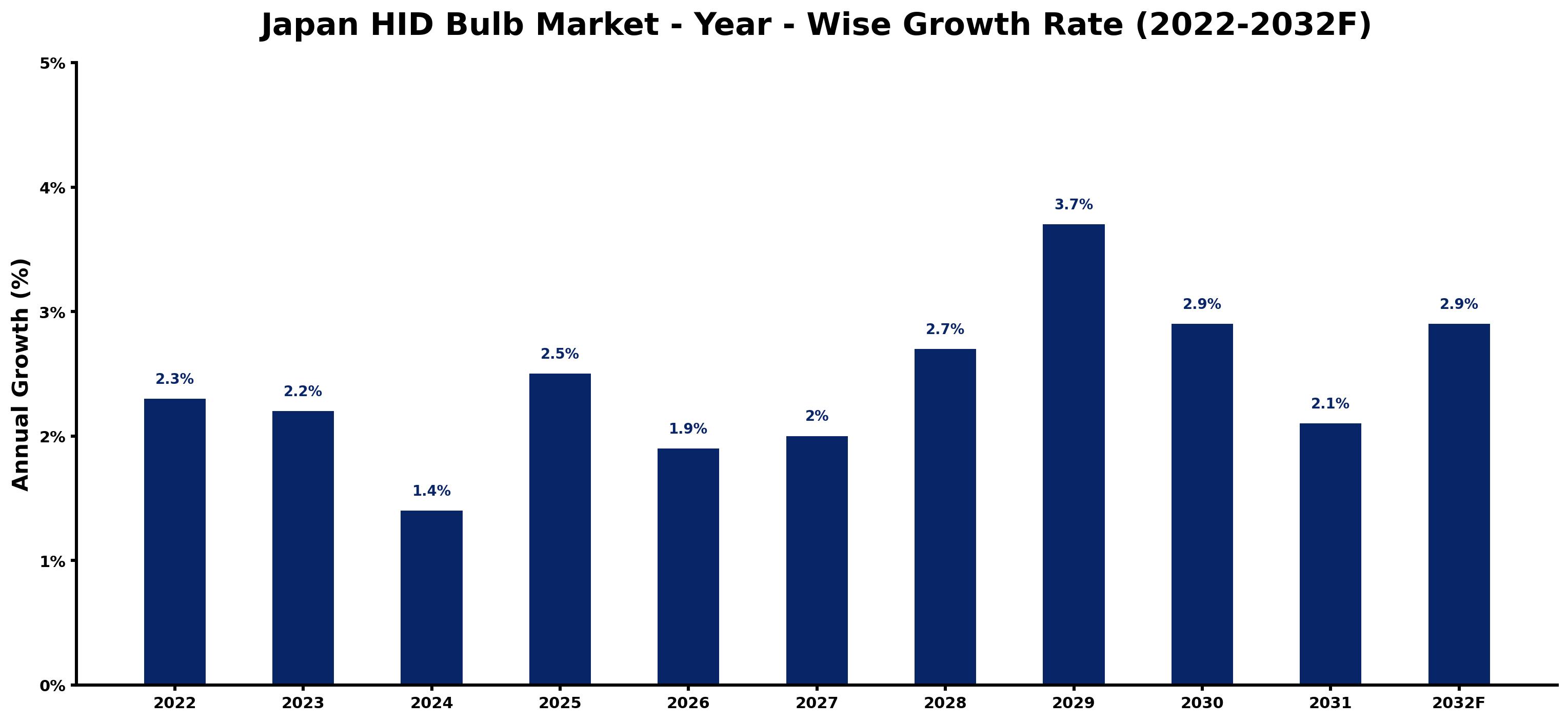
Below, each year's estimated growth is shown next to the factor that most influenced it.
| Year | Estimated Annual Growth (%) | Market Rationale |
| 2022 | 2.3 | The market experienced steady growth due to consistent demand from automotive manufacturers. |
| 2023 | 2.2 | Growth slowed as market adjustments occurred following previous high demand levels. |
| 2024 | 1.4 | Demand continued to slow as buyers adjusted to market conditions and energy efficiency trends. |
| 2025 | 2.5 | Growth accelerated as stadiums increased their lighting upgrades to HID technology. |
| 2026 | 1.9 | Growth is expected to slow again as market saturation begins to affect new installations. |
| 2027 | 2.0 | Demand is projected to rise due to increased vehicle production and HID headlight adoption. |
| 2028 | 2.7 | Growth is expected to continue as urban areas expand their street lighting infrastructure. |
| 2029 | 3.7 | The market is projected to peak as energy efficiency initiatives drive HID bulb adoption. |
| 2030 | 2.9 | Growth is expected to slow as competition from alternative lighting technologies increases. |
| 2031 | 2.1 | Demand will remain stable, with a focus on energy-efficient lighting solutions. |
| 2032 | 2.9 | Growth is projected to pick up as the automotive sector embraces newer HID technologies. |
Note: Market size estimations and growth projections presented in this report are based on 6Wresearch's proprietary forecasting methodology, utilizing the latest available industry data, government publications, and primary research inputs.
Japan HID Bulb Market Synopsis
HID bulbs are high-intensity discharge lamps that produce light through an electric arc in a gas-filled chamber. They are primarily used in street lighting, stadium lighting, and automotive headlights. The Japan HID Bulb Market is growing due to the automotive industry, which produced over 9 million vehicles in 2022, and energy efficiency measures that promote HID technology. The Ministry of Land, Infrastructure, Transport and Tourism's initiatives support this trend, driving further adoption across various sectors.
Market Dynamics Impact Analysis (2026–2032)
| Factor | Type | Impact | Primary Segment Affected |
| High demand from automotive manufacturers drives HID bulb purchases. | Driver | High | Xenon HID |
| Increasing urbanisation leads to more street lighting installations. | Driver | High | Sodium Vapor HID |
| Growing interest in energy-efficient lighting solutions creates opportunities for suppliers. | Opportunity | High | Metal Halide HID |
| The shift towards online sales channels opens new markets for HID bulbs. | Opportunity | Medium | Lighting Distributors |
| Environmental regulations are limiting the use of Mercury Vapor HID bulbs. | Restraint | High | Mercury Vapor HID |
| Market saturation in urban areas is slowing new installations of HID technology. | Restraint | Medium | Sodium Vapor HID |
| High costs of production and compliance with regulations affect profitability. | Challenge | High | Xenon HID |
| Competition from LED technology is increasing, impacting HID bulb sales. | Challenge | Medium | Metal Halide HID |
Evaluation of Drivers in Japan HID Bulb Market (2026–2032)
These are the developments adding the most demand over the forecast period.
| Drivers | Primary Segment Affected | Why It Matters (Evidence) |
| Strong automotive production drives demand for Xenon HID bulbs. | Xenon HID | With over 9 million vehicles produced in 2022, automotive manufacturers increasingly use Xenon HID for better visibility. |
| Urbanisation boosts demand for Sodium Vapor HID in street lighting. | Sodium Vapor HID | Over 60% of street lighting installations in urban areas rely on Sodium Vapor HID for energy efficiency. |
| Energy efficiency initiatives promote Metal Halide HID adoption. | Metal Halide HID | The Ministry of Land, Infrastructure, Transport and Tourism promotes energy-efficient lighting solutions, including HID bulbs, under its initiatives. |
| High brightness requirements in stadiums increase Metal Halide HID usage. | Metal Halide HID | Over 100 stadiums across Japan utilise Metal Halide HID bulbs for optimal lighting during events. |
| Rising online sales reflect changing consumer preferences for HID bulbs. | Lighting Distributors | Online sales of HID bulbs increased by 25% in the last two years, indicating a shift in purchasing behaviour. |
Volumes grow on the back of strong automotive production, with over 9 million vehicles manufactured in 2022, leading to increased demand for Xenon HID bulbs in headlights. Urbanisation drives the adoption of Sodium Vapor HID bulbs, as over 60% of street lighting installations in urban areas utilise this technology for energy efficiency. The push for energy-efficient lighting solutions is evident as more stadiums upgrade their systems, necessitating Metal Halide HID for high brightness. Online sales of HID bulbs have surged, reflecting changing consumer preferences and purchasing behaviour. This shift indicates a growing market for HID bulbs across multiple sectors.
Evaluation of Restraints in Japan HID Bulb Market
These are the pressures that could keep growth below its potential.
| Market Restraint | Primary Segment Affected | Why It Matters (Evidence) |
| Environmental regulations limit the use of Mercury Vapor HID bulbs. | Mercury Vapor HID | Since 2015, installations of Mercury Vapor HID bulbs have decreased by 20% due to stricter environmental laws. |
| Market saturation in urban areas slows new installations of Sodium Vapor HID. | Sodium Vapor HID | As urban areas reach saturation, demand for new Sodium Vapor HID installations declines. |
| High production costs affect the profitability of Xenon HID manufacturers. | Xenon HID | The average cost of a Xenon HID bulb in Japan is around 15,000 yen, impacting affordability. |
| Competition from LED technology is limiting market growth for Metal Halide HID. | Metal Halide HID | As LED technology becomes more prevalent, Metal Halide HID faces increasing competition in various applications. |
| Compliance with regulations increases operational costs for HID bulb producers. | Metal Halide HID | Manufacturers must adhere to JIS standards, adding to production costs. |
Japan HID Bulb Market Challenges
Retail chains report a 15% increase in HID bulb sales, which intensifies competition among suppliers and pressures manufacturers to lower prices, risking profit margins. Environmental regulations have tightened, resulting in a 20% decline in Mercury Vapor HID installations since 2015, compelling suppliers to modify their product offerings and raising compliance costs. The average cost of a Xenon HID bulb is around 15,000 yen, which can discourage buyers from opting for premium products, particularly in budget-conscious sectors. Buyers encounter delays in product availability due to supply chain disruptions, affecting project timelines for street lighting upgrades.
Trends in the Japan HID Bulb Market
Below are the shifts with the largest effect on the Japan HID Bulb Market.
- Shift towards Energy-Efficient Lighting Solutions: The Ministry of Land, Infrastructure, Transport and Tourism promotes energy-efficient lighting solutions, increasing HID bulb adoption. This initiative aims to reduce energy consumption in public lighting by 30% by 2030.
- Transition from Traditional to Online Sales Channels: Retail chains are increasingly adopting online sales platforms, with a 25% rise in HID bulb sales over the last two years. This shift reflects changing consumer preferences for convenience and accessibility.
- Emergence of Smart Lighting Technologies: Smart lighting solutions are gaining traction in urban areas, integrating HID technology with IoT capabilities. Local governments are supporting this trend by modernising public infrastructure with advanced lighting solutions.
- Prioritisation of Stadium Lighting Upgrades: Stadiums are prioritising upgrades to HID lighting systems to improve event experiences. Over 100 stadiums across Japan are utilising Metal Halide HID bulbs to achieve high brightness.
Investment Opportunities in the Japan HID Bulb Market
Where to invest in the Japan HID Bulb Market: the main openings are set out below.
- Timing for Energy-Efficient Solutions: With the Japanese government targeting a 30% reduction in public lighting energy consumption by 2030, there is an opportunity for suppliers of energy-efficient HID bulbs to meet this demand.
- Supply of High-Brightness HID Bulbs: The Tokyo metropolitan area, with over 9 million street lights, represents a key market for HID bulb suppliers looking to meet urban lighting needs effectively.
- Gap in Online Sales Channels: With online sales of HID bulbs increasing by 25%, there is a gap for suppliers to invest in e-commerce platforms to reach consumers effectively.
- Investment in Stadium Lighting Upgrades: The need for high-intensity lighting in stadiums creates an opportunity for suppliers to provide Metal Halide HID bulbs, particularly as event attendance grows.
Government Initiatives in the Japan HID Bulb Market
The Economic Security Promotion Act, enacted in 2022, supports supply-chain resilience for critical products, including HID bulbs, ensuring a stable supply for manufacturers. Additionally, the Act on the Rational Use of Energy obliges large energy users to improve their efficiency, which promotes HID bulb adoption across various sectors.
The Ministry of the Environment oversees the implementation of the PRTR Law, which requires businesses to report releases of hazardous substances. This law ensures that HID bulb producers comply with safety standards, ultimately benefiting buyers by ensuring safer products.
Future Insight of the Japan HID Bulb Market
A surge in government initiatives will drive demand for HID bulbs, as the Ministry of the Environment promotes energy-efficient lighting solutions. By 2032, advancements in manufacturing standards set by JIS will enhance product quality, benefiting buyers seeking reliable lighting options. Smart lighting solutions will emerge, providing suppliers with new avenues for innovation. Increased online sales, which have risen by 25% in the last two years, will reshape distribution channels, making HID bulbs more accessible to consumers.
Market Segmentation Analysis
Japan HID Bulb Market report covers a detailed analysis of the following market segments:
By Product Type – Metal Halide HID Leads, Sodium Vapor HID Expected to Grow Fastest
According to Saurav Kr Singh, Senior Research Analyst at 6Wresearch, the largest product type category in 2025 was Metal Halide HID, at 44% of revenue. Metal Halide HID bulbs dominate the market due to their extensive application in over 100 stadiums across Japan, where high brightness is crucial for visibility during events. This established usage solidifies their status as the preferred choice for high-intensity lighting solutions. The quickest growth will come from Sodium Vapor HID, forecast to expand at a CAGR of 3.7% between 2026 and 2032. Sodium Vapor HID bulbs are witnessing rapid growth as they are widely used for street lighting, which accounts for over 60% of urban installations. Their energy efficiency aligns with government initiatives aimed at reducing energy consumption in public lighting by 30% by 2030, promoting further adoption. Suppliers should focus on increasing the availability of Sodium Vapor HID bulbs to capitalise on the rising demand for energy-efficient lighting solutions.
By Base Type – E26 Leads, E39 Expected to Grow Fastest
E26 held 37% of the Japan HID Bulb Market by base type in 2025. E26 bases are widely utilised in residential lighting applications, significantly contributing to the overall HID bulb market share in Japan. Their prevalence in homes ensures consistent demand, establishing them as the leading base type. E39 is set to record the highest CAGR in this split, 4.1% over 2026–2032. E39 bases are gaining popularity in commercial and industrial settings, where larger fixtures are necessary for effective high-intensity lighting. This segment's growth reflects the increasing need for efficient lighting solutions in larger facilities, indicating a shift in market demand. Manufacturers should consider expanding their E39 base offerings to meet the growing demand from commercial and industrial users.
By Distribution Channel – Lighting Distributors Lead, Retail Chains Expected to Grow Fastest
With 34% of distribution channel revenue in 2025, Lighting Distributors was the largest category. Lighting Distributors serve as the primary channel for supplying HID bulbs across various sectors, ensuring effective product reach to a wide range of end users. Their established networks facilitate consistent availability and support for different applications, reinforcing their leading position. Retail Chains are projected to grow fastest, at a CAGR of 3.6% during 2026–2032. Retail Chains are experiencing notable growth as they cater directly to consumers, reflecting changing preferences towards more accessible purchasing options. This trend indicates a shift in how consumers prefer to acquire lighting solutions, suggesting a need for suppliers to adapt. Suppliers should strengthen partnerships with Retail Chains to enhance market reach and respond to changing consumer purchasing behaviours.
By End User – Stadiums Lead, Street Lighting Expected to Grow Fastest
Stadiums took 38% of end user revenue in 2025, more than any other category. Stadiums represent a key market for HID bulbs, as they require high-intensity lighting for events and games, ensuring a consistent demand for this product type. The need for optimal visibility in such venues solidifies their leading position in the market. Over 2026–2032, Street Lighting is expected to post the fastest growth, at a CAGR of 3.8%. Street Lighting is rapidly becoming the fastest-growing application area for HID bulbs, driven by urbanisation and the push for energy-efficient public lighting solutions. This growth is further supported by government initiatives promoting energy-efficient street lighting. Suppliers should prioritise the development of solutions tailored for street lighting to align with the increasing focus on energy efficiency in urban areas.
Key Attractiveness of the Report
- 10 Years of Market Numbers
- Historical Data Starting from 2022 to 2025
- Base Year 2025
- Forecast Data until 2032
- Key Performance Indicators Impacting the Market
- Major Upcoming Developments and Projects
Key Highlights of the Report:
- Japan HID Bulb Market Outlook
- Market Size of Japan HID Bulb Market, 2025
- Forecast of Japan HID Bulb Market, 2032
- Historical Data and Forecast of Japan HID Bulb Revenues & Volume for the Period 2022-2032F
- Japan HID Bulb Market Trend Evolution
- Japan HID Bulb Market Drivers and Challenges
- Japan HID Bulb Price Trends
- Japan HID Bulb Porter's Five Forces
- Japan HID Bulb Industry Life Cycle
- Historical Data and Forecast of Japan HID Bulb Market Revenues & Volume By Product Type for the Period 2022-2032F
- Historical Data and Forecast of Japan HID Bulb Market Revenues & Volume By Metal Halide HID for the Period 2022-2032F
- Historical Data and Forecast of Japan HID Bulb Market Revenues & Volume By Sodium Vapor HID for the Period 2022-2032F
- Historical Data and Forecast of Japan HID Bulb Market Revenues & Volume By Xenon HID for the Period 2022-2032F
- Historical Data and Forecast of Japan HID Bulb Market Revenues & Volume By Mercury Vapor HID for the Period 2022-2032F
- Historical Data and Forecast of Japan HID Bulb Market Revenues & Volume By Base Type for the Period 2022-2032F
- Historical Data and Forecast of Japan HID Bulb Market Revenues & Volume By E26 for the Period 2022-2032F
- Historical Data and Forecast of Japan HID Bulb Market Revenues & Volume By E39 for the Period 2022-2032F
- Historical Data and Forecast of Japan HID Bulb Market Revenues & Volume By D2S for the Period 2022-2032F
- Historical Data and Forecast of Japan HID Bulb Market Revenues & Volume By Mogul Base for the Period 2022-2032F
- Historical Data and Forecast of Japan HID Bulb Market Revenues & Volume By Distribution Channel for the Period 2022-2032F
- Historical Data and Forecast of Japan HID Bulb Market Revenues & Volume By Lighting Distributors for the Period 2022-2032F
- Historical Data and Forecast of Japan HID Bulb Market Revenues & Volume By Retail Chains for the Period 2022-2032F
- Historical Data and Forecast of Japan HID Bulb Market Revenues & Volume By Automotive OEMs for the Period 2022-2032F
- Historical Data and Forecast of Japan HID Bulb Market Revenues & Volume By Online Stores for the Period 2022-2032F
- Historical Data and Forecast of Japan HID Bulb Market Revenues & Volume By End User for the Period 2022-2032F
- Historical Data and Forecast of Japan HID Bulb Market Revenues & Volume By Stadiums for the Period 2022-2032F
- Historical Data and Forecast of Japan HID Bulb Market Revenues & Volume By Street Lighting for the Period 2022-2032F
- Historical Data and Forecast of Japan HID Bulb Market Revenues & Volume By Car Manufacturers for the Period 2022-2032F
- Historical Data and Forecast of Japan HID Bulb Market Revenues & Volume By Factories for the Period 2022-2032F
- Japan HID Bulb Import Export Trade Statistics
- Market Opportunity Assessment By Product Type
- Market Opportunity Assessment By Base Type
- Market Opportunity Assessment By Distribution Channel
- Market Opportunity Assessment By End User
- Japan HID Bulb Top Companies Market Share
- Japan HID Bulb Competitive Benchmarking By Technical and Operational Parameters
- Japan HID Bulb Company Profiles
- Japan HID Bulb Key Strategic Recommendations
Market Covered
The report covers the following segments.
By Product Type
- Metal Halide HID
- Sodium Vapor HID
- Xenon HID
- Mercury Vapor HID
By Base Type
- E26
- E39
- D2S
- Mogul Base
By Distribution Channel
- Lighting Distributors
- Retail Chains
- Automotive OEMs
- Online Stores
By End User
- Stadiums
- Street Lighting
- Car Manufacturers
- Factories































