Japan High Bandwidth Interconnect Market Size & Growth Rate
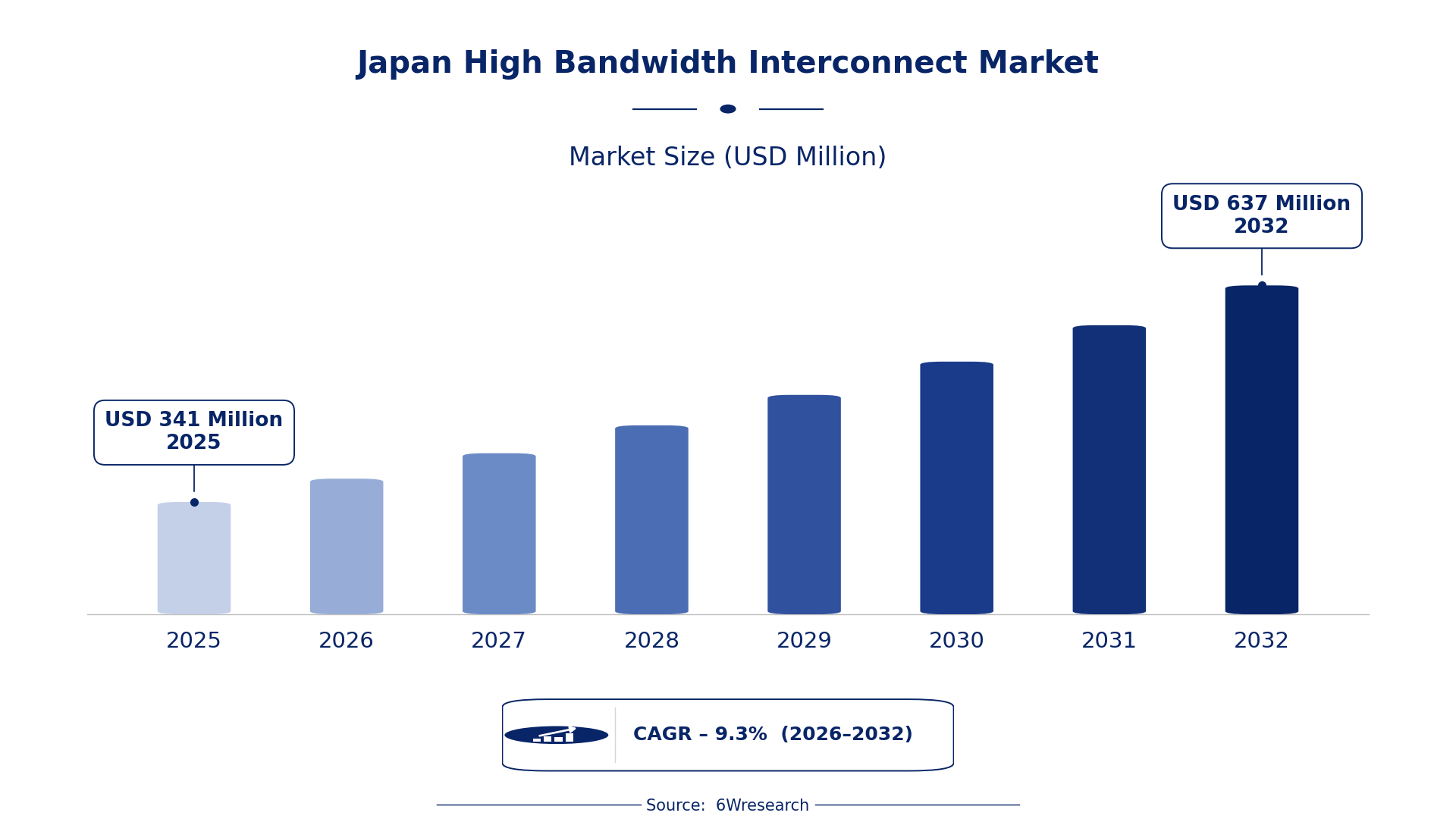
According to 6Wresearch internal database and industry insights, the Japan High Bandwidth Interconnect Market was valued at USD 341 Million in 2025 and is projected to reach USD 637 Million by 2032, growing at a CAGR of approximately 9.3% during 2026–2032.
Japan High Bandwidth Interconnect Market Highlights
| Report Metric | Details |
| Report Name | Japan High Bandwidth Interconnect Market (2026-2032) |
| Market Size 2025 | USD 341 Million |
| Market Size 2032 | USD 637 Million |
| Absolute Growth 2025–2032 | USD 296 Million |
| CAGR 2026–2032 | 9.3% |
| Peak Annual Growth | 10.6% in 2028 |
| Forecast Period | 2026–2032 |
| Historical Data | 2022–2025 |
| Base Year | 2025 |
| Leading Product Type, 2025 | Optical Interconnects (39% share) |
| Leading Technology Type, 2025 | Fiber Optics (39% share) |
| Leading Distribution Channel, 2025 | OEM Channels (53% share) |
| Leading End User, 2025 | Data Centers (46% share) |
| Fastest-Growing Product Type | High-Speed Cables (13.1% CAGR) |
| Fastest-Growing Technology Type | Copper-Based (12.8% CAGR) |
| Fastest-Growing Distribution Channel | Online Stores (11.6% CAGR) |
| Fastest-Growing End User | Telecom Firms (12.2% CAGR) |
| Growing Sector | Telecom Infrastructure |
| Key End Users | Data Centers, Telecom Firms, Cloud Services |
Japan High Bandwidth Interconnect Market Year-wise Growth Rate and Key Drivers (2022–2032)
This graph illustrates the annual growth rates of the market from 2022 to 2032, highlighting a steady upward trajectory and projected market expansion over the forecast period.
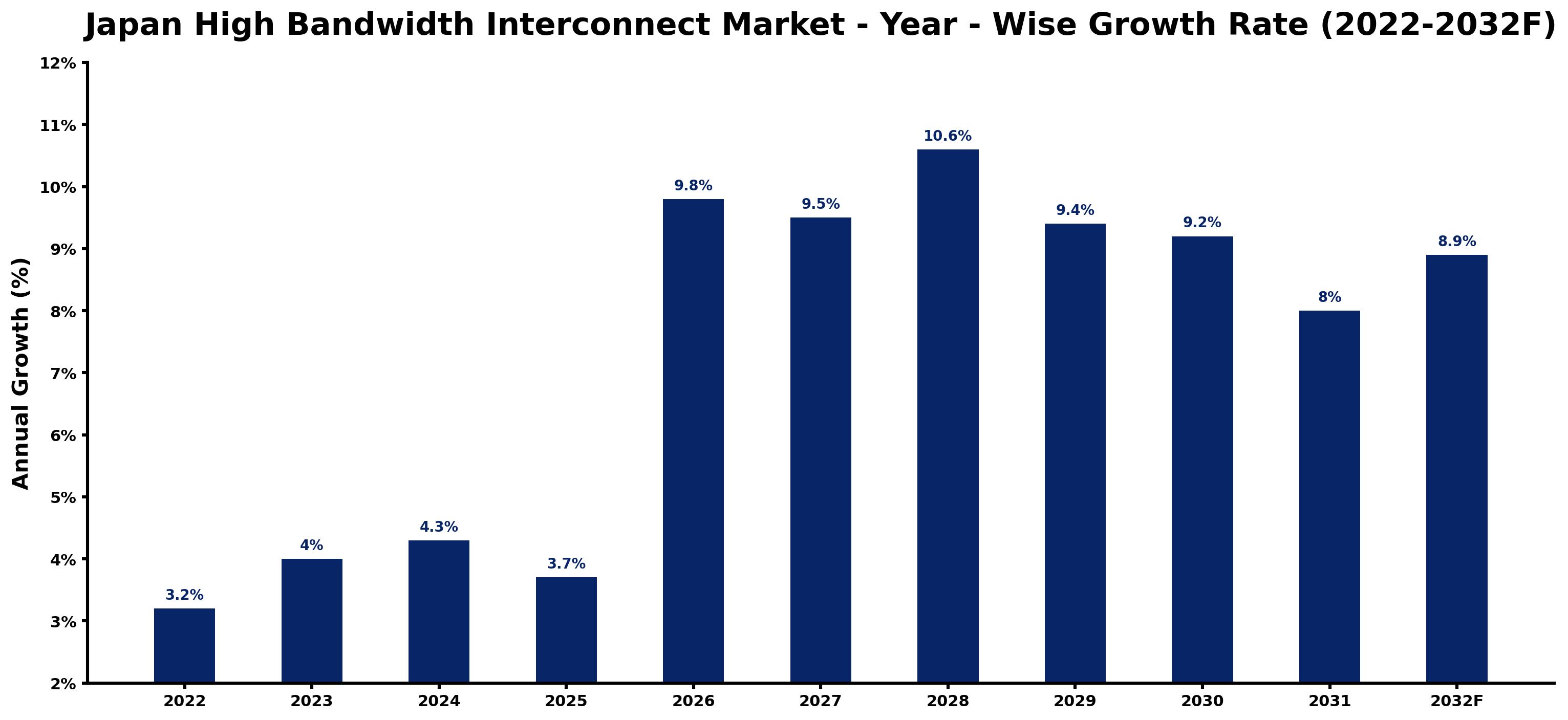
The yearly estimates that follow link every growth rate to its principal driver, so readers can see why the pace changed in each period.
| Year | Estimated Annual Growth (%) | Market Rationale |
| 2022 | 3.2 | The market was stable, reflecting established demand from data centers and telecom firms. |
| 2023 | 4.0 | Growth accelerated due to increased investments in cloud services and telecom infrastructure. |
| 2024 | 4.3 | Demand rose further as data centers expanded operations and upgraded technologies. |
| 2025 | 3.7 | Growth slowed slightly as firms adjusted to market conditions and project timelines. |
| 2026 | 9.8 | Demand surged as telecom firms ramped up investments in optical interconnects for 5G. |
| 2027 | 9.5 | The market continued to grow, although at a slower pace due to project completions. |
| 2028 | 10.6 | A peak in growth occurred as new technologies and infrastructure projects launched. |
| 2029 | 9.4 | Growth slowed again as the market stabilised after the peak investment phase. |
| 2030 | 9.2 | Demand continued to moderate as firms consolidated their investments and operations. |
| 2031 | 8.0 | The market experienced a further slowdown as growth rates normalised post-peak. |
| 2032 | 8.9 | Growth picked up again as new applications and technologies emerged in the sector. |
Note: Market size estimations and growth projections presented in this report are based on 6Wresearch's proprietary forecasting methodology, utilizing the latest available industry data, government publications, and primary research inputs.
Japan High Bandwidth Interconnect Market Synopsis
High Bandwidth Interconnects facilitate high-speed data transfer, primarily made from fiber optics and copper. Their main applications span data centers, telecom infrastructure, and cloud services. The Japan High Bandwidth Interconnect Market is growing due to rising demand from over 450 data centers and the increasing number of cloud service users, which reached 12 million in 2022. Investments in 5G infrastructure and government initiatives to improve fiber optic coverage are further driving market expansion.
Market Dynamics Impact Analysis (2026–2032)
| Factor | Type | Impact | Primary Segment Affected |
| Rising investments in data centers and telecom infrastructure | Driver | High | Data Centers |
| Growing adoption of cloud services among businesses | Driver | High | Cloud Services |
| Increasing demand for high-speed connectivity in rural areas | Opportunity | Medium | Telecom Firms |
| Expansion of AI startups requiring data transfer solutions | Opportunity | Medium | AI Startups |
| High costs associated with upgrading existing infrastructure | Restraint | High | Telecom Firms |
| Shortage of skilled workforce for advanced technologies | Restraint | Medium | Data Centers |
| Intense competition among telecom firms driving price wars | Challenge | High | Telecom Firms |
| Rapid technological changes requiring constant adaptation | Challenge | Medium | Data Centers |
Evaluation of Drivers in Japan High Bandwidth Interconnect Market (2026–2032)
The table below links each growth driver to the segment it affects and the evidence for it.
| Drivers | Primary Segment Affected | Why It Matters (Evidence) |
| Increased data center expansion and upgrades | Data Centers | Japan has over 450 data centers, driving demand for high bandwidth solutions. |
| Rising cloud service adoption among businesses | Cloud Services | The number of cloud service users in Japan reached 12 million in 2022. |
| Government support for fiber optic deployment | Telecom Firms | The government aims to increase fiber optic coverage to 90% by 2025. |
| Investments in 5G infrastructure development | Telecom Firms | High-speed cables are essential for 5G infrastructure development in Japan. |
| Growing AI startup ecosystem requiring high-speed connectivity | AI Startups | In 2023, the number of AI startups in Japan exceeded 1,000. |
Behind the steady rise in orders sits the expansion of data centers, with investments in high bandwidth solutions. The number of cloud service users reached 12 million in 2022, prompting businesses to invest in faster connectivity. Telecom firms are investing heavily in optical interconnects for 5G infrastructure, as high-speed cables are critical for this development. The growing number of AI startups in Japan is increasing the need for advanced data transfer solutions, reflecting ongoing demand for innovation in connectivity.
Evaluation of Restraints in Japan High Bandwidth Interconnect Market
Below are the constraints most often cited by buyers and suppliers, with the segment each affects.
| Market Restraint | Primary Segment Affected | Why It Matters (Evidence) |
| High costs of upgrading existing telecom infrastructure | Telecom Firms | Upgrading infrastructure can be prohibitively expensive, limiting investment capacity. |
| Shortage of skilled workforce for advanced technologies | Data Centers | A lack of qualified professionals hampers the implementation of new technologies. |
| Price wars among telecom firms affecting profitability | Telecom Firms | Intense competition leads to reduced margins, impacting investment in infrastructure. |
| Rapid technological changes requiring constant adaptation | Data Centers | Frequent advancements necessitate ongoing investment, straining budgets for upgrades. |
| Limited availability of high-quality materials for production | High-Speed Cables | Supply chain constraints can delay production and increase costs. |
Japan High Bandwidth Interconnect Market Challenges
High bandwidth interconnect buyers face a shortage of skilled technicians, as Japan's tech workforce is not expanding rapidly enough, delaying projects by up to six months. Regulatory compliance with standards like ISO/IEC 11801 complicates installations, costing suppliers additional time and resources. Supply chain issues arise from reliance on specific materials, which can lead to delays in product availability and increased costs for buyers. Fluctuating demand from telecom firms creates uncertainty, forcing buyers to overstock and tie up capital, negatively impacting their cash flow by as much as 20%.
Trends in the Japan High Bandwidth Interconnect Market
Several trends are reshaping the Japan High Bandwidth Interconnect Market; the most important are set out below.
- Shift from Copper to Fiber Optics: Telecom firms in Japan are increasingly adopting fiber optics over copper for superior speed and reliability. In 2022, fiber optics accounted for 39% of the technology type market share, reflecting this trend.
- Surge in Demand for 5G Infrastructure: The push for 5G has led to a surge in demand for high-speed cables, essential for supporting this technology. In 2023, telecom firms invested heavily in optical interconnects to meet growing connectivity needs.
- Expansion of Cloud Services: The number of cloud service users in Japan reached 12 million in 2022, driving demand for high bandwidth interconnects. This trend is reshaping the telecom sector as firms adapt to increased data transfer needs.
- Growth of AI Startups: With over 1,000 AI startups in Japan as of 2023, the demand for high-speed data transfer solutions is rising. This trend highlights the need for advanced interconnect technologies to support AI applications.
Investment Opportunities in the Japan High Bandwidth Interconnect Market
Where to invest in the Japan High Bandwidth Interconnect Market: the main openings are set out below.
- Government Targeting Fiber Optic Coverage: With the government aiming for 90% fiber optic coverage by 2025, there is an opportunity for suppliers in this sector. Partnering with local telecom firms can facilitate market entry.
- Investments in 5G Infrastructure: Telecom firms are heavily investing in 5G infrastructure, representing a promising opportunity for suppliers of high-speed cables. Collaborating with these firms can enhance market presence.
- Growing Demand from AI Startups: The increasing number of AI startups creates a need for high bandwidth solutions. Suppliers can target this sector by offering tailored interconnect technologies.
- Expansion of Data Centers: The continued expansion of data centers across Japan presents an opportunity for high bandwidth interconnect suppliers. Establishing partnerships with data center operators can drive sales.
Government Initiatives in the Japan High Bandwidth Interconnect Market
The Electrical Appliance and Material Safety Act (1961) regulates the safety of electrical appliances and materials in Japan, ensuring that high bandwidth interconnects meet safety standards. This law mandates that producers conduct thorough testing and certification, which adds to the operational costs but boosts consumer confidence in the products. Additionally, the AI Promotion Act (2025) establishes a framework for AI research and development, encouraging telecom firms to adopt advanced interconnect technologies to support AI applications, thereby driving market growth.
Buyers in the telecom sector benefit from the Digital Agency, which leads government digital transformation efforts. This agency supports the development of common system standards and funds projects aimed at improving broadband access. With $200 million allocated for rural broadband expansion, telecom firms can enhance their infrastructure, facilitating the deployment of high bandwidth interconnects and expanding their service reach to underserved areas.
Future Insight of the Japan High Bandwidth Interconnect Market
Investment in broadband infrastructure will surge, driven by government funding of $200 million for rural expansion, creating increased demand for high bandwidth interconnects. By 2032, achieving 90% fiber optic coverage will enable faster data transfer, benefiting both buyers and suppliers. The rollout of 5G technology will necessitate advanced interconnect solutions, prompting suppliers to innovate. Continued research in high-speed communication technologies will ensure Japan maintains its position as a leader in the sector.
Market Segmentation Analysis
Japan High Bandwidth Interconnect Market report covers a detailed analysis of the following market segments:
By Product Type – Optical Interconnects Lead, High-Speed Cables Expected to Grow Fastest
According to Saurav Kr Singh, Senior Research Analyst at 6Wresearch, in 2025, Optical Interconnects led the product type split with a 39% share. Optical Interconnects hold the largest market share due to their essential role in facilitating high-speed data transfer within Japan's extensive network of data centers. The presence of over 450 data centers across major cities highlights the critical demand for these interconnects. High-Speed Cables are set to record the highest CAGR in this split, 13.1% over 2026–2032. High-Speed Cables are witnessing rapid growth, primarily driven by their necessity in connecting devices within telecom networks, especially amid the ongoing rollout of 5G infrastructure. This surge is bolstered by substantial investments from telecom firms in enhancing their optical interconnect capabilities. Suppliers should concentrate on developing optical interconnects to satisfy the increasing demand from data centers.
By Technology Type – Fiber Optics Lead, Copper-Based Expected to Grow Fastest
With 39% of technology type revenue in 2025, Fiber Optics was the largest category. Fiber Optics leads the technology segment as it is the cornerstone of high-speed communication, making it the preferred choice for contemporary data transfer needs. The Japanese government's initiatives to promote fiber optic deployment further solidify its dominance in the market. Over 2026–2032, Copper-Based is expected to post the fastest growth, at a CAGR of 12.8%. Copper-Based technology, while experiencing a decline in preference, is still growing as it remains a cost-effective option for certain applications. This growth indicates a transitional phase as businesses adjust to evolving communication requirements. Buyers should evaluate the long-term advantages of investing in fiber optics over copper-based solutions to future-proof their infrastructure.
By Distribution Channel – OEM Channels Lead, Online Stores Expected to Grow Fastest
OEM Channels accounted for 53% of the market by distribution channel in 2025. OEM Channels serve as the primary distribution method for manufacturers, ensuring effective access to their customer base. The established relationships within this channel facilitate a consistent supply of high bandwidth interconnects to meet market demands. The quickest growth will come from Online Stores, forecast to expand at a CAGR of 11.6% between 2026 and 2032. Online Stores are rapidly gaining popularity as they cater to the rising demand for consumer-level products, providing convenience and accessibility. This trend signifies a shift in purchasing behaviour towards digital platforms, reflecting changing consumer preferences. Suppliers must strengthen their online presence to capture the expanding consumer market and adapt to evolving purchasing habits.
By End User – Data Centers Lead, Telecom Firms Expected to Grow Fastest
Data Centers held 46% of the Japan High Bandwidth Interconnect Market by end user in 2025. Data Centers are the foremost end users, significantly driving the demand for high bandwidth solutions that are vital for their operations. Their substantial presence in Japan, with over 450 data centers, underscores their pivotal role in the market. Telecom Firms are projected to grow fastest, at a CAGR of 12.2% during 2026–2032. Telecom Firms represent the fastest-growing end user segment, necessitating high bandwidth interconnects to support the expansion of 5G infrastructure. The ongoing investments by these firms suggest a robust future demand for these solutions. Suppliers should prioritise collaborations with telecom firms to align with their increasing requirements for high bandwidth interconnects.
Key Attractiveness of the Report
- 10 Years of Market Numbers
- Historical Data Starting from 2022 to 2025
- Base Year 2025
- Forecast Data until 2032
- Key Performance Indicators Impacting the Market
- Major Upcoming Developments and Projects
Key Highlights of the Report:
- Japan High Bandwidth Interconnect Market Outlook
- Market Size of Japan High Bandwidth Interconnect Market, 2025
- Forecast of Japan High Bandwidth Interconnect Market, 2032
- Historical Data and Forecast of Japan High Bandwidth Interconnect Revenues & Volume for the Period 2022-2032F
- Japan High Bandwidth Interconnect Market Trend Evolution
- Japan High Bandwidth Interconnect Market Drivers and Challenges
- Japan High Bandwidth Interconnect Price Trends
- Japan High Bandwidth Interconnect Porter's Five Forces
- Japan High Bandwidth Interconnect Industry Life Cycle
- Historical Data and Forecast of Japan High Bandwidth Interconnect Market Revenues & Volume By Product Type for the Period 2022-2032F
- Historical Data and Forecast of Japan High Bandwidth Interconnect Market Revenues & Volume By Optical Interconnects for the Period 2022-2032F
- Historical Data and Forecast of Japan High Bandwidth Interconnect Market Revenues & Volume By High-Speed Cables for the Period 2022-2032F
- Historical Data and Forecast of Japan High Bandwidth Interconnect Market Revenues & Volume By Wireless Interlinks for the Period 2022-2032F
- Historical Data and Forecast of Japan High Bandwidth Interconnect Market Revenues & Volume By Optical Engine for the Period 2022-2032F
- Historical Data and Forecast of Japan High Bandwidth Interconnect Market Revenues & Volume By Technology Type for the Period 2022-2032F
- Historical Data and Forecast of Japan High Bandwidth Interconnect Market Revenues & Volume By Fiber Optics for the Period 2022-2032F
- Historical Data and Forecast of Japan High Bandwidth Interconnect Market Revenues & Volume By Copper-Based for the Period 2022-2032F
- Historical Data and Forecast of Japan High Bandwidth Interconnect Market Revenues & Volume By mmWave for the Period 2022-2032F
- Historical Data and Forecast of Japan High Bandwidth Interconnect Market Revenues & Volume By VCSEL for the Period 2022-2032F
- Historical Data and Forecast of Japan High Bandwidth Interconnect Market Revenues & Volume By Distribution Channel for the Period 2022-2032F
- Historical Data and Forecast of Japan High Bandwidth Interconnect Market Revenues & Volume By OEM Channels for the Period 2022-2032F
- Historical Data and Forecast of Japan High Bandwidth Interconnect Market Revenues & Volume By Online Stores for the Period 2022-2032F
- Historical Data and Forecast of Japan High Bandwidth Interconnect Market Revenues & Volume By Enterprise Suppliers for the Period 2022-2032F
- Historical Data and Forecast of Japan High Bandwidth Interconnect Market Revenues & Volume By Direct Sales for the Period 2022-2032F
- Historical Data and Forecast of Japan High Bandwidth Interconnect Market Revenues & Volume By End User for the Period 2022-2032F
- Historical Data and Forecast of Japan High Bandwidth Interconnect Market Revenues & Volume By Data Centers for the Period 2022-2032F
- Historical Data and Forecast of Japan High Bandwidth Interconnect Market Revenues & Volume By Telecom Firms for the Period 2022-2032F
- Historical Data and Forecast of Japan High Bandwidth Interconnect Market Revenues & Volume By Cloud Services for the Period 2022-2032F
- Historical Data and Forecast of Japan High Bandwidth Interconnect Market Revenues & Volume By AI Startups for the Period 2022-2032F
- Japan High Bandwidth Interconnect Import Export Trade Statistics
- Market Opportunity Assessment By Product Type
- Market Opportunity Assessment By Technology Type
- Market Opportunity Assessment By Distribution Channel
- Market Opportunity Assessment By End User
- Japan High Bandwidth Interconnect Top Companies Market Share
- Japan High Bandwidth Interconnect Competitive Benchmarking By Technical and Operational Parameters
- Japan High Bandwidth Interconnect Company Profiles
- Japan High Bandwidth Interconnect Key Strategic Recommendations
Market Covered
Segments analysed in this report are listed below.
By Product Type
- Optical Interconnects
- High-Speed Cables
- Wireless Interlinks
- Optical Engine
By Technology Type
- Fiber Optics
- Copper-Based
- mmWave
- VCSEL
By Distribution Channel
- OEM Channels
- Online Stores
- Enterprise Suppliers
- Direct Sales
By End User
- Data Centers
- Telecom Firms
- Cloud Services
- AI Startups































