Japan High-Efficiency Furnace Market Size & Growth Rate
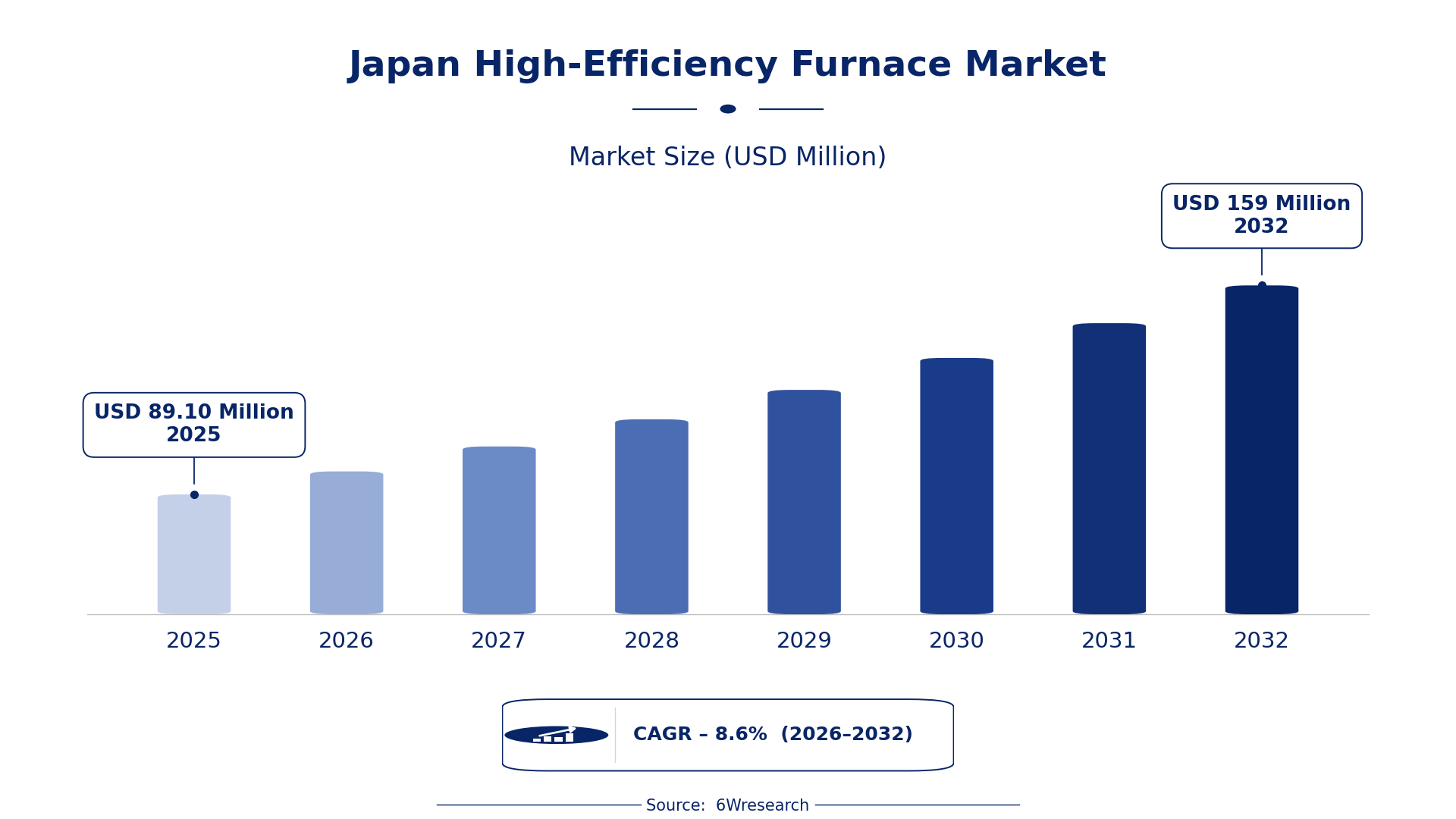
According to 6Wresearch internal database and industry insights, the Japan High-Efficiency Furnace Market was valued at USD 89.10 Million in 2025 and is projected to reach USD 159 Million by 2032, growing at a CAGR of approximately 8.6% during 2026–2032.
Japan High-Efficiency Furnace Market Highlights
| Report Metric | Details |
| Report Name | Japan High-Efficiency Furnace Market (2026-2032) |
| Market Size 2025 | USD 89.10 Million |
| Market Size 2032 | USD 159 Million |
| Absolute Growth 2025–2032 | USD 69.90 Million |
| CAGR 2026–2032 | 8.6% |
| Peak Annual Growth | 9.2% in 2028 |
| Forecast Period | 2026–2032 |
| Historical Data | 2022–2025 |
| Base Year | 2025 |
| Leading Product Type, 2025 | Condensing Furnace (36% share) |
| Leading Fuel Type, 2025 | Natural Gas (35% share) |
| Leading Distribution Channel, 2025 | HVAC Distributors (43% share) |
| Leading End User, 2025 | Residential Homes (48% share) |
| Fastest-Growing Product Type | Modulating Furnace (11.8% CAGR) |
| Fastest-Growing Fuel Type | Electric (12.3% CAGR) |
| Fastest-Growing Distribution Channel | Online Platforms (11.2% CAGR) |
| Fastest-Growing End User | Commercial Buildings (10.8% CAGR) |
| Growing Sector | Commercial Buildings |
| Key End Users | Residential Homes, Commercial Buildings, Industrial Plants, Rural Homes |
Japan High-Efficiency Furnace Market Year-wise Growth Rate and Key Drivers (2022–2032)
This graph illustrates the annual growth rates of the market from 2022 to 2032, highlighting a steady upward trajectory and projected market expansion over the forecast period.
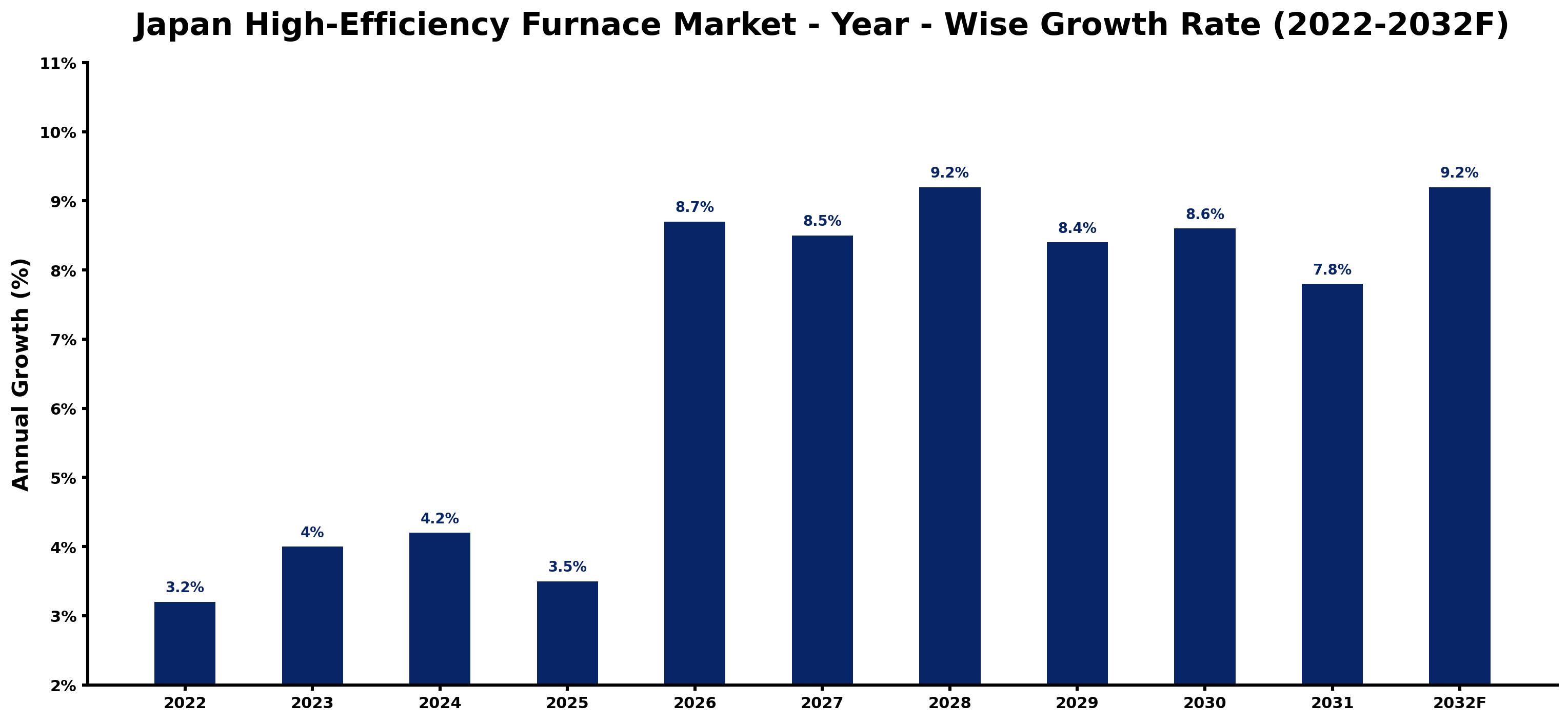
Below, each year's estimated growth is shown next to the factor that most influenced it.
| Year | Estimated Annual Growth (%) | Market Rationale |
| 2022 | 3.2 | The market showed steady growth due to rising energy efficiency awareness. |
| 2023 | 4.0 | Increased demand for energy-efficient solutions boosted market growth. |
| 2024 | 4.2 | The ongoing implementation of stricter energy regulations supported higher growth. |
| 2025 | 3.5 | Growth slowed slightly as market adjustments took place after previous gains. |
| 2026 | 8.7 | A surge in investments in energy-efficient technologies is expected to drive growth. |
| 2027 | 8.5 | Market expansion will continue, albeit at a slower pace compared to the previous year. |
| 2028 | 9.2 | The introduction of new energy standards will catalyse peak growth in the market. |
| 2029 | 8.4 | Growth will decelerate slightly as market saturation begins to set in. |
| 2030 | 8.6 | Demand for high-efficiency solutions will rise again as urban installations increase. |
| 2031 | 7.8 | Growth will slow as the market stabilises following rapid expansions. |
| 2032 | 9.2 | A renewed focus on energy conservation policies will spur growth once more. |
Note: Market size estimations and growth projections presented in this report are based on 6Wresearch's proprietary forecasting methodology, utilizing the latest available industry data, government publications, and primary research inputs.
Japan High-Efficiency Furnace Market Synopsis
High-efficiency furnaces are advanced heating systems designed to maximise energy efficiency and minimise fuel consumption. The Japan High-Efficiency Furnace Market is expanding due to rising investments in energy-efficient technologies and tightening energy regulations. In 2022, the residential heating market was valued at approximately 1.5 trillion yen, driven by strong demand from residential users and commercial sectors. The recent subsidy programme for home upgrades, which allocated 50 billion yen, further encourages the adoption of high-efficiency furnaces.
Market Dynamics Impact Analysis (2026–2032)
| Factor | Type | Impact | Primary Segment Affected |
| Rising energy efficiency standards drive demand for high-efficiency furnaces. | Driver | High | Condensing Furnace |
| Increased investments in energy-efficient technologies enhance market growth. | Driver | High | Modulating Furnace |
| The government subsidy programme encourages homeowners to upgrade heating systems. | Opportunity | High | Residential Homes |
| Urban areas are expanding, increasing the need for efficient heating solutions. | Opportunity | Medium | Commercial Buildings |
| High installation costs can deter potential buyers from upgrading systems. | Restraint | High | Two-Stage Furnace |
| Market saturation in urban areas limits growth potential for new installations. | Restraint | Medium | Multi-Position Furnace |
| Supply chain disruptions can lead to delays in product availability. | Challenge | High | Natural Gas |
| Technological advancements require continuous investment, affecting smaller players. | Challenge | Medium | Propane |
Evaluation of Drivers in Japan High-Efficiency Furnace Market (2026–2032)
The main growth drivers and the segments they affect most are set out below.
| Drivers | Primary Segment Affected | Why It Matters (Evidence) |
| Increased energy efficiency regulations drive demand for high-efficiency furnaces. | Condensing Furnace | In 2022, energy efficiency regulations were tightened, leading to greater adoption of high-efficiency models. |
| Government initiatives promote energy-efficient technologies, boosting market growth. | Modulating Furnace | The Ministry of the Environment's promotion of energy-efficient technologies encourages consumers to invest in modern heating solutions. |
| Rising energy costs prompt consumers to seek more efficient heating options. | Two-Stage Furnace | The average household in Japan spends about 100,000 yen annually on heating, motivating upgrades to more efficient systems. |
| Growing urbanisation increases the demand for efficient heating solutions. | Multi-Position Furnace | The Tokyo metropolitan area has a high concentration of residential heating installations, driving demand for advanced systems. |
| The HVAC industry employs over 300,000 people, supporting market growth. | Natural Gas | A skilled workforce in the HVAC sector facilitates the installation and maintenance of high-efficiency furnaces. |
The average household in Japan spends about 100,000 yen annually on heating, prompting consumers to seek more efficient options. The dense population in urban areas drives demand for high-efficiency furnaces, as installations are concentrated in these regions. A skilled workforce in the HVAC sector ensures the installation and maintenance of high-efficiency furnaces, supporting overall market growth.
Evaluation of Restraints in Japan High-Efficiency Furnace Market
The table below lists the restraints and the evidence behind each.
| Market Restraint | Primary Segment Affected | Why It Matters (Evidence) |
| High installation costs can deter potential buyers from upgrading systems. | Two-Stage Furnace | The average cost of a high-efficiency furnace installation is around 300,000 yen, which can be prohibitive for some consumers. |
| Market saturation in urban areas limits growth potential for new installations. | Multi-Position Furnace | In urban areas, existing heating systems saturate the market, making it challenging for new installations to gain traction. |
| Supply chain disruptions can lead to delays in product availability. | Natural Gas | Recent global supply chain issues have affected the timely availability of heating systems, impacting consumer choices. |
| Technological advancements require continuous investment, affecting smaller players. | Propane | Smaller manufacturers may struggle to keep up with rapid technological changes, limiting their competitiveness. |
| Regulatory compliance costs can burden manufacturers and suppliers. | Electric | Compliance with JIS standards adds to production costs, impacting pricing strategies for manufacturers. |
Japan High-Efficiency Furnace Market Challenges
High-efficiency furnaces face high installation costs, averaging around 400,000 yen, which discourages buyers from making upgrades. Residential users in urban areas often postpone purchases due to limited financial incentives, despite the government's subsidy program. Suppliers encounter difficulties meeting stricter energy efficiency regulations established in 2022, resulting in delays for manufacturers. Supply chain disruptions occur as the HVAC industry, employing over 300,000 people, struggles to source high-grade materials, leading to extended lead times for installers and diminishing end-user satisfaction.
Trends in the Japan High-Efficiency Furnace Market
These developments are changing demand patterns in the Japan High-Efficiency Furnace Market.
- Shift towards Energy-Efficient Heating Solutions: The promotion of energy-efficient technologies is reshaping the heating market. In 2023, the government launched a subsidy programme for energy-efficient home upgrades, encouraging more households to invest in high-efficiency furnaces.
- Urban Areas Driving Demand for High-Efficiency Furnaces: The Kanto region is experiencing a surge in demand for high-efficiency furnaces due to its dense population. In 2022, approximately 70% of residential heating systems used natural gas, highlighting the need for efficient solutions.
- Increased Focus on Energy Conservation: Since 2022, energy conservation has become a key focus of Japan's national energy policy. The tightening of energy efficiency regulations has led to increased investments in high-efficiency heating technologies.
- Growing Adoption of Smart Heating Technologies: The introduction of smart heating systems is gaining traction in urban areas. In 2023, the average energy savings from high-efficiency furnaces reached 30% compared to older models, attracting more consumers.
Investment Opportunities in the Japan High-Efficiency Furnace Market
Below are the investment opportunities with the strongest case in the Japan High-Efficiency Furnace Market.
- Expansion in Urban Heating Installations: The Kanto region is a major market for heating systems, with a dense population driving demand. The installation of high-efficiency furnaces is expected to rise as urban areas expand.
- Government Subsidy Programmes for Home Upgrades: With the government allocating 50 billion yen for energy efficiency initiatives, there is an opportunity for suppliers to engage with residential buyers seeking upgrades.
- Investing in Advanced Heating Technologies: The growing focus on energy efficiency creates opportunities for manufacturers to develop new heating solutions. The HVAC industry is actively seeking advancements to meet evolving consumer demands.
- Partnerships with HVAC Distributors: By collaborating with HVAC distributors, suppliers can effectively reach residential and commercial buyers. This strategy is particularly relevant as the market shifts towards energy-efficient solutions.
Government Initiatives in the Japan High-Efficiency Furnace Market
The Building Energy Efficiency Act, amended in 2022, requires all new buildings to meet stringent energy standards starting April 2025. This law updates previous regulations by ensuring that new constructions contribute to energy conservation goals, thereby promoting the adoption of high-efficiency furnaces.
In 2023, the government allocated 50 billion yen for energy efficiency initiatives, administered by the Ministry of the Environment. This funding supports various projects aimed at improving energy efficiency in residential and commercial buildings, facilitating the transition to high-efficiency heating solutions.
Future Insight of the Japan High-Efficiency Furnace Market
Japan's government will continue to promote energy-efficient technologies, driving a shift towards high-efficiency furnaces by 2032. The increase in urban installations will provide buyers with opportunities for lower heating costs, as annual energy savings from these furnaces can reach 30% compared to older models. Compliance with JIS standards will motivate suppliers to innovate and improve product offerings. The adoption of ISO 50001 standards in industrial settings will support advancements in energy management, benefiting both buyers and suppliers.
Market Segmentation Analysis
Japan High-Efficiency Furnace Market report covers a detailed analysis of the following market segments:
By Product Type – Condensing Furnace Leads, Modulating Furnace Expected to Grow Fastest
According to Saurav Kr Singh, Senior Research Analyst at 6Wresearch, Condensing Furnace took 36% of product type revenue in 2025, more than any other category. Condensing furnaces hold the largest share due to their widespread use in residential and commercial heating applications, achieving efficiency levels of up to 98%. This is particularly evident in urban areas like Tokyo, where energy conservation is a priority. Modulating Furnace is projected to grow fastest, at a CAGR of 11.8% during 2026–2032. The modulating furnace segment is growing quickly as it offers variable heating output, which aligns with the increasing demand for energy-efficient technologies. The government's subsidy programme for energy-efficient home upgrades is also boosting this segment's growth. Suppliers should focus on promoting modulating furnaces to capitalise on the rising market demand.
By Fuel Type – Natural Gas Lead, Electric Expected to Grow Fastest
In 2025, Natural Gas led the fuel type split with a 35% share. Natural gas is the predominant fuel type in Japan, used in approximately 70% of residential heating systems, making it the leading segment. Its availability and established infrastructure contribute to its widespread adoption. Over 2026–2032, Electric is expected to post the fastest growth, at a CAGR of 12.3%. Electric heating is gaining traction, particularly in specific applications, as consumers seek alternatives to traditional fuel sources. The government's push for energy efficiency initiatives is likely to accelerate this transition. Buyers may increasingly consider electric options as part of their energy efficiency strategies.
By Distribution Channel – HVAC Distributors Lead, Online Platforms Expected to Grow Fastest
HVAC Distributors accounted for 43% of the market by distribution channel in 2025. HVAC distributors dominate the market as the primary channel for distributing heating systems across Japan. Their established networks ensure that high-efficiency furnaces reach a broad customer base effectively. The quickest growth will come from Online Platforms, forecast to expand at a CAGR of 11.2% between 2026 and 2032. Online platforms are rapidly expanding, driven by changing consumer purchasing habits and the convenience of digital shopping. This trend is expected to continue as consumers increasingly look for accessible product information and purchasing options. Suppliers should enhance their online presence to align with the evolving purchasing preferences of consumers.
By End User – Residential Homes Lead, Commercial Buildings Expected to Grow Fastest
With 48% of end user revenue in 2025, Residential Homes was the largest category. Residential homes represent the largest end-user segment for high-efficiency furnaces, reflecting strong demand for efficient heating solutions in households. The average household expenditure on heating further underscores this segment's significance. Commercial Buildings are set to record the highest CAGR in this split, 10.8% over 2026–2032. The commercial buildings segment is experiencing the fastest growth as businesses prioritise energy efficiency to reduce operational costs. This trend is supported by stricter energy regulations and a focus on sustainability. Suppliers should engage commercial clients with tailored solutions to capture this growing market segment.
Key Attractiveness of the Report
- 10 Years of Market Numbers
- Historical Data Starting from 2022 to 2025
- Base Year 2025
- Forecast Data until 2032
- Key Performance Indicators Impacting the Market
- Major Upcoming Developments and Projects
Key Highlights of the Report:
- Japan High-Efficiency Furnace Market Outlook
- Market Size of Japan High-Efficiency Furnace Market, 2025
- Forecast of Japan High-Efficiency Furnace Market, 2032
- Historical Data and Forecast of Japan High-Efficiency Furnace Revenues & Volume for the Period 2022-2032F
- Japan High-Efficiency Furnace Market Trend Evolution
- Japan High-Efficiency Furnace Market Drivers and Challenges
- Japan High-Efficiency Furnace Price Trends
- Japan High-Efficiency Furnace Porter's Five Forces
- Japan High-Efficiency Furnace Industry Life Cycle
- Historical Data and Forecast of Japan High-Efficiency Furnace Market Revenues & Volume By Product Type for the Period 2022-2032F
- Historical Data and Forecast of Japan High-Efficiency Furnace Market Revenues & Volume By Condensing Furnace for the Period 2022-2032F
- Historical Data and Forecast of Japan High-Efficiency Furnace Market Revenues & Volume By Modulating Furnace for the Period 2022-2032F
- Historical Data and Forecast of Japan High-Efficiency Furnace Market Revenues & Volume By Two-Stage Furnace for the Period 2022-2032F
- Historical Data and Forecast of Japan High-Efficiency Furnace Market Revenues & Volume By Multi-Position Furnace for the Period 2022-2032F
- Historical Data and Forecast of Japan High-Efficiency Furnace Market Revenues & Volume By Fuel Type for the Period 2022-2032F
- Historical Data and Forecast of Japan High-Efficiency Furnace Market Revenues & Volume By Natural Gas for the Period 2022-2032F
- Historical Data and Forecast of Japan High-Efficiency Furnace Market Revenues & Volume By Propane for the Period 2022-2032F
- Historical Data and Forecast of Japan High-Efficiency Furnace Market Revenues & Volume By Electric for the Period 2022-2032F
- Historical Data and Forecast of Japan High-Efficiency Furnace Market Revenues & Volume By Oil for the Period 2022-2032F
- Historical Data and Forecast of Japan High-Efficiency Furnace Market Revenues & Volume By Distribution Channel for the Period 2022-2032F
- Historical Data and Forecast of Japan High-Efficiency Furnace Market Revenues & Volume By HVAC Distributors for the Period 2022-2032F
- Historical Data and Forecast of Japan High-Efficiency Furnace Market Revenues & Volume By Online Platforms for the Period 2022-2032F
- Historical Data and Forecast of Japan High-Efficiency Furnace Market Revenues & Volume By OEMs for the Period 2022-2032F
- Historical Data and Forecast of Japan High-Efficiency Furnace Market Revenues & Volume By Specialty Retailers for the Period 2022-2032F
- Historical Data and Forecast of Japan High-Efficiency Furnace Market Revenues & Volume By End User for the Period 2022-2032F
- Historical Data and Forecast of Japan High-Efficiency Furnace Market Revenues & Volume By Residential Homes for the Period 2022-2032F
- Historical Data and Forecast of Japan High-Efficiency Furnace Market Revenues & Volume By Commercial Buildings for the Period 2022-2032F
- Historical Data and Forecast of Japan High-Efficiency Furnace Market Revenues & Volume By Industrial Plants for the Period 2022-2032F
- Historical Data and Forecast of Japan High-Efficiency Furnace Market Revenues & Volume By Rural Homes for the Period 2022-2032F
- Japan High-Efficiency Furnace Import Export Trade Statistics
- Market Opportunity Assessment By Product Type
- Market Opportunity Assessment By Fuel Type
- Market Opportunity Assessment By Distribution Channel
- Market Opportunity Assessment By End User
- Japan High-Efficiency Furnace Top Companies Market Share
- Japan High-Efficiency Furnace Competitive Benchmarking By Technical and Operational Parameters
- Japan High-Efficiency Furnace Company Profiles
- Japan High-Efficiency Furnace Key Strategic Recommendations
Market Covered
The following segment groups are covered in the report.
By Product Type
- Condensing Furnace
- Modulating Furnace
- Two-Stage Furnace
- Multi-Position Furnace
By Fuel Type
- Natural Gas
- Propane
- Electric
- Oil
By Distribution Channel
- HVAC Distributors
- Online Platforms
- OEMs
- Specialty Retailers
By End User
- Residential Homes
- Commercial Buildings
- Industrial Plants
- Rural Homes































