Japan High-End Apparel Market Size & Growth Rate
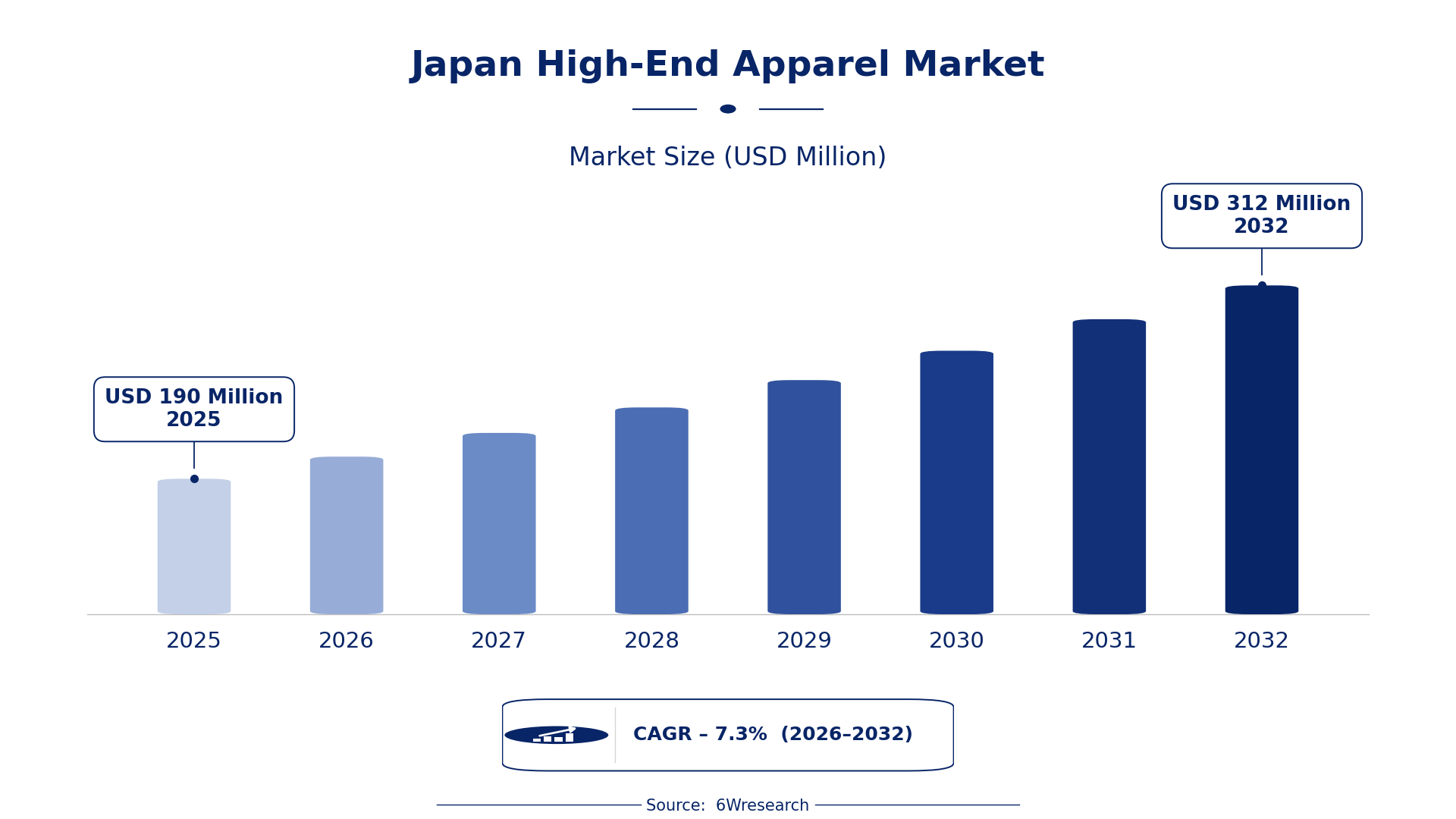
According to 6Wresearch internal database and industry insights, the Japan High-End Apparel Market was valued at USD 190 Million in 2025 and is projected to reach USD 312 Million by 2032, growing at a CAGR of approximately 7.3% during 2026–2032.
Japan High-End Apparel Market Highlights
| Report Metric | Details |
| Report Name | Japan High-End Apparel Market (2026-2032) |
| Market Size 2025 | USD 190 Million |
| Market Size 2032 | USD 312 Million |
| Absolute Growth 2025–2032 | USD 122 Million |
| CAGR 2026–2032 | 7.3% |
| Peak Annual Growth | 8.1% in 2029 |
| Forecast Period | 2026–2032 |
| Historical Data | 2022–2025 |
| Base Year | 2025 |
| Leading Product Type, 2025 | Designer Dresses (33% share) |
| Leading Material Used, 2025 | Silk (34% share) |
| Leading Distribution Channel, 2025 | Fashion Retailers (43% share) |
| Leading End User, 2025 | Luxury Consumers (42% share) |
| Fastest-Growing Product Type | Custom Suits (10.1% CAGR) |
| Fastest-Growing Material Used | Wool Blend (10.5% CAGR) |
| Fastest-Growing Distribution Channel | Boutique Stores (9.4% CAGR) |
| Fastest-Growing End User | Corporate Clients (9.3% CAGR) |
| Growing Sector | Luxury Apparel |
| Key End Users | Luxury Consumers, Corporate Clients, Fashion Retailers |
Japan High-End Apparel Market Year-wise Growth Rate and Key Drivers (2022–2032)
This graph illustrates the annual growth rates of the market from 2022 to 2032, highlighting a steady upward trajectory and projected market expansion over the forecast period.
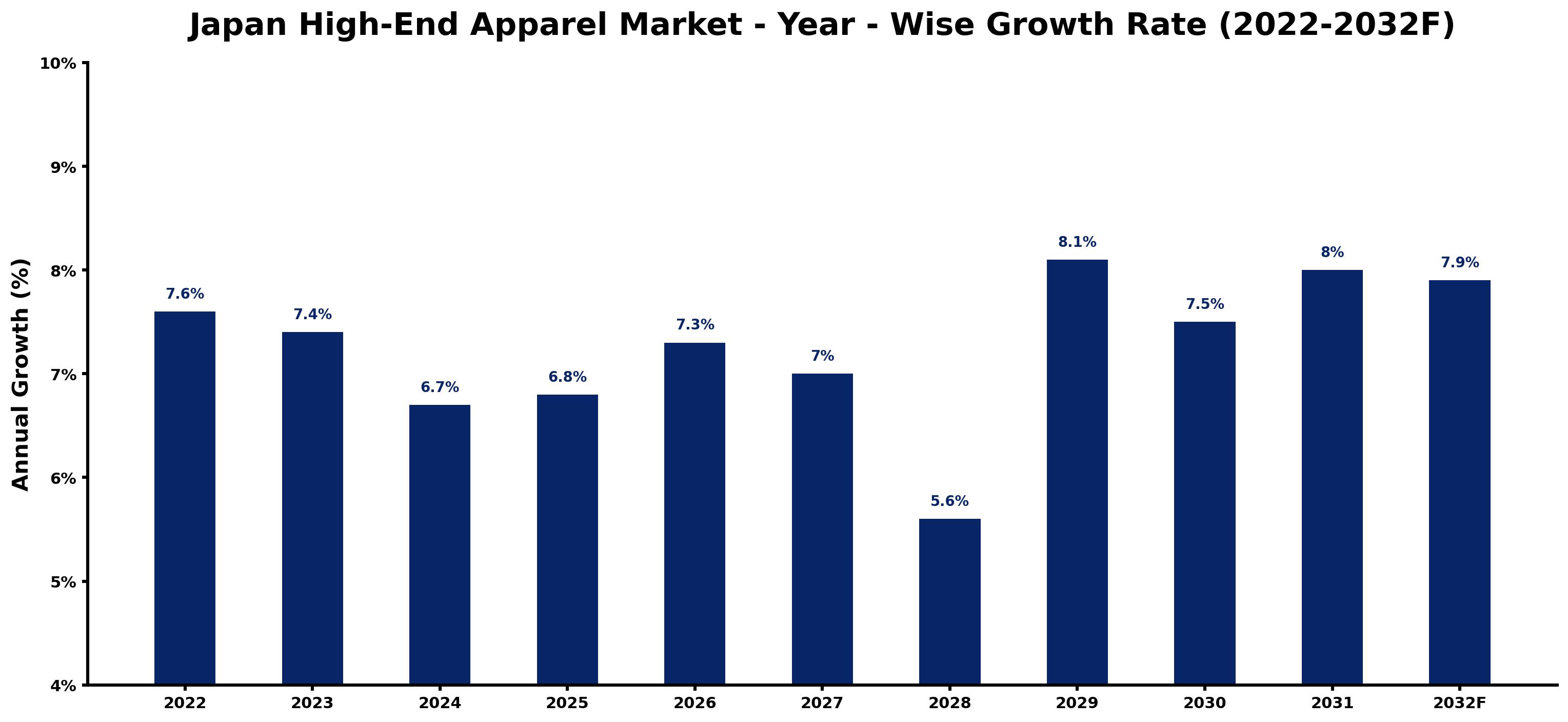
Year by year, the estimates below pair each growth rate with the development that shaped it.
| Year | Estimated Annual Growth (%) | Market Rationale |
| 2022 | 7.6 | The market experienced solid demand driven by luxury consumers and high-profile events. |
| 2023 | 7.4 | Growth slowed slightly due to market saturation and changing consumer preferences. |
| 2024 | 6.7 | Continued growth was supported by the Tokyo Fashion Week and rising disposable incomes. |
| 2025 | 6.8 | An increase in spending on luxury apparel was noted as consumer confidence improved. |
| 2026 | 7.3 | Demand is expected to accelerate as online luxury sales gain traction among younger buyers. |
| 2027 | 7.0 | Growth is projected to slow as competition intensifies among high-end retailers in urban areas. |
| 2028 | 5.6 | A slowdown in growth is expected as consumer spending stabilises. |
| 2029 | 8.1 | The market is projected to surge as luxury dresses see a strong increase during wedding season. |
| 2030 | 7.5 | Growth is anticipated to slow as the market adjusts to new consumer habits and preferences. |
| 2031 | 8.0 | Demand will rise again as corporate clients increase purchases of custom suits. |
| 2032 | 7.9 | Growth is expected to moderate as the market stabilises after several years of rapid expansion. |
Note: Market size estimations and growth projections presented in this report are based on 6Wresearch's proprietary forecasting methodology, utilizing the latest available industry data, government publications, and primary research inputs.
Japan High-End Apparel Market Synopsis
High-end apparel in Japan encompasses luxury clothing items distinguished by quality, craftsmanship, and design, primarily made from silk and organic cotton. The Japan High-End Apparel Market was valued at approximately 2 trillion JPY in 2022, reflecting strong demand driven by increasing consumer spending, particularly among affluent buyers. The average annual expenditure on luxury apparel is around 300,000 JPY, showcasing the market's growth potential fuelled by events like Tokyo Fashion Week.
Market Dynamics Impact Analysis (2026–2032)
| Factor | Type | Impact | Primary Segment Affected |
| Increasing disposable income among luxury consumers drives demand for high-end apparel. | Driver | High | Designer Dresses |
| The rise of online shopping platforms enhances accessibility for luxury apparel buyers. | Driver | High | Fashion Retailers |
| Growing interest in sustainable fashion creates opportunities for organic cotton apparel. | Opportunity | High | Organic Cotton |
| The demand for custom suits is rising among corporate clients seeking tailored options. | Opportunity | High | Custom Suits |
| High competition among retailers may limit profit margins for high-end apparel producers. | Restraint | Medium | Luxury Streetwear |
| Consumer preferences are shifting towards casual wear, affecting formal apparel sales. | Restraint | Medium | Designer Dresses |
| Rising production costs may impact pricing strategies for high-end apparel manufacturers. | Challenge | High | Custom Suits |
| Supply chain disruptions can delay product availability for luxury retailers. | Challenge | Medium | Fashion Retailers |
Evaluation of Drivers in Japan High-End Apparel Market (2026–2032)
Demand rests on the following drivers, each shown with the segment it touches most.
| Drivers | Primary Segment Affected | Why It Matters (Evidence) |
| Increased disposable income | Luxury Consumers | The average annual spending on luxury apparel is around 300,000 JPY, which boosts purchases among affluent consumers. |
| Growth of online shopping | Online Platforms | Online luxury sales increased by 30% in 2023, indicating a shift in consumer shopping habits. |
| Sustainable fashion initiatives | Organic Cotton | Government support for sustainable fashion is increasing demand for eco-friendly materials, enhancing market appeal. |
| Corporate events and weddings | Custom Suits | Demand for luxury dresses surged by 25% during the 2023 wedding season, positively impacting custom suit sales. |
| Influence of fashion events | Designer Dresses | Tokyo Fashion Week showcases over 50 high-end apparel brands each year, stimulating consumer interest. |
Several shifts outside the market lift sales. The average annual spending on luxury apparel is around 300,000 JPY, which boosts purchases among affluent consumers. Online luxury sales increased by 30% in 2023, reflecting a shift in shopping habits, particularly among younger demographics. Interest in sustainable fashion is rising, with organic cotton gaining traction. The 2023 wedding season saw a 25% surge in luxury dress demand, positively impacting custom suit purchases. Events like Tokyo Fashion Week, featuring over 50 high-end brands, stimulate consumer interest in exclusive apparel.
Evaluation of Restraints in Japan High-End Apparel Market
These restraints slow adoption and weigh on supplier margins.
| Market Restraint | Primary Segment Affected | Why It Matters (Evidence) |
| High competition among retailers | Luxury Streetwear | Intense competition restricts profit margins, affecting profitability for luxury streetwear brands. |
| Shifting consumer preferences | Designer Dresses | A trend towards casual wear impacts sales of formal apparel, reducing demand for designer dresses. |
| Rising production costs | Custom Suits | Increased costs for materials and labour may lead to higher prices for custom suits, deterring buyers. |
| Supply chain disruptions | Fashion Retailers | Delays in the supply chain can affect product availability, impacting sales for fashion retailers. |
| Market saturation | Luxury Consumers | An oversaturated market can slow growth as consumers have many options, resulting in reduced spending. |
Japan High-End Apparel Market Challenges
Producers face supply chain disruptions as Japan's declining population limits the workforce, increasing operational expenses by up to 15%. Buyers experience rising costs due to limited production capacity, which can lead to price increases of 10% for luxury apparel. Competition escalates as new brands enter the market, forcing established players to divert resources to marketing, potentially compromising product quality. Skills shortages in traditional craftsmanship hinder the production of high-quality items, risking brand reputation and leading to customer attrition among discerning buyers.
Trends in the Japan High-End Apparel Market
Four trends stand out in the Japan High-End Apparel Market.
- Shift from Traditional to Online Shopping: The trend towards online shopping has accelerated, with online luxury sales growing by 30% in 2023. This reflects changing consumer preferences, particularly among younger buyers seeking convenience.
- Increase in Sustainable Fashion: Sustainable fashion is gaining traction, supported by government initiatives. The Ministry of the Environment promotes eco-friendly practices, influencing consumer choices towards organic cotton apparel.
- Rise in Demand for Custom Suits: The demand for custom suits has surged, particularly among corporate clients. This growth is driven by the increasing need for tailored clothing for professional settings.
- Growth of Luxury Streetwear: Luxury streetwear has seen a 20% increase in popularity among millennials in 2023. This trend highlights a shift in fashion preferences towards more casual yet upscale attire.
Investment Opportunities in the Japan High-End Apparel Market
The opportunities below stand out in the Japan High-End Apparel Market for new entrants and existing suppliers.
- Partnerships with Local Designers: Now is an ideal time for partnerships with local designers, especially with the government's support for local talent. This can improve brand visibility and appeal to consumers seeking unique offerings.
- Investment in Sustainable Materials: With a growing interest in sustainable fashion, investing in organic cotton can meet rising consumer demand. Fashion retailers focusing on eco-friendly products can attract environmentally conscious buyers.
- Expansion of Boutique Stores: Boutique stores are experiencing a 40% increase in foot traffic in 2023, indicating a strong opportunity for investment in this channel. Engaging local artisans can enrich product offerings.
- Utilisation of Online Platforms: The rise of online shopping presents a strong opportunity for brands to expand their reach. Establishing a robust online presence can attract younger consumers looking for luxury apparel.
Government Initiatives in the Japan High-End Apparel Market
The Industrial Standardization Act, established in 1949 and amended in 2019, governs product standards for high-end apparel. This law ensures that manufacturers adhere to quality and safety standards, thereby building consumer trust in luxury products. The Act against Unjustifiable Premiums and Misleading Representations from 1962 prohibits misleading advertising, protecting buyers from deceptive practices.
The Digital Agency, established in September 2021, oversees government digital transformation efforts. This agency supports initiatives that improve online shopping experiences for consumers, ensuring that high-end apparel brands can effectively reach their target audience through digital platforms.
Future Insight of the Japan High-End Apparel Market
By 2032, the Ministry of Economy, Trade and Industry will enhance support for local designers, driving innovation in high-end apparel. Sustainable fashion initiatives will encourage the use of eco-friendly materials, appealing to buyers focused on sustainability. Online luxury sales are projected to reach a growth of 30%, prompting suppliers to refine their digital strategies. Tokyo's fashion events will continue to showcase unique designs, creating collaboration opportunities and elevating the visibility of high-end apparel.
Market Segmentation Analysis
Japan High-End Apparel Market report covers a detailed analysis of the following market segments:
By Product Type – Designer Dresses Lead, Custom Suits Expected to Grow Fastest
According to Saurav Kr Singh, Senior Research Analyst at 6Wresearch, Designer Dresses accounted for 33% of the market by product type in 2025. Designer dresses dominate the high-end apparel market in Japan, appealing to consumers seeking elegance for formal events. This segment benefits from the Tokyo Fashion Week, which showcases over 50 high-end apparel brands annually, reinforcing its popularity. Over 2026–2032, Custom Suits are expected to post the fastest growth, at a CAGR of 10.1%. Custom suits are rapidly gaining traction among corporate clients who require tailored options for special events. The increasing demand for bespoke tailoring services in urban centres like Tokyo and Osaka is driving this growth. Suppliers should prioritise the development of custom suit offerings to capitalise on the expanding corporate client base.
By Material Used – Silk Leads, Wool Blend Expected to Grow Fastest
Silk took 34% of material used revenue in 2025, more than any other category. Silk is the leading material in high-end apparel, valued for its exceptional quality and luxurious feel. Approximately 30% of luxury garments sold in Japan feature silk, underscoring its prominence in the market. Wool Blend is set to record the highest CAGR in this split, 10.5% over 2026–2032. Wool blend fabrics are becoming increasingly popular, especially for suits and outerwear, due to their warmth and adaptability. This trend is likely to continue as consumers seek functional yet stylish high-end apparel during colder seasons. Buyers should explore wool blend options as they gain popularity, ensuring they remain aligned with market trends.
By Distribution Channel – Fashion Retailers Lead, Boutique Stores Expected to Grow Fastest
The largest distribution channel category in 2025 was Fashion Retailers, at 43% of revenue. Fashion retailers serve as the primary distribution channel for high-end apparel, providing a wide range of luxury brands to consumers. The Tokyo Fashion Week, showcasing over 50 high-end apparel brands annually, underscores the significance of this channel in the market. The quickest growth will come from Boutique Stores, forecast to expand at a CAGR of 9.4% between 2026 and 2032. Boutique stores are experiencing rapid growth, particularly in affluent districts like Ginza, where foot traffic increased by 40% in 2023. This trend highlights a strong consumer inclination towards exclusive collections and personalised shopping experiences. Suppliers should explore partnerships with boutique stores to strengthen their market presence and appeal to discerning luxury consumers.
By End User – Luxury Consumers Lead, Corporate Clients Expected to Grow Fastest
In 2025, Luxury Consumers led the end user split with a 42% share. Luxury consumers represent the predominant end users of high-end apparel, playing a crucial role in shaping market trends. With 60% of these consumers being female, their preferences significantly influence the demand for various luxury fashion items. Corporate Clients are projected to grow fastest, at a CAGR of 9.3% during 2026–2032. Corporate clients are increasingly prioritising custom suits and formal wear, indicating a shift towards tailored attire in professional environments. This trend is likely to continue as businesses recognise the value of a polished appearance. Suppliers should tailor their marketing strategies to meet the specific needs of corporate clients within the luxury apparel market.
Key Attractiveness of the Report
- 10 Years of Market Numbers
- Historical Data Starting from 2022 to 2025
- Base Year 2025
- Forecast Data until 2032
- Key Performance Indicators Impacting the Market
- Major Upcoming Developments and Projects
Key Highlights of the Report:
- Japan High-End Apparel Market Outlook
- Market Size of Japan High-End Apparel Market, 2025
- Forecast of Japan High-End Apparel Market, 2032
- Historical Data and Forecast of Japan High-End Apparel Revenues & Volume for the Period 2022-2032F
- Japan High-End Apparel Market Trend Evolution
- Japan High-End Apparel Market Drivers and Challenges
- Japan High-End Apparel Price Trends
- Japan High-End Apparel Porter's Five Forces
- Japan High-End Apparel Industry Life Cycle
- Historical Data and Forecast of Japan High-End Apparel Market Revenues & Volume By Product Type for the Period 2022-2032F
- Historical Data and Forecast of Japan High-End Apparel Market Revenues & Volume By Designer Dresses for the Period 2022-2032F
- Historical Data and Forecast of Japan High-End Apparel Market Revenues & Volume By Custom Suits for the Period 2022-2032F
- Historical Data and Forecast of Japan High-End Apparel Market Revenues & Volume By Luxury Streetwear for the Period 2022-2032F
- Historical Data and Forecast of Japan High-End Apparel Market Revenues & Volume By High-End Sportswear for the Period 2022-2032F
- Historical Data and Forecast of Japan High-End Apparel Market Revenues & Volume By Material Used for the Period 2022-2032F
- Historical Data and Forecast of Japan High-End Apparel Market Revenues & Volume By Silk for the Period 2022-2032F
- Historical Data and Forecast of Japan High-End Apparel Market Revenues & Volume By Wool Blend for the Period 2022-2032F
- Historical Data and Forecast of Japan High-End Apparel Market Revenues & Volume By Organic Cotton for the Period 2022-2032F
- Historical Data and Forecast of Japan High-End Apparel Market Revenues & Volume By Lycra for the Period 2022-2032F
- Historical Data and Forecast of Japan High-End Apparel Market Revenues & Volume By Distribution Channel for the Period 2022-2032F
- Historical Data and Forecast of Japan High-End Apparel Market Revenues & Volume By Fashion Retailers for the Period 2022-2032F
- Historical Data and Forecast of Japan High-End Apparel Market Revenues & Volume By Boutique Stores for the Period 2022-2032F
- Historical Data and Forecast of Japan High-End Apparel Market Revenues & Volume By Online Platforms for the Period 2022-2032F
- Historical Data and Forecast of Japan High-End Apparel Market Revenues & Volume By Brand Outlets for the Period 2022-2032F
- Historical Data and Forecast of Japan High-End Apparel Market Revenues & Volume By End User for the Period 2022-2032F
- Historical Data and Forecast of Japan High-End Apparel Market Revenues & Volume By Luxury Consumers for the Period 2022-2032F
- Historical Data and Forecast of Japan High-End Apparel Market Revenues & Volume By Corporate Clients for the Period 2022-2032F
- Historical Data and Forecast of Japan High-End Apparel Market Revenues & Volume By Millennials for the Period 2022-2032F
- Historical Data and Forecast of Japan High-End Apparel Market Revenues & Volume By Athletes for the Period 2022-2032F
- Japan High-End Apparel Import Export Trade Statistics
- Market Opportunity Assessment By Product Type
- Market Opportunity Assessment By Material Used
- Market Opportunity Assessment By Distribution Channel
- Market Opportunity Assessment By End User
- Japan High-End Apparel Top Companies Market Share
- Japan High-End Apparel Competitive Benchmarking By Technical and Operational Parameters
- Japan High-End Apparel Company Profiles
- Japan High-End Apparel Key Strategic Recommendations
Market Covered
The following segment groups are covered in the report.
By Product Type
- Designer Dresses
- Custom Suits
- Luxury Streetwear
- High-End Sportswear
By Material Used
- Silk
- Wool Blend
- Organic Cotton
- Lycra
By Distribution Channel
- Fashion Retailers
- Boutique Stores
- Online Platforms
- Brand Outlets
By End User
- Luxury Consumers
- Corporate Clients
- Millennials
- Athletes































