Japan High-Frequency Telecom Market Size & Growth Rate
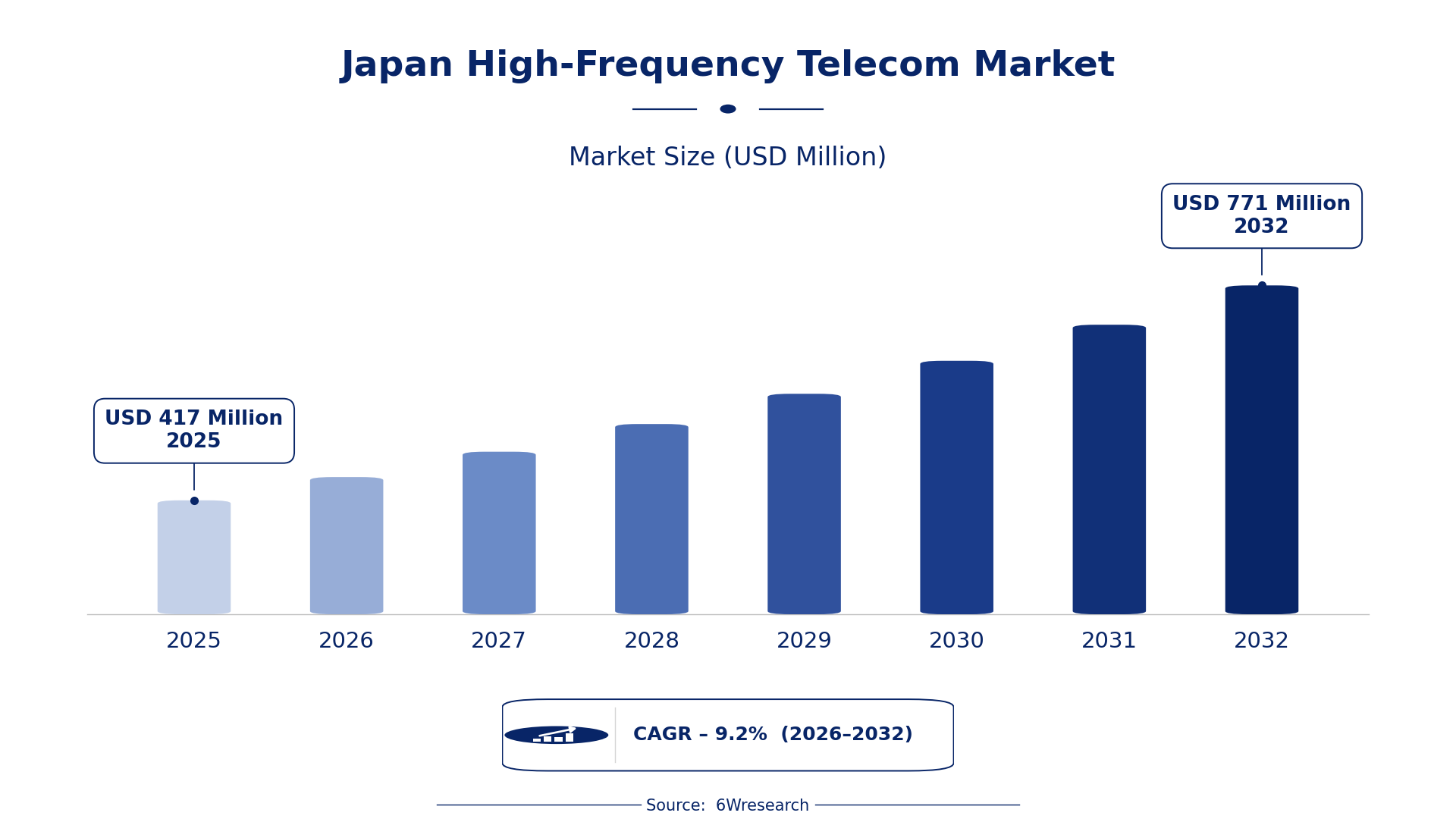
According to 6Wresearch internal database and industry insights, the Japan High-Frequency Telecom Market was valued at USD 417 Million in 2025 and is projected to reach USD 771 Million by 2032, growing at a CAGR of approximately 9.2% during 2026–2032.
Japan High-Frequency Telecom Market Highlights
| Report Metric | Details |
| Report Name | Japan High-Frequency Telecom Market (2026-2032) |
| Market Size 2025 | USD 417 Million |
| Market Size 2032 | USD 771 Million |
| Absolute Growth 2025–2032 | USD 354 Million |
| CAGR 2026–2032 | 9.2% |
| Peak Annual Growth | 10.7% in 2027 |
| Forecast Period | 2026–2032 |
| Historical Data | 2022–2025 |
| Base Year | 2025 |
| Leading Product Type, 2025 | mmWave Antennas (47% share) |
| Leading Technology Type, 2025 | 5G NR (39% share) |
| Leading Distribution Channel, 2025 | OEM Sales (38% share) |
| Leading End User, 2025 | Mobile Networks (47% share) |
| Fastest-Growing Product Type | High-Frequency Routers (12.5% CAGR) |
| Fastest-Growing Technology Type | GHz-Band (12.7% CAGR) |
| Fastest-Growing Distribution Channel | Online B2B Platforms (11.6% CAGR) |
| Fastest-Growing End User | Enterprises (12.1% CAGR) |
| Growing Sector | Smart Cities |
| Key End Users | Telecom Carriers, Mobile Networks, Telecom Vendors, Enterprises |
Japan High-Frequency Telecom Market Year-wise Growth Rate and Key Drivers (2022–2032)
This graph illustrates the annual growth rates of the market from 2022 to 2032, highlighting a steady upward trajectory and projected market expansion over the forecast period.
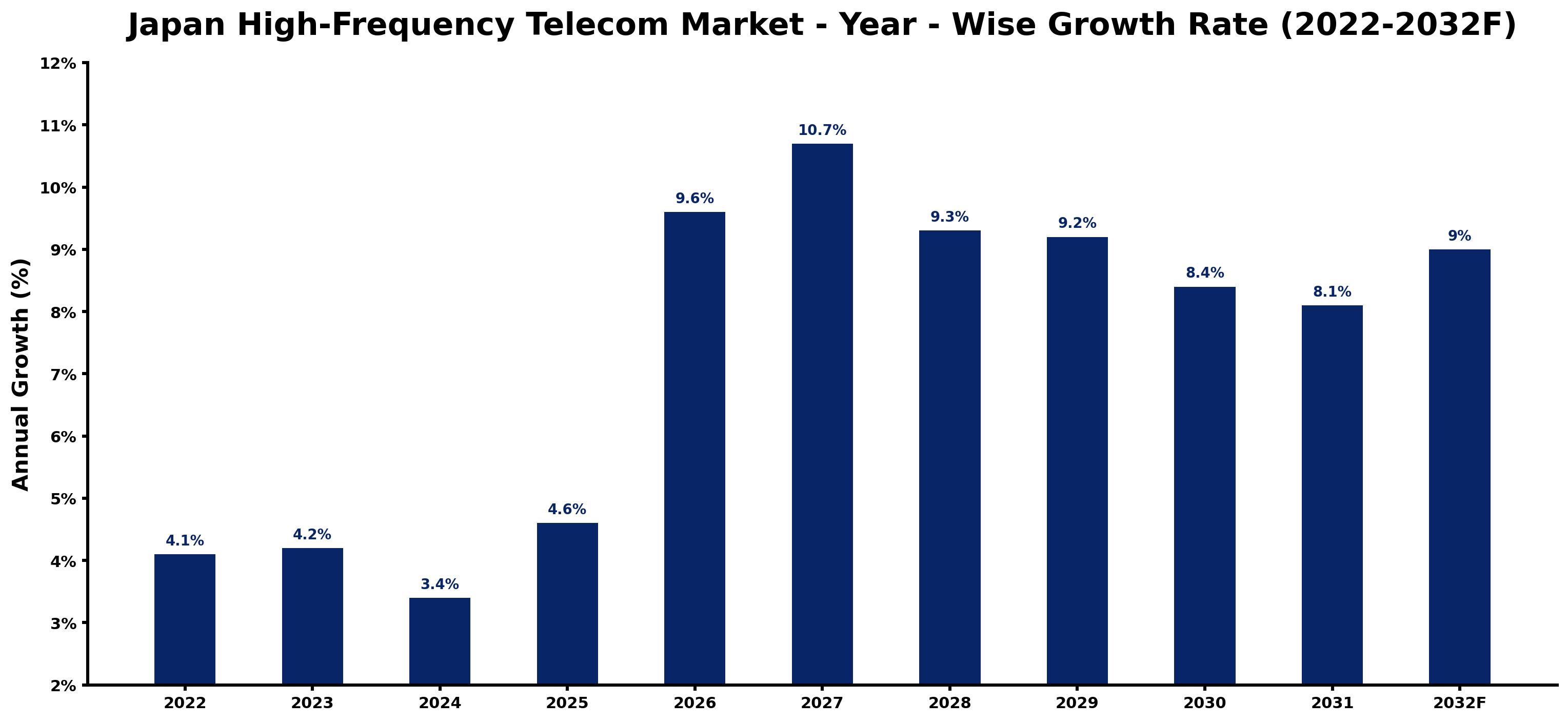
The following figures match every annual growth estimate with the main market development of that year, giving the reasoning behind each rise or slowdown.
| Year | Estimated Annual Growth (%) | Market Rationale |
| 2022 | 4.1 | The market experienced stable demand driven by existing mobile network infrastructure. |
| 2023 | 4.2 | Growth accelerated due to increased investments in 5G technology and urban infrastructure. |
| 2024 | 3.4 | Growth slowed as market saturation began affecting new subscriptions and installations. |
| 2025 | 4.6 | Demand surged with the completion of major 5G deployments across urban areas. |
| 2026 | 9.6 | Investment in high-frequency technologies is expected to rise as smart city initiatives gain traction. |
| 2027 | 10.7 | The market is projected to peak as mobile networks expand their capacities with advanced technologies. |
| 2028 | 9.3 | Growth is anticipated to slow as the market matures and competition intensifies among suppliers. |
| 2029 | 9.2 | Demand will continue to grow, but at a reduced rate as market conditions stabilise. |
| 2030 | 8.4 | Growth is expected to slow further as the focus shifts to optimising existing network capabilities. |
| 2031 | 8.1 | A slight slowdown will occur as the market adjusts to new technological standards. |
| 2032 | 9.0 | Growth will pick up again with renewed investments in next-generation telecom infrastructure. |
Note: Market size estimations and growth projections presented in this report are based on 6Wresearch's proprietary forecasting methodology, utilizing the latest available industry data, government publications, and primary research inputs.
Japan High-Frequency Telecom Market Synopsis
High-Frequency Telecom products represent advanced telecommunications technologies used for high-speed data transmission, utilising semiconductor materials and advanced manufacturing techniques. The Japan High-Frequency Telecom Market is growing due to strong domestic demand driven by mobile networks and smart city projects, with 5G deployment aiming for 99% coverage by 2025 and over 70 million 5G users recorded in 2023. This growth is supported by substantial investments in infrastructure and technology enhancements that improve network performance.
Market Dynamics Impact Analysis (2026–2032)
| Factor | Type | Impact | Primary Segment Affected |
| Growing investment in smart city projects | Driver | High | High-Frequency Routers |
| Increasing mobile subscriptions driving demand for high-speed data | Driver | High | mmWave Antennas |
| Rising need for enhanced network capacity in urban areas | Opportunity | High | Small Cell Units |
| Expansion of 5G infrastructure across major cities | Opportunity | High | 5G NR |
| Market saturation limiting new subscriber growth | Restraint | Medium | Telecom Carriers |
| High costs associated with advanced technology adoption | Restraint | Medium | Telecom Vendors |
| Intense competition among telecom vendors impacting pricing | Challenge | High | Telecom Vendors |
| Rapid technological advancements requiring constant upgrades | Challenge | Medium | Infrastructure Distributors |
Evaluation of Drivers in Japan High-Frequency Telecom Market (2026–2032)
Below are the drivers that matter most for revenue growth, with supporting evidence.
| Drivers | Primary Segment Affected | Why It Matters (Evidence) |
| Increased mobile subscriptions | mmWave Antennas | Japan's total mobile subscriptions reached 180 million in 2023, boosting demand for high-frequency technologies. |
| Smart city initiatives | High-Frequency Routers | The Smart City initiative drives demand for improved network capabilities in urban areas, with investments in infrastructure estimated at ¥1 trillion. |
| 5G deployment efforts | 5G NR | The target of 99% 5G coverage by 2025 accelerates investments in high-frequency telecom products. |
| Carrier Aggregation technology adoption | Carrier Aggregation | Widespread use of Carrier Aggregation in urban areas improves bandwidth utilisation, increasing demand. |
| Beamforming technology integration | Beamforming | Over 60% of new telecom installations utilise Beamforming, improving signal quality and coverage. |
Behind the steady rise in orders sits the increasing number of mobile subscriptions, which reached 180 million in 2023, driving demand for high-frequency technologies. Smart city projects are pushing for improved network capabilities in urban areas, leading to greater investments in infrastructure. The target of 99% 5G coverage by 2025 is driving demand for 5G NR technology. Additionally, the integration of Carrier Aggregation technology in urban settings improves bandwidth utilisation, while Beamforming technology is now part of over 60% of new telecom installations, enhancing signal quality and coverage across networks.
Evaluation of Restraints in Japan High-Frequency Telecom Market
Below are the constraints most often cited by buyers and suppliers, with the segment each affects.
| Market Restraint | Primary Segment Affected | Why It Matters (Evidence) |
| Market saturation limiting growth potential | Telecom Carriers | As the market matures, new subscriber growth slows, impacting telecom carriers' revenue. |
| High costs of advanced technology adoption | Telecom Vendors | Investing in high-frequency technologies requires substantial capital, affecting vendor profitability. |
| Intense competition affecting pricing strategies | Telecom Vendors | Increased competition among suppliers leads to price wars, squeezing margins for telecom vendors. |
| Rapid technological advancements necessitating upgrades | Infrastructure Distributors | Distributors face challenges in keeping up with fast-paced technology changes, impacting supply chain efficiency. |
| Regulatory compliance costs | Telecom Vendors | Adhering to standards and regulations incurs additional costs for telecom vendors. |
Japan High-Frequency Telecom Market Challenges
A shortage of skilled technicians hampers the deployment of high-frequency telecom products, as training programmes do not keep pace with technological advancements. This skills gap delays project timelines for suppliers, potentially increasing costs by 15% due to overtime and recruitment efforts. Rapid technological changes create integration challenges, leading to installation delays of up to six months for telecom companies. Stringent regulations from the Ministry of Internal Affairs and Communications can extend project approval times, causing suppliers to miss critical market opportunities. Intense competition among telecom providers drives down prices, squeezing profit margins and limiting investment in new technologies.
Trends in the Japan High-Frequency Telecom Market
Four trends stand out in the Japan High-Frequency Telecom Market.
- Shift towards Smart City Integration: Tokyo is increasingly integrating telecom solutions into urban management, improving infrastructure efficiency. The Smart City initiative aims to improve urban living conditions, with an investment of ¥1 trillion in telecom infrastructure.
- Transition from 4G to 5G Technologies: The deployment of 5G NR technology is replacing older systems, enabling faster data transmission. With over 70 million 5G users in Japan as of 2023, this transition is reshaping urban telecom infrastructure.
- Emergence of Carrier Aggregation: Carrier Aggregation technology is becoming standard in urban areas, allowing better bandwidth utilisation. This shift is evident as urban telecom networks adopt this technology widely, improving user experience.
- Prioritisation of Beamforming Technology: Beamforming technology is now a key feature in over 60% of new telecom installations. This prioritisation improves signal quality and coverage, reflecting a shift in network design.
Investment Opportunities in the Japan High-Frequency Telecom Market
Where to invest in the Japan High-Frequency Telecom Market: the main openings are set out below.
- Timing for Smart City Investments: With the Smart City initiative driving urban infrastructure improvements, there is an opportunity for investment in high-frequency telecom products, estimated at ¥1 trillion.
- Entry through Local Partnerships: Telecom vendors can enter the market by forming joint ventures with local distributors, utilising existing networks to improve distribution capabilities.
- Focus on Urban Infrastructure: Urban areas are prioritising the integration of high-frequency telecom solutions, creating opportunities for suppliers to meet growing demand in metropolitan regions.
- Gap in High-Frequency Router Supply: As demand for High-Frequency Routers rises, there is an opportunity for suppliers to fill the gap, particularly in urban telecom networks.
Government Initiatives in the Japan High-Frequency Telecom Market
The Industrial Standardization Act governs product and test standards in the telecom sector, ensuring compliance and quality for producers. This law mandates adherence to Japanese Industrial Standards, which affects how telecom products are manufactured and marketed. The act plays a key role in maintaining product integrity and consumer trust.
The Digital Agency oversees the implementation of digital transformation initiatives, providing funding for projects that improve telecom infrastructure. This agency supports telecom vendors and carriers in adopting new technologies, facilitating smoother transitions to advanced systems. The funding helps ensure that high-frequency telecom products meet modern standards and consumer expectations.
Future Insight of the Japan High-Frequency Telecom Market
The rollout of smart city initiatives will accelerate by 2032, driven by government support and significant investments in urban infrastructure. Advanced technologies will enhance the efficiency of telecom networks, improving service for users. By 2025, the goal of 99% 5G coverage will enable seamless connectivity, contributing to an anticipated increase in mobile subscriptions to 200 million. Collaborative efforts among telecom suppliers will optimise supply chains, facilitating quicker deployment of high-frequency products and driving sector advancements.
Market Segmentation Analysis
Japan High-Frequency Telecom Market report covers a detailed analysis of the following market segments:
By Product Type – mmWave Antennas Lead, High-Frequency Routers Expected to Grow Fastest
According to Saurav Kr Singh, Senior Research Analyst at 6Wresearch, mmWave Antennas accounted for 47% of the market by product type in 2025. mmWave Antennas dominate the market because they are crucial for high-frequency data transmission, particularly in urban telecom networks with high demand. Their role is vital in supporting advanced mobile technologies, especially in major regions like Tokyo. High-Frequency Routers are projected to grow fastest, at a CAGR of 12.5% during 2026–2032. High-Frequency Routers are experiencing rapid growth as they are essential for managing the increasing data traffic in mobile networks, particularly with mobile subscriptions reaching 180 million. This segment's growth will be sustained as 5G adoption accelerates across urban areas. Suppliers should enhance their offerings in mmWave Antennas to address the growing demand in urban environments.
By Technology Type – 5G NR Leads, GHz-Band Expected to Grow Fastest
The largest technology type category in 2025 was 5G NR, at 39% of revenue. 5G NR technology leads the market as it serves as the backbone for next-generation mobile networks, enabling high-speed data transmission and connectivity. Its extensive implementation is critical for achieving the government's target of 99% coverage by 2025. GHz-Band is set to record the highest CAGR in this split, 12.7% over 2026–2032. GHz-Band technology is witnessing the fastest growth due to its significance in high-frequency communication applications, which are increasingly necessary for effective 5G deployment. The demand for improved mobile network capacity is propelling this segment's rapid expansion. Buyers should prioritise investments in GHz-Band solutions to maintain competitiveness in the evolving telecom sector.
By Distribution Channel – OEM Sales Leads, Online B2B Platforms Expected to Grow Fastest
In 2025, OEM Sales led the distribution channel split with a 38% share. OEM Sales are the primary distribution channel as they effectively connect manufacturers with a wide range of customers, ensuring the distribution of telecom equipment. This channel is particularly important for high-frequency products that require specialised knowledge. The quickest growth will come from Online B2B Platforms, forecast to expand at a CAGR of 11.6% between 2026 and 2032. Online B2B Platforms are growing swiftly as they offer a convenient method for purchasing telecom equipment, especially as businesses shift towards digital procurement. This trend is expected to continue as more enterprises seek efficiency in their purchasing processes. Suppliers must optimise their online presence to capture the increasing demand through digital sales channels.
By End User – Mobile Networks Lead, Enterprises Expected to Grow Fastest
Mobile Networks held 47% of the Japan High-Frequency Telecom Market by end user in 2025. Mobile Networks constitute the largest end-user segment for high-frequency telecom products, driven by the extensive number of mobile subscriptions and the need for enhanced network capacity. This segment's growth is essential for supporting the overall telecom infrastructure in Japan. Over 2026–2032, Enterprises are expected to post the fastest growth, at a CAGR of 12.1%. Enterprises are rapidly adopting high-frequency telecom products to enhance their business operations, reflecting a growing reliance on digital communication. This trend is likely to accelerate as more companies integrate smart technologies into their operations. Suppliers should tailor their offerings to meet the specific needs of enterprise customers to capitalise on this growth opportunity.
Key Attractiveness of the Report
- 10 Years of Market Numbers
- Historical Data Starting from 2022 to 2025
- Base Year 2025
- Forecast Data until 2032
- Key Performance Indicators Impacting the Market
- Major Upcoming Developments and Projects
Key Highlights of the Report:
- Japan High-Frequency Telecom Market Outlook
- Market Size of Japan High-Frequency Telecom Market, 2025
- Forecast of Japan High-Frequency Telecom Market, 2032
- Historical Data and Forecast of Japan High-Frequency Telecom Revenues & Volume for the Period 2022-2032F
- Japan High-Frequency Telecom Market Trend Evolution
- Japan High-Frequency Telecom Market Drivers and Challenges
- Japan High-Frequency Telecom Price Trends
- Japan High-Frequency Telecom Porter's Five Forces
- Japan High-Frequency Telecom Industry Life Cycle
- Historical Data and Forecast of Japan High-Frequency Telecom Market Revenues & Volume By Product Type for the Period 2022-2032F
- Historical Data and Forecast of Japan High-Frequency Telecom Market Revenues & Volume By mmWave Antennas for the Period 2022-2032F
- Historical Data and Forecast of Japan High-Frequency Telecom Market Revenues & Volume By High-Frequency Routers for the Period 2022-2032F
- Historical Data and Forecast of Japan High-Frequency Telecom Market Revenues & Volume By Signal Modulators for the Period 2022-2032F
- Historical Data and Forecast of Japan High-Frequency Telecom Market Revenues & Volume By Small Cell Units for the Period 2022-2032F
- Historical Data and Forecast of Japan High-Frequency Telecom Market Revenues & Volume By Technology Type for the Period 2022-2032F
- Historical Data and Forecast of Japan High-Frequency Telecom Market Revenues & Volume By 5G NR for the Period 2022-2032F
- Historical Data and Forecast of Japan High-Frequency Telecom Market Revenues & Volume By GHz-Band for the Period 2022-2032F
- Historical Data and Forecast of Japan High-Frequency Telecom Market Revenues & Volume By Carrier Aggregation for the Period 2022-2032F
- Historical Data and Forecast of Japan High-Frequency Telecom Market Revenues & Volume By Beamforming for the Period 2022-2032F
- Historical Data and Forecast of Japan High-Frequency Telecom Market Revenues & Volume By Distribution Channel for the Period 2022-2032F
- Historical Data and Forecast of Japan High-Frequency Telecom Market Revenues & Volume By OEM Sales for the Period 2022-2032F
- Historical Data and Forecast of Japan High-Frequency Telecom Market Revenues & Volume By Online B2B Platforms for the Period 2022-2032F
- Historical Data and Forecast of Japan High-Frequency Telecom Market Revenues & Volume By Telecom Vendors for the Period 2022-2032F
- Historical Data and Forecast of Japan High-Frequency Telecom Market Revenues & Volume By Infrastructure Distributors for the Period 2022-2032F
- Historical Data and Forecast of Japan High-Frequency Telecom Market Revenues & Volume By End User for the Period 2022-2032F
- Historical Data and Forecast of Japan High-Frequency Telecom Market Revenues & Volume By Mobile Networks for the Period 2022-2032F
- Historical Data and Forecast of Japan High-Frequency Telecom Market Revenues & Volume By Enterprises for the Period 2022-2032F
- Historical Data and Forecast of Japan High-Frequency Telecom Market Revenues & Volume By Telecom Carriers for the Period 2022-2032F
- Historical Data and Forecast of Japan High-Frequency Telecom Market Revenues & Volume By Smart Cities for the Period 2022-2032F
- Japan High-Frequency Telecom Import Export Trade Statistics
- Market Opportunity Assessment By Product Type
- Market Opportunity Assessment By Technology Type
- Market Opportunity Assessment By Distribution Channel
- Market Opportunity Assessment By End User
- Japan High-Frequency Telecom Top Companies Market Share
- Japan High-Frequency Telecom Competitive Benchmarking By Technical and Operational Parameters
- Japan High-Frequency Telecom Company Profiles
- Japan High-Frequency Telecom Key Strategic Recommendations
Market Covered
The study includes the following segmentation.
By Product Type
- mmWave Antennas
- High-Frequency Routers
- Signal Modulators
- Small Cell Units
By Technology Type
- 5G NR
- GHz-Band
- Carrier Aggregation
- Beamforming
By Distribution Channel
- OEM Sales
- Online B2B Platforms
- Telecom Vendors
- Infrastructure Distributors
By End User
- Mobile Networks
- Enterprises
- Telecom Carriers
- Smart Cities































