Japan High-Performance AI Simulation Market Size & Growth Rate
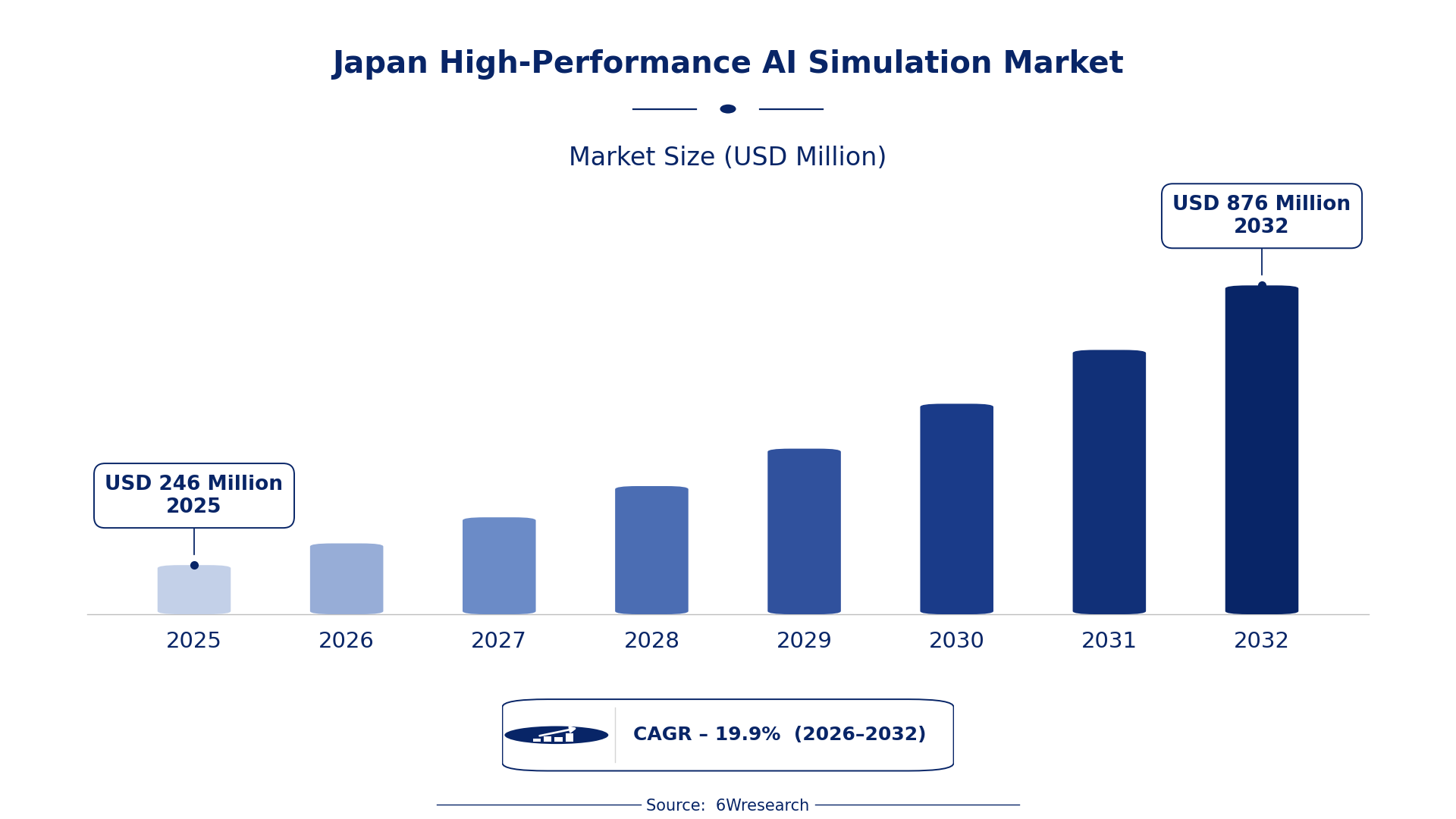
According to 6Wresearch internal database and industry insights, the Japan High-Performance AI Simulation Market was valued at USD 246 Million in 2025 and is projected to reach USD 876 Million by 2032, growing at a CAGR of approximately 19.9% during 2026–2032.
Japan High-Performance AI Simulation Market Highlights
| Report Metric | Details |
| Report Name | Japan High-Performance AI Simulation Market (2026-2032) |
| Market Size 2025 | USD 246 Million |
| Market Size 2032 | USD 876 Million |
| Absolute Growth 2025–2032 | USD 630 Million |
| CAGR 2026–2032 | 19.9% |
| Peak Annual Growth | 20.8% in 2029 |
| Forecast Period | 2026–2032 |
| Historical Data | 2022–2025 |
| Base Year | 2025 |
| Leading Product Type, 2025 | AI Modeling Platforms (38% share) |
| Leading Technology Type, 2025 | Cloud-Based (42% share) |
| Leading Distribution Channel, 2025 | SaaS Vendors (38% share) |
| Leading End User, 2025 | Manufacturing Firms (53% share) |
| Fastest-Growing Product Type | Digital Twin Simulators (21.4% CAGR) |
| Fastest-Growing Technology Type | Neural Networks (27.7% CAGR) |
| Fastest-Growing End User | Healthcare Providers (25.1% CAGR) |
| Growing Sector | Healthcare Providers |
| Key End Users | Manufacturing Firms, Automotive Companies, Healthcare Providers, R&D Labs |
Japan High-Performance AI Simulation Market Year-wise Growth Rate and Key Drivers (2022–2032)
This graph illustrates the annual growth rates of the market from 2022 to 2032, highlighting a steady upward trajectory and projected market expansion over the forecast period.
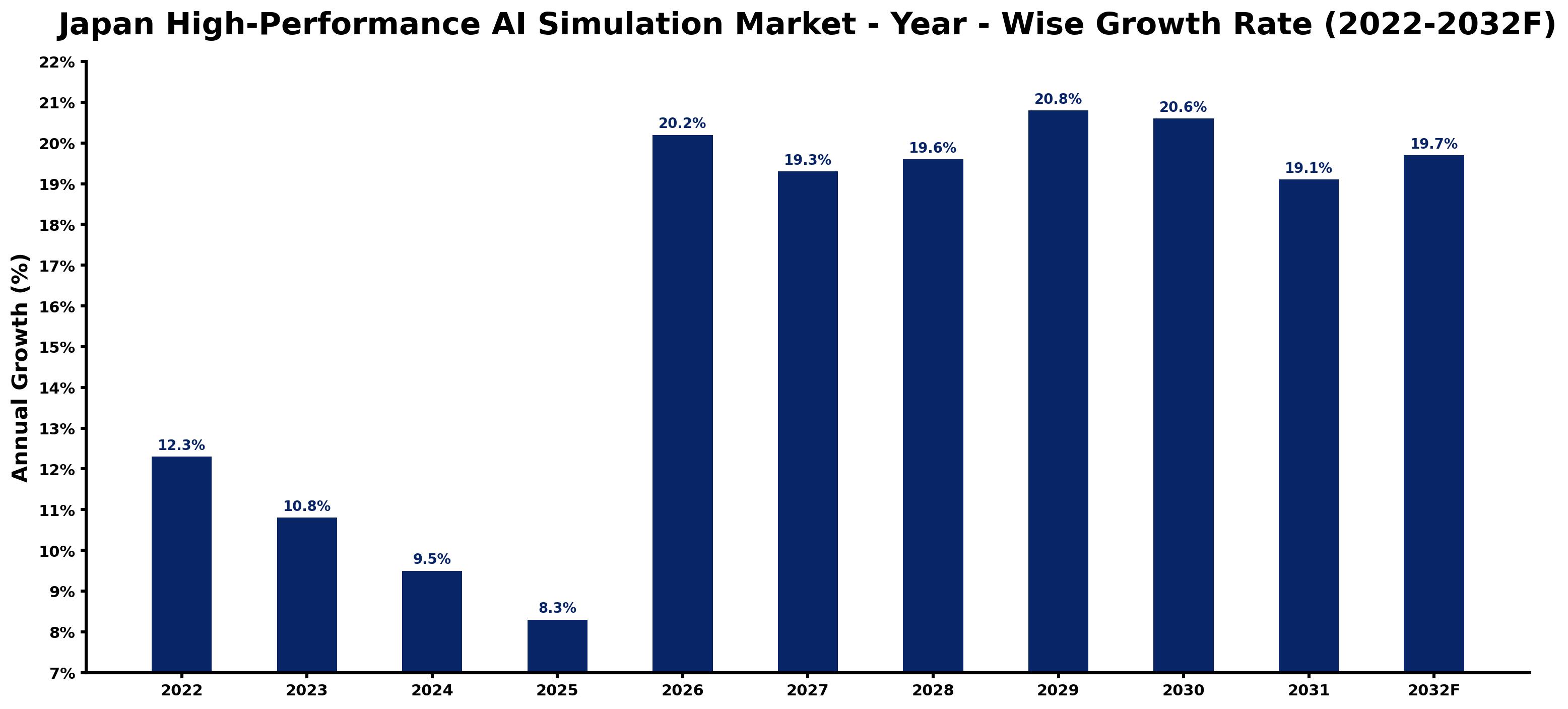
Year by year, the estimates below pair each growth rate with the development that shaped it.
| Year | Estimated Annual Growth (%) | Market Rationale |
| 2022 | 12.3 | The market experienced steady growth supported by increasing adoption of AI technologies. |
| 2023 | 10.8 | Growth slowed slightly as companies adjusted to new AI regulations and standards. |
| 2024 | 9.5 | Continued investment in AI technologies led to further market expansion, albeit at a slower pace. |
| 2025 | 8.3 | The market showed signs of maturity, with growth rates declining as saturation approached. |
| 2026 | 20.2 | Growth is expected to accelerate sharply as demand for AI-driven solutions surges across industries. |
| 2027 | 19.3 | The market will continue to grow, although at a slightly reduced pace compared to the previous year. |
| 2028 | 19.6 | Demand is projected to increase again as more sectors adopt advanced AI simulation technologies. |
| 2029 | 20.8 | The market is expected to peak due to substantial investments in AI infrastructure and capabilities. |
| 2030 | 20.6 | Growth will slow slightly as the market begins to stabilise after reaching its peak. |
| 2031 | 19.1 | The market will maintain a positive growth trend, driven by ongoing technological advancements. |
| 2032 | 19.7 | Growth is expected to rise again as new applications for AI simulations emerge. |
Note: Market size estimations and growth projections presented in this report are based on 6Wresearch's proprietary forecasting methodology, utilizing the latest available industry data, government publications, and primary research inputs.
Japan High-Performance AI Simulation Market Synopsis
High-Performance AI Simulation encompasses advanced computational techniques for creating simulations across various applications, particularly in manufacturing and healthcare. In Japan, the automotive sector is making substantial investments in digital twin technology to optimise design and production processes. The Japan High-Performance AI Simulation Market is growing due to increased demand from manufacturing firms and healthcare providers, with investments in AI technologies expected to reach 1 trillion yen by 2025.
Market Dynamics Impact Analysis (2026–2032)
| Factor | Type | Impact | Primary Segment Affected |
| Increased investment in AI technologies | Driver | High | AI Modeling Platforms |
| Growing adoption of digital twin technology | Driver | High | Digital Twin Simulators |
| Rising demand for predictive analytics in healthcare | Opportunity | High | Predictive Simulation Tools |
| Expansion of R&D labs in the Tokyo region | Opportunity | Medium | AI Training Simulators |
| High costs associated with AI implementation | Restraint | High | AI Modeling Platforms |
| Limited access to high-performance computing resources | Restraint | Medium | Digital Twin Simulators |
| Competition from alternative simulation technologies | Challenge | High | Predictive Simulation Tools |
| Shortage of skilled professionals in AI fields | Challenge | Medium | AI Training Simulators |
Evaluation of Drivers in Japan High-Performance AI Simulation Market (2026–2032)
These are the developments adding the most demand over the forecast period.
| Drivers | Primary Segment Affected | Why It Matters (Evidence) |
| Increased investment in digital twin technology | Digital Twin Simulators | This technology enhances design processes, with 30% of major automotive companies adopting it to improve efficiency. |
| Growing reliance on AI modeling platforms | AI Modeling Platforms | Over 70% of R&D labs in Japan utilise these platforms, driving demand for advanced simulations. |
| Rising adoption of predictive simulation tools | Predictive Simulation Tools | Healthcare providers are increasingly using these tools to improve patient outcomes, leading to higher demand. |
| Preference for cloud-based solutions | Cloud-Based | 60% of manufacturing firms favour these solutions for improved accessibility and collaboration in AI simulations. |
| Expansion of AI training simulators | AI Training Simulators | Japan has over 500 active AI training simulators, supporting the development of AI models across various sectors. |
Several shifts outside the market lift sales. The automotive sector is heavily investing in digital twin technology, with 30% of major companies adopting these systems to improve design processes. Research and development labs are utilising AI modeling platforms, driving demand for advanced simulations. Healthcare providers are increasingly relying on predictive simulation tools to improve patient outcomes, with adoption rates rising. Manufacturing firms favour cloud-based solutions, improving accessibility and collaboration in AI simulations.
Evaluation of Restraints in Japan High-Performance AI Simulation Market
The table below lists the restraints and the evidence behind each.
| Market Restraint | Primary Segment Affected | Why It Matters (Evidence) |
| High costs associated with advanced AI technologies | AI Modeling Platforms | The implementation costs deter smaller firms from adopting AI modeling platforms, limiting market growth. |
| Limited access to high-performance computing resources | Digital Twin Simulators | Many firms struggle to secure the necessary computing power for effective digital twin simulations. |
| Competition from alternative simulation technologies | Predictive Simulation Tools | Emerging technologies may divert investment away from predictive simulation tools, affecting market share. |
| Shortage of skilled professionals in AI fields | AI Training Simulators | The lack of qualified personnel hampers the development and deployment of AI training simulators. |
| Regulatory compliance costs for AI solutions | Cloud-Based | Compliance with standards like ISO/IEC 27001 increases operational costs for cloud-based AI solutions. |
Japan High-Performance AI Simulation Market Challenges
Japan's automotive sector faces supply chain disruptions due to reliance on specific AI simulation components, delaying production timelines by up to six months for manufacturers. Regulatory hurdles arise from compliance with ISO/IEC 27001 standards, increasing costs for firms that must invest in data security measures, costing upwards of 10 million yen annually for affected companies. A shortage of skilled AI professionals hampers innovation, as over 70% of R&D labs report difficulties in hiring qualified personnel, extending project timelines for developers. Competition from international firms pressures local producers to lower prices, impacting profit margins by approximately 15% for suppliers.
Trends in the Japan High-Performance AI Simulation Market
Four trends stand out in the Japan High-Performance AI Simulation Market.
- Shift from Traditional to Digital Twin Simulations: The automotive sector is increasingly adopting digital twin technology, with 30% of major companies implementing it since 2022. This shift improves design and testing processes, resulting in better product outcomes.
- Transition to Cloud-Based AI Solutions: Since 2023, manufacturing firms have increasingly favoured cloud-based AI solutions, with 60% now using them. This trend facilitates greater accessibility and collaboration across teams, streamlining operations.
- Emergence of Predictive Analytics in Healthcare: Healthcare providers have begun integrating predictive simulation tools into their practices, with adoption rates rising since 2023. This shift is improving patient care outcomes and operational efficiency.
- Prioritisation of AI Training Simulators: In 2023, R&D labs intensified their focus on AI training simulators, with over 500 active units in various sectors. This trend supports innovation and accelerates the development of AI technologies.
Investment Opportunities in the Japan High-Performance AI Simulation Market
Several openings in the Japan High-Performance AI Simulation Market merit attention from investors.
- Tokyo as a Hub for AI Innovation: With 40% of Japan's AI simulation activities taking place in Tokyo, there is a growing demand for advanced AI simulation tools, projected to reach 1 trillion yen by 2025. Investing in local partnerships can facilitate market entry.
- Manufacturing Firms Seeking Efficiency: Manufacturing firms are increasingly implementing AI simulations to optimise processes, with 60% favouring cloud-based solutions. This presents an opportunity for suppliers to provide tailored AI simulation tools.
- Healthcare Providers Adopting Predictive Tools: Healthcare providers are progressively integrating predictive simulation tools, with adoption rates rising since 2023. Suppliers can tap into this market by offering customised solutions that enhance patient outcomes.
- Investment in AI Training Facilities: With a growing number of active AI training simulators in Japan, there is an urgent need for improved training facilities. Investing in local training centres can effectively address this demand.
Government Initiatives in the Japan High-Performance AI Simulation Market
The Semiconductor and Digital Industry Strategy, introduced by the Ministry of Economy, Trade and Industry in June 2021, aims to secure domestic semiconductor manufacturing, which is vital for AI technologies. The Battery Industry Strategy, launched in August 2022, targets domestic battery manufacturing capacity to support AI applications in various sectors.
In 2023, the Japanese government launched a program to promote AI in manufacturing, with a budget of 10 billion yen allocated for AI innovation initiatives. The Ministry of Economy, Trade and Industry oversees this program, which aims to boost AI adoption across industries.
Future Insight of the Japan High-Performance AI Simulation Market
By 2032, substantial investment in AI simulation technology will arise from government initiatives and increasing industry demand, creating new opportunities for buyers and suppliers. Improved digital twin technology will optimise manufacturing processes, leading to greater efficiency. The expanding use of predictive analytics in healthcare will enhance patient outcomes and encourage collaboration across sectors. The growth of AI simulation capabilities will enable manufacturers to scale operations effectively, ensuring they meet evolving market demands.
Market Segmentation Analysis
Japan High-Performance AI Simulation Market report covers a detailed analysis of the following market segments:
By Product Type – AI Modeling Platforms Lead, Digital Twin Simulators Expected to Grow Fastest
According to Saurav Kr Singh, Senior Research Analyst at 6Wresearch, AI Modeling Platforms took 38% of product type revenue in 2025, more than any other category. AI modeling platforms hold the largest share due to their critical function in creating simulations for various applications. For instance, over 70% of R&D labs in Japan rely on these platforms for their simulation needs. Over 2026–2032, Digital Twin Simulators are expected to post the fastest growth, at a CAGR of 21.4%. Digital twin simulators are rapidly growing because they provide real-time system monitoring, essential for sectors like automotive. Notably, 30% of major automotive companies in Japan are adopting these simulators to enhance their operational efficiency. Suppliers should enhance the capabilities of AI modeling platforms to meet the increasing demand.
By Technology Type – Cloud-Based Leads, Neural Networks Expected to Grow Fastest
Cloud-Based held 42% of the Japan High-Performance AI Simulation Market by technology type in 2025. Cloud-based solutions lead the market as they provide essential accessibility for simulations, allowing firms to utilise high-performance computing without heavy initial investments. Approximately 60% of manufacturing firms in Japan prefer cloud-based options for their simulation requirements. The quickest growth will come from Neural Networks, forecast to expand at a CAGR of 27.7% between 2026 and 2032. Neural networks are experiencing rapid growth due to their foundational role in developing advanced models necessary for various applications. The increasing complexity of tasks in AI is significantly boosting this demand. Buyers should consider cloud-based solutions to improve operational efficiency, while suppliers must ensure robust support for neural network technologies.
By Distribution Channel – SaaS Vendors Lead and Record the Fastest Growth
In 2025, SaaS Vendors led the distribution channel split with a 38% share. SaaS vendors dominate the distribution channels by offering crucial platforms that facilitate easy access to simulation tools for a wide range of users. This model effectively caters to both large and small enterprises looking for scalable solutions. Its lead should widen, with a projected CAGR of 21.0% during 2026–2032, the highest in this split. SaaS vendors are also the fastest-growing channel, spurred by the rising demand for accessible and flexible simulation solutions across industries. Their ability to adapt to market needs ensures sustained growth in this segment. Both suppliers and buyers should focus on partnerships with SaaS vendors to leverage their platforms effectively.
By End User – Manufacturing Firms Lead, Healthcare Providers Expected to Grow Fastest
Manufacturing Firms accounted for 53% of the market by end user in 2025. Manufacturing firms represent the largest end-user segment as they extensively use simulations for process optimisation and efficiency improvements. This sector's significant investment in advanced technologies solidifies its dominant market position. Healthcare Providers are set to record the highest CAGR in this split, 25.1% over 2026–2032. Healthcare providers are the fastest-growing segment, driven by their increasing adoption of simulations to enhance patient care outcomes. The ongoing demand for improved healthcare solutions is propelling this growth. Suppliers should tailor their offerings to meet the specific needs of healthcare providers while continuing to support manufacturing firms.
Key Attractiveness of the Report
- 10 Years of Market Numbers
- Historical Data Starting from 2022 to 2025
- Base Year 2025
- Forecast Data until 2032
- Key Performance Indicators Impacting the Market
- Major Upcoming Developments and Projects
Key Highlights of the Report:
- Japan High-Performance AI Simulation Market Outlook
- Market Size of Japan High-Performance AI Simulation Market, 2025
- Forecast of Japan High-Performance AI Simulation Market, 2032
- Historical Data and Forecast of Japan High-Performance AI Simulation Revenues & Volume for the Period 2022-2032F
- Japan High-Performance AI Simulation Market Trend Evolution
- Japan High-Performance AI Simulation Market Drivers and Challenges
- Japan High-Performance AI Simulation Price Trends
- Japan High-Performance AI Simulation Porter's Five Forces
- Japan High-Performance AI Simulation Industry Life Cycle
- Historical Data and Forecast of Japan High-Performance AI Simulation Market Revenues & Volume By Product Type for the Period 2022-2032F
- Historical Data and Forecast of Japan High-Performance AI Simulation Market Revenues & Volume By AI Modeling Platforms for the Period 2022-2032F
- Historical Data and Forecast of Japan High-Performance AI Simulation Market Revenues & Volume By Digital Twin Simulators for the Period 2022-2032F
- Historical Data and Forecast of Japan High-Performance AI Simulation Market Revenues & Volume By AI Training Simulators for the Period 2022-2032F
- Historical Data and Forecast of Japan High-Performance AI Simulation Market Revenues & Volume By Predictive Simulation Tools for the Period 2022-2032F
- Historical Data and Forecast of Japan High-Performance AI Simulation Market Revenues & Volume By Technology Type for the Period 2022-2032F
- Historical Data and Forecast of Japan High-Performance AI Simulation Market Revenues & Volume By Cloud-Based for the Period 2022-2032F
- Historical Data and Forecast of Japan High-Performance AI Simulation Market Revenues & Volume By Edge Computing for the Period 2022-2032F
- Historical Data and Forecast of Japan High-Performance AI Simulation Market Revenues & Volume By GPU Accelerated for the Period 2022-2032F
- Historical Data and Forecast of Japan High-Performance AI Simulation Market Revenues & Volume By Neural Networks for the Period 2022-2032F
- Historical Data and Forecast of Japan High-Performance AI Simulation Market Revenues & Volume By Distribution Channel for the Period 2022-2032F
- Historical Data and Forecast of Japan High-Performance AI Simulation Market Revenues & Volume By SaaS Vendors for the Period 2022-2032F
- Historical Data and Forecast of Japan High-Performance AI Simulation Market Revenues & Volume By Direct Sales for the Period 2022-2032F
- Historical Data and Forecast of Japan High-Performance AI Simulation Market Revenues & Volume By Online Portals for the Period 2022-2032F
- Historical Data and Forecast of Japan High-Performance AI Simulation Market Revenues & Volume By B2B Distributors for the Period 2022-2032F
- Historical Data and Forecast of Japan High-Performance AI Simulation Market Revenues & Volume By End User for the Period 2022-2032F
- Historical Data and Forecast of Japan High-Performance AI Simulation Market Revenues & Volume By R&D Labs for the Period 2022-2032F
- Historical Data and Forecast of Japan High-Performance AI Simulation Market Revenues & Volume By Manufacturing Firms for the Period 2022-2032F
- Historical Data and Forecast of Japan High-Performance AI Simulation Market Revenues & Volume By Automotive Companies for the Period 2022-2032F
- Historical Data and Forecast of Japan High-Performance AI Simulation Market Revenues & Volume By Healthcare Providers for the Period 2022-2032F
- Japan High-Performance AI Simulation Import Export Trade Statistics
- Market Opportunity Assessment By Product Type
- Market Opportunity Assessment By Technology Type
- Market Opportunity Assessment By Distribution Channel
- Market Opportunity Assessment By End User
- Japan High-Performance AI Simulation Top Companies Market Share
- Japan High-Performance AI Simulation Competitive Benchmarking By Technical and Operational Parameters
- Japan High-Performance AI Simulation Company Profiles
- Japan High-Performance AI Simulation Key Strategic Recommendations
Market Covered
The following segment groups are covered in the report.
By Product Type
- AI Modeling Platforms
- Digital Twin Simulators
- AI Training Simulators
- Predictive Simulation Tools
By Technology Type
- Cloud-Based
- Edge Computing
- GPU Accelerated
- Neural Networks
By Distribution Channel
- SaaS Vendors
- Direct Sales
- Online Portals
- B2B Distributors
By End User
- R&D Labs
- Manufacturing Firms
- Automotive Companies
- Healthcare Providers































