Japan High Performance Computing Software Market Size & Growth Rate
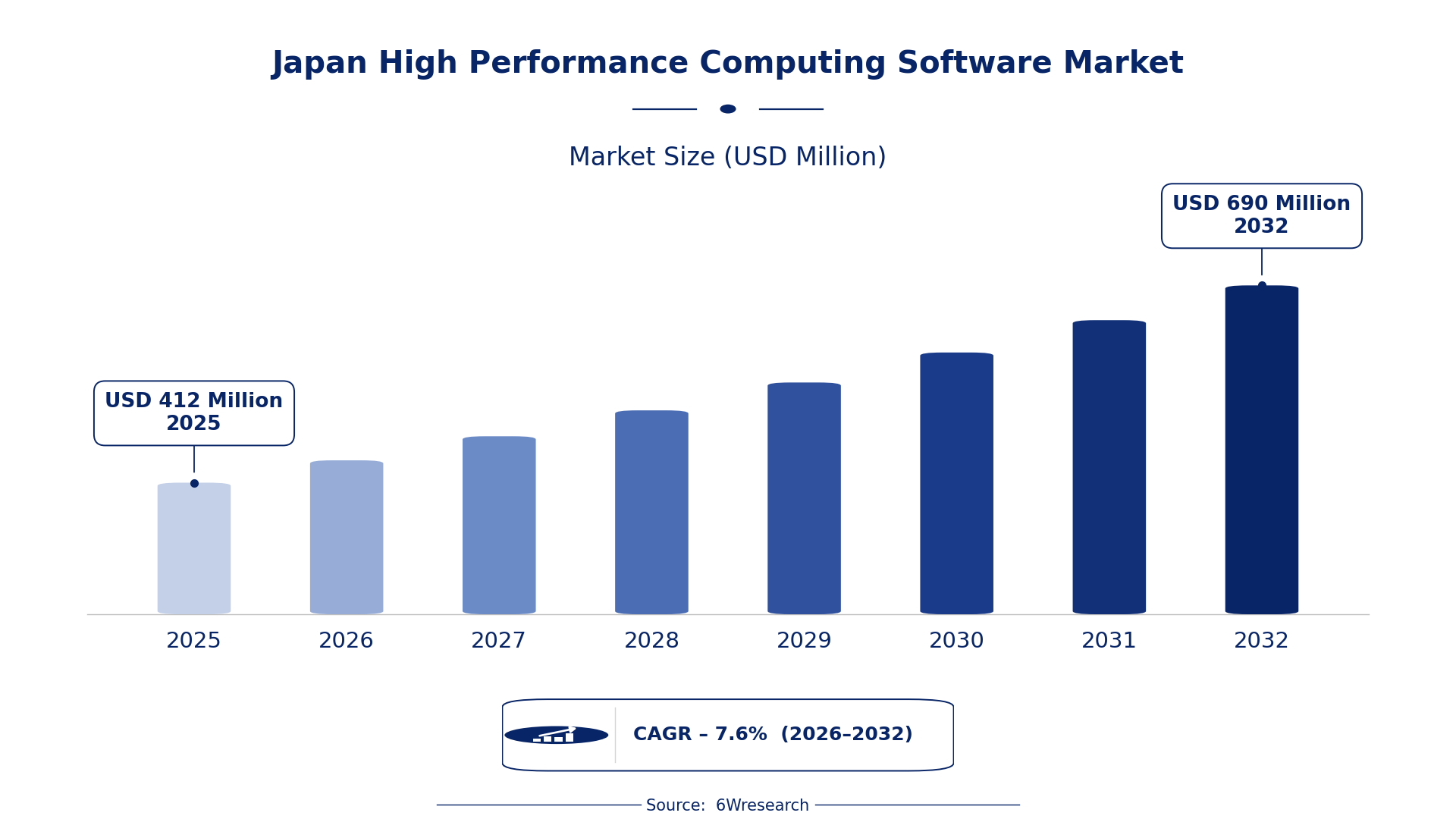
According to 6Wresearch internal database and industry insights, the Japan High Performance Computing Software Market was valued at USD 412 Million in 2025 and is projected to reach USD 690 Million by 2032, growing at a CAGR of approximately 7.6% during 2026–2032.
Japan High Performance Computing Software Market Highlights
| Report Metric | Details |
| Report Name | Japan High Performance Computing Software Market (2026-2032) |
| Market Size 2025 | USD 412 Million |
| Market Size 2032 | USD 690 Million |
| Absolute Growth 2025–2032 | USD 278 Million |
| CAGR 2026–2032 | 7.6% |
| Peak Annual Growth | 8.9% in 2032 |
| Forecast Period | 2026–2032 |
| Historical Data | 2022–2025 |
| Base Year | 2025 |
| Leading Type, 2025 | Cloud-Based (63% share) |
| Leading Application, 2025 | Scientific Research (44% share) |
| Leading End User, 2025 | Government (48% share) |
| Fastest-Growing Type | On-Premise (10.8% CAGR) |
| Fastest-Growing Application | Financial Services (10.1% CAGR) |
| Fastest-Growing End User | Enterprises (9.7% CAGR) |
| Growing Sector | Financial Services |
| Key End Users | Scientific Research, Financial Services, Engineering Simulation |
Japan High Performance Computing Software Market Year-wise Growth Rate and Key Drivers (2022–2032)
This graph illustrates the annual growth rates of the market from 2022 to 2032, highlighting a steady upward trajectory and projected market expansion over the forecast period.
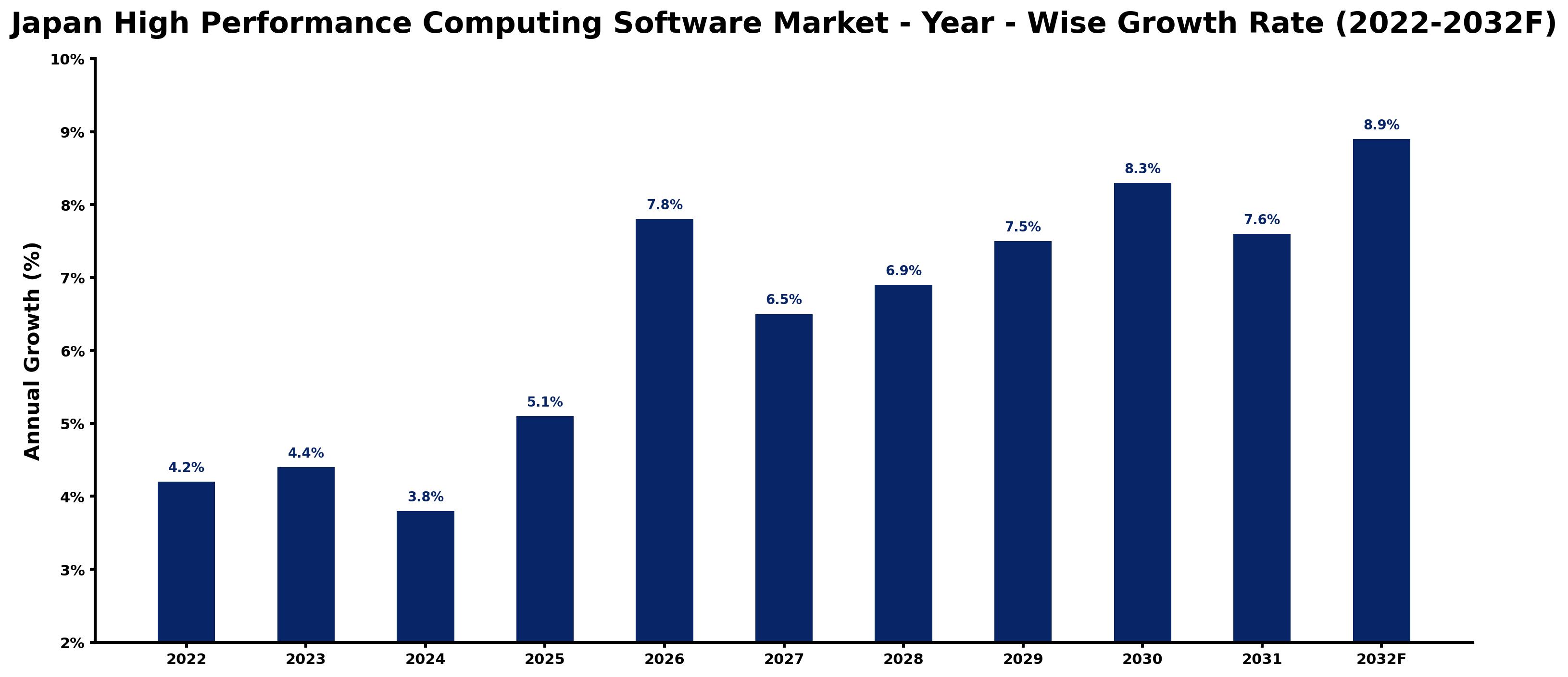
Annual growth estimates for each year appear below with the principal reason behind them, explaining the shifts that set the pace of the market.
| Year | Estimated Annual Growth (%) | Market Rationale |
| 2022 | 4.2 | The market experienced steady growth as research institutions increased their HPC software usage. |
| 2023 | 4.4 | Demand rose due to rising investments in scientific research and technology development. |
| 2024 | 3.8 | Growth slowed as some enterprises reassessed their HPC software needs amid economic shifts. |
| 2025 | 5.1 | The market saw a resurgence as new applications in engineering simulations gained traction. |
| 2026 | 7.8 | Increased adoption of cloud-based solutions is expected to drive demand for HPC software in enterprises. |
| 2027 | 6.5 | Growth is projected to slow as market maturity begins to set in for established software solutions. |
| 2028 | 6.9 | Demand is expected to rise again as financial services expand their use of HPC for risk analysis. |
| 2029 | 7.5 | The market is projected to experience further growth as academic institutions increase their HPC capabilities. |
| 2030 | 8.3 | Demand will surge as new supercomputing projects are initiated across various sectors. |
| 2031 | 7.6 | Growth is expected to slow slightly as the market stabilises amid increased competition. |
| 2032 | 8.9 | The market is projected to peak as advancements in HPC technology attract new users across industries. |
Note: Market size estimations and growth projections presented in this report are based on 6Wresearch's proprietary forecasting methodology, utilizing the latest available industry data, government publications, and primary research inputs.
Japan High Performance Computing Software Market Synopsis
High Performance Computing Software refers to specialized software designed for supercomputers and clusters, enabling complex computations in fields like scientific simulations and financial modeling. In Japan, the High Performance Computing Software Market is driven by strong demand from over 1,000 research institutions and enterprises, alongside government initiatives. The Ministry of Education, Culture, Sports, Science and Technology (MEXT) supports HPC development, while the Supercomputer Fugaku illustrates advanced applications. Cloud-based solutions are increasingly adopted by many enterprises, reflecting a shift towards more accessible HPC resources and improving operational efficiency.
Market Dynamics Impact Analysis (2026–2032)
| Factor | Type | Impact | Primary Segment Affected |
| Growing investments in research and development | Driver | High | Scientific Research |
| Increased demand for cloud-based solutions | Driver | High | Cloud-Based |
| Expansion of financial services requiring advanced analytics | Opportunity | High | Financial Services |
| Rising need for engineering simulations in automotive design | Opportunity | High | Engineering Simulation |
| High costs associated with on-premise infrastructure | Restraint | Medium | On-Premise |
| Limited awareness of HPC benefits among smaller enterprises | Restraint | Medium | Enterprises |
| Competition from international HPC software providers | Challenge | High | Cloud-Based |
| Rapid technological advancements requiring constant updates | Challenge | Medium | Cloud-Based |
Evaluation of Drivers in Japan High Performance Computing Software Market (2026–2032)
These are the developments adding the most demand over the forecast period.
| Drivers | Primary Segment Affected | Why It Matters (Evidence) |
| Increased funding for scientific research initiatives | Scientific Research | In 2023, the government allocated ¥10 billion for HPC research and development, boosting institutional demand. |
| Growing adoption of cloud-based HPC solutions | Cloud-Based | 40% of enterprises in Japan are adopting cloud-based HPC, facilitating access to advanced computing resources. |
| Rising demand for data analysis in financial services | Financial Services | Financial institutions are increasingly using HPC for risk analysis, driving software purchases. |
| Need for advanced engineering simulations in automotive industry | Engineering Simulation | HPC software is essential for product design in Japan's automotive sector, which is a major industry. |
| Expansion of academic institutions utilizing HPC resources | Academic Institutions | Over 1,000 research institutions in Japan use HPC for advanced research and education. |
The automotive industry relies heavily on HPC software for engineering simulations, driving demand as product design becomes more complex. Financial services are increasingly utilising HPC for risk analysis, further pushing software purchases. Many enterprises are adopting cloud-based solutions to improve accessibility, creating a steady demand for advanced software solutions.
Evaluation of Restraints in Japan High Performance Computing Software Market
The main factors holding the market back are set out below.
| Market Restraint | Primary Segment Affected | Why It Matters (Evidence) |
| High costs associated with maintaining on-premise infrastructure | On-Premise | The initial investment and maintenance costs deter smaller enterprises from adopting HPC solutions. |
| Limited awareness of HPC benefits among smaller enterprises | Enterprises | Many smaller enterprises lack knowledge about the advantages of HPC, slowing market penetration. |
| Intense competition from international HPC software providers | Cloud-Based | Local producers face challenges from established global players, impacting market share. |
| Rapid technological advancements requiring constant updates | Cloud-Based | Keeping up with fast-paced technology changes incurs additional costs for buyers. |
| Regulatory compliance costs for data security standards | Cloud-Based | Compliance with ISO/IEC 27001 standards increases operational costs for software providers. |
Japan High Performance Computing Software Market Challenges
Japan's HPC software development must adhere to ISO/IEC 27001 standards, which elevate costs for producers and can postpone product launches by up to six months. Local suppliers face intense competition from international firms, forcing them to reduce prices and leading to profit margin declines for 30% of domestic developers. A shortage of skilled programming talent stifles innovation, causing research institutions to experience project delays averaging three months. Buyers in the automotive sector encounter longer lead times for customised HPC solutions, resulting in increased production costs and disrupting project timelines.
Trends in the Japan High Performance Computing Software Market
Below are the shifts with the largest effect on the Japan High Performance Computing Software Market.
- Shift from On-Premise to Cloud-Based Solutions: Since 2023, enterprises in Japan have increasingly shifted towards cloud-based HPC solutions, allowing greater flexibility and scalability. This trend is evidenced by the 40% adoption rate among enterprises, resulting in reduced infrastructure costs.
- Emergence of Financial Services as a Key User: In 2026, financial services began to dominate HPC software usage, driven by the need for advanced analytics. This sector's growing reliance on HPC for risk analysis highlights the software's important role in financial decision-making.
- Expansion of HPC in Academic Institutions: Beginning in 2025, academic institutions have expanded their HPC capabilities, with many institutions actively using HPC resources. This growth underscores the increasing importance of HPC in research and education.
- Government Support for HPC Development: In 2023, the Japanese government launched a program to enhance HPC capabilities in universities, allocating ¥10 billion for research and development. This initiative aims to strengthen Japan's position in global HPC advancements.
Investment Opportunities in the Japan High Performance Computing Software Market
Several openings in the Japan High Performance Computing Software Market merit attention from investors.
- Enterprises Seeking Efficiency: Enterprises in Japan are increasingly looking for HPC solutions to improve operational efficiency, particularly in data analysis. With many enterprises adopting cloud-based services, there is a notable opportunity to supply tailored HPC software.
- Cloud-Based HPC Solutions: The demand for cloud-based HPC solutions is growing as more enterprises seek flexibility. Suppliers can target this market by providing scalable software solutions that meet the needs of various sectors, including finance and engineering.
- Academic Institutions Expanding HPC Use: Academic institutions are investing in HPC capabilities to support research initiatives. Suppliers can enter this market by partnering with universities to provide specialized software and support services.
- Government Initiatives in HPC Development: With the government's ¥10 billion investment in HPC research, there is an opportunity to supply software that meets the standards set by the Ministry of Education, Culture, Sports, Science and Technology (MEXT). Collaborating with local research institutions can facilitate market entry.
Government Initiatives in the Japan High Performance Computing Software Market
The Act on Japanese Industrial Standards (2019) governs product and test standards, ensuring that HPC software meets quality and safety requirements. Compliance with these standards is essential for producers, as it affects their ability to market software effectively and gain user trust.
The Digital Agency, established in September 2021, leads government digital transformation and approves initiatives that support HPC capabilities. This agency plays a vital role in funding projects that advance the development of computing technologies in Japan.
Future Insight of the Japan High Performance Computing Software Market
Advanced HPC software technologies will transform demand by 2032, with 40% of enterprises anticipated to adopt cloud-based solutions. The government's ¥10 billion allocation for HPC research will strengthen capabilities in universities, promoting collaboration and technological advancements. New standards from the Japan Society of Computational Engineering and Science will streamline software development processes. The Supercomputer Fugaku's advanced capabilities will broaden applications, particularly in sectors such as automotive engineering.
Market Segmentation Analysis
Japan High Performance Computing Software Market report covers a detailed analysis of the following market segments:
By Type – Cloud-Based Leads, On-Premise Expected to Grow Fastest
According to Sachin Kumar Rai, Senior Research Analyst at 6Wresearch, Cloud-Based accounted for 63% of the market by type in 2025. Cloud-based HPC solutions dominate the market as they facilitate access to HPC resources without the need for local infrastructure. This model is particularly appealing to many enterprises in Japan, allowing them to scale their computing needs efficiently. On-Premise is set to record the highest CAGR in this split, 10.8% over 2026–2032. On-premise HPC software is experiencing rapid growth due to enterprises seeking greater control and customisation for their specific computational tasks. This trend is particularly pronounced in sectors where precise performance is essential, ensuring that on-premise solutions remain vital. Suppliers should focus on enhancing their on-premise offerings to meet the rising demand for tailored HPC solutions.
By Application – Scientific Research Leads, Financial Services Expected to Grow Fastest
The largest application category in 2025 was Scientific Research, at 44% of revenue. Scientific research holds the largest market share, being essential for data-intensive simulations conducted by numerous research institutions across Japan. Government initiatives further bolster the significance of this application area, ensuring sustained investment and development. Over 2026–2032, Financial Services are expected to post the fastest growth, at a CAGR of 10.1%. Financial services are the fastest-growing application segment, propelled by the increasing demand for advanced risk analysis and high-frequency trading capabilities. The financial sector's reliance on sophisticated computational methods is significantly driving the need for HPC software. Buyers in the financial sector should prioritise HPC solutions that enhance data processing capabilities to maintain a competitive advantage.
By End User – Government Leads, Enterprises Expected to Grow Fastest
In 2025, Government led the end user split with a 48% share. The government sector leads the market, underpinning national research initiatives and defence applications, which results in substantial investments in HPC software. Notable funding allocations for research and development underscore the sector's strong position. The quickest growth will come from Enterprises, forecast to expand at a CAGR of 9.7% between 2026 and 2032. Enterprises represent the fastest-growing end user group, driven by their increasing need for HPC software to improve data analysis and operational efficiency. The ongoing digital transformation across various industries is accelerating this demand. Suppliers must customise their offerings to meet the specific needs of enterprises aiming to leverage HPC for enhanced operational performance.
Key Attractiveness of the Report
- 10 Years of Market Numbers
- Historical Data Starting from 2022 to 2025
- Base Year 2025
- Forecast Data until 2032
- Key Performance Indicators Impacting the Market
- Major Upcoming Developments and Projects
Key Highlights of the Report:
- Japan High Performance Computing Software Market Outlook
- Market Size of Japan High Performance Computing Software Market,2025
- Forecast of Japan High Performance Computing Software Market, 2032
- Historical Data and Forecast of Japan High Performance Computing Software Revenues & Volume for the Period 2022-2032
- Japan High Performance Computing Software Market Trend Evolution
- Japan High Performance Computing Software Market Drivers and Challenges
- Japan High Performance Computing Software Price Trends
- Japan High Performance Computing Software Porter's Five Forces
- Japan High Performance Computing Software Industry Life Cycle
- Historical Data and Forecast of Japan High Performance Computing Software Market Revenues & Volume By Type for the Period 2022-2032
- Historical Data and Forecast of Japan High Performance Computing Software Market Revenues & Volume By Cloud-Based for the Period 2022-2032
- Historical Data and Forecast of Japan High Performance Computing Software Market Revenues & Volume By On-Premise for the Period 2022-2032
- Historical Data and Forecast of Japan High Performance Computing Software Market Revenues & Volume By Application for the Period 2022-2032
- Historical Data and Forecast of Japan High Performance Computing Software Market Revenues & Volume By Scientific Research for the Period 2022-2032
- Historical Data and Forecast of Japan High Performance Computing Software Market Revenues & Volume By Financial Services for the Period 2022-2032
- Historical Data and Forecast of Japan High Performance Computing Software Market Revenues & Volume By Engineering Simulation for the Period 2022-2032
- Historical Data and Forecast of Japan High Performance Computing Software Market Revenues & Volume By End User for the Period 2022-2032
- Historical Data and Forecast of Japan High Performance Computing Software Market Revenues & Volume By Government for the Period 2022-2032
- Historical Data and Forecast of Japan High Performance Computing Software Market Revenues & Volume By Enterprises for the Period 2022-2032
- Historical Data and Forecast of Japan High Performance Computing Software Market Revenues & Volume By Academic Institutions for the Period 2022-2032
- Japan High Performance Computing Software Import Export Trade Statistics
- Market Opportunity Assessment By Type
- Market Opportunity Assessment By Application
- Market Opportunity Assessment By End User
- Japan High Performance Computing Software Top Companies Market Share
- Japan High Performance Computing Software Competitive Benchmarking By Technical and Operational Parameters
- Japan High Performance Computing Software Company Profiles
- Japan High Performance Computing Software Key Strategic Recommendations
Market Covered
Coverage by segment is as follows.
By Type
- Cloud-Based
- On-Premise
By Application
- Scientific Research
- Financial Services
- Engineering Simulation
By End User
- Government
- Enterprises
- Academic Institutions






































