Japan High Power Density Components Market Size & Growth Rate
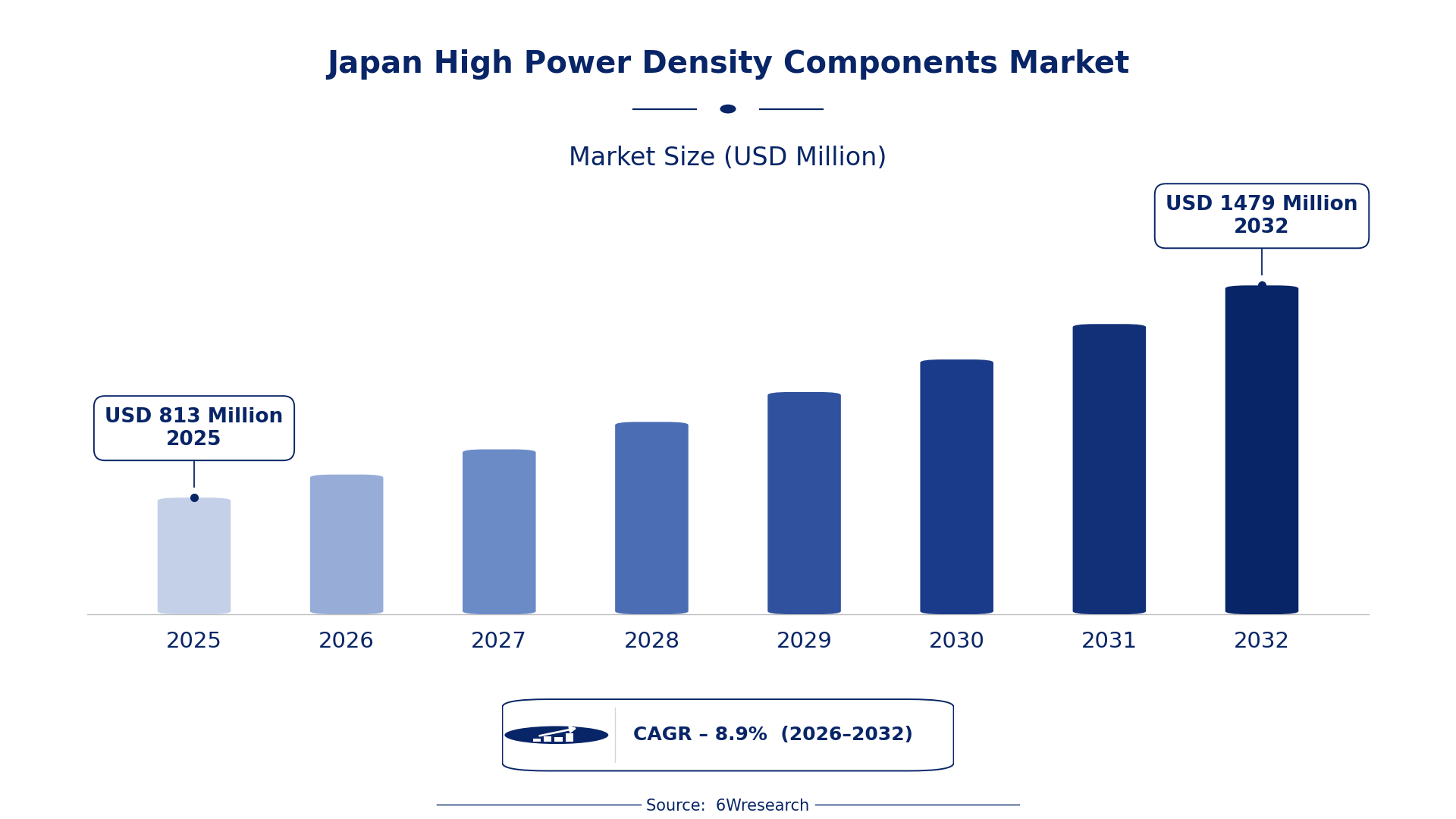
According to 6Wresearch internal database and industry insights, the Japan High Power Density Components Market was valued at USD 813 Million in 2025 and is projected to reach USD 1,479 Million by 2032, growing at a CAGR of approximately 8.9% during 2026–2032.
Japan High Power Density Components Market Highlights
| Report Metric | Details |
| Report Name | Japan High Power Density Components Market (2026-2032) |
| Market Size 2025 | USD 813 Million |
| Market Size 2032 | USD 1,479 Million |
| Absolute Growth 2025–2032 | USD 666 Million |
| CAGR 2026–2032 | 8.9% |
| Peak Annual Growth | 9.7% in 2032 |
| Forecast Period | 2026–2032 |
| Historical Data | 2022–2025 |
| Base Year | 2025 |
| Leading Product Type, 2025 | Power Modules (43% share) |
| Leading Component Type, 2025 | SiC MOSFETs (44% share) |
| Leading Distribution Channel, 2025 | Electronic Distributors (38% share) |
| Leading End User, 2025 | EV Manufacturers (44% share) |
| Fastest-Growing Product Type | Inductors (12.3% CAGR) |
| Fastest-Growing Component Type | Ferrite Core (12.5% CAGR) |
| Fastest-Growing Distribution Channel | Online Stores (11.4% CAGR) |
| Fastest-Growing End User | Telecom Providers (11.5% CAGR) |
| Growing Sector | Electric Vehicles |
| Key End Users | EV Manufacturers, Telecom Providers, Industrial Equipment, Power Grids |
Japan High Power Density Components Market Year-wise Growth Rate and Key Drivers (2022–2032)
This graph illustrates the annual growth rates of the market from 2022 to 2032, highlighting a steady upward trajectory and projected market expansion over the forecast period.
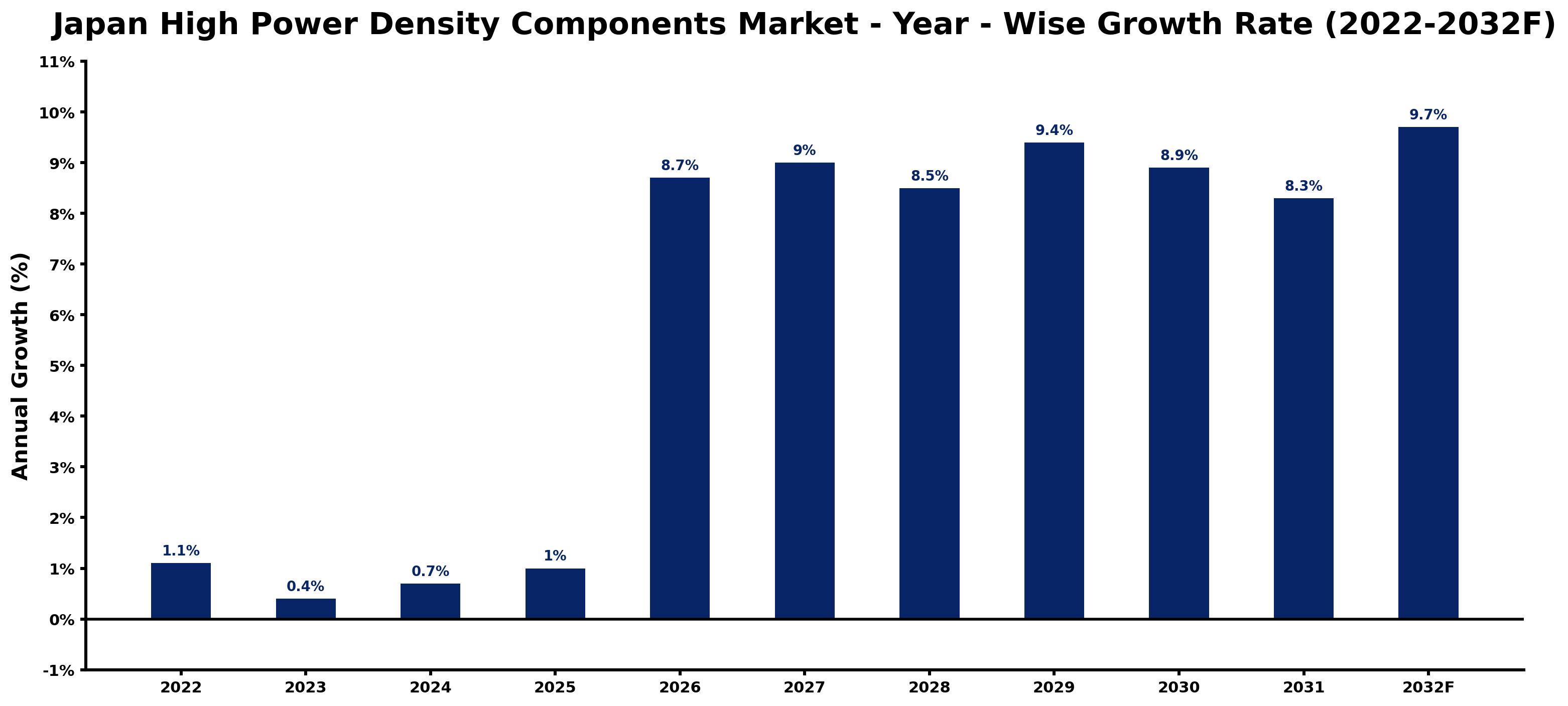
Annual growth estimates for each year appear below with the principal reason behind them, explaining the shifts that set the pace of the market.
| Year | Estimated Annual Growth (%) | Market Rationale |
| 2022 | 1.1 | Market activity was stable, reflecting ongoing demand from the automotive sector. |
| 2023 | 0.4 | Growth slowed as manufacturers adjusted to supply chain disruptions affecting production. |
| 2024 | 0.7 | Demand increased as investments in electric vehicles began to materialise. |
| 2025 | 1.0 | Growth continued with rising adoption of high power density components in industrial applications. |
| 2026 | 8.7 | Market expansion is expected to accelerate due to increased investments in EV infrastructure. |
| 2027 | 9.0 | Increased production capacity and technology advancements will drive further growth. |
| 2028 | 8.5 | Growth will slow slightly as the market stabilises after rapid expansion. |
| 2029 | 9.4 | Demand will surge again, driven by increased adoption in telecommunications. |
| 2030 | 8.9 | Growth will moderate as the market matures, but demand will remain strong. |
| 2031 | 8.3 | A further slowdown will occur as competition intensifies among manufacturers. |
| 2032 | 9.7 | Peak growth is projected as decarbonisation initiatives gain momentum. |
Note: Market size estimations and growth projections presented in this report are based on 6Wresearch's proprietary forecasting methodology, utilizing the latest available industry data, government publications, and primary research inputs.
Japan High Power Density Components Market Synopsis
High Power Density Components are advanced electronic elements designed to manage high power levels in compact sizes, primarily utilised in electric vehicles, telecommunications, and industrial equipment. The Japan High Power Density Components Market is expanding due to increased investments in electric vehicle infrastructure and a strong manufacturing base. The automotive sector is the largest consumer, supported by initiatives targeting a 46% reduction in greenhouse gas emissions by 2030 and substantial public-private decarbonisation investments over the next decade.
Market Dynamics Impact Analysis (2026–2032)
| Factor | Type | Impact | Primary Segment Affected |
| Growing demand for electric vehicles drives the need for efficient power management solutions. | Driver | High | Power Modules |
| The increasing adoption of renewable energy sources boosts demand for energy-efficient components. | Driver | High | DC-DC Converters |
| The shift towards electric vehicles presents opportunities for manufacturers to innovate. | Opportunity | High | EV Manufacturers |
| Investment in EV infrastructure creates demand for high power density components. | Opportunity | High | Telecom Providers |
| Supply chain disruptions have impacted the availability of components. | Restraint | High | Inductors |
| High production costs limit the affordability of advanced components for some buyers. | Restraint | Medium | Capacitors |
| Competition from international manufacturers pressures local producers' pricing. | Challenge | High | SiC MOSFETs |
| Technological advancements require continuous investment in R&D, straining budgets. | Challenge | Medium | GaN Based |
Evaluation of Drivers in Japan High Power Density Components Market (2026–2032)
Key forces behind demand, with the segment each one moves most, are listed below.
| Drivers | Primary Segment Affected | Why It Matters (Evidence) |
| Increased electric vehicle production boosts demand for high power density components. | Power Modules | In 2023, the Japanese government allocated ¥10 billion for EV infrastructure development, leading to higher component purchases. |
| Growing adoption of renewable energy sources increases the need for efficient power solutions. | DC-DC Converters | Japan's installed base of power grids exceeds 1,000 substations, necessitating advanced components for energy management. |
| Rising consumer electronics demand drives the need for compact, efficient components. | Ceramic MLCC | The total population of Japan is approximately 125 million, influencing market size and component demand. |
| Technological advancements in semiconductor materials improve component performance. | SiC MOSFETs | The demand for SiC MOSFETs is increasing due to their efficiency in power conversion. |
| Government initiatives to reduce carbon emissions stimulate market growth. | GaN Based | Japan targets a 46% cut in greenhouse-gas emissions by fiscal 2030, promoting EV usage. |
The growing adoption of renewable energy sources further increases the need for efficient power solutions, driving demand for these components in the energy sector. Additionally, the rising consumer electronics demand, influenced by Japan's population of approximately 125 million, necessitates compact and efficient components across various applications.
Evaluation of Restraints in Japan High Power Density Components Market
The table below lists the restraints and the evidence behind each.
| Market Restraint | Primary Segment Affected | Why It Matters (Evidence) |
| Supply chain disruptions have led to shortages of key components. | Inductors | In 2023, many manufacturers faced delays due to global supply chain issues, impacting production schedules. |
| High production costs limit the affordability of advanced components. | Capacitors | The manufacturing costs for high power density components have risen by approximately 15% in the last year. |
| Intense competition from international manufacturers affects local pricing strategies. | SiC MOSFETs | Local producers are pressured to reduce prices to compete with imports, impacting profit margins. |
| Technological advancements require continuous investment in research and development. | GaN Based | R&D costs have increased, with companies needing to invest more than ¥5 billion annually to stay competitive. |
| Market maturity leads to slower growth rates as competition intensifies. | Power Modules | The market has seen a gradual slowdown in growth rates as it stabilises. |
Japan High Power Density Components Market Challenges
In Japan, buyers in the automotive sector encounter rising costs as demand for high power density components increased by 25% last year. Compliance with the JIS C 61000 standard creates regulatory hurdles that delay product launches for suppliers, costing them an average of six months. Technological advancements in semiconductor materials necessitate significant investment, straining smaller suppliers who lack the capital and limiting their competitiveness. Supply chain disruptions have led to delays in component availability, forcing buyers to extend lead times by up to 40% for critical projects.
Trends in the Japan High Power Density Components Market
The following changes are redrawing the Japan High Power Density Components Market.
- Shift from Traditional to Advanced Semiconductor Materials: Since 2023, there has been a notable shift towards using silicon carbide and gallium nitride in high power density components. This change is evidenced by the increasing adoption of SiC MOSFETs in electric vehicles, which has risen by 20%.
- Transition from Distributors to Online Sales Channels: The rise of online sales channels has transformed how components are purchased. In 2026, online stores are projected to grow at an 11.4% CAGR, reflecting changing buyer preferences for convenience and accessibility.
- Emergence of Renewable Energy Applications: As of 2023, the demand for high power density components in renewable energy applications has surged. This is evidenced by the increasing integration of these components in energy storage systems, with a projected growth of 15% in this sector.
- Increased Focus on Energy Efficiency Standards: The JIS C 61000 standard, governing electromagnetic compatibility, has become more stringent since 2023. This shift is prompting manufacturers to improve their products, ensuring compliance and enhancing market competitiveness.
Investment Opportunities in the Japan High Power Density Components Market
The following areas offer the clearest openings for investors and suppliers in the Japan High Power Density Components Market.
- Growing EV Market Creates Demand for Components: With Japan targeting a 46% reduction in greenhouse gas emissions by 2030, the demand for high power density components in electric vehicles is set to rise. Manufacturers can enter this market through partnerships with EV manufacturers.
- Investment in Renewable Energy Infrastructure: The Japanese government plans to invest approximately JPY 150 trillion in decarbonisation over the next decade. This presents opportunities for suppliers of high power density components to engage with energy providers and infrastructure developers.
- Telecom Sector Expansion Drives Component Needs: The increasing number of telecom providers in Japan, currently over 1,500, creates a demand for high power density components. Suppliers can target this sector by aligning with infrastructure projects.
- Rising Demand for Energy Storage Solutions: As energy storage solutions gain traction, manufacturers can capitalise on this trend. The current demand for energy-efficient components is expected to rise, particularly in the industrial sector.
Government Initiatives in the Japan High Power Density Components Market
The Act on the Rational Use of Energy mandates large energy users to enhance efficiency and report energy consumption, impacting buyers of high power density components. This measure encourages manufacturers to innovate and comply with energy efficiency standards, ensuring their products meet regulatory requirements. In 2023, the government allocated ¥10 billion for EV infrastructure development, supporting manufacturers and buyers in the high power density components market.
The Ministry of Economy, Trade and Industry approves funding for projects that advance semiconductor technology. In 2023, the government allocated ¥10 billion for EV infrastructure development, supporting manufacturers and buyers in the high power density components market.
Future Insight of the Japan High Power Density Components Market
Japan's ¥150 trillion investment in decarbonisation will drive demand for high power density components, especially in electric vehicles and energy applications. By 2032, advancements in semiconductor technology will improve efficiency and lower costs, benefiting both buyers and suppliers. The government's push to reduce carbon emissions will accelerate the adoption of these components across various sectors. With over 1,500 telecom providers increasingly relying on these components, their integration will be vital for strengthening Japan's technological infrastructure.
Market Segmentation Analysis
Japan High Power Density Components Market report covers a detailed analysis of the following market segments:
By Product Type – Power Modules Lead, Inductors Expected to Grow Fastest
According to Saurav Kr Singh, Senior Research Analyst at 6Wresearch, in 2025, Power Modules led the product type split with a 43% share. Power Modules hold the largest share due to their essential function in power management for electric vehicles and industrial applications. Their widespread application in Japan's automotive sector, which is the foremost consumer of high power density components, solidifies their market position. Inductors are set to record the highest CAGR in this split, 12.3% over 2026–2032. Inductors are experiencing rapid growth as they are crucial for filtering and energy storage in power circuits, particularly in the automotive and telecommunications sectors. The rising demand for efficient energy solutions is driving this segment's expansion. This indicates suppliers should focus on enhancing their offerings in inductors to capitalise on the growing market.
By Component Type – SiC MOSFETs Lead, Ferrite Core Expected to Grow Fastest
SiC MOSFETs accounted for 44% of the market by component type in 2025. SiC MOSFETs dominate the market as they are extensively used in high-efficiency power applications, particularly in electric vehicles and renewable energy systems. Their superior efficiency in power conversion makes them a preferred choice among manufacturers in Japan's advanced technology sector. Ferrite Core is projected to grow fastest, at a CAGR of 12.5% during 2026–2032. Ferrite Core is witnessing swift growth as it is integral to inductors and transformers, which are increasingly utilised in various applications including telecommunications. The rising need for energy-efficient solutions in these sectors is propelling this segment's growth. Suppliers should consider expanding their product lines to include ferrite core components to meet the increasing demand.
By Distribution Channel – Electronic Distributors Lead, Online Stores Expected to Grow Fastest
With 38% of distribution channel revenue in 2025, Electronic Distributors was the largest category. Electronic Distributors lead the market by facilitating the sale of high power density components, serving as a crucial link between manufacturers and end users. Their established networks and relationships with various sectors, including automotive and telecommunications, enhance their market presence. The quickest growth will come from Online Stores, forecast to expand at a CAGR of 11.4% between 2026 and 2032. Online Stores are rapidly gaining traction as they offer a convenient platform for purchasing components, catering to the growing trend of digital commerce. The shift towards online purchasing is being accelerated by the increasing number of tech-savvy buyers in Japan. This suggests that suppliers should enhance their online presence to capture the expanding market of digital buyers.
By End User – EV Manufacturers Lead, Telecom Providers Expected to Grow Fastest
EV Manufacturers took 44% of end user revenue in 2025, more than any other category. EV Manufacturers represent the largest consumer group for high power density components, driven by Japan's commitment to electric vehicles and decarbonisation goals. Their substantial investment in advanced technologies further solidifies their leading position in the market. Over 2026–2032, Telecom Providers are expected to post the fastest growth, at a CAGR of 11.5%. Telecom Providers are experiencing the fastest growth as they increasingly utilise high power density components for their infrastructure needs. The ongoing expansion of telecommunications networks and services in Japan is a key factor in this growth. This means suppliers should tailor their strategies to meet the specific needs of telecom providers as they expand their operations.
Key Attractiveness of the Report
- 10 Years of Market Numbers
- Historical Data Starting from 2022 to 2025
- Base Year 2025
- Forecast Data until 2032
- Key Performance Indicators Impacting the Market
- Major Upcoming Developments and Projects
Key Highlights of the Report:
- Japan High Power Density Components Market Outlook
- Market Size of Japan High Power Density Components Market, 2025
- Forecast of Japan High Power Density Components Market, 2032
- Historical Data and Forecast of Japan High Power Density Components Revenues & Volume for the Period 2022-2032F
- Japan High Power Density Components Market Trend Evolution
- Japan High Power Density Components Market Drivers and Challenges
- Japan High Power Density Components Price Trends
- Japan High Power Density Components Porter's Five Forces
- Japan High Power Density Components Industry Life Cycle
- Historical Data and Forecast of Japan High Power Density Components Market Revenues & Volume By Product Type for the Period 2022-2032F
- Historical Data and Forecast of Japan High Power Density Components Market Revenues & Volume By Power Modules for the Period 2022-2032F
- Historical Data and Forecast of Japan High Power Density Components Market Revenues & Volume By Inductors for the Period 2022-2032F
- Historical Data and Forecast of Japan High Power Density Components Market Revenues & Volume By DC-DC Converters for the Period 2022-2032F
- Historical Data and Forecast of Japan High Power Density Components Market Revenues & Volume By Capacitors for the Period 2022-2032F
- Historical Data and Forecast of Japan High Power Density Components Market Revenues & Volume By Component Type for the Period 2022-2032F
- Historical Data and Forecast of Japan High Power Density Components Market Revenues & Volume By SiC MOSFETs for the Period 2022-2032F
- Historical Data and Forecast of Japan High Power Density Components Market Revenues & Volume By Ferrite Core for the Period 2022-2032F
- Historical Data and Forecast of Japan High Power Density Components Market Revenues & Volume By GaN Based for the Period 2022-2032F
- Historical Data and Forecast of Japan High Power Density Components Market Revenues & Volume By Ceramic MLCC for the Period 2022-2032F
- Historical Data and Forecast of Japan High Power Density Components Market Revenues & Volume By Distribution Channel for the Period 2022-2032F
- Historical Data and Forecast of Japan High Power Density Components Market Revenues & Volume By Electronic Distributors for the Period 2022-2032F
- Historical Data and Forecast of Japan High Power Density Components Market Revenues & Volume By Online Stores for the Period 2022-2032F
- Historical Data and Forecast of Japan High Power Density Components Market Revenues & Volume By OEM Sales for the Period 2022-2032F
- Historical Data and Forecast of Japan High Power Density Components Market Revenues & Volume By B2B Sales for the Period 2022-2032F
- Historical Data and Forecast of Japan High Power Density Components Market Revenues & Volume By End User for the Period 2022-2032F
- Historical Data and Forecast of Japan High Power Density Components Market Revenues & Volume By EV Manufacturers for the Period 2022-2032F
- Historical Data and Forecast of Japan High Power Density Components Market Revenues & Volume By Telecom Providers for the Period 2022-2032F
- Historical Data and Forecast of Japan High Power Density Components Market Revenues & Volume By Industrial Equipment for the Period 2022-2032F
- Historical Data and Forecast of Japan High Power Density Components Market Revenues & Volume By Power Grids for the Period 2022-2032F
- Japan High Power Density Components Import Export Trade Statistics
- Market Opportunity Assessment By Product Type
- Market Opportunity Assessment By Component Type
- Market Opportunity Assessment By Distribution Channel
- Market Opportunity Assessment By End User
- Japan High Power Density Components Top Companies Market Share
- Japan High Power Density Components Competitive Benchmarking By Technical and Operational Parameters
- Japan High Power Density Components Company Profiles
- Japan High Power Density Components Key Strategic Recommendations
Market Covered
The study includes the following segmentation.
By Product Type
- Power Modules
- Inductors
- DC-DC Converters
- Capacitors
By Component Type
- SiC MOSFETs
- Ferrite Core
- GaN Based
- Ceramic MLCC
By Distribution Channel
- Electronic Distributors
- Online Stores
- OEM Sales
- B2B Sales
By End User
- EV Manufacturers
- Telecom Providers
- Industrial Equipment
- Power Grids































