Japan High-Precision Sensors Market Size & Growth Rate
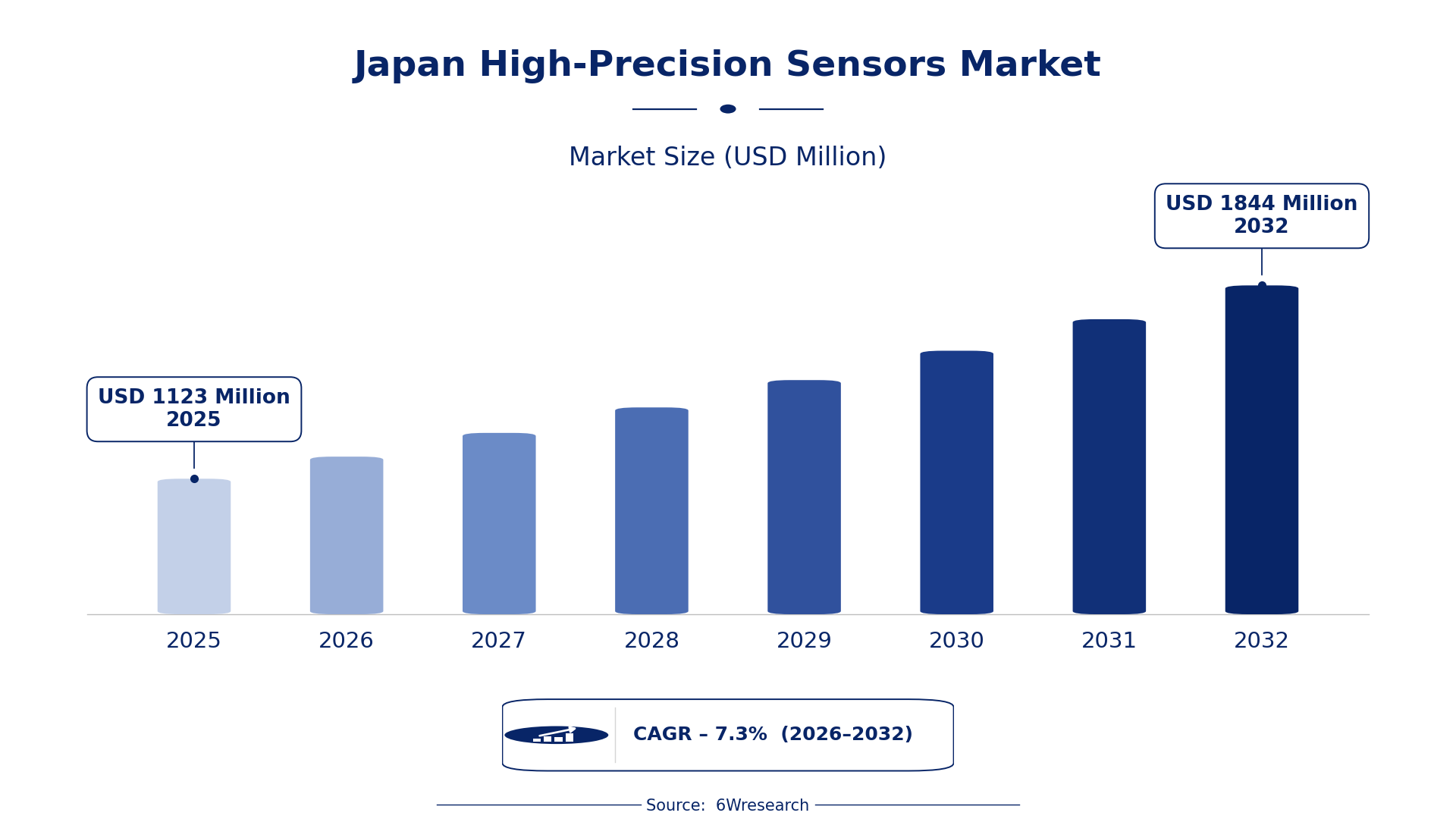
According to 6Wresearch internal database and industry insights, the Japan High-Precision Sensors Market was valued at USD 1,123 Million in 2025 and is projected to reach USD 1,844 Million by 2032, growing at a CAGR of approximately 7.3% during 2026–2032.
Japan High-Precision Sensors Market Highlights
| Report Metric | Details |
| Report Name | Japan High-Precision Sensors Market (2026-2032) |
| Market Size 2025 | USD 1,123 Million |
| Market Size 2032 | USD 1,844 Million |
| Absolute Growth 2025–2032 | USD 721 Million |
| CAGR 2026–2032 | 7.3% |
| Peak Annual Growth | 8.6% in 2032 |
| Forecast Period | 2026–2032 |
| Historical Data | 2022–2025 |
| Base Year | 2025 |
| Leading Product Type, 2025 | Pressure Sensors (42% share) |
| Leading Sensor Type, 2025 | MEMS (42% share) |
| Leading Distribution Channel, 2025 | Electronic Distributors (40% share) |
| Leading End User, 2025 | Industrial Systems (50% share) |
| Fastest-Growing Product Type | Position Sensors (10.8% CAGR) |
| Fastest-Growing Sensor Type | Optical Encoders (10.4% CAGR) |
| Fastest-Growing Distribution Channel | OEM Supply Chain (10.3% CAGR) |
| Fastest-Growing End User | Robotics Industry (9.7% CAGR) |
| Growing Sector | Robotics Industry |
| Key End Users | Industrial Systems, Automotive Sector, Laboratory Equipment, Robotics Industry |
Japan High-Precision Sensors Market Year-wise Growth Rate and Key Drivers (2022–2032)
This graph illustrates the annual growth rates of the market from 2022 to 2032, highlighting a steady upward trajectory and projected market expansion over the forecast period.
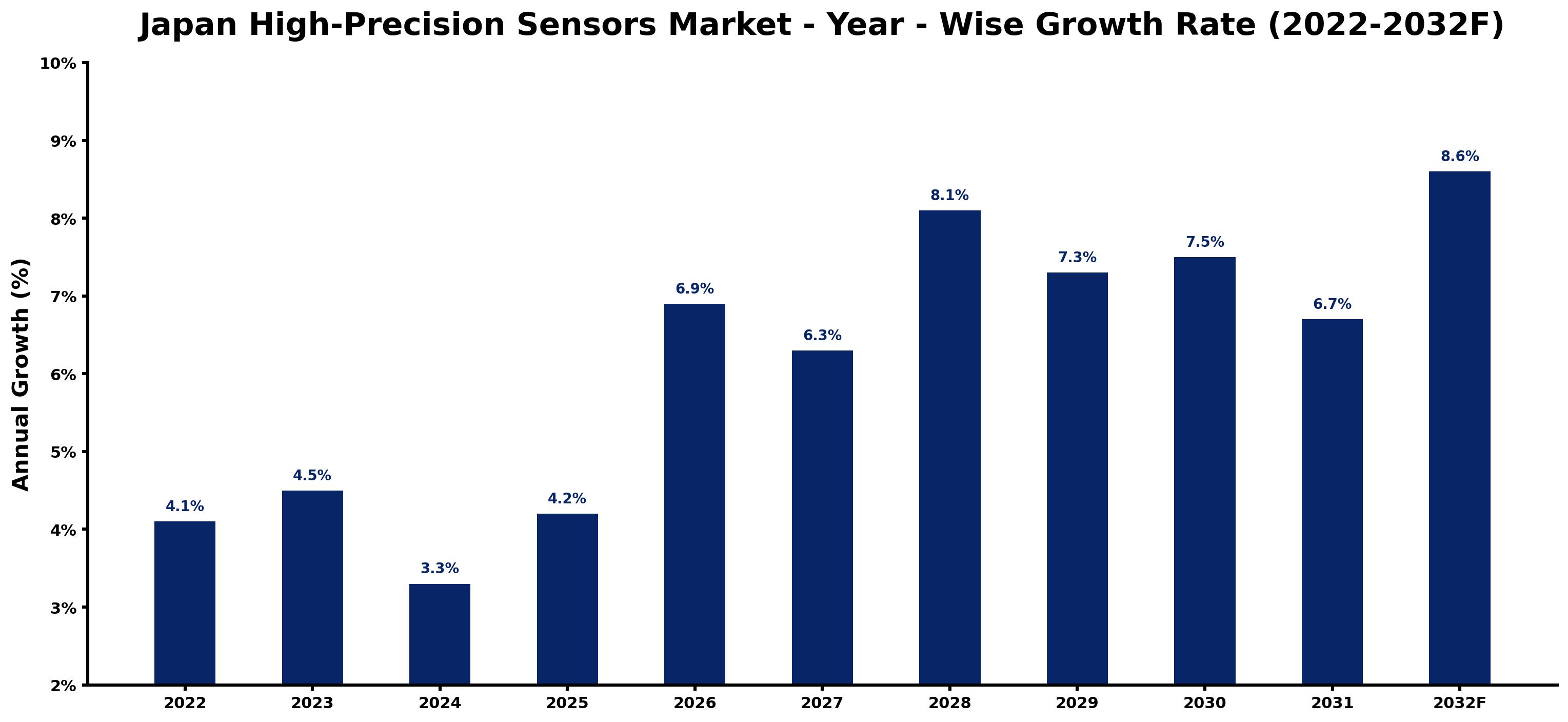
The following figures match every annual growth estimate with the main market development of that year, giving the reasoning behind each rise or slowdown.
| Year | Estimated Annual Growth (%) | Market Rationale |
| 2022 | 4.1 | The market experienced steady growth, driven by increasing industrial automation. |
| 2023 | 4.5 | Demand rose due to heightened sensor integration in automotive applications. |
| 2024 | 3.3 | Growth slowed as manufacturers adjusted to supply chain challenges. |
| 2025 | 4.2 | The market rebounded with renewed investment in robotics and automation. |
| 2026 | 6.9 | Demand is projected to surge as the Robotics Industry expands its automation capabilities. |
| 2027 | 6.3 | A slight slowdown is anticipated as the market stabilises after rapid growth. |
| 2028 | 8.1 | Growth is expected to accelerate again, supported by rising demand for MEMS sensors. |
| 2029 | 7.3 | A slowdown is anticipated as the market adjusts to increased competition. |
| 2030 | 7.5 | Demand will rise again, driven by advancements in sensor technology. |
| 2031 | 6.7 | The market will see a slowdown as saturation in some segments occurs. |
| 2032 | 8.6 | Growth is expected to peak as the automotive sector ramps up sensor integration. |
Note: Market size estimations and growth projections presented in this report are based on 6Wresearch's proprietary forecasting methodology, utilizing the latest available industry data, government publications, and primary research inputs.
Japan High-Precision Sensors Market Synopsis
High-Precision Sensors are advanced devices that measure physical quantities with exceptional accuracy, primarily used in industrial automation, robotics, and automotive applications. The Japan High-Precision Sensors Market is valued at approximately 1.5 billion USD, with the automotive sector accounting for about 30% of demand. Growth is driven by increasing automation across industries, substantial investments in robotics, and initiatives like the Smart Manufacturing programme launched by the Ministry of Economy, Trade and Industry in 2023, which aims to improve manufacturing capabilities.
Market Dynamics Impact Analysis (2026–2032)
| Factor | Type | Impact | Primary Segment Affected |
| Increasing investments in robotics and automation technologies | Driver | High | Robotics Industry |
| Growing demand for MEMS sensors in consumer electronics | Driver | High | MEMS |
| Expansion of the automotive sector's sensor requirements | Opportunity | High | Automotive Sector |
| Rising demand for precision in laboratory equipment | Opportunity | Medium | Laboratory Equipment |
| Supply chain disruptions affecting semiconductor availability | Restraint | High | Pressure Sensors |
| Intense competition leading to pricing pressures | Restraint | Medium | Position Sensors |
| Challenges in scaling production capacity for new technologies | Challenge | High | Temperature Sensors |
| Dependence on global semiconductor supply chains | Challenge | Medium | Force Sensors |
Evaluation of Drivers in Japan High-Precision Sensors Market (2026–2032)
Below are the drivers that matter most for revenue growth, with supporting evidence.
| Drivers | Primary Segment Affected | Why It Matters (Evidence) |
| Increased automation in industrial processes | Industrial Systems | This trend drives demand for high-precision sensors, as companies seek to enhance operational efficiency, evidenced by the production of over 8 million vehicles in 2022. |
| Growing investment in robotics | Robotics Industry | Significant funding in robotics is propelling the need for precision sensors, with the sector projected to grow significantly, leading to higher sensor purchases. |
| Rising adoption of MEMS technology | MEMS | The increasing use of MEMS sensors in consumer electronics is expanding the market, as manufacturers incorporate these devices for enhanced functionality. |
| Expansion of research institutions | Laboratory Equipment | With over 1,000 research institutions in Japan, the demand for precision sensors in laboratory applications is increasing, driving higher sales. |
| Implementation of Smart Manufacturing initiatives | Automotive Sector | The Smart Manufacturing initiative, launched in 2023, promotes advanced sensor technologies, boosting demand in the automotive sector for safety and performance monitoring. |
A wider customer base explains much of the growth, as investments in automation technologies are driving demand for high-precision sensors. The automotive sector, producing over 8 million vehicles in 2022, boosts sensor demand for safety and performance monitoring. The rising adoption of MEMS sensors in consumer electronics is increasing demand from manufacturers. The expansion of research institutions drives demand for precision sensors in laboratory equipment. Technological advancements are improving sensor capabilities, leading to greater purchases across various industrial applications.
Evaluation of Restraints in Japan High-Precision Sensors Market
Below are the constraints most often cited by buyers and suppliers, with the segment each affects.
| Market Restraint | Primary Segment Affected | Why It Matters (Evidence) |
| Supply chain disruptions affecting semiconductor availability | Pressure Sensors | Disruptions in semiconductor supply chains have caused delays and increased costs for manufacturers of pressure sensors. |
| Intense competition leading to pricing pressures | Position Sensors | Increased competition among manufacturers has resulted in pricing pressures, impacting profitability for position sensor producers. |
| Challenges in scaling production capacity for new technologies | Temperature Sensors | Manufacturers are encountering difficulties in expanding production for advanced temperature sensors, delaying market entry and affecting supply. |
| Dependence on global semiconductor supply chains | Force Sensors | Reliance on global supply chains for semiconductors poses risks, impacting the availability of force sensors in the market. |
| Regulatory compliance costs for sensor manufacturing | MEMS | Compliance with stringent regulations raises costs for MEMS manufacturers, affecting pricing and market competitiveness. |
Japan High-Precision Sensors Market Challenges
In Tokyo, sensor manufacturers encounter supply chain disruptions due to reliance on a limited number of raw material sources, causing delays that can extend lead times by up to three weeks for producers. Many facilities lack the latest technology, which hampers their ability to meet the growing demand for advanced sensors, resulting in a potential revenue loss of 15% for suppliers. Buyers face increased costs as competition for high-precision sensors intensifies, with prices rising by 10% over the past year. The growing number of entrants in the market is driving down profit margins, forcing established producers to rethink their pricing strategies.
Trends in the Japan High-Precision Sensors Market
These developments are changing demand patterns in the Japan High-Precision Sensors Market.
- Shift in Automotive Sensor Integration: The automotive sector is increasingly integrating high-precision sensors for enhanced safety features, with approximately 30% of sensor demand driven by this trend. This shift supports greater sensor adoption in vehicle manufacturing.
- Rise of MEMS Sensors in Consumer Electronics: MEMS sensors are becoming prevalent in consumer electronics applications, reflecting a growing trend towards miniaturisation and efficiency. This trend is expected to increase demand in the coming years.
- Increasing Automation in Industrial Systems: Industrial systems are adopting more high-precision sensors to improve automation processes, particularly in regions like Tokyo and Osaka, which are key manufacturing hubs. This trend is driving up sensor demand.
- Focus on Quality Standards in Manufacturing: The adoption of ISO 9001 quality standards in sensor manufacturing is becoming more common, ensuring higher reliability and performance. This focus on quality is influencing purchasing decisions among industrial buyers.
Investment Opportunities in the Japan High-Precision Sensors Market
The following areas offer the clearest openings for investors and suppliers in the Japan High-Precision Sensors Market.
- Growing gap in sensor supply versus demand: The market gap for high-precision sensors is increasing, with demand projected to rise. Investing in production capabilities in regions like Osaka can help meet this demand.
- Supply of advanced MEMS sensors: There is a strong opportunity to supply advanced MEMS sensors, particularly for consumer electronics. Collaborating with electronics manufacturers can facilitate market entry.
- Demand from the Robotics Industry: The Robotics Industry increasingly requires high-precision sensors for automation. Focusing on partnerships with robotics manufacturers can capture this growing demand.
- Expansion of laboratory equipment needs: With numerous research institutions in Japan, there is a significant opportunity to supply high-precision sensors for laboratory equipment. Establishing local partnerships can enhance market presence.
Government Initiatives in the Japan High-Precision Sensors Market
The Semiconductor and Digital Industry Strategy, launched in June 2021, aims to strengthen domestic semiconductor manufacturing capabilities, building on the Economic Security Promotion Act of 2022, which supports supply-chain resilience for critical products. These measures are intended to support the high-precision sensor market by ensuring a stable supply of essential components.
In 2023, the Ministry of Economy, Trade and Industry allocated JPY 50 billion to support the Smart Manufacturing initiative, which promotes advanced manufacturing technologies. The Japan Electronics and Information Technology Industries Association oversees this initiative, encouraging innovation in sensor technologies.
Future Insight of the Japan High-Precision Sensors Market
By 2032, buyers will benefit from the Smart Manufacturing initiative, as advanced sensors become integral to production lines, improving operational efficiency. The automotive sector will see a significant increase in sensor demand, driven by the production of over 8 million vehicles annually. Japan's population of approximately 125 million will sustain a robust market for high-precision sensors across various sectors. As the Robotics Industry evolves, suppliers will prioritise the development of advanced sensor technologies that improve precision and reliability.
Market Segmentation Analysis
Japan High-Precision Sensors Market report covers a detailed analysis of the following market segments:
By Product Type – Pressure Sensors Lead, Position Sensors Expected to Grow Fastest
According to Saurav Kr Singh, Senior Research Analyst at 6Wresearch, in 2025, Pressure Sensors led the product type split with a 42% share. Pressure Sensors dominate the market as they are essential for accurate pressure measurement in automotive and industrial applications. Their critical role in monitoring engine performance in over 8 million vehicles produced in 2022 underlines their importance. Position Sensors are projected to grow fastest, at a CAGR of 10.8% during 2026–2032. Position Sensors are witnessing rapid growth, particularly in the Robotics Industry where precise control of moving parts is vital. The increasing focus on automation across various sectors is set to drive their further adoption. Suppliers should focus on enhancing Position Sensor offerings to meet the rising demand in automation.
By Sensor Type – MEMS Leads, Optical Encoders Expected to Grow Fastest
MEMS accounted for 42% of the market by sensor type in 2025. MEMS sensors hold the largest share as they are widely employed across multiple applications, particularly in consumer electronics and automotive sectors. Their miniaturisation has made them essential for compact device designs, driving substantial market uptake. Over 2026–2032, Optical Encoders are expected to post the fastest growth, at a CAGR of 10.4%. Optical Encoders are growing quickly due to their critical role in providing precise position feedback in machinery, which is increasingly important as industries automate. The ongoing advancements in manufacturing technologies are likely to boost their demand further. Suppliers need to prioritise the development of Optical Encoders to capitalise on this growth opportunity.
By Distribution Channel – Electronic Distributors Lead, OEM Supply Chain Expected to Grow Fastest
The largest distribution channel category in 2025 was Electronic Distributors, at 40% of revenue. Electronic Distributors hold the largest market share due to their extensive supply networks that serve a variety of industries needing high-precision sensors. Their established connections across sectors ensure consistent demand and facilitate effective market access. The quickest growth will come from OEM Supply Chain, forecast to expand at a CAGR of 10.3% between 2026 and 2032. The OEM Supply Chain is growing quickly as manufacturers look for integrated solutions for sensor production. This shift is largely influenced by the need for improved efficiency and quality in manufacturing processes. This trend suggests that suppliers should strengthen partnerships with OEMs to remain competitive.
By End User – Industrial Systems Lead, Robotics Industry Expected to Grow Fastest
Industrial Systems held 50% of the Japan High-Precision Sensors Market by end user in 2025. Industrial Systems are the primary end user segment, necessitating high-precision sensors for effective automation and process control. The substantial investments in industrial automation technologies have solidified their demand in this sector. Robotics Industry is set to record the highest CAGR in this split, 9.7% over 2026–2032. The Robotics Industry is expanding swiftly, driven by the increasing demand for precision in robotic applications. As more industries integrate robotics into their operations, the need for high-precision sensors will continue to grow. This suggests that suppliers should tailor their offerings to address the specific requirements of the Robotics Industry.
Key Attractiveness of the Report
- 10 Years of Market Numbers
- Historical Data Starting from 2022 to 2025
- Base Year 2025
- Forecast Data until 2032
- Key Performance Indicators Impacting the Market
- Major Upcoming Developments and Projects
Key Highlights of the Report:
- Japan High-Precision Sensors Market Outlook
- Market Size of Japan High-Precision Sensors Market, 2025
- Forecast of Japan High-Precision Sensors Market, 2032
- Historical Data and Forecast of Japan High-Precision Sensors Revenues & Volume for the Period 2022-2032F
- Japan High-Precision Sensors Market Trend Evolution
- Japan High-Precision Sensors Market Drivers and Challenges
- Japan High-Precision Sensors Price Trends
- Japan High-Precision Sensors Porter's Five Forces
- Japan High-Precision Sensors Industry Life Cycle
- Historical Data and Forecast of Japan High-Precision Sensors Market Revenues & Volume By Product Type for the Period 2022-2032F
- Historical Data and Forecast of Japan High-Precision Sensors Market Revenues & Volume By Pressure Sensors for the Period 2022-2032F
- Historical Data and Forecast of Japan High-Precision Sensors Market Revenues & Volume By Position Sensors for the Period 2022-2032F
- Historical Data and Forecast of Japan High-Precision Sensors Market Revenues & Volume By Temperature Sensors for the Period 2022-2032F
- Historical Data and Forecast of Japan High-Precision Sensors Market Revenues & Volume By Force Sensors for the Period 2022-2032F
- Historical Data and Forecast of Japan High-Precision Sensors Market Revenues & Volume By Sensor Type for the Period 2022-2032F
- Historical Data and Forecast of Japan High-Precision Sensors Market Revenues & Volume By MEMS for the Period 2022-2032F
- Historical Data and Forecast of Japan High-Precision Sensors Market Revenues & Volume By Optical Encoders for the Period 2022-2032F
- Historical Data and Forecast of Japan High-Precision Sensors Market Revenues & Volume By RTDs/Thermocouples for the Period 2022-2032F
- Historical Data and Forecast of Japan High-Precision Sensors Market Revenues & Volume By Strain Gauge Type for the Period 2022-2032F
- Historical Data and Forecast of Japan High-Precision Sensors Market Revenues & Volume By Distribution Channel for the Period 2022-2032F
- Historical Data and Forecast of Japan High-Precision Sensors Market Revenues & Volume By Electronic Distributors for the Period 2022-2032F
- Historical Data and Forecast of Japan High-Precision Sensors Market Revenues & Volume By OEM Supply Chain for the Period 2022-2032F
- Historical Data and Forecast of Japan High-Precision Sensors Market Revenues & Volume By Online Marketplaces for the Period 2022-2032F
- Historical Data and Forecast of Japan High-Precision Sensors Market Revenues & Volume By Specialty Sensor Stores for the Period 2022-2032F
- Historical Data and Forecast of Japan High-Precision Sensors Market Revenues & Volume By End User for the Period 2022-2032F
- Historical Data and Forecast of Japan High-Precision Sensors Market Revenues & Volume By Industrial Systems for the Period 2022-2032F
- Historical Data and Forecast of Japan High-Precision Sensors Market Revenues & Volume By Robotics Industry for the Period 2022-2032F
- Historical Data and Forecast of Japan High-Precision Sensors Market Revenues & Volume By Laboratory Equipment for the Period 2022-2032F
- Historical Data and Forecast of Japan High-Precision Sensors Market Revenues & Volume By Automotive Sector for the Period 2022-2032F
- Japan High-Precision Sensors Import Export Trade Statistics
- Market Opportunity Assessment By Product Type
- Market Opportunity Assessment By Sensor Type
- Market Opportunity Assessment By Distribution Channel
- Market Opportunity Assessment By End User
- Japan High-Precision Sensors Top Companies Market Share
- Japan High-Precision Sensors Competitive Benchmarking By Technical and Operational Parameters
- Japan High-Precision Sensors Company Profiles
- Japan High-Precision Sensors Key Strategic Recommendations
Market Covered
The study includes the following segmentation.
By Product Type
- Pressure Sensors
- Position Sensors
- Temperature Sensors
- Force Sensors
By Sensor Type
- MEMS
- Optical Encoders
- RTDs/Thermocouples
- Strain Gauge Type
By Distribution Channel
- Electronic Distributors
- OEM Supply Chain
- Online Marketplaces
- Specialty Sensor Stores
By End User
- Industrial Systems
- Robotics Industry
- Laboratory Equipment
- Automotive Sector































