Japan High-Rise Building Materials Market Size & Growth Rate
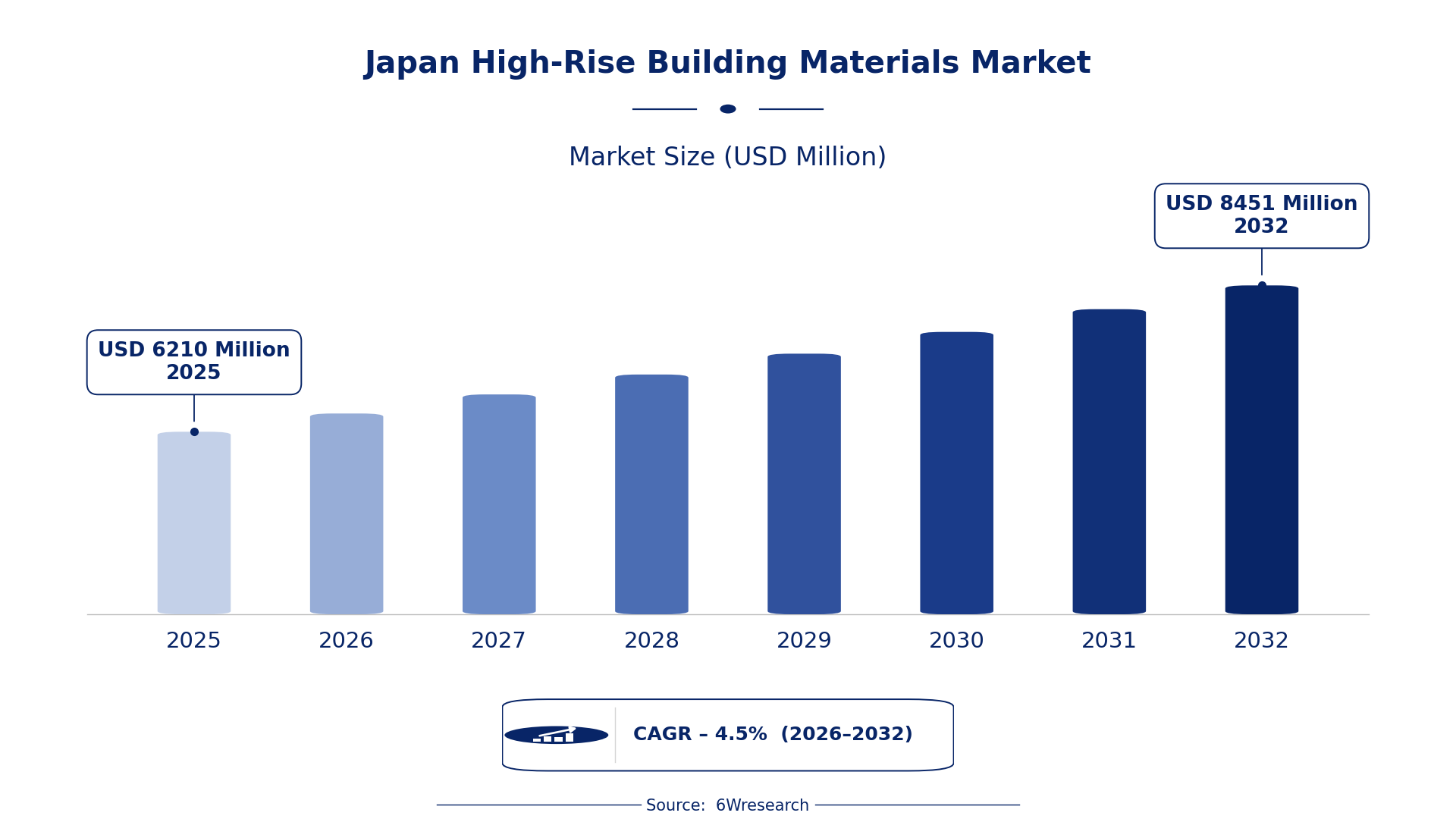
According to 6Wresearch internal database and industry insights, the Japan High-Rise Building Materials Market was valued at USD 6,210 Million in 2025 and is projected to reach USD 8,451 Million by 2032, growing at a CAGR of approximately 4.5% during 2026–2032.
Japan High-Rise Building Materials Market Highlights
| Report Metric | Details |
| Report Name | Japan High-Rise Building Materials Market (2026-2032) |
| Market Size 2025 | USD 6,210 Million |
| Market Size 2032 | USD 8,451 Million |
| Absolute Growth 2025–2032 | USD 2,241 Million |
| CAGR 2026–2032 | 4.5% |
| Peak Annual Growth | 5.1% in 2027 |
| Forecast Period | 2026–2032 |
| Historical Data | 2022–2025 |
| Base Year | 2025 |
| Leading Product Type, 2025 | Structural Steel (43% share) |
| Leading Material Composition, 2025 | Alloy Steel (37% share) |
| Leading Distribution Channel, 2025 | Direct Sales (38% share) |
| Leading End User, 2025 | Construction Firms (34% share) |
| Fastest-Growing Product Type | Reinforced Concrete (6.3% CAGR) |
| Fastest-Growing Material Composition | Concrete & Rebar (6.4% CAGR) |
| Fastest-Growing Distribution Channel | OEM Distributors (5.6% CAGR) |
| Fastest-Growing End User | High-Rise Developers (5.8% CAGR) |
| Growing Sector | Construction |
| Key End Users | Construction Firms, High-Rise Developers, Commercial Projects |
Japan High-Rise Building Materials Market Year-wise Growth Rate and Key Drivers (2022–2032)
This graph illustrates the annual growth rates of the market from 2022 to 2032, highlighting a steady upward trajectory and projected market expansion over the forecast period.
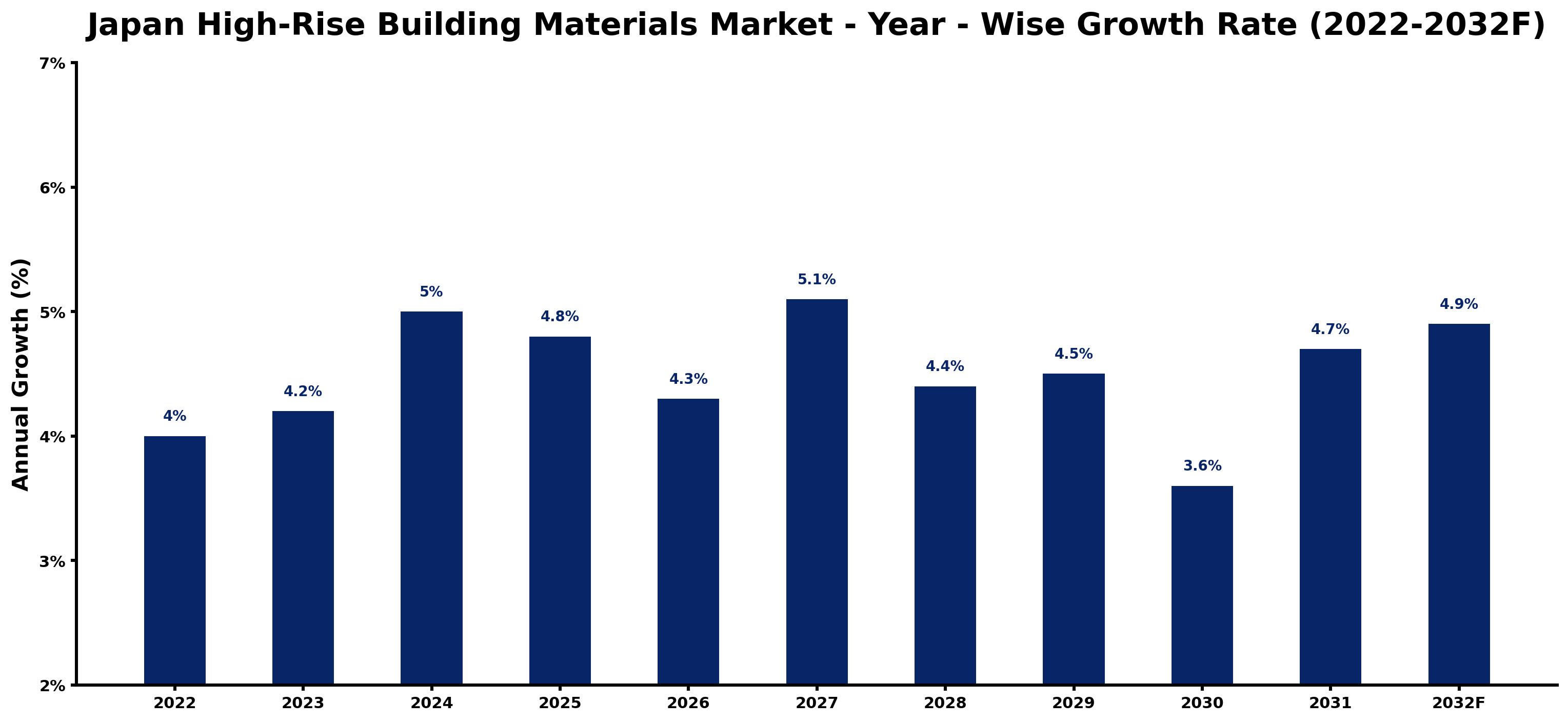
The following figures match every annual growth estimate with the main market development of that year, giving the reasoning behind each rise or slowdown.
| Year | Estimated Annual Growth (%) | Market Rationale |
| 2022 | 4.0 | The construction industry remained active, with ongoing urban development projects driving demand. |
| 2023 | 4.2 | Increased investment in urban infrastructure projects contributed to faster growth than the previous year. |
| 2024 | 5.0 | The Tokyo Metropolitan Government's skyscraper development plan stimulated construction activity. |
| 2025 | 4.8 | The market experienced a slowdown as growth moderated after reaching a peak in the previous year. |
| 2026 | 4.3 | Demand is expected to continue rising, although at a slower pace due to market saturation in certain areas. |
| 2027 | 5.1 | The introduction of new building technologies is projected to spur faster growth compared to the previous year. |
| 2028 | 4.4 | Growth is expected to slow again as the market adjusts to previous high levels of activity. |
| 2029 | 4.5 | Increased private investment in urban development projects will lead to a rise in demand. |
| 2030 | 3.6 | The market is projected to face a slowdown as economic conditions prompt cautious spending in construction. |
| 2031 | 4.7 | Demand is expected to pick up again as new projects are initiated, leading to faster growth than before. |
| 2032 | 4.9 | The ongoing urbanisation trend will continue to drive demand, resulting in growth faster than the previous year. |
Note: Market size estimations and growth projections presented in this report are based on 6Wresearch's proprietary forecasting methodology, utilizing the latest available industry data, government publications, and primary research inputs.
Japan High-Rise Building Materials Market Synopsis
High-rise building materials include structural steel, reinforced concrete, and fireproof materials, essential for constructing skyscrapers and commercial buildings. The Japan High-Rise Building Materials Market is expanding due to increasing demand from construction firms and ongoing urban development projects. With Japan's construction industry valued at approximately 50 trillion yen, the government aims for a 46% reduction in greenhouse gas emissions by 2030, driving investments in sustainable building practices and materials.
Market Dynamics Impact Analysis (2026–2032)
| Factor | Type | Impact | Primary Segment Affected |
| Growing urbanisation and infrastructure development in Tokyo | Driver | High | Structural Steel |
| Rising demand for fire safety compliance in high-rise buildings | Driver | High | Fireproof Materials |
| Investment in urban development projects creates new opportunities | Opportunity | High | Commercial Projects |
| Increasing focus on sustainable building practices opens market potential | Opportunity | High | Reinforced Concrete |
| High costs associated with advanced materials limit market access | Restraint | Medium | Curtain Walls |
| Strict building codes raise compliance costs for contractors | Restraint | Medium | Reinforced Concrete |
| Supply chain disruptions affect material availability and pricing | Challenge | High | Structural Steel |
| Skilled labour shortages hinder project timelines and efficiency | Challenge | High | Construction Firms |
Evaluation of Drivers in Japan High-Rise Building Materials Market (2026–2032)
The table below links each growth driver to the segment it affects and the evidence for it.
| Drivers | Primary Segment Affected | Why It Matters (Evidence) |
| Increased urbanisation in Tokyo leads to higher demand for structural steel. | Structural Steel | Tokyo's skyscraper development plan necessitates materials for new constructions. |
| Growing emphasis on fire safety regulations boosts demand for fireproof materials. | Fireproof Materials | The implementation of JIS A 5308 standard mandates fireproof materials in all high-rise projects. |
| The construction industry's value of approximately 50 trillion yen drives material purchases. | Reinforced Concrete | Construction firms are investing heavily in reinforced concrete for structural integrity. |
| Investment in urban development projects supports demand for high-rise building materials. | Commercial Projects | The government's 10 billion yen budget for urban development projects in 2023 fuels material needs. |
| The average height of skyscrapers in Japan encourages the use of advanced materials. | Curtain Walls | With an average height of around 200 meters, high-rise buildings require durable facade solutions. |
Most of the extra volume comes from ongoing urbanisation in Tokyo, which drives demand for structural steel as new skyscrapers are built. The construction industry, valued at approximately 50 trillion yen, fuels purchases of reinforced concrete, vital for structural integrity. The average height of skyscrapers, around 200 meters, necessitates advanced materials for durability and safety compliance.
Evaluation of Restraints in Japan High-Rise Building Materials Market
Below are the constraints most often cited by buyers and suppliers, with the segment each affects.
| Market Restraint | Primary Segment Affected | Why It Matters (Evidence) |
| High costs of advanced materials limit access for smaller contractors. | Curtain Walls | Smaller contractors struggle to afford premium materials required for high-rise projects. |
| Strict building codes increase compliance costs for construction firms. | Reinforced Concrete | Compliance with earthquake resistance standards raises project expenses for construction firms. |
| Supply chain disruptions impact the availability of structural steel. | Structural Steel | Global supply chain issues have led to delays and increased prices for essential materials. |
| Limited skilled labour availability affects project timelines. | Construction Firms | A shortage of skilled workers delays construction schedules and increases costs for contractors. |
| Market saturation in urban areas limits new project opportunities. | Commercial Projects | High competition in established markets makes it challenging for new entrants to secure contracts. |
Japan High-Rise Building Materials Market Challenges
High-rise producers face a shortage of skilled labour, with Japan's construction workforce at approximately 5 million people, causing project delays that inflate costs for contractors. Technology adoption is slow, particularly in advanced manufacturing processes, which leads to increased production times and higher expenses for suppliers. Buyers contend with rising prices due to strict building codes for earthquake resistance, necessitating costly compliance measures that strain project budgets. Supply chain disruptions arise as the legal requirement for fireproof materials in all high-rise projects delays timelines and escalates expenses for developers sourcing compliant products.
Trends in the Japan High-Rise Building Materials Market
Buyers and suppliers in the Japan High-Rise Building Materials Market are adjusting to the following trends.
- Shift from Traditional to Sustainable Materials: Since 2020, there has been a notable shift towards sustainable building materials in Japan. The Green Growth Strategy aims for JPY 150 trillion in decarbonisation investment, prompting construction firms to adopt eco-friendly materials.
- Transition from Conventional to Advanced Fireproofing Solutions: The introduction of JIS A 5308 standard in 2022 has led to a transition towards advanced fireproofing solutions in high-rise buildings. This shift ensures compliance with safety regulations while improving structural integrity.
- Emergence of Prefabricated Building Components: The trend towards prefabricated building components has gained traction since 2021, with a 20% increase in gypsum board usage in commercial projects. This approach reduces construction time and improves efficiency.
- Prioritisation of Energy Efficiency in Building Designs: Beginning in 2025, the Building Energy Efficiency Act mandates energy standards for new buildings. This requirement pushes construction firms to prioritise energy-efficient designs and materials.
Investment Opportunities in the Japan High-Rise Building Materials Market
Investors looking at the Japan High-Rise Building Materials Market should consider the following areas.
- Timing for Urban Development Investment: With the government's 10 billion yen budget for urban development in 2023, there is an opportunity for suppliers to provide high-rise materials. Collaborating with local construction firms could facilitate market entry.
- Supply of Sustainable Building Materials: As Japan targets a 46% cut in greenhouse gas emissions by 2030, there is a growing demand for sustainable building materials. Suppliers can focus on eco-friendly options to meet this need.
- Gap in Fireproof Material Compliance: With fireproof materials mandated in all high-rise projects, there is a gap in compliance solutions. Suppliers can develop products to address this requirement and capture market share.
- Entry into Prefabricated Component Market: The increasing use of prefabricated components presents a timely opportunity. Suppliers can partner with construction firms to provide these materials, enhancing project efficiency.
Government Initiatives in the Japan High-Rise Building Materials Market
The Building Energy Efficiency Act, amended in 2022, mandates all new buildings to comply with energy standards starting April 2025. This law drives producers to invest in energy-efficient materials and technologies, ensuring compliance with national sustainability goals. The PRTR Law requires businesses to report chemical substance releases, influencing material selection in construction.
The Urban Renaissance Agency funds urban redevelopment initiatives, supporting projects that align with sustainability objectives and offering financial assistance for compliant materials. This agency's support helps construction firms implement measures that improve the use of high-rise building materials.
Future Insight of the Japan High-Rise Building Materials Market
Japan's commitment to a 46% reduction in greenhouse-gas emissions by 2030 will drive the development of sustainable building technologies, prompting suppliers to adapt. By 2032, the JPY 150 trillion investment in urban development will reshape infrastructure, creating new opportunities for buyers in the construction sector. The skyscraper development plan set by the Tokyo Metropolitan Government for 2025 will increase demand for high-rise materials, pushing suppliers to meet evolving standards. Regulations will require that all new high-rises incorporate advanced fireproof materials, ensuring enhanced safety and durability.
Market Segmentation Analysis
Japan High-Rise Building Materials Market report covers a detailed analysis of the following market segments:
By Product Type – Structural Steel Leads, Reinforced Concrete Expected to Grow Fastest
According to Saurav Kr Singh, Senior Research Analyst at 6Wresearch, Structural Steel took 43% of product type revenue in 2025, more than any other category. Structural steel commands the largest share as it is fundamental for load-bearing structures in high-rise buildings. This material is extensively used in over 300 high-rise buildings located in Tokyo, highlighting its critical importance in the market. Reinforced Concrete is projected to grow fastest, at a CAGR of 6.3% during 2026–2032. Reinforced concrete is experiencing rapid growth due to its essential role in ensuring structural integrity for high-rise projects. The increasing number of new buildings, with 15% being high-rises in 2022, is expected to drive this demand further. Suppliers should focus on reinforcing their product lines in reinforced concrete to capitalise on this growth trend.
By Material Composition – Alloy Steel Leads, Concrete & Rebar Expected to Grow Fastest
Alloy Steel held 37% of the Japan High-Rise Building Materials Market by material composition in 2025. Alloy steel leads this segment as it is specifically employed in vital structural applications, ensuring safety and durability in high-rise buildings. It constitutes 30% of structural applications, highlighting its significance in the market. Over 2026–2032, Concrete & Rebar is expected to post the fastest growth, at a CAGR of 6.4%. Concrete and rebar are experiencing the fastest growth because they are fundamental components for construction, especially in high-rise projects. The government's budget for urban development projects in 2023 is likely to drive this demand further. Buyers should prioritise sourcing concrete and rebar to effectively address the increasing construction requirements.
By Distribution Channel – Direct Sales Leads, OEM Distributors Expected to Grow Fastest
In 2025, Direct Sales led the distribution channel split with a 38% share. Direct sales lead the distribution channel as it is the primary method for delivering high-rise building materials, allowing suppliers to engage directly with construction firms. This direct approach fosters strong relationships and ensures timely delivery of essential materials. OEM Distributors are set to record the highest CAGR in this split, 5.6% over 2026–2032. OEM distributors are witnessing the fastest growth as they streamline the supply chain for construction materials. The government's budget for urban development projects in 2023 is likely to enhance the role of these distributors in the market. Suppliers might explore partnerships with OEM distributors to expand their market reach and improve distribution efficiency.
By End User – Construction Firms Lead, High-Rise Developers Expected to Grow Fastest
The largest end user category in 2025 was Construction Firms, at 34% of revenue. Construction firms are the predominant end users of high-rise building materials, as they are responsible for the actual construction of skyscrapers and tall structures. With the construction industry in Japan valued at approximately 50 trillion yen, these firms play a crucial role in driving market demand. The quickest growth will come from High-Rise Developers, forecast to expand at a CAGR of 5.8% between 2026 and 2032. High-rise developers are growing rapidly as they focus specifically on the construction of tall buildings. The government's skyscraper development plan for 2025 is expected to further accelerate their activities in this sector. Suppliers should tailor their strategies to address the unique needs of high-rise developers to maximise their market potential.
Key Attractiveness of the Report
- 10 Years of Market Numbers
- Historical Data Starting from 2022 to 2025
- Base Year 2025
- Forecast Data until 2032
- Key Performance Indicators Impacting the Market
- Major Upcoming Developments and Projects
Key Highlights of the Report:
- Japan High-Rise Building Materials Market Outlook
- Market Size of Japan High-Rise Building Materials Market, 2025
- Forecast of Japan High-Rise Building Materials Market, 2032
- Historical Data and Forecast of Japan High-Rise Building Materials Revenues & Volume for the Period 2022-2032F
- Japan High-Rise Building Materials Market Trend Evolution
- Japan High-Rise Building Materials Market Drivers and Challenges
- Japan High-Rise Building Materials Price Trends
- Japan High-Rise Building Materials Porter's Five Forces
- Japan High-Rise Building Materials Industry Life Cycle
- Historical Data and Forecast of Japan High-Rise Building Materials Market Revenues & Volume By Product Type for the Period 2022-2032F
- Historical Data and Forecast of Japan High-Rise Building Materials Market Revenues & Volume By Structural Steel for the Period 2022-2032F
- Historical Data and Forecast of Japan High-Rise Building Materials Market Revenues & Volume By Reinforced Concrete for the Period 2022-2032F
- Historical Data and Forecast of Japan High-Rise Building Materials Market Revenues & Volume By Curtain Walls for the Period 2022-2032F
- Historical Data and Forecast of Japan High-Rise Building Materials Market Revenues & Volume By Fireproof Materials for the Period 2022-2032F
- Historical Data and Forecast of Japan High-Rise Building Materials Market Revenues & Volume By Material Composition for the Period 2022-2032F
- Historical Data and Forecast of Japan High-Rise Building Materials Market Revenues & Volume By Alloy Steel for the Period 2022-2032F
- Historical Data and Forecast of Japan High-Rise Building Materials Market Revenues & Volume By Concrete & Rebar for the Period 2022-2032F
- Historical Data and Forecast of Japan High-Rise Building Materials Market Revenues & Volume By Glass + Aluminum for the Period 2022-2032F
- Historical Data and Forecast of Japan High-Rise Building Materials Market Revenues & Volume By Gypsum & Cladding for the Period 2022-2032F
- Historical Data and Forecast of Japan High-Rise Building Materials Market Revenues & Volume By Distribution Channel for the Period 2022-2032F
- Historical Data and Forecast of Japan High-Rise Building Materials Market Revenues & Volume By Direct Sales for the Period 2022-2032F
- Historical Data and Forecast of Japan High-Rise Building Materials Market Revenues & Volume By OEM Distributors for the Period 2022-2032F
- Historical Data and Forecast of Japan High-Rise Building Materials Market Revenues & Volume By Project Contractors for the Period 2022-2032F
- Historical Data and Forecast of Japan High-Rise Building Materials Market Revenues & Volume By Industrial Suppliers for the Period 2022-2032F
- Historical Data and Forecast of Japan High-Rise Building Materials Market Revenues & Volume By End User for the Period 2022-2032F
- Historical Data and Forecast of Japan High-Rise Building Materials Market Revenues & Volume By Construction Firms for the Period 2022-2032F
- Historical Data and Forecast of Japan High-Rise Building Materials Market Revenues & Volume By High-Rise Developers for the Period 2022-2032F
- Historical Data and Forecast of Japan High-Rise Building Materials Market Revenues & Volume By Commercial Projects for the Period 2022-2032F
- Historical Data and Forecast of Japan High-Rise Building Materials Market Revenues & Volume By Skyscraper Builders for the Period 2022-2032F
- Japan High-Rise Building Materials Import Export Trade Statistics
- Market Opportunity Assessment By Product Type
- Market Opportunity Assessment By Material Composition
- Market Opportunity Assessment By Distribution Channel
- Market Opportunity Assessment By End User
- Japan High-Rise Building Materials Top Companies Market Share
- Japan High-Rise Building Materials Competitive Benchmarking By Technical and Operational Parameters
- Japan High-Rise Building Materials Company Profiles
- Japan High-Rise Building Materials Key Strategic Recommendations
Market Covered
Coverage by segment is as follows.
By Product Type
- Structural Steel
- Reinforced Concrete
- Curtain Walls
- Fireproof Materials
By Material Composition
- Alloy Steel
- Concrete & Rebar
- Glass + Aluminum
- Gypsum & Cladding
By Distribution Channel
- Direct Sales
- OEM Distributors
- Project Contractors
- Industrial Suppliers
By End User
- Construction Firms
- High-Rise Developers
- Commercial Projects
- Skyscraper Builders































