Japan High-Speed Data Transmission Market Size & Growth Rate
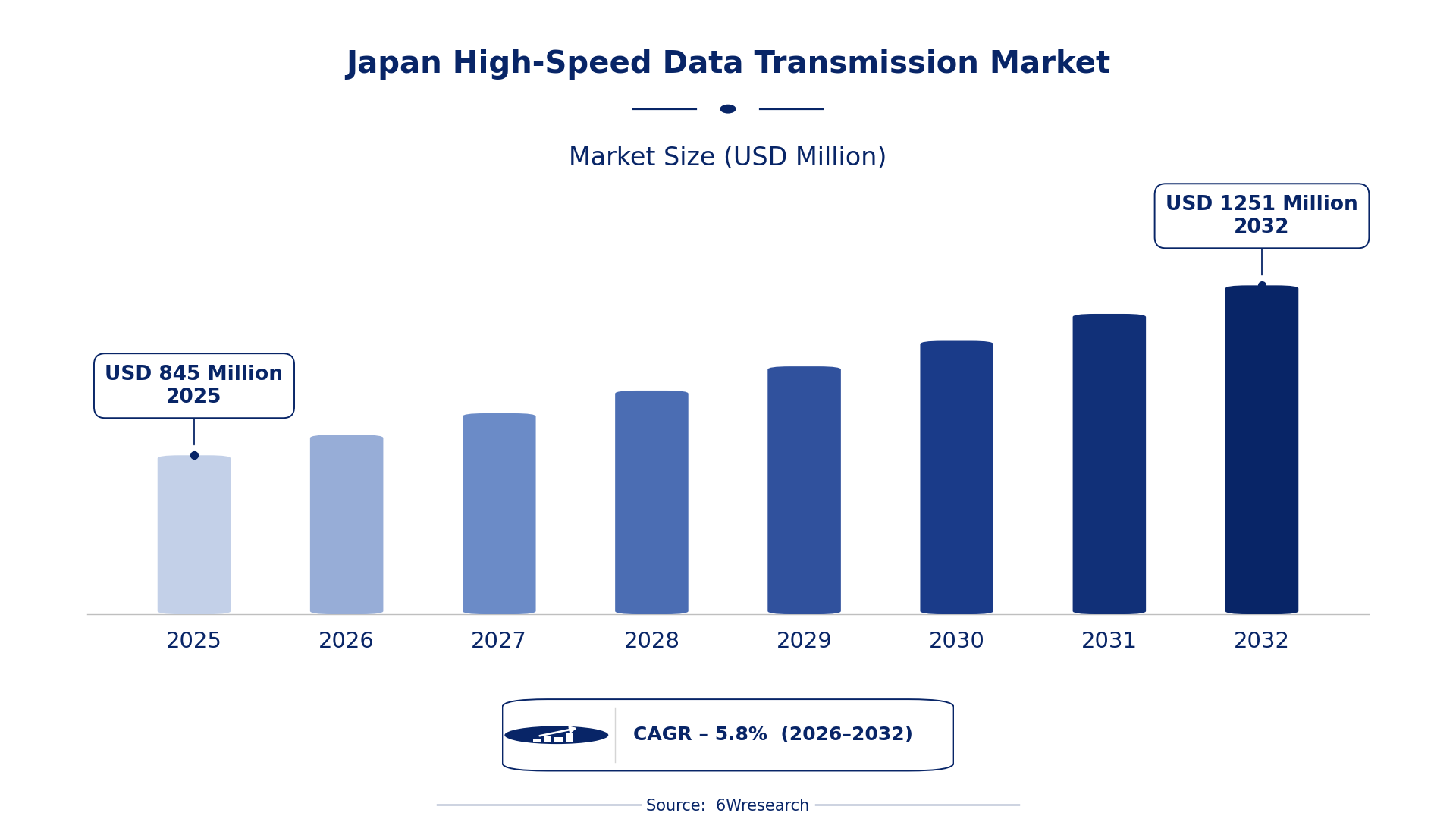
According to 6Wresearch internal database and industry insights, the Japan High-Speed Data Transmission Market was valued at USD 845 Million in 2025 and is projected to reach USD 1,251 Million by 2032, growing at a CAGR of approximately 5.8% during 2026–2032.
Japan High-Speed Data Transmission Market Highlights
| Report Metric | Details |
| Report Name | Japan High-Speed Data Transmission Market (2026-2032) |
| Market Size 2025 | USD 845 Million |
| Market Size 2032 | USD 1,251 Million |
| Absolute Growth 2025–2032 | USD 406 Million |
| CAGR 2026–2032 | 5.8% |
| Peak Annual Growth | 6.7% in 2028 |
| Forecast Period | 2026–2032 |
| Historical Data | 2022–2025 |
| Base Year | 2025 |
| Leading Technology Type, 2025 | 5G NR Transmission (44% share) |
| Leading Protocol, 2025 | DWDM (47% share) |
| Leading Distribution Channel, 2025 | Direct Sales (36% share) |
| Leading End User, 2025 | Mobile Network Operators (48% share) |
| Fastest-Growing Technology Type | Fiber Backbone Systems (8.1% CAGR) |
| Fastest-Growing Protocol | mmWave (7.3% CAGR) |
| Fastest-Growing Distribution Channel | Government Contracts (7.5% CAGR) |
| Fastest-Growing End User | Internet Backbone Providers (7.4% CAGR) |
| Growing Sector | telecommunications |
| Key End Users | mobile network operators, internet backbone providers, enterprise networks |
Japan High-Speed Data Transmission Market Year-wise Growth Rate and Key Drivers (2022–2032)
This graph illustrates the annual growth rates of the market from 2022 to 2032, highlighting a steady upward trajectory and projected market expansion over the forecast period.
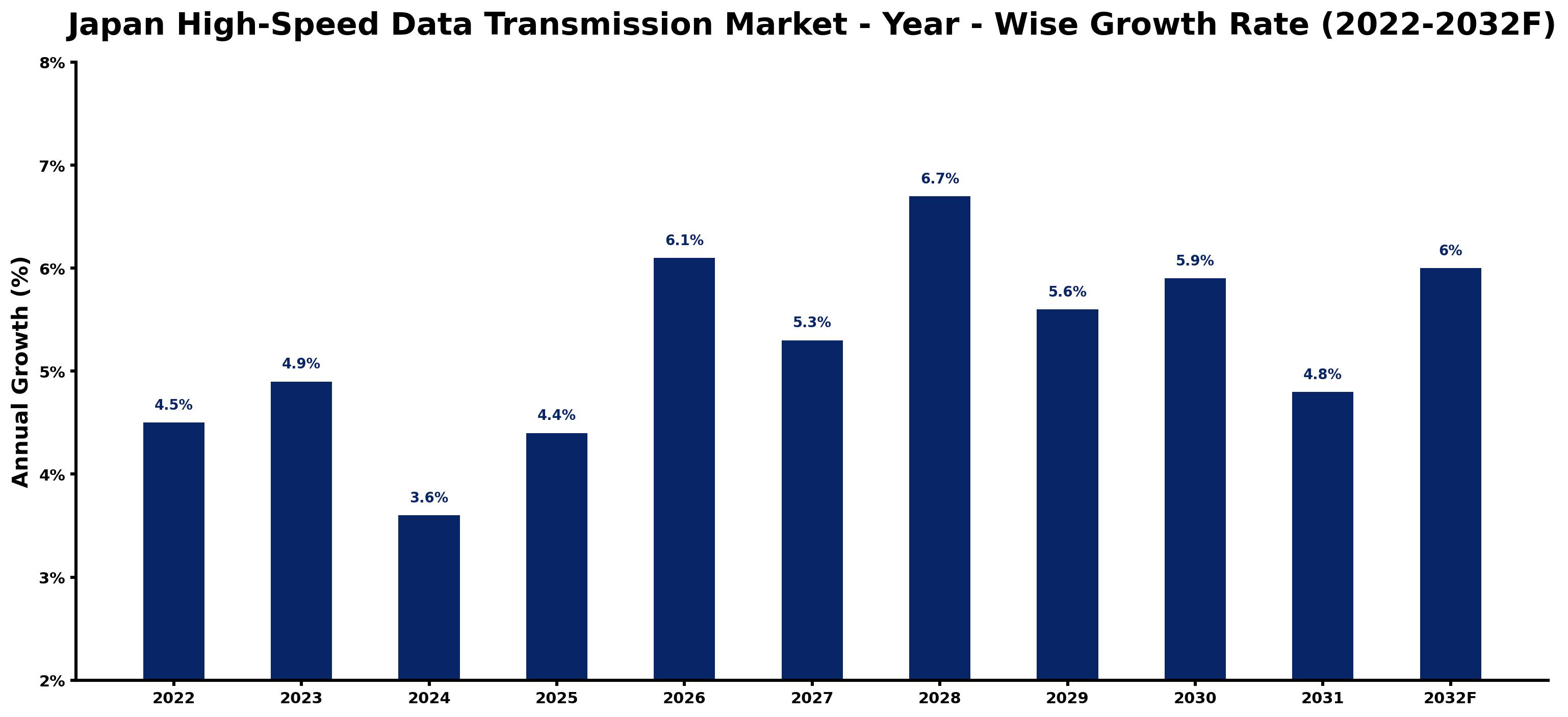
For each year, the table pairs the estimated growth rate with the leading influence on demand, showing how the drivers changed across the period.
| Year | Estimated Annual Growth (%) | Market Rationale |
| 2022 | 4.5 | Demand was driven by increasing mobile data usage across urban areas. |
| 2023 | 4.9 | Growth was supported by advancements in 5G technology and infrastructure. |
| 2024 | 3.6 | Growth slowed due to market saturation in some urban segments. |
| 2025 | 4.4 | Demand accelerated as new fiber backbone systems were deployed. |
| 2026 | 6.1 | Growth is expected to be boosted by rising investments in digital infrastructure. |
| 2027 | 5.3 | A slowdown is projected as competition intensifies among providers. |
| 2028 | 6.7 | Demand is expected to surge with the introduction of new high-speed technologies. |
| 2029 | 5.6 | Growth is projected to slow as the market adjusts to new capacity levels. |
| 2030 | 5.9 | Investments in rural connectivity initiatives will spur demand. |
| 2031 | 4.8 | A slowdown is expected as the market stabilises after rapid growth. |
| 2032 | 6.0 | Growth is projected to accelerate with the expansion of urban fiber networks. |
Note: Market size estimations and growth projections presented in this report are based on 6Wresearch's proprietary forecasting methodology, utilizing the latest available industry data, government publications, and primary research inputs.
Japan High-Speed Data Transmission Market Synopsis
High-Speed Data Transmission involves advanced telecommunications technologies such as fiber optics and 5G networks, which are vital for mobile communications and internet infrastructure. The Japan High-Speed Data Transmission Market is growing due to over 100 million 5G subscribers and government investment of ¥1 trillion in digital infrastructure by 2025. Key buyer groups include mobile network operators and internet backbone providers, which drive demand for efficient solutions and connectivity across urban areas.
Market Dynamics Impact Analysis (2026–2032)
| Factor | Type | Impact | Primary Segment Affected |
| Increasing mobile data consumption drives demand for 5G NR Transmission. | Driver | High | 5G NR Transmission |
| Expansion of fiber backbone systems supports internet infrastructure growth. | Driver | High | Fiber Backbone Systems |
| Rural connectivity initiatives create demand for broadband solutions. | Opportunity | Medium | Fiber Backbone Systems |
| Government contracts for infrastructure projects enhance market opportunities. | Opportunity | High | Government Contracts |
| Market saturation in urban areas limits growth potential. | Restraint | High | 5G NR Transmission |
| High competition among providers can lead to price wars. | Restraint | Medium | Fiber Backbone Systems |
| High costs of deploying fiber infrastructure can deter investments. | Challenge | High | Fiber Backbone Systems |
| Technological obsolescence risks existing investments in older systems. | Challenge | Medium | 5G NR Transmission |
Evaluation of Drivers in Japan High-Speed Data Transmission Market (2026–2032)
The main growth drivers and the segments they affect most are set out below.
| Drivers | Primary Segment Affected | Why It Matters (Evidence) |
| Growing number of 5G subscribers increases demand for high-speed data services. | 5G NR Transmission | Japan has over 100 million 5G subscribers as of 2023, leading to higher data consumption. |
| Expansion of fiber optic networks improves data transfer capabilities. | Fiber Backbone Systems | The total length of fiber optic cables in Japan exceeds 1 million kilometers, supporting increased connectivity. |
| Government investment in digital infrastructure boosts market growth. | Government Contracts | The government plans to invest ¥1 trillion in digital infrastructure by 2025, creating new opportunities. |
| Rising internet speeds drive demand for advanced transmission technologies. | Optical Network Units | The average internet speed in Japan is over 100 Mbps as of 2023, necessitating efficient solutions. |
| Urbanisation increases the need for reliable communication networks. | Mobile Network Operators | The Tokyo metropolitan area is a major hub for fiber backbone systems, enhancing connectivity. |
Orders continue to rise as Japan's telecommunications sector responds to the increasing number of 5G subscribers, which surpassed 100 million in 2023. This growth compels mobile network operators to invest in high-speed data services, driving demand for 5G NR Transmission. The expansion of fiber optic networks, with over 1 million kilometres of cables, improves data transfer capabilities. Average internet speeds exceeding 100 Mbps require efficient solutions, prompting internet backbone providers to upgrade their systems.
Evaluation of Restraints in Japan High-Speed Data Transmission Market
Below are the constraints most often cited by buyers and suppliers, with the segment each affects.
| Market Restraint | Primary Segment Affected | Why It Matters (Evidence) |
| Market saturation in urban areas limits growth potential for new providers. | 5G NR Transmission | The concentration of services in urban areas reduces opportunities for new entrants. |
| High competition can lead to price wars, impacting profitability. | Fiber Backbone Systems | Intense rivalry among providers in metropolitan areas drives down prices. |
| Deployment costs for fiber infrastructure deter smaller players from entering the market. | Fiber Backbone Systems | High initial investments required for infrastructure limit market entry. |
| Technological obsolescence risks existing investments in older systems. | 5G NR Transmission | Rapid advancements in technology can render older systems inefficient. |
| Limited consumer market for components restricts growth in online retail channels. | Online Retail | The niche market for high-speed data components reduces sales opportunities. |
Japan High-Speed Data Transmission Market Challenges
Intense competition among telecommunications providers drives down prices, which reduces profit margins for producers. This pressure leads to underinvestment in network upgrades, causing delays in service improvements for buyers who expect high-speed data. A shortage of skilled technicians hampers the ability of companies to expand their services, resulting in longer wait times for consumers needing installations. Rising operational costs, driven by regulatory compliance and maintenance of infrastructure, can burden producers, forcing them to pass on expenses to buyers, which can increase the average household internet expenditure beyond ¥5,000 per month.
Trends in the Japan High-Speed Data Transmission Market
Four trends stand out in the Japan High-Speed Data Transmission Market.
- Shift from Traditional to 5G Networks: As of 2023, Japan has over 100 million 5G subscribers, indicating a shift towards advanced mobile networks. This transition drives demand for high-speed data transmission solutions.
- Transition from Copper to Fiber Optics: The Tokyo metropolitan area has experienced rapid deployment of fiber backbone systems, which now exceed 1 million kilometres. This shift supports the growing demand for high-speed internet.
- 5G Technology Prioritised over Legacy Systems: The introduction of 5G networks in urban areas has reduced reliance on legacy systems. Mobile network operators are upgrading their infrastructure to meet modern demands.
- Government Investment in Digital Infrastructure: The government plans to invest ¥1 trillion in digital infrastructure by 2025, aiming to improve connectivity across rural areas. This funding is expected to enhance broadband access.
Investment Opportunities in the Japan High-Speed Data Transmission Market
Several openings in the Japan High-Speed Data Transmission Market merit attention from investors.
- Investment in Rural Broadband Expansion: The government has a strategy to improve rural connectivity by 2025, creating a demand for broadband solutions. This presents opportunities for internet backbone providers to expand their services.
- Supply of Advanced Fiber Backbone Systems: With the total length of fiber optic cables exceeding 1 million kilometres, there is a gap in advanced fiber backbone systems. Internet backbone providers can invest in upgrading existing infrastructure.
- Development of 5G Infrastructure: The growing number of 5G subscribers indicates a need for enhanced mobile network infrastructure. Mobile network operators can invest in new technologies to meet this demand.
- Government Contracts for Infrastructure Projects: The government plans to invest ¥1 trillion in digital infrastructure, presenting opportunities for companies involved in telecommunications projects. Collaborating with local partners can facilitate market entry.
Government Initiatives in the Japan High-Speed Data Transmission Market
The Digital Agency, established in September 2021, leads the government's digital transformation efforts. It oversees the implementation of common system standards and funds projects aimed at improving digital infrastructure. This agency ensures that telecommunications regulations align with modern technological advancements, benefiting both producers and buyers in the high-speed data transmission market.
The Ministry of Internal Affairs and Communications regulates telecommunications in Japan. It approves projects related to digital infrastructure and oversees compliance with standards such as ISO/IEC 27001 for information security management. This regulatory framework ensures that buyers can trust the integrity and security of high-speed data transmission services.
Future Insight of the Japan High-Speed Data Transmission Market
The rollout of advanced optical network facilities will greatly improve high-speed data transmission capabilities in Japan. By 2032, enhancements in optical network technologies will elevate average internet speeds to over 200 Mbps and reduce latency for urban users to around 5 ms. Ongoing initiatives to expand rural broadband will connect underserved areas, increasing access for more consumers. Improved standards from the Japan Telecommunications Association will ensure better service quality and reliability, benefiting both buyers and suppliers.
Market Segmentation Analysis
Japan High-Speed Data Transmission Market report covers a detailed analysis of the following market segments:
By Technology Type – 5G NR Transmission Leads, Fiber Backbone Systems Expected to Grow Fastest
According to Saurav Kr Singh, Senior Research Analyst at 6Wresearch, 5G NR Transmission took 44% of technology type revenue in 2025, more than any other category. 5G NR Transmission holds the largest share due to its extensive adoption among mobile network users, with over 100 million subscribers in Japan as of 2023. This technology is essential for enhancing mobile communications and meeting the increasing demand for high-speed data services. Fiber Backbone Systems are projected to grow fastest, at a CAGR of 8.1% during 2026–2032. The growth of Fiber Backbone Systems is propelled by the urgent need for robust internet infrastructure, especially in urban areas like Tokyo. With substantial government investments planned for digital infrastructure, this segment is set for rapid expansion. Suppliers should focus on developing solutions that enhance fiber backbone systems to meet the rising demand.
By Protocol – DWDM Leads, mmWave Expected to Grow Fastest
The largest protocol category in 2025 was DWDM, at 47% of revenue. DWDM technology dominates the market as it is vital for increasing fiber capacity, facilitating efficient data transmission across Japan's extensive optical networks. This technology is crucial for high-speed data services, particularly in urban environments where demand is highest. The quickest growth will come from mmWave, forecast to expand at a CAGR of 7.3% between 2026 and 2032. The mmWave protocol is experiencing rapid growth due to its critical role in high-speed wireless communication, especially for 5G applications. As the need for faster wireless solutions escalates, mmWave is expected to gain substantial market traction. Buyers should consider investing in mmWave technology to stay competitive in the high-speed data transmission sector.
By Distribution Channel – Direct Sales Leads, Government Contracts Expected to Grow Fastest
With 36% of distribution channel revenue in 2025, Direct Sales was the largest category. Direct Sales is the leading distribution channel, preferred for delivering tailored enterprise solutions directly to clients. This approach allows providers to specifically address the unique requirements of the telecommunications sector. Government Contracts are set to record the highest CAGR in this split, 7.5% over 2026–2032. Government Contracts are the fastest-growing distribution channel, driven by significant public investments in infrastructure projects. This trend indicates a shift towards increased public-private partnerships within the telecommunications industry. Suppliers should actively pursue government contracts to capitalise on the growing investment in digital infrastructure.
By End User – Mobile Network Operators Lead, Internet Backbone Providers Expected to Grow Fastest
Mobile Network Operators accounted for 48% of the market by end user in 2025. Mobile Network Operators represent the largest end user group, as they are the primary consumers of high-speed data transmission technologies. Their extensive networks are essential for supporting millions of subscribers, highlighting their critical role in the market. Over 2026–2032, Internet Backbone Providers are expected to post the fastest growth, at a CAGR of 7.4%. Internet Backbone Providers are the fastest-growing end user segment, as they play a crucial role in enabling data transmission across Japan. The increasing demand for reliable internet services is driving their rapid growth. Suppliers need to tailor their offerings to meet the specific needs of internet backbone providers to capture this expanding market segment.
Key Attractiveness of the Report
- 10 Years of Market Numbers
- Historical Data Starting from 2022 to 2025
- Base Year 2025
- Forecast Data until 2032
- Key Performance Indicators Impacting the Market
- Major Upcoming Developments and Projects
Key Highlights of the Report:
- Japan High-Speed Data Transmission Market Outlook
- Market Size of Japan High-Speed Data Transmission Market, 2025
- Forecast of Japan High-Speed Data Transmission Market, 2032
- Historical Data and Forecast of Japan High-Speed Data Transmission Revenues & Volume for the Period 2022-2032F
- Japan High-Speed Data Transmission Market Trend Evolution
- Japan High-Speed Data Transmission Market Drivers and Challenges
- Japan High-Speed Data Transmission Price Trends
- Japan High-Speed Data Transmission Porter's Five Forces
- Japan High-Speed Data Transmission Industry Life Cycle
- Historical Data and Forecast of Japan High-Speed Data Transmission Market Revenues & Volume By Technology Type for the Period 2022-2032F
- Historical Data and Forecast of Japan High-Speed Data Transmission Market Revenues & Volume By 5G NR Transmission for the Period 2022-2032F
- Historical Data and Forecast of Japan High-Speed Data Transmission Market Revenues & Volume By Fiber Backbone Systems for the Period 2022-2032F
- Historical Data and Forecast of Japan High-Speed Data Transmission Market Revenues & Volume By Satellite Uplink Systems for the Period 2022-2032F
- Historical Data and Forecast of Japan High-Speed Data Transmission Market Revenues & Volume By Optical Network Units for the Period 2022-2032F
- Historical Data and Forecast of Japan High-Speed Data Transmission Market Revenues & Volume By Protocol for the Period 2022-2032F
- Historical Data and Forecast of Japan High-Speed Data Transmission Market Revenues & Volume By mmWave for the Period 2022-2032F
- Historical Data and Forecast of Japan High-Speed Data Transmission Market Revenues & Volume By DWDM for the Period 2022-2032F
- Historical Data and Forecast of Japan High-Speed Data Transmission Market Revenues & Volume By Ka-Band for the Period 2022-2032F
- Historical Data and Forecast of Japan High-Speed Data Transmission Market Revenues & Volume By GPON for the Period 2022-2032F
- Historical Data and Forecast of Japan High-Speed Data Transmission Market Revenues & Volume By Distribution Channel for the Period 2022-2032F
- Historical Data and Forecast of Japan High-Speed Data Transmission Market Revenues & Volume By OEM Partnerships for the Period 2022-2032F
- Historical Data and Forecast of Japan High-Speed Data Transmission Market Revenues & Volume By Direct Sales for the Period 2022-2032F
- Historical Data and Forecast of Japan High-Speed Data Transmission Market Revenues & Volume By Government Contracts for the Period 2022-2032F
- Historical Data and Forecast of Japan High-Speed Data Transmission Market Revenues & Volume By Online Retail for the Period 2022-2032F
- Historical Data and Forecast of Japan High-Speed Data Transmission Market Revenues & Volume By End User for the Period 2022-2032F
- Historical Data and Forecast of Japan High-Speed Data Transmission Market Revenues & Volume By Mobile Network Operators for the Period 2022-2032F
- Historical Data and Forecast of Japan High-Speed Data Transmission Market Revenues & Volume By Internet Backbone Providers for the Period 2022-2032F
- Historical Data and Forecast of Japan High-Speed Data Transmission Market Revenues & Volume By Remote Communication for the Period 2022-2032F
- Historical Data and Forecast of Japan High-Speed Data Transmission Market Revenues & Volume By Enterprise Networks for the Period 2022-2032F
- Japan High-Speed Data Transmission Import Export Trade Statistics
- Market Opportunity Assessment By Technology Type
- Market Opportunity Assessment By Protocol
- Market Opportunity Assessment By Distribution Channel
- Market Opportunity Assessment By End User
- Japan High-Speed Data Transmission Top Companies Market Share
- Japan High-Speed Data Transmission Competitive Benchmarking By Technical and Operational Parameters
- Japan High-Speed Data Transmission Company Profiles
- Japan High-Speed Data Transmission Key Strategic Recommendations
Market Covered
The following segment groups are covered in the report.
By Technology Type
- 5G NR Transmission
- Fiber Backbone Systems
- Satellite Uplink Systems
- Optical Network Units
By Protocol
- mmWave
- DWDM
- Ka-Band
- GPON
By Distribution Channel
- OEM Partnerships
- Direct Sales
- Government Contracts
- Online Retail
By End User
- Mobile Network Operators
- Internet Backbone Providers
- Remote Communication
- Enterprise Networks































