Japan High-Speed Industrial Doors Market Size & Growth Rate
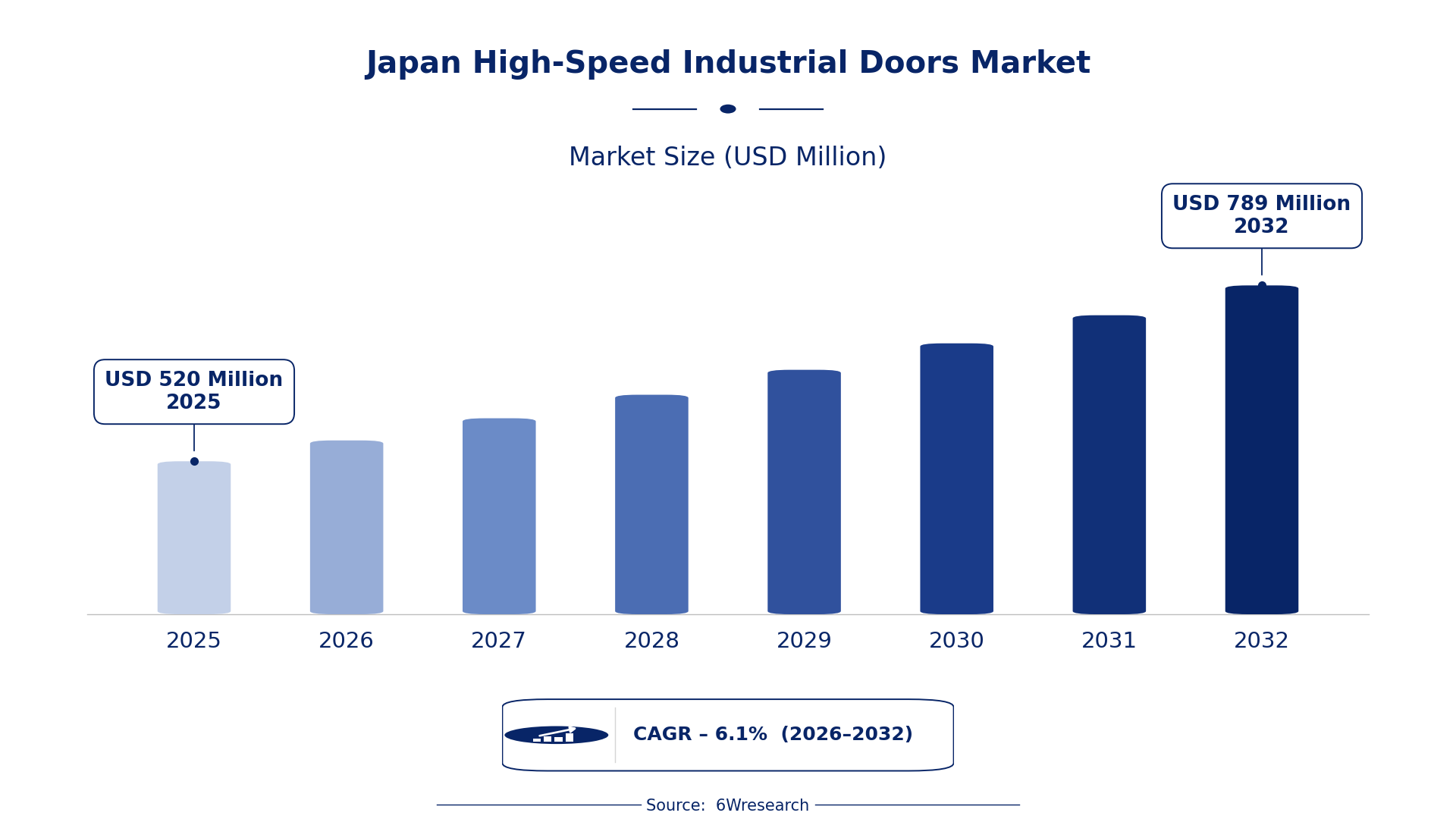
According to 6Wresearch internal database and industry insights, the Japan High-Speed Industrial Doors Market was valued at USD 520 Million in 2025 and is projected to reach USD 789 Million by 2032, growing at a CAGR of approximately 6.1% during 2026–2032.
Japan High-Speed Industrial Doors Market Highlights
| Report Metric | Details |
| Report Name | Japan High-Speed Industrial Doors Market (2026-2032) |
| Market Size 2025 | USD 520 Million |
| Market Size 2032 | USD 789 Million |
| Absolute Growth 2025–2032 | USD 269 Million |
| CAGR 2026–2032 | 6.1% |
| Peak Annual Growth | 7.0% in 2028 |
| Forecast Period | 2026–2032 |
| Historical Data | 2022–2025 |
| Base Year | 2025 |
| Leading Product Type, 2025 | Roll-Up Doors (42% share) |
| Leading Operation Mechanism, 2025 | Motorized (53% share) |
| Leading Distribution Channel, 2025 | Direct Sales (41% share) |
| Leading End User, 2025 | Manufacturing Plants (41% share) |
| Fastest-Growing Product Type | Folding Doors (8.6% CAGR) |
| Fastest-Growing Operation Mechanism | Manual/Electric (9.0% CAGR) |
| Fastest-Growing Distribution Channel | OEM Distributors (8.2% CAGR) |
| Fastest-Growing End User | Warehousing Facilities (7.9% CAGR) |
| Growing Sector | Warehousing Facilities |
| Key End Users | Manufacturing Plants, Warehousing Facilities, Logistics Centers, Cold Storage Units |
Japan High-Speed Industrial Doors Market Year-wise Growth Rate and Key Drivers (2022–2032)
This graph illustrates the annual growth rates of the market from 2022 to 2032, highlighting a steady upward trajectory and projected market expansion over the forecast period.
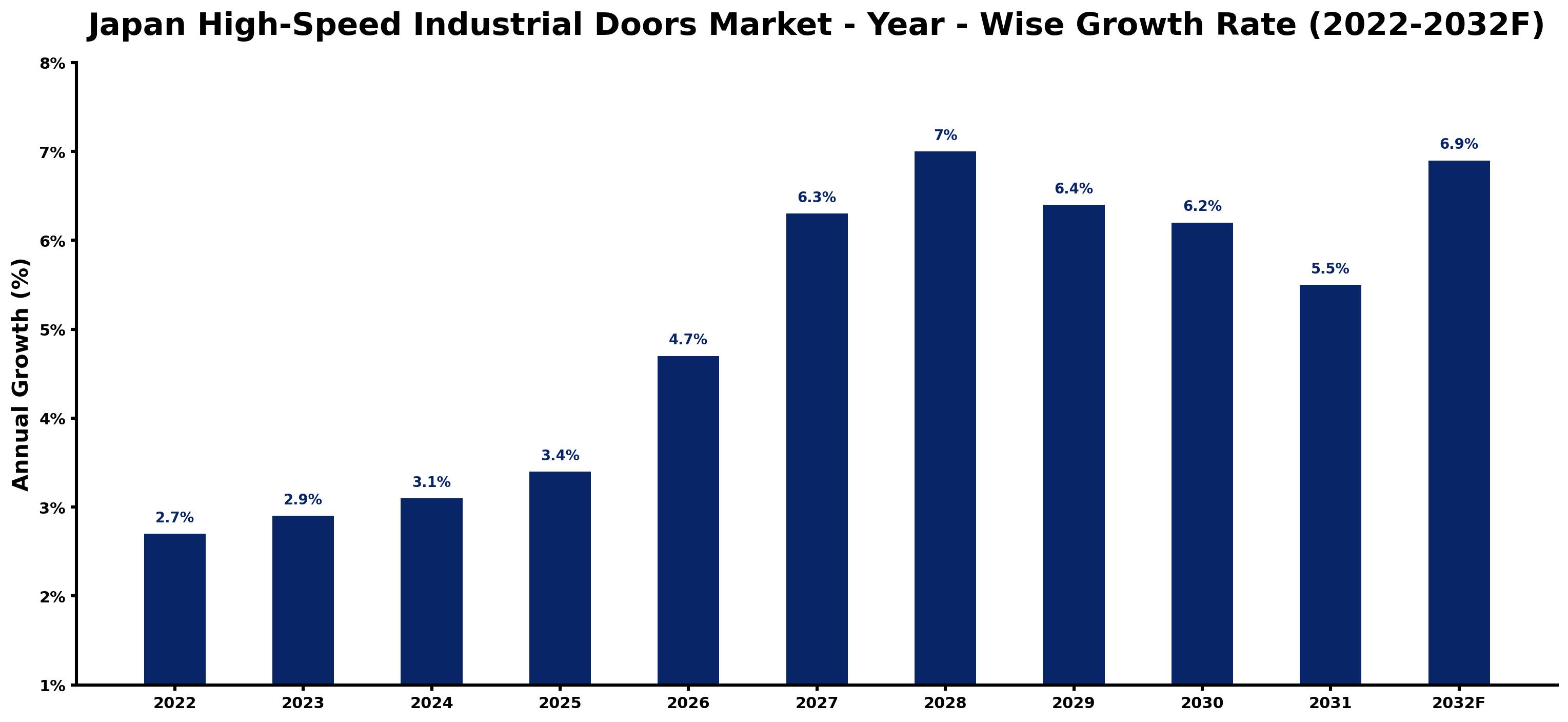
Year by year, the estimates below pair each growth rate with the development that shaped it.
| Year | Estimated Annual Growth (%) | Market Rationale |
| 2022 | 2.7 | The market experienced steady demand from manufacturing plants in Japan. |
| 2023 | 2.9 | Growth continued as logistics centers expanded their operations. |
| 2024 | 3.1 | Increased adoption of automated solutions drove higher demand for high-speed doors. |
| 2025 | 3.4 | The market saw a boost from energy efficiency initiatives in industrial settings. |
| 2026 | 4.7 | Rising investments in cold storage facilities will further stimulate demand for high-speed doors. |
| 2027 | 6.3 | Demand surged as manufacturers sought to improve operational efficiency. |
| 2028 | 7.0 | The peak growth will be fueled by a notable rise in automated door installations. |
| 2029 | 6.4 | Growth will slow slightly as market saturation begins in certain sectors. |
| 2030 | 6.2 | Demand will continue to grow, albeit at a slower pace due to market maturity. |
| 2031 | 5.5 | The market will maintain growth as new technologies emerge in door systems. |
| 2032 | 6.9 | Increased focus on energy efficiency will drive demand for high-speed doors. |
Note: Market size estimations and growth projections presented in this report are based on 6Wresearch's proprietary forecasting methodology, utilizing the latest available industry data, government publications, and primary research inputs.
Japan High-Speed Industrial Doors Market Synopsis
High-speed industrial doors are designed for rapid opening and closing, made from durable materials like steel or fabric. They improve workflow efficiency in manufacturing plants and control temperatures in cold storage units. The Japan High-Speed Industrial Doors Market is expanding due to increased demand from manufacturing and logistics sectors, with investments in energy-efficient solutions and automated systems driving new purchases. The logistics sector employs over 1.5 million workers, contributing to the rising need for efficient operations and access solutions.
Market Dynamics Impact Analysis (2026–2032)
| Factor | Type | Impact | Primary Segment Affected |
| Growing investments in energy-efficient solutions | Driver | High | Motorized |
| Expansion of logistics centers and warehousing facilities | Driver | High | Manufacturing Plants |
| Increased demand for automated solutions in urban logistics | Opportunity | High | Automated Tracks |
| Rising focus on energy efficiency in industrial applications | Opportunity | High | Cold Storage Units |
| High installation costs of advanced door systems | Restraint | Medium | Roll-Up Doors |
| Market saturation in certain segments limiting growth potential | Restraint | Medium | Folding Doors |
| Challenges in meeting safety regulations and standards | Challenge | High | Sectional Doors |
| Technological advancements requiring constant upgrades | Challenge | Medium | Sliding Doors |
Evaluation of Drivers in Japan High-Speed Industrial Doors Market (2026–2032)
The main growth drivers and the segments they affect most are set out below.
| Drivers | Primary Segment Affected | Why It Matters (Evidence) |
| Increased investment in energy efficiency | Motorized | Japan's GX Basic Policy aims for JPY 150 trillion in decarbonisation investment over 10 years, prompting manufacturers to adopt energy-efficient solutions. |
| Expansion of logistics centers | Manufacturing Plants | With over 1,000 manufacturing plants utilizing high-speed doors, the logistics sector's growth drives demand for efficient access solutions. |
| Rising popularity of automated solutions | Automated Tracks | Automated high-speed doors are gaining traction in urban logistics centers, improving operational speed and efficiency. |
| Growing cold storage facilities | Cold Storage Units | Cold storage facilities in Japan have increased by 15% since 2020, necessitating high-speed doors for temperature control. |
| Focus on hygiene in food processing | Roll-Up Doors | High-speed doors are essential in food processing plants, ensuring hygiene and operational efficiency. |
What keeps demand rising is the increased investment in energy efficiency, with Japan targeting JPY 150 trillion in decarbonisation investments over 10 years. This investment encourages manufacturing plants to adopt high-speed doors for operational efficiency. The expansion of logistics centers, employing over 1.5 million workers, drives the need for efficient access solutions. The rise of automated tracks in urban logistics improves operational speed, while the growth of cold storage facilities, increasing by 15% since 2020, necessitates high-speed doors for temperature control. The focus on hygiene in food processing plants further boosts the adoption of these solutions.
Evaluation of Restraints in Japan High-Speed Industrial Doors Market
Several factors work against faster growth; the main ones are summarised below.
| Market Restraint | Primary Segment Affected | Why It Matters (Evidence) |
| High installation costs of advanced door systems | Roll-Up Doors | The average installation cost of high-speed doors is around 1 million yen, which can deter smaller businesses from investing. |
| Market saturation in certain segments | Folding Doors | As the market matures, demand for folding doors is limited, affecting overall growth potential. |
| Challenges in meeting safety regulations and standards | Sectional Doors | High-speed doors must comply with strict safety regulations, increasing costs and complexity for producers. |
| Technological advancements requiring constant upgrades | Sliding Doors | As technology evolves, manufacturers face pressure to upgrade systems, which can delay new installations. |
| Dependence on specific buyer groups for demand | Motorized | The market's reliance on manufacturing plants limits diversification of demand sources. |
Japan High-Speed Industrial Doors Market Challenges
Annual demand for high-speed doors in Japan is estimated at 50,000 units, yet rising material costs for PVC and aluminium inflate installation expenses, imposing an average cost of around 1 million yen per door on buyers. Logistics companies encounter delays due to prolonged installation processes, disrupting workflows and leading to inefficiencies. Compliance with safety regulations under Japanese law compels manufacturers to allocate additional resources, extending production timelines for suppliers. A shortage of skilled workers in advanced door technology limits producers' ability to meet growing demand, resulting in longer lead times for buyers.
Trends in the Japan High-Speed Industrial Doors Market
Buyers and suppliers in the Japan High-Speed Industrial Doors Market are adjusting to the following trends.
- Shift towards Automated High-Speed Doors: In 2023, the Japan Industrial Door Association reported an increase in automated door solutions, reflecting a trend towards greater efficiency in logistics. This shift corresponds with the logistics sector's expansion, which employs over 1.5 million workers.
- Increase in Cold Storage Facilities: Since 2020, cold storage facilities in Japan have risen by 15%, driving demand for high-speed doors. This growth underscores the necessity for temperature control solutions within the food supply chain.
- Adoption of Energy-Efficient Standards: The introduction of ISO 9001 standards among manufacturers in Japan promotes energy efficiency in high-speed door production. This trend aligns with the broader decarbonisation objectives established by the government.
- Expansion of Logistics Centers: The Osaka region has become a focal point for warehousing and logistics, significantly increasing demand for high-speed doors. This growth is apparent as logistics centres expand operations to meet escalating consumer expectations.
Investment Opportunities in the Japan High-Speed Industrial Doors Market
Where to invest in the Japan High-Speed Industrial Doors Market: the main openings are set out below.
- Manufacturing Plants: With over 1,000 manufacturing plants in Japan, there is a strong need for high-speed doors to improve operational efficiency. Investing in energy-efficient door solutions can meet this demand, particularly in regions like Tokyo.
- Cold Storage Units: The increase in cold storage facilities by 15% since 2020 highlights the need for high-speed doors to maintain temperature control. Suppliers should focus on providing energy-efficient solutions to meet this growing demand.
- Logistics Centers: As logistics centers expand, the demand for high-speed doors is expected to rise. Investing in automated door systems can cater to this need, particularly in the Osaka region, a logistics hub.
- Food Processing Plants: The focus on hygiene in food processing plants creates a demand for high-speed doors. Suppliers can capitalize on this trend by offering solutions that ensure operational efficiency and compliance with safety standards.
Government Initiatives in the Japan High-Speed Industrial Doors Market
The GX Promotion Act, adopted in 2023, establishes the legal framework for Japan's decarbonisation efforts, targeting JPY 150 trillion in public and private investments over the next decade. The Act on the Rational Use of Energy mandates large energy users to improve efficiency, impacting high-speed door producers by requiring them to meet stricter energy standards.
The Ministry of Land, Infrastructure, Transport and Tourism oversees initiatives promoting energy-efficient industrial solutions. In 2023, the ministry launched a program to support manufacturers in adopting advanced technologies, which will facilitate compliance with safety regulations and improve operational efficiency in high-speed door production.
Future Insight of the Japan High-Speed Industrial Doors Market
The integration of energy-efficient technologies will reshape demand for high-speed doors by 2032, aligning with Japan's commitment to a 46% reduction in greenhouse gas emissions. The 2023 initiative from the Ministry of Economy, Trade and Industry will drive the adoption of these technologies across various sectors. As cold storage facilities expand, the need for high-speed doors will increase significantly to maintain operational efficiency. Automated door solutions are projected to become common in urban logistics, improving workflow and minimising energy consumption.
Market Segmentation Analysis
Japan High-Speed Industrial Doors Market report covers a detailed analysis of the following market segments:
By Product Type – Roll-Up Doors Lead, Folding Doors Expected to Grow Fastest
According to Saurav Kr Singh, Senior Research Analyst at 6Wresearch, in 2025, Roll-Up Doors led the product type split with a 42% share. Roll-Up Doors hold the largest share as they are widely utilised for quick access in warehouses, essential for maintaining operational efficiency. Their prevalence in over 1,000 manufacturing plants underscores their importance in the market. Folding Doors are projected to grow fastest, at a CAGR of 8.6% during 2026–2032. Folding Doors are experiencing rapid growth due to their suitability for specific applications that require efficient space utilisation. Their design is increasingly appealing to modern warehousing solutions, leading to heightened interest and sales. Suppliers should consider promoting folding doors to capture emerging opportunities in niche markets.
By Operation Mechanism – Motorized Leads, Manual/Electric Expected to Grow Fastest
Motorized accounted for 53% of the market by operation mechanism in 2025. Motorized doors dominate the market as they are essential for high-speed operation, catering to the needs of fast-paced industrial environments. Their reliability and efficiency have made them the preferred choice among many manufacturing plants. The quickest growth will come from Manual/Electric, forecast to expand at a CAGR of 9.0% between 2026 and 2032. Manual/Electric doors are gaining traction as they are suitable for less frequent access situations, appealing to facilities with varying operational needs. This segment's growth reflects a shift towards cost-effective solutions in certain applications. Buyers may benefit from considering a mix of operation mechanisms to optimise their door solutions based on specific access requirements.
By Distribution Channel – Direct Sales Leads, OEM Distributors Expected to Grow Fastest
Direct Sales took 41% of distribution channel revenue in 2025, more than any other category. Direct Sales is the primary channel for large installations, enabling customers to receive tailored solutions directly from manufacturers. This approach is particularly effective for high-volume projects in the manufacturing sector, fostering strong customer relationships. OEM Distributors are set to record the highest CAGR in this split, 8.2% over 2026–2032. OEM Distributors are witnessing accelerated growth as they serve smaller projects, providing flexibility and accessibility for clients. Their rising importance indicates a growing demand for customised solutions in the market. Suppliers should strengthen partnerships with OEM distributors to expand their market reach and address diverse customer needs.
By End User – Manufacturing Plants Lead, Warehousing Facilities Expected to Grow Fastest
With 41% of end user revenue in 2025, Manufacturing Plants was the largest category. Manufacturing Plants are the largest end users of high-speed doors, employing them to enhance workflow efficiency and maintain operational standards. The significant installed base in this sector plays a crucial role in driving overall market demand. Over 2026–2032, Warehousing Facilities are expected to post the fastest growth, at a CAGR of 7.9%. Warehousing Facilities are increasingly demanding high-speed doors to improve efficiency and streamline operations. This trend aligns with broader advancements in logistics and storage solutions. Suppliers should tailor their offerings to meet the specific needs of warehousing facilities to capitalise on this growing segment.
Key Attractiveness of the Report
- 10 Years of Market Numbers
- Historical Data Starting from 2022 to 2025
- Base Year 2025
- Forecast Data until 2032
- Key Performance Indicators Impacting the Market
- Major Upcoming Developments and Projects
Key Highlights of the Report:
- Japan High-Speed Industrial Doors Market Outlook
- Market Size of Japan High-Speed Industrial Doors Market, 2025
- Forecast of Japan High-Speed Industrial Doors Market, 2032
- Historical Data and Forecast of Japan High-Speed Industrial Doors Revenues & Volume for the Period 2022-2032F
- Japan High-Speed Industrial Doors Market Trend Evolution
- Japan High-Speed Industrial Doors Market Drivers and Challenges
- Japan High-Speed Industrial Doors Price Trends
- Japan High-Speed Industrial Doors Porter's Five Forces
- Japan High-Speed Industrial Doors Industry Life Cycle
- Historical Data and Forecast of Japan High-Speed Industrial Doors Market Revenues & Volume By Product Type for the Period 2022-2032F
- Historical Data and Forecast of Japan High-Speed Industrial Doors Market Revenues & Volume By Roll-Up Doors for the Period 2022-2032F
- Historical Data and Forecast of Japan High-Speed Industrial Doors Market Revenues & Volume By Folding Doors for the Period 2022-2032F
- Historical Data and Forecast of Japan High-Speed Industrial Doors Market Revenues & Volume By Sectional Doors for the Period 2022-2032F
- Historical Data and Forecast of Japan High-Speed Industrial Doors Market Revenues & Volume By Sliding Doors for the Period 2022-2032F
- Historical Data and Forecast of Japan High-Speed Industrial Doors Market Revenues & Volume By Operation Mechanism for the Period 2022-2032F
- Historical Data and Forecast of Japan High-Speed Industrial Doors Market Revenues & Volume By Motorized for the Period 2022-2032F
- Historical Data and Forecast of Japan High-Speed Industrial Doors Market Revenues & Volume By Manual/Electric for the Period 2022-2032F
- Historical Data and Forecast of Japan High-Speed Industrial Doors Market Revenues & Volume By Hydraulic for the Period 2022-2032F
- Historical Data and Forecast of Japan High-Speed Industrial Doors Market Revenues & Volume By Automated Tracks for the Period 2022-2032F
- Historical Data and Forecast of Japan High-Speed Industrial Doors Market Revenues & Volume By Distribution Channel for the Period 2022-2032F
- Historical Data and Forecast of Japan High-Speed Industrial Doors Market Revenues & Volume By Direct Sales for the Period 2022-2032F
- Historical Data and Forecast of Japan High-Speed Industrial Doors Market Revenues & Volume By OEM Distributors for the Period 2022-2032F
- Historical Data and Forecast of Japan High-Speed Industrial Doors Market Revenues & Volume By Industrial Suppliers for the Period 2022-2032F
- Historical Data and Forecast of Japan High-Speed Industrial Doors Market Revenues & Volume By Online B2B Stores for the Period 2022-2032F
- Historical Data and Forecast of Japan High-Speed Industrial Doors Market Revenues & Volume By End User for the Period 2022-2032F
- Historical Data and Forecast of Japan High-Speed Industrial Doors Market Revenues & Volume By Manufacturing Plants for the Period 2022-2032F
- Historical Data and Forecast of Japan High-Speed Industrial Doors Market Revenues & Volume By Warehousing Facilities for the Period 2022-2032F
- Historical Data and Forecast of Japan High-Speed Industrial Doors Market Revenues & Volume By Logistics Centers for the Period 2022-2032F
- Historical Data and Forecast of Japan High-Speed Industrial Doors Market Revenues & Volume By Cold Storage Units for the Period 2022-2032F
- Japan High-Speed Industrial Doors Import Export Trade Statistics
- Market Opportunity Assessment By Product Type
- Market Opportunity Assessment By Operation Mechanism
- Market Opportunity Assessment By Distribution Channel
- Market Opportunity Assessment By End User
- Japan High-Speed Industrial Doors Top Companies Market Share
- Japan High-Speed Industrial Doors Competitive Benchmarking By Technical and Operational Parameters
- Japan High-Speed Industrial Doors Company Profiles
- Japan High-Speed Industrial Doors Key Strategic Recommendations
Market Covered
The following segment groups are covered in the report.
By Product Type
- Roll-Up Doors
- Folding Doors
- Sectional Doors
- Sliding Doors
By Operation Mechanism
- Motorized
- Manual/Electric
- Hydraulic
- Automated Tracks
By Distribution Channel
- Direct Sales
- OEM Distributors
- Industrial Suppliers
- Online B2B Stores
By End User
- Manufacturing Plants
- Warehousing Facilities
- Logistics Centers
- Cold Storage Units































