Japan High-Speed Optical Module Market Size & Growth Rate
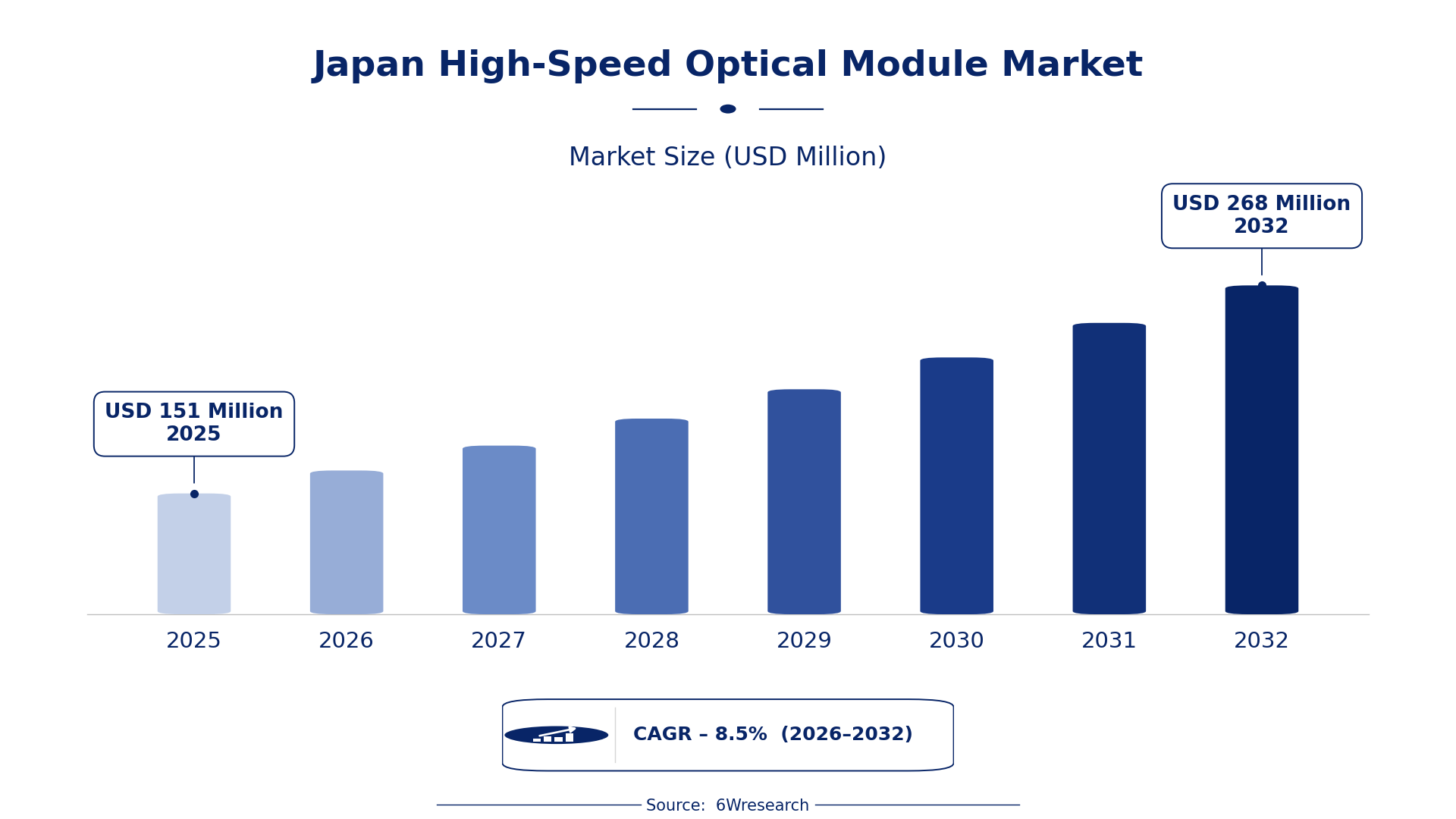
According to 6Wresearch internal database and industry insights, the Japan High-Speed Optical Module Market was valued at USD 151 Million in 2025 and is projected to reach USD 268 Million by 2032, growing at a CAGR of approximately 8.5% during 2026–2032.
Japan High-Speed Optical Module Market Highlights
| Report Metric | Details |
| Report Name | Japan High-Speed Optical Module Market (2026-2032) |
| Market Size 2025 | USD 151 Million |
| Market Size 2032 | USD 268 Million |
| Absolute Growth 2025–2032 | USD 117 Million |
| CAGR 2026–2032 | 8.5% |
| Peak Annual Growth | 10.6% in 2026 |
| Forecast Period | 2026–2032 |
| Historical Data | 2022–2025 |
| Base Year | 2025 |
| Leading Product Type, 2025 | QSFP Modules (42% share) |
| Leading Data Rate, 2025 | 40G/100G (39% share) |
| Leading Distribution Channel, 2025 | OEM Distributors (40% share) |
| Leading End User, 2025 | Data Centers (40% share) |
| Fastest-Growing Product Type | SFP+ Modules (11.5% CAGR) |
| Fastest-Growing Data Rate | 10G (11.2% CAGR) |
| Fastest-Growing Distribution Channel | Online Platforms (10.6% CAGR) |
| Fastest-Growing End User | Telecommunication Hubs (11.3% CAGR) |
| Growing Sector | Telecommunication Hubs |
| Key End Users | Data Centers, Telecommunication Hubs, High-Performance Networks, Cloud Infrastructure |
Japan High-Speed Optical Module Market Year-wise Growth Rate and Key Drivers (2022–2032)
This graph illustrates the annual growth rates of the market from 2022 to 2032, highlighting a steady upward trajectory and projected market expansion over the forecast period.
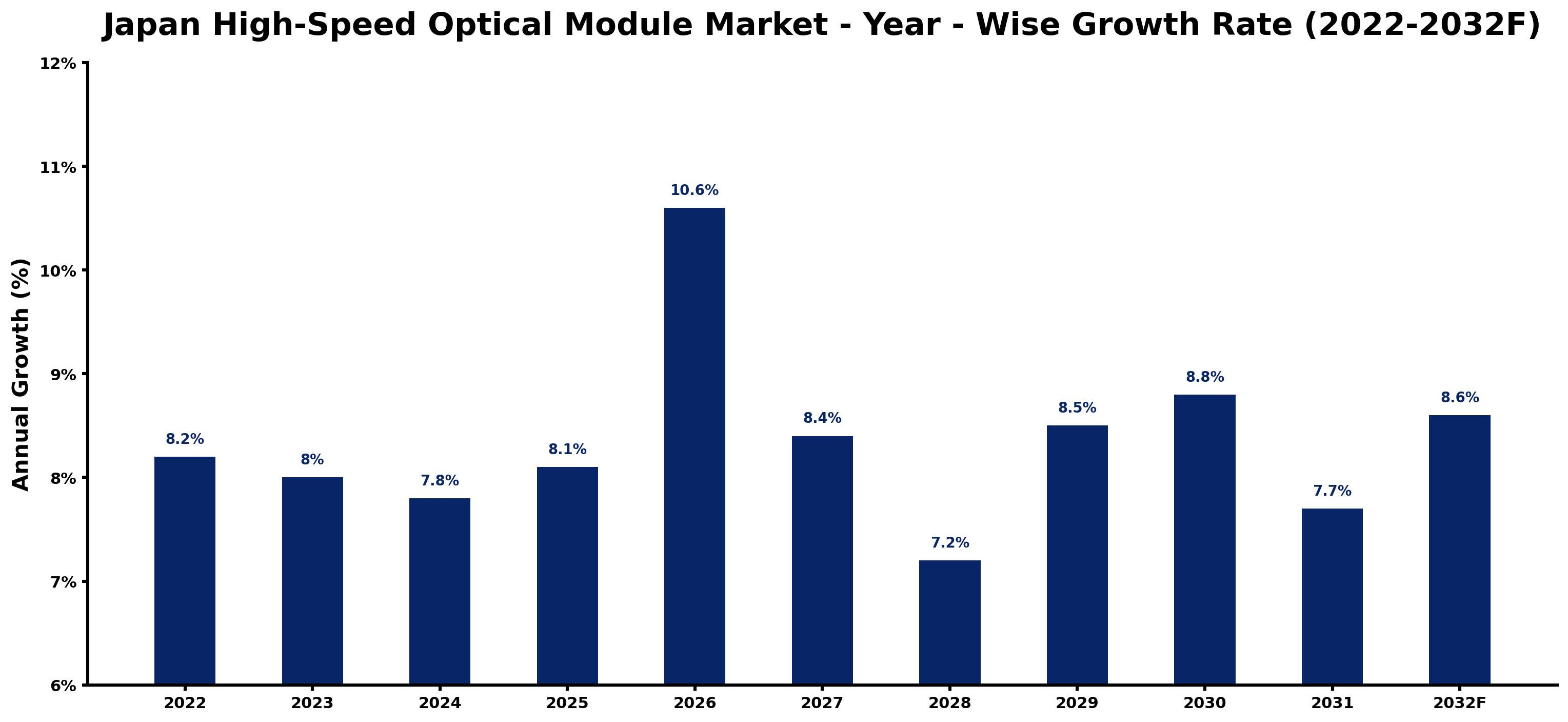
Below, each year's estimated growth is shown next to the factor that most influenced it.
| Year | Estimated Annual Growth (%) | Market Rationale |
| 2022 | 8.2 | The market experienced solid demand from data centers and telecommunications sectors. |
| 2023 | 8.0 | Growth slowed slightly as the market adjusted to previous high demand levels. |
| 2024 | 7.8 | Market growth continued to decelerate as supply chain issues persisted. |
| 2025 | 8.1 | Demand increased as data centers expanded operations to meet rising internet usage. |
| 2026 | 10.6 | Growth is expected to accelerate due to investments in digital infrastructure improvements. |
| 2027 | 8.4 | Market growth will slow as supply chain constraints begin to affect availability. |
| 2028 | 7.2 | Demand is projected to continue moderating as the market stabilises after rapid growth phases. |
| 2029 | 8.5 | Expansion in telecommunication hubs will spur renewed interest in high-speed modules. |
| 2030 | 8.8 | Growth is expected to pick up as more facilities upgrade to higher data transmission standards. |
| 2031 | 7.7 | The market will experience a slight slowdown as competition intensifies among suppliers. |
| 2032 | 8.6 | Demand is projected to rise again as new technologies are adopted in data centers. |
Note: Market size estimations and growth projections presented in this report are based on 6Wresearch's proprietary forecasting methodology, utilizing the latest available industry data, government publications, and primary research inputs.
Japan High-Speed Optical Module Market Synopsis
High-Speed Optical Modules are vital devices for transmitting data at high speeds over optical fibres, primarily utilised in telecommunications and data centres. The Japan High-Speed Optical Module Market is growing due to rising demand from data centres, which represent over 50% of the market, alongside government initiatives promoting digital infrastructure, including a ¥10 billion allocation for improvements in 2023. The adoption of standards like JIS X 5050 further drives this market, ensuring quality and reliability in optical communications. This growth is supported by the increasing deployment of high-speed modules and the expansion of telecommunication hubs, creating new opportunities for suppliers.
Market Dynamics Impact Analysis (2026–2032)
| Factor | Type | Impact | Primary Segment Affected |
| Rising demand from data centers for high-speed connections | Driver | High | QSFP Modules |
| Increased internet usage leading to higher data transmission needs | Driver | High | SFP+ Modules |
| Growing investment in digital infrastructure by the government | Opportunity | High | Data Centers |
| Expansion of telecommunication hubs necessitating upgraded technology | Opportunity | High | Telecommunication Hubs |
| Supply chain disruptions affecting module availability | Restraint | High | CFP Modules |
| High energy consumption of data centers limiting expansion | Restraint | Medium | Data Centers |
| Rising costs of semiconductor materials impacting production | Challenge | High | SFP+ Modules |
| Compliance with stringent standards increasing operational complexity | Challenge | Medium | QSFP Modules |
Evaluation of Drivers in Japan High-Speed Optical Module Market (2026–2032)
Key forces behind demand, with the segment each one moves most, are listed below.
| Drivers | Primary Segment Affected | Why It Matters (Evidence) |
| Increased deployment of 40G and 100G modules in new installations | 40G/100G | Over 70% of new installations utilise these modules, driving demand for high-speed connections. |
| Growing demand for efficient optical modules due to data center energy consumption | Data Centers | The average data center consumes about 2MW of power, pushing for high-efficiency solutions. |
| Government initiatives promoting high-speed internet access | Telecommunication Hubs | The Ministry of Internal Affairs and Communications supports high-speed internet, boosting optical module demand. |
| Rising fibre optic infrastructure supporting high-speed connectivity | SFP+ Modules | Japan has over 1 million kilometers of fibre optic cables installed, facilitating module usage. |
| Expansion in cloud infrastructure requiring advanced connectivity solutions | Cloud Infrastructure | The push for 100% fibre coverage by 2025 increases demand for high-speed optical modules. |
Behind the steady rise in orders sits increased deployment of 40G and 100G modules in new installations, with over 70% of new setups utilising these technologies. The average data center consumes about 2MW of power, necessitating efficient optical modules to manage energy use effectively. With over 1 million kilometers of fibre optic cables installed, the infrastructure supports the growing need for high-speed connections. The expansion in cloud infrastructure, driven by the goal of achieving 100% fibre coverage by 2025, contributes to the market's growth.
Evaluation of Restraints in Japan High-Speed Optical Module Market
These restraints slow adoption and weigh on supplier margins.
| Market Restraint | Primary Segment Affected | Why It Matters (Evidence) |
| Supply chain disruptions affecting module availability | CFP Modules | Ongoing supply chain issues have led to delays in module production and delivery. |
| High energy consumption of data centers limiting expansion | Data Centers | The substantial power requirements hinder the growth of new data centers. |
| Rising costs of semiconductor materials impacting production | SFP+ Modules | Increased material costs have raised production expenses, affecting pricing strategies. |
| Compliance with stringent standards increasing operational complexity | QSFP Modules | Adhering to regulations like JIS X 5050 complicates manufacturing processes. |
| Limited adoption of emerging technologies like DWDM/400G | DWDM/400G | The niche market for these modules restricts widespread usage and investment. |
Japan High-Speed Optical Module Market Challenges
Producers face high compliance costs due to stringent regulations, which can increase production expenses by 15%, ultimately raising prices for buyers. Importers encounter intense competition, as over 70% of new installations favour 40G and 100G modules, forcing them to lower prices and reduce profit margins. Buyers experience delays because the Ministry of Internal Affairs and Communications’ initiatives for high-speed internet necessitate extensive infrastructure upgrades, potentially postponing project timelines by several months. Technology adoption is restricted since the average data centre consumes about 2MW of power, limiting the integration of advanced optical modules and impacting operational efficiency for producers.
Trends in the Japan High-Speed Optical Module Market
Several trends are reshaping the Japan High-Speed Optical Module Market; the most important are set out below.
- Shift from Traditional to Cloud-Based Data Centers: The Tokyo metropolitan area is experiencing a transition towards cloud-based data centres, with over 50% of Japan's data centres adapting to this model. This shift is anticipated to drive demand for high-speed optical modules, as cloud services require improved data transmission capabilities.
- Increase in 100G Module Adoption: In 2023, the adoption of 100G modules has surged, accounting for a significant portion of new installations. This trend reflects the growing need for faster data transmission in high-performance networks, prompting suppliers to increase production capacity.
- Transition from SFP+ to QSFP Modules: The market is transitioning from SFP+ modules to QSFP modules, driven by the need for higher bandwidth. The growing demand for 40G and 100G connections is reshaping production strategies among manufacturers.
- Emergence of Online Platforms for Distribution: The rise of online platforms for distribution is changing how optical modules reach customers. With a projected CAGR of 10.6% for online sales channels, suppliers are adapting to new purchasing behaviours.
Investment Opportunities in the Japan High-Speed Optical Module Market
The following opportunities in the Japan High-Speed Optical Module Market pair current demand with a clear way in.
- Data Centers Seeking High-Speed Solutions: Data centres are increasingly looking for high-speed optical modules to improve their infrastructure. With over 50% of Japan's data centres located in the Tokyo area, suppliers can target this market effectively.
- Investment in Digital Infrastructure Improvements: The Japanese government allocated ¥10 billion for digital infrastructure improvements in 2023, creating opportunities for suppliers of optical modules to engage with public projects.
- Partnerships with Telecommunication Hubs: Telecommunication hubs are expanding and require advanced optical modules. Suppliers can enter this market through partnerships with local hubs to meet their growing demands.
- Supply of High-Performance Networking Solutions: The shift towards high-performance networks presents opportunities for suppliers to provide advanced optical modules. Engaging with cloud infrastructure providers can facilitate entry into this expanding market.
Government Initiatives in the Japan High-Speed Optical Module Market
The AI Promotion Act of 2025 establishes a national framework for AI research and development, which supports the production of high-speed optical modules by ensuring a resilient supply chain for critical materials, thereby benefiting producers and buyers alike. This builds on the Economic Security Promotion Act of 2022, which also aims to secure the supply chains for essential products.
The Digital Agency oversees government digital transformation efforts and approves funding for projects aimed at improving digital infrastructure, which includes high-speed optical modules. In recent years, it has allocated significant resources to support these initiatives, ensuring that the market can meet growing demands.
Future Insight of the Japan High-Speed Optical Module Market
A policy-driven shift towards enhanced digital infrastructure will transform the market for high-speed optical modules by 2032, prompting suppliers to innovate in photonic integration. The government's ¥10 billion allocation for digital improvements will strengthen connectivity, benefiting telecommunications. Evolving standards will push buyers to seek more efficient solutions, increasing competition among producers. The Telecommunications Association of Japan will likely lead the charge in advocating for new technologies, ensuring optical module advancements meet rising data transmission demands.
Market Segmentation Analysis
Japan High-Speed Optical Module Market report covers a detailed analysis of the following market segments:
By Product Type – QSFP Modules Lead, SFP+ Modules Expected to Grow Fastest
According to Saurav Kr Singh, Senior Research Analyst at 6Wresearch, QSFP Modules accounted for 42% of the market by product type in 2025. QSFP Modules hold the largest share as they are extensively used in data centers, which are crucial for high-speed connections. With over 50% of Japan's data centers located in the Tokyo metropolitan area, this sub-segment benefits from substantial local demand. SFP+ Modules are projected to grow fastest, at a CAGR of 11.5% during 2026–2032. SFP+ Modules are seeing rapid growth due to their increasing adoption in various networking applications, reflecting the need for adaptable solutions. The ongoing improvements in digital infrastructure, supported by government funding, further facilitate this growth. Suppliers should focus on increasing the availability of SFP+ Modules to meet the rising demand in diverse networking environments.
By Data Rate – 40G/100G Leads, 10G Expected to Grow Fastest
In 2025, 40G/100G led the data rate split with a 39% share. 40G/100G modules are the standard for high-speed networks, making them essential for modern telecommunications and data transmission. Their prevalence in over 70% of new installations highlights their critical role in the market. The quickest growth will come from 10G, forecast to expand at a CAGR of 11.2% between 2026 and 2032. The 10G data rate is gaining traction due to its widespread adoption in enterprise networks, driven by the need for efficient data handling. This growth is likely to continue as businesses upgrade their infrastructure to support higher speeds. Buyers may benefit from investing in 10G solutions to future-proof their networks against increasing data demands.
By Distribution Channel – OEM Distributors Lead, Online Platforms Expected to Grow Fastest
OEM Distributors held 40% of the Japan High-Speed Optical Module Market by distribution channel in 2025. OEM Distributors are the primary channel for distributing optical modules, providing a reliable source for manufacturers and end-users. Their established networks ensure efficient market access, catering to the high demand for these products. Over 2026–2032, Online Platforms are expected to post the fastest growth, at a CAGR of 10.6%. Online Platforms are rapidly becoming a popular distribution channel, indicating a shift towards digital purchasing habits among consumers. This trend is likely to continue as more buyers seek convenience and accessibility in their procurement processes. Suppliers should enhance their online presence to take advantage of the growing trend of digital sales channels.
By End User – Data Centers Lead, Telecommunication Hubs Expected to Grow Fastest
With 40% of end user revenue in 2025, Data Centers was the largest category. Data Centers are the largest consumers of optical modules, driven by their need for high-speed data transmission capabilities. The average data center's substantial power consumption of about 2MW highlights their reliance on efficient optical solutions. Telecommunication Hubs are set to record the highest CAGR in this split, 11.3% over 2026–2032. Telecommunication Hubs are experiencing the fastest growth due to their critical role in communication infrastructure, essential for maintaining connectivity. The increasing number of telecommunication hubs, exceeding 300, indicates a rising demand for optical modules in this sector. Suppliers should prioritise partnerships with telecommunication hubs to align with the growing infrastructure needs.
Key Attractiveness of the Report
- 10 Years of Market Numbers
- Historical Data Starting from 2022 to 2025
- Base Year 2025
- Forecast Data until 2032
- Key Performance Indicators Impacting the Market
- Major Upcoming Developments and Projects
Key Highlights of the Report:
- Japan High-Speed Optical Module Market Outlook
- Market Size of Japan High-Speed Optical Module Market, 2025
- Forecast of Japan High-Speed Optical Module Market, 2032
- Historical Data and Forecast of Japan High-Speed Optical Module Revenues & Volume for the Period 2022-2032F
- Japan High-Speed Optical Module Market Trend Evolution
- Japan High-Speed Optical Module Market Drivers and Challenges
- Japan High-Speed Optical Module Price Trends
- Japan High-Speed Optical Module Porter's Five Forces
- Japan High-Speed Optical Module Industry Life Cycle
- Historical Data and Forecast of Japan High-Speed Optical Module Market Revenues & Volume By Product Type for the Period 2022-2032F
- Historical Data and Forecast of Japan High-Speed Optical Module Market Revenues & Volume By QSFP Modules for the Period 2022-2032F
- Historical Data and Forecast of Japan High-Speed Optical Module Market Revenues & Volume By SFP+ Modules for the Period 2022-2032F
- Historical Data and Forecast of Japan High-Speed Optical Module Market Revenues & Volume By CFP Modules for the Period 2022-2032F
- Historical Data and Forecast of Japan High-Speed Optical Module Market Revenues & Volume By Coherent Modules for the Period 2022-2032F
- Historical Data and Forecast of Japan High-Speed Optical Module Market Revenues & Volume By Data Rate for the Period 2022-2032F
- Historical Data and Forecast of Japan High-Speed Optical Module Market Revenues & Volume By 40G/100G for the Period 2022-2032F
- Historical Data and Forecast of Japan High-Speed Optical Module Market Revenues & Volume By 10G for the Period 2022-2032F
- Historical Data and Forecast of Japan High-Speed Optical Module Market Revenues & Volume By 100G/200G for the Period 2022-2032F
- Historical Data and Forecast of Japan High-Speed Optical Module Market Revenues & Volume By DWDM/400G for the Period 2022-2032F
- Historical Data and Forecast of Japan High-Speed Optical Module Market Revenues & Volume By Distribution Channel for the Period 2022-2032F
- Historical Data and Forecast of Japan High-Speed Optical Module Market Revenues & Volume By OEM Distributors for the Period 2022-2032F
- Historical Data and Forecast of Japan High-Speed Optical Module Market Revenues & Volume By Online Platforms for the Period 2022-2032F
- Historical Data and Forecast of Japan High-Speed Optical Module Market Revenues & Volume By Direct Sales for the Period 2022-2032F
- Historical Data and Forecast of Japan High-Speed Optical Module Market Revenues & Volume By OEM Supply for the Period 2022-2032F
- Historical Data and Forecast of Japan High-Speed Optical Module Market Revenues & Volume By End User for the Period 2022-2032F
- Historical Data and Forecast of Japan High-Speed Optical Module Market Revenues & Volume By Data Centers for the Period 2022-2032F
- Historical Data and Forecast of Japan High-Speed Optical Module Market Revenues & Volume By Telecommunication Hubs for the Period 2022-2032F
- Historical Data and Forecast of Japan High-Speed Optical Module Market Revenues & Volume By High-Performance Networks for the Period 2022-2032F
- Historical Data and Forecast of Japan High-Speed Optical Module Market Revenues & Volume By Cloud Infrastructure for the Period 2022-2032F
- Japan High-Speed Optical Module Import Export Trade Statistics
- Market Opportunity Assessment By Product Type
- Market Opportunity Assessment By Data Rate
- Market Opportunity Assessment By Distribution Channel
- Market Opportunity Assessment By End User
- Japan High-Speed Optical Module Top Companies Market Share
- Japan High-Speed Optical Module Competitive Benchmarking By Technical and Operational Parameters
- Japan High-Speed Optical Module Company Profiles
- Japan High-Speed Optical Module Key Strategic Recommendations
Market Covered
The study includes the following segmentation.
By Product Type
- QSFP Modules
- SFP+ Modules
- CFP Modules
- Coherent Modules
By Data Rate
- 40G/100G
- 10G
- 100G/200G
- DWDM/400G
By Distribution Channel
- OEM Distributors
- Online Platforms
- Direct Sales
- OEM Supply
By End User
- Data Centers
- Telecommunication Hubs
- High-Performance Networks
- Cloud Infrastructure































