Japan High-Strength Conductive Materials Market Size & Growth Rate
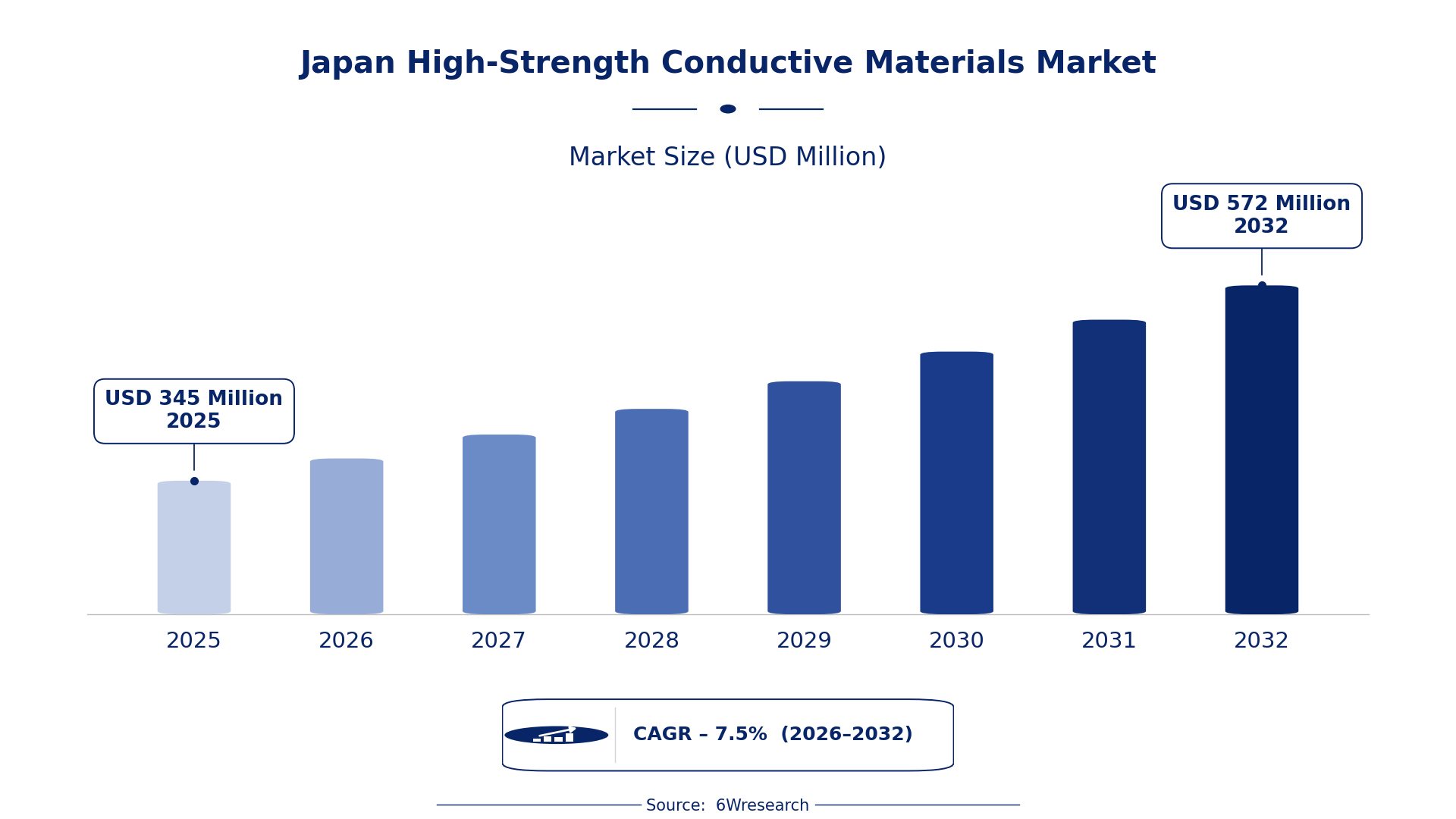
According to 6Wresearch internal database and industry insights, the Japan High-Strength Conductive Materials Market was valued at USD 345 Million in 2025 and is projected to reach USD 572 Million by 2032, growing at a CAGR of approximately 7.5% during 2026–2032.
Japan High-Strength Conductive Materials Market Highlights
| Report Metric | Details |
| Report Name | Japan High-Strength Conductive Materials Market (2026-2032) |
| Market Size 2025 | USD 345 Million |
| Market Size 2032 | USD 572 Million |
| Absolute Growth 2025–2032 | USD 227 Million |
| CAGR 2026–2032 | 7.5% |
| Peak Annual Growth | 8.1% in 2026 |
| Forecast Period | 2026–2032 |
| Historical Data | 2022–2025 |
| Base Year | 2025 |
| Leading Product Type, 2025 | Copper Alloys (41% share) |
| Leading Material Base, 2025 | Copper Composite (52% share) |
| Leading Distribution Channel, 2025 | Direct Sales (44% share) |
| Leading End User, 2025 | Semiconductor Plants (45% share) |
| Fastest-Growing Product Type | Conductive Polymers (10.8% CAGR) |
| Fastest-Growing Material Base | Polymer-Based (10.7% CAGR) |
| Fastest-Growing Distribution Channel | Online Platforms (9.6% CAGR) |
| Fastest-Growing End User | Flexible Electronics (10.0% CAGR) |
| Growing Sector | Flexible Electronics |
| Key End Users | Semiconductor Plants, Circuit Board Makers, Flexible Electronics, Medical Device Firms |
Japan High-Strength Conductive Materials Market Year-wise Growth Rate and Key Drivers (2022–2032)
This graph illustrates the annual growth rates of the market from 2022 to 2032, highlighting a steady upward trajectory and projected market expansion over the forecast period.
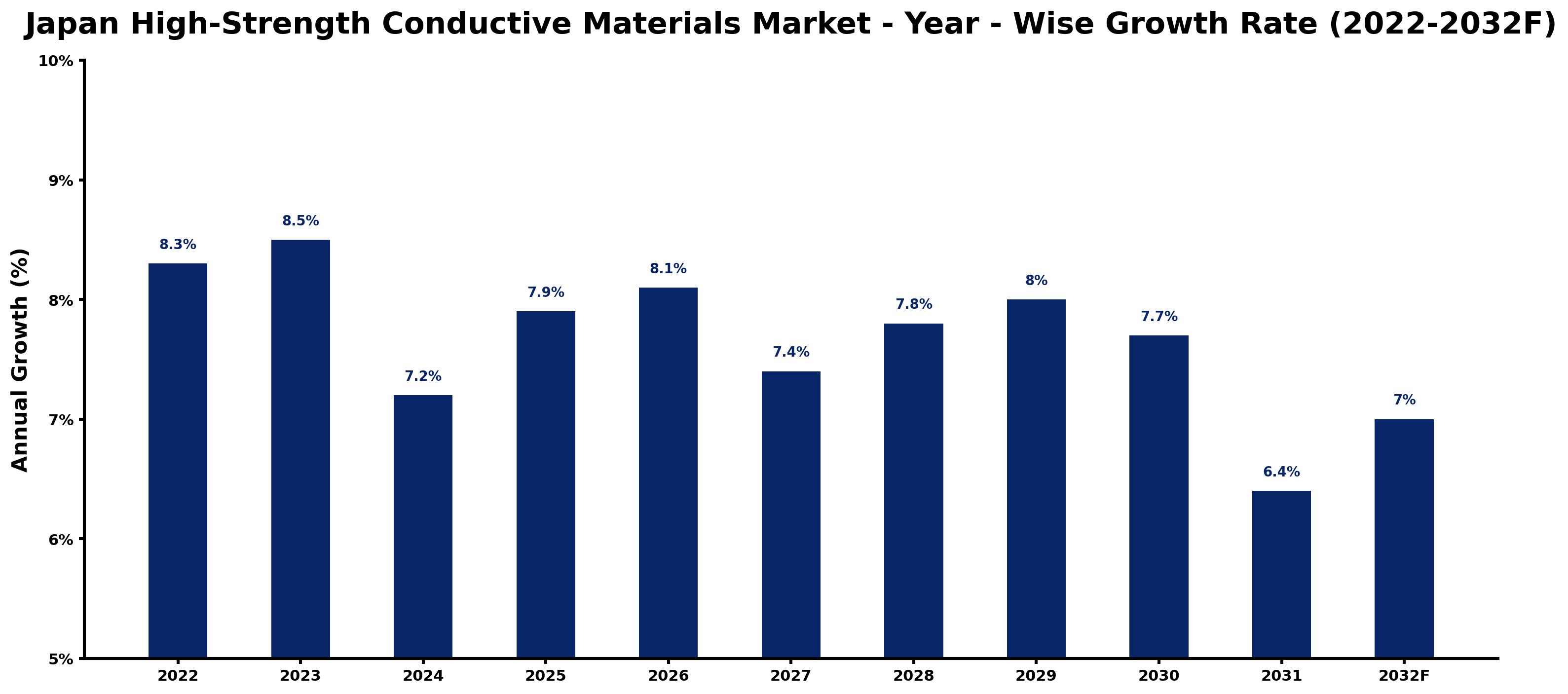
Each row of the following table gives one year's estimated growth and the event or demand shift that explains it.
| Year | Estimated Annual Growth (%) | Market Rationale |
| 2022 | 8.3 | The market experienced strong demand from semiconductor plants and electronics manufacturers. |
| 2023 | 8.5 | Growth accelerated due to increased investments in advanced materials and technology. |
| 2024 | 7.2 | A slowdown occurred as demand stabilised after rapid growth in the previous year. |
| 2025 | 7.9 | Demand rebounded as manufacturers increased production capabilities in electronics. |
| 2026 | 8.1 | The market is expected to grow faster due to rising investments in flexible electronics and automotive applications. |
| 2027 | 7.4 | Growth is projected to slow as the market adjusts to previous peaks in demand. |
| 2028 | 7.8 | A resurgence in demand is anticipated as new applications for conductive materials emerge. |
| 2029 | 8.0 | Demand will continue as the flexible electronics market expands, increasing the need for conductive materials. |
| 2030 | 7.7 | A slowdown is expected as the market begins to stabilise after years of rapid growth. |
| 2031 | 6.4 | The market is projected to grow at a slower pace as demand from key sectors matures. |
| 2032 | 7.0 | Growth will accelerate again due to renewed investments in semiconductor manufacturing. |
Note: Market size estimations and growth projections presented in this report are based on 6Wresearch's proprietary forecasting methodology, utilizing the latest available industry data, government publications, and primary research inputs.
Japan High-Strength Conductive Materials Market Synopsis
High-strength conductive materials are engineered to conduct electricity efficiently while maintaining structural integrity. They are essential in electronics, medical devices, and automotive applications. The Japan High-Strength Conductive Materials Market is expanding, driven by the thriving semiconductor industry and increasing demand for flexible electronics. With over 100 semiconductor plants in Japan, the market is projected to grow, supported by the GX Promotion Act, which encourages investments in advanced materials and aligns with Japan's decarbonisation targets.
Market Dynamics Impact Analysis (2026–2032)
| Factor | Type | Impact | Primary Segment Affected |
| Growing demand from semiconductor plants for high-strength conductive materials | Driver | High | Copper Alloys |
| Increased investments in flexible electronics production | Driver | High | Conductive Polymers |
| Rising demand for advanced medical devices utilizing conductive materials | Opportunity | High | Medical Device Firms |
| Expansion of online sales channels for smaller suppliers | Opportunity | Medium | Online Platforms |
| High costs associated with research and development in advanced materials | Restraint | High | Carbon Nanotubes |
| Strict regulatory compliance requirements for chemical substances | Restraint | Medium | Silver-Based Materials |
| Limited availability of skilled workforce in advanced materials | Challenge | High | Conductive Polymers |
| High competition among suppliers leading to price pressures | Challenge | Medium | Copper Alloys |
Evaluation of Drivers in Japan High-Strength Conductive Materials Market (2026–2032)
Key forces behind demand, with the segment each one moves most, are listed below.
| Drivers | Primary Segment Affected | Why It Matters (Evidence) |
| Increased production capacity in semiconductor plants | Copper Alloys | Japan's semiconductor industry, with over 100 plants, is driving demand for high-strength conductive materials. |
| Growing applications in flexible electronics | Conductive Polymers | The flexible electronics market is expanding, boosting demand for conductive polymers in various applications. |
| Rising use in wearable medical devices | Medical Device Firms | The medical device sector is increasingly utilising conductive materials for diagnostics and treatment applications. |
| Technological advancements in automotive applications | Copper Alloys | Copper alloys are widely used in automotive components, essential for Japan's automotive industry. |
| Research initiatives in nanotechnology | Carbon Nanotubes | Research at the Tokyo Institute of Technology is focusing on carbon nanotubes, improving their application in electronics. |
Buyers are adding capacity as Japan's semiconductor plants expand, driving demand for conductive materials. The flexible electronics market is growing, prompting manufacturers to invest in conductive polymers. Wearable medical devices are increasingly utilising these materials, reflecting a trend in healthcare technology. Automotive applications are also expanding, with copper alloys being essential for various components. Research on carbon nanotubes is further increasing their use in advanced electronics, pushing demand higher.
Evaluation of Restraints in Japan High-Strength Conductive Materials Market
The key brakes on demand, and where they bite hardest, are shown below.
| Market Restraint | Primary Segment Affected | Why It Matters (Evidence) |
| High research and development costs for advanced materials | Carbon Nanotubes | Developing new carbon nanotube applications requires substantial investment, limiting supplier capabilities. |
| Regulatory compliance with chemical substance laws | Silver-Based Materials | Strict regulations under the Chemical Substances Control Law increase operational costs for producers. |
| Limited skilled workforce in advanced materials | Conductive Polymers | A shortage of qualified professionals in Japan hampers innovation and production efficiency. |
| Market saturation in certain product segments | Copper Alloys | Increased competition and market saturation lead to price pressures among suppliers. |
| Dependence on traditional manufacturing processes | Copper Composite | Many manufacturers still rely on outdated methods, slowing down the adoption of advanced materials. |
Japan High-Strength Conductive Materials Market Challenges
Supply chain disruptions arise from reliance on specific raw materials, delaying production for manufacturers and increasing costs by up to 15%. A lack of skilled workers in advanced material processing limits suppliers' ability to meet rising demand, leading to longer lead times for buyers. Insufficient investment in R&D stifles innovation in conductive materials, which can hinder growth for electronics firms. Increased competition from emerging markets pressures local producers to reduce prices, potentially compromising quality and reliability for end-users like automotive and medical device companies.
Trends in the Japan High-Strength Conductive Materials Market
The shifts below are changing how Japan High-Strength Conductive Materials Market products are bought and supplied.
- Tokyo Region Leading in Flexible Electronics Production: The Tokyo region is emerging as a hub for flexible electronics, driving demand for conductive polymers. This shift is reflected in the flexible electronics market, projected to reach $2 billion by 2025.
- Increased Use of Conductive Polymers in Wearable Devices: Wearable medical devices are increasingly utilising conductive polymers, reflecting a shift towards advanced healthcare solutions. The market for these devices is growing, indicating a strong demand for conductive materials.
- Research Advancements in Carbon Nanotubes: Research at the Tokyo Institute of Technology is focusing on carbon nanotubes for energy storage applications. This initiative is expected to improve the material's market potential significantly.
- Growth of Online Sales Channels for Conductive Materials: Online platforms are becoming a vital distribution channel for conductive materials, especially for smaller suppliers. This trend is reflected in the 9.6% CAGR projected for online sales channels through 2032.
Investment Opportunities in the Japan High-Strength Conductive Materials Market
The following areas offer the clearest openings for investors and suppliers in the Japan High-Strength Conductive Materials Market.
- Joint Ventures for Advanced Material Development: Establishing joint ventures with local firms can facilitate market entry for advanced materials. The semiconductor industry is a key target, with over 100 plants needing innovative solutions.
- Investment in Conductive Polymers for Electronics: Investing in conductive polymers is essential as the flexible electronics market grows. The Tokyo region's focus on electronics production highlights the opportunity for suppliers.
- Gap in High-Performance Medical Devices: With the medical device market expanding, there is a gap for high-performance conductive materials. Medical device firms are actively seeking innovative solutions to improve their product offerings.
- Approval Pathways for New Materials: Navigating regulatory approval pathways for new conductive materials presents an opportunity for suppliers. The Japan Electronics and Information Technology Industries Association supports standards that facilitate market entry.
Government Initiatives in the Japan High-Strength Conductive Materials Market
The GX Promotion Act of 2023 strengthens the legal framework for promoting green technologies, building on the Green Growth Strategy established in 2020. This act encourages investments in advanced materials, aligning with Japan's target of JPY 150 trillion in decarbonisation investments over the next decade.
The semiconductor sector benefits from the GX Promotion Act, which allocates $50 million for research in nanotechnology. This initiative supports the development of high-strength conductive materials, enabling manufacturers to improve their production capabilities and meet growing demand.
Future Insight of the Japan High-Strength Conductive Materials Market
Investment in decarbonisation initiatives will drive demand for high-strength conductive materials across multiple industries. By 2032, advancements in nanotechnology will enhance material performance, offering benefits to both buyers and suppliers. Research initiatives will expand applications in medical devices and automotive sectors.
Market Segmentation Analysis
Japan High-Strength Conductive Materials Market report covers a detailed analysis of the following market segments:
By Product Type – Copper Alloys Lead, Conductive Polymers Expected to Grow Fastest
According to Saurav Kr Singh, Senior Research Analyst at 6Wresearch, the largest product type category in 2025 was Copper Alloys, at 41% of revenue. Copper alloys are crucial in the market as they are extensively used in electrical connections and components, which are essential for ensuring high conductivity. Their significant application in the automotive industry underpins a consistent demand for these materials. Conductive Polymers are set to record the highest CAGR in this split, 10.8% over 2026–2032. Conductive polymers are gaining traction due to their increasing use in flexible electronics and sensors, which cater to the lightweight requirements of modern devices. The flexible electronics market in Japan is projected to reach $2 billion by 2025, propelling this segment's growth. Suppliers should focus on developing conductive polymers to capitalise on the expanding flexible electronics sector.
By Material Base – Copper Composite Leads, Polymer-Based Expected to Grow Fastest
Copper Composite took 52% of material base revenue in 2025, more than any other category. Copper composites lead the market as they are integral for circuit boards and connectors, delivering enhanced performance that is vital for the electronics industry. Their prevalent use in semiconductor plants ensures a steady demand from key manufacturers. The quickest growth will come from Polymer-Based, forecast to expand at a CAGR of 10.7% between 2026 and 2032. Polymer-based materials are witnessing rapid growth, driven by their critical role in lightweight and flexible electronic applications that are increasingly in demand. The shift towards portable and efficient devices is accelerating this segment's expansion. Buyers should consider polymer-based materials for their projects to meet the rising demand for lightweight and flexible solutions.
By Distribution Channel – Direct Sales Leads, Online Platforms Expected to Grow Fastest
Direct Sales held 44% of the Japan High-Strength Conductive Materials Market by distribution channel in 2025. Direct sales represent the primary distribution channel for manufacturers, allowing them to effectively engage with industrial clients and establish strong relationships. This method enables suppliers to customise their offerings to align with the specific needs of large-scale buyers in crucial sectors. Online Platforms are projected to grow fastest, at a CAGR of 9.6% during 2026–2032. Online platforms are swiftly becoming a preferred distribution channel, especially for smaller suppliers offering niche products. The digital transformation of procurement processes is driving the adoption of this channel, facilitating broader market access. Suppliers must strengthen their online presence to reach a wider audience and adapt to changing purchasing behaviours of clients.
By End User – Semiconductor Plants Lead, Flexible Electronics Expected to Grow Fastest
With 45% of end user revenue in 2025, Semiconductor Plants was the largest category. Semiconductor plants are the leading end user as they require high conductivity materials for critical manufacturing processes, ensuring a steady demand. With over 100 semiconductor plants in Japan, this sector remains a cornerstone for high-strength conductive materials. Over 2026–2032, Flexible Electronics is expected to post the fastest growth, at a CAGR of 10.0%. Flexible electronics are the fastest-growing end user due to the rising demand for lightweight and flexible conductive solutions in various applications. The projected growth of the flexible electronics market highlights the increasing need for these materials. Suppliers should target the flexible electronics sector to align with market trends and maximise growth opportunities.
Key Attractiveness of the Report
- 10 Years of Market Numbers
- Historical Data Starting from 2022 to 2025
- Base Year 2025
- Forecast Data until 2032
- Key Performance Indicators Impacting the Market
- Major Upcoming Developments and Projects
Key Highlights of the Report:
- Japan High-Strength Conductive Materials Market Outlook
- Market Size of Japan High-Strength Conductive Materials Market, 2025
- Forecast of Japan High-Strength Conductive Materials Market, 2032
- Historical Data and Forecast of Japan High-Strength Conductive Materials Revenues & Volume for the Period 2022-2032F
- Japan High-Strength Conductive Materials Market Trend Evolution
- Japan High-Strength Conductive Materials Market Drivers and Challenges
- Japan High-Strength Conductive Materials Price Trends
- Japan High-Strength Conductive Materials Porter's Five Forces
- Japan High-Strength Conductive Materials Industry Life Cycle
- Historical Data and Forecast of Japan High-Strength Conductive Materials Market Revenues & Volume By Product Type for the Period 2022-2032F
- Historical Data and Forecast of Japan High-Strength Conductive Materials Market Revenues & Volume By Copper Alloys for the Period 2022-2032F
- Historical Data and Forecast of Japan High-Strength Conductive Materials Market Revenues & Volume By Conductive Polymers for the Period 2022-2032F
- Historical Data and Forecast of Japan High-Strength Conductive Materials Market Revenues & Volume By Silver-Based Materials for the Period 2022-2032F
- Historical Data and Forecast of Japan High-Strength Conductive Materials Market Revenues & Volume By Carbon Nanotubes for the Period 2022-2032F
- Historical Data and Forecast of Japan High-Strength Conductive Materials Market Revenues & Volume By Material Base for the Period 2022-2032F
- Historical Data and Forecast of Japan High-Strength Conductive Materials Market Revenues & Volume By Copper Composite for the Period 2022-2032F
- Historical Data and Forecast of Japan High-Strength Conductive Materials Market Revenues & Volume By Polymer-Based for the Period 2022-2032F
- Historical Data and Forecast of Japan High-Strength Conductive Materials Market Revenues & Volume By Silver Nano for the Period 2022-2032F
- Historical Data and Forecast of Japan High-Strength Conductive Materials Market Revenues & Volume By Carbon-Based for the Period 2022-2032F
- Historical Data and Forecast of Japan High-Strength Conductive Materials Market Revenues & Volume By Distribution Channel for the Period 2022-2032F
- Historical Data and Forecast of Japan High-Strength Conductive Materials Market Revenues & Volume By Direct Sales for the Period 2022-2032F
- Historical Data and Forecast of Japan High-Strength Conductive Materials Market Revenues & Volume By Online Platforms for the Period 2022-2032F
- Historical Data and Forecast of Japan High-Strength Conductive Materials Market Revenues & Volume By Specialty Suppliers for the Period 2022-2032F
- Historical Data and Forecast of Japan High-Strength Conductive Materials Market Revenues & Volume By OEM Supply Chains for the Period 2022-2032F
- Historical Data and Forecast of Japan High-Strength Conductive Materials Market Revenues & Volume By End User for the Period 2022-2032F
- Historical Data and Forecast of Japan High-Strength Conductive Materials Market Revenues & Volume By Circuit Board Makers for the Period 2022-2032F
- Historical Data and Forecast of Japan High-Strength Conductive Materials Market Revenues & Volume By Flexible Electronics for the Period 2022-2032F
- Historical Data and Forecast of Japan High-Strength Conductive Materials Market Revenues & Volume By Medical Device Firms for the Period 2022-2032F
- Historical Data and Forecast of Japan High-Strength Conductive Materials Market Revenues & Volume By Semiconductor Plants for the Period 2022-2032F
- Japan High-Strength Conductive Materials Import Export Trade Statistics
- Market Opportunity Assessment By Product Type
- Market Opportunity Assessment By Material Base
- Market Opportunity Assessment By Distribution Channel
- Market Opportunity Assessment By End User
- Japan High-Strength Conductive Materials Top Companies Market Share
- Japan High-Strength Conductive Materials Competitive Benchmarking By Technical and Operational Parameters
- Japan High-Strength Conductive Materials Company Profiles
- Japan High-Strength Conductive Materials Key Strategic Recommendations
Market Covered
The report covers the following segments.
By Product Type
- Copper Alloys
- Conductive Polymers
- Silver-Based Materials
- Carbon Nanotubes
By Material Base
- Copper Composite
- Polymer-Based
- Silver Nano
- Carbon-Based
By Distribution Channel
- Direct Sales
- Online Platforms
- Specialty Suppliers
- OEM Supply Chains
By End User
- Circuit Board Makers
- Flexible Electronics
- Medical Device Firms
- Semiconductor Plants































