Japan High-Strength Metal Forming Market Size & Growth Rate
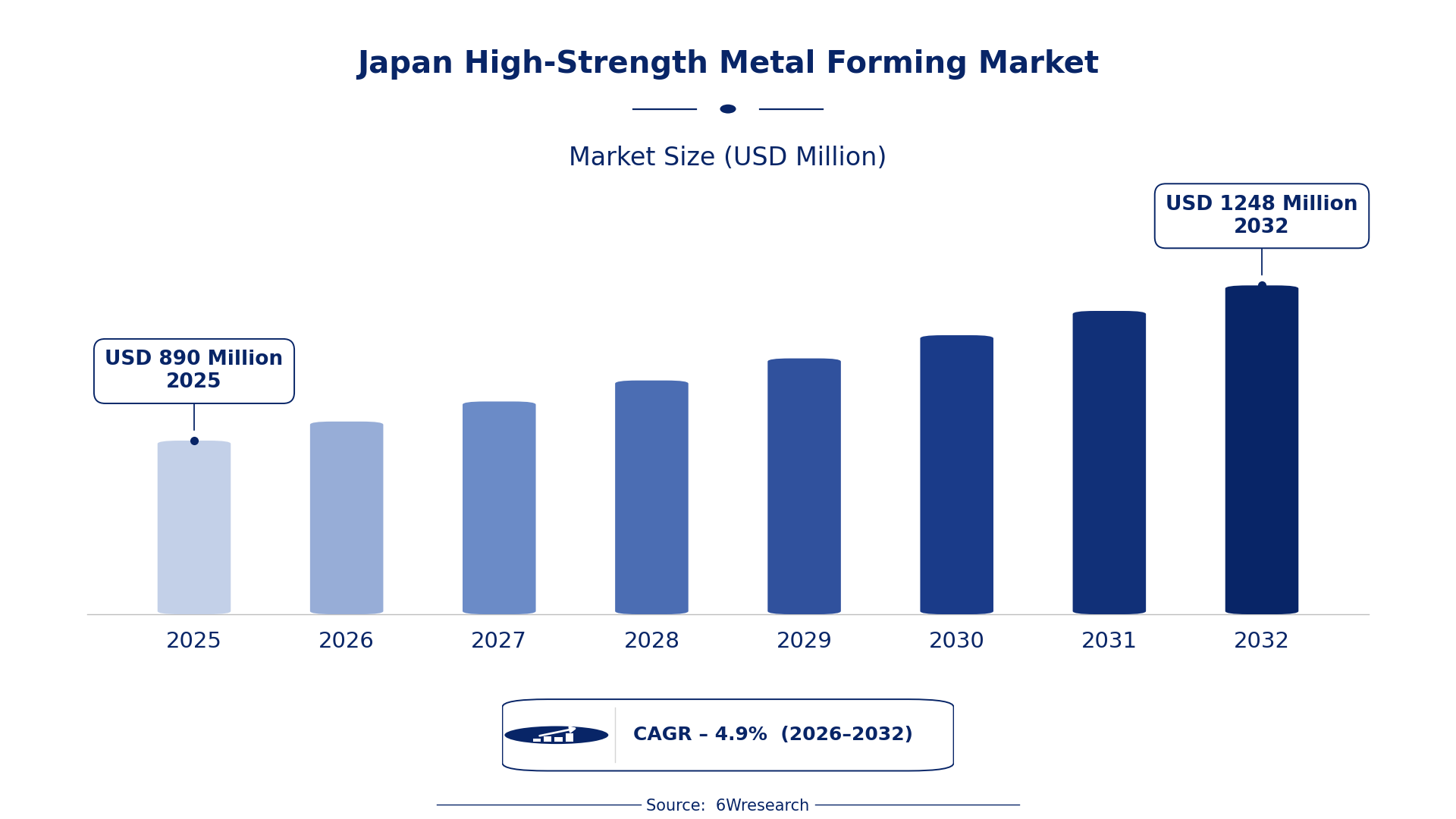
According to 6Wresearch internal database and industry insights, the Japan High-Strength Metal Forming Market was valued at USD 890 Million in 2025 and is projected to reach USD 1,248 Million by 2032, growing at a CAGR of approximately 4.9% during 2026–2032.
Japan High-Strength Metal Forming Market Highlights
| Report Metric | Details |
| Report Name | Japan High-Strength Metal Forming Market (2026-2032) |
| Market Size 2025 | USD 890 Million |
| Market Size 2032 | USD 1,248 Million |
| Absolute Growth 2025–2032 | USD 358 Million |
| CAGR 2026–2032 | 4.9% |
| Peak Annual Growth | 5.7% in 2029 |
| Forecast Period | 2026–2032 |
| Historical Data | 2022–2025 |
| Base Year | 2025 |
| Leading Forming Process, 2025 | Hot Forming (32% share) |
| Leading Metal Type, 2025 | High-Strength Steel (38% share) |
| Leading Distribution Channel, 2025 | Direct Sales (37% share) |
| Leading End User, 2025 | Automotive Frames (41% share) |
| Fastest-Growing Forming Process | Cold Forming (6.7% CAGR) |
| Fastest-Growing Metal Type | Titanium Alloys (7.1% CAGR) |
| Fastest-Growing Distribution Channel | OEM Partnerships (6.4% CAGR) |
| Fastest-Growing End User | Aerospace Components (6.2% CAGR) |
| Growing Sector | automotive |
| Key End Users | automotive manufacturers, aerospace component producers, industrial suppliers |
Japan High-Strength Metal Forming Market Year-wise Growth Rate and Key Drivers (2022–2032)
This graph illustrates the annual growth rates of the market from 2022 to 2032, highlighting a steady upward trajectory and projected market expansion over the forecast period.
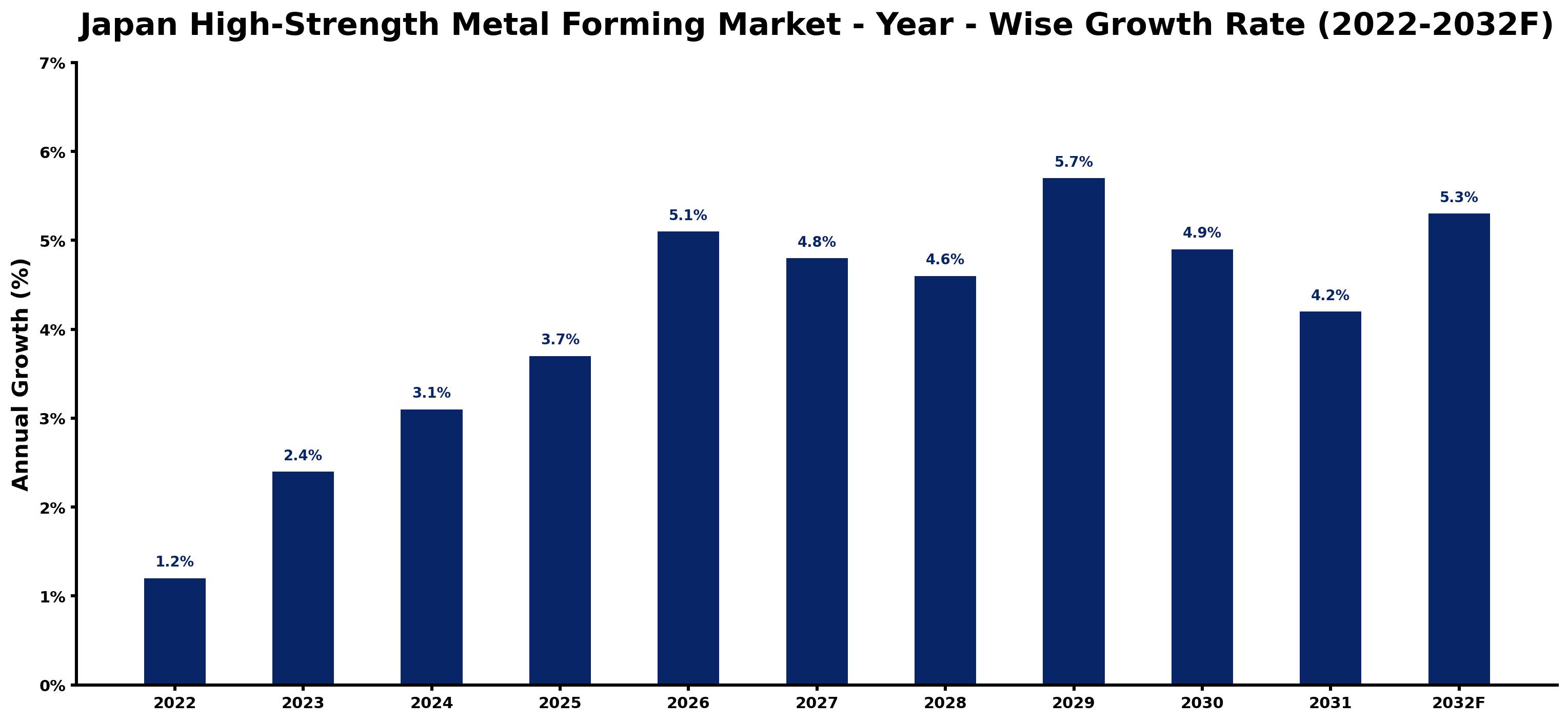
The yearly estimates that follow link every growth rate to its principal driver, so readers can see why the pace changed in each period.
| Year | Estimated Annual Growth (%) | Market Rationale |
| 2022 | 1.2 | The market experienced modest growth due to stable demand from domestic manufacturers. |
| 2023 | 2.4 | Growth accelerated as automotive production increased, boosting the need for high-strength components. |
| 2024 | 3.1 | Demand continued to rise with advancements in metal forming technologies improving production efficiency. |
| 2025 | 3.7 | The market reached a historical peak as automotive manufacturers expanded their production capabilities. |
| 2026 | 5.1 | Growth is anticipated to remain strong as investments in advanced manufacturing technologies increase. |
| 2027 | 4.8 | A slight slowdown in growth is expected as market conditions stabilise. |
| 2028 | 4.6 | The market is projected to continue growing, albeit at a slower pace, reflecting ongoing demand from key industries. |
| 2029 | 5.7 | A surge in growth is forecasted as new automotive models require high-strength materials. |
| 2030 | 4.9 | Growth is likely to moderate as the market adjusts to previous peaks in demand. |
| 2031 | 4.2 | A further slowdown is anticipated as the market stabilises after rapid growth periods. |
| 2032 | 5.3 | Growth is expected to rise again as new aerospace projects drive demand for high-strength components. |
Note: Market size estimations and growth projections presented in this report are based on 6Wresearch's proprietary forecasting methodology, utilizing the latest available industry data, government publications, and primary research inputs.
Japan High-Strength Metal Forming Market Synopsis
High-Strength Metal Forming involves shaping metals with strong properties through techniques like hot and cold forming. The Japan High-Strength Metal Forming Market is experiencing growth due to rising demand from the automotive and aerospace sectors, driven by Japan's production of over 8 million vehicles in 2022 and a projected need for 15,000 tons of titanium alloys annually by 2025. Investments in advanced metal processing technologies are driving expansion, creating opportunities for manufacturers and suppliers across various applications.
Market Dynamics Impact Analysis (2026–2032)
| Factor | Type | Impact | Primary Segment Affected |
| Rising automotive production | Driver | High | High-Strength Steel |
| Technological advancements in metal forming | Driver | High | Cold Forming |
| Growing aerospace sector demand | Opportunity | High | Titanium Alloys |
| Increased investment in decarbonisation technologies | Opportunity | Medium | High-Strength Steel |
| Supply chain vulnerabilities | Restraint | High | Hot Forming |
| High initial investment costs for advanced machinery | Restraint | Medium | Cold Forming |
| Fluctuations in raw material prices | Challenge | High | Titanium Alloys |
| Competition from international suppliers | Challenge | Medium | High-Strength Steel |
Evaluation of Drivers in Japan High-Strength Metal Forming Market (2026–2032)
These are the developments adding the most demand over the forecast period.
| Drivers | Primary Segment Affected | Why It Matters (Evidence) |
| Increased vehicle production | High-Strength Steel | High-strength steel accounts for over 40% of automotive frame materials used in Japan, driving demand for components. |
| Improvements in forming technologies | Cold Forming | A program launched in 2023 to improve metal processing technologies boosts production capabilities for manufacturers. |
| Growing need for lightweight materials | Titanium Alloys | The aerospace sector is projected to require 15,000 tons of titanium alloys annually by 2025, increasing purchases. |
| Investment in decarbonisation | High-Strength Steel | Japan targets about JPY 150 trillion of decarbonisation investment over 10 years, stimulating demand for advanced materials. |
| Growth in mining sector | Nickel Alloys | Demand from mining equipment manufacturers is increasing, as durable components are essential for harsh conditions. |
Most of the extra volume comes from increased vehicle production, with over 8 million vehicles produced in Japan in 2022, driving demand for high-strength steel components. The aerospace sector's projected requirement of 15,000 tons of titanium alloys by 2025 is generating substantial demand. Investments targeting JPY 150 trillion for decarbonisation are energising the market. Growth in the mining sector is also increasing purchases of durable nickel alloys.
Evaluation of Restraints in Japan High-Strength Metal Forming Market
The key brakes on demand, and where they bite hardest, are shown below.
| Market Restraint | Primary Segment Affected | Why It Matters (Evidence) |
| Supply chain vulnerabilities | Hot Forming | The Economic Security Promotion Act (2022) highlights supply-chain resilience issues, affecting material availability for manufacturers. |
| High initial investment costs for advanced machinery | Cold Forming | The installed base of high-strength metal forming machinery exceeds 5,000 units, indicating substantial capital requirements for new entrants. |
| Fluctuations in raw material prices | Titanium Alloys | Volatile titanium prices impact production costs and profitability for manufacturers, limiting their pricing flexibility. |
| Regulatory compliance costs | High-Strength Steel | Compliance with standards like JIS G 3136 increases operational costs for manufacturers, affecting profitability. |
| Limited skilled workforce | Hot Forming | A shortage of skilled workers in advanced metal forming technologies constrains production capacity and efficiency. |
Japan High-Strength Metal Forming Market Challenges
Producers in Japan's high-strength metal forming market face fierce competition from international manufacturers, leading to reduced profit margins. This competition arises from lower production costs abroad, which can result in losses for local suppliers. Rising raw material costs, particularly for high-strength steel, have increased production expenses, causing some manufacturers to raise prices, which may deter buyers in the automotive sector. Skills shortages in advanced metal forming techniques limit production efficiency, delaying project timelines for manufacturers and leading to missed opportunities for buyers in both automotive and aerospace industries.
Trends in the Japan High-Strength Metal Forming Market
The shifts below are changing how Japan High-Strength Metal Forming Market products are bought and supplied.
- Shift from Traditional to Advanced Metal Forming Techniques: Manufacturers are increasingly adopting advanced forming techniques to improve efficiency and reduce waste, particularly in Aichi, where high-strength steel production is concentrated. In 2023, over 40% of automotive frames used high-strength steel.
- Transition from Steel to Lightweight Materials: The aerospace sector is shifting towards titanium alloys for components, driven by the need for lightweight materials. By 2025, the sector is projected to require 15,000 tons of titanium alloys annually, reflecting this trend.
- Emergence of OEM Partnerships in Supply Chains: OEM partnerships are becoming more prevalent in Japan's metal forming market, facilitating integration into larger systems. This trend is supported by a projected CAGR of 6.4% for OEM partnerships from 2026 to 2032.
- Prioritisation of Decarbonisation in Manufacturing: Manufacturers are focusing on decarbonisation, aligning with Japan's target of net zero emissions by 2050. The government allocated ¥10 billion in 2023 for research in advanced metal forming technologies to support this initiative.
Investment Opportunities in the Japan High-Strength Metal Forming Market
Investors looking at the Japan High-Strength Metal Forming Market should consider the following areas.
- Joint Ventures for Advanced Manufacturing: Now is the time to invest in joint ventures with local manufacturers in Aichi, where high-strength steel production is concentrated. This region presents a growing market with substantial demand for advanced forming technologies.
- Investment in Research and Development: Investing in R&D for lightweight materials is essential, especially in the aerospace sector, which is projected to require 15,000 tons of titanium alloys annually by 2025. Collaborating with research institutions can facilitate entry.
- Supply of High-Strength Steel Components: The automotive industry is a prime target for supplying high-strength steel components, given that over 40% of automotive frames use this material. Engaging with automotive manufacturers can yield substantial returns.
- Expansion into Online Sales Channels: With the rise of online platforms, now is an opportune moment to explore digital sales channels for high-strength metal forming products. This trend is gaining traction, especially among industrial suppliers.
Government Initiatives in the Japan High-Strength Metal Forming Market
The Green Growth Strategy Through Achieving Carbon Neutrality in 2050 (December 2020, updated 2021) identifies 14 growth sectors, including advanced metal forming, and aims to promote sustainable practices in manufacturing. This strategy enhances existing regulations by providing a framework for innovation and investment in cleaner technologies, benefiting producers in the high-strength metal forming market.
In 2023, the Japanese government allocated ¥10 billion for research in advanced metal forming technologies, administered by the Ministry of Economy, Trade and Industry. This funding aims to support innovation and improve production capabilities in the sector.
Future Insight of the Japan High-Strength Metal Forming Market
Japan's public and private decarbonisation investment, projected at JPY 150 trillion over the next decade, will stimulate demand for high-strength metal forming processes. By 2032, the automotive industry will continue to rely heavily on high-strength steel, which accounts for over 40% of frame materials. The METI program initiated in 2023 will advance metal processing technologies, improving production capabilities. As standards like ISO 9001 become more prevalent, buyers will benefit from enhanced quality assurance, while suppliers will need to comply with evolving industry standards.
Market Segmentation Analysis
Japan High-Strength Metal Forming Market report covers a detailed analysis of the following market segments:
By Forming Process – Hot Forming Leads, Cold Forming Expected to Grow Fastest
According to Saurav Kr Singh, Senior Research Analyst at 6Wresearch, the largest forming process category in 2025 was Hot Forming, at 32% of revenue. Hot forming holds the largest share as it is essential for shaping high-strength metals at elevated temperatures, crucial for producing robust automotive components. The automotive sector's reliance on hot forming techniques ensures the structural integrity of vehicle frames, making it indispensable. Over 2026–2032, Cold Forming is expected to post the fastest growth, at a CAGR of 6.7%. Cold forming is rapidly gaining traction as manufacturers prioritise precision shaping methods that preserve material properties without heat. This shift is particularly evident in the automotive sector, where demand for high-precision components continues to rise. Suppliers should enhance their cold forming capabilities to align with the increasing demand for precision-engineered components.
By Metal Type – High-Strength Steel Leads, Titanium Alloys Expected to Grow Fastest
High-Strength Steel took 38% of metal type revenue in 2025, more than any other category. High-strength steel dominates the market due to its extensive use in automotive and structural applications, comprising over 40% of automotive frame materials in Japan. This widespread adoption highlights its vital role in meeting safety and performance standards in vehicles. The quickest growth will come from Titanium Alloys, forecast to expand at a CAGR of 7.1% between 2026 and 2032. Titanium alloys are experiencing the fastest growth, driven by their lightweight and strength, which are critical for aerospace components. The aerospace sector's projected need for 15,000 tons of titanium alloys annually by 2025 underscores this trend. Manufacturers should focus on developing titanium alloy solutions to capitalise on opportunities in the expanding aerospace market.
By Distribution Channel – Direct Sales Leads, OEM Partnerships Expected to Grow Fastest
Direct Sales held 37% of the Japan High-Strength Metal Forming Market by distribution channel in 2025. Direct sales are the leading distribution channel, serving as the primary method for selling high-strength metal forming products directly to manufacturers. This approach fosters closer relationships with clients, allowing for tailored solutions to meet their specific needs. OEM Partnerships are set to record the highest CAGR in this split, 6.4% over 2026–2032. OEM partnerships are rapidly expanding as they are essential for integrating high-strength metal components into larger systems. The increasing complexity of automotive and aerospace systems necessitates collaboration between manufacturers and OEMs. Companies should strengthen their OEM partnerships to improve market reach and integration capabilities.
By End User – Automotive Frames Lead, Aerospace Components Expected to Grow Fastest
Automotive Frames accounted for 41% of the market by end user in 2025. Automotive frames are the leading end user segment, representing a major application area for high-strength metal forming, supported by Japan's production of over 8 million vehicles in 2022. This robust demand ensures a consistent need for high-strength metal components in vehicle manufacturing. Aerospace Components are projected to grow fastest, at a CAGR of 6.2% during 2026–2032. Aerospace components are the fastest-growing segment, vital for producing lightweight and strong parts required in modern aircraft. The anticipated demand for titanium alloys in the aerospace sector indicates a significant shift towards advanced materials in this industry. Suppliers must adapt to the rising demand for aerospace components by investing in technologies that support lightweight and high-strength applications.
Key Attractiveness of the Report
- 10 Years of Market Numbers
- Historical Data Starting from 2022 to 2025
- Base Year 2025
- Forecast Data until 2032
- Key Performance Indicators Impacting the Market
- Major Upcoming Developments and Projects
Key Highlights of the Report:
- Japan High-Strength Metal Forming Market Outlook
- Market Size of Japan High-Strength Metal Forming Market, 2025
- Forecast of Japan High-Strength Metal Forming Market, 2032
- Historical Data and Forecast of Japan High-Strength Metal Forming Revenues & Volume for the Period 2022-2032F
- Japan High-Strength Metal Forming Market Trend Evolution
- Japan High-Strength Metal Forming Market Drivers and Challenges
- Japan High-Strength Metal Forming Price Trends
- Japan High-Strength Metal Forming Porter's Five Forces
- Japan High-Strength Metal Forming Industry Life Cycle
- Historical Data and Forecast of Japan High-Strength Metal Forming Market Revenues & Volume By Forming Process for the Period 2022-2032F
- Historical Data and Forecast of Japan High-Strength Metal Forming Market Revenues & Volume By Hot Forming for the Period 2022-2032F
- Historical Data and Forecast of Japan High-Strength Metal Forming Market Revenues & Volume By Cold Forming for the Period 2022-2032F
- Historical Data and Forecast of Japan High-Strength Metal Forming Market Revenues & Volume By Roll Forming for the Period 2022-2032F
- Historical Data and Forecast of Japan High-Strength Metal Forming Market Revenues & Volume By Forging for the Period 2022-2032F
- Historical Data and Forecast of Japan High-Strength Metal Forming Market Revenues & Volume By Metal Type for the Period 2022-2032F
- Historical Data and Forecast of Japan High-Strength Metal Forming Market Revenues & Volume By High-Strength Steel for the Period 2022-2032F
- Historical Data and Forecast of Japan High-Strength Metal Forming Market Revenues & Volume By Titanium Alloys for the Period 2022-2032F
- Historical Data and Forecast of Japan High-Strength Metal Forming Market Revenues & Volume By Aluminum for the Period 2022-2032F
- Historical Data and Forecast of Japan High-Strength Metal Forming Market Revenues & Volume By Nickel Alloys for the Period 2022-2032F
- Historical Data and Forecast of Japan High-Strength Metal Forming Market Revenues & Volume By Distribution Channel for the Period 2022-2032F
- Historical Data and Forecast of Japan High-Strength Metal Forming Market Revenues & Volume By Direct Sales for the Period 2022-2032F
- Historical Data and Forecast of Japan High-Strength Metal Forming Market Revenues & Volume By OEM Partnerships for the Period 2022-2032F
- Historical Data and Forecast of Japan High-Strength Metal Forming Market Revenues & Volume By Industrial Suppliers for the Period 2022-2032F
- Historical Data and Forecast of Japan High-Strength Metal Forming Market Revenues & Volume By Online Platforms for the Period 2022-2032F
- Historical Data and Forecast of Japan High-Strength Metal Forming Market Revenues & Volume By End User for the Period 2022-2032F
- Historical Data and Forecast of Japan High-Strength Metal Forming Market Revenues & Volume By Automotive Frames for the Period 2022-2032F
- Historical Data and Forecast of Japan High-Strength Metal Forming Market Revenues & Volume By Aerospace Components for the Period 2022-2032F
- Historical Data and Forecast of Japan High-Strength Metal Forming Market Revenues & Volume By HVAC Ducting Systems for the Period 2022-2032F
- Historical Data and Forecast of Japan High-Strength Metal Forming Market Revenues & Volume By Mining Equipment for the Period 2022-2032F
- Japan High-Strength Metal Forming Import Export Trade Statistics
- Market Opportunity Assessment By Forming Process
- Market Opportunity Assessment By Metal Type
- Market Opportunity Assessment By Distribution Channel
- Market Opportunity Assessment By End User
- Japan High-Strength Metal Forming Top Companies Market Share
- Japan High-Strength Metal Forming Competitive Benchmarking By Technical and Operational Parameters
- Japan High-Strength Metal Forming Company Profiles
- Japan High-Strength Metal Forming Key Strategic Recommendations
Market Covered
Segments analysed in this report are listed below.
By Forming Process
- Hot Forming
- Cold Forming
- Roll Forming
- Forging
By Metal Type
- High-Strength Steel
- Titanium Alloys
- Aluminum
- Nickel Alloys
By Distribution Channel
- Direct Sales
- OEM Partnerships
- Industrial Suppliers
- Online Platforms
By End User
- Automotive Frames
- Aerospace Components
- HVAC Ducting Systems
- Mining Equipment































