Japan High Throughput Aviation Ka-Band Market Size & Growth Rate
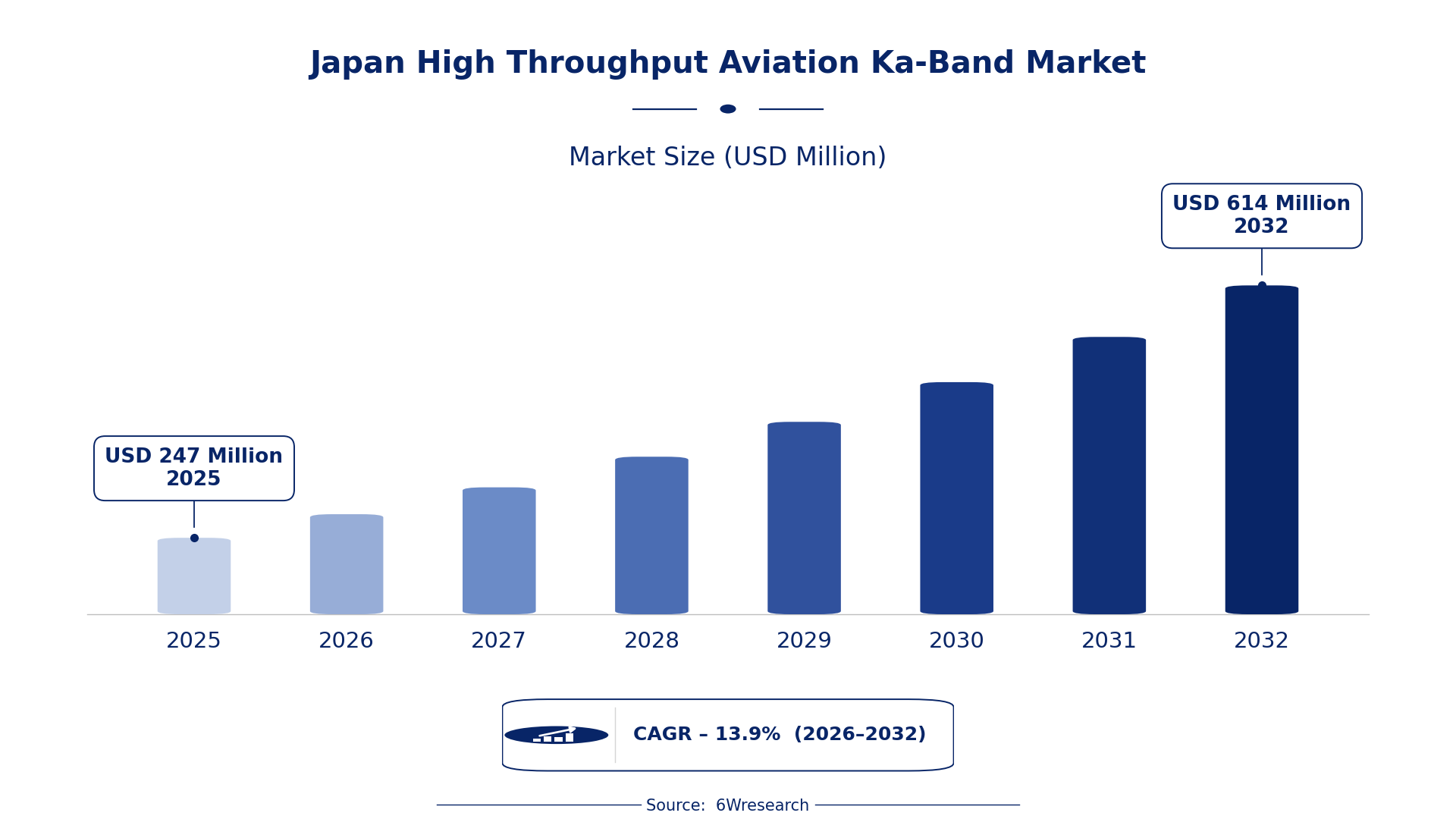
According to 6Wresearch internal database and industry insights, the Japan High Throughput Aviation Ka-Band Market was valued at USD 247 Million in 2025 and is projected to reach USD 614 Million by 2032, growing at a CAGR of approximately 13.9% during 2026–2032.
Japan High Throughput Aviation Ka-Band Market Highlights
| Report Metric | Details |
| Report Name | Japan High Throughput Aviation Ka-Band Market (2026-2032) |
| Market Size 2025 | USD 247 Million |
| Market Size 2032 | USD 614 Million |
| Absolute Growth 2025–2032 | USD 367 Million |
| CAGR 2026–2032 | 13.9% |
| Peak Annual Growth | 14.9% in 2029 |
| Forecast Period | 2026–2032 |
| Historical Data | 2022–2025 |
| Base Year | 2025 |
| Leading Product Type, 2025 | Aero Terminals (47% share) |
| Leading Technology Type, 2025 | Phased Array (44% share) |
| Leading Distribution Channel, 2025 | OEM Sales (36% share) |
| Leading End User, 2025 | Airline Operators (36% share) |
| Fastest-Growing Product Type | Modems (19.1% CAGR) |
| Fastest-Growing Technology Type | Adaptive Coding (20.0% CAGR) |
| Fastest-Growing Distribution Channel | System Integrators (17.9% CAGR) |
| Fastest-Growing End User | Aviation Networks (17.5% CAGR) |
| Growing Sector | Aviation |
| Key End Users | Airline Operators, Aviation Networks, UAV Systems |
Japan High Throughput Aviation Ka-Band Market Year-wise Growth Rate and Key Drivers (2022–2032)
This graph illustrates the annual growth rates of the market from 2022 to 2032, highlighting a steady upward trajectory and projected market expansion over the forecast period.
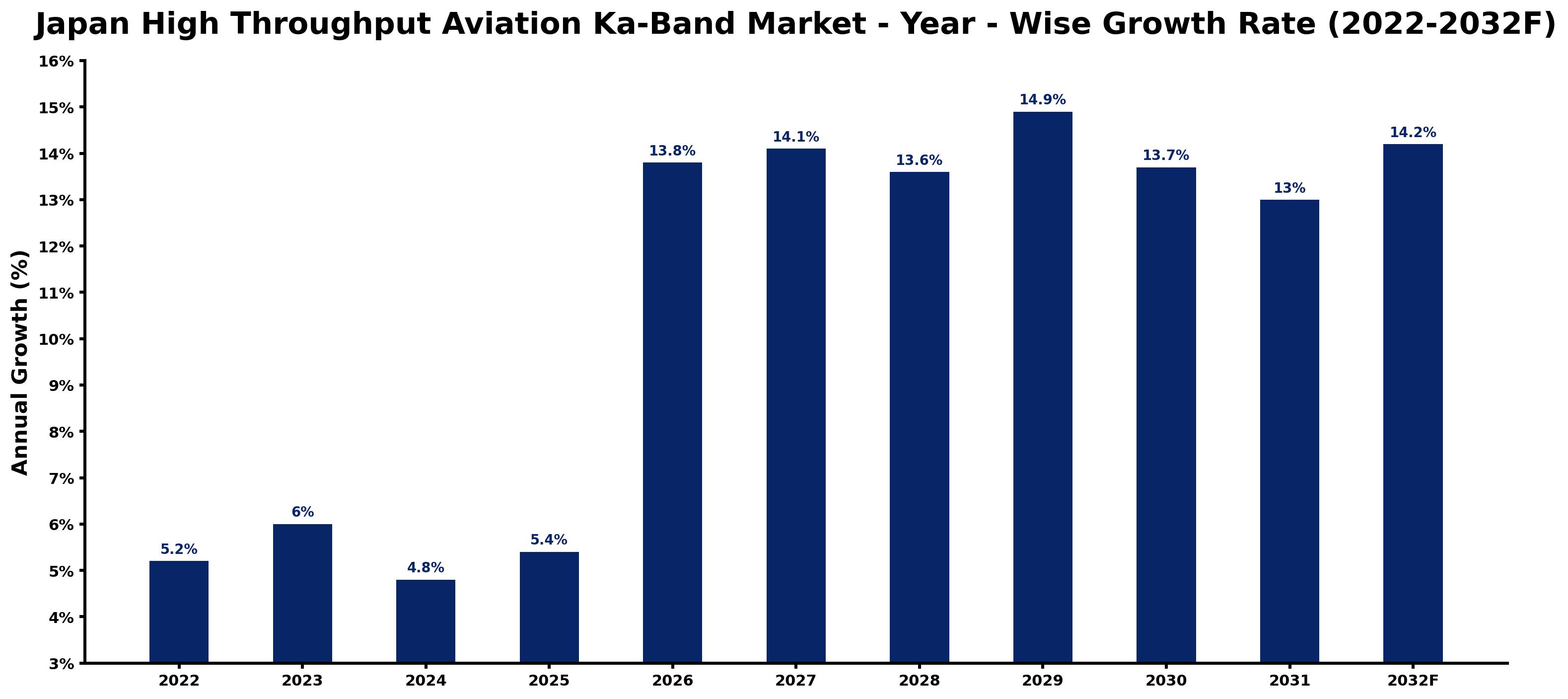
The following figures match every annual growth estimate with the main market development of that year, giving the reasoning behind each rise or slowdown.
| Year | Estimated Annual Growth (%) | Market Rationale |
| 2022 | 5.2 | The market experienced steady growth, driven by increasing demand for in-flight connectivity services. |
| 2023 | 6.0 | Growth accelerated as airlines adopted Ka-Band technology to enhance passenger services. |
| 2024 | 4.8 | The market saw a slowdown due to competitive pricing pressures and market adjustments. |
| 2025 | 5.4 | Demand picked up again as airlines expanded their service offerings with advanced communication technology. |
| 2026 | 13.8 | Investment in aviation technology is expected to surge, leading to rapid adoption of Ka-Band systems. |
| 2027 | 14.1 | The market will continue to grow as major airlines modernise their communication systems. |
| 2028 | 13.6 | Growth is projected to slow slightly as the market matures and competition intensifies. |
| 2029 | 14.9 | A peak in growth is expected as airlines invest heavily in next-generation communication systems. |
| 2030 | 13.7 | The market is projected to stabilise with consistent demand from airline operators and aviation networks. |
| 2031 | 13.0 | Growth will continue at a steady pace as technology adoption becomes widespread. |
| 2032 | 14.2 | The market is expected to grow further as satellite communication capacity increases. |
Note: Market size estimations and growth projections presented in this report are based on 6Wresearch's proprietary forecasting methodology, utilizing the latest available industry data, government publications, and primary research inputs.
Japan High Throughput Aviation Ka-Band Market Synopsis
High Throughput Aviation Ka-Band technology provides high-speed internet connectivity for aviation applications, essential for in-flight services and operational communications. The Japanese market is expanding rapidly, driven by investments in aviation technology and increasing passenger traffic, which reached 100 million in 2022. Domestic airline operators are the primary buyers, supported by initiatives to improve satellite communication capabilities by 2025, including the government's target to increase capacity by 30%.
Market Dynamics Impact Analysis (2026–2032)
| Factor | Type | Impact | Primary Segment Affected |
| Investment in aviation technology | Driver | High | Aero Terminals |
| Increasing passenger traffic | Driver | High | Airline Operators |
| Growing demand for in-flight connectivity | Opportunity | High | Commercial Aircraft |
| Expansion of aviation networks | Opportunity | High | Aviation Networks |
| Regulatory compliance costs | Restraint | Medium | Modems |
| Limited infrastructure for satellite communication | Restraint | Medium | Amplifiers |
| High initial investment costs | Challenge | High | RF Transceivers |
| Capacity constraints in existing systems | Challenge | Medium | Phased Array |
Evaluation of Drivers in Japan High Throughput Aviation Ka-Band Market (2026–2032)
These are the developments adding the most demand over the forecast period.
| Drivers | Primary Segment Affected | Why It Matters (Evidence) |
| Rising investment in aviation technology | Aero Terminals | Investment in advanced satellite systems is increasing, with prioritisation of aviation technology under the 5th Basic Plan for Space Policy. |
| Surge in passenger traffic | Airline Operators | With total passenger traffic reaching 100 million in 2022, airlines are improving connectivity services to meet customer expectations. |
| Adoption of Ka-Band technology | Modems | Major airlines are increasingly adopting Ka-Band technology to improve in-flight internet services, resulting in higher modem sales. |
| Expansion of aviation networks | Aviation Networks | Demand for improved communication infrastructure is rising, boosting network investments across the country. |
| Technological advancements in satellite communication | RF Transceivers | Innovations in RF transceiver technology are enabling better signal quality, prompting airlines to upgrade their systems. |
Behind the steady rise in orders is a surge in passenger traffic, which reached 100 million in 2022, prompting airlines to enhance in-flight connectivity services. Investment in aviation technology is increasing, focusing on advancements that meet customer demands. The adoption of Ka-Band technology is rising among major airlines, leading to higher sales of modems. Demand for improved communication infrastructure is driving investments in aviation networks across Japan. Technological advancements in satellite communication are enabling better signal quality, prompting airlines to modernise their systems.
Evaluation of Restraints in Japan High Throughput Aviation Ka-Band Market
Several factors work against faster growth; the main ones are summarised below.
| Market Restraint | Primary Segment Affected | Why It Matters (Evidence) |
| Regulatory compliance costs | Modems | Compliance with JIS standards increases costs for manufacturers, impacting pricing strategies in a competitive market. |
| Limited infrastructure for satellite communication | Amplifiers | Inadequate infrastructure hampers the deployment of amplifiers, affecting overall market growth. |
| High initial investment costs | RF Transceivers | The substantial upfront costs deter smaller airlines from adopting advanced communication systems. |
| Capacity constraints in existing systems | Phased Array | Current systems face capacity limitations, restricting the scalability of services offered by airlines. |
| Market maturity leading to price competition | Aero Terminals | As the market matures, increased competition results in price pressures, affecting profit margins. |
Japan High Throughput Aviation Ka-Band Market Challenges
Regulatory complexities from the Ministry of Land, Infrastructure, Transport and Tourism slow the approval process for new Ka-Band technology, causing delays for buyers who need timely upgrades for in-flight services. Supply disruptions in advanced satellite communication components hinder suppliers, resulting in postponed technology rollouts for operators. Rising implementation costs, due to adherence to JIS standards, can inflate operational expenses for airlines by up to 15%. Insufficient technological infrastructure in rural areas restricts effective communication, adversely affecting passenger experience and operational efficiency for airlines serving those regions.
Trends in the Japan High Throughput Aviation Ka-Band Market
Several trends are reshaping the Japan High Throughput Aviation Ka-Band Market; the most important are set out below.
- Shift towards Improved In-Flight Connectivity: Tokyo is experiencing a shift towards improved in-flight connectivity as airlines upgrade their systems to meet rising passenger expectations. The total passenger traffic reached 100 million in 2022, driving demand for better services.
- Airline Operators Focusing on Ka-Band Technology: Airline operators are increasingly focusing on Ka-Band technology to enhance passenger experience. The adoption rate is rising, with major airlines investing heavily in this technology to improve service quality.
- Growth in Aviation Networks: Aviation networks in Japan are expanding, particularly in Tokyo. This growth is driven by initiatives aimed at improving satellite communication capabilities, with significant investments expected in the coming years.
- Emergence of UAV Systems: The UAV market in Japan is emerging, with applications in agriculture and surveillance. This sector is expected to grow as technology advances and regulations evolve, creating new opportunities for suppliers.
Investment Opportunities in the Japan High Throughput Aviation Ka-Band Market
The following areas offer the clearest openings for investors and suppliers in the Japan High Throughput Aviation Ka-Band Market.
- Timing for Investment in Ka-Band Infrastructure: With the government aiming to improve satellite communication capabilities by 2025, there is a significant opportunity to invest in Ka-Band infrastructure. Airline operators are looking to upgrade their systems to enhance connectivity.
- Expansion of Aviation Networks in Tokyo: Tokyo's aviation networks are expanding, creating opportunities for suppliers to provide advanced communication systems. The total passenger traffic reached 100 million in 2022, highlighting the need for improved services.
- Partnerships with System Integrators: Now is an ideal time to form partnerships with system integrators for implementing complex Ka-Band systems. This approach can help streamline operations for airline operators seeking to modernise their services.
- Investment Gap in UAV Systems: The growing UAV market presents an investment gap, particularly in satellite communication systems. Suppliers can target agricultural and surveillance sectors to meet this rising demand.
Government Initiatives in the Japan High Throughput Aviation Ka-Band Market
The AI Promotion Act (2025) introduces a national framework for AI research and development, which improves the regulatory environment for High Throughput Aviation Ka-Band technology. This act complements the Industrial Standardization Act (1949), ensuring that aviation communication equipment meets high-quality benchmarks and supports innovation in the sector.
The Digital Agency oversees the implementation of aviation regulations and standards, ensuring compliance while facilitating approvals for new technologies. This agency plays a crucial role in helping buyers navigate the regulatory landscape, enabling them to adopt advanced systems more efficiently.
Future Insight of the Japan High Throughput Aviation Ka-Band Market
Domestic airline operators will increasingly embrace advanced satellite communication systems by 2032, driven by government initiatives to boost satellite communication capabilities. Investment in aviation technology will enhance connectivity and service offerings. By 2025, the government plans to increase satellite communication capacity by 30%, improving in-flight internet services. Collaboration between the Japan Aerospace Exploration Agency and private sectors will propel technology advancements, ensuring suppliers can effectively meet the rising demand.
Market Segmentation Analysis
Japan High Throughput Aviation Ka-Band Market report covers a detailed analysis of the following market segments:
By Product Type – Aero Terminals Lead, Modems Expected to Grow Fastest
According to Saurav Kr Singh, Senior Research Analyst at 6Wresearch, Aero Terminals accounted for 47% of the market by product type in 2025. Aero Terminals hold the largest share as they are essential for receiving satellite signals in aircraft, enabling in-flight connectivity. Their extensive deployment among domestic airline operators, particularly in regions with high passenger traffic, reinforces their dominant position. Modems are projected to grow fastest, at a CAGR of 19.1% during 2026–2032. Modems are witnessing rapid growth due to their necessity for converting signals for data transmission, a function increasingly vital as airlines adopt Ka-Band technology. The surge in total passenger traffic in Japan, which reached 100 million in 2022, further accelerates the demand for these devices. Suppliers should enhance the availability and features of modems to cater to the increasing demands of airline operators.
By Technology Type – Phased Array Leads, Adaptive Coding Expected to Grow Fastest
In 2025, Phased Array led the technology type split with a 44% share. Phased Array technology leads the market because it is integral to advanced beamforming in satellite communications, ensuring superior signal quality for aviation. Its critical role in maintaining reliable connectivity for major airlines operating in key regions like Tokyo solidifies its leading status. Over 2026–2032, Adaptive Coding is expected to post the fastest growth, at a CAGR of 20.0%. Adaptive Coding is the fastest-growing segment as it greatly improves data transmission efficiency in variable conditions, essential for maintaining connectivity during flights. The rising complexity of in-flight services and the demand for uninterrupted internet access drive the need for this technology. Buyers will gain from investing in adaptive coding solutions to enhance communication reliability across diverse operational environments.
By Distribution Channel – OEM Sales Leads, System Integrators Expected to Grow Fastest
OEM Sales took 36% of distribution channel revenue in 2025, more than any other category. OEM Sales are the primary distribution channel, allowing manufacturers to sell equipment directly to airline operators, ensuring efficient delivery of the latest technology to the aviation sector. This method is particularly effective in a market with over 100 commercial airports supporting aviation operations. System Integrators are set to record the highest CAGR in this split, 17.9% over 2026–2032. System Integrators are rapidly expanding as they are crucial for implementing complex systems, essential for airlines upgrading their communication infrastructure. The need for seamless integration of new technologies to enhance operational efficiency propels this growth. Suppliers should strengthen partnerships with system integrators to expand market reach and support complex aviation projects.
By End User – Airline Operators Lead, Aviation Networks Expected to Grow Fastest
Airline Operators held 36% of the Japan High Throughput Aviation Ka-Band Market by end user in 2025. Airline Operators represent the largest share as they are the main users of Ka-Band services for passenger connectivity, directly influencing customer satisfaction and operational efficiency. With around 2,500 registered aircraft in Japan, their demand for high-speed internet services is substantial. The quickest growth will come from Aviation Networks, forecast to expand at a CAGR of 17.5% between 2026 and 2032. Aviation Networks are the fastest-growing end user as they provide the necessary infrastructure for Ka-Band communication, crucial for supporting the increasing number of flights. The government's initiative to enhance satellite communication capabilities by 2025 further fuels this growth. Suppliers must align their offerings with the evolving needs of aviation networks to ensure robust infrastructure support.
Key Attractiveness of the Report
- 10 Years of Market Numbers
- Historical Data Starting from 2022 to 2025
- Base Year 2025
- Forecast Data until 2032
- Key Performance Indicators Impacting the Market
- Major Upcoming Developments and Projects
Key Highlights of the Report:
- Japan High Throughput Aviation Ka-Band Market Outlook
- Market Size of Japan High Throughput Aviation Ka-Band Market, 2025
- Forecast of Japan High Throughput Aviation Ka-Band Market, 2032
- Historical Data and Forecast of Japan High Throughput Aviation Ka-Band Revenues & Volume for the Period 2022-2032F
- Japan High Throughput Aviation Ka-Band Market Trend Evolution
- Japan High Throughput Aviation Ka-Band Market Drivers and Challenges
- Japan High Throughput Aviation Ka-Band Price Trends
- Japan High Throughput Aviation Ka-Band Porter's Five Forces
- Japan High Throughput Aviation Ka-Band Industry Life Cycle
- Historical Data and Forecast of Japan High Throughput Aviation Ka-Band Market Revenues & Volume By Product Type for the Period 2022-2032F
- Historical Data and Forecast of Japan High Throughput Aviation Ka-Band Market Revenues & Volume By Aero Terminals for the Period 2022-2032F
- Historical Data and Forecast of Japan High Throughput Aviation Ka-Band Market Revenues & Volume By Modems for the Period 2022-2032F
- Historical Data and Forecast of Japan High Throughput Aviation Ka-Band Market Revenues & Volume By Amplifiers for the Period 2022-2032F
- Historical Data and Forecast of Japan High Throughput Aviation Ka-Band Market Revenues & Volume By RF Transceivers for the Period 2022-2032F
- Historical Data and Forecast of Japan High Throughput Aviation Ka-Band Market Revenues & Volume By Technology Type for the Period 2022-2032F
- Historical Data and Forecast of Japan High Throughput Aviation Ka-Band Market Revenues & Volume By Phased Array for the Period 2022-2032F
- Historical Data and Forecast of Japan High Throughput Aviation Ka-Band Market Revenues & Volume By Adaptive Coding for the Period 2022-2032F
- Historical Data and Forecast of Japan High Throughput Aviation Ka-Band Market Revenues & Volume By GaN-Based for the Period 2022-2032F
- Historical Data and Forecast of Japan High Throughput Aviation Ka-Band Market Revenues & Volume By Software Defined for the Period 2022-2032F
- Historical Data and Forecast of Japan High Throughput Aviation Ka-Band Market Revenues & Volume By Distribution Channel for the Period 2022-2032F
- Historical Data and Forecast of Japan High Throughput Aviation Ka-Band Market Revenues & Volume By OEM Sales for the Period 2022-2032F
- Historical Data and Forecast of Japan High Throughput Aviation Ka-Band Market Revenues & Volume By System Integrators for the Period 2022-2032F
- Historical Data and Forecast of Japan High Throughput Aviation Ka-Band Market Revenues & Volume By B2B Online for the Period 2022-2032F
- Historical Data and Forecast of Japan High Throughput Aviation Ka-Band Market Revenues & Volume By Direct Sales for the Period 2022-2032F
- Historical Data and Forecast of Japan High Throughput Aviation Ka-Band Market Revenues & Volume By End User for the Period 2022-2032F
- Historical Data and Forecast of Japan High Throughput Aviation Ka-Band Market Revenues & Volume By Airline Operators for the Period 2022-2032F
- Historical Data and Forecast of Japan High Throughput Aviation Ka-Band Market Revenues & Volume By Aviation Networks for the Period 2022-2032F
- Historical Data and Forecast of Japan High Throughput Aviation Ka-Band Market Revenues & Volume By UAV Systems for the Period 2022-2032F
- Historical Data and Forecast of Japan High Throughput Aviation Ka-Band Market Revenues & Volume By Commercial Aircraft for the Period 2022-2032F
- Japan High Throughput Aviation Ka-Band Import Export Trade Statistics
- Market Opportunity Assessment By Product Type
- Market Opportunity Assessment By Technology Type
- Market Opportunity Assessment By Distribution Channel
- Market Opportunity Assessment By End User
- Japan High Throughput Aviation Ka-Band Top Companies Market Share
- Japan High Throughput Aviation Ka-Band Competitive Benchmarking By Technical and Operational Parameters
- Japan High Throughput Aviation Ka-Band Company Profiles
- Japan High Throughput Aviation Ka-Band Key Strategic Recommendations
Market Covered
Segments analysed in this report are listed below.
By Product Type
- Aero Terminals
- Modems
- Amplifiers
- RF Transceivers
By Technology Type
- Phased Array
- Adaptive Coding
- GaN-Based
- Software Defined
By Distribution Channel
- OEM Sales
- System Integrators
- B2B Online
- Direct Sales
By End User
- Airline Operators
- Aviation Networks
- UAV Systems
- Commercial Aircraft































