Japan High-Value Fish Market Size & Growth Rate
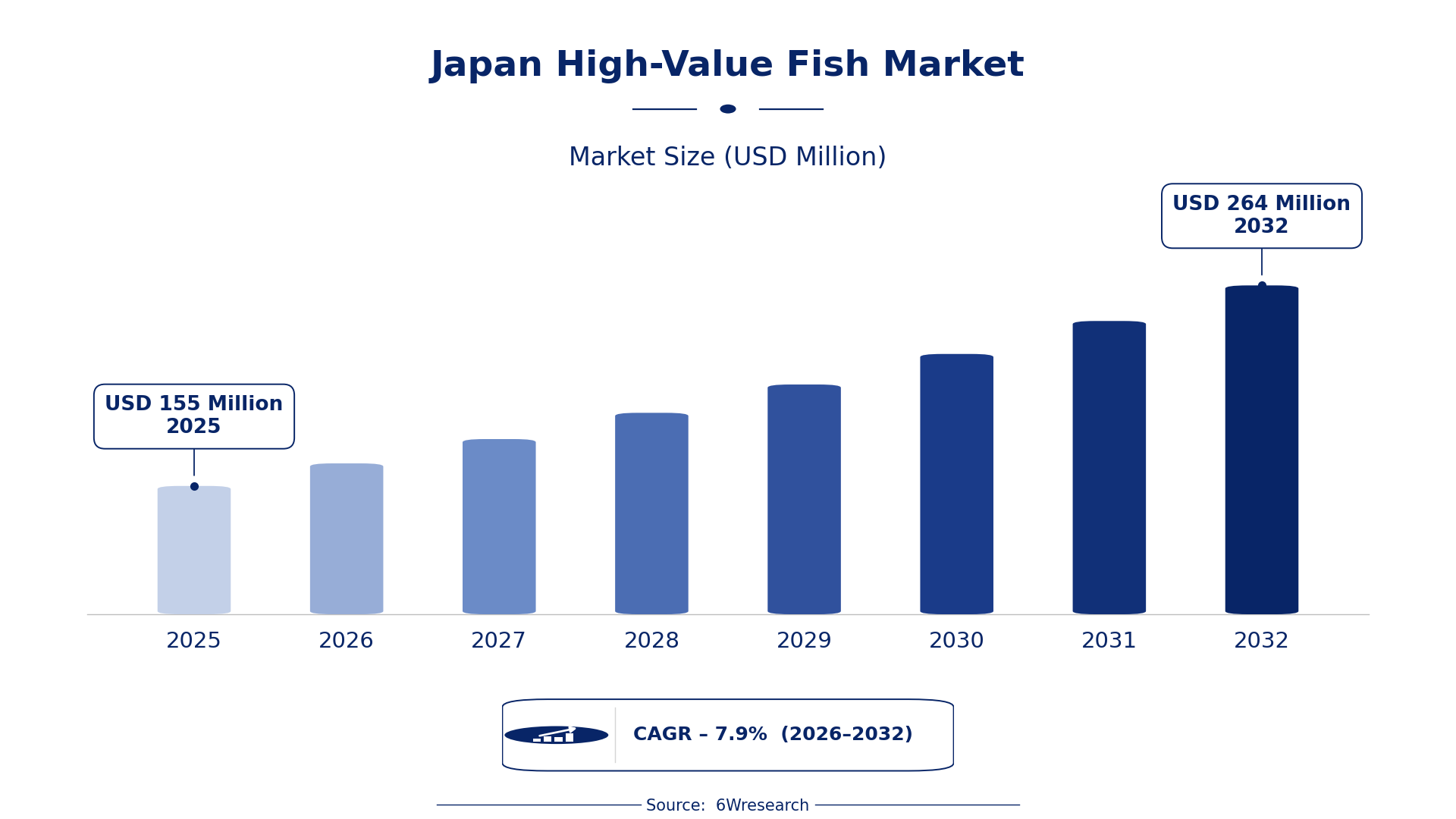
According to 6Wresearch internal database and industry insights, the Japan High-Value Fish Market was valued at USD 155 Million in 2025 and is projected to reach USD 264 Million by 2032, growing at a CAGR of approximately 7.9% during 2026–2032.
Japan High-Value Fish Market Highlights
| Report Metric | Details |
| Report Name | Japan High-Value Fish Market (2026-2032) |
| Market Size 2025 | USD 155 Million |
| Market Size 2032 | USD 264 Million |
| Absolute Growth 2025–2032 | USD 109 Million |
| CAGR 2026–2032 | 7.9% |
| Peak Annual Growth | 8.5% in 2032 |
| Forecast Period | 2026–2032 |
| Historical Data | 2022–2025 |
| Base Year | 2025 |
| Leading Fish Type, 2025 | Tuna (40% share) |
| Leading Source Type, 2025 | Wild-Caught (40% share) |
| Leading Distribution Channel, 2025 | Fish Traders (50% share) |
| Leading End User, 2025 | Supermarket Chains (44% share) |
| Fastest-Growing Fish Type | Salmon (11.1% CAGR) |
| Fastest-Growing Source Type | Farmed (11.6% CAGR) |
| Fastest-Growing Distribution Channel | Online Seafood Portals (10.5% CAGR) |
| Fastest-Growing End User | Home Consumers (10.2% CAGR) |
| Growing Sector | fine dining |
| Key End Users | supermarket chains, fine dining restaurants, home consumers |
Japan High-Value Fish Market Year-wise Growth Rate and Key Drivers (2022–2032)
This graph illustrates the annual growth rates of the market from 2022 to 2032, highlighting a steady upward trajectory and projected market expansion over the forecast period.
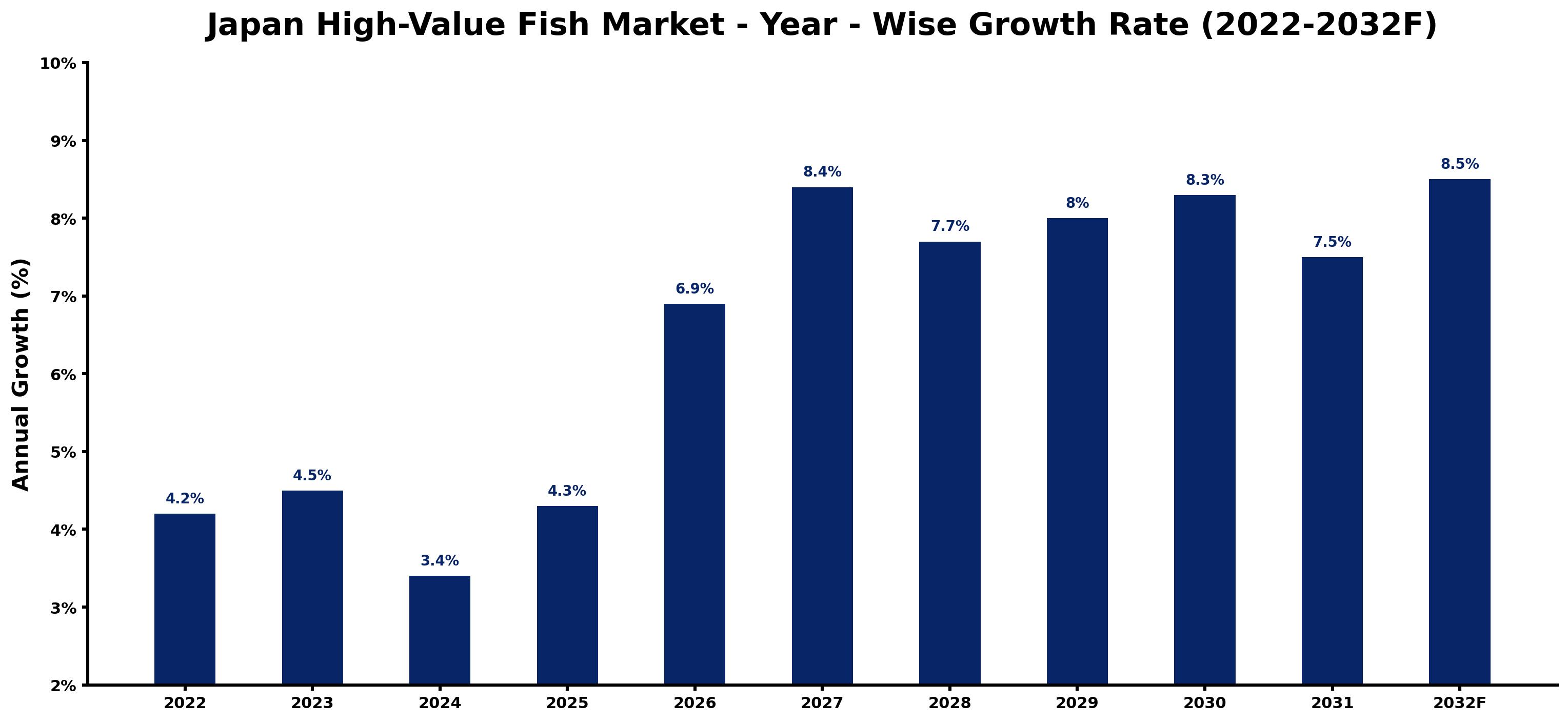
Below, each year's estimated growth is shown next to the factor that most influenced it.
| Year | Estimated Annual Growth (%) | Market Rationale |
| 2022 | 4.2 | The market experienced steady growth due to strong domestic consumption patterns. |
| 2023 | 4.5 | Growth accelerated as fine dining establishments expanded their offerings. |
| 2024 | 3.4 | The growth rate slowed as market saturation began to set in. |
| 2025 | 4.3 | Demand rebounded as tourism levels increased, boosting restaurant patronage. |
| 2026 | 6.9 | The market will grow faster due to rising interest in sustainable seafood. |
| 2027 | 8.4 | The growth rate is expected to rise as aquaculture practices become more prevalent. |
| 2028 | 7.7 | A slight slowdown is anticipated as competition intensifies among suppliers. |
| 2029 | 8.0 | Growth is expected to accelerate again as online sales channels gain traction. |
| 2030 | 8.3 | The market will maintain strong growth driven by culinary trends. |
| 2031 | 7.5 | A slowdown is anticipated as the market stabilises after rapid expansion. |
| 2032 | 8.5 | The market will peak as consumer preferences shift towards premium offerings. |
Note: Market size estimations and growth projections presented in this report are based on 6Wresearch's proprietary forecasting methodology, utilizing the latest available industry data, government publications, and primary research inputs.
Japan High-Value Fish Market Synopsis
High-value fish includes premium seafood species such as tuna, salmon, swordfish, and yellowtail, primarily harvested through wild-caught or aquaculture methods. In 2022, the average annual consumption of tuna per person was about 2.5 kg, reflecting strong domestic demand. Factors driving growth in the Japan High-Value Fish Market include increasing tourism, a focus on sustainability in aquaculture, and the expansion of fine dining establishments, all contributing to heightened consumer interest in premium seafood.
Market Dynamics Impact Analysis (2026–2032)
| Factor | Type | Impact | Primary Segment Affected |
| Increasing disposable incomes drive demand for premium seafood, particularly in fine dining establishments in Tokyo. | Driver | High | Tuna |
| The expansion of online seafood sales meets changing consumer habits, allowing easier access to high-value fish. | Driver | High | Online Seafood Portals |
| The rise of aquaculture facilities presents opportunities for sustainable fish production, particularly in Hokkaido. | Opportunity | High | Farmed |
| Growing interest in premium seafood among home consumers creates a demand for high-quality fish products. | Opportunity | High | Home Consumers |
| Strict regulations from the Japanese Fisheries Agency can delay product availability, impacting supply chains. | Restraint | High | Wild-Caught |
| Rising operational costs due to technology adoption challenges hinder supplier efficiency, affecting pricing. | Restraint | Medium | Farmed |
| Skills shortages in aquaculture limit production capacity, resulting in longer lead times for buyers. | Challenge | High | Tuna |
| Competition from international markets pressures local suppliers to improve quality and pricing strategies. | Challenge | Medium | Export Houses |
Evaluation of Drivers in Japan High-Value Fish Market (2026–2032)
Key forces behind demand, with the segment each one moves most, are listed below.
| Drivers | Primary Segment Affected | Why It Matters (Evidence) |
| Increased disposable income driving higher spending on premium seafood. | Tuna | In Japan, the average annual consumption of tuna per person was about 2.5 kg, reflecting strong demand for high-quality products. |
| Rising consumer preference for sustainable seafood options. | Salmon | The government launched a program to promote sustainable aquaculture practices in 2023, encouraging more purchases. |
| Growth in online sales channels for seafood, catering to consumer convenience. | Online Seafood Portals | Online seafood sales increased by 20% last year, reflecting changing consumer buying habits. |
| Expansion of the fine dining sector, driven by increased tourism. | Fine Dining Restaurants | The fine dining sector is projected to grow due to rising tourism, resulting in higher seafood demand. |
| Increased awareness of health benefits associated with high-value fish consumption. | Yellowtail | Health-conscious consumers are increasingly choosing premium fish for their nutritional value. |
Most of the additional volume stems from increasing disposable incomes, which lead to greater spending on premium seafood. In Japan, the average annual consumption of high-value fish is remarkable, with consumers increasingly pursuing quality options. The rise of fine dining establishments, particularly in Tokyo, further stimulates demand for premium seafood. The growing trend towards online seafood sales also reflects evolving consumer habits, with a notable surge in online purchases over the past year.
Evaluation of Restraints in Japan High-Value Fish Market
The key brakes on demand, and where they bite hardest, are shown below.
| Market Restraint | Primary Segment Affected | Why It Matters (Evidence) |
| Regulatory challenges related to sustainable fishing practices affecting supply. | Wild-Caught | The Japanese Fisheries Agency oversees sustainable fishing regulations, which can limit available supply. |
| Market saturation leading to intensified competition among suppliers. | Farmed | As more suppliers enter the market, pricing pressure may affect profitability for existing players. |
| Limitations on fishing quotas for certain species impacting availability. | Tuna | Strict regulations on tuna fishing quotas can restrict supply, affecting market stability. |
| Consumer price sensitivity affecting premium fish sales. | Salmon | High-quality salmon can reach prices of 1,000 JPY per kg, which may deter some buyers. |
| Dependence on seasonal availability of certain fish species. | Swordfish | Seasonal fluctuations can lead to inconsistent supply, impacting market stability. |
Japan High-Value Fish Market Challenges
Buyers face rising costs as the average price of high-quality tuna can reach 1,000 JPY per kg, restricting access to premium seafood. Regulatory challenges arise for suppliers due to the Japanese Fisheries Agency's strict sustainable fishing practices, which can delay product availability by three months. Technology adoption lags among producers, resulting in inefficiencies that inflate operational costs and ultimately raise prices for consumers. Skills shortages in aquaculture hinder supplier growth, forcing reliance on traditional methods that limit output and extend lead times for buyers.
Trends in the Japan High-Value Fish Market
Four trends stand out in the Japan High-Value Fish Market.
- Shift from Traditional to Online Seafood Sales: Since 2022, there has been a marked shift towards online seafood sales, with a 20% increase in sales last year. This trend is particularly pronounced among younger consumers seeking convenience, influencing how suppliers engage with their customers.
- Transition from Wild-Caught to Sustainable Aquaculture: In 2023, the government initiated a program promoting sustainable aquaculture practices, reflecting a move towards environmentally responsible sourcing. This change is crucial for suppliers aiming to satisfy consumer demand for sustainability.
- Emergence of Premium Seafood in Home Cooking: The trend towards home cooking has gained traction, with more consumers purchasing high-value fish for personal use. This shift is supported by the growing availability of premium seafood in supermarkets, catering to home consumers.
- Growth in Fine Dining Sector Driven by Tourism: The fine dining sector has been expanding since 2022, fuelled by increased tourism in Japan. This growth is important for high-value fish suppliers, as restaurants seek to provide premium seafood options.
Investment Opportunities in the Japan High-Value Fish Market
Where to invest in the Japan High-Value Fish Market: the main openings are set out below.
- Tokyo Seafood Markets: Tokyo's seafood markets offer opportunities for suppliers to showcase high-value fish. With a population of approximately 125 million, there is strong demand for premium seafood in this major hub.
- Sustainable Aquaculture Practices: Investing in sustainable aquaculture can satisfy the rising demand for responsibly sourced seafood. The Seafood Export Association of Japan supports initiatives that can enhance exports.
- Emergence of Online Seafood Portals: The growth of online seafood portals presents a chance to capitalise on the increasing consumer preference for convenience. Collaborating with local platforms can facilitate market entry and broaden reach.
- Fine Dining Restaurants: Fine dining establishments are increasingly in search of premium fish to elevate their menus. Suppliers can penetrate this market by forming partnerships with restaurant groups focused on high-quality offerings.
Government Initiatives in the Japan High-Value Fish Market
The Food Sanitation Act amendment in 2018 introduced a positive list system for food utensils, containers, and packaging, impacting seafood producers by ensuring compliance with hygiene standards. This law, enforced by the Ministry of Health, Labour and Welfare, aims to protect consumer health and enhance food safety.
The Digital Agency, established in September 2021, spearheads government digital transformation efforts. It approves funding for initiatives that improve the digital infrastructure of food businesses, which can enhance traceability and transparency in the seafood supply chain.
Future Insight of the Japan High-Value Fish Market
New aquaculture facilities in Hokkaido will increase salmon production capabilities by 2032, supporting the expanding fine dining sector as tourism rises. The government's sustainable aquaculture program will improve fish quality and availability, benefiting both buyers and suppliers. Online seafood sales are expected to grow as consumer demand for convenience drives advancements in distribution methods. By 2032, Japan's seafood market will likely see a considerable rise in online sales, reflecting shifting consumer preferences.
Market Segmentation Analysis
Japan High-Value Fish Market report covers a detailed analysis of the following market segments:
By Fish Type – Tuna Leads, Salmon Expected to Grow Fastest
According to Saurav Kr Singh, Senior Research Analyst at 6Wresearch, with 40% of fish type revenue in 2025, Tuna was the largest category. Tuna holds the largest share as it is a staple in sushi and sashimi, catering to both domestic and international consumers. The average annual consumption of tuna per person in Japan is about 2.5 kg, highlighting its widespread appeal. The quickest growth will come from Salmon, forecast to expand at a CAGR of 11.1% between 2026 and 2032. Salmon is witnessing rapid growth due to its versatility in various cuisines, making it increasingly popular among consumers. The concentration of salmon farming in Hokkaido, known for its cold waters, ensures a reliable supply to meet this rising demand. Suppliers should prioritise their tuna offerings while also increasing salmon availability to align with shifting consumer preferences.
By Source Type – Wild-Caught Leads, Farmed Expected to Grow Fastest
The largest source type category in 2025 was Wild-Caught, at 40% of revenue. Wild-Caught fish dominates the market as it is essential for ensuring premium quality, which is highly valued by consumers. The Japanese Fisheries Agency's regulations promote sustainable practices, further supporting this segment's prominence in high-value fish. Farmed is set to record the highest CAGR in this split, 11.6% over 2026–2032. Farmed fish is the fastest-growing segment, driven by rising sustainability concerns among consumers. The government's recent programme to promote sustainable aquaculture practices will likely accelerate this growth, making it a viable alternative. Buyers may increasingly prefer farmed options, prompting suppliers to adapt their sourcing strategies accordingly.
By Distribution Channel – Fish Traders Lead, Online Seafood Portals Expected to Grow Fastest
Fish Traders held 50% of the Japan High-Value Fish Market by distribution channel in 2025. Fish Traders dominate the distribution channel as they play a crucial role in the supply chain, connecting producers with consumers effectively. Their established networks ensure consistent availability of high-value fish, particularly in urban markets. Over 2026–2032, Online Seafood Portals are expected to post the fastest growth, at a CAGR of 10.5%. Online Seafood Portals are growing rapidly, with a 20% increase in online seafood sales reflecting a shift towards convenience in purchasing. This trend indicates a growing preference for home delivery options among consumers, especially younger demographics. Suppliers should enhance their online strategies to capture the increasing number of consumers opting for digital purchasing.
By End User – Supermarket Chains Lead, Home Consumers Expected to Grow Fastest
Supermarket Chains took 44% of end user revenue in 2025, more than any other category. Supermarket Chains are the leading end user, acting as major retailers of high-value fish and catering to a large customer base. Their extensive reach ensures consistent availability of premium seafood to consumers. Home Consumers are projected to grow fastest, at a CAGR of 10.2% during 2026–2032. Home Consumers represent the fastest-growing segment as demand for quality seafood increases, particularly with the rise in home cooking trends. This shift indicates a changing consumer behaviour towards more home-prepared meals. Suppliers may need to adjust their marketing strategies to better target home consumers seeking high-quality seafood options.
Key Attractiveness of the Report
- 10 Years of Market Numbers
- Historical Data Starting from 2022 to 2025
- Base Year 2025
- Forecast Data until 2032
- Key Performance Indicators Impacting the Market
- Major Upcoming Developments and Projects
Key Highlights of the Report:
- Japan High-Value Fish Market Outlook
- Market Size of Japan High-Value Fish Market, 2025
- Forecast of Japan High-Value Fish Market, 2032
- Historical Data and Forecast of Japan High-Value Fish Revenues & Volume for the Period 2022-2032F
- Japan High-Value Fish Market Trend Evolution
- Japan High-Value Fish Market Drivers and Challenges
- Japan High-Value Fish Price Trends
- Japan High-Value Fish Porter's Five Forces
- Japan High-Value Fish Industry Life Cycle
- Historical Data and Forecast of Japan High-Value Fish Market Revenues & Volume By Fish Type for the Period 2022-2032F
- Historical Data and Forecast of Japan High-Value Fish Market Revenues & Volume By Tuna for the Period 2022-2032F
- Historical Data and Forecast of Japan High-Value Fish Market Revenues & Volume By Salmon for the Period 2022-2032F
- Historical Data and Forecast of Japan High-Value Fish Market Revenues & Volume By Swordfish for the Period 2022-2032F
- Historical Data and Forecast of Japan High-Value Fish Market Revenues & Volume By Yellowtail for the Period 2022-2032F
- Historical Data and Forecast of Japan High-Value Fish Market Revenues & Volume By Source Type for the Period 2022-2032F
- Historical Data and Forecast of Japan High-Value Fish Market Revenues & Volume By Wild-Caught for the Period 2022-2032F
- Historical Data and Forecast of Japan High-Value Fish Market Revenues & Volume By Farmed for the Period 2022-2032F
- Historical Data and Forecast of Japan High-Value Fish Market Revenues & Volume By Deep-Sea for the Period 2022-2032F
- Historical Data and Forecast of Japan High-Value Fish Market Revenues & Volume By Hatchery-Raised for the Period 2022-2032F
- Historical Data and Forecast of Japan High-Value Fish Market Revenues & Volume By Distribution Channel for the Period 2022-2032F
- Historical Data and Forecast of Japan High-Value Fish Market Revenues & Volume By Fish Traders for the Period 2022-2032F
- Historical Data and Forecast of Japan High-Value Fish Market Revenues & Volume By Direct Sales for the Period 2022-2032F
- Historical Data and Forecast of Japan High-Value Fish Market Revenues & Volume By Seafood Markets for the Period 2022-2032F
- Historical Data and Forecast of Japan High-Value Fish Market Revenues & Volume By Online Seafood Portals for the Period 2022-2032F
- Historical Data and Forecast of Japan High-Value Fish Market Revenues & Volume By End User for the Period 2022-2032F
- Historical Data and Forecast of Japan High-Value Fish Market Revenues & Volume By Export Houses for the Period 2022-2032F
- Historical Data and Forecast of Japan High-Value Fish Market Revenues & Volume By Supermarket Chains for the Period 2022-2032F
- Historical Data and Forecast of Japan High-Value Fish Market Revenues & Volume By Fine Dining Restaurants for the Period 2022-2032F
- Historical Data and Forecast of Japan High-Value Fish Market Revenues & Volume By Home Consumers for the Period 2022-2032F
- Japan High-Value Fish Import Export Trade Statistics
- Market Opportunity Assessment By Fish Type
- Market Opportunity Assessment By Source Type
- Market Opportunity Assessment By Distribution Channel
- Market Opportunity Assessment By End User
- Japan High-Value Fish Top Companies Market Share
- Japan High-Value Fish Competitive Benchmarking By Technical and Operational Parameters
- Japan High-Value Fish Company Profiles
- Japan High-Value Fish Key Strategic Recommendations
Market Covered
This report examines the market across the segments below.
By Fish Type
- Tuna
- Salmon
- Swordfish
- Yellowtail
By Source Type
- Wild-Caught
- Farmed
- Deep-Sea
- Hatchery-Raised
By Distribution Channel
- Fish Traders
- Direct Sales
- Seafood Markets
- Online Seafood Portals
By End User
- Export Houses
- Supermarket Chains
- Fine Dining Restaurants
- Home Consumers































