Japan Higher-Education IT Market Size & Growth Rate
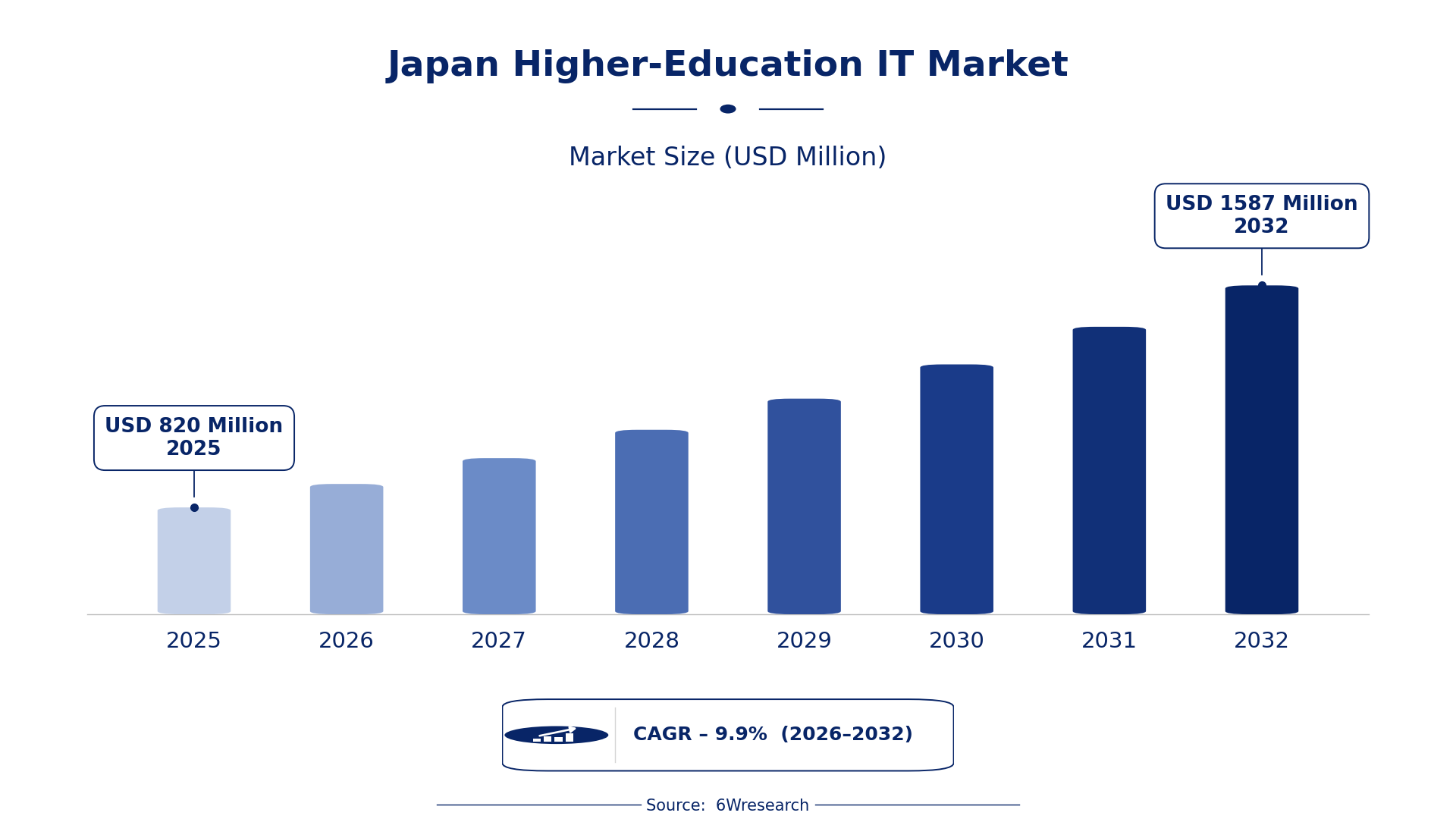
According to 6Wresearch internal database and industry insights, the Japan Higher-Education IT Market was valued at USD 820 Million in 2025 and is projected to reach USD 1,587 Million by 2032, growing at a CAGR of approximately 9.9% during 2026–2032.
Japan Higher-Education IT Market Highlights
| Report Metric | Details |
| Report Name | Japan Higher-Education IT Market (2026-2032) |
| Market Size 2025 | USD 820 Million |
| Market Size 2032 | USD 1,587 Million |
| Absolute Growth 2025–2032 | USD 767 Million |
| CAGR 2026–2032 | 9.9% |
| Peak Annual Growth | 11.5% in 2026 |
| Forecast Period | 2026–2032 |
| Historical Data | 2022–2025 |
| Base Year | 2025 |
| Leading Product Type, 2025 | Learning Management Systems (41% share) |
| Leading Solution Type, 2025 | Cloud-Based (45% share) |
| Leading Distribution Channel, 2025 | EdTech Vendors (47% share) |
| Leading End User, 2025 | Universities (38% share) |
| Fastest-Growing Product Type | Library Automation Tools (13.9% CAGR) |
| Fastest-Growing Distribution Channel | Online EdTech Portals (12.2% CAGR) |
| Fastest-Growing End User | Colleges (12.3% CAGR) |
| Growing Sector | Higher education |
| Key End Users | Universities, Colleges, Educational Institutions, IT Integrators |
Japan Higher-Education IT Market Year-wise Growth Rate and Key Drivers (2022–2032)
This graph illustrates the annual growth rates of the market from 2022 to 2032, highlighting a steady upward trajectory and projected market expansion over the forecast period.
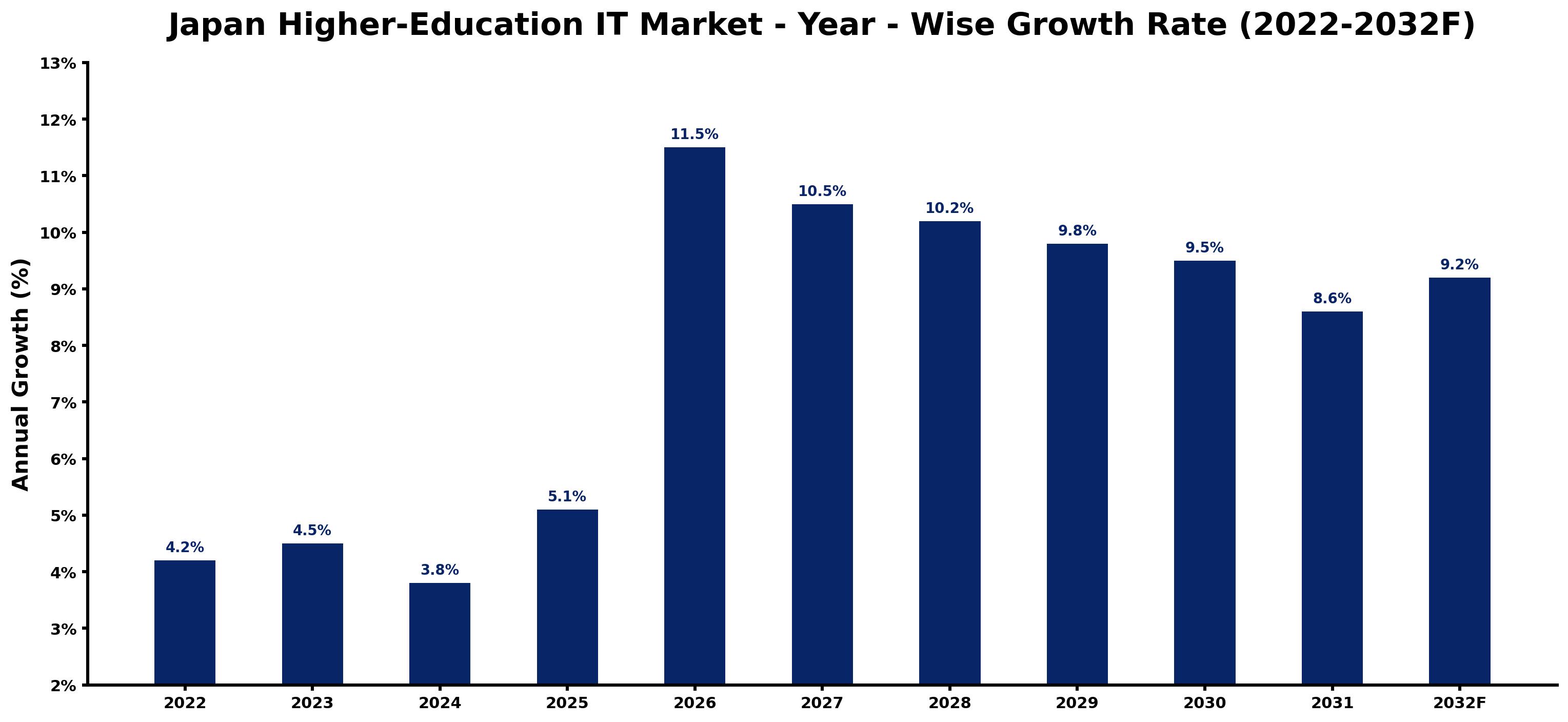
For each year, the table pairs the estimated growth rate with the leading influence on demand, showing how the drivers changed across the period.
| Year | Estimated Annual Growth (%) | Market Rationale |
| 2022 | 4.2 | The market showed steady growth with increasing adoption of IT solutions in universities. |
| 2023 | 4.5 | Growth accelerated as universities invested more in digital infrastructure and learning tools. |
| 2024 | 3.8 | The growth rate slowed slightly as institutions reassessed their IT budgets amid economic factors. |
| 2025 | 5.1 | Demand surged as universities embraced new technologies for improved learning experiences. |
| 2026 | 11.5 | The peak growth year will see strong investment in cloud-based solutions and digital transformation efforts. |
| 2027 | 10.5 | Growth will moderate as universities focus on optimising existing IT systems and resources. |
| 2028 | 10.2 | The market is projected to continue expanding, driven by ongoing digitalisation efforts in education. |
| 2029 | 9.8 | A slight slowdown is expected as institutions face challenges in integrating new technologies. |
| 2030 | 9.5 | Growth will remain steady as universities seek to improve their online education capabilities. |
| 2031 | 8.6 | The market is projected to show signs of stabilisation as institutions balance investments and operational needs. |
| 2032 | 9.2 | Demand is expected to rise again as new technologies and initiatives are introduced. |
Note: Market size estimations and growth projections presented in this report are based on 6Wresearch's proprietary forecasting methodology, utilizing the latest available industry data, government publications, and primary research inputs.
Japan Higher-Education IT Market Synopsis
Higher-Education IT encompasses technology solutions tailored for educational institutions, including software and hardware that improve administrative efficiency and learning experiences. The Japan Higher-Education IT Market is expanding due to increased investments from universities, with over 780 institutions in Japan. The adoption of Learning Management Systems reached 70% in 2023, while the digital transformation initiative launched by the Ministry of Education, Culture, Sports, Science and Technology (MEXT) further drives demand for advanced IT solutions. Universities are increasingly prioritising cloud-based solutions, focusing on improving student engagement and educational outcomes.
Market Dynamics Impact Analysis (2026–2032)
| Factor | Type | Impact | Primary Segment Affected |
| Growing adoption of Learning Management Systems in universities | Driver | High | Learning Management Systems |
| Increased investment in digital infrastructure by universities | Driver | High | Cloud-Based |
| Rising demand for library automation tools due to increased student enrolment | Opportunity | Medium | Library Automation Tools |
| Expansion of online EdTech portals to meet educational needs | Opportunity | Medium | Online EdTech Portals |
| Budget constraints in some universities affecting IT investments | Restraint | High | Campus Management Software |
| Slow adoption of IoT-enabled devices in classrooms | Restraint | Medium | IoT-Enabled |
| Challenges in integrating new technologies into existing systems | Challenge | High | Smart Class Hardware |
| Competition among EdTech vendors leading to pricing pressures | Challenge | Medium | EdTech Vendors |
Evaluation of Drivers in Japan Higher-Education IT Market (2026–2032)
Demand rests on the following drivers, each shown with the segment it touches most.
| Drivers | Primary Segment Affected | Why It Matters (Evidence) |
| Increased student enrolment in universities | Learning Management Systems | Approximately 3 million students enrolled in higher education drive demand for effective online learning solutions. |
| Government initiatives promoting digital transformation | Cloud-Based | The digital transformation initiative in 2023 encourages universities to adopt cloud-based solutions, with a 50% adoption rate in colleges. |
| Growing need for efficient library management | Library Automation Tools | Over 60% of university libraries utilise automation tools to streamline operations and improve user experience. |
| Rising trend of remote learning | SaaS | The flexibility of SaaS solutions supports the growing number of online courses offered by universities. |
| Increased focus on interactive learning environments | Smart Class Hardware | Investment in smart class hardware improves the learning experience in universities, attracting more students. |
Much of the new demand stems from the substantial enrolment of approximately 3 million students in higher education. This influx compels universities to adopt effective online learning solutions, with many institutions now prioritising cloud-based technologies. The digital transformation efforts initiated in 2023 encourage educational institutions to implement advanced IT systems, which are now widely adopted across campuses. Additionally, over 60% of university libraries are utilising automation tools to improve operational efficiency. The trend of remote learning is further increasing the demand for flexible SaaS solutions, while investments in interactive learning environments are attracting more students to universities.
Evaluation of Restraints in Japan Higher-Education IT Market
The table below lists the restraints and the evidence behind each.
| Market Restraint | Primary Segment Affected | Why It Matters (Evidence) |
| Budget constraints limiting IT investments in some universities | Campus Management Software | Budget limitations restrict universities from investing in essential IT solutions, affecting operational efficiency. |
| Slow integration of IoT-enabled devices in classrooms | IoT-Enabled | Limited pilot projects in 30 universities hinder widespread adoption of IoT technologies for smart classrooms. |
| Challenges in adapting to new technology | Smart Class Hardware | Universities face difficulties in integrating advanced hardware into existing systems, delaying implementation. |
| Intense competition among EdTech vendors | EdTech Vendors | Pricing pressures from multiple vendors can lead to reduced margins and impact service quality. |
| Limited awareness of library automation benefits | Library Automation Tools | Some universities remain hesitant to invest in automation due to a lack of understanding of its advantages. |
Japan Higher-Education IT Market Challenges
MEXT's stringent regulations for higher education IT standards often lead to lengthy approval processes, delaying technology adoption for institutions and hindering improvements in educational delivery. Budget limitations faced by colleges due to insufficient government funding restrict investment in critical IT infrastructure, ultimately impacting the educational experience for around 3 million students. Heightened competition among educational institutions drives down prices for IT solutions, forcing suppliers to reduce their margins and stifling innovation. Supply chain issues for hardware components result in delivery delays, causing colleges to postpone essential upgrades and diminishing their operational effectiveness.
Trends in the Japan Higher-Education IT Market
The following changes are redrawing the Japan Higher-Education IT Market.
- Shift from Traditional to Cloud-Based Solutions: Since 2023, universities have increasingly adopted cloud-based IT solutions, with a 50% adoption rate in colleges. This shift allows for greater flexibility and scalability in managing educational resources.
- Emergence of Online EdTech Portals: In 2023, online EdTech portals experienced a 40% increase in user registrations, reflecting a growing preference for digital learning resources among students and educators.
- Growing Importance of Library Automation Tools: As of 2023, over 60% of university libraries utilise automation tools, highlighting the trend towards efficient library management and improved user experience.
- Increased Adoption of Learning Management Systems: The adoption rate of Learning Management Systems reached 75% in 2023, demonstrating a shift towards online learning and digital course delivery.
Investment Opportunities in the Japan Higher-Education IT Market
The opportunities below stand out in the Japan Higher-Education IT Market for new entrants and existing suppliers.
- Tokyo as a Hub for Digital Education: Tokyo's universities are investing heavily in digital education, with MEXT allocating funds for infrastructure improvements. This presents opportunities for suppliers of IT solutions.
- Partnerships with Universities for IT Solutions: Collaborating with universities can facilitate the supply of IT solutions, especially in light of the 2023 digital transformation initiative.
- Investment in Library Automation Tools: With over 60% of university libraries using automation tools, there is a growing need for suppliers to provide advanced solutions to improve library services.
- Focus on Interactive Learning Environments: Colleges are increasingly seeking smart class hardware to improve learning experiences, creating opportunities for suppliers to enter this market.
Government Initiatives in the Japan Higher-Education IT Market
The policy framework for higher education IT in Japan is shaped by laws such as the Education Law (1947) and the MEXT's digital transformation initiative launched in 2023. These measures require educational institutions to adopt modern IT solutions to improve administrative efficiency and learning experiences, ensuring compliance with evolving educational standards.
The Ministry of Education, Culture, Sports, Science and Technology (MEXT) is responsible for approving and funding digital education initiatives. In 2023, MEXT allocated significant budget resources to improve digital infrastructure in universities, supporting the adoption of advanced technology solutions.
Future Insight of the Japan Higher-Education IT Market
Investment in higher education IT will surge by 2032, driven by government grants and MEXT's digital transformation initiatives, generating robust demand for advanced technology solutions. The adoption of cloud-based systems is expected to rise to 80%, enabling institutions to improve operational efficiency and learning experiences. Enhanced collaboration between educational experts and IT professionals will yield more customised solutions, addressing the varied needs of students. As IoT devices are integrated, institutions will harness real-time data to optimise administrative processes and elevate student engagement.
Market Segmentation Analysis
Japan Higher-Education IT Market report covers a detailed analysis of the following market segments:
By Product Type – Learning Management Systems Lead, Library Automation Tools Expected to Grow Fastest
According to Saurav Kr Singh, Senior Research Analyst at 6Wresearch, Learning Management Systems accounted for 41% of the market by product type in 2025. Learning Management Systems play a critical role in delivering online courses and tracking student progress, making them vital for educational institutions. With over 3 million students enrolled in higher education, the reliance on these systems is expected to increase further. Library Automation Tools are projected to grow fastest, at a CAGR of 13.9% during 2026–2032. The swift uptake of Library Automation Tools is propelled by the necessity for efficient library management, with over 60% of university libraries employing such solutions. As institutions strive to optimise their operations, this trend is likely to gain momentum. Suppliers should focus on improving library automation tools to cater to the rising demand in educational institutions.
By Solution Type – Cloud-Based Leads and Records the Fastest Growth
The largest solution type category in 2025 was Cloud-Based, at 45% of revenue. Cloud-Based solutions are preferred for their remote access capabilities and scalability, making them attractive to educational institutions. The 50% adoption rate in colleges reflects a strong shift towards cloud technologies in higher education. Its lead should widen, with a projected CAGR of 11.1% during 2026–2032, the highest in this split. The growth of Cloud-Based solutions will continue as institutions increasingly recognise the benefits of flexibility and cost-effectiveness in their IT infrastructure. This trend will further solidify the position of cloud services in the market. Buyers should prioritise cloud solutions to ensure they remain competitive and responsive to changing educational needs.
By Distribution Channel – EdTech Vendors Lead, Online EdTech Portals Expected to Grow Fastest
EdTech Vendors took 47% of distribution channel revenue in 2025, more than any other category. EdTech Vendors hold a substantial position as primary suppliers of educational technology solutions, providing essential tools to institutions across Japan. Their established relationships with universities facilitate widespread adoption of various IT products, ensuring they meet the needs of a diverse educational landscape. Over 2026–2032, Online EdTech Portals are expected to post the fastest growth, at a CAGR of 12.2%. Online EdTech Portals are experiencing rapid growth, becoming increasingly crucial for accessing educational resources, as indicated by a 40% increase in user registrations in 2023. This trend highlights the shift towards digital platforms, which are essential for modern educational practices. Suppliers should enhance their online strategies to capitalise on the increasing reliance on digital resources in education.
By End User – Universities Lead, Colleges Expected to Grow Fastest
With 38% of end user revenue in 2025, Universities was the largest category. Universities represent the largest consumer group for higher education IT solutions, utilising these technologies to support their vast student populations effectively. Their significant investments in IT infrastructure underscore the continuous demand for advanced educational technologies across the sector. Colleges are set to record the highest CAGR in this split, 12.3% over 2026–2032. Colleges are rapidly becoming important users of educational technology, driven by increasing enrolments and the necessity for effective learning tools. This growth in the college segment is likely to contribute substantially to the overall market expansion. Suppliers need to tailor their products to address the specific requirements of colleges as this segment continues to grow.
Key Attractiveness of the Report
- 10 Years of Market Numbers
- Historical Data Starting from 2022 to 2025
- Base Year 2025
- Forecast Data until 2032
- Key Performance Indicators Impacting the Market
- Major Upcoming Developments and Projects
Key Highlights of the Report:
- Japan Higher-Education IT Market Outlook
- Market Size of Japan Higher-Education IT Market, 2025
- Forecast of Japan Higher-Education IT Market, 2032
- Historical Data and Forecast of Japan Higher-Education IT Revenues & Volume for the Period 2022-2032F
- Japan Higher-Education IT Market Trend Evolution
- Japan Higher-Education IT Market Drivers and Challenges
- Japan Higher-Education IT Price Trends
- Japan Higher-Education IT Porter's Five Forces
- Japan Higher-Education IT Industry Life Cycle
- Historical Data and Forecast of Japan Higher-Education IT Market Revenues & Volume By Product Type for the Period 2022-2032F
- Historical Data and Forecast of Japan Higher-Education IT Market Revenues & Volume By Campus Management Software for the Period 2022-2032F
- Historical Data and Forecast of Japan Higher-Education IT Market Revenues & Volume By Learning Management Systems for the Period 2022-2032F
- Historical Data and Forecast of Japan Higher-Education IT Market Revenues & Volume By Smart Class Hardware for the Period 2022-2032F
- Historical Data and Forecast of Japan Higher-Education IT Market Revenues & Volume By Library Automation Tools for the Period 2022-2032F
- Historical Data and Forecast of Japan Higher-Education IT Market Revenues & Volume By Solution Type for the Period 2022-2032F
- Historical Data and Forecast of Japan Higher-Education IT Market Revenues & Volume By SaaS for the Period 2022-2032F
- Historical Data and Forecast of Japan Higher-Education IT Market Revenues & Volume By Cloud-Based for the Period 2022-2032F
- Historical Data and Forecast of Japan Higher-Education IT Market Revenues & Volume By IoT-Enabled for the Period 2022-2032F
- Historical Data and Forecast of Japan Higher-Education IT Market Revenues & Volume By On-Premise for the Period 2022-2032F
- Historical Data and Forecast of Japan Higher-Education IT Market Revenues & Volume By Distribution Channel for the Period 2022-2032F
- Historical Data and Forecast of Japan Higher-Education IT Market Revenues & Volume By EdTech Vendors for the Period 2022-2032F
- Historical Data and Forecast of Japan Higher-Education IT Market Revenues & Volume By Online EdTech Portals for the Period 2022-2032F
- Historical Data and Forecast of Japan Higher-Education IT Market Revenues & Volume By IT Integrators for the Period 2022-2032F
- Historical Data and Forecast of Japan Higher-Education IT Market Revenues & Volume By Direct Sales for the Period 2022-2032F
- Historical Data and Forecast of Japan Higher-Education IT Market Revenues & Volume By End User for the Period 2022-2032F
- Historical Data and Forecast of Japan Higher-Education IT Market Revenues & Volume By Universities for the Period 2022-2032F
- Historical Data and Forecast of Japan Higher-Education IT Market Revenues & Volume By Colleges for the Period 2022-2032F
- Historical Data and Forecast of Japan Higher-Education IT Market Revenues & Volume By Schools for the Period 2022-2032F
- Historical Data and Forecast of Japan Higher-Education IT Market Revenues & Volume By Institutes for the Period 2022-2032F
- Japan Higher-Education IT Import Export Trade Statistics
- Market Opportunity Assessment By Product Type
- Market Opportunity Assessment By Solution Type
- Market Opportunity Assessment By Distribution Channel
- Market Opportunity Assessment By End User
- Japan Higher-Education IT Top Companies Market Share
- Japan Higher-Education IT Competitive Benchmarking By Technical and Operational Parameters
- Japan Higher-Education IT Company Profiles
- Japan Higher-Education IT Key Strategic Recommendations
Market Covered
Segments analysed in this report are listed below.
By Product Type
- Campus Management Software
- Learning Management Systems
- Smart Class Hardware
- Library Automation Tools
By Solution Type
- SaaS
- Cloud-Based
- IoT-Enabled
- On-Premise
By Distribution Channel
- EdTech Vendors
- Online EdTech Portals
- IT Integrators
- Direct Sales
By End User
- Universities
- Colleges
- Schools
- Institutes































