Japan Highway Safety Barriers Market Size & Growth Rate
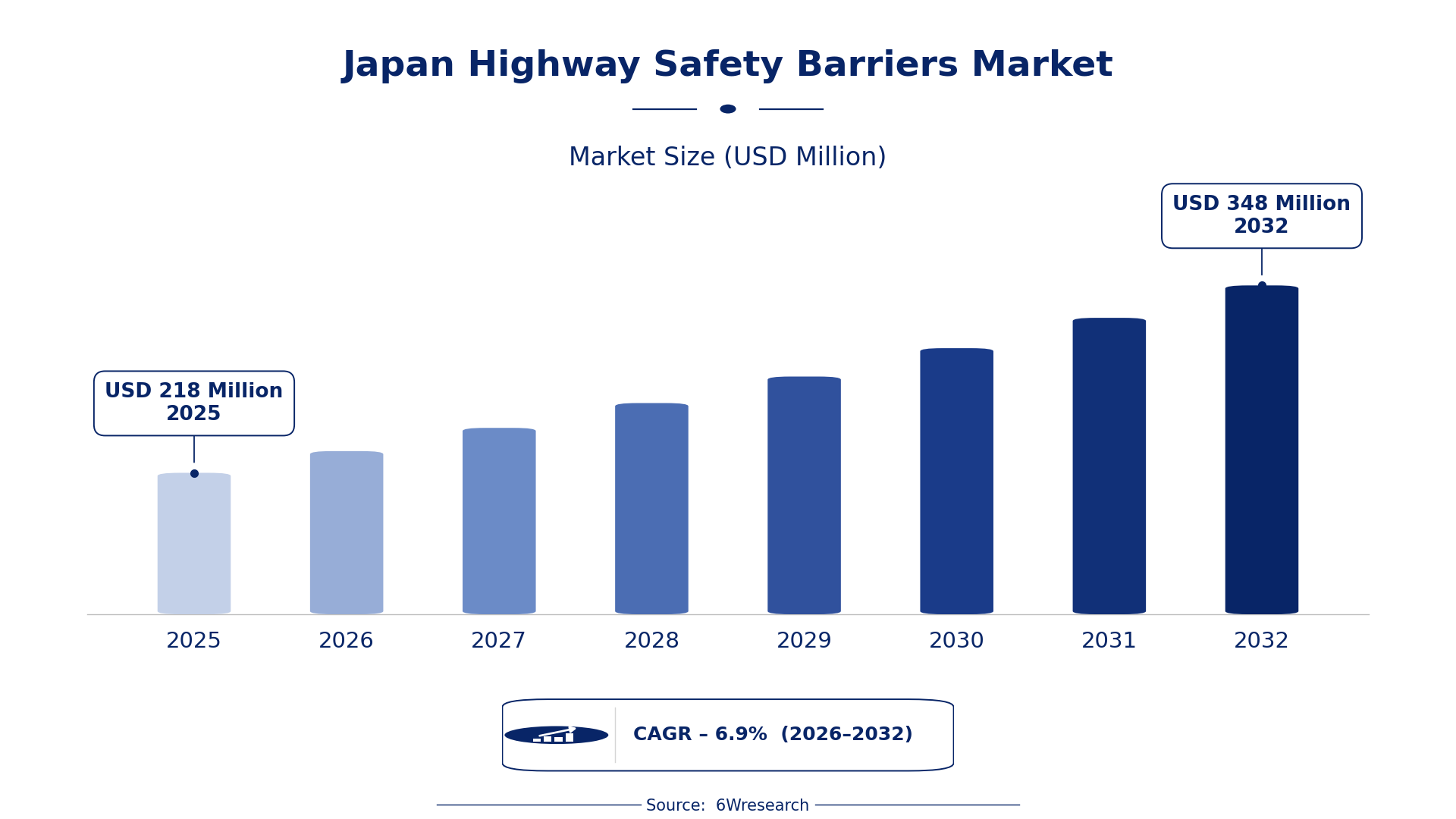
According to 6Wresearch internal database and industry insights, the Japan Highway Safety Barriers Market was valued at USD 218 Million in 2025 and is projected to reach USD 348 Million by 2032, growing at a CAGR of approximately 6.9% during 2026–2032.
Japan Highway Safety Barriers Market Highlights
| Report Metric | Details |
| Report Name | Japan Highway Safety Barriers Market (2026-2032) |
| Market Size 2025 | USD 218 Million |
| Market Size 2032 | USD 348 Million |
| Absolute Growth 2025–2032 | USD 130 Million |
| CAGR 2026–2032 | 6.9% |
| Peak Annual Growth | 7.4% in 2027 |
| Forecast Period | 2026–2032 |
| Historical Data | 2022–2025 |
| Base Year | 2025 |
| Leading Product Type, 2025 | Concrete Barriers (47% share) |
| Leading Material Type, 2025 | Reinforced Concrete (41% share) |
| Leading Distribution Channel, 2025 | Government Tenders (54% share) |
| Leading End User, 2025 | Road Infrastructure Depts (47% share) |
| Fastest-Growing Product Type | Cable Barriers (9.6% CAGR) |
| Fastest-Growing Material Type | HDPE (10.1% CAGR) |
| Fastest-Growing Distribution Channel | Online Platforms (9.1% CAGR) |
| Fastest-Growing End User | Road Contractors (9.0% CAGR) |
| Growing Sector | Highway Infrastructure |
| Key End Users | Road Contractors, Highway Authorities, Road Infrastructure Departments |
Japan Highway Safety Barriers Market Year-wise Growth Rate and Key Drivers (2022–2032)
This graph illustrates the annual growth rates of the market from 2022 to 2032, highlighting a steady upward trajectory and projected market expansion over the forecast period.
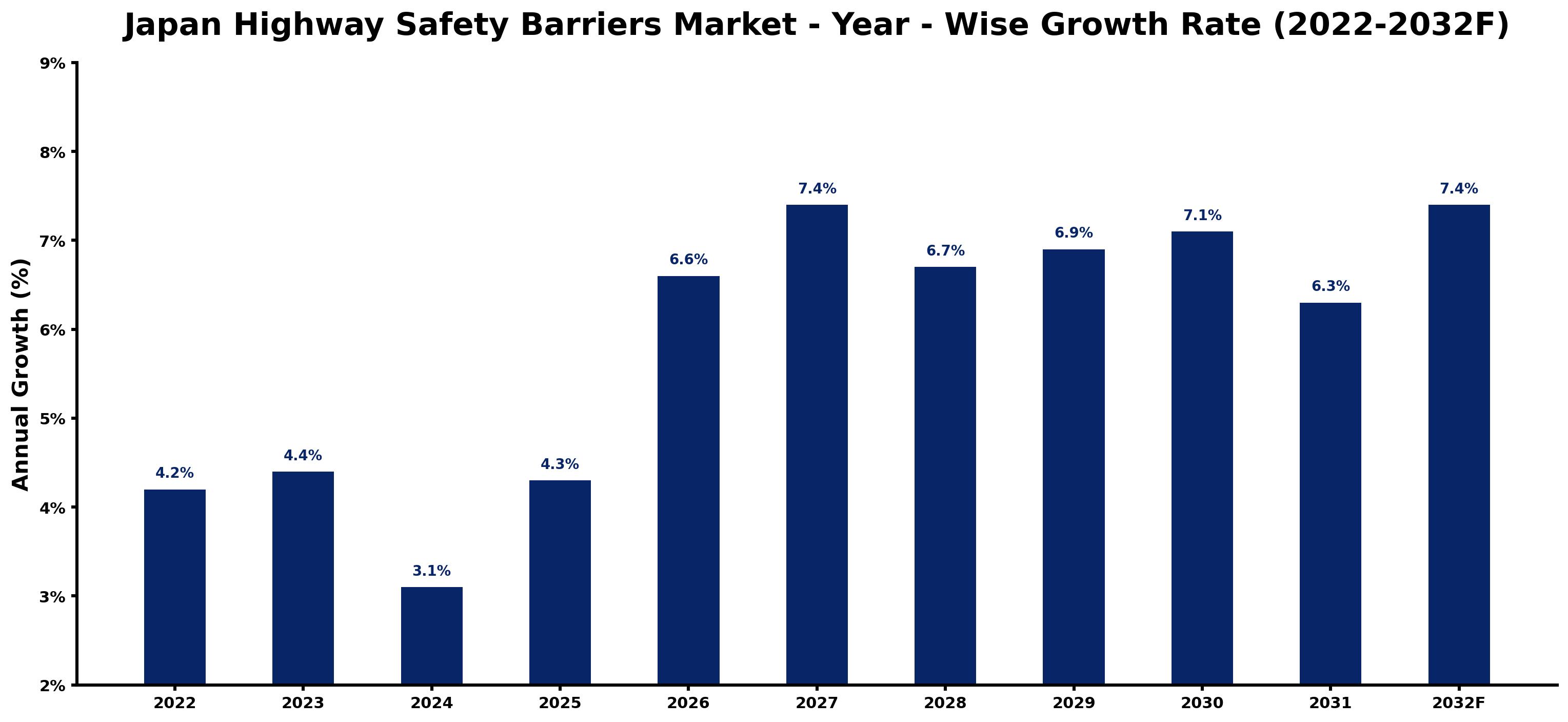
Each row of the following table gives one year's estimated growth and the event or demand shift that explains it.
| Year | Estimated Annual Growth (%) | Market Rationale |
| 2022 | 4.2 | The market showed steady growth due to ongoing highway projects and maintenance activities. |
| 2023 | 4.4 | Growth accelerated as the demand for safety barriers increased in urban areas. |
| 2024 | 3.1 | Growth slowed as some projects faced delays, but demand remained positive. |
| 2025 | 4.3 | Demand picked up again with new government contracts for highway safety improvements. |
| 2026 | 6.6 | Growth is expected to surge as infrastructure investment increases in preparation for upcoming events. |
| 2027 | 7.4 | The market is projected to peak as projects expand and safety regulations tighten. |
| 2028 | 6.7 | Growth is expected to slow slightly as the market stabilises after peak demand. |
| 2029 | 6.9 | Demand is projected to rise again as highway authorities initiate new safety measures. |
| 2030 | 7.1 | Growth is expected to continue as contractors increase procurement for ongoing projects. |
| 2031 | 6.3 | A slight slowdown is projected as the market adjusts to new standards. |
| 2032 | 7.4 | Demand is expected to peak again as major infrastructure projects are completed. |
Note: Market size estimations and growth projections presented in this report are based on 6Wresearch's proprietary forecasting methodology, utilizing the latest available industry data, government publications, and primary research inputs.
Japan Highway Safety Barriers Market Synopsis
Highway safety barriers are engineered structures designed to prevent vehicles from veering off the road and are made from materials like concrete and steel. The Japan Highway Safety Barriers Market is growing, driven by over 1,200 km of expressways and a ¥10 billion government allocation for safety improvements. Ongoing highway projects, heightened demand from road contractors, and the enforcement of stricter safety regulations create a steady requirement for effective safety solutions throughout the country.
Market Dynamics Impact Analysis (2026–2032)
| Factor | Type | Impact | Primary Segment Affected |
| Investment in highway infrastructure | Driver | High | Concrete Barriers |
| Increasing safety regulations | Driver | High | Metal Beam Barriers |
| Growing demand for enhanced safety measures | Opportunity | High | Cable Barriers |
| Rising urbanisation leading to more highways | Opportunity | High | Reinforced Concrete |
| High costs of installation and maintenance | Restraint | Medium | Plastic Barriers |
| Limited awareness of temporary barrier options | Restraint | Medium | Cable Barriers |
| Compliance with stringent safety standards | Challenge | High | Metal Beam Barriers |
| Capacity constraints in production | Challenge | Medium | Reinforced Concrete |
Evaluation of Drivers in Japan Highway Safety Barriers Market (2026–2032)
The factors lifting demand, and the evidence behind each, are summarised below.
| Drivers | Primary Segment Affected | Why It Matters (Evidence) |
| Government investment in infrastructure | Concrete Barriers | The government allocated ¥10 billion for highway safety improvements, increasing demand for durable barriers. |
| Growing urbanisation and highway expansion | Metal Beam Barriers | Urban areas require more effective safety measures due to the extensive expressway network. |
| Increased focus on road safety standards | Cable Barriers | Stricter safety standards drive demand for advanced solutions in high-risk areas. |
| Rising number of new highway projects | Reinforced Concrete | Road contractors utilise safety barriers in over 80% of new highway projects. |
| Growing safety concerns in mountainous regions | Galvanized Steel | Cable barriers are increasingly used in mountainous regions for improved safety. |
The Tokyo metropolitan area, with the highest density of highway safety barriers, drives demand for durable options. Over 1,200 km of expressways necessitate effective safety measures, leading to increased purchases of concrete and metal beam barriers. The implementation of ISO 39001 standards raises the focus on road safety, encouraging contractors to invest in advanced systems.
Evaluation of Restraints in Japan Highway Safety Barriers Market
Below are the constraints most often cited by buyers and suppliers, with the segment each affects.
| Market Restraint | Primary Segment Affected | Why It Matters (Evidence) |
| High installation and maintenance costs | Plastic Barriers | The cost of installation can deter contractors from using temporary barriers, limiting their market penetration. |
| Limited awareness of temporary barrier applications | Cable Barriers | Some contractors may not fully understand the benefits of cable barriers in specific high-risk areas. |
| Compliance with stringent safety regulations | Metal Beam Barriers | Meeting safety standards can increase production costs, affecting pricing strategies. |
| Capacity constraints in production facilities | Reinforced Concrete | Limited production capacity can delay project timelines for contractors needing immediate supplies. |
| Dependence on government contracts for demand | Concrete Barriers | Fluctuations in government spending can directly impact the demand for concrete barriers. |
Japan Highway Safety Barriers Market Challenges
Material costs for producers have surged due to global supply chain issues, leading to increased expenses that reduce profit margins. Importers experience inconsistent tariffs on steel, which can delay shipments and inflate prices, impacting project timelines for contractors. A shortage of skilled workers in the construction sector complicates the installation of safety barriers, causing delays for road contractors who rely on timely project execution. Buyers face budget constraints as government funding for infrastructure projects is limited, resulting in postponed safety upgrades and heightened accident risks on highways.
Trends in the Japan Highway Safety Barriers Market
The shifts below are changing how Japan Highway Safety Barriers Market products are bought and supplied.
- Shift towards Sustainable Barrier Materials: Japan is increasingly adopting sustainable materials for highway safety barriers, with reinforced concrete leading the way. The use of eco-friendly materials is projected to rise, with government initiatives for greener infrastructure supporting this trend.
- Increase in Smart Barrier Technologies: Highway authorities are integrating smart technologies into safety barriers, improving their functionality. The implementation of sensors and monitoring systems is expected to grow, which will improve safety management on highways.
- Expansion of Cable Barriers in High-Risk Areas: Cable barriers are being increasingly deployed in mountainous regions due to their effectiveness in preventing accidents. This trend is supported by a rise in safety concerns, leading to more installations in these areas.
- Growing Demand for Temporary Barriers: The use of temporary barriers for events and construction sites is on the rise, driven by increased safety regulations. This trend reflects a shift in focus towards flexible safety solutions.
Investment Opportunities in the Japan Highway Safety Barriers Market
The openings below show where demand in the Japan Highway Safety Barriers Market is visible and how suppliers can enter.
- ¥10 billion allocated for highway safety improvements: With the government investing heavily in highway safety, contractors can supply durable safety solutions. This investment creates a significant opportunity for suppliers in urban areas, particularly in Tokyo.
- Growing need for advanced safety solutions: As safety regulations tighten, there is a demand for innovative barrier systems. Collaborating with road contractors in metropolitan regions can facilitate market entry.
- Rising urbanisation necessitating more highways: The increasing urban population is driving the need for expanded highway infrastructure. Suppliers can target road infrastructure departments to meet this demand.
- Emerging focus on eco-friendly materials: With a shift towards sustainability, there is a growing market for environmentally friendly barrier materials. Suppliers can enter this market by partnering with local manufacturers.
Government Initiatives in the Japan Highway Safety Barriers Market
The GX Promotion Act (2023) establishes a stronger legal framework for highway safety, building on the Economic Security Promotion Act (2022) that supports supply-chain resilience. This new measure mandates stricter compliance with safety standards, ensuring that producers meet higher quality requirements for highway safety barriers.
In 2023, the government allocated ¥10 billion for highway safety improvements, overseen by the Ministry of Land, Infrastructure, Transport and Tourism. This funding aims to improve safety measures across expressways, ensuring regular inspections and maintenance.
Future Insight of the Japan Highway Safety Barriers Market
New highway projects will feature advanced safety barrier systems by 2032, as the government emphasises road safety initiatives. The integration of smart technology in barrier design will enhance traffic management and accident prevention. Increased funding, including the ¥10 billion allocated for highway safety improvements, will facilitate infrastructure upgrades. Regular inspections mandated by highway authorities will ensure compliance with JIS standards, promoting long-term reliability for road users.
Market Segmentation Analysis
Japan Highway Safety Barriers Market report covers a detailed analysis of the following market segments:
By Product Type – Concrete Barriers Lead, Cable Barriers Expected to Grow Fastest
According to Saurav Kr Singh, Senior Research Analyst at 6Wresearch, Concrete Barriers took 47% of product type revenue in 2025, more than any other category. Concrete barriers dominate the market due to their robust design and suitability for permanent installations along Japan's extensive expressway network. Their use in over 1,200 km of expressways underscores their critical role in ensuring highway safety. Cable Barriers are set to record the highest CAGR in this split, 9.6% over 2026–2032. Cable barriers are increasingly utilised in mountainous regions, where their design provides enhanced safety features tailored for challenging terrains. The growing emphasis on accident prevention in these areas is propelling their rapid growth. Suppliers should prioritise the development of cable barriers to capture emerging opportunities in mountainous regions.
By Material Type – Reinforced Concrete Leads, HDPE Expected to Grow Fastest
In 2025, Reinforced Concrete led the material type split with a 41% share. Reinforced concrete is the leading material for highway safety barriers, offering durability and stability across various weather conditions. Its essential role in long-lasting installations throughout Japan’s highways reinforces its market dominance. Over 2026–2032, HDPE is expected to post the fastest growth, at a CAGR of 10.1%. HDPE barriers are becoming more popular for lightweight and temporary installations, catering to specific needs in construction projects. This shift towards versatile materials is driving their swift adoption in the market. Buyers may benefit from exploring HDPE options for temporary solutions, while suppliers should consider expanding their product lines to include lightweight materials.
By Distribution Channel – Government Tenders Lead, Online Platforms Expected to Grow Fastest
With 54% of distribution channel revenue in 2025, Government Tenders was the largest category. Government tenders are a major source of demand, as public sector projects necessitate compliance with strict safety standards. This channel is vital for suppliers aiming to secure substantial contracts within the highway infrastructure sector. Online Platforms are projected to grow fastest, at a CAGR of 9.1% during 2026–2032. Online platforms are becoming a convenient option for niche purchases, enabling buyers to access a broader range of products. As digital procurement practices grow, this channel's expansion is anticipated to continue. Suppliers should invest in online sales strategies to reach a wider audience and adapt to the changing purchasing preferences of buyers.
By End User – Road Infrastructure Depts Lead, Road Contractors Expected to Grow Fastest
Road Infrastructure Depts accounted for 47% of the market by end user in 2025. Road infrastructure departments are the primary end users of highway safety barriers, responsible for implementing safety measures across the highway network. Their crucial role in upholding safety standards solidifies their market leadership. The quickest growth will come from Road Contractors, forecast to expand at a CAGR of 9.0% between 2026 and 2032. Road contractors are increasingly procuring safety barriers for construction projects, reflecting the ongoing demand for new highway developments. This trend indicates a strong growth trajectory for this segment in the coming years. Suppliers should focus on building relationships with road contractors to ensure a steady flow of orders in the construction sector.
Key Attractiveness of the Report
- 10 Years of Market Numbers
- Historical Data Starting from 2022 to 2025
- Base Year 2025
- Forecast Data until 2032
- Key Performance Indicators Impacting the Market
- Major Upcoming Developments and Projects
Key Highlights of the Report:
- Japan Highway Safety Barriers Market Outlook
- Market Size of Japan Highway Safety Barriers Market, 2025
- Forecast of Japan Highway Safety Barriers Market, 2032
- Historical Data and Forecast of Japan Highway Safety Barriers Revenues & Volume for the Period 2022-2032F
- Japan Highway Safety Barriers Market Trend Evolution
- Japan Highway Safety Barriers Market Drivers and Challenges
- Japan Highway Safety Barriers Price Trends
- Japan Highway Safety Barriers Porter's Five Forces
- Japan Highway Safety Barriers Industry Life Cycle
- Historical Data and Forecast of Japan Highway Safety Barriers Market Revenues & Volume By Product Type for the Period 2022-2032F
- Historical Data and Forecast of Japan Highway Safety Barriers Market Revenues & Volume By Concrete Barriers for the Period 2022-2032F
- Historical Data and Forecast of Japan Highway Safety Barriers Market Revenues & Volume By Metal Beam Barriers for the Period 2022-2032F
- Historical Data and Forecast of Japan Highway Safety Barriers Market Revenues & Volume By Cable Barriers for the Period 2022-2032F
- Historical Data and Forecast of Japan Highway Safety Barriers Market Revenues & Volume By Plastic Barriers for the Period 2022-2032F
- Historical Data and Forecast of Japan Highway Safety Barriers Market Revenues & Volume By Material Type for the Period 2022-2032F
- Historical Data and Forecast of Japan Highway Safety Barriers Market Revenues & Volume By Reinforced Concrete for the Period 2022-2032F
- Historical Data and Forecast of Japan Highway Safety Barriers Market Revenues & Volume By Galvanized Steel for the Period 2022-2032F
- Historical Data and Forecast of Japan Highway Safety Barriers Market Revenues & Volume By Steel Wire Systems for the Period 2022-2032F
- Historical Data and Forecast of Japan Highway Safety Barriers Market Revenues & Volume By HDPE for the Period 2022-2032F
- Historical Data and Forecast of Japan Highway Safety Barriers Market Revenues & Volume By Distribution Channel for the Period 2022-2032F
- Historical Data and Forecast of Japan Highway Safety Barriers Market Revenues & Volume By Direct Sales for the Period 2022-2032F
- Historical Data and Forecast of Japan Highway Safety Barriers Market Revenues & Volume By Government Tenders for the Period 2022-2032F
- Historical Data and Forecast of Japan Highway Safety Barriers Market Revenues & Volume By OEM Supply Chains for the Period 2022-2032F
- Historical Data and Forecast of Japan Highway Safety Barriers Market Revenues & Volume By Online Platforms for the Period 2022-2032F
- Historical Data and Forecast of Japan Highway Safety Barriers Market Revenues & Volume By End User for the Period 2022-2032F
- Historical Data and Forecast of Japan Highway Safety Barriers Market Revenues & Volume By Road Infrastructure Depts for the Period 2022-2032F
- Historical Data and Forecast of Japan Highway Safety Barriers Market Revenues & Volume By Highway Authorities for the Period 2022-2032F
- Historical Data and Forecast of Japan Highway Safety Barriers Market Revenues & Volume By Road Contractors for the Period 2022-2032F
- Historical Data and Forecast of Japan Highway Safety Barriers Market Revenues & Volume By Event & Temporary Use for the Period 2022-2032F
- Japan Highway Safety Barriers Import Export Trade Statistics
- Market Opportunity Assessment By Product Type
- Market Opportunity Assessment By Material Type
- Market Opportunity Assessment By Distribution Channel
- Market Opportunity Assessment By End User
- Japan Highway Safety Barriers Top Companies Market Share
- Japan Highway Safety Barriers Competitive Benchmarking By Technical and Operational Parameters
- Japan Highway Safety Barriers Company Profiles
- Japan Highway Safety Barriers Key Strategic Recommendations
Market Covered
The report covers the following segments.
By Product Type
- Concrete Barriers
- Metal Beam Barriers
- Cable Barriers
- Plastic Barriers
By Material Type
- Reinforced Concrete
- Galvanized Steel
- Steel Wire Systems
- HDPE
By Distribution Channel
- Direct Sales
- Government Tenders
- OEM Supply Chains
- Online Platforms
By End User
- Road Infrastructure Depts
- Highway Authorities
- Road Contractors
- Event & Temporary Use































