Japan HMI Interface Market Size & Growth Rate
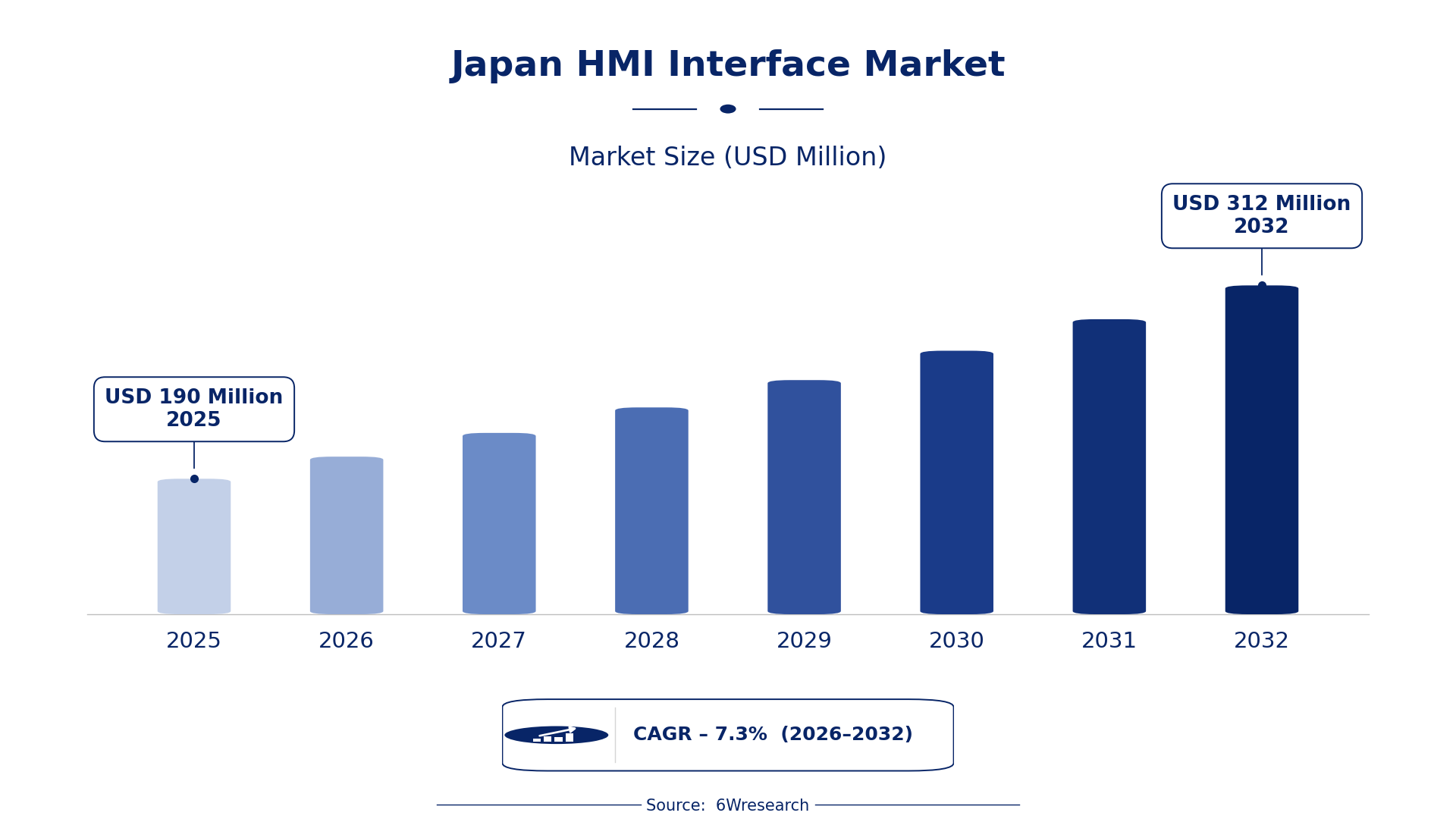
According to 6Wresearch internal database and industry insights, the Japan HMI Interface Market was valued at USD 190 Million in 2025 and is projected to reach USD 312 Million by 2032, growing at a CAGR of approximately 7.3% during 2026–2032.
Japan HMI Interface Market Highlights
| Report Metric | Details |
| Report Name | Japan HMI Interface Market (2026-2032) |
| Market Size 2025 | USD 190 Million |
| Market Size 2032 | USD 312 Million |
| Absolute Growth 2025–2032 | USD 122 Million |
| CAGR 2026–2032 | 7.3% |
| Peak Annual Growth | 9.0% in 2027 |
| Forecast Period | 2026–2032 |
| Historical Data | 2022–2025 |
| Base Year | 2025 |
| Leading Interface Type, 2025 | Touchscreen Panels (49% share) |
| Leading Input Type, 2025 | Resistive/Capacitive (38% share) |
| Leading Distribution Channel, 2025 | OEM Distributors (43% share) |
| Leading End User, 2025 | Industrial Automation Firms (42% share) |
| Fastest-Growing Interface Type | Rotary Controls (9.9% CAGR) |
| Fastest-Growing Input Type | Mechanical (10.5% CAGR) |
| Fastest-Growing Distribution Channel | Online Platforms (9.3% CAGR) |
| Fastest-Growing End User | Home Appliance OEMs (9.4% CAGR) |
| Growing Sector | Industrial Automation |
| Key End Users | Industrial Automation Firms, Home Appliance OEMs, Consumer Electronics Firms, Vehicle Dashboard Suppliers |
Japan HMI Interface Market Year-wise Growth Rate and Key Drivers (2022–2032)
This graph illustrates the annual growth rates of the market from 2022 to 2032, highlighting a steady upward trajectory and projected market expansion over the forecast period.
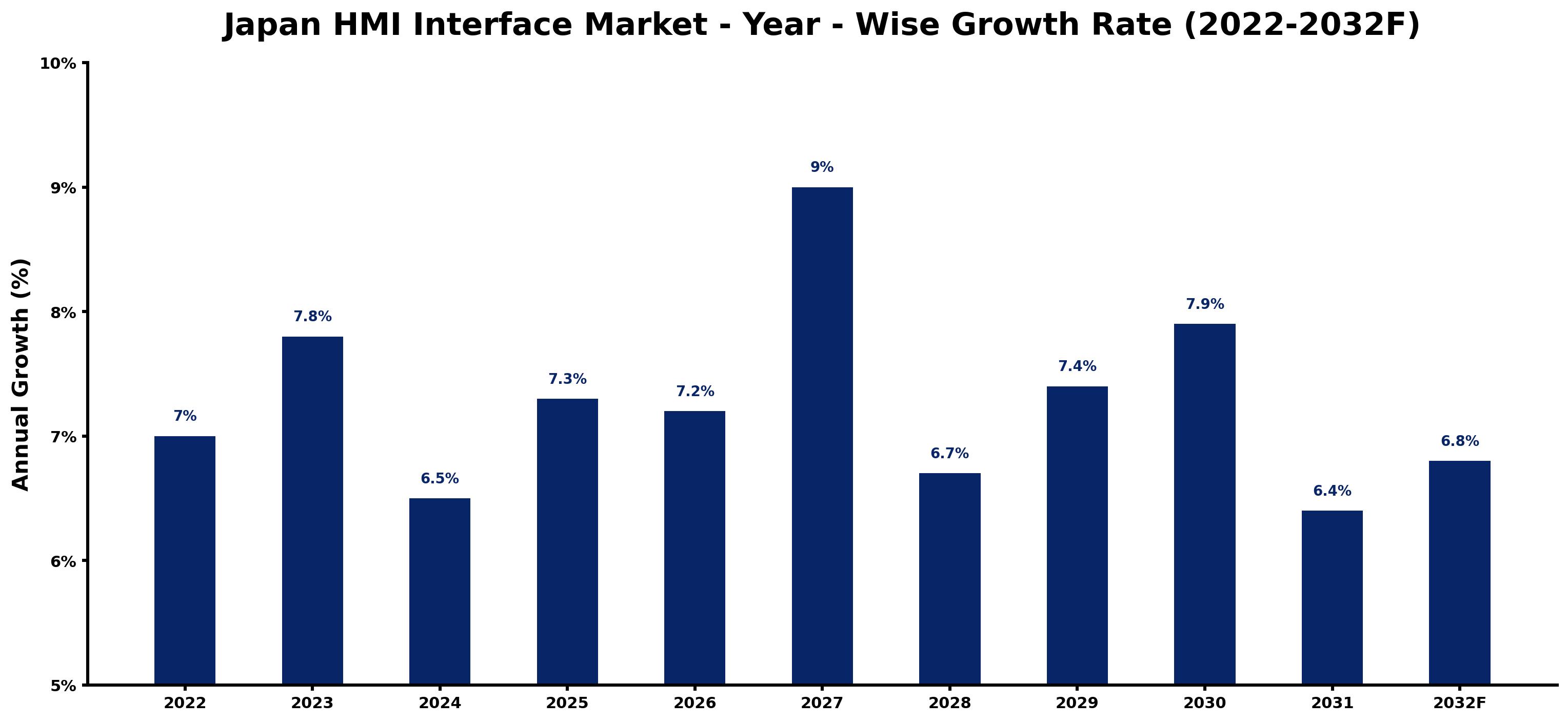
Each row of the following table gives one year's estimated growth and the event or demand shift that explains it.
| Year | Estimated Annual Growth (%) | Market Rationale |
| 2022 | 7.0 | The market exhibited solid growth, driven by strong demand from industrial automation sectors. |
| 2023 | 7.8 | Growth accelerated due to increased investment in smart manufacturing technologies. |
| 2024 | 6.5 | Growth slowed slightly as the market adjusted to previous high levels of demand. |
| 2025 | 7.3 | Demand rose again as industrial automation firms expanded their operations. |
| 2026 | 7.2 | A slight slowdown is expected as market saturation begins to influence growth rates. |
| 2027 | 9.0 | A surge in demand for touchscreen panels will lead to peak growth in the market. |
| 2028 | 6.7 | Growth is projected to decelerate as the market stabilises after the peak year. |
| 2029 | 7.4 | Demand will rebound as new applications for HMI interfaces emerge in various sectors. |
| 2030 | 7.9 | The market will see renewed interest from automotive manufacturers integrating advanced interfaces. |
| 2031 | 6.4 | Growth is expected to slow again as competition intensifies among HMI technology providers. |
| 2032 | 6.8 | Demand is expected to rise as consumer electronics firms adopt more sophisticated interfaces. |
Note: Market size estimations and growth projections presented in this report are based on 6Wresearch's proprietary forecasting methodology, utilizing the latest available industry data, government publications, and primary research inputs.
Japan HMI Interface Market Synopsis
HMI interfaces facilitate interaction between humans and machines through input methods like touchscreens and voice recognition. These systems are essential in industrial automation, consumer electronics, and home appliances. The Japan HMI Interface Market is expanding due to strong demand from industrial automation firms investing heavily in smart manufacturing technologies. The Tokyo region serves as a key hub for HMI development, with touchscreen panels accounting for over 50% of usage, highlighting a trend towards intuitive user interactions.
Market Dynamics Impact Analysis (2026–2032)
| Factor | Type | Impact | Primary Segment Affected |
| Increased investment in smart manufacturing technologies | Driver | High | Touchscreen Panels |
| Rising adoption of automation in various sectors | Driver | High | Rotary Controls |
| Growing demand for advanced user interfaces in consumer electronics | Opportunity | High | Voice Interface |
| Expansion of online sales channels for HMI products | Opportunity | Medium | Online Platforms |
| Market saturation in traditional manufacturing sectors | Restraint | High | Mechanical |
| High costs associated with advanced HMI technology development | Restraint | Medium | Button Interfaces |
| Challenges in integrating new technologies into existing systems | Challenge | High | Voice Interface |
| Intense competition among HMI technology providers | Challenge | Medium | Touchscreen Panels |
Evaluation of Drivers in Japan HMI Interface Market (2026–2032)
The table below links each growth driver to the segment it affects and the evidence for it.
| Drivers | Primary Segment Affected | Why It Matters (Evidence) |
| Investment in smart manufacturing technologies | Touchscreen Panels | This investment increases demand for intuitive interfaces, with touchscreen panels accounting for over 50% of usage in Japan. |
| Automation trends across industries | Rotary Controls | The automotive sector's demand for advanced interfaces drives the need for rotary controls in modern vehicles. |
| Rising consumer electronics adoption | Voice Interface | The growing integration of voice interfaces in home appliances has reached a 15% adoption rate, boosting demand. |
| Expansion of online sales channels | Online Platforms | Online sales of HMI products surged by 30% last year, reflecting changing purchasing behaviours. |
| Automotive sector's demand for advanced interfaces | Vehicle Dashboard Suppliers | The automotive industry is a major user of HMI technologies, enhancing dashboard interfaces for modern vehicles. |
Volumes grow on the back of increased investment in smart manufacturing technologies, which are estimated to reach 20 trillion JPY in Japan's industrial automation market. As industries adopt automation, demand for rotary controls rises, particularly in machinery applications. The consumer electronics sector is also expanding, with a 15% adoption rate for voice interfaces in home appliances. The automotive sector's demand for advanced interfaces in vehicle dashboards drives further growth in the market. These factors encourage manufacturers to innovate their HMI offerings.
Evaluation of Restraints in Japan HMI Interface Market
The table below lists the restraints and the evidence behind each.
| Market Restraint | Primary Segment Affected | Why It Matters (Evidence) |
| Market saturation in traditional manufacturing sectors | Mechanical | As traditional sectors reach saturation, demand for mechanical input devices declines, limiting growth opportunities. |
| High costs of advanced HMI technology development | Button Interfaces | The investment required for developing advanced button interfaces can deter smaller manufacturers from entering the market. |
| Integration challenges with existing systems | Voice Interface | Manufacturers face difficulties in integrating new voice technologies into established systems, slowing adoption. |
| Limited applications for emerging technologies | Natural Language AI | Current applications of natural language AI in industrial settings restrict its market growth potential. |
| Intense competition among HMI technology providers | Touchscreen Panels | High competition leads to price pressures, impacting profitability for manufacturers in the touchscreen panel segment. |
Japan HMI Interface Market Challenges
Producers in Japan's industrial automation sector face supply chain disruptions due to reliance on specific component imports, leading to production delays of up to three months. Technology adoption lags because of the slow integration of advanced systems, causing a 20% efficiency gap compared to global standards. Increased competition from international markets forces local manufacturers to lower prices, impacting profit margins by approximately 15%. Skills shortages in advanced HMI technologies create a talent gap, compelling companies to invest an additional 10% in training and recruitment costs.
Trends in the Japan HMI Interface Market
The following changes are redrawing the Japan HMI Interface Market.
- Launch of Smart Manufacturing Initiative: In 2023, a program was initiated to promote smart manufacturing, aiming to improve productivity in Japan's industrial sector. This initiative is expected to boost the adoption of HMI technologies, contributing to market growth.
- Shift Towards Online Sales Channels: Online platforms are becoming increasingly popular for purchasing HMI products, with a 30% rise in online sales last year. This trend reflects changing buyer preferences, making it essential for suppliers to adapt their distribution strategies.
- Rise of Voice Interfaces in Home Appliances: Voice interfaces are increasingly integrated into home appliances, with a 15% adoption rate. This trend indicates a growing demand for intuitive user interactions, prompting manufacturers to innovate their HMI offerings.
- Focus on Automotive HMI Technologies: The automotive sector is prioritising advanced HMI technologies for vehicle dashboards, reflecting a demand shift. This trend is driven by the need for improved user experiences in modern vehicles, with substantial investments in interface design.
Investment Opportunities in the Japan HMI Interface Market
The opportunities below stand out in the Japan HMI Interface Market for new entrants and existing suppliers.
- Joint Ventures in Smart Manufacturing: Partnering with local firms in Japan's industrial automation sector presents an opportunity, especially as the market is valued at approximately 20 trillion JPY. Collaborating with industrial automation firms can facilitate access to advanced technologies.
- Expansion in the Tokyo Region: The Tokyo region is a major hub for HMI technology development, offering opportunities for suppliers to establish a presence. With a growing market, firms can benefit from local partnerships and innovation initiatives.
- Investment in Voice Interface Development: With a 15% adoption rate for voice interfaces in home appliances, there is a clear gap for investment in this technology. Collaborating with home appliance OEMs can help suppliers tap into this growing demand.
- Focus on Online Sales Strategies: The surge in online sales, which increased by 30% last year, indicates a ripe opportunity for suppliers to enhance their e-commerce capabilities. Establishing online platforms can help reach a broader customer base.
Government Initiatives in the Japan HMI Interface Market
The Semiconductor and Digital Industry Strategy, established by the Ministry of Economy, Trade and Industry in June 2021, aims to secure domestic semiconductor manufacturing, which is vital for HMI technology. The Green Growth Strategy, updated in 2021, identifies growth sectors, including HMI technologies, as key to achieving carbon neutrality by 2050.
The Ministry of Economy, Trade and Industry approves funding for projects that support HMI technology integration in manufacturing. In 2023, a government initiative was announced to promote AI integration in industrial automation, aiding firms that innovate within this space.
Future Insight of the Japan HMI Interface Market
Investment in smart manufacturing will create heightened demand for advanced HMI technologies by 2032, particularly in the automotive sector for dashboard interfaces. The government initiative to enhance AI integration in industrial automation will drive the development of more sophisticated systems. Compliance with ISO 9241 will become essential, ensuring improved usability across all applications. Online sales of HMI products are expected to rise by 30% as digital platforms expand.
Market Segmentation Analysis
Japan HMI Interface Market report covers a detailed analysis of the following market segments:
By Interface Type – Touchscreen Panels Lead, Rotary Controls Expected to Grow Fastest
According to Saurav Kr Singh, Senior Research Analyst at 6Wresearch, Touchscreen Panels held 49% of the Japan HMI Interface Market by interface type in 2025. Touchscreen panels hold the largest share due to their intuitive interaction capabilities, particularly in industrial automation and consumer electronics. Their extensive use is highlighted by the Tokyo region, a key area for HMI technology development. Rotary Controls are projected to grow fastest, at a CAGR of 9.9% during 2026–2032. Rotary controls are experiencing rapid growth as they provide precise control in machinery and appliances, which is crucial for various sectors. The increasing complexity of machinery is driving this trend, with notable integration in advanced systems. Suppliers should enhance rotary control offerings to capture the growing interest in precise user interfaces.
By Input Type – Resistive/Capacitive Leads, Mechanical Expected to Grow Fastest
In 2025, Resistive/Capacitive led the input type split with a 38% share. Resistive and capacitive input types are crucial for touchscreen functionality, widely employed across diverse applications in the market. Their prevalence is driven by the high demand for touchscreens in both industrial and consumer markets. Mechanical is set to record the highest CAGR in this split, 10.5% over 2026–2032. Mechanical input types are gaining traction due to their tactile feedback, which is highly valued in numerous applications. The renewed interest in traditional controls reflects manufacturers' pursuit of reliable user interaction solutions. Buyers may benefit from exploring mechanical options to complement their existing HMI systems and enhance user experience.
By Distribution Channel – OEM Distributors Lead, Online Platforms Expected to Grow Fastest
With 43% of distribution channel revenue in 2025, OEM Distributors was the largest category. OEM distributors are vital for supplying HMI components to manufacturers, ensuring a consistent flow of products to meet market demands. Their established networks and relationships with manufacturers reinforce their leading position in distribution. Over 2026–2032, Online Platforms are expected to post the fastest growth, at a CAGR of 9.3%. Online platforms are rapidly becoming a preferred channel for purchasing HMI products, as evidenced by a 30% increase in online sales over the past year. This shift highlights changing consumer preferences towards convenience and accessibility in procurement. Suppliers should enhance their online presence to tap into the growing trend of digital purchasing among customers.
By End User – Industrial Automation Firms Lead, Home Appliance OEMs Expected to Grow Fastest
Industrial Automation Firms accounted for 42% of the market by end user in 2025. Industrial automation firms are the primary users of HMI technology, extensively utilising it in manufacturing processes to boost efficiency. Their substantial investment in automation solutions underscores their dominant market position. The quickest growth will come from Home Appliance OEMs, forecast to expand at a CAGR of 9.4% between 2026 and 2032. Home appliance OEMs are increasingly integrating HMI technologies to improve user interaction in consumer products, reflecting a shift towards smarter appliances. This trend is likely to accelerate as consumer demand for advanced features continues to rise. Suppliers should target home appliance OEMs to capitalise on the growing integration of HMI technologies in consumer products.
Key Attractiveness of the Report
- 10 Years of Market Numbers
- Historical Data Starting from 2022 to 2025
- Base Year 2025
- Forecast Data until 2032
- Key Performance Indicators Impacting the Market
- Major Upcoming Developments and Projects
Key Highlights of the Report:
- Japan HMI Interface Market Outlook
- Market Size of Japan HMI Interface Market, 2025
- Forecast of Japan HMI Interface Market, 2032
- Historical Data and Forecast of Japan HMI Interface Revenues & Volume for the Period 2022-2032F
- Japan HMI Interface Market Trend Evolution
- Japan HMI Interface Market Drivers and Challenges
- Japan HMI Interface Price Trends
- Japan HMI Interface Porter's Five Forces
- Japan HMI Interface Industry Life Cycle
- Historical Data and Forecast of Japan HMI Interface Market Revenues & Volume By Interface Type for the Period 2022-2032F
- Historical Data and Forecast of Japan HMI Interface Market Revenues & Volume By Touchscreen Panels for the Period 2022-2032F
- Historical Data and Forecast of Japan HMI Interface Market Revenues & Volume By Rotary Controls for the Period 2022-2032F
- Historical Data and Forecast of Japan HMI Interface Market Revenues & Volume By Voice Interface for the Period 2022-2032F
- Historical Data and Forecast of Japan HMI Interface Market Revenues & Volume By Button Interfaces for the Period 2022-2032F
- Historical Data and Forecast of Japan HMI Interface Market Revenues & Volume By Input Type for the Period 2022-2032F
- Historical Data and Forecast of Japan HMI Interface Market Revenues & Volume By Resistive/Capacitive for the Period 2022-2032F
- Historical Data and Forecast of Japan HMI Interface Market Revenues & Volume By Mechanical for the Period 2022-2032F
- Historical Data and Forecast of Japan HMI Interface Market Revenues & Volume By Natural Language AI for the Period 2022-2032F
- Historical Data and Forecast of Japan HMI Interface Market Revenues & Volume By Manual for the Period 2022-2032F
- Historical Data and Forecast of Japan HMI Interface Market Revenues & Volume By Distribution Channel for the Period 2022-2032F
- Historical Data and Forecast of Japan HMI Interface Market Revenues & Volume By OEM Distributors for the Period 2022-2032F
- Historical Data and Forecast of Japan HMI Interface Market Revenues & Volume By Online Platforms for the Period 2022-2032F
- Historical Data and Forecast of Japan HMI Interface Market Revenues & Volume By Specialty Distributors for the Period 2022-2032F
- Historical Data and Forecast of Japan HMI Interface Market Revenues & Volume By Direct Sales for the Period 2022-2032F
- Historical Data and Forecast of Japan HMI Interface Market Revenues & Volume By End User for the Period 2022-2032F
- Historical Data and Forecast of Japan HMI Interface Market Revenues & Volume By Industrial Automation Firms for the Period 2022-2032F
- Historical Data and Forecast of Japan HMI Interface Market Revenues & Volume By Home Appliance OEMs for the Period 2022-2032F
- Historical Data and Forecast of Japan HMI Interface Market Revenues & Volume By Consumer Electronics Firms for the Period 2022-2032F
- Historical Data and Forecast of Japan HMI Interface Market Revenues & Volume By Vehicle Dashboard Suppliers for the Period 2022-2032F
- Japan HMI Interface Import Export Trade Statistics
- Market Opportunity Assessment By Interface Type
- Market Opportunity Assessment By Input Type
- Market Opportunity Assessment By Distribution Channel
- Market Opportunity Assessment By End User
- Japan HMI Interface Top Companies Market Share
- Japan HMI Interface Competitive Benchmarking By Technical and Operational Parameters
- Japan HMI Interface Company Profiles
- Japan HMI Interface Key Strategic Recommendations
Market Covered
The study includes the following segmentation.
By Interface Type
- Touchscreen Panels
- Rotary Controls
- Voice Interface
- Button Interfaces
By Input Type
- Resistive/Capacitive
- Mechanical
- Natural Language AI
- Manual
By Distribution Channel
- OEM Distributors
- Online Platforms
- Specialty Distributors
- Direct Sales
By End User
- Industrial Automation Firms
- Home Appliance OEMs
- Consumer Electronics Firms
- Vehicle Dashboard Suppliers































