Japan Home Automation Products Market Size & Growth Rate
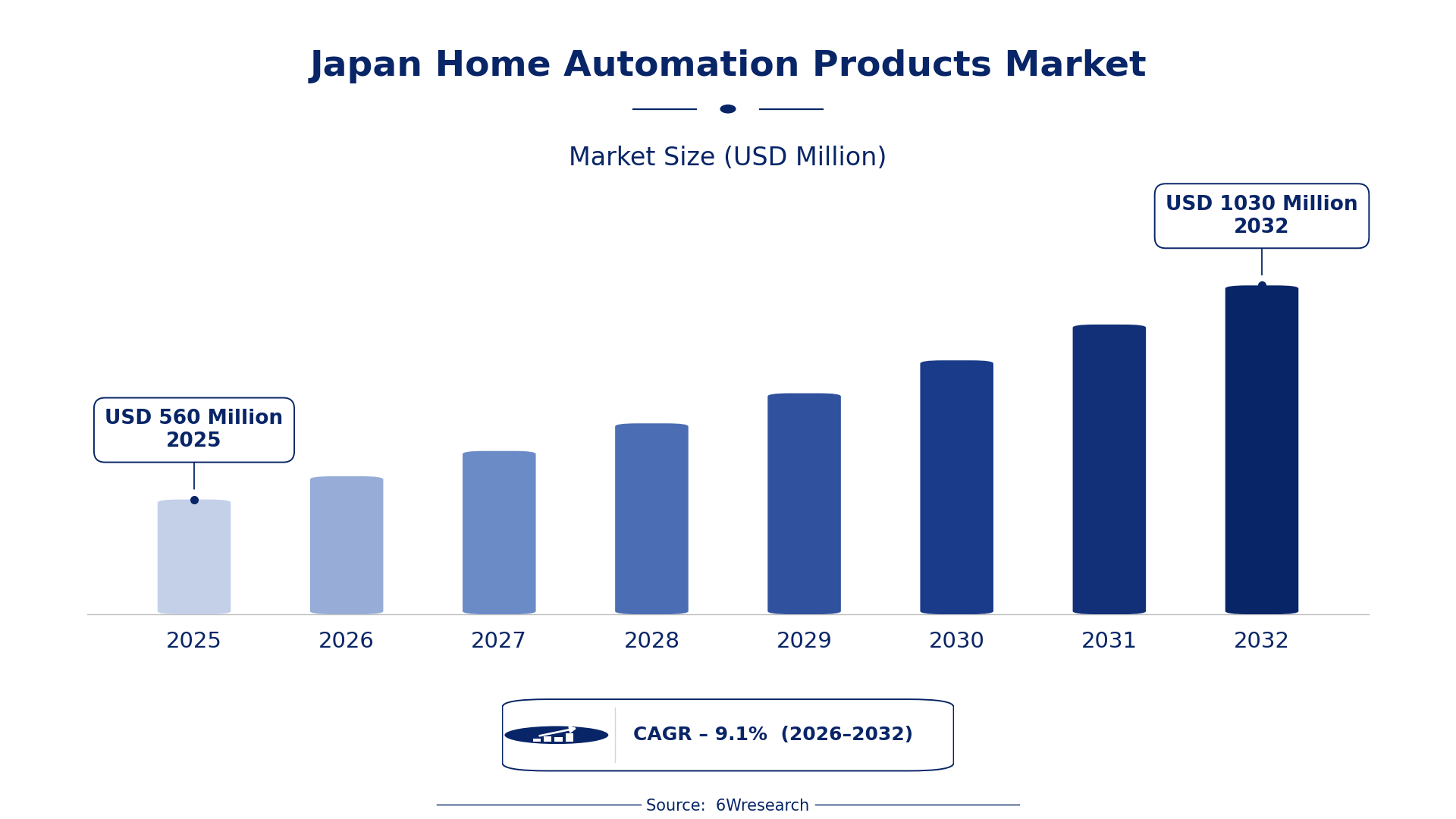
According to 6Wresearch internal database and industry insights, the Japan Home Automation Products Market was valued at USD 560 Million in 2025 and is projected to reach USD 1,030 Million by 2032, growing at a CAGR of approximately 9.1% during 2026–2032.
Japan Home Automation Products Market Highlights
| Report Metric | Details |
| Report Name | Japan Home Automation Products Market (2026-2032) |
| Market Size 2025 | USD 560 Million |
| Market Size 2032 | USD 1,030 Million |
| Absolute Growth 2025–2032 | USD 470 Million |
| CAGR 2026–2032 | 9.1% |
| Peak Annual Growth | 10.0% in 2032 |
| Forecast Period | 2026–2032 |
| Historical Data | 2022–2025 |
| Base Year | 2025 |
| Leading Product Type, 2025 | Smart Lighting (40% share) |
| Leading Connectivity Standard, 2025 | Zigbee/Z-Wave (44% share) |
| Leading Distribution Channel, 2025 | Online Platforms (39% share) |
| Leading End User, 2025 | Homeowners (51% share) |
| Fastest-Growing Product Type | Smart Thermostats (14.0% CAGR) |
| Fastest-Growing Connectivity Standard | Wi-Fi/Bluetooth (12.4% CAGR) |
| Fastest-Growing Distribution Channel | OEM Supply Chains (12.1% CAGR) |
| Fastest-Growing End User | Green Homes (12.2% CAGR) |
| Growing Sector | Residential Automation |
| Key End Users | Homeowners, Urban Residents, Green Homes |
Japan Home Automation Products Market Year-wise Growth Rate and Key Drivers (2022–2032)
This graph illustrates the annual growth rates of the market from 2022 to 2032, highlighting a steady upward trajectory and projected market expansion over the forecast period.
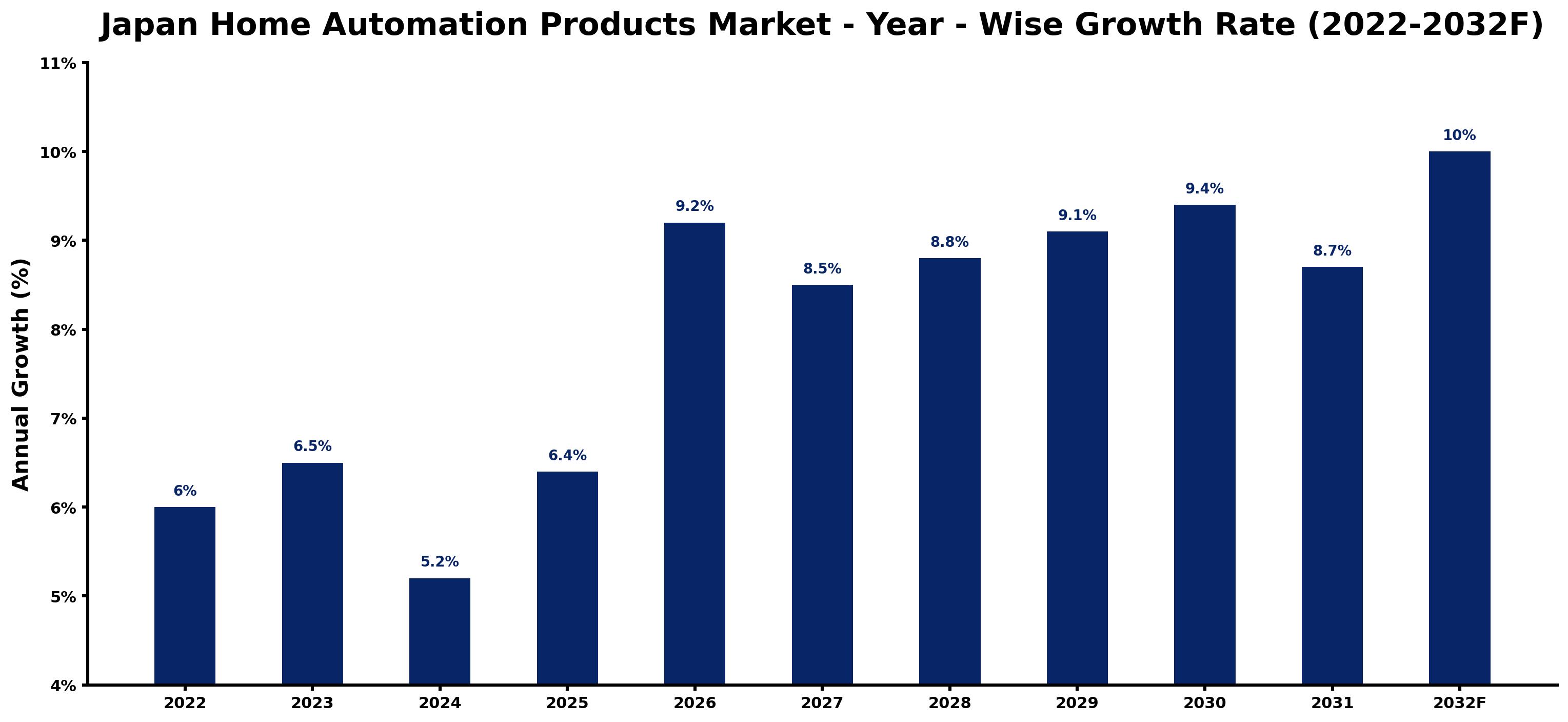
Year by year, the estimates below pair each growth rate with the development that shaped it.
| Year | Estimated Annual Growth (%) | Market Rationale |
| 2022 | 6.0 | The market experienced steady demand from homeowners seeking modern solutions. |
| 2023 | 6.5 | Growth accelerated due to increased interest in smart home technology among urban residents. |
| 2024 | 5.2 | Growth slowed as market saturation began to impact new installations. |
| 2025 | 6.4 | Demand rose again with more homeowners adopting energy-efficient devices. |
| 2026 | 9.2 | The market is expected to see a boost from rising investments in smart technologies. |
| 2027 | 8.5 | Growth is projected to slow slightly as competition intensifies among product offerings. |
| 2028 | 8.8 | Demand is expected to increase as more urban residents seek automation for convenience. |
| 2029 | 9.1 | The market will continue to grow with heightened awareness of energy management. |
| 2030 | 9.4 | Growth is projected to accelerate further due to advancements in connectivity standards. |
| 2031 | 8.7 | The market is expected to experience a slight slowdown as consumer preferences evolve. |
| 2032 | 10.0 | Demand will peak as smart home technology becomes mainstream in households. |
Note: Market size estimations and growth projections presented in this report are based on 6Wresearch's proprietary forecasting methodology, utilizing the latest available industry data, government publications, and primary research inputs.
Japan Home Automation Products Market Synopsis
Home automation products are smart devices that improve convenience and energy efficiency in residential settings, including smart thermostats and sensors. The Japan Home Automation Products Market is expanding, driven by urban residents' interest in smart technology and a growing emphasis on energy management. With over 60% of urban residents expressing interest in smart home technology and targeted investments in decarbonisation initiatives, the market reflects strong demand for modern living solutions.
Market Dynamics Impact Analysis (2026–2032)
| Factor | Type | Impact | Primary Segment Affected |
| Increased interest in energy-efficient solutions | Driver | High | Smart Thermostats |
| Rising urban population seeking modern living solutions | Driver | High | Smart Lighting |
| Growing demand for eco-friendly homes | Opportunity | High | Green Homes |
| Expansion of online sales channels | Opportunity | Medium | Online Platforms |
| High installation costs for automation systems | Restraint | High | Smart Sensors |
| Market saturation impacting new installations | Restraint | Medium | Smart Plugs |
| Cost pressures from rising material prices | Challenge | High | Smart Lighting |
| Compliance with stringent quality standards | Challenge | Medium | Smart Thermostats |
Evaluation of Drivers in Japan Home Automation Products Market (2026–2032)
Key forces behind demand, with the segment each one moves most, are listed below.
| Drivers | Primary Segment Affected | Why It Matters (Evidence) |
| Increased adoption of energy-efficient devices | Smart Thermostats | The estimated 2 million smart thermostat installations reflect homeowners' focus on energy savings. |
| Urban population growth driving demand | Smart Lighting | With approximately 37 million urban residents, there is a strong push for smart lighting solutions. |
| Interest in sustainable living | Green Homes | The anticipated doubling of green homes by 2025 indicates a shift towards eco-friendly solutions. |
| Expansion of online sales channels | Online Platforms | Online platforms accounted for 40% of home automation product sales in Japan. |
| Technological advancements in connectivity | Zigbee/Z-Wave | Zigbee/Z-Wave standards are essential for device communication, improving smart home integration. |
Volumes grow due to increased adoption of energy-efficient devices, with 2 million smart thermostat installations reflecting a focus on savings. The anticipated doubling of green homes by 2025 indicates a shift towards eco-friendly solutions, while online platforms, accounting for 40% of sales, expand access to smart products. Urban population growth fuels demand for smart lighting solutions, as approximately 37 million urban residents seek modern living options. Technological advancements in connectivity improve integration, further boosting market growth.
Evaluation of Restraints in Japan Home Automation Products Market
The main factors holding the market back are set out below.
| Market Restraint | Primary Segment Affected | Why It Matters (Evidence) |
| High installation costs for automation systems | Smart Sensors | The average installation cost of around 200,000 JPY limits adoption among budget-conscious homeowners. |
| Market saturation impacting new installations | Smart Plugs | As the market matures, growth in smart plug installations has slowed to 15% annually. |
| Cost pressures from rising material prices | Smart Lighting | Increased costs for components affect pricing strategies and consumer willingness to invest. |
| Compliance with stringent quality standards | Smart Thermostats | JIS standards impose additional testing and certification costs on manufacturers. |
| Limited awareness of automation benefits | Smart Sensors | Some homeowners remain unaware of the advantages of smart sensors for security. |
Japan Home Automation Products Market Challenges
In 2023, supply chain disruptions lead to delays in product availability, impacting over 500 registered dealers who rely on timely access to components. Installation costs have surged to around 200,000 JPY, straining budgets for urban residents eager to modernise their homes. Despite over 60% of urban residents expressing interest in smart home technology, the adoption rate remains only 25%, reflecting a gap between interest and actual purchases. Regulatory compliance with standards like JIS adds extra costs for suppliers, limiting options for buyers and discouraging new market entrants.
Trends in the Japan Home Automation Products Market
Below are the shifts with the largest effect on the Japan Home Automation Products Market.
- Tokyo's Urban Development Initiatives: Tokyo's urban development initiatives stimulate demand for smart home solutions, with over 60% of urban residents expressing interest in smart technology. This trend drives innovation and adoption of home automation products.
- Rise of Online Sales Channels: In 2023, online platforms accounted for 40% of home automation product sales, reflecting a shift in consumer purchasing behaviour towards digital channels. This trend benefits suppliers by expanding their market reach.
- Growing Adoption of Smart Thermostats: The number of smart thermostat installations in Japan is estimated at 2 million units, indicating a shift towards energy management solutions. This growth highlights the increasing demand for automation in homes.
- Focus on Green Homes: Green homes in Japan are expected to double by 2025, driven by consumer interest in sustainability. This trend presents opportunities for suppliers of eco-friendly home automation products.
Investment Opportunities in the Japan Home Automation Products Market
The openings below show where demand in the Japan Home Automation Products Market is visible and how suppliers can enter.
- Tokyo's Urban Development: Tokyo's urban development initiatives create a demand for smart home solutions, with significant investments in energy-efficient technologies. Suppliers can enter through partnerships with local builders.
- Supply of Smart Sensors: The growing need for security solutions drives demand for smart sensors, with an annual growth rate of 15%. Suppliers can target homeowners seeking improved safety features.
- Investment in Energy Management Products: Japan targets a 46% cut in greenhouse-gas emissions by 2030, creating a demand for energy management products. Suppliers can engage with homeowners focused on sustainability.
- Expansion of Home Automation Dealers: With over 500 registered home automation dealers nationwide, there is an opportunity for suppliers to collaborate with these experts to reach more consumers effectively.
Government Initiatives in the Japan Home Automation Products Market
The GX Promotion Act (2023) impacts buyers of home automation products by establishing a legal framework for decarbonisation efforts. This act aims for a 46% reduction in greenhouse gas emissions from fiscal 2013 levels by fiscal 2030, promoting energy-efficient technologies in residential settings. As a result, buyers can access incentives for adopting smart home solutions that align with sustainability goals, improving energy management and reducing costs.
The Ministry of the Environment plays a crucial role in implementing green home initiatives by providing subsidies for energy-efficient upgrades. This agency supports projects aimed at improving home automation technologies, with funding allocated to promote the adoption of smart devices. The ongoing support for the 'Smart House' initiative facilitates access to financial resources, encouraging homeowners to invest in modern living solutions that improve energy efficiency.
Future Insight of the Japan Home Automation Products Market
The upcoming 'Smart House' initiative will drive the development of energy-efficient homes, increasing market potential. By 2032, the installed base of smart home devices will exceed 10 million units, indicating a shift towards greater consumer acceptance. The 'Cool Choice' program will further encourage the adoption of energy-saving technologies, appealing to urban residents. As green homes are projected to double by 2025, suppliers must adapt their offerings to meet evolving energy management standards.
Market Segmentation Analysis
Japan Home Automation Products Market report covers a detailed analysis of the following market segments:
By Product Type – Smart Lighting Leads, Smart Thermostats Expected to Grow Fastest
According to Saurav Kr Singh, Senior Research Analyst at 6Wresearch, Smart Lighting held 40% of the Japan Home Automation Products Market by product type in 2025. Smart Lighting holds the largest share as it is widely employed for energy-efficient illumination and ambiance control in homes. The integration of these solutions aligns with the government's push for energy efficiency, appealing to a growing base of environmentally conscious homeowners. Over 2026–2032, Smart Thermostats are expected to post the fastest growth, at a CAGR of 14.0%. Smart Thermostats are experiencing rapid growth due to their ability to efficiently manage heating and cooling, which translates into significant energy savings. With an estimated 2 million units installed, this trend indicates a strong consumer shift towards energy management solutions, likely to continue as awareness rises. Suppliers should prioritise the development of smart thermostats to meet the increasing demand for energy-efficient home solutions.
By Connectivity Standard – Zigbee/Z-Wave Leads, Wi-Fi/Bluetooth Expected to Grow Fastest
With 44% of connectivity standard revenue in 2025, Zigbee/Z-Wave was the largest category. Zigbee/Z-Wave dominates the market because it is essential for effective device communication in smart homes, facilitating seamless integration of various automation products. Its widespread acceptance among manufacturers positions it as the preferred standard for homeowners seeking reliable automation solutions. Wi-Fi/Bluetooth is set to record the highest CAGR in this split, 12.4% over 2026–2032. Wi-Fi/Bluetooth is rapidly gaining traction due to its prevalent use for connectivity in home automation, appealing to tech-savvy consumers. The familiarity and convenience of these standards resonate with the rising interest in smart home technology among urban residents. Manufacturers should focus on ensuring compatibility with Wi-Fi/Bluetooth to align with consumer preferences and expand market reach.
By Distribution Channel – Online Platforms Lead, OEM Supply Chains Expected to Grow Fastest
The largest distribution channel category in 2025 was Online Platforms, at 39% of revenue. Online Platforms dominate the distribution channel as they serve as the primary avenue for purchasing smart home devices. The convenience and accessibility of online shopping cater well to the tech-savvy homeowner demographic, driving sales in this segment. The quickest growth will come from OEM Supply Chains, forecast to expand at a CAGR of 12.1% between 2026 and 2032. OEM Supply Chains are growing quickly as they facilitate the manufacturing and distribution of products in the home automation sector. The increase in registered dealers highlights a rising demand for efficient supply chain solutions to meet market needs. Suppliers must strengthen partnerships with OEMs to ensure efficient product distribution and effectively respond to market demand.
By End User – Homeowners Lead, Green Homes Expected to Grow Fastest
Homeowners accounted for 51% of the market by end user in 2025. Homeowners constitute the largest end user group, driven by their primary role as consumers of home automation products seeking enhanced convenience and energy efficiency. The increasing population of tech-savvy homeowners significantly bolsters this segment's prominence in the market. Green Homes are projected to grow fastest, at a CAGR of 12.2% during 2026–2032. Green Homes are witnessing rapid growth as they prioritise sustainability and energy efficiency, aligning with Japan's environmental goals. The government's backing for green home initiatives further propels this segment, reflecting a shift in consumer preferences towards eco-friendly solutions. Suppliers should tailor their offerings to cater to the rising demand for sustainable home automation solutions.
Key Attractiveness of the Report
- 10 Years of Market Numbers
- Historical Data Starting from 2022 to 2025
- Base Year 2025
- Forecast Data until 2032
- Key Performance Indicators Impacting the Market
- Major Upcoming Developments and Projects
Key Highlights of the Report:
- Japan Home Automation Products Market Outlook
- Market Size of Japan Home Automation Products Market, 2025
- Forecast of Japan Home Automation Products Market, 2032
- Historical Data and Forecast of Japan Home Automation Products Revenues & Volume for the Period 2022-2032F
- Japan Home Automation Products Market Trend Evolution
- Japan Home Automation Products Market Drivers and Challenges
- Japan Home Automation Products Price Trends
- Japan Home Automation Products Porter's Five Forces
- Japan Home Automation Products Industry Life Cycle
- Historical Data and Forecast of Japan Home Automation Products Market Revenues & Volume By Product Type for the Period 2022-2032F
- Historical Data and Forecast of Japan Home Automation Products Market Revenues & Volume By Smart Lighting for the Period 2022-2032F
- Historical Data and Forecast of Japan Home Automation Products Market Revenues & Volume By Smart Thermostats for the Period 2022-2032F
- Historical Data and Forecast of Japan Home Automation Products Market Revenues & Volume By Smart Plugs for the Period 2022-2032F
- Historical Data and Forecast of Japan Home Automation Products Market Revenues & Volume By Smart Sensors for the Period 2022-2032F
- Historical Data and Forecast of Japan Home Automation Products Market Revenues & Volume By Connectivity Standard for the Period 2022-2032F
- Historical Data and Forecast of Japan Home Automation Products Market Revenues & Volume By Zigbee/Z-Wave for the Period 2022-2032F
- Historical Data and Forecast of Japan Home Automation Products Market Revenues & Volume By Wi-Fi/Bluetooth for the Period 2022-2032F
- Historical Data and Forecast of Japan Home Automation Products Market Revenues & Volume By App Controlled for the Period 2022-2032F
- Historical Data and Forecast of Japan Home Automation Products Market Revenues & Volume By Motion & Temp-Based for the Period 2022-2032F
- Historical Data and Forecast of Japan Home Automation Products Market Revenues & Volume By Distribution Channel for the Period 2022-2032F
- Historical Data and Forecast of Japan Home Automation Products Market Revenues & Volume By Online Platforms for the Period 2022-2032F
- Historical Data and Forecast of Japan Home Automation Products Market Revenues & Volume By OEM Supply Chains for the Period 2022-2032F
- Historical Data and Forecast of Japan Home Automation Products Market Revenues & Volume By Retail Stores for the Period 2022-2032F
- Historical Data and Forecast of Japan Home Automation Products Market Revenues & Volume By Home Automation Dealers for the Period 2022-2032F
- Historical Data and Forecast of Japan Home Automation Products Market Revenues & Volume By End User for the Period 2022-2032F
- Historical Data and Forecast of Japan Home Automation Products Market Revenues & Volume By Homeowners for the Period 2022-2032F
- Historical Data and Forecast of Japan Home Automation Products Market Revenues & Volume By Green Homes for the Period 2022-2032F
- Historical Data and Forecast of Japan Home Automation Products Market Revenues & Volume By Urban Residents for the Period 2022-2032F
- Historical Data and Forecast of Japan Home Automation Products Market Revenues & Volume By Residential Apartments for the Period 2022-2032F
- Japan Home Automation Products Import Export Trade Statistics
- Market Opportunity Assessment By Product Type
- Market Opportunity Assessment By Connectivity Standard
- Market Opportunity Assessment By Distribution Channel
- Market Opportunity Assessment By End User
- Japan Home Automation Products Top Companies Market Share
- Japan Home Automation Products Competitive Benchmarking By Technical and Operational Parameters
- Japan Home Automation Products Company Profiles
- Japan Home Automation Products Key Strategic Recommendations
Market Covered
The report covers the following segments.
By Product Type
- Smart Lighting
- Smart Thermostats
- Smart Plugs
- Smart Sensors
By Connectivity Standard
- Zigbee/Z-Wave
- Wi-Fi/Bluetooth
- App Controlled
- Motion & Temp-Based
By Distribution Channel
- Online Platforms
- OEM Supply Chains
- Retail Stores
- Home Automation Dealers
By End User
- Homeowners
- Green Homes
- Urban Residents
- Residential Apartments































