Japan Home Healthcare Equipment Market Size & Growth Rate
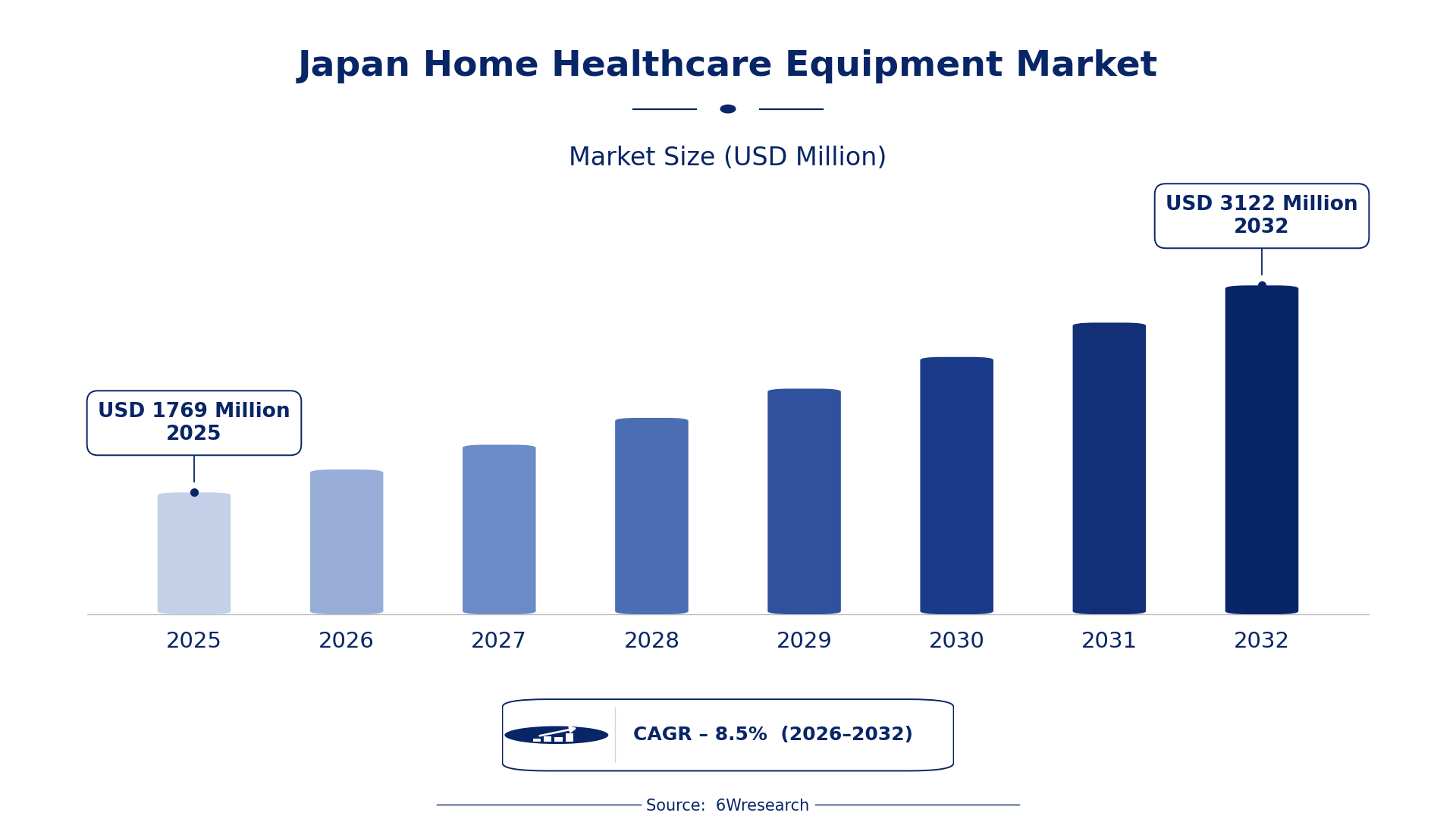
According to 6Wresearch internal database and industry insights, the Japan Home Healthcare Equipment Market was valued at USD 1,769 Million in 2025 and is projected to reach USD 3,122 Million by 2032, growing at a CAGR of approximately 8.5% during 2026–2032.
Japan Home Healthcare Equipment Market Highlights
| Report Metric | Details |
| Report Name | Japan Home Healthcare Equipment Market (2026-2032) |
| Market Size 2025 | USD 1,769 Million |
| Market Size 2032 | USD 3,122 Million |
| Absolute Growth 2025–2032 | USD 1,353 Million |
| CAGR 2026–2032 | 8.5% |
| Peak Annual Growth | 9.2% in 2029 |
| Forecast Period | 2026–2032 |
| Historical Data | 2022–2025 |
| Base Year | 2025 |
| Leading Equipment Type, 2025 | Beds & Wheelchairs (51% share) |
| Leading Purpose, 2025 | Mobility/Support (45% share) |
| Leading Distribution Channel, 2025 | Medical Equipment Stores (41% share) |
| Leading End User, 2025 | Home Hospitals (51% share) |
| Fastest-Growing Equipment Type | Monitoring Units (12.0% CAGR) |
| Fastest-Growing Purpose | Health Tracking (11.5% CAGR) |
| Fastest-Growing Distribution Channel | Online Medical Retail (11.1% CAGR) |
| Fastest-Growing End User | ICU Home Setups (10.9% CAGR) |
| Growing Sector | home healthcare services |
| Key End Users | elderly patients, home hospitals, healthcare providers, caregivers |
Japan Home Healthcare Equipment Market Year-wise Growth Rate and Key Drivers (2022–2032)
This graph illustrates the annual growth rates of the market from 2022 to 2032, highlighting a steady upward trajectory and projected market expansion over the forecast period.
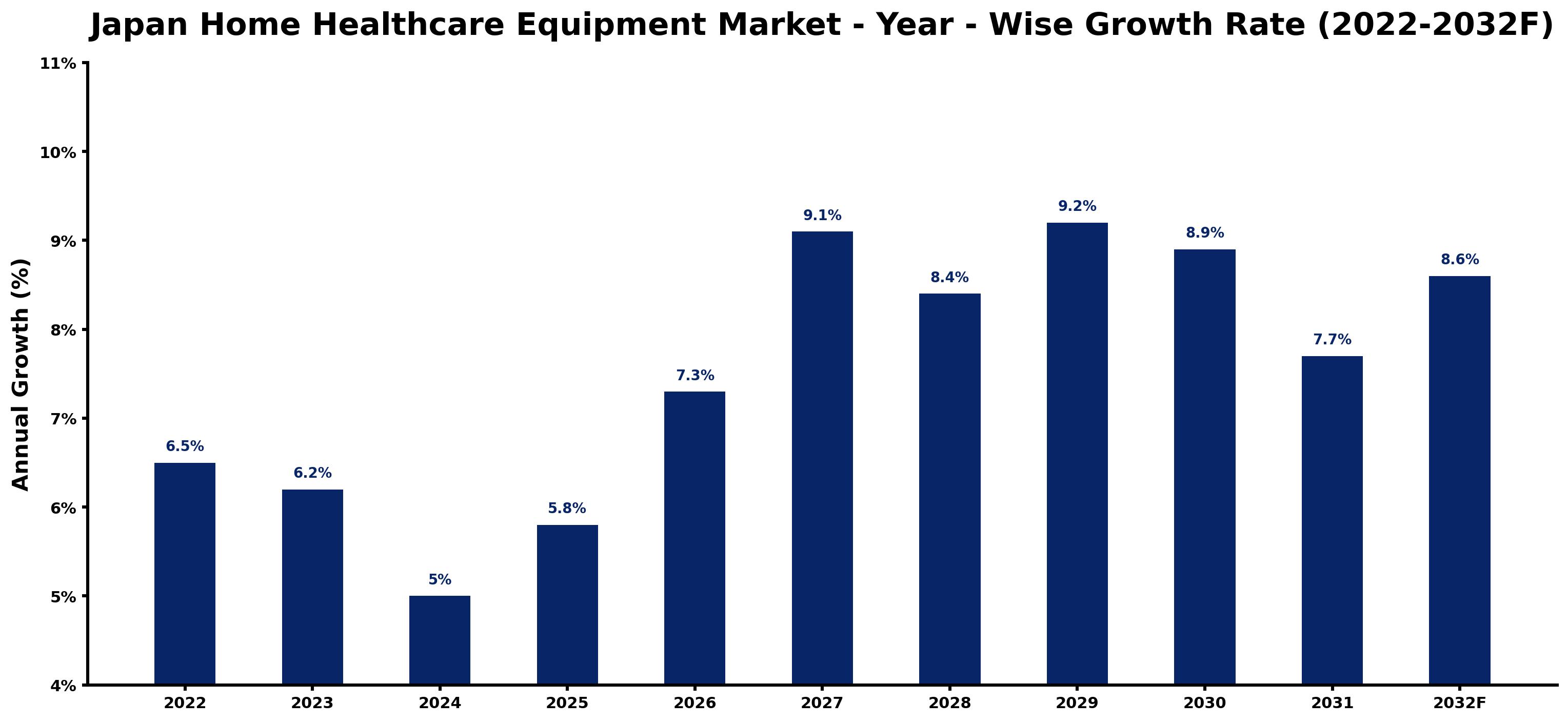
Below, each year's estimated growth is shown next to the factor that most influenced it.
| Year | Estimated Annual Growth (%) | Market Rationale |
| 2022 | 6.5 | The market experienced steady growth due to increased demand for patient care at home. |
| 2023 | 6.2 | Growth slowed as the market adjusted to changing consumer preferences and economic conditions. |
| 2024 | 5.0 | Demand continued to moderate as consumers became more selective in purchasing decisions. |
| 2025 | 5.8 | An increase in home healthcare service providers boosted market growth as more options became available. |
| 2026 | 7.3 | Growth is anticipated to accelerate as technological advancements improve the functionality of home healthcare equipment. |
| 2027 | 9.1 | Demand is projected to surge due to a rise in the elderly population requiring at-home care solutions. |
| 2028 | 8.4 | Growth will decelerate slightly as market saturation begins to affect new purchases. |
| 2029 | 9.2 | The market is expected to peak as innovations in health tracking devices drive consumer interest. |
| 2030 | 8.9 | Growth will moderate as competition intensifies among suppliers in the home healthcare sector. |
| 2031 | 7.7 | A slight slowdown is expected as the market stabilises following rapid previous growth. |
| 2032 | 8.6 | Demand is projected to rise again as the aging population continues to expand. |
Note: Market size estimations and growth projections presented in this report are based on 6Wresearch's proprietary forecasting methodology, utilizing the latest available industry data, government publications, and primary research inputs.
Japan Home Healthcare Equipment Market Synopsis
Home healthcare equipment includes devices designed for patient care at home, such as beds, wheelchairs, and monitoring units. The Japan Home Healthcare Equipment Market is growing, propelled by an aging population, with 28.4% of individuals aged 65 or older in 2023. Factors like technological advancements and an increase in home healthcare service providers are driving demand for at-home care solutions, greatly improving the quality of life for elderly patients.
Market Dynamics Impact Analysis (2026–2032)
| Factor | Type | Impact | Primary Segment Affected |
| Aging population drives demand for home healthcare equipment. | Driver | High | Mobility/Support |
| Technological advancements in health monitoring systems create new opportunities. | Driver | High | Monitoring Units |
| Growing online medical retail sales provide easier access to products. | Opportunity | High | Online Medical Retail |
| Expansion of home hospitals increases demand for specialized equipment. | Opportunity | Medium | Home Hospitals |
| High costs of advanced equipment can limit accessibility for some consumers. | Restraint | High | Infusion Pumps |
| Regulatory compliance can slow down product availability in the market. | Restraint | Medium | Medical Equipment Stores |
| Limited awareness about available home healthcare solutions restricts market growth. | Challenge | High | Health Tracking |
| Competition among suppliers can lead to price wars, affecting profitability. | Challenge | Medium | Patient Lifts |
Evaluation of Drivers in Japan Home Healthcare Equipment Market (2026–2032)
These are the developments adding the most demand over the forecast period.
| Drivers | Primary Segment Affected | Why It Matters (Evidence) |
| Increasing elderly population requiring at-home care solutions. | Mobility/Support | With 28.4% of the population aged 65 or older, there is a rising need for mobility aids. |
| Technological advancements in health monitoring devices improve functionality. | Monitoring Units | Integration with telemedicine solutions has increased demand for remote patient monitoring capabilities. |
| Expansion of home healthcare service providers improves access to equipment. | Infusion Pumps | Approximately 50,000 service providers in Japan facilitate the use of home healthcare devices. |
| Growth in online medical retail sales offers convenience for consumers. | Online Medical Retail | Sales grew by 20% in 2023, reflecting changing purchasing preferences towards online platforms. |
| Government support through insurance schemes boosts market confidence. | Home Hospitals | The Long-Term Care Insurance System financially supports home healthcare services, enhancing accessibility. |
Behind the steady rise in orders sits Japan's increasing elderly population, with 28.4% aged 65 or older in 2023, driving demand for mobility aids like wheelchairs and beds. The expansion of home healthcare service providers, approximately 50,000 in 2022, has improved access to essential equipment. Online medical retail sales surged by 20% in 2023, reflecting a shift towards more convenient purchasing options. Technological innovations in health monitoring devices, integrated with telemedicine, are improving remote patient care. Support through the Long-Term Care Insurance System is further encouraging investment in home healthcare solutions.
Evaluation of Restraints in Japan Home Healthcare Equipment Market
The following restraints limit how fast demand can grow.
| Market Restraint | Primary Segment Affected | Why It Matters (Evidence) |
| High costs of advanced home healthcare equipment limit consumer access. | Infusion Pumps | The average price of infusion pumps can reach JPY 500,000, making them unaffordable for many households. |
| Regulatory compliance can delay product launches in the market. | Medical Equipment Stores | Strict regulations under the Pharmaceutical and Medical Device Act require thorough testing before market entry, delaying availability. |
| Limited awareness of available home healthcare solutions restricts market growth. | Health Tracking | Many potential users lack knowledge about the benefits of health monitoring devices, hindering adoption. |
| Market saturation may slow down new equipment purchases. | Mobility/Support | As more options become available, consumers may delay purchasing decisions, leading to slower growth. |
| Economic fluctuations can impact consumer spending on healthcare equipment. | Patient Lifts | Economic downturns lead to reduced budgets for home healthcare expenditures, affecting sales. |
Japan Home Healthcare Equipment Market Challenges
Japan's national medical care expenditure reached JPY 46.7 trillion in fiscal 2022, straining budgets for hospitals acquiring home healthcare equipment. Rising costs compel buyers to postpone essential purchases, affecting patient care for the 1.5 million individuals receiving home healthcare services. Strict regulations hinder technology adoption, preventing clinics from implementing telemedicine solutions that could improve patient monitoring. Supply chain disruptions delay the timely delivery of equipment, leading to longer wait times for patients and increased operational challenges for healthcare providers.
Trends in the Japan Home Healthcare Equipment Market
Buyers and suppliers in the Japan Home Healthcare Equipment Market are adjusting to the following trends.
- Shift from Traditional to Online Purchasing: Consumers are increasingly choosing online medical retail for home healthcare equipment, with sales rising by 20% in 2023. This shift provides greater convenience and accessibility, influencing how suppliers connect with their customers.
- Integration of Telemedicine in Home Healthcare: Home healthcare monitoring units are increasingly being integrated with telemedicine solutions, enhancing remote consultations. This trend is evident as more patients choose at-home health tracking, reflecting a growing preference for convenience.
- Growing Demand for Specialized Home Hospitals: The number of certified home hospitals in Japan exceeds 1,000, meeting the rising demand for specialised at-home care. This trend indicates a movement towards more comprehensive care solutions for patients.
- Increased Focus on Health Tracking Technologies: Health tracking devices are becoming more popular, with a projected CAGR of 11.5% in the coming years. This trend is driven by the need for continuous monitoring of chronic conditions, improving patient care.
Investment Opportunities in the Japan Home Healthcare Equipment Market
Below are the investment opportunities with the strongest case in the Japan Home Healthcare Equipment Market.
- Investment in Telemedicine Integration: Investing in telemedicine integration for home healthcare equipment is timely, given the increasing need for remote consultations. The Tokyo Metropolitan Area serves as a key hub for such innovations, offering opportunities for partnerships.
- Supply of Mobility Aids for Elderly Care: There is a notable opportunity to supply mobility aids as the elderly population continues to grow. Home hospitals are expanding, creating demand for essential equipment to support patient mobility.
- Expansion of Online Medical Retail Channels: The rise in online medical retail sales presents an opportunity to invest in e-commerce platforms. Collaborating with medical equipment stores can facilitate entry into this expanding market segment.
- Development of Innovative Health Monitoring Devices: Now is the time to develop advanced health monitoring devices, as demand for continuous health tracking increases. The growing number of home healthcare service providers creates a market for sophisticated solutions.
Government Initiatives in the Japan Home Healthcare Equipment Market
The Elderly Care Promotion Act, enacted in 2023, significantly impacts buyers of home healthcare equipment by ensuring funding for services that improve at-home care for older individuals. This legislation enhances accessibility to necessary devices, making it easier for consumers to obtain essential equipment.
In 2023, the Japanese government allocated JPY 46.7 trillion for national medical care expenditure, overseen by the Ministry of Health, Labour and Welfare. This funding supports various healthcare initiatives, including home healthcare services, thereby improving the availability of necessary equipment for patients.
Future Insight of the Japan Home Healthcare Equipment Market
Home healthcare providers will increasingly adopt telemedicine solutions, improving remote monitoring capabilities for patients. The aging population, projected to account for 29.3% of Japan's total population by 2032, will heighten demand for home healthcare equipment. ISO 13485 will enforce rigorous quality standards, ensuring better outcomes for suppliers and patients alike. As the number of certified home hospitals increases, buyers will gain improved access to specialised care options, streamlining procurement processes and enhancing service delivery.
Market Segmentation Analysis
Japan Home Healthcare Equipment Market report covers a detailed analysis of the following market segments:
By Equipment Type – Beds & Wheelchairs Lead, Monitoring Units Expected to Grow Fastest
According to Saurav Kr Singh, Senior Research Analyst at 6Wresearch, Beds & Wheelchairs took 51% of equipment type revenue in 2025, more than any other category. Beds and wheelchairs hold the largest share as they are crucial for patient mobility and support in home settings. The reliance on these devices is evident, particularly among the elderly population who require assistance for daily activities. Monitoring Units are set to record the highest CAGR in this split, 12.0% over 2026–2032. Monitoring units are experiencing rapid growth due to their role in enabling continuous health tracking and remote consultations, which are increasingly desired by patients. The integration of these units with telemedicine solutions is driving their adoption in home healthcare. Suppliers should focus on expanding the availability of monitoring units to meet the growing demand for remote health management.
By Purpose – Mobility/Support Leads, Health Tracking Expected to Grow Fastest
Mobility/Support accounted for 45% of the market by purpose in 2025. Mobility and support products lead the market as they directly assist in patient mobility and independence, which is essential for the elderly demographic. This segment is vital for improving the quality of life for patients who need assistance at home. Over 2026–2032, Health Tracking is expected to post the fastest growth, at a CAGR of 11.5%. Health tracking is the fastest-growing purpose, fuelled by the increasing demand for continuous monitoring of patient health metrics. The rise of telemedicine has further accelerated the adoption of health tracking solutions in home care. Buyers should consider investing in health tracking solutions to provide comprehensive care for patients at home.
By Distribution Channel – Medical Equipment Stores Lead, Online Medical Retail Expected to Grow Fastest
In 2025, Medical Equipment Stores led the distribution channel split with a 41% share. Medical equipment stores are the primary source for purchasing home healthcare equipment, providing a wide range of essential products. Their established presence and expertise in the field make them a reliable choice for consumers seeking these devices. Online Medical Retail is projected to grow fastest, at a CAGR of 11.1% during 2026–2032. Online medical retail is rapidly growing as a distribution channel, with a reported 20% increase in 2023. This trend indicates a shift in consumer preferences towards convenient access to home healthcare products. Suppliers need to enhance their online presence to capture the growing segment of consumers who prefer digital purchasing options.
By End User – Home Hospitals Lead, ICU Home Setups Expected to Grow Fastest
With 51% of end user revenue in 2025, Home Hospitals was the largest category. Home hospitals lead the market as they provide care in a home-like environment, catering to patients who require ongoing support. Their established infrastructure and services make them a preferred choice for many families. The quickest growth will come from ICU Home Setups, forecast to expand at a CAGR of 10.9% between 2026 and 2032. ICU home setups are experiencing the fastest growth due to the rising demand for specialised care for critically ill patients at home. This shift towards at-home intensive care is reshaping the home healthcare sector. Providers should explore opportunities to develop ICU home setups to meet the needs of critically ill patients seeking care at home.
Key Attractiveness of the Report
- 10 Years of Market Numbers
- Historical Data Starting from 2022 to 2025
- Base Year 2025
- Forecast Data until 2032
- Key Performance Indicators Impacting the Market
- Major Upcoming Developments and Projects
Key Highlights of the Report:
- Japan Home Healthcare Equipment Market Outlook
- Market Size of Japan Home Healthcare Equipment Market, 2025
- Forecast of Japan Home Healthcare Equipment Market, 2032
- Historical Data and Forecast of Japan Home Healthcare Equipment Revenues & Volume for the Period 2022-2032F
- Japan Home Healthcare Equipment Market Trend Evolution
- Japan Home Healthcare Equipment Market Drivers and Challenges
- Japan Home Healthcare Equipment Price Trends
- Japan Home Healthcare Equipment Porter's Five Forces
- Japan Home Healthcare Equipment Industry Life Cycle
- Historical Data and Forecast of Japan Home Healthcare Equipment Market Revenues & Volume By Equipment Type for the Period 2022-2032F
- Historical Data and Forecast of Japan Home Healthcare Equipment Market Revenues & Volume By Beds & Wheelchairs for the Period 2022-2032F
- Historical Data and Forecast of Japan Home Healthcare Equipment Market Revenues & Volume By Patient Lifts for the Period 2022-2032F
- Historical Data and Forecast of Japan Home Healthcare Equipment Market Revenues & Volume By Infusion Pumps for the Period 2022-2032F
- Historical Data and Forecast of Japan Home Healthcare Equipment Market Revenues & Volume By Monitoring Units for the Period 2022-2032F
- Historical Data and Forecast of Japan Home Healthcare Equipment Market Revenues & Volume By Purpose for the Period 2022-2032F
- Historical Data and Forecast of Japan Home Healthcare Equipment Market Revenues & Volume By Mobility/Support for the Period 2022-2032F
- Historical Data and Forecast of Japan Home Healthcare Equipment Market Revenues & Volume By Transfer Aid for the Period 2022-2032F
- Historical Data and Forecast of Japan Home Healthcare Equipment Market Revenues & Volume By Medication Delivery for the Period 2022-2032F
- Historical Data and Forecast of Japan Home Healthcare Equipment Market Revenues & Volume By Health Tracking for the Period 2022-2032F
- Historical Data and Forecast of Japan Home Healthcare Equipment Market Revenues & Volume By Distribution Channel for the Period 2022-2032F
- Historical Data and Forecast of Japan Home Healthcare Equipment Market Revenues & Volume By Medical Equipment Stores for the Period 2022-2032F
- Historical Data and Forecast of Japan Home Healthcare Equipment Market Revenues & Volume By Direct Sales for the Period 2022-2032F
- Historical Data and Forecast of Japan Home Healthcare Equipment Market Revenues & Volume By Online Medical Retail for the Period 2022-2032F
- Historical Data and Forecast of Japan Home Healthcare Equipment Market Revenues & Volume By Pharmacies for the Period 2022-2032F
- Historical Data and Forecast of Japan Home Healthcare Equipment Market Revenues & Volume By End User for the Period 2022-2032F
- Historical Data and Forecast of Japan Home Healthcare Equipment Market Revenues & Volume By Home Hospitals for the Period 2022-2032F
- Historical Data and Forecast of Japan Home Healthcare Equipment Market Revenues & Volume By Long-Term Care Units for the Period 2022-2032F
- Historical Data and Forecast of Japan Home Healthcare Equipment Market Revenues & Volume By ICU Home Setups for the Period 2022-2032F
- Historical Data and Forecast of Japan Home Healthcare Equipment Market Revenues & Volume By Home Nurses for the Period 2022-2032F
- Japan Home Healthcare Equipment Import Export Trade Statistics
- Market Opportunity Assessment By Equipment Type
- Market Opportunity Assessment By Purpose
- Market Opportunity Assessment By Distribution Channel
- Market Opportunity Assessment By End User
- Japan Home Healthcare Equipment Top Companies Market Share
- Japan Home Healthcare Equipment Competitive Benchmarking By Technical and Operational Parameters
- Japan Home Healthcare Equipment Company Profiles
- Japan Home Healthcare Equipment Key Strategic Recommendations
Market Covered
The report covers the following segments.
By Equipment Type
- Beds & Wheelchairs
- Patient Lifts
- Infusion Pumps
- Monitoring Units
By Purpose
- Mobility/Support
- Transfer Aid
- Medication Delivery
- Health Tracking
By Distribution Channel
- Medical Equipment Stores
- Direct Sales
- Online Medical Retail
- Pharmacies
By End User
- Home Hospitals
- Long-Term Care Units
- ICU Home Setups
- Home Nurses































