Japan Home Internet Market Size & Growth Rate
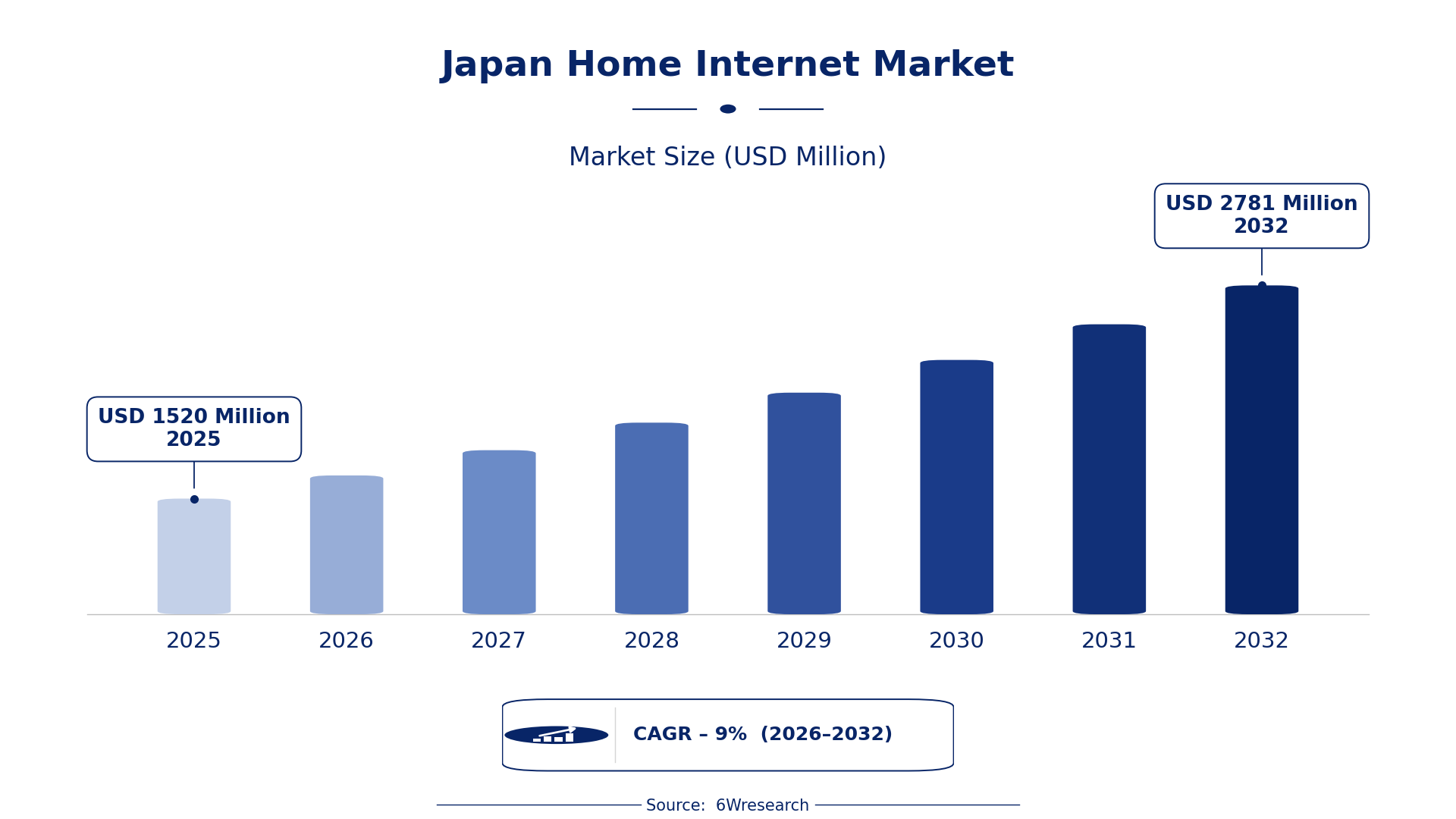
According to 6Wresearch internal database and industry insights, the Japan Home Internet Market was valued at USD 1,520 Million in 2025 and is projected to reach USD 2,781 Million by 2032, growing at a CAGR of approximately 9% during 2026–2032.
Japan Home Internet Market Highlights
| Report Metric | Details |
| Report Name | Japan Home Internet Market (2026-2032) |
| Market Size 2025 | USD 1,520 Million |
| Market Size 2032 | USD 2,781 Million |
| Absolute Growth 2025–2032 | USD 1,261 Million |
| CAGR 2026–2032 | 9% |
| Peak Annual Growth | 9.7% in 2026 |
| Forecast Period | 2026–2032 |
| Historical Data | 2022–2025 |
| Base Year | 2025 |
| Leading Connection Type, 2025 | Broadband Connections (40% share) |
| Leading Technology, 2025 | Fiber/DSL (47% share) |
| Leading Distribution Channel, 2025 | ISP Service Providers (42% share) |
| Leading End User, 2025 | Residential Subscribers (42% share) |
| Fastest-Growing Connection Type | Satellite Internet (12.9% CAGR) |
| Fastest-Growing Technology | Ku-Band/C-Band (13.4% CAGR) |
| Fastest-Growing Distribution Channel | Regional Resellers (11.8% CAGR) |
| Fastest-Growing End User | Rural Users (11.9% CAGR) |
| Growing Sector | Rural Users |
| Key End Users | Residential Subscribers, Rural Users, Smart Homes, Tech-Savvy Households |
Japan Home Internet Market Year-wise Growth Rate and Key Drivers (2022–2032)
This graph illustrates the annual growth rates of the market from 2022 to 2032, highlighting a steady upward trajectory and projected market expansion over the forecast period.
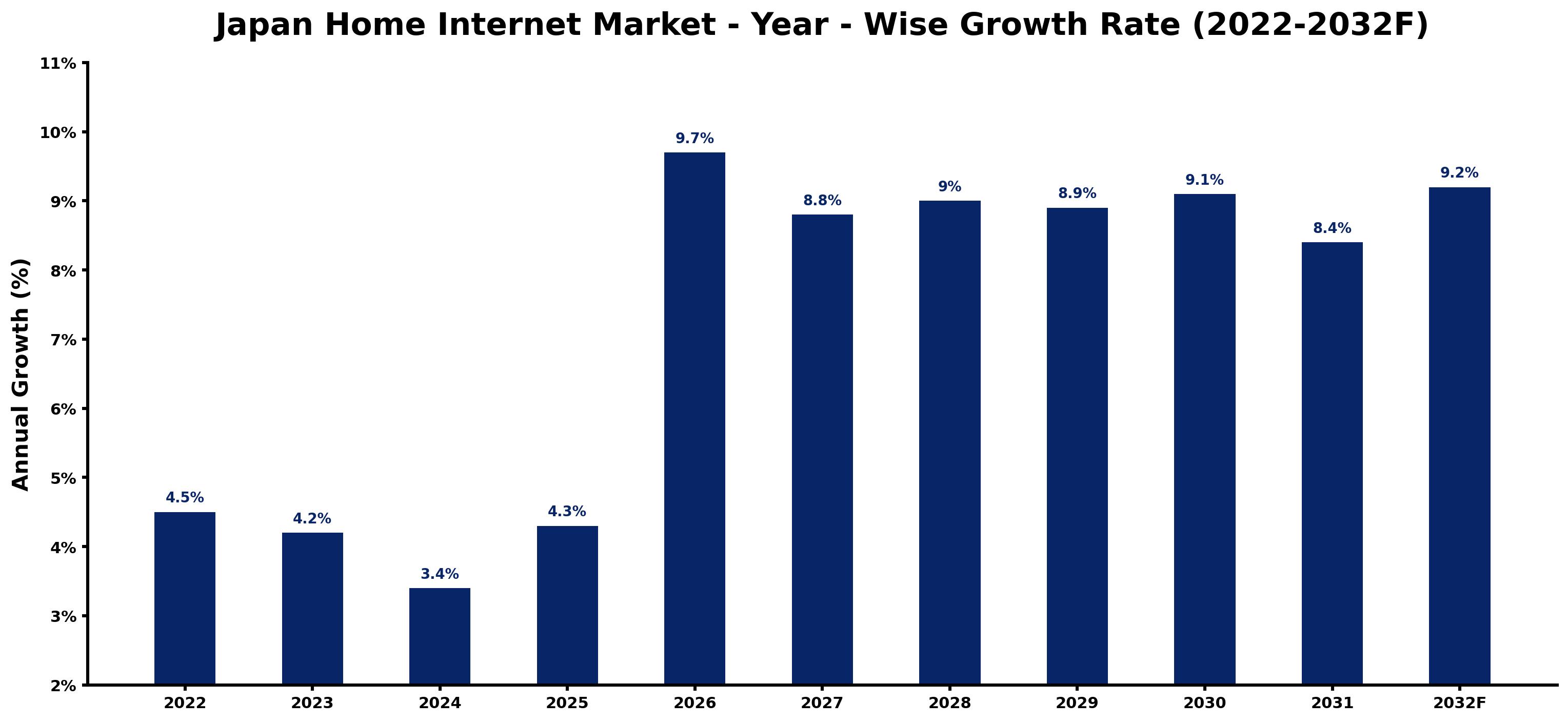
For each year, the table pairs the estimated growth rate with the leading influence on demand, showing how the drivers changed across the period.
| Year | Estimated Annual Growth (%) | Market Rationale |
| 2022 | 4.5 | The market showed strong demand for broadband connections, reflecting high internet penetration. |
| 2023 | 4.2 | Growth slowed due to market saturation in urban areas, impacting new subscriber additions. |
| 2024 | 3.4 | Continued saturation in major cities led to a further slowdown in growth rates. |
| 2025 | 4.3 | Urban expansion and smart home adoption drove a rebound in growth, boosting subscriber numbers. |
| 2026 | 9.7 | Increased investments in 5G technology will create new demand for mobile connectivity. |
| 2027 | 8.8 | Growth will slow as the market adjusts to the rapid expansion of infrastructure in previous years. |
| 2028 | 9.0 | Rising demand for high-speed internet in rural areas will stimulate renewed growth opportunities. |
| 2029 | 8.9 | Growth will slow as urban markets reach maturity, limiting new subscriber growth. |
| 2030 | 9.1 | Demand for high-speed internet will surge due to the ongoing smart city initiatives across regions. |
| 2031 | 8.4 | Growth will slow as competition intensifies among service providers in urban markets. |
| 2032 | 9.2 | Rising investments in broadband infrastructure are expected to drive growth in underserved regions. |
Note: Market size estimations and growth projections presented in this report are based on 6Wresearch's proprietary forecasting methodology, utilizing the latest available industry data, government publications, and primary research inputs.
Japan Home Internet Market Synopsis
Home Internet in Japan encompasses broadband connections, satellite internet, and mobile networks, primarily delivered through fibre optics and DSL. With over 40 million broadband subscribers in 2023, the market is growing due to rising demand from residential users and smart homes. The government aims for 100% broadband coverage by 2025, while the proliferation of smart homes and 5G technology further stimulates investment and demand for high-speed internet access nationwide. The increasing focus on connectivity is transforming internet services, creating opportunities for various stakeholders.
Market Dynamics Impact Analysis (2026–2032)
| Factor | Type | Impact | Primary Segment Affected |
| Growing investments in 5G technology. | Driver | High | 5G Internet |
| Increased demand for smart home connectivity. | Driver | High | Smart Homes |
| Rural internet access programs are expanding. | Opportunity | High | Rural Users |
| Urban expansion is creating new subscriber bases. | Opportunity | High | Residential Subscribers |
| Market saturation in urban areas limits growth potential. | Restraint | High | Broadband Connections |
| Intense competition among service providers can lead to price wars. | Restraint | Medium | ISP Service Providers |
| High infrastructure investment costs deter new entrants. | Challenge | High | Telecom Operators |
| Rapid technological changes require constant upgrades. | Challenge | Medium | Wireless Routers |
Evaluation of Drivers in Japan Home Internet Market (2026–2032)
Demand rests on the following drivers, each shown with the segment it touches most.
| Drivers | Primary Segment Affected | Why It Matters (Evidence) |
| Increased investments in 5G infrastructure. | 5G Internet | This investment is expected to create new demand for mobile connectivity, with 20 million subscriptions recorded in 2023. |
| Rising smart home adoption among consumers. | Smart Homes | The number of smart homes reached approximately 10 million in 2023, driving demand for high-speed internet. |
| Government initiatives for rural internet access. | Rural Users | Programs launched in 2023 aim to improve connectivity in underserved areas, increasing subscriber numbers. |
| Urban expansion and new residential developments. | Residential Subscribers | New housing projects in urban areas are contributing to subscriber growth in cities like Tokyo and Osaka. |
| Fibre optics becoming the primary technology for broadband. | Fiber/DSL | Over 70% of urban households are using fibre optics, ensuring high-speed connectivity. |
Buyers are adding capacity as investments in 5G infrastructure rise, with 20 million subscriptions recorded in 2023. The growing adoption of smart home technology, with around 10 million smart homes, increases demand for high-speed internet. Urban expansion in cities contributes to the increase in residential subscribers. Fibre optics has become the primary technology for broadband, with over 70% of urban households opting for this solution, ensuring high-speed access.
Evaluation of Restraints in Japan Home Internet Market
These restraints slow adoption and weigh on supplier margins.
| Market Restraint | Primary Segment Affected | Why It Matters (Evidence) |
| Market saturation in urban areas limits new subscriber growth. | Broadband Connections | As the market matures, new subscriber additions in urban regions are becoming increasingly difficult to achieve. |
| Intense competition among service providers can lead to price wars. | ISP Service Providers | This competition can erode profit margins, making it challenging for providers to sustain growth. |
| High infrastructure investment costs deter new entrants. | Telecom Operators | The capital required for network expansion limits the number of new players in the market. |
| Rapid technological changes require constant upgrades. | Wireless Routers | Service providers must continually invest in new technologies to remain competitive, increasing operational costs. |
| Limited consumer awareness of available services in rural areas. | Rural Users | This lack of awareness can hinder the adoption of new internet services, slowing growth in these regions. |
Japan Home Internet Market Challenges
Japan's declining population, approximately 124 million in 2023, reduces the number of potential buyers for internet services, leading to stagnant market growth. Limited investment in rural internet infrastructure creates connectivity delays for users in these regions, costing them access to vital online services. High technology upgrade costs burden producers, with annual expenses potentially exceeding 300 million, limiting their capacity to innovate. Global supply chain disruptions for technology components can delay service expansions, restricting access to high-speed internet for consumers across the country.
Trends in the Japan Home Internet Market
Four trends stand out in the Japan Home Internet Market.
- Shift from DSL to Fiber Optics: Since 2023, Japan has seen a shift towards fibre optics for internet access, with over 70% of urban households adopting this technology. This transition improves internet speed and reliability, benefiting both consumers and service providers.
- Emergence of Smart Homes: The rise of smart homes began in 2023, with approximately 10 million households adopting IoT devices. This trend drives demand for high-speed internet, prompting service providers to improve their offerings.
- Growth of 5G Internet: The total number of 5G subscriptions reached 20 million in 2023, marking a shift towards mobile connectivity. This growth is reshaping consumer expectations and driving investments in mobile infrastructure.
- Expansion of Rural Internet Access Programs: In 2023, Japan launched rural internet access programs to improve connectivity in underserved areas. These initiatives aim to bridge the digital divide, ensuring more residents can access high-speed internet.
Investment Opportunities in the Japan Home Internet Market
Investors looking at the Japan Home Internet Market should consider the following areas.
- Rural internet access programs are expanding now: With approximately 10 million smart homes in 2023, there is a pressing need for better connectivity in rural areas. Collaborating with local governments can facilitate market entry and service expansion.
- Urban expansion is creating new subscriber bases: As urban areas grow, there is a demand for high-speed internet services. Partnering with local developers can help service providers tap into new residential projects.
- Rising demand for smart home connectivity: The increasing number of smart homes presents an opportunity for service providers to offer tailored internet packages. Engaging with tech-savvy households can drive subscription growth.
- Investing in 5G infrastructure is timely: With the total number of 5G subscriptions reaching 20 million in 2023, there is a strong need for investment in mobile connectivity. Collaborating with telecom operators can improve market presence.
Government Initiatives in the Japan Home Internet Market
The Electrical Appliance and Material Safety Act, established in 1961, regulates the safety of electrical appliances and materials in Japan. This law ensures that internet-related devices meet safety standards, protecting consumers and building trust in broadband services. Additionally, the Industrial Standardization Act governs product and test standards, ensuring quality service delivery in the Home Internet sector.
The Ministry of Internal Affairs oversees telecommunications regulations, approving new service providers and funding broadband expansion programs. In 2023, the government allocated resources to improve internet accessibility, aiming for 100% broadband coverage by 2025, benefiting both urban and rural users.
Future Insight of the Japan Home Internet Market
The government's rural internet access programmes will enhance connectivity in underserved areas, providing reliable services to millions. By 2032, advancements in broadband technology will facilitate average internet speeds of 200 Mbps, improving user experience for households. The establishment of the Digital Agency will streamline regulatory processes, encouraging investment in infrastructure. With over 40 million broadband subscribers, the integration of advanced technologies will create new opportunities for suppliers and consumers alike.
Market Segmentation Analysis
Japan Home Internet Market report covers a detailed analysis of the following market segments:
By Connection Type – Broadband Connections Lead, Satellite Internet Expected to Grow Fastest
According to Saurav Kr Singh, Senior Research Analyst at 6Wresearch, in 2025, Broadband Connections led the connection type split with a 40% share. Broadband connections dominate the market as they are essential for high-speed access, with over 40 million subscribers in Japan relying on them. The robust infrastructure in urban areas such as Tokyo and Osaka reinforces their leading position. Satellite Internet is set to record the highest CAGR in this split, 12.9% over 2026–2032. Satellite internet is witnessing rapid growth due to its capability to deliver connectivity in remote regions, supported by government initiatives aimed at enhancing rural internet access. This trend is expected to persist as more households seek reliable internet options beyond urban centres. Suppliers should focus on developing satellite internet solutions to address the increasing demand in rural areas.
By Technology – Fiber/DSL Leads, Ku-Band/C-Band Expected to Grow Fastest
Fiber/DSL held 47% of the Japan Home Internet Market by technology in 2025. Fiber/DSL technology leads the market as the primary means of delivering broadband services, with over 70% of urban households relying on it for high-speed internet. This established infrastructure supports a large installed base of users. Ku-Band/C-Band is projected to grow fastest, at a CAGR of 13.4% during 2026–2032. Ku-Band/C-Band technology is growing quickly due to its specific applications in rural areas, where traditional broadband may not be feasible. The increasing number of rural internet access programs will likely fuel this growth further. Suppliers must consider investing in Ku-Band/C-Band technologies to meet the unique demands of rural customers.
By Distribution Channel – ISP Service Providers Lead, Regional Resellers Expected to Grow Fastest
ISP Service Providers took 42% of distribution channel revenue in 2025, more than any other category. ISP service providers serve as the primary distribution channel for internet access, effectively connecting consumers to broadband services. Their extensive networks and established relationships with customers facilitate efficient service delivery across Japan. Over 2026–2032, Regional Resellers are expected to post the fastest growth, at a CAGR of 11.8%. Regional resellers are growing at the fastest rate as they address local distribution needs, particularly in underserved areas. This growth is further encouraged by government initiatives to improve broadband coverage nationwide. Suppliers ought to explore partnerships with regional resellers to expand their market reach.
By End User – Residential Subscribers Lead, Rural Users Expected to Grow Fastest
With 42% of end user revenue in 2025, Residential Subscribers was the largest category. Residential subscribers represent the largest user base in the home internet market, driven by the high demand for connectivity in households across Japan. This segment is critical for sustaining the growth of broadband services. The quickest growth will come from Rural Users, forecast to expand at a CAGR of 11.9% between 2026 and 2032. Rural users are the fastest-growing demographic as initiatives aim to improve internet access in less populated areas, reflecting a shift in focus towards inclusivity in connectivity. This growth is likely to accelerate with ongoing government support. Suppliers need to tailor their offerings to address the specific needs of rural users to capitalise on this growth opportunity.
Key Attractiveness of the Report
- 10 Years of Market Numbers
- Historical Data Starting from 2022 to 2025
- Base Year 2025
- Forecast Data until 2032
- Key Performance Indicators Impacting the Market
- Major Upcoming Developments and Projects
Key Highlights of the Report:
- Japan Home Internet Market Outlook
- Market Size of Japan Home Internet Market, 2025
- Forecast of Japan Home Internet Market, 2032
- Historical Data and Forecast of Japan Home Internet Revenues & Volume for the Period 2022-2032F
- Japan Home Internet Market Trend Evolution
- Japan Home Internet Market Drivers and Challenges
- Japan Home Internet Price Trends
- Japan Home Internet Porter's Five Forces
- Japan Home Internet Industry Life Cycle
- Historical Data and Forecast of Japan Home Internet Market Revenues & Volume By Connection Type for the Period 2022-2032F
- Historical Data and Forecast of Japan Home Internet Market Revenues & Volume By Broadband Connections for the Period 2022-2032F
- Historical Data and Forecast of Japan Home Internet Market Revenues & Volume By Satellite Internet for the Period 2022-2032F
- Historical Data and Forecast of Japan Home Internet Market Revenues & Volume By 5G Internet for the Period 2022-2032F
- Historical Data and Forecast of Japan Home Internet Market Revenues & Volume By Mesh Wi-Fi Systems for the Period 2022-2032F
- Historical Data and Forecast of Japan Home Internet Market Revenues & Volume By Technology for the Period 2022-2032F
- Historical Data and Forecast of Japan Home Internet Market Revenues & Volume By Fiber/DSL for the Period 2022-2032F
- Historical Data and Forecast of Japan Home Internet Market Revenues & Volume By Ku-Band/C-Band for the Period 2022-2032F
- Historical Data and Forecast of Japan Home Internet Market Revenues & Volume By Mobile Network for the Period 2022-2032F
- Historical Data and Forecast of Japan Home Internet Market Revenues & Volume By Wireless Routers for the Period 2022-2032F
- Historical Data and Forecast of Japan Home Internet Market Revenues & Volume By Distribution Channel for the Period 2022-2032F
- Historical Data and Forecast of Japan Home Internet Market Revenues & Volume By ISP Service Providers for the Period 2022-2032F
- Historical Data and Forecast of Japan Home Internet Market Revenues & Volume By Regional Resellers for the Period 2022-2032F
- Historical Data and Forecast of Japan Home Internet Market Revenues & Volume By Telecom Operators for the Period 2022-2032F
- Historical Data and Forecast of Japan Home Internet Market Revenues & Volume By E-commerce Channels for the Period 2022-2032F
- Historical Data and Forecast of Japan Home Internet Market Revenues & Volume By End User for the Period 2022-2032F
- Historical Data and Forecast of Japan Home Internet Market Revenues & Volume By Residential Subscribers for the Period 2022-2032F
- Historical Data and Forecast of Japan Home Internet Market Revenues & Volume By Rural Users for the Period 2022-2032F
- Historical Data and Forecast of Japan Home Internet Market Revenues & Volume By Smart Homes for the Period 2022-2032F
- Historical Data and Forecast of Japan Home Internet Market Revenues & Volume By Tech-Savvy Households for the Period 2022-2032F
- Japan Home Internet Import Export Trade Statistics
- Market Opportunity Assessment By Connection Type
- Market Opportunity Assessment By Technology
- Market Opportunity Assessment By Distribution Channel
- Market Opportunity Assessment By End User
- Japan Home Internet Top Companies Market Share
- Japan Home Internet Competitive Benchmarking By Technical and Operational Parameters
- Japan Home Internet Company Profiles
- Japan Home Internet Key Strategic Recommendations
Market Covered
The following segment groups are covered in the report.
By Connection Type
- Broadband Connections
- Satellite Internet
- 5G Internet
- Mesh Wi-Fi Systems
By Technology
- Fiber/DSL
- Ku-Band/C-Band
- Mobile Network
- Wireless Routers
By Distribution Channel
- ISP Service Providers
- Regional Resellers
- Telecom Operators
- E-commerce Channels
By End User
- Residential Subscribers
- Rural Users
- Smart Homes
- Tech-Savvy Households































