Japan Honey Beekeeping Apiculture Market Size & Growth Rate
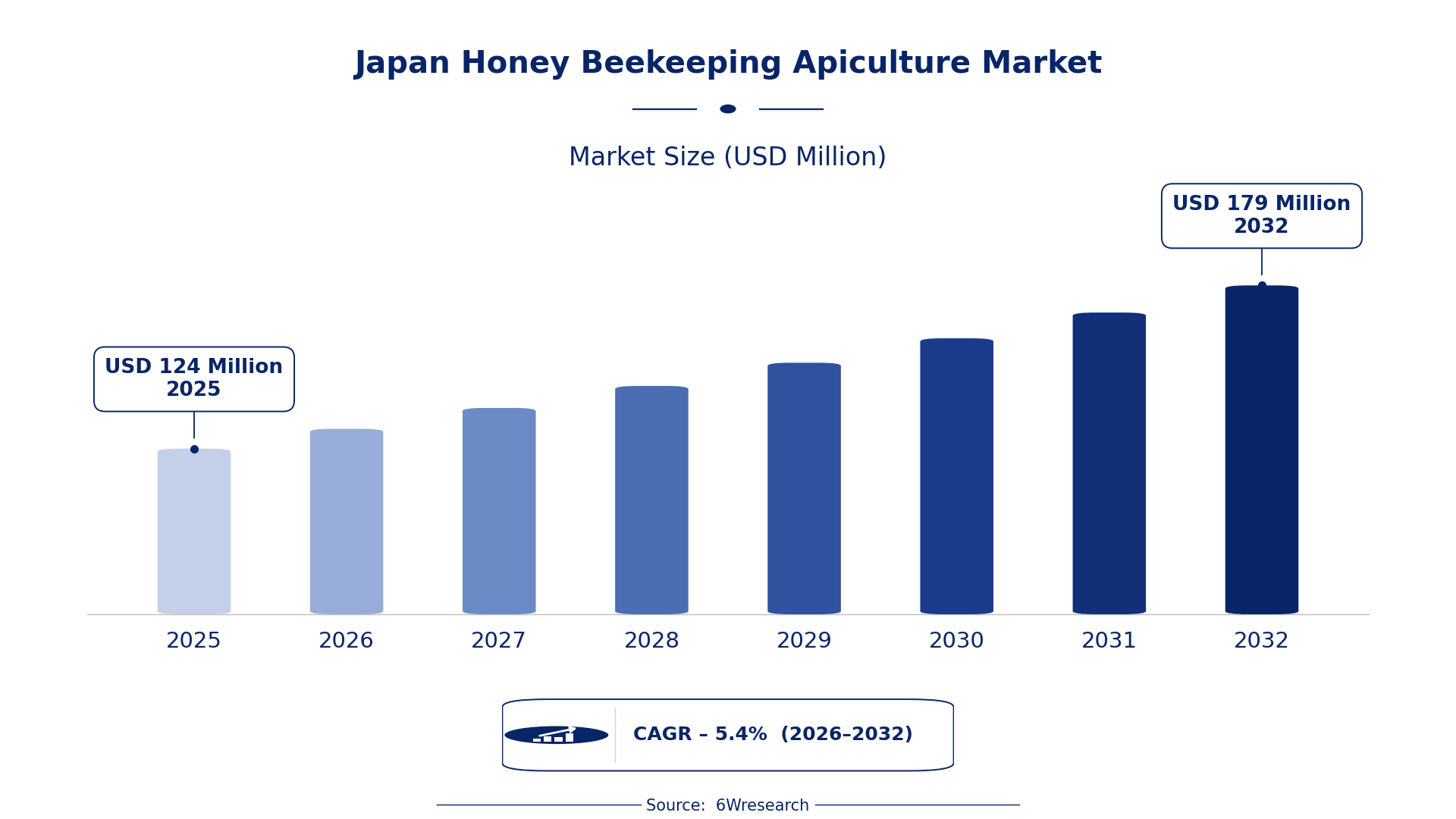
According to 6Wresearch internal database and industry insights, the Japan Honey Beekeeping Apiculture Market was valued at USD 124 Million in 2025 and is projected to reach USD 179 Million by 2032, growing at a CAGR of approximately 5.4% during 2026–2032.
Japan Honey Beekeeping Apiculture Market Highlights
| Report Metric | Details |
| Report Name | Japan Honey Beekeeping Apiculture Market (2026-2032) |
| Market Size 2025 | USD 124 Million |
| Market Size 2032 | USD 179 Million |
| Absolute Growth 2025–2032 | USD 55 Million |
| CAGR 2026–2032 | 5.4% |
| Peak Annual Growth | 6.8% in 2028 |
| Forecast Period | 2026–2032 |
| Historical Data | 2022–2025 |
| Base Year | 2025 |
| Leading Beekeeping Type, 2025 | Commercial Beekeeping (46% share) |
| Leading Equipment Type, 2025 | Wooden Beehives (38% share) |
| Leading End User, 2025 | Large-scale Apiculturists (34% share) |
| Leading Application, 2025 | Mass Honey Production (41% share) |
| Fastest-Growing Beekeeping Type | Organic Beekeeping (7.9% CAGR) |
| Fastest-Growing Equipment Type | Natural Wax Frames (8.0% CAGR) |
| Fastest-Growing End User | Organic Farmers (7.3% CAGR) |
| Fastest-Growing Application | Pesticide-free Honey (7.2% CAGR) |
| Growing Sector | Organic Beekeeping |
| Key End Users | Large-scale Apiculturists, Small-scale Farmers, Honey Processing Units, Organic Farmers |
Japan Honey Beekeeping Apiculture Market Year-wise Growth Rate and Key Drivers (2022–2032)
This graph illustrates the annual growth rates of the market from 2022 to 2032, highlighting a steady upward trajectory and projected market expansion over the forecast period.
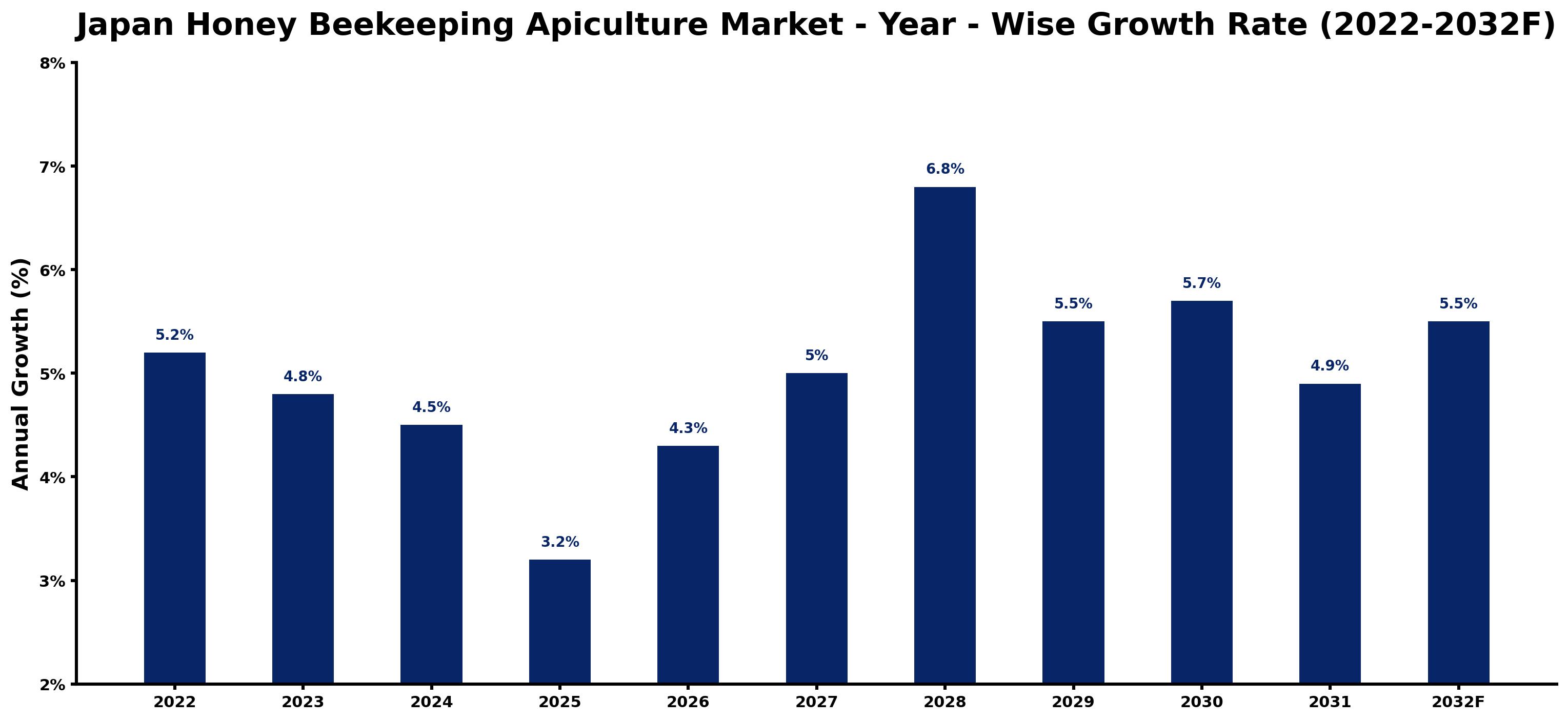
Year by year, the estimates below pair each growth rate with the development that shaped it.
| Year | Estimated Annual Growth (%) | Market Rationale |
| 2022 | 5.2 | The market experienced steady growth due to increased consumer interest in honey products. |
| 2023 | 4.8 | Growth slowed as honey production faced challenges from adverse weather conditions. |
| 2024 | 4.5 | The market continued to grow, albeit at a slower pace, influenced by rising health awareness. |
| 2025 | 3.2 | Demand growth slowed further as consumer spending patterns shifted towards other sweeteners. |
| 2026 | 4.3 | Growth is expected to accelerate with rising interest in organic honey products. |
| 2027 | 5.0 | The market will see increased demand as consumer preferences shift towards local honey. |
| 2028 | 6.8 | Growth will peak as mass honey production aligns with export opportunities. |
| 2029 | 5.5 | Demand growth is expected to slow slightly as market saturation begins to occur in urban areas. |
| 2030 | 5.7 | The market is projected to grow faster as new beekeeping technologies are adopted. |
| 2031 | 4.9 | Growth is expected to slow again as competition increases among local producers. |
| 2032 | 5.5 | Demand is expected to rise with a focus on sustainable and pesticide-free honey. |
Note: Market size estimations and growth projections presented in this report are based on 6Wresearch's proprietary forecasting methodology, utilizing the latest available industry data, government publications, and primary research inputs.
Japan Honey Beekeeping Apiculture Market Synopsis
Honey beekeeping, or apiculture, involves maintaining bee colonies primarily for honey production and pollination. In Japan, approximately 6,000 tons of honey were produced in 2022, with demand driven by culinary uses, health products, and local consumption. The Japan Honey Beekeeping Apiculture Market is expanding due to increasing health awareness and rising consumer interest in organic honey, along with government support for sustainable practices. This growth reflects both domestic consumption and export opportunities, positioning the market for further development.
Market Dynamics Impact Analysis (2026–2032)
| Factor | Type | Impact | Primary Segment Affected |
| Growing consumer interest in health benefits of honey | Driver | High | Organic Beekeeping |
| Increased demand for local honey products | Driver | High | Mass Honey Production |
| Expansion of organic honey production | Opportunity | Medium | Organic Beekeeping |
| Government initiatives supporting rural beekeeping | Opportunity | Medium | Traditional Beekeeping |
| Adverse weather conditions affecting honey yields | Restraint | High | Commercial Beekeeping |
| Limited awareness of sustainable practices among small-scale producers | Restraint | Medium | Traditional Beekeeping |
| Competition from alternative sweeteners | Challenge | High | Mass Honey Production |
| Rising costs of beekeeping equipment and supplies | Challenge | Medium | Commercial Beekeeping |
Evaluation of Drivers in Japan Honey Beekeeping Apiculture Market (2026–2032)
Demand rests on the following drivers, each shown with the segment it touches most.
| Drivers | Primary Segment Affected | Why It Matters (Evidence) |
| Increased health consciousness among consumers | Organic Beekeeping | The average Japanese consumer consumes about 0.5 kg of honey annually, driving demand for organic products. |
| Rising popularity of local honey in culinary applications | Mass Honey Production | Honey is a key ingredient in traditional Japanese sweets, increasing demand for local production. |
| Support for sustainable beekeeping practices | Traditional Beekeeping | The Japanese Beekeepers Association promotes sustainable practices, encouraging more beekeepers to engage. |
| Growing interest in pesticide-free honey | Pesticide-free Honey | Health-conscious consumers are increasingly seeking pesticide-free options, boosting demand. |
| Development of beekeeping workshops by local governments | Small-scale Farmers | Beekeeping workshops organized by local governments are improving skills and knowledge among farmers. |
Spending rises because Hokkaido and Nagano are major honey-producing regions, contributing to approximately 6,000 tons of honey produced in 2022. The average Japanese consumer consumes about 0.5 kg of honey annually, which drives demand for organic products. Local honey is a key ingredient in traditional Japanese sweets, which further boosts its appeal. Workshops organized by local governments are also improving skills among small-scale farmers, contributing to growth in this sector. Increasing interest in sustainable practices is encouraging more beekeepers to engage in environmentally friendly methods, enhancing overall production.
Evaluation of Restraints in Japan Honey Beekeeping Apiculture Market
Below are the constraints most often cited by buyers and suppliers, with the segment each affects.
| Market Restraint | Primary Segment Affected | Why It Matters (Evidence) |
| Adverse weather conditions affecting honey yields | Commercial Beekeeping | Weather variability can disrupt yields, impacting overall honey production levels in Japan. |
| Limited awareness of sustainable practices among small-scale producers | Traditional Beekeeping | Many small-scale farmers still rely on traditional methods, limiting their growth potential. |
| Competition from alternative sweeteners | Mass Honey Production | The average price of honey in Japan is around 1,500 yen per kg, making alternatives attractive. |
| Rising costs of beekeeping equipment and supplies | Commercial Beekeeping | Increased costs can deter new entrants into the beekeeping market, affecting overall supply. |
| Market saturation in urban areas | Mass Honey Production | As urban consumers become more selective, competition increases among local producers. |
Japan Honey Beekeeping Apiculture Market Challenges
Producers face high operational costs due to low honey yields, which can reach only 6,000 tons annually, forcing them to increase prices for buyers. Strict regulations on honey quality impose significant compliance costs, delaying product availability and raising expenses for local consumers. Increased competition from imported honey pressures local producers, with prices averaging around 1,500 yen per kg, resulting in reduced market share for domestic suppliers. Slow adoption of modern beekeeping technology limits productivity, preventing producers from meeting the growing consumer demand for honey.
Trends in the Japan Honey Beekeeping Apiculture Market
Buyers and suppliers in the Japan Honey Beekeeping Apiculture Market are adjusting to the following trends.
- Shift towards Organic Honey Production: Since 2023, organic honey production has gained traction, reflecting a broader trend towards health-conscious options. Approximately 7.9% growth is projected in this segment, indicating a shift in consumer preferences.
- Rise of Local Honey Festivals: In 2022, local festivals celebrating honey and beekeeping were held annually in various regions, attracting public interest. These events have increased awareness and appreciation for local honey, boosting sales.
- Growing Preference for Pesticide-free Honey: Health-conscious consumers are increasingly seeking pesticide-free honey, leading to a 7.2% growth in this segment. This trend is evident in urban markets where health food stores prominently feature these products.
- Expansion of Beekeeping Workshops: Since 2023, local governments have organized beekeeping workshops to promote the industry, improving skills among small-scale farmers. This initiative has led to increased participation and interest in apiculture.
Investment Opportunities in the Japan Honey Beekeeping Apiculture Market
The following opportunities in the Japan Honey Beekeeping Apiculture Market pair current demand with a clear way in.
- Investment in Organic Beekeeping Facilities: Hokkaido is seeing a rise in organic beekeeping facilities, supported by a 7.9% increase in organic honey demand. Investors can partner with local farmers to establish organic production.
- Supply of Natural Wax Frames: With the growing preference for eco-friendly products, there is an opportunity to supply natural wax frames. Organic farmers are increasingly seeking these materials for their operations.
- Focus on Local Honey Production: Local honey production is supported by government initiatives, with funding aimed at improving rural economies. This presents an opportunity for suppliers to engage with local producers.
- Entry into Honey Processing Units: Honey processing units in urban areas are expanding, creating opportunities for suppliers of processing equipment. Collaborating with these units can improve market presence.
Government Initiatives in the Japan Honey Beekeeping Apiculture Market
The legal framework affecting honey beekeeping in Japan includes the Plastic Resource Circulation Act (2021) and the Economic Security Promotion Act (2022). These laws encourage sustainable practices and support supply-chain resilience, benefiting honey producers and promoting environmentally friendly beekeeping methods. Additionally, the Japanese government has initiated various programs to enhance the beekeeping sector, ensuring compliance with quality standards and fostering growth.
In 2023, the Ministry of Agriculture, Forestry and Fisheries launched a beekeeping support program, providing funding and training for local beekeepers. This initiative aims to improve honey production and quality, ensuring compliance with strict regulations. The program has allocated significant resources to support approximately 30,000 beekeepers across Japan, enhancing their operational capabilities.
Future Insight of the Japan Honey Beekeeping Apiculture Market
A policy-driven shift will prioritise sustainable beekeeping practices, prompting producers to adopt eco-friendly methods in response to consumer demand. Urban honey processing facilities will expand, improving distribution efficiency and ensuring better access for buyers. Rising consumer awareness of health benefits will fuel demand for pesticide-free honey, encouraging suppliers to enhance product quality. Investment in advanced beekeeping equipment will support increased local honey production, helping meet the anticipated rise in consumption.
Market Segmentation Analysis
Japan Honey Beekeeping Apiculture Market report covers a detailed analysis of the following market segments:
By Beekeeping Type – Commercial Beekeeping Leads, Organic Beekeeping Expected to Grow Fastest
According to Sachin Kumar Rai, Senior Research Analyst at 6Wresearch, the largest beekeeping type category in 2025 was Commercial Beekeeping, at 46% of revenue. Commercial beekeeping holds the largest share as it efficiently supplies honey to markets and retailers, with operations concentrated in regions like Hokkaido and Nagano. This segment benefits from a robust distribution network and established practices that cater to both domestic and export demands. The quickest growth will come from Organic Beekeeping, forecast to expand at a CAGR of 7.9% between 2026 and 2032. Organic beekeeping is experiencing rapid growth driven by increasing consumer demand for organic products, particularly in health food stores. The rising awareness of health benefits associated with organic honey is propelling this segment forward, ensuring its continued expansion. Suppliers should enhance their organic product lines to cater to the growing consumer interest in organic honey.
By Equipment Type – Wooden Beehives Lead, Natural Wax Frames Expected to Grow Fastest
In 2025, Wooden Beehives led the equipment type split with a 38% share. Wooden beehives dominate the market due to their widespread preference for durability and traditional use in beekeeping practices. Their effectiveness in maintaining bee colonies and producing honey makes them the primary choice among beekeepers across Japan. Natural Wax Frames are set to record the highest CAGR in this split, 8.0% over 2026–2032. Natural wax frames are gaining popularity as they are essential for honey production and are favoured for their eco-friendly properties. The increasing focus on sustainable practices in beekeeping is expected to drive demand for these frames significantly. Manufacturers should focus on producing natural wax frames to meet the rising demand for sustainable beekeeping equipment.
By End User – Large-scale Apiculturists Lead, Organic Farmers Expected to Grow Fastest
Large-scale Apiculturists held 34% of the Japan Honey Beekeeping Apiculture Market by end user in 2025. Large-scale apiculturists lead this segment, providing a consistent supply of honey for both domestic and export markets. Their operations are bolstered by government initiatives aimed at enhancing honey production capabilities and ensuring quality standards. Organic Farmers are projected to grow fastest, at a CAGR of 7.3% during 2026–2032. Organic farmers are rapidly increasing their focus on pesticide-free honey production, aligning with the growing consumer preference for healthier options. This trend is likely to accelerate as more farmers adopt organic practices to meet market demands. Suppliers should target organic farmers to tap into the growing market for pesticide-free honey.
By Application – Mass Honey Production Leads, Pesticide-free Honey Expected to Grow Fastest
With 41% of application revenue in 2025, Mass Honey Production was the largest category. Mass honey production is the leading application, effectively meeting both national and export demands for honey. This segment plays a crucial role in ensuring honey availability across various markets, driven by consistent consumer consumption patterns. Over 2026–2032, Pesticide-free Honey is expected to post the fastest growth, at a CAGR of 7.2%. Pesticide-free honey is increasingly sought after by health-conscious consumers, reflecting a shift towards natural and organic food choices. This trend is expected to persist as awareness of health benefits continues to grow, driving demand further. Producers should expand their pesticide-free honey offerings to attract health-oriented buyers.
Key Attractiveness of the Report
- 10 Years of Market Numbers
- Historical Data Starting from 2022 to 2025
- Base Year 2025
- Forecast Data until 2032
- Key Performance Indicators Impacting the Market
- Major Upcoming Developments and Projects
Key Highlights of the Report:
- Japan Honey Beekeeping Apiculture Market Outlook
- Market Size of Japan Honey Beekeeping Apiculture Market,2025
- Forecast of Japan Honey Beekeeping Apiculture Market, 2032
- Historical Data and Forecast of Japan Honey Beekeeping Apiculture Revenues & Volume for the Period 2022-2032
- Japan Honey Beekeeping Apiculture Market Trend Evolution
- Japan Honey Beekeeping Apiculture Market Drivers and Challenges
- Japan Honey Beekeeping Apiculture Price Trends
- Japan Honey Beekeeping Apiculture Porter's Five Forces
- Japan Honey Beekeeping Apiculture Industry Life Cycle
- Historical Data and Forecast of Japan Honey Beekeeping Apiculture Market Revenues & Volume By Beekeeping Type for the Period 2022-2032
- Historical Data and Forecast of Japan Honey Beekeeping Apiculture Market Revenues & Volume By Traditional Beekeeping for the Period 2022-2032
- Historical Data and Forecast of Japan Honey Beekeeping Apiculture Market Revenues & Volume By Commercial Beekeeping for the Period 2022-2032
- Historical Data and Forecast of Japan Honey Beekeeping Apiculture Market Revenues & Volume By Organic Beekeeping for the Period 2022-2032
- Historical Data and Forecast of Japan Honey Beekeeping Apiculture Market Revenues & Volume By Industrial Beekeeping for the Period 2022-2032
- Historical Data and Forecast of Japan Honey Beekeeping Apiculture Market Revenues & Volume By Equipment Type for the Period 2022-2032
- Historical Data and Forecast of Japan Honey Beekeeping Apiculture Market Revenues & Volume By Wooden Beehives for the Period 2022-2032
- Historical Data and Forecast of Japan Honey Beekeeping Apiculture Market Revenues & Volume By Plastic Beehives for the Period 2022-2032
- Historical Data and Forecast of Japan Honey Beekeeping Apiculture Market Revenues & Volume By Natural Wax Frames for the Period 2022-2032
- Historical Data and Forecast of Japan Honey Beekeeping Apiculture Market Revenues & Volume By Automated Extractors for the Period 2022-2032
- Historical Data and Forecast of Japan Honey Beekeeping Apiculture Market Revenues & Volume By End User for the Period 2022-2032
- Historical Data and Forecast of Japan Honey Beekeeping Apiculture Market Revenues & Volume By Small-scale Farmers for the Period 2022-2032
- Historical Data and Forecast of Japan Honey Beekeeping Apiculture Market Revenues & Volume By Large-scale Apiculturists for the Period 2022-2032
- Historical Data and Forecast of Japan Honey Beekeeping Apiculture Market Revenues & Volume By Organic Farmers for the Period 2022-2032
- Historical Data and Forecast of Japan Honey Beekeeping Apiculture Market Revenues & Volume By Honey Processing Units for the Period 2022-2032
- Historical Data and Forecast of Japan Honey Beekeeping Apiculture Market Revenues & Volume By Application for the Period 2022-2032
- Historical Data and Forecast of Japan Honey Beekeeping Apiculture Market Revenues & Volume By Local Honey Production for the Period 2022-2032
- Historical Data and Forecast of Japan Honey Beekeeping Apiculture Market Revenues & Volume By Mass Honey Production for the Period 2022-2032
- Historical Data and Forecast of Japan Honey Beekeeping Apiculture Market Revenues & Volume By Pesticide-free Honey for the Period 2022-2032
- Historical Data and Forecast of Japan Honey Beekeeping Apiculture Market Revenues & Volume By Bulk Honey Supply for the Period 2022-2032
- Japan Honey Beekeeping Apiculture Import Export Trade Statistics
- Market Opportunity Assessment By Beekeeping Type
- Market Opportunity Assessment By Equipment Type
- Market Opportunity Assessment By End User
- Market Opportunity Assessment By Application
- Japan Honey Beekeeping Apiculture Top Companies Market Share
- Japan Honey Beekeeping Apiculture Competitive Benchmarking By Technical and Operational Parameters
- Japan Honey Beekeeping Apiculture Company Profiles
- Japan Honey Beekeeping Apiculture Key Strategic Recommendations
Market Covered
Segments analysed in this report are listed below.
By Beekeeping Type
- Traditional Beekeeping
- Commercial Beekeeping
- Organic Beekeeping
- Industrial Beekeeping
By Equipment Type
- Wooden Beehives
- Plastic Beehives
- Natural Wax Frames
- Automated Extractors
By End User
- Small-scale Farmers
- Large-scale Apiculturists
- Organic Farmers
- Honey Processing Units
By Application
- Local Honey Production
- Mass Honey Production
- Pesticide-free Honey
- Bulk Honey Supply






































