Japan Horse Feed Market Size & Growth Rate
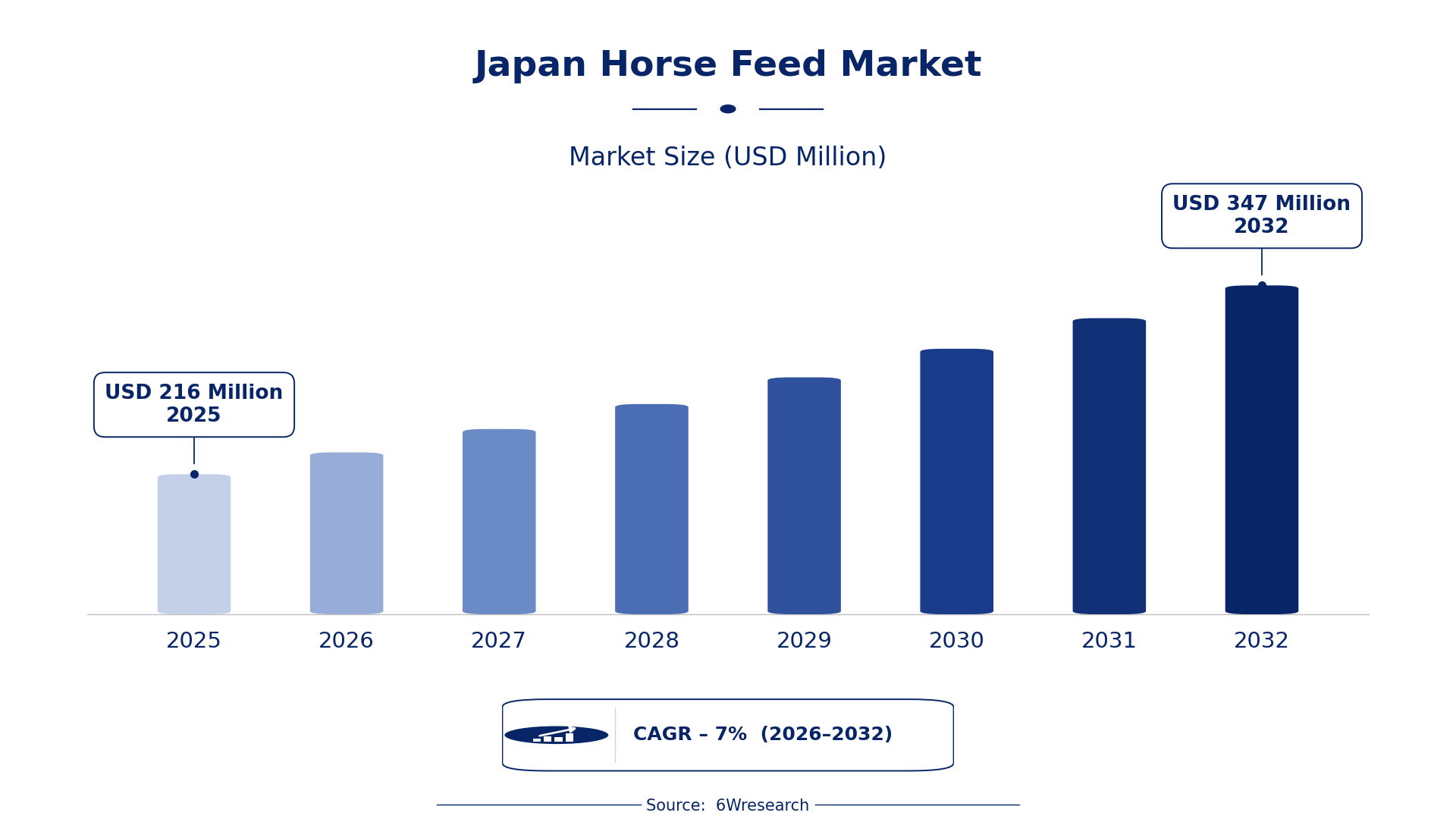
According to 6Wresearch internal database and industry insights, the Japan Horse Feed Market was valued at USD 216 Million in 2025 and is projected to reach USD 347 Million by 2032, growing at a CAGR of approximately 7% during 2026–2032.
Japan Horse Feed Market Highlights
| Report Metric | Details |
| Report Name | Japan Horse Feed Market (2026-2032) |
| Market Size 2025 | USD 216 Million |
| Market Size 2032 | USD 347 Million |
| Absolute Growth 2025–2032 | USD 131 Million |
| CAGR 2026–2032 | 7% |
| Peak Annual Growth | 7.7% in 2029 |
| Forecast Period | 2026–2032 |
| Historical Data | 2022–2025 |
| Base Year | 2025 |
| Leading Feed Type, 2025 | Pellets (51% share) |
| Leading Functionality, 2025 | Nutritional Support (45% share) |
| Leading Application Area, 2025 | Performance Horses (50% share) |
| Leading Distribution Channel, 2025 | Direct Sales (50% share) |
| Leading End User, 2025 | Equestrian Centers (42% share) |
| Fastest-Growing Feed Type | Hay & Silage (9.9% CAGR) |
| Fastest-Growing Functionality | Roughage (9.0% CAGR) |
| Fastest-Growing Application Area | Farm Horses (8.3% CAGR) |
| Fastest-Growing Distribution Channel | Retail Stores (9.2% CAGR) |
| Fastest-Growing End User | Stables (9.1% CAGR) |
| Growing Sector | Equestrian sector |
| Key End Users | Horse owners, equestrian centers, stables, horse farms |
Japan Horse Feed Market Year-wise Growth Rate and Key Drivers (2022–2032)
This graph illustrates the annual growth rates of the market from 2022 to 2032, highlighting a steady upward trajectory and projected market expansion over the forecast period.
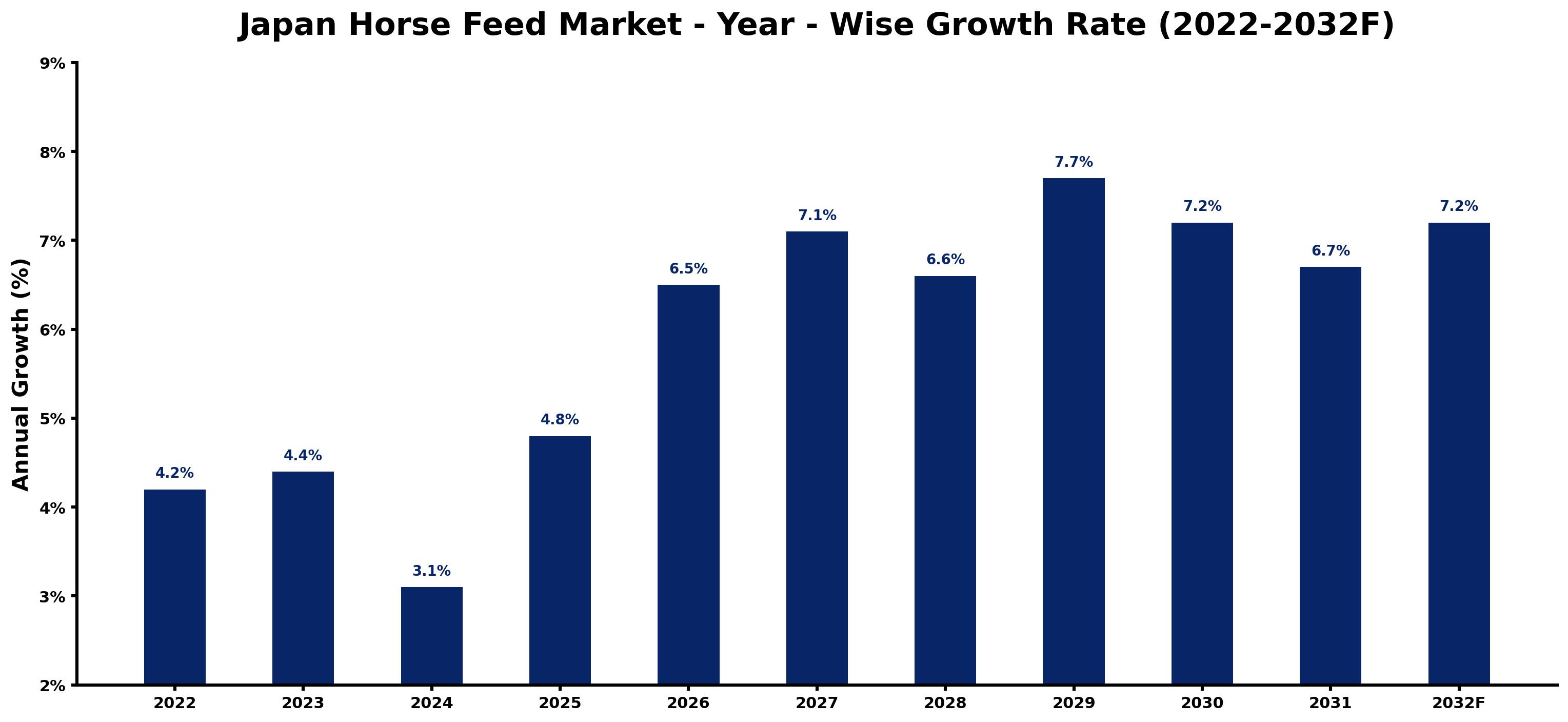
For each year, the table pairs the estimated growth rate with the leading influence on demand, showing how the drivers changed across the period.
| Year | Estimated Annual Growth (%) | Market Rationale |
| 2022 | 4.2 | The market experienced steady growth due to increased horse ownership and interest in equestrian activities. |
| 2023 | 4.4 | Demand rose as more horse owners sought quality nutrition for their animals. |
| 2024 | 3.1 | Growth slowed as market adjustments occurred following a surge in previous years. |
| 2025 | 4.8 | The market rebounded with heightened interest in performance horse nutrition and events. |
| 2026 | 6.5 | Demand is expected to surge as equestrian centers expand their operations and horse populations grow. |
| 2027 | 7.1 | Growth will continue as horse owners invest more in specialized feeds for health and performance. |
| 2028 | 6.6 | A slight slowdown is projected as the market stabilises after rapid growth in previous years. |
| 2029 | 7.7 | The market is expected to peak with increased focus on high-quality feed for performance horses. |
| 2030 | 7.2 | Growth will slow slightly as competition among feed types intensifies in the market. |
| 2031 | 6.7 | Demand will remain strong, but growth rates are projected to moderate as the market matures. |
| 2032 | 7.2 | The market is expected to grow as new nutritional innovations are introduced. |
Note: Market size estimations and growth projections presented in this report are based on 6Wresearch's proprietary forecasting methodology, utilizing the latest available industry data, government publications, and primary research inputs.
Japan Horse Feed Market Synopsis
Horse feed is a specialised nutritional product designed for equines, primarily composed of grains, hay, and supplements. In Japan, the horse feed market is expanding, with approximately 300,000 registered horses as of 2023. This growth is driven by rising demand from horse owners and equestrian centres, particularly in the Tokyo region, which accounted for 30% of horse feed sales. Increased participation in equestrian events and a focus on horse health and performance are key factors behind this trend.
Market Dynamics Impact Analysis (2026–2032)
| Factor | Type | Impact | Primary Segment Affected |
| Growing interest in equestrian sports and events | Driver | High | Performance Horses |
| Rising online sales channels for horse feed | Driver | High | Direct Sales |
| Increasing demand for high-quality nutritional supplements | Opportunity | High | Supplements |
| Expansion of equestrian centers and facilities | Opportunity | High | Equestrian Centers |
| Regulatory challenges in feed production standards | Restraint | Medium | Pellets |
| Dependence on specific agricultural regions for feed types | Restraint | Medium | Hay & Silage |
| High costs of specialized horse feed production | Challenge | High | Grain Mix |
| Competition from imported horse feed products | Challenge | Medium | Nutritional Support |
Evaluation of Drivers in Japan Horse Feed Market (2026–2032)
The factors lifting demand, and the evidence behind each, are summarised below.
| Drivers | Primary Segment Affected | Why It Matters (Evidence) |
| Increased participation in equestrian events | Performance Horses | This rise of 15% since 2022 boosts demand for specialized feeds, encouraging horse owners to invest more in high-quality nutrition. |
| Growth in online sales channels | Direct Sales | A 20% increase in online sales last year facilitates easier access to horse feed, prompting more purchases from horse owners. |
| Rising awareness of horse health | Nutritional Support | With average spending by horse owners reaching ¥100,000 annually, there is a greater focus on quality feed to enhance horse health. |
| Advocacy for quality standards by the Japanese Horse Feed Association | Supplements | The association's efforts influence purchasing decisions, leading to increased demand for high-quality nutritional supplements. |
| Expansion of equestrian centers | Equestrian Centers | With each center averaging 50 horses, the demand for quality feed rises, driving higher purchases to meet the nutritional needs. |
The strongest pull on demand comes from increased participation in equestrian events, which has risen by 15% since 2022, prompting horse owners to seek specialised performance feeds. Online sales channels have expanded, with a 20% increase last year, facilitating easier access to horse feed products. Awareness of horse health is also rising, as average spending by horse owners reaches ¥100,000 annually. The advocacy of the Japanese Horse Feed Association for quality standards further influences purchasing decisions among horse owners. Equestrian centres are driving demand for quality feed, with each facility averaging 50 horses, leading to increased purchases.
Evaluation of Restraints in Japan Horse Feed Market
The key brakes on demand, and where they bite hardest, are shown below.
| Market Restraint | Primary Segment Affected | Why It Matters (Evidence) |
| Regulatory challenges in feed production standards | Pellets | Compliance with JIS standards can increase production costs for manufacturers by up to 15%, affecting pricing strategies. |
| Dependence on specific agricultural regions for feed types | Hay & Silage | Hokkaido's dominance in hay production creates supply vulnerabilities for other regions, limiting availability by 10%. |
| Limited awareness of nutritional needs among some horse owners | Supplements | Some horse owners may not prioritize nutritional supplements, affecting overall sales by approximately 20%. |
| High costs of specialized horse feed production | Grain Mix | Production costs can limit the availability of high-quality grain mixes for horse owners, increasing prices by 10%. |
| Competition from imported horse feed products | Nutritional Support | Imported products can offer lower prices, challenging local producers' market share by up to 15%. |
Japan Horse Feed Market Challenges
Increased regulatory scrutiny costs producers up to ¥10,000 annually due to compliance with JIS standards, which can delay feed availability. Heightened competition from imported products pressures local manufacturers, resulting in a 10% reduction in profit margins for smaller producers. Supply chain disruptions in Hokkaido can lead to a 20% decrease in hay availability, forcing equestrian centres to source more expensive alternatives. Rising production costs, driven by fluctuating grain prices, result in a 10% hike in feed prices, impacting the budgets of horse owners across Japan.
Trends in the Japan Horse Feed Market
Buyers and suppliers in the Japan Horse Feed Market are adjusting to the following trends.
- Shift towards Online Purchasing of Horse Feed: Since 2022, horse owners increasingly prefer online platforms for purchasing feed, with sales rising by 20%. This shift allows buyers to access a wider selection and compare prices easily.
- Growing Demand for Nutritional Supplements: The trend towards improved horse health has led to a rise in the demand for nutritional supplements, with horse owners now spending approximately ¥100,000 annually on feed.
- Increased Focus on Performance Horse Nutrition: As equestrian events gain popularity, there is a notable shift towards specialised feeds for performance horses, driving innovation in high-protein and high-fibre options.
- Expansion of Equestrian Centers: The number of equestrian centres has increased, with each facility averaging 50 horses, leading to higher demand for quality horse feed.
Investment Opportunities in the Japan Horse Feed Market
The opportunities below stand out in the Japan Horse Feed Market for new entrants and existing suppliers.
- Market Gap in High-Quality Feed: With the equestrian sector growing, there is a gap in high-quality horse feed products, particularly in urban areas like Tokyo, where demand is high and expected to rise by 15%.
- Investment in Nutritional Supplements: The rising awareness of horse health creates opportunities for suppliers of nutritional supplements, especially in regions with active equestrian centres, where demand is increasing by 20%.
- Expansion of Retail Stores: With retail stores growing at a rate of 9.2%, there is an opportunity to supply horse feed products through physical outlets in urban areas, meeting local demand effectively.
- Growth in Performance Horse Events: As participation in performance horse events increases, suppliers can focus on developing specialised feeds tailored for competitive horses, capitalising on a growing market.
Government Initiatives in the Japan Horse Feed Market
The regulatory framework for horse feed production in Japan is shaped by JIS standards, ensuring quality and safety. The Japan Equestrian Federation supports the industry through various initiatives, promoting equestrian sports and providing guidelines for feed production, which directly impacts producers and buyers alike. The government also funds programmes aimed at improving horse welfare, benefiting both producers and consumers by promoting higher quality feed and care standards.
The Ministry of Agriculture, Forestry and Fisheries oversees the regulation of nutritional supplements for horses, ensuring compliance with safety standards. This agency also funds programmes aimed at improving horse welfare, which benefits both producers and consumers by promoting higher quality feed and care standards.
Future Insight of the Japan Horse Feed Market
Technological advancements in customised nutrition solutions will reshape demand by 2032, offering tailored options for buyers and suppliers alike. The implementation of new performance standards will improve product quality and safety, aligning with consumer expectations. Equestrian events will continue to grow, with participation rates projected to increase by 10%, driving higher consumption of horse feed. By 2030, online sales are expected to represent 30% of total horse feed transactions, reflecting shifts in purchasing behaviour.
Market Segmentation Analysis
Japan Horse Feed Market report covers a detailed analysis of the following market segments:
By Feed Type – Pellets Lead, Hay & Silage Expected to Grow Fastest
According to Aarti Yadav, Research Associate at 6Wresearch, the largest feed type category in 2025 was Pellets, at 51% of revenue. Pellets dominate the market due to their concentrated nutritional profile, making them a popular choice among horse owners and equestrian centres. In 2023, the Tokyo region, a hub for equestrian activities, reported a notable volume of pellet sales. Hay & Silage is projected to grow fastest, at a CAGR of 9.9% during 2026–2032. Hay & silage are rapidly gaining traction as they are crucial for providing roughage, which supports horses' digestive health. The increasing number of equestrian events has significantly boosted the demand for these feed types, ensuring their continued relevance. Suppliers should prioritise the availability of hay and silage to address the growing demand.
By Functionality – Nutritional Support Leads, Roughage Expected to Grow Fastest
Nutritional Support took 45% of functionality revenue in 2025, more than any other category. Nutritional support leads the market as it is vital for maintaining horse health and performance, especially in competitive environments. The average horse owner allocates a considerable budget towards feed that delivers these essential nutrients, highlighting its critical role. The quickest growth will come from Roughage, forecast to expand at a CAGR of 9.0% between 2026 and 2032. Roughage is experiencing accelerated growth due to its importance for digestive health, as horse owners become more aware of dietary requirements. The rising participation in equestrian events has further propelled this trend, signalling a shift in feeding practices. Buyers will increasingly seek products that provide balanced nutritional support and roughage to ensure optimal health for their horses.
By Application Area – Performance Horses Lead, Farm Horses Expected to Grow Fastest
Performance Horses held 50% of the Japan Horse Feed Market by application area in 2025. Performance horses account for the largest segment as they require specialised feed to achieve optimal results in competitions. This segment is driven by the high stakes associated with equestrian events, which fuels demand for tailored nutrition solutions. Farm Horses are set to record the highest CAGR in this split, 8.3% over 2026–2032. Farm horses are seeing the fastest growth as their need for balanced nutrition for daily tasks becomes more recognised among horse owners. The trend towards sustainable farming practices is also contributing to this rise in demand. Suppliers should consider developing feed products specifically designed for farm horses to capitalise on this expanding segment.
By Distribution Channel – Direct Sales Leads, Retail Stores Expected to Grow Fastest
Direct Sales accounted for 50% of the market by distribution channel in 2025. Direct sales capture the largest share as they provide immediate access to horse feed, directly addressing the needs of equestrian centres and horse owners. This approach ensures customers receive fresh products without intermediaries, enhancing overall satisfaction. Over 2026–2032, Retail Stores are expected to post the fastest growth, at a CAGR of 9.2%. Retail stores are experiencing the fastest growth as they offer convenience for horse owners seeking quick purchases. The increase in equestrian activities has resulted in higher foot traffic at these retail locations, driving sales. Suppliers should strengthen partnerships with retail stores to improve distribution and accessibility for horse owners.
By End User – Equestrian Centers Lead, Stables Expected to Grow Fastest
With 42% of end user revenue in 2025, Equestrian Centers was the largest category. Equestrian centres are the leading users of horse feed as they require substantial quantities for training and care of multiple horses. These centres often have a consistent and high demand for quality feed to support their operations. Stables are projected to grow fastest, at a CAGR of 9.1% during 2026–2032. Stables are experiencing the fastest growth as they require a reliable supply of horse feed for the horses in their care. The rising number of stables correlates with the growing interest in equestrian activities. Suppliers must ensure a steady supply chain to meet the needs of stables, which are becoming increasingly important in the market.
Key Attractiveness of the Report
- 10 Years of Market Numbers
- Historical Data Starting from 2022 to 2025
- Base Year 2025
- Forecast Data until 2032
- Key Performance Indicators Impacting the Market
- Major Upcoming Developments and Projects
Key Highlights of the Report:
- Japan Horse Feed Market Outlook
- Market Size of Japan Horse Feed Market, 2025
- Forecast of Japan Horse Feed Market, 2032
- Historical Data and Forecast of Japan Horse Feed Market Revenues & Volume for the Period 2022-2032F
- Japan Horse Feed Market Trend Evolution
- Japan Horse Feed Market Drivers and Challenges
- Japan Horse Feed Market Price Trends
- Japan Horse Feed Market Porter's Five Forces
- Japan Horse Feed Market Industry Life Cycle
- Historical Data and Forecast of Japan Horse Feed Market Revenues & Volume By Feed Type for the Period 2022-2032F
- Historical Data and Forecast of Japan Horse Feed Market Revenues & Volume By Pellets for the Period 2022-2032F
- Historical Data and Forecast of Japan Horse Feed Market Revenues & Volume By Hay & Silage for the Period 2022-2032F
- Historical Data and Forecast of Japan Horse Feed Market Revenues & Volume By Grain Mix for the Period 2022-2032F
- Historical Data and Forecast of Japan Horse Feed Market Revenues & Volume By Supplements for the Period 2022-2032F
- Historical Data and Forecast of Japan Horse Feed Market Revenues & Volume By Functionality for the Period 2022-2032F
- Historical Data and Forecast of Japan Horse Feed Market Revenues & Volume By Nutritional Support for the Period 2022-2032F
- Historical Data and Forecast of Japan Horse Feed Market Revenues & Volume By Roughage for the Period 2022-2032F
- Historical Data and Forecast of Japan Horse Feed Market Revenues & Volume By Energy Source for the Period 2022-2032F
- Historical Data and Forecast of Japan Horse Feed Market Revenues & Volume By Health Improvement for the Period 2022-2032F
- Historical Data and Forecast of Japan Horse Feed Market Revenues & Volume By Application Area for the Period 2022-2032F
- Historical Data and Forecast of Japan Horse Feed Market Revenues & Volume By Performance Horses for the Period 2022-2032F
- Historical Data and Forecast of Japan Horse Feed Market Revenues & Volume By Farm Horses for the Period 2022-2032F
- Historical Data and Forecast of Japan Horse Feed Market Revenues & Volume By Racing Horses for the Period 2022-2032F
- Historical Data and Forecast of Japan Horse Feed Market Revenues & Volume By Show Horses for the Period 2022-2032F
- Historical Data and Forecast of Japan Horse Feed Market Revenues & Volume By Distribution Channel for the Period 2022-2032F
- Historical Data and Forecast of Japan Horse Feed Market Revenues & Volume By Direct Sales for the Period 2022-2032F
- Historical Data and Forecast of Japan Horse Feed Market Revenues & Volume By Retail Stores for the Period 2022-2032F
- Historical Data and Forecast of Japan Horse Feed Market Revenues & Volume By Online Platforms for the Period 2022-2032F
- Historical Data and Forecast of Japan Horse Feed Market Revenues & Volume By Specialty Distributors for the Period 2022-2032F
- Historical Data and Forecast of Japan Horse Feed Market Revenues & Volume By End User for the Period 2022-2032F
- Historical Data and Forecast of Japan Horse Feed Market Revenues & Volume By Equestrian Centers for the Period 2022-2032F
- Historical Data and Forecast of Japan Horse Feed Market Revenues & Volume By Stables for the Period 2022-2032F
- Historical Data and Forecast of Japan Horse Feed Market Revenues & Volume By Horse Owners for the Period 2022-2032F
- Historical Data and Forecast of Japan Horse Feed Market Revenues & Volume By Horse Farms for the Period 2022-2032F
- Japan Horse Feed Market Import Export Trade Statistics
- Market Opportunity Assessment By Feed Type
- Market Opportunity Assessment By Functionality
- Market Opportunity Assessment By Application Area
- Market Opportunity Assessment By Distribution Channel
- Market Opportunity Assessment By End User
- Japan Horse Feed Market Top Companies Market Share
- Japan Horse Feed Market Competitive Benchmarking By Technical and Operational Parameters
- Japan Horse Feed Market Company Profiles
- Japan Horse Feed Market Key Strategic Recommendations
Market Covered
Segments analysed in this report are listed below.
By Feed Type
- Pellets
- Hay & Silage
- Grain Mix
- Supplements
By Functionality
- Nutritional Support
- Roughage
- Energy Source
- Health Improvement
By Application Area
- Performance Horses
- Farm Horses
- Racing Horses
- Show Horses
By Distribution Channel
- Direct Sales
- Retail Stores
- Online Platforms
- Specialty Distributors
By End User
- Equestrian Centers
- Stables
- Horse Owners
- Horse Farms






































