Japan Hot Melt Adhesive Market Size & Growth Rate
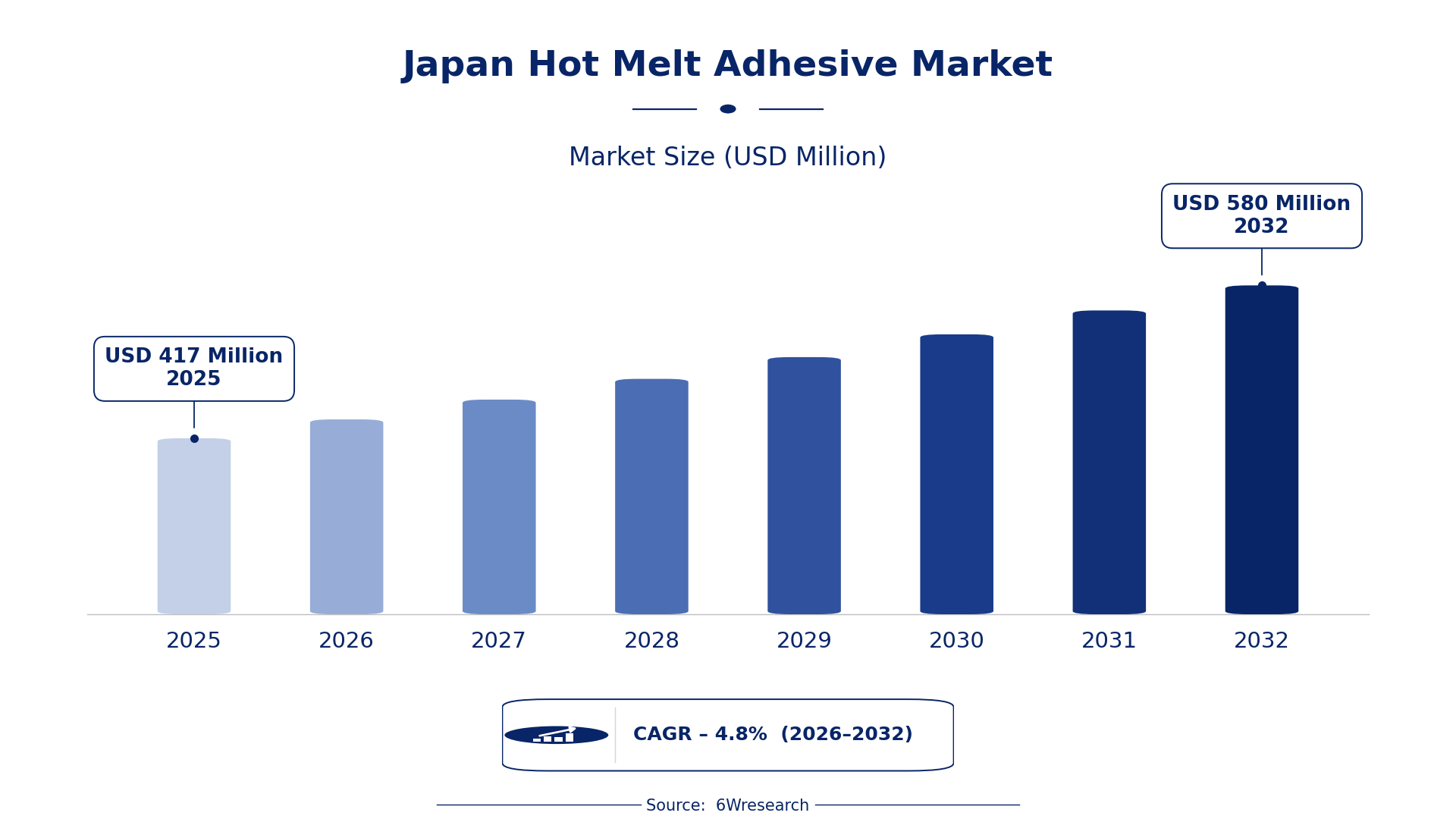
According to 6Wresearch internal database and industry insights, the Japan Hot Melt Adhesive Market was valued at USD 417 Million in 2025 and is projected to reach USD 580 Million by 2032, growing at a CAGR of approximately 4.8% during 2026–2032.
Japan Hot Melt Adhesive Market Highlights
| Report Metric | Details |
| Report Name | Japan Hot Melt Adhesive Market (2026-2032) |
| Market Size 2025 | USD 417 Million |
| Market Size 2032 | USD 580 Million |
| Absolute Growth 2025–2032 | USD 163 Million |
| CAGR 2026–2032 | 4.8% |
| Peak Annual Growth | 6.2% in 2026 |
| Forecast Period | 2026–2032 |
| Historical Data | 2022–2025 |
| Base Year | 2025 |
| Leading Product Type, 2025 | EVA-based Adhesives (50% share) |
| Leading Resin Type, 2025 | Ethylene Vinyl Acetate (51% share) |
| Leading End User, 2025 | Packaging Manufacturers (42% share) |
| Leading Application, 2025 | Carton Sealing (49% share) |
| Fastest-Growing Product Type | Polyurethane-based Adhesives (6.6% CAGR) |
| Fastest-Growing Resin Type | Synthetic and Bio-based (7.1% CAGR) |
| Fastest-Growing End User | Textile and Footwear Industry (6.1% CAGR) |
| Fastest-Growing Application | Shoe Assembly (6.3% CAGR) |
| Growing Sector | packaging |
| Key End Users | packaging manufacturers, automotive industry, textile and footwear industry, woodworking sector |
Japan Hot Melt Adhesive Market Year-wise Growth Rate and Key Drivers (2022–2032)
This graph illustrates the annual growth rates of the market from 2022 to 2032, highlighting a steady upward trajectory and projected market expansion over the forecast period.
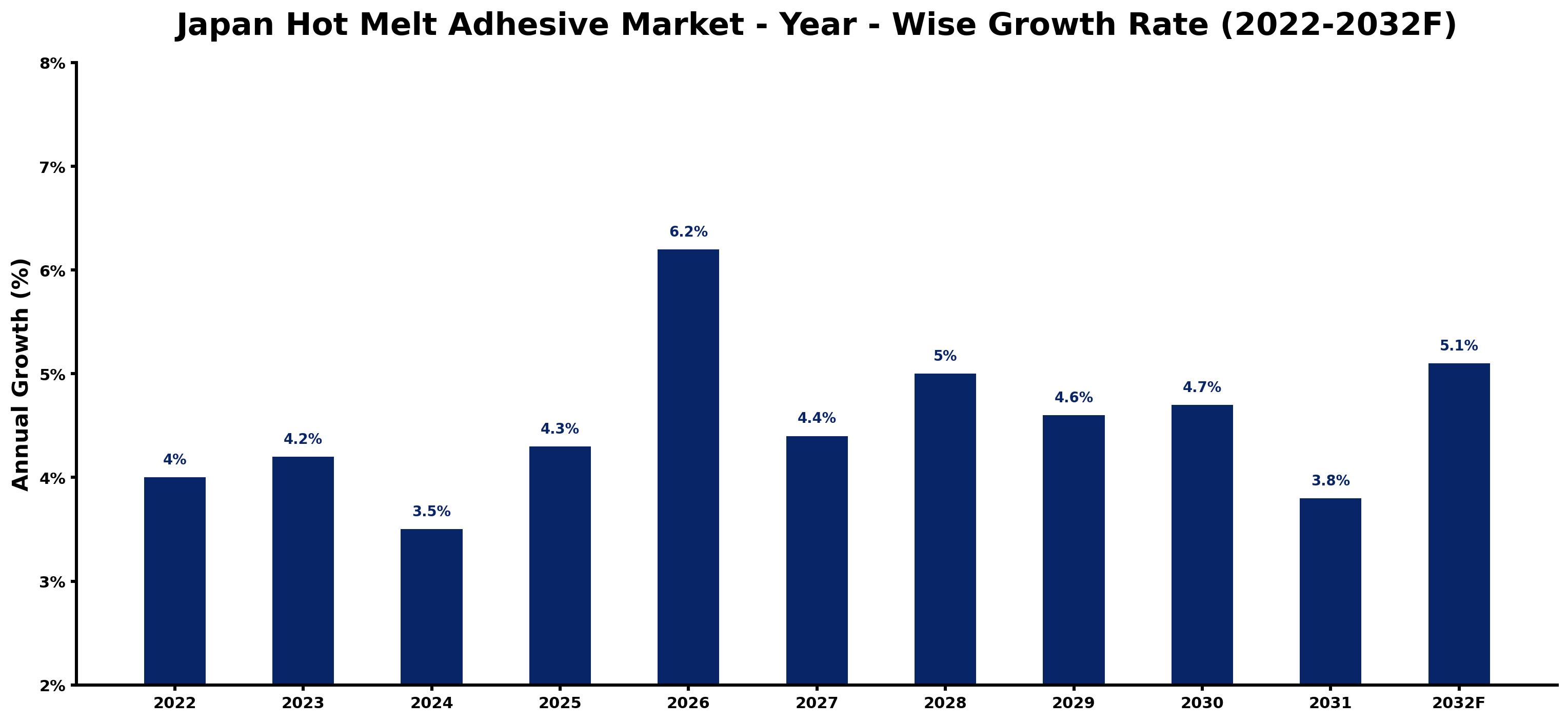
Each row of the following table gives one year's estimated growth and the event or demand shift that explains it.
| Year | Estimated Annual Growth (%) | Market Rationale |
| 2022 | 4.0 | The market experienced stable growth, supported by steady demand from the packaging sector. |
| 2023 | 4.2 | Growth accelerated due to increased production in the automotive industry, boosting adhesive use. |
| 2024 | 3.5 | Growth slowed as the market adjusted to previous high demand levels in packaging. |
| 2025 | 4.3 | The market rebounded with faster growth, driven by innovations in adhesive formulations. |
| 2026 | 6.2 | Peak growth is anticipated as demand surges from the automotive and packaging sectors. |
| 2027 | 4.4 | Growth is projected to slow as the market stabilises after the peak, still benefiting from strong demand. |
| 2028 | 5.0 | The market is expected to see renewed growth, driven by advancements in bio-based adhesive technologies. |
| 2029 | 4.6 | Growth is projected to slow again as the market adjusts to the previous year's high levels. |
| 2030 | 4.7 | Growth is expected to pick up, supported by rising demand from the textile and footwear industries. |
| 2031 | 3.8 | The market is projected to slow as it stabilises, with consistent demand from established sectors. |
| 2032 | 5.1 | Growth is expected to resume, driven by increased investments in sustainable adhesive solutions. |
Note: Market size estimations and growth projections presented in this report are based on 6Wresearch's proprietary forecasting methodology, utilizing the latest available industry data, government publications, and primary research inputs.
Japan Hot Melt Adhesive Market Synopsis
Hot melt adhesives are thermoplastic adhesives made from polymers, resins, and additives, primarily used in packaging, automotive interiors, textiles, and woodworking. The Japan Hot Melt Adhesive Market is growing due to rising demand from the packaging industry, which accounts for 42% of adhesive use, particularly in carton sealing applications. The automotive sector is a major end-user, especially for interior trims, while government programs promote innovation in adhesive technologies, further supporting market expansion.
Market Dynamics Impact Analysis (2026–2032)
| Factor | Type | Impact | Primary Segment Affected |
| Strong demand from the packaging industry drives adhesive consumption. | Driver | High | EVA-based Adhesives |
| The automotive industry's growth boosts demand for adhesives in interior trims. | Driver | High | Polyurethane-based Adhesives |
| Emerging demand for bio-based adhesives presents new market opportunities. | Opportunity | Medium | Synthetic and Bio-based |
| Rising investments in sustainable adhesive technologies create market potential. | Opportunity | High | Polyolefin-based Adhesives |
| Compliance with the JIS standard can limit market entry for new products. | Restraint | High | Polyurethane-based Adhesives |
| Competition from alternative adhesive technologies may hinder market growth. | Restraint | Medium | EVA-based Adhesives |
| High production costs for bio-based adhesives challenge market expansion. | Challenge | High | Synthetic and Bio-based |
| Limited awareness of hot melt adhesive benefits restricts market penetration. | Challenge | Medium | Polyolefin-based Adhesives |
Evaluation of Drivers in Japan Hot Melt Adhesive Market (2026–2032)
The main growth drivers and the segments they affect most are set out below.
| Drivers | Primary Segment Affected | Why It Matters (Evidence) |
| Increased demand from the packaging industry boosts adhesive consumption. | EVA-based Adhesives | The packaging sector accounted for 42% of adhesive use, with carton sealing applications driving growth. |
| Expansion of the automotive industry increases the need for adhesives. | Polyurethane-based Adhesives | Japan's automotive production ranks among the highest globally, leading to higher adhesive consumption for interior trims. |
| Focus on sustainability drives demand for bio-based adhesives. | Synthetic and Bio-based | The growing consumer preference for eco-friendly products is pushing manufacturers to explore bio-based adhesive options. |
| Technological advancements in adhesive formulations improve performance. | Polyolefin-based Adhesives | Innovations in adhesive technology enhance bonding capabilities, attracting more users in various applications. |
| Consumer preferences for lightweight materials boost adhesive use. | EVA-based Adhesives | The trend towards lightweight packaging solutions in Japan is increasing the demand for effective hot melt adhesives. |
Much of the new demand traces back to the packaging industry's growth, which accounted for 42% of adhesive use, particularly in carton sealing applications. The automotive sector also contributes significantly, with Japan's production levels leading to increased adhesive consumption for interior trims. The focus on sustainability is prompting manufacturers to explore bio-based adhesive options, with a notable increase in demand from the textile and footwear industries. Consumer preferences for lightweight materials are pushing manufacturers to adopt hot melt adhesives, reflecting a shift in production strategies in the packaging and automotive sectors.
Evaluation of Restraints in Japan Hot Melt Adhesive Market
The key brakes on demand, and where they bite hardest, are shown below.
| Market Restraint | Primary Segment Affected | Why It Matters (Evidence) |
| Compliance with the JIS standard can limit market entry for new products. | Polyurethane-based Adhesives | Producers must ensure their products meet strict quality and safety standards, which can delay market entry. |
| Competition from alternative adhesive technologies may hinder market growth. | EVA-based Adhesives | Emerging technologies can offer similar bonding capabilities, diverting demand from traditional hot melt adhesives. |
| High production costs for bio-based adhesives challenge market expansion. | Synthetic and Bio-based | The cost of sourcing sustainable materials can make bio-based adhesives less competitive in pricing. |
| Limited awareness of hot melt adhesive benefits restricts market penetration. | Polyolefin-based Adhesives | Many potential users remain unaware of the advantages of hot melt adhesives, limiting their adoption. |
| Market saturation in key sectors may slow growth rates. | EVA-based Adhesives | As the market matures, growth rates may decline due to saturation in established applications. |
Japan Hot Melt Adhesive Market Challenges
EVA-based adhesives are crucial for carton sealing, but outdated technology in production lines results in inefficiencies, costing packaging manufacturers up to 15% in lost productivity. Rising raw material prices, particularly for resins, inflate costs for producers, leading to a 10% increase in prices for end-users. Supply chain disruptions, exacerbated by global events, delay deliveries of essential adhesive components, causing production holdups for the automotive and woodworking sectors. A shortage of skilled workers in adhesive application techniques hampers growth, forcing clinics and plants to invest in training programmes, which can take up to six months to yield results.
Trends in the Japan Hot Melt Adhesive Market
The following changes are redrawing the Japan Hot Melt Adhesive Market.
- Packaging Manufacturers Adopting Sustainable Practices: Packaging manufacturers are increasingly using bio-based adhesives to meet consumer demand for sustainable products. In 2023, the demand for bio-based adhesives rose by 15%, reflecting a shift towards sustainability in the industry.
- Automotive Industry Embracing Lightweight Solutions: The automotive industry in Japan is moving towards lightweight materials, increasing the use of hot melt adhesives for interior trims. In 2022, approximately 30% of new automotive models incorporated lightweight materials, driving adhesive demand.
- Advancements in Adhesive Applications: Innovations in adhesive formulations are becoming more prevalent, with manufacturers focusing on performance improvements. In 2024, 40% of hot melt adhesives produced in Japan will feature advanced bonding capabilities, catering to diverse applications.
- Textile and Footwear Sector Focusing on Efficiency: The textile and footwear industry is prioritising efficiency in production processes, leading to greater reliance on hot melt adhesives for shoe assembly. In 2025, this sector is expected to account for 25% of total adhesive consumption.
Investment Opportunities in the Japan Hot Melt Adhesive Market
Below are the investment opportunities with the strongest case in the Japan Hot Melt Adhesive Market.
- Growing Market for Bio-based Adhesives: The increasing consumer preference for sustainable products creates an opportunity in the bio-based adhesive sector. With demand rising, manufacturers can invest in bio-based formulations to capture this market, projected to grow by 15% annually.
- Automotive Sector Expansion: The automotive industry's growth presents an opportunity for suppliers to provide advanced adhesive solutions. By partnering with automotive manufacturers, suppliers can strengthen their market presence and meet increasing adhesive needs, particularly for interior trims.
- Investment in Innovative Packaging Solutions: With the packaging industry contributing significantly to adhesive demand, there is a chance to invest in innovative adhesive technologies. Suppliers can target packaging manufacturers to supply high-performance adhesives, capitalising on market growth projected at 4.8% through 2032.
- Focus on Advanced Adhesive Formulations: The trend towards advanced adhesive technologies creates an opportunity for suppliers to develop new products. By focusing on performance improvements, manufacturers can attract new users in various sectors, responding to evolving market needs.
Government Initiatives in the Japan Hot Melt Adhesive Market
The JIS standard governs the quality of adhesives used in Japan, ensuring compliance and safety. This standard mandates rigorous testing and certification processes for producers, ensuring product reliability. The Green Growth Strategy promotes innovation in adhesive technologies, identifying growth sectors and encouraging sustainable practices, with a target of reducing carbon emissions by 50% by 2030.
Packaging manufacturers utilise government programs to support innovation in adhesive technologies. The Japan Adhesive Industry Association facilitates collaboration and knowledge sharing, playing a key role in promoting hot melt adhesives across various industries. Programs funding research and development initiatives have seen investments of approximately USD 10 million in the past year, benefiting manufacturers and improving product offerings.
Future Insight of the Japan Hot Melt Adhesive Market
By 2032, government programs will drive the adoption of advanced adhesive technologies, enhancing production efficiency and reducing costs for suppliers. The demand for bio-based adhesives will grow as buyers increasingly prioritise sustainability, reflecting a broader industry shift. New quality standards will emerge, ensuring compliance and safety in adhesive applications, which will benefit both buyers and suppliers. Japan's automotive production is projected to rise by 20%, further elevating the demand for high-performance hot melt adhesives.
Market Segmentation Analysis
Japan Hot Melt Adhesive Market report covers a detailed analysis of the following market segments:
By Product Type – EVA-based Adhesives Lead, Polyurethane-based Adhesives Expected to Grow Fastest
According to Sachin Kumar Rai, Senior Research Analyst at 6Wresearch, with 50% of product type revenue in 2025, EVA-based Adhesives was the largest category. EVA-based adhesives are extensively utilised in packaging and woodworking applications, establishing their prominence among manufacturers. Their strong performance in carton sealing makes them a preferred choice, particularly in Japan's robust packaging industry. Polyurethane-based Adhesives are set to record the highest CAGR in this split, 6.6% over 2026–2032. The polyurethane-based adhesives segment is rapidly expanding, primarily due to their critical applications in automotive and furniture bonding. As Japan's automotive production continues to rise, the demand for these adhesives is anticipated to grow significantly. Suppliers must enhance their product lines in polyurethane-based adhesives to leverage the expanding automotive sector.
By Resin Type – Ethylene Vinyl Acetate Leads, Synthetic and Bio-based Expected to Grow Fastest
Ethylene Vinyl Acetate took 51% of resin type revenue in 2025, more than any other category. Ethylene vinyl acetate serves as a key component in numerous adhesive formulations, making it highly sought after by manufacturers across various industries. Its established presence in the market solidifies its leading position among resin types. Over 2026–2032, Synthetic and Bio-based is expected to post the fastest growth, at a CAGR of 7.1%. The synthetic and bio-based segment is emerging as a growth area, driven by increasing interest in sustainable adhesive solutions. As environmental concerns rise, this segment is likely to attract more attention and investment in the coming years. Buyers may benefit from exploring synthetic and bio-based options as sustainability becomes a priority in adhesive procurement.
By End User – Packaging Manufacturers Lead, Textile and Footwear Industry Expected to Grow Fastest
Packaging Manufacturers held 42% of the Japan Hot Melt Adhesive Market by end user in 2025. Packaging manufacturers represent the largest consumer group for hot melt adhesives, primarily utilising them for carton sealing. The robust growth of the packaging industry in Japan drives substantial demand for effective bonding solutions. Textile and Footwear Industry is projected to grow fastest, at a CAGR of 6.1% during 2026–2032. The textile and footwear industry is experiencing notable growth, particularly in shoe assembly processes, which is increasing the need for hot melt adhesives. As this sector expands, it is expected to play a larger role in the overall adhesive market. Suppliers should develop targeted strategies to cater to the specific requirements of the textile and footwear industry.
By Application – Carton Sealing Leads, Shoe Assembly Expected to Grow Fastest
The largest application category in 2025 was Carton Sealing, at 49% of revenue. Carton sealing is the primary application for hot melt adhesives, especially within the packaging sector where efficiency and reliability are essential. This prevalent use underscores its significance and reinforces its leading market position. The quickest growth will come from Shoe Assembly, forecast to expand at a CAGR of 6.3% between 2026 and 2032. Shoe assembly is emerging as a vital application for hot melt adhesives, driven by growth in the footwear manufacturing sector. With rising demand for footwear, this application is set for rapid development. Suppliers should focus on innovations in adhesive solutions specifically designed for shoe assembly to seize new market opportunities.
Key Attractiveness of the Report
- 10 Years of Market Numbers
- Historical Data Starting from 2022 to 2025
- Base Year 2025
- Forecast Data until 2032
- Key Performance Indicators Impacting the Market
- Major Upcoming Developments and Projects
Key Highlights of the Report:
- Japan Hot Melt Adhesive Market Outlook
- Market Size of Japan Hot Melt Adhesive Market,2025
- Forecast of Japan Hot Melt Adhesive Market, 2032
- Historical Data and Forecast of Japan Hot Melt Adhesive Revenues & Volume for the Period 2022-2032
- Japan Hot Melt Adhesive Market Trend Evolution
- Japan Hot Melt Adhesive Market Drivers and Challenges
- Japan Hot Melt Adhesive Price Trends
- Japan Hot Melt Adhesive Porter's Five Forces
- Japan Hot Melt Adhesive Industry Life Cycle
- Historical Data and Forecast of Japan Hot Melt Adhesive Market Revenues & Volume By Product Type for the Period 2022-2032
- Historical Data and Forecast of Japan Hot Melt Adhesive Market Revenues & Volume By EVA-based Adhesives for the Period 2022-2032
- Historical Data and Forecast of Japan Hot Melt Adhesive Market Revenues & Volume By Polyolefin-based Adhesives for the Period 2022-2032
- Historical Data and Forecast of Japan Hot Melt Adhesive Market Revenues & Volume By Polyamide-based Adhesives for the Period 2022-2032
- Historical Data and Forecast of Japan Hot Melt Adhesive Market Revenues & Volume By Polyurethane-based Adhesives for the Period 2022-2032
- Historical Data and Forecast of Japan Hot Melt Adhesive Market Revenues & Volume By Resin Type for the Period 2022-2032
- Historical Data and Forecast of Japan Hot Melt Adhesive Market Revenues & Volume By Ethylene Vinyl Acetate for the Period 2022-2032
- Historical Data and Forecast of Japan Hot Melt Adhesive Market Revenues & Volume By Polypropylene and Polyethylene for the Period 2022-2032
- Historical Data and Forecast of Japan Hot Melt Adhesive Market Revenues & Volume By Synthetic and Bio-based for the Period 2022-2032
- Historical Data and Forecast of Japan Hot Melt Adhesive Market Revenues & Volume By Thermoplastic and Thermoset for the Period 2022-2032
- Historical Data and Forecast of Japan Hot Melt Adhesive Market Revenues & Volume By End User for the Period 2022-2032
- Historical Data and Forecast of Japan Hot Melt Adhesive Market Revenues & Volume By Packaging Manufacturers for the Period 2022-2032
- Historical Data and Forecast of Japan Hot Melt Adhesive Market Revenues & Volume By Automotive Industry for the Period 2022-2032
- Historical Data and Forecast of Japan Hot Melt Adhesive Market Revenues & Volume By Textile and Footwear Industry for the Period 2022-2032
- Historical Data and Forecast of Japan Hot Melt Adhesive Market Revenues & Volume By Wood working Sector for the Period 2022-2032
- Historical Data and Forecast of Japan Hot Melt Adhesive Market Revenues & Volume By Application for the Period 2022-2032
- Historical Data and Forecast of Japan Hot Melt Adhesive Market Revenues & Volume By Carton Sealing for the Period 2022-2032
- Historical Data and Forecast of Japan Hot Melt Adhesive Market Revenues & Volume By Interior Trims for the Period 2022-2032
- Historical Data and Forecast of Japan Hot Melt Adhesive Market Revenues & Volume By Shoe Assembly for the Period 2022-2032
- Historical Data and Forecast of Japan Hot Melt Adhesive Market Revenues & Volume By Furniture Bonding for the Period 2022-2032
- Japan Hot Melt Adhesive Import Export Trade Statistics
- Market Opportunity Assessment By Product Type
- Market Opportunity Assessment By Resin Type
- Market Opportunity Assessment By End User
- Market Opportunity Assessment By Application
- Japan Hot Melt Adhesive Top Companies Market Share
- Japan Hot Melt Adhesive Competitive Benchmarking By Technical and Operational Parameters
- Japan Hot Melt Adhesive Company Profiles
- Japan Hot Melt Adhesive Key Strategic Recommendations
Market Covered
Coverage by segment is as follows.
By Product Type
- EVA-based Adhesives
- Polyolefin-based Adhesives
- Polyamide-based Adhesives
- Polyurethane-based Adhesives
By Resin Type
- Ethylene Vinyl Acetate
- Polypropylene and Polyethylene
- Synthetic and Bio-based
- Thermoplastic and Thermoset
By End User
- Packaging Manufacturers
- Automotive Industry
- Textile and Footwear Industry
- Wood working Sector
By Application
- Carton Sealing
- Interior Trims
- Shoe Assembly
- Furniture Bonding































