Japan Human-Centric Computing Market Size & Growth Rate
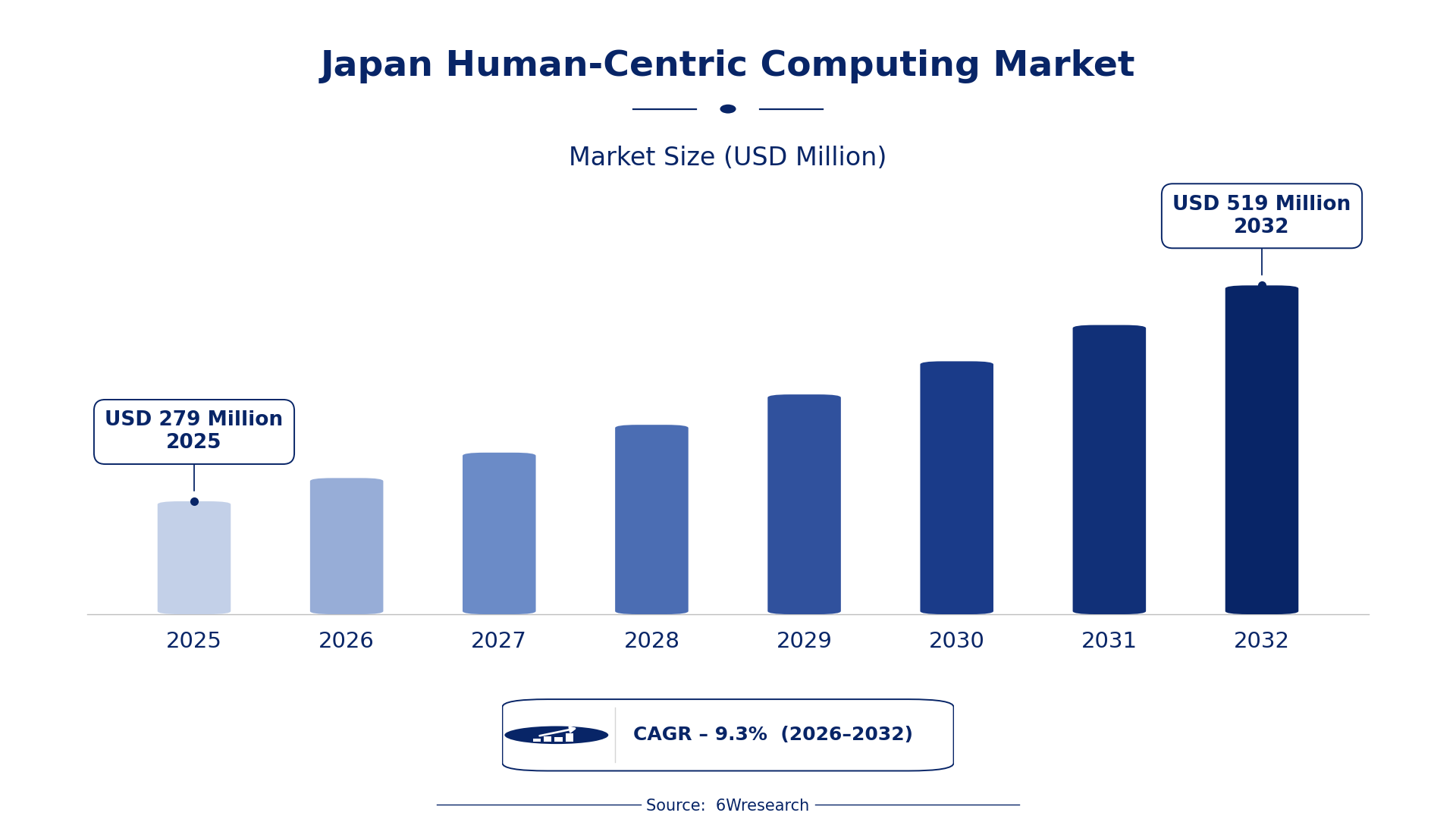
According to 6Wresearch internal database and industry insights, the Japan Human-Centric Computing Market was valued at USD 279 Million in 2025 and is projected to reach USD 519 Million by 2032, growing at a CAGR of approximately 9.3% during 2026–2032.
Japan Human-Centric Computing Market Highlights
| Report Metric | Details |
| Report Name | Japan Human-Centric Computing Market (2026-2032) |
| Market Size 2025 | USD 279 Million |
| Market Size 2032 | USD 519 Million |
| Absolute Growth 2025–2032 | USD 240 Million |
| CAGR 2026–2032 | 9.3% |
| Peak Annual Growth | 12.5% in 2026 |
| Forecast Period | 2026–2032 |
| Historical Data | 2022–2025 |
| Base Year | 2025 |
| Leading Technology Type, 2025 | Emotion Recognition (39% share) |
| Leading Application Area, 2025 | Smart Environments (42% share) |
| Leading Distribution Channel, 2025 | AI Software Firms (38% share) |
| Leading End User, 2025 | Healthcare & Wellness (38% share) |
| Fastest-Growing Technology Type | Context-Aware Systems (13.1% CAGR) |
| Fastest-Growing Application Area | Wearable Systems (11.1% CAGR) |
| Fastest-Growing End User | Smart Homes/Buildings (12.0% CAGR) |
| Growing Sector | Healthcare & Wellness |
| Key End Users | Healthcare providers, technology developers, urban planners |
Japan Human-Centric Computing Market Year-wise Growth Rate and Key Drivers (2022–2032)
This graph illustrates the annual growth rates of the market from 2022 to 2032, highlighting a steady upward trajectory and projected market expansion over the forecast period.
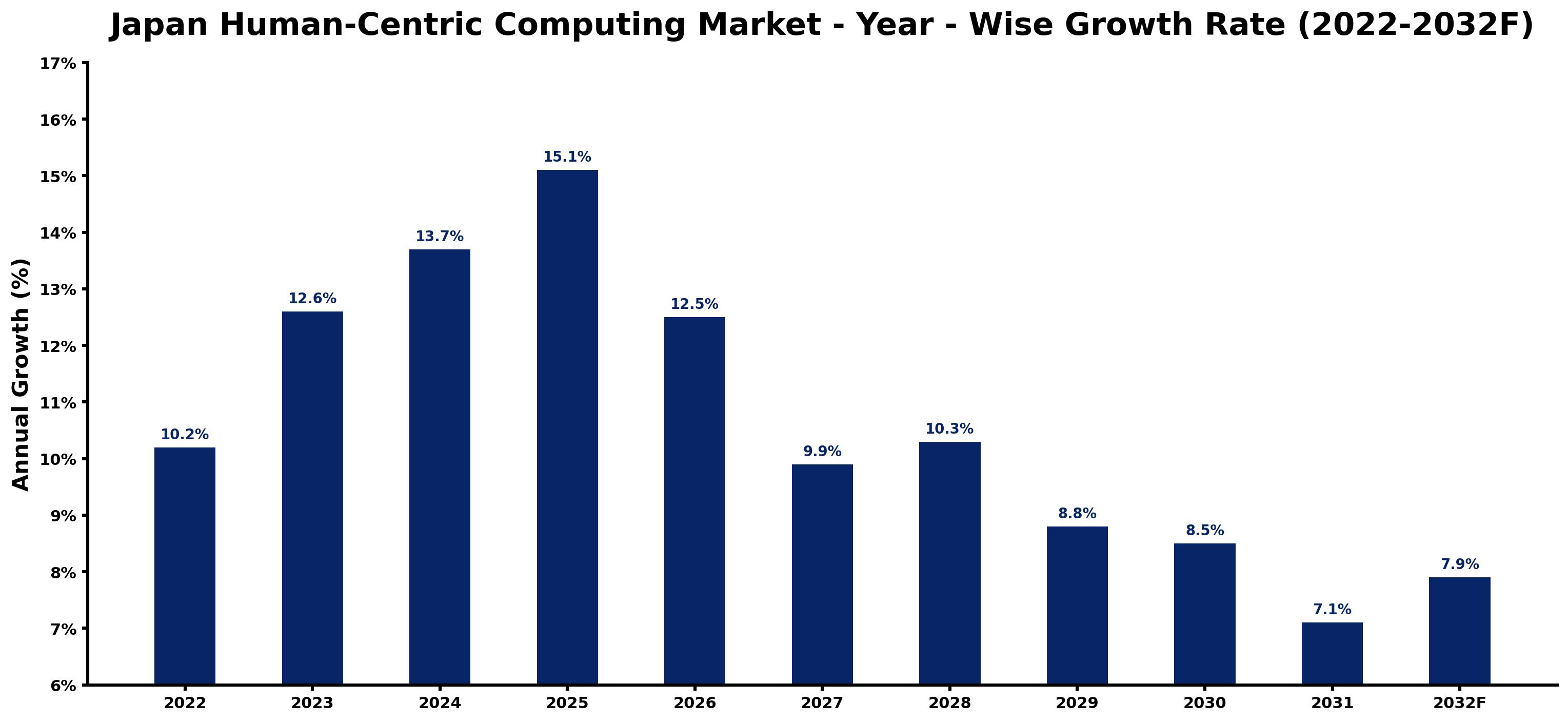
The yearly estimates that follow link every growth rate to its principal driver, so readers can see why the pace changed in each period.
| Year | Estimated Annual Growth (%) | Market Rationale |
| 2022 | 10.2 | The market experienced solid growth as demand for human-centric technologies surged across various sectors. |
| 2023 | 12.6 | Growth accelerated due to increased adoption of wearable devices among the population. |
| 2024 | 13.7 | The rise in healthcare applications drove further demand for emotion recognition technologies. |
| 2025 | 15.1 | The peak growth was achieved as smart environments gained widespread acceptance in urban areas. |
| 2026 | 12.5 | Growth slowed slightly as the market began to stabilise after the peak year. |
| 2027 | 9.9 | A further slowdown occurred as the market adjusted to previous high growth rates. |
| 2028 | 10.3 | Demand picked up again as innovation in smart homes revitalised interest in the sector. |
| 2029 | 8.8 | Growth decelerated as competition intensified among technology providers in the market. |
| 2030 | 8.5 | The market continued to slow down as saturation in certain segments became apparent. |
| 2031 | 7.1 | A further slowdown was noted as the market matured and innovation cycles lengthened. |
| 2032 | 7.9 | Growth rebounded slightly as new applications in healthcare emerged, stimulating demand. |
Note: Market size estimations and growth projections presented in this report are based on 6Wresearch's proprietary forecasting methodology, utilizing the latest available industry data, government publications, and primary research inputs.
Japan Human-Centric Computing Market Synopsis
Human-Centric Computing encompasses technologies that adapt to user needs through context awareness and emotional recognition, enhancing user experience in smart environments, healthcare, and wearables. The Japan Human-Centric Computing Market is growing due to a large population of wearable device users, with over 30 million virtual assistant users as of 2023. Smart city initiatives and the Healthcare and Medical Strategy Council are driving investments in technology, leading to increased demand for these solutions across various sectors.
Market Dynamics Impact Analysis (2026–2032)
| Factor | Type | Impact | Primary Segment Affected |
| Growing adoption of wearable devices in healthcare applications | Driver | High | Wearable Systems |
| Expansion of smart city initiatives promoting human-centric technologies | Driver | High | Smart Environments |
| Rising demand for healthcare technologies due to an aging population | Opportunity | High | Healthcare & Wellness |
| Increasing urbanisation leading to more smart home projects | Opportunity | High | Smart Homes/Buildings |
| High competition among technology providers affecting pricing | Restraint | Medium | AI Software Firms |
| Regulatory compliance requirements for data security in applications | Restraint | Medium | Emotion Recognition |
| Limited awareness among end-users about available technologies | Challenge | Medium | Context-Aware Systems |
| High development costs for advanced human-centric applications | Challenge | Medium | Human-Computer Interaction |
Evaluation of Drivers in Japan Human-Centric Computing Market (2026–2032)
The following drivers explain most of the expected growth.
| Drivers | Primary Segment Affected | Why It Matters (Evidence) |
| Increased healthcare spending | Healthcare & Wellness | Japan's healthcare sector, with over 1.2 million hospital beds, drives demand for human-centric technologies. |
| Smart city initiatives | Smart Environments | Promoting smart city initiatives leads to increased technology adoption in urban areas. |
| Growing user base for virtual assistants | Wearable Systems | The wearable technology market is projected to reach 3.5 billion USD by 2025, driving innovation. |
| Rising awareness of emotion recognition applications | Emotion Recognition | Advancements in research boost market growth and application in healthcare. |
| Investment in smart home technologies | Smart Homes/Buildings | The Smart City Strategy aims to integrate human-centric computing into urban planning by 2025. |
Purchasing is picking up as the healthcare sector expands, with over 1.2 million hospital beds driving demand for human-centric technologies. Urban areas are adopting smart city projects, leading to increased technology integration. The rise in users of virtual assistants is stimulating demand for human-centric computing. The wearable technology market is set to reach 3.5 billion USD by 2025, further driving innovation. Research in emotion recognition technologies is advancing, which is important for improving user experience in healthcare applications.
Evaluation of Restraints in Japan Human-Centric Computing Market
These are the pressures that could keep growth below its potential.
| Market Restraint | Primary Segment Affected | Why It Matters (Evidence) |
| Intense competition among technology providers | AI Software Firms | High competition leads to pricing pressures, affecting profitability for providers in Japan. |
| Regulatory compliance for data security | Emotion Recognition | Compliance with ISO/IEC 27001 standards increases operational costs for developers. |
| Limited consumer awareness of technologies | Context-Aware Systems | Many potential users remain unaware of the benefits and applications of context-aware systems. |
| High development costs for advanced applications | Human-Computer Interaction | Developing sophisticated human-computer interaction systems requires substantial investment. |
| Slow adoption rates in certain sectors | Wearable Systems | Some sectors are hesitant to adopt new technologies due to cost and training requirements. |
Japan Human-Centric Computing Market Challenges
The primary challenge in the human-centric computing market is intense competition, which pressures producers to lower prices, diminishing profit margins and limiting R&D investments. Skills shortages in advanced algorithms persist, causing delays in developing effective solutions, especially for healthcare providers who depend on timely innovations. Rapid technological advancements create a divide between existing capabilities and market demands, compelling clinics to invest in frequent upgrades, diverting funds from essential services. Supply chain disruptions can delay the procurement of critical components, raising operational costs for hospitals by up to 20%.
Trends in the Japan Human-Centric Computing Market
Below are the shifts with the largest effect on the Japan Human-Centric Computing Market.
- Shift towards Smart City Initiatives: The Tokyo Metropolitan Area is integrating human-centric computing into urban planning, aiming for smart city solutions by 2025. This shift is set to improve urban living standards and drive technology adoption.
- Growing Demand for Wearable Health Technologies: Japan's wearable technology market is projected to reach 3.5 billion USD by 2025, reflecting strong demand for health monitoring devices. This trend encourages suppliers to innovate and expand their product offerings.
- Increased Focus on Emotion Recognition: Research in emotion recognition technologies is advancing, which is important for improving user experience in healthcare applications. This focus is expected to drive market growth.
- Expansion of Virtual Assistants in Daily Life: With over 30 million users of virtual assistants as of 2023, their integration into daily routines is transforming user interaction. This trend highlights the need for more human-centric computing solutions.
Investment Opportunities in the Japan Human-Centric Computing Market
The following areas offer the clearest openings for investors and suppliers in the Japan Human-Centric Computing Market.
- Investment in Smart Home Technologies: The Smart City Strategy aims to incorporate human-centric computing into urban planning by 2025, creating opportunities for investment in smart home technologies. Urban developers and technology providers can capitalise on this trend.
- Healthcare Technology Advancements: The establishment of the Healthcare and Medical Strategy Council in 2020 offers opportunities for investment in healthcare technologies. This initiative seeks to enhance patient engagement and monitoring solutions.
- Growth in Wearable Device Adoption: As Japan's population increasingly adopts wearable devices, there is a considerable opportunity for suppliers to create innovative health monitoring solutions. This trend is particularly pertinent for healthcare providers.
- Expansion of AI Software Firms: AI Software Firms are excelling in distribution channels, with a projected growth of 12.1% from 2026 to 2032. Partnering with local entities can assist new entrants in accessing this expanding market.
Government Initiatives in the Japan Human-Centric Computing Market
The Act on the Rational Use of Energy, established in 1979, mandates energy efficiency improvements among large users. This law encourages producers of human-centric computing technologies to develop energy-efficient solutions, aligning with Japan's sustainability goals. The Semiconductor and Digital Industry Strategy, introduced in June 2021, aims to secure domestic semiconductor manufacturing, which is vital for the production of advanced computing technologies.
The Economic Security Promotion Act of 2022 supports supply-chain resilience for critical products, including those used in human-centric computing. The Ministry of Economy, Trade and Industry oversees this act, ensuring that producers and buyers can rely on a stable supply of essential materials.
Future Insight of the Japan Human-Centric Computing Market
By 2032, a notable policy shift will drive the integration of human-centric computing into urban planning, leading to improved collaboration between suppliers and local governments. The healthcare sector will experience enhancements in patient care as the Healthcare and Medical Strategy Council advances technology initiatives. With Japan's wearable technology market projected to reach 3.5 billion USD by 2025, suppliers must develop user-friendly applications to satisfy rising demand. The adoption of ISO/IEC 27001 will bolster data security, building user trust and facilitating broader technology adoption.
Market Segmentation Analysis
Japan Human-Centric Computing Market report covers a detailed analysis of the following market segments:
By Technology Type – Emotion Recognition Leads, Context-Aware Systems Expected to Grow Fastest
According to Saurav Kr Singh, Senior Research Analyst at 6Wresearch, with 39% of technology type revenue in 2025, Emotion Recognition was the largest category. Emotion recognition holds the largest share due to its critical applications in healthcare, where over 1.2 million hospital beds require patient emotion monitoring. This technology is essential for improving patient care and engagement, making it a priority in medical settings. Context-Aware Systems are projected to grow fastest, at a CAGR of 13.1% during 2026–2032. Context-aware systems are experiencing rapid growth as they adapt environments based on user interactions, particularly in smart homes. The push for smart city initiatives further accelerates this trend, with integration expected by 2025. Suppliers should focus on developing context-aware solutions to meet the increasing demand for adaptable environments.
By Application Area – Smart Environments Lead, Wearable Systems Expected to Grow Fastest
Smart Environments held 42% of the Japan Human-Centric Computing Market by application area in 2025. Smart environments represent the largest share due to their critical role in home automation systems, particularly in urban centres like the Tokyo Metropolitan Area. These technologies significantly improve user experiences by adapting to individual needs in real-time. Over 2026–2032, Wearable Systems are expected to post the fastest growth, at a CAGR of 11.1%. Wearable systems are witnessing rapid growth as they are increasingly used in health monitoring devices, essential for personal health management. The wearable technology market is on track to reach 3.5 billion USD by 2025, showcasing robust demand. Suppliers should prioritise the development of solutions tailored for smart environments to capitalise on the growing home automation market.
By Distribution Channel – AI Software Firms Lead and Record the Fastest Growth
The largest distribution channel category in 2025 was AI Software Firms, at 38% of revenue. AI software firms lead this segment as they develop software that effectively utilises human-centric technologies, catering to diverse user requirements. Their expertise in advanced algorithms makes them vital players in the market. Its lead should widen, with a projected CAGR of 12.1% during 2026–2032, the highest in this split. AI software firms also represent the fastest-growing segment, as their solutions become indispensable across multiple sectors. Their continuous technological advancements will likely strengthen their market position further. Suppliers need to focus on innovation in their offerings to maintain competitiveness in the AI software market.
By End User – Healthcare & Wellness Leads, Smart Homes/Buildings Expected to Grow Fastest
Healthcare & Wellness accounted for 38% of the market by end user in 2025. Healthcare and wellness is the leading end user, heavily relying on human-centric computing for patient engagement and monitoring. The extensive infrastructure in this sector facilitates the adoption of advanced technologies to improve patient outcomes. Smart Homes/Buildings are set to record the highest CAGR in this split, 12.0% over 2026–2032. Smart homes and buildings represent the fastest-growing end user segment, employing human-centric computing for automation and improved living conditions. The Smart City Strategy aims to integrate these technologies into urban planning by 2025, further driving growth. Buyers in the smart home sector should seek collaborations with technology providers to harness advancements in human-centric computing.
Key Attractiveness of the Report
- 10 Years of Market Numbers
- Historical Data Starting from 2022 to 2025
- Base Year 2025
- Forecast Data until 2032
- Key Performance Indicators Impacting the Market
- Major Upcoming Developments and Projects
Key Highlights of the Report:
- Japan Human-Centric Computing Market Outlook
- Market Size of Japan Human-Centric Computing Market, 2025
- Forecast of Japan Human-Centric Computing Market, 2032
- Historical Data and Forecast of Japan Human-Centric Computing Revenues & Volume for the Period 2022-2032F
- Japan Human-Centric Computing Market Trend Evolution
- Japan Human-Centric Computing Market Drivers and Challenges
- Japan Human-Centric Computing Price Trends
- Japan Human-Centric Computing Porter's Five Forces
- Japan Human-Centric Computing Industry Life Cycle
- Historical Data and Forecast of Japan Human-Centric Computing Market Revenues & Volume By Technology Type for the Period 2022-2032F
- Historical Data and Forecast of Japan Human-Centric Computing Market Revenues & Volume By Context-Aware Systems for the Period 2022-2032F
- Historical Data and Forecast of Japan Human-Centric Computing Market Revenues & Volume By Emotion Recognition for the Period 2022-2032F
- Historical Data and Forecast of Japan Human-Centric Computing Market Revenues & Volume By Behavior Modeling for the Period 2022-2032F
- Historical Data and Forecast of Japan Human-Centric Computing Market Revenues & Volume By Sensory Interfaces for the Period 2022-2032F
- Historical Data and Forecast of Japan Human-Centric Computing Market Revenues & Volume By Application Area for the Period 2022-2032F
- Historical Data and Forecast of Japan Human-Centric Computing Market Revenues & Volume By Smart Environments for the Period 2022-2032F
- Historical Data and Forecast of Japan Human-Centric Computing Market Revenues & Volume By Human-Computer Interaction for the Period 2022-2032F
- Historical Data and Forecast of Japan Human-Centric Computing Market Revenues & Volume By Wearable Systems for the Period 2022-2032F
- Historical Data and Forecast of Japan Human-Centric Computing Market Revenues & Volume By Haptic Feedback for the Period 2022-2032F
- Historical Data and Forecast of Japan Human-Centric Computing Market Revenues & Volume By Distribution Channel for the Period 2022-2032F
- Historical Data and Forecast of Japan Human-Centric Computing Market Revenues & Volume By Tech Consultants for the Period 2022-2032F
- Historical Data and Forecast of Japan Human-Centric Computing Market Revenues & Volume By AI Software Firms for the Period 2022-2032F
- Historical Data and Forecast of Japan Human-Centric Computing Market Revenues & Volume By SaaS Vendors for the Period 2022-2032F
- Historical Data and Forecast of Japan Human-Centric Computing Market Revenues & Volume By Online Tech Providers for the Period 2022-2032F
- Historical Data and Forecast of Japan Human-Centric Computing Market Revenues & Volume By End User for the Period 2022-2032F
- Historical Data and Forecast of Japan Human-Centric Computing Market Revenues & Volume By Smart Homes/Buildings for the Period 2022-2032F
- Historical Data and Forecast of Japan Human-Centric Computing Market Revenues & Volume By Virtual Assistants for the Period 2022-2032F
- Historical Data and Forecast of Japan Human-Centric Computing Market Revenues & Volume By Healthcare & Wellness for the Period 2022-2032F
- Historical Data and Forecast of Japan Human-Centric Computing Market Revenues & Volume By XR/AR Developers for the Period 2022-2032F
- Japan Human-Centric Computing Import Export Trade Statistics
- Market Opportunity Assessment By Technology Type
- Market Opportunity Assessment By Application Area
- Market Opportunity Assessment By Distribution Channel
- Market Opportunity Assessment By End User
- Japan Human-Centric Computing Top Companies Market Share
- Japan Human-Centric Computing Competitive Benchmarking By Technical and Operational Parameters
- Japan Human-Centric Computing Company Profiles
- Japan Human-Centric Computing Key Strategic Recommendations
Market Covered
The following segment groups are covered in the report.
By Technology Type
- Context-Aware Systems
- Emotion Recognition
- Behavior Modeling
- Sensory Interfaces
By Application Area
- Smart Environments
- Human-Computer Interaction
- Wearable Systems
- Haptic Feedback
By Distribution Channel
- Tech Consultants
- AI Software Firms
- SaaS Vendors
- Online Tech Providers
By End User
- Smart Homes/Buildings
- Virtual Assistants
- Healthcare & Wellness
- XR/AR Developers































