Japan Human-Computer Interaction Market Size & Growth Rate
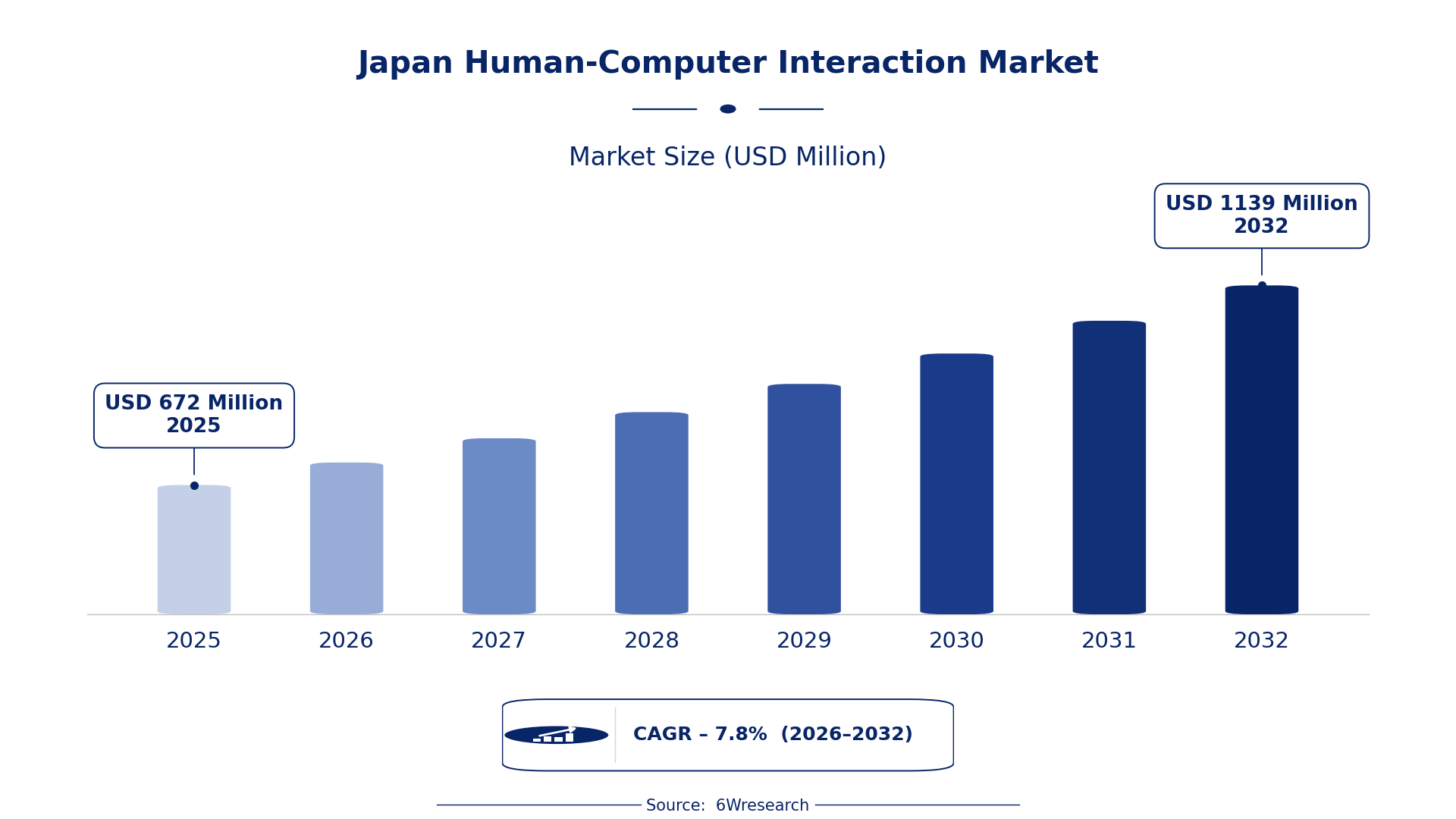
According to 6Wresearch internal database and industry insights, the Japan Human-Computer Interaction Market was valued at USD 672 Million in 2025 and is projected to reach USD 1,139 Million by 2032, growing at a CAGR of approximately 7.8% during 2026–2032.
Japan Human-Computer Interaction Market Highlights
| Report Metric | Details |
| Report Name | Japan Human-Computer Interaction Market (2026-2032) |
| Market Size 2025 | USD 672 Million |
| Market Size 2032 | USD 1,139 Million |
| Absolute Growth 2025–2032 | USD 467 Million |
| CAGR 2026–2032 | 7.8% |
| Peak Annual Growth | 8.7% in 2026 |
| Forecast Period | 2026–2032 |
| Historical Data | 2022–2025 |
| Base Year | 2025 |
| Leading Interaction Type, 2025 | Touch Interfaces (51% share) |
| Leading Interface Device, 2025 | Touchscreens (48% share) |
| Leading Distribution Channel, 2025 | Device Manufacturers (51% share) |
| Leading End User, 2025 | Consumer Electronics (34% share) |
| Fastest-Growing Interaction Type | Voice Interfaces (10.8% CAGR) |
| Fastest-Growing Interface Device | Smart Speakers (10.4% CAGR) |
| Fastest-Growing Distribution Channel | AI Tech Distributors (10.3% CAGR) |
| Fastest-Growing End User | Smart Home Users (10.2% CAGR) |
| Growing Sector | Consumer Electronics |
| Key End Users | Device Manufacturers, Automotive OEMs, Smart Home Users, Research Labs |
Japan Human-Computer Interaction Market Year-wise Growth Rate and Key Drivers (2022–2032)
This graph illustrates the annual growth rates of the market from 2022 to 2032, highlighting a steady upward trajectory and projected market expansion over the forecast period.
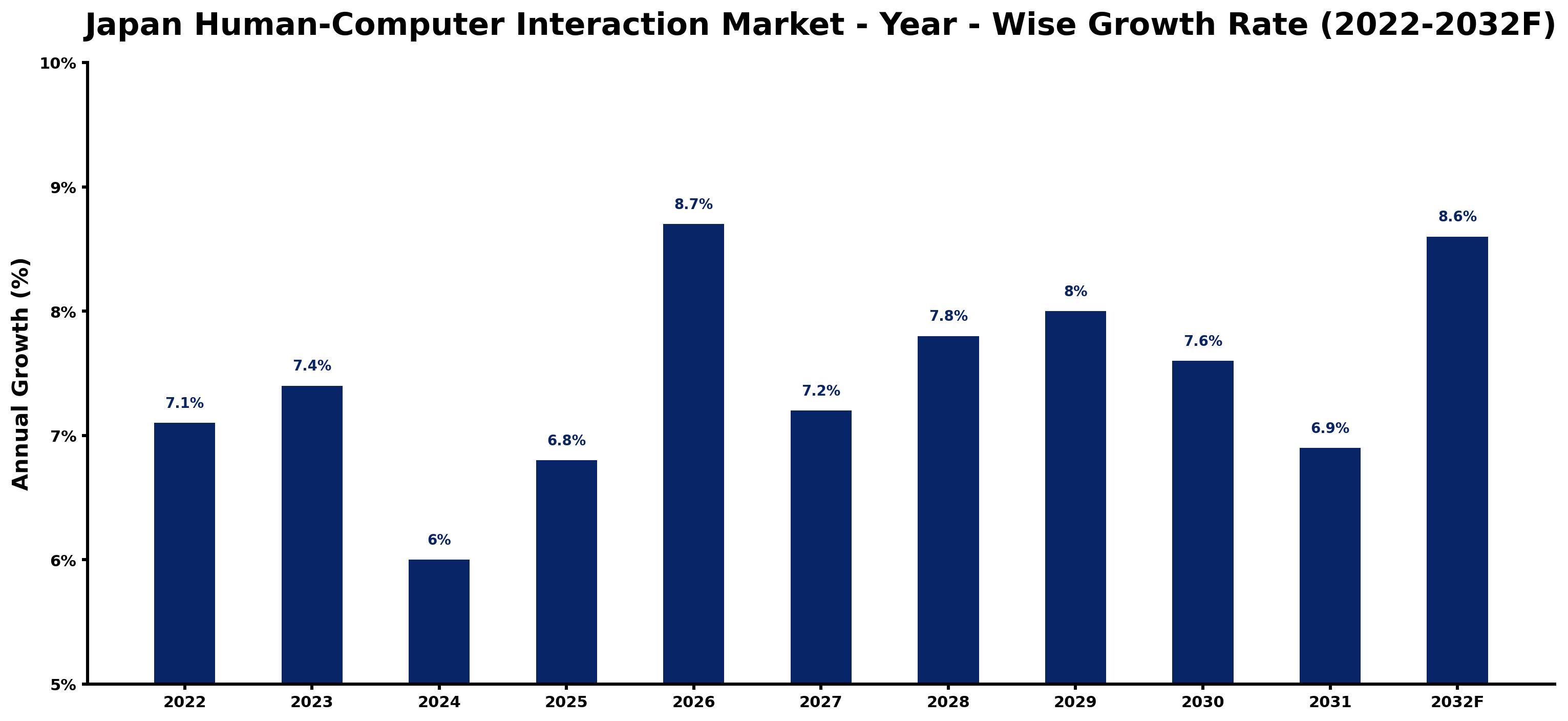
The table below sets out the estimated growth rate for each year and the main factor behind it.
| Year | Estimated Annual Growth (%) | Market Rationale |
| 2022 | 7.1 | The market experienced steady growth due to high consumer interest in smart devices. |
| 2023 | 7.4 | Growth accelerated as smart speaker sales reached 5 million units, reflecting increasing adoption. |
| 2024 | 6.0 | Growth slowed as market saturation began to affect new device sales. |
| 2025 | 6.8 | Demand rose again, driven by advancements in voice technologies and smart home integration. |
| 2026 | 8.7 | The peak growth year will see a surge in investments in AI technologies and automation. |
| 2027 | 7.2 | Growth is projected to slow as the market matures, with increased competition among manufacturers. |
| 2028 | 7.8 | Demand is anticipated to rebound with the rising integration of gesture technologies in automotive applications. |
| 2029 | 8.0 | The market is expected to continue growing as consumer electronics increasingly adopt voice technologies. |
| 2030 | 7.6 | Growth is projected to slow as the market stabilises, reflecting a balance between supply and demand. |
| 2031 | 6.9 | A further slowdown is expected as buyers become more selective in their technology investments. |
| 2032 | 8.6 | Growth is anticipated to accelerate again, driven by new innovations in HCI technologies. |
Note: Market size estimations and growth projections presented in this report are based on 6Wresearch's proprietary forecasting methodology, utilizing the latest available industry data, government publications, and primary research inputs.
Japan Human-Computer Interaction Market Synopsis
Human-Computer Interaction (HCI) encompasses technologies that enable users to interact with computers through various interfaces, including touchscreens and voice technologies. The Japan Human-Computer Interaction Market is expanding, driven by a tech-savvy population and investments in AI integration, particularly in consumer electronics. The 'AI Strategy 2023' supports this growth, while Tokyo's vibrant tech startup environment encourages innovation. Demand is expected to rise across multiple sectors as new technologies emerge, particularly in smart homes and automotive applications.
Market Dynamics Impact Analysis (2026–2032)
| Factor | Type | Impact | Primary Segment Affected |
| Growing adoption of smart devices among consumers | Driver | High | Touch Interfaces |
| Increased integration of AI technologies in consumer electronics | Driver | High | Voice Interfaces |
| Rising demand for smart home technologies | Opportunity | High | Smart Speakers |
| Advancements in automotive applications for gesture interfaces | Opportunity | Medium | Gesture Interfaces |
| Market saturation in consumer electronics | Restraint | High | Touch Interfaces |
| Limited commercial use of brain-computer interfaces | Restraint | Medium | Brain-Computer Interfaces |
| High competition among device manufacturers | Challenge | High | Device Manufacturers |
| Rapid technological advancements requiring constant adaptation | Challenge | Medium | Research Labs |
Evaluation of Drivers in Japan Human-Computer Interaction Market (2026–2032)
The factors lifting demand, and the evidence behind each, are summarised below.
| Drivers | Primary Segment Affected | Why It Matters (Evidence) |
| High consumer adoption of smart devices | Touch Interfaces | In 2023, Japan's population of 125 million shows a high adoption rate of smart devices, driving demand for touch interfaces. |
| Integration of voice technologies in new electronics | Voice Interfaces | Voice interfaces are expected to be integrated into 50% of new consumer electronics by 2025, boosting demand. |
| Growth in smart home technology adoption | Smart Speakers | The Economic Security Promotion Act of 2022 supports supply-chain resilience for critical products, ensuring stability in smart home technology production. |
| Investment in gesture technologies for automotive safety | Gesture Interfaces | Gesture-based technologies are increasingly used in automotive applications, improving driver safety and user experience. |
| Research funding for brain-computer interfaces | Brain-Computer Interfaces | Research labs in Japan focus on developing advanced brain-computer interfaces for medical applications. |
Several shifts outside the market lift sales. The high adoption rate of smart devices, with Japan's population reaching approximately 125 million, drives demand for touch technologies. By 2025, voice technologies are projected to be integrated into half of new consumer electronics, increasing purchases among tech-savvy consumers. Investment in gesture technologies improves automotive safety, while research funding supports brain-computer interface advancements, creating new demand in medical applications. The ongoing development of smart home technologies further fuels the market as consumers seek enhanced automation and convenience.
Evaluation of Restraints in Japan Human-Computer Interaction Market
These restraints slow adoption and weigh on supplier margins.
| Market Restraint | Primary Segment Affected | Why It Matters (Evidence) |
| Market saturation limiting new device sales | Touch Interfaces | As the market matures, saturation in consumer electronics reduces new sales opportunities for touch interfaces. |
| Limited commercial applications for brain-computer interfaces | Brain-Computer Interfaces | The ongoing research phase restricts the commercial viability of brain-computer interfaces, limiting market expansion. |
| Intense competition among device manufacturers | Device Manufacturers | High competition drives pricing pressures, impacting profitability for manufacturers in the HCI market. |
| Consumer hesitance towards new technologies | Smart Speakers | Some consumers remain cautious about adopting new smart technologies, affecting overall market growth. |
| Slow adoption of gesture interfaces in mainstream applications | Gesture Interfaces | Despite advancements, gesture interfaces are still primarily used in niche applications, limiting broader market penetration. |
Japan Human-Computer Interaction Market Challenges
High costs arise for producers sourcing specialised HCI components, leading to a 15% increase in production expenses. Buyers face delays in receiving products due to ongoing supply chain disruptions, resulting in a 20% increase in lead times for consumer electronics. Developers struggle to comply with the JIS X 8341-3 standard, complicating project timelines and adding 10% to software update durations. Rapid technological advancements create a skills gap, forcing hospitals to allocate additional resources for staff training on new HCI systems, which can reach up to 5 million yen.
Trends in the Japan Human-Computer Interaction Market
Four trends stand out in the Japan Human-Computer Interaction Market.
- Shift towards Voice Technologies in Consumer Electronics: The 'AI Strategy 2023' is driving a shift towards voice technologies in consumer electronics. By 2025, voice interfaces are projected to be integrated into 50% of new devices, improving user interaction.
- Growth of Smart Home Technologies in Tokyo: Tokyo is emerging as a hub for smart home technologies, with the Economic Security Promotion Act promoting innovations. Sales of smart speakers reached 5 million units in 2022, reflecting growing consumer interest.
- Transition from Touch to Gesture Technologies in Automotive: Gesture technologies are increasingly being adopted in automotive applications, improving driver safety. This change is clear as automotive OEMs invest heavily in HCI technologies for autonomous vehicles.
- Rise of Brain-Computer Interfaces in Healthcare: Research labs in Japan are advancing brain-computer interfaces for medical applications. The healthcare sector is exploring EEG headsets for patient monitoring, indicating a shift towards modern medical technologies.
Investment Opportunities in the Japan Human-Computer Interaction Market
Where to invest in the Japan Human-Computer Interaction Market: the main openings are set out below.
- Gap in Smart Home Device Integration: With a projected 30% rise in motion sensor adoption by 2025, there is an opportunity to supply advanced motion sensors to smart home users, improving security and automation.
- Investment in Gesture Technologies for Automotive Safety: The automotive sector is investing heavily in gesture technologies, creating opportunities for suppliers to provide solutions that enhance driver safety and user experience.
- Growing Demand for AI-Integrated HCI Technologies: As AI integration in consumer electronics rises, there is a pressing need for suppliers to develop AI-driven HCI technologies, particularly for device manufacturers looking to innovate.
- Expansion of Brain-Computer Interfaces in Healthcare: With research labs focusing on brain-computer interfaces, there is an opportunity for investment in medical applications, particularly EEG headsets for patient monitoring and rehabilitation.
Government Initiatives in the Japan Human-Computer Interaction Market
The Semiconductor and Digital Industry Strategy, established by METI in June 2021, outlines measures to secure domestic semiconductor manufacturing, which is essential for HCI technologies. The Economic Security Promotion Act of 2022 supports supply-chain resilience for critical products, ensuring stability in HCI production and distribution.
In 2023, the Japanese government allocated 10 billion yen for AI research, including HCI applications, with the Ministry of Economy, Trade and Industry overseeing the funding. This initiative aims to stimulate innovation and improve the integration of AI technologies in consumer electronics.
Future Insight of the Japan Human-Computer Interaction Market
Investment in HCI technologies will surpass 10 billion yen by 2032, driven by government initiatives and rising consumer demand. This funding will support the development of advanced brain-computer interfaces for medical applications, enhancing patient monitoring. The integration of gesture-based interfaces in automotive systems will improve driver safety and user experience. As the adoption of smart home technology grows, demand for innovative HCI solutions will create new opportunities for suppliers and buyers alike.
Market Segmentation Analysis
Japan Human-Computer Interaction Market report covers a detailed analysis of the following market segments:
By Interaction Type – Touch Interfaces Lead, Voice Interfaces Expected to Grow Fastest
According to Saurav Kr Singh, Senior Research Analyst at 6Wresearch, Touch Interfaces took 51% of interaction type revenue in 2025, more than any other category. Touch interfaces hold the largest share due to their extensive application in consumer electronics, particularly in smartphones and tablets that are integral to daily activities. The high adoption rate of smart devices in Japan reinforces their dominant position in the market. Voice Interfaces are set to record the highest CAGR in this split, 10.8% over 2026–2032. Voice interfaces are rapidly gaining traction as they become more prevalent in smart speakers, which achieved sales of 5 million units in 2022. This trend reflects a growing consumer preference for hands-free interaction, which will likely continue to expand. Suppliers should prioritise the development of voice interface technologies to align with the increasing demand in smart home applications.
By Interface Device – Touchscreens Lead, Smart Speakers Expected to Grow Fastest
Touchscreens accounted for 48% of the market by interface device in 2025. Touchscreens hold the largest share as they are integral to the operation of smartphones and tablets, which are prevalent in Japan. Their utilisation in over 90% of smartphones sold highlights their importance in the HCI sector. The quickest growth will come from Smart Speakers, forecast to expand at a CAGR of 10.4% between 2026 and 2032. Smart speakers are experiencing rapid growth due to their increasing adoption in smart home setups. The government's backing of smart home initiatives is likely to further propel this segment's expansion. Suppliers should prioritise the development of smart speaker technologies to capitalise on the growing smart home market.
By Distribution Channel – Device Manufacturers Lead, AI Tech Distributors Expected to Grow Fastest
With 51% of distribution channel revenue in 2025, Device Manufacturers was the largest category. Device manufacturers dominate the distribution channel as they are crucial in creating a wide range of HCI-enabled devices that satisfy market needs. Their strong foothold ensures a steady supply of cutting-edge products to consumers. AI Tech Distributors are projected to grow fastest, at a CAGR of 10.3% during 2026–2032. AI tech distributors are rapidly expanding as they respond to the surging demand for HCI technologies across multiple sectors. The allocation of government funds for research in 2023 is expected to enhance this segment's growth prospects. Businesses should consider partnerships with AI tech distributors to increase their market reach and improve product distribution.
By End User – Consumer Electronics Leads, Smart Home Users Expected to Grow Fastest
The largest end user category in 2025 was Consumer Electronics, at 34% of revenue. Consumer electronics account for the largest end-user segment, as HCI technologies are primarily developed to improve user experiences in devices such as smartphones and tablets. The high demand for these electronic products in Japan highlights the significance of HCI technologies in daily life. Over 2026–2032, Smart Home Users are expected to post the fastest growth, at a CAGR of 10.2%. Smart home users represent the fastest-growing end-user group, driven by the increasing integration of HCI technologies in home automation devices. The anticipated 30% rise in motion sensor adoption by 2025 indicates a shift towards more sophisticated smart home solutions. Suppliers should adapt their products to cater to the specific requirements of smart home users to capitalise on this growing market.
Key Attractiveness of the Report
- 10 Years of Market Numbers
- Historical Data Starting from 2022 to 2025
- Base Year 2025
- Forecast Data until 2032
- Key Performance Indicators Impacting the Market
- Major Upcoming Developments and Projects
Key Highlights of the Report:
- Japan Human-Computer Interaction Market Outlook
- Market Size of Japan Human-Computer Interaction Market, 2025
- Forecast of Japan Human-Computer Interaction Market, 2032
- Historical Data and Forecast of Japan Human-Computer Interaction Revenues & Volume for the Period 2022-2032F
- Japan Human-Computer Interaction Market Trend Evolution
- Japan Human-Computer Interaction Market Drivers and Challenges
- Japan Human-Computer Interaction Price Trends
- Japan Human-Computer Interaction Porter's Five Forces
- Japan Human-Computer Interaction Industry Life Cycle
- Historical Data and Forecast of Japan Human-Computer Interaction Market Revenues & Volume By Interaction Type for the Period 2022-2032F
- Historical Data and Forecast of Japan Human-Computer Interaction Market Revenues & Volume By Touch Interfaces for the Period 2022-2032F
- Historical Data and Forecast of Japan Human-Computer Interaction Market Revenues & Volume By Voice Interfaces for the Period 2022-2032F
- Historical Data and Forecast of Japan Human-Computer Interaction Market Revenues & Volume By Gesture Interfaces for the Period 2022-2032F
- Historical Data and Forecast of Japan Human-Computer Interaction Market Revenues & Volume By Brain-Computer Interfaces for the Period 2022-2032F
- Historical Data and Forecast of Japan Human-Computer Interaction Market Revenues & Volume By Interface Device for the Period 2022-2032F
- Historical Data and Forecast of Japan Human-Computer Interaction Market Revenues & Volume By Touchscreens for the Period 2022-2032F
- Historical Data and Forecast of Japan Human-Computer Interaction Market Revenues & Volume By Smart Speakers for the Period 2022-2032F
- Historical Data and Forecast of Japan Human-Computer Interaction Market Revenues & Volume By Motion Sensors for the Period 2022-2032F
- Historical Data and Forecast of Japan Human-Computer Interaction Market Revenues & Volume By EEG Headsets for the Period 2022-2032F
- Historical Data and Forecast of Japan Human-Computer Interaction Market Revenues & Volume By Distribution Channel for the Period 2022-2032F
- Historical Data and Forecast of Japan Human-Computer Interaction Market Revenues & Volume By Device Manufacturers for the Period 2022-2032F
- Historical Data and Forecast of Japan Human-Computer Interaction Market Revenues & Volume By AI Tech Distributors for the Period 2022-2032F
- Historical Data and Forecast of Japan Human-Computer Interaction Market Revenues & Volume By OEM Supply Chains for the Period 2022-2032F
- Historical Data and Forecast of Japan Human-Computer Interaction Market Revenues & Volume By Online Tech Platforms for the Period 2022-2032F
- Historical Data and Forecast of Japan Human-Computer Interaction Market Revenues & Volume By End User for the Period 2022-2032F
- Historical Data and Forecast of Japan Human-Computer Interaction Market Revenues & Volume By Consumer Electronics for the Period 2022-2032F
- Historical Data and Forecast of Japan Human-Computer Interaction Market Revenues & Volume By Smart Home Users for the Period 2022-2032F
- Historical Data and Forecast of Japan Human-Computer Interaction Market Revenues & Volume By Automotive OEMs for the Period 2022-2032F
- Historical Data and Forecast of Japan Human-Computer Interaction Market Revenues & Volume By Research Labs for the Period 2022-2032F
- Japan Human-Computer Interaction Import Export Trade Statistics
- Market Opportunity Assessment By Interaction Type
- Market Opportunity Assessment By Interface Device
- Market Opportunity Assessment By Distribution Channel
- Market Opportunity Assessment By End User
- Japan Human-Computer Interaction Top Companies Market Share
- Japan Human-Computer Interaction Competitive Benchmarking By Technical and Operational Parameters
- Japan Human-Computer Interaction Company Profiles
- Japan Human-Computer Interaction Key Strategic Recommendations
Market Covered
The report covers the following segments.
By Interaction Type
- Touch Interfaces
- Voice Interfaces
- Gesture Interfaces
- Brain-Computer Interfaces
By Interface Device
- Touchscreens
- Smart Speakers
- Motion Sensors
- EEG Headsets
By Distribution Channel
- Device Manufacturers
- AI Tech Distributors
- OEM Supply Chains
- Online Tech Platforms
By End User
- Consumer Electronics
- Smart Home Users
- Automotive OEMs
- Research Labs































