Japan Human-Machine Collaboration Market Size & Growth Rate
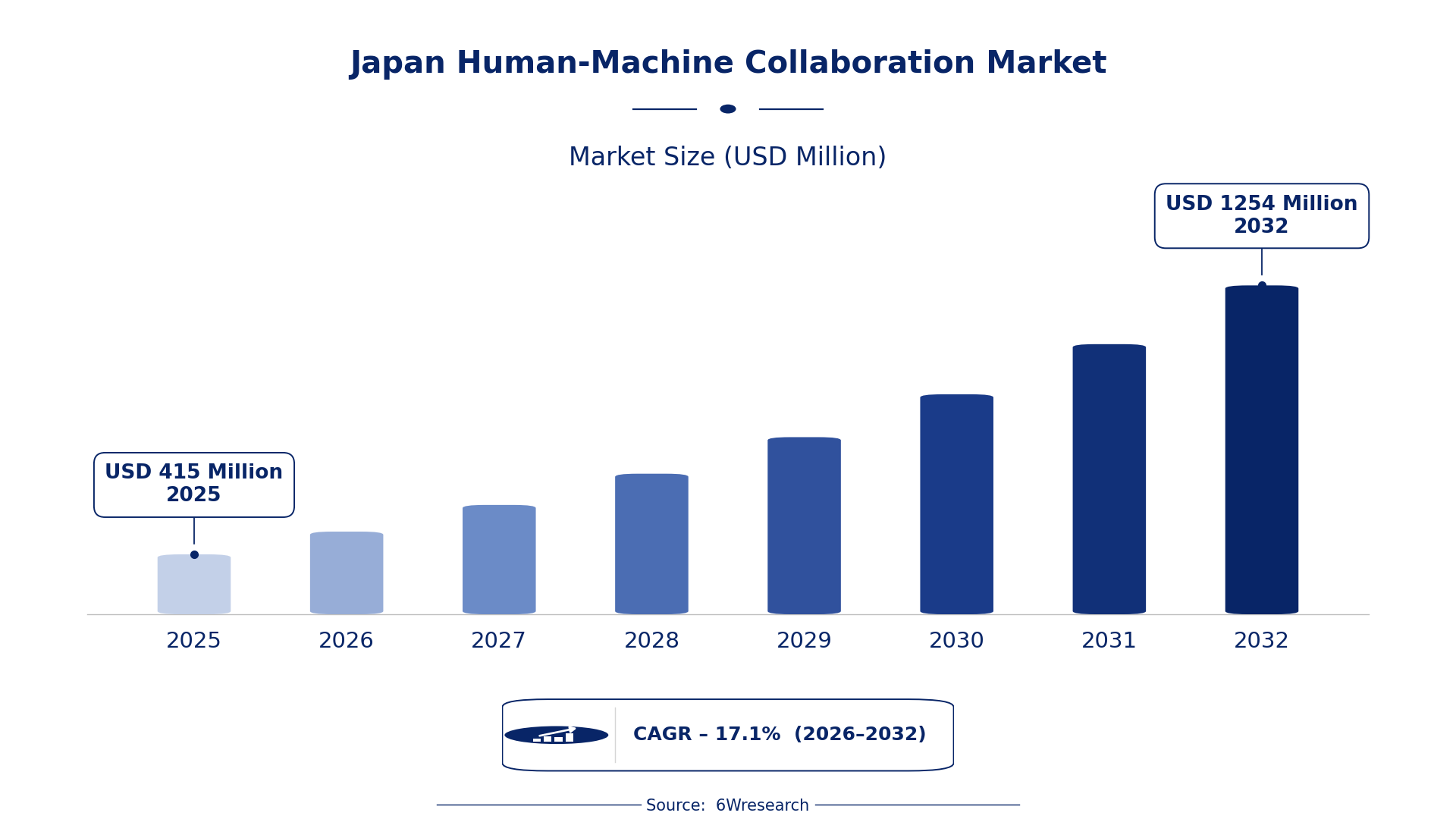
According to 6Wresearch internal database and industry insights, the Japan Human-Machine Collaboration Market was valued at USD 415 Million in 2025 and is projected to reach USD 1,254 Million by 2032, growing at a CAGR of approximately 17.1% during 2026–2032.
Japan Human-Machine Collaboration Market Highlights
| Report Metric | Details |
| Report Name | Japan Human-Machine Collaboration Market (2026-2032) |
| Market Size 2025 | USD 415 Million |
| Market Size 2032 | USD 1,254 Million |
| Absolute Growth 2025–2032 | USD 839 Million |
| CAGR 2026–2032 | 17.1% |
| Peak Annual Growth | 20.6% in 2026 |
| Forecast Period | 2026–2032 |
| Historical Data | 2022–2025 |
| Base Year | 2025 |
| Leading Collaboration Type, 2025 | Robotic Assistance (42% share) |
| Leading Industry Use Case, 2025 | Manufacturing & Assembly (44% share) |
| Leading Distribution Channel, 2025 | Robotics Integrators (39% share) |
| Leading End User, 2025 | Automotive Plants (40% share) |
| Fastest-Growing Collaboration Type | AI Co-Piloting (18.6% CAGR) |
| Fastest-Growing Industry Use Case | Decision Support (21.8% CAGR) |
| Fastest-Growing Distribution Channel | SaaS Platforms (21.4% CAGR) |
| Fastest-Growing End User | Business Analysts (21.5% CAGR) |
| Growing Sector | Manufacturing |
| Key End Users | Manufacturers, Automotive Plants, Technology Providers, Healthcare Sector |
Japan Human-Machine Collaboration Market Year-wise Growth Rate and Key Drivers (2022–2032)
This graph illustrates the annual growth rates of the market from 2022 to 2032, highlighting a steady upward trajectory and projected market expansion over the forecast period.
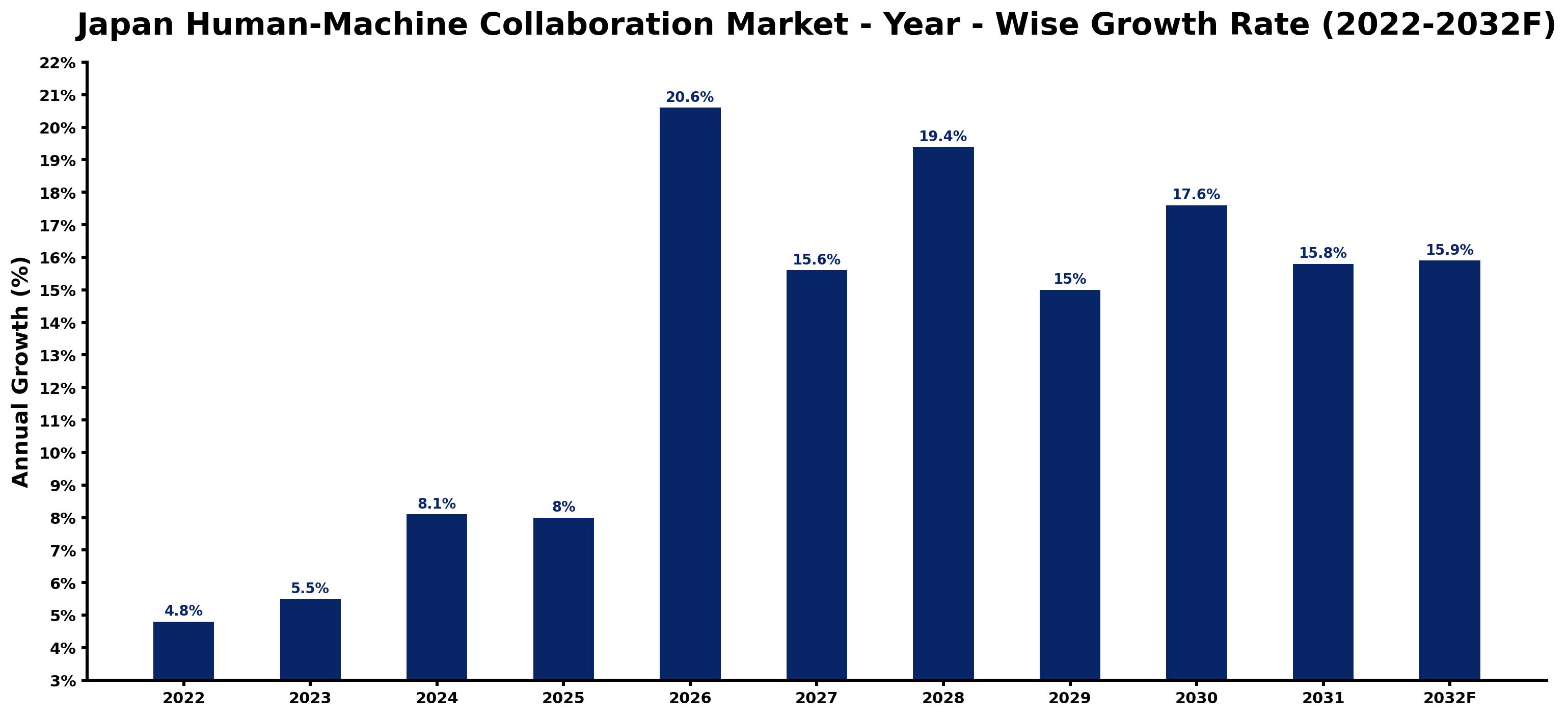
The following figures match every annual growth estimate with the main market development of that year, giving the reasoning behind each rise or slowdown.
| Year | Estimated Annual Growth (%) | Market Rationale |
| 2022 | 4.8 | The market experienced moderate growth as companies began adopting automation technologies. |
| 2023 | 5.5 | Demand increased due to rising labour costs and the need for efficiency in manufacturing. |
| 2024 | 8.1 | Growth accelerated as more manufacturers integrated advanced robotics into their operations. |
| 2025 | 8.0 | The growth rate slowed slightly as the market matured and competition intensified. |
| 2026 | 20.6 | A surge in demand is anticipated as companies invest heavily in automation technologies. |
| 2027 | 15.6 | Growth is projected to decelerate as the market adjusts to the rapid expansion of the previous year. |
| 2028 | 19.4 | Demand is expected to rebound strongly, driven by technological advancements and new applications. |
| 2029 | 15.0 | The growth rate is likely to moderate again as the market stabilises after the previous surge. |
| 2030 | 17.6 | Demand will rise as more sectors begin adopting human-machine collaboration solutions. |
| 2031 | 15.8 | The market will continue to grow, supported by ongoing technological improvements and investments. |
| 2032 | 15.9 | Growth is projected to remain strong as automation becomes essential in various industries. |
Note: Market size estimations and growth projections presented in this report are based on 6Wresearch's proprietary forecasting methodology, utilizing the latest available industry data, government publications, and primary research inputs.
Japan Human-Machine Collaboration Market Synopsis
Human-Machine Collaboration integrates human and machine capabilities to improve productivity, primarily through robotics and AI. The Japan Human-Machine Collaboration Market is driven by the manufacturing sector, which employs over 8 million workers and demonstrates a growing demand for robotic assistance technologies. Factors such as the ageing workforce and Japan's robotics strategy launched in 2021 are propelling growth.
Market Dynamics Impact Analysis (2026–2032)
| Factor | Type | Impact | Primary Segment Affected |
| Rising labour costs drive demand for automation solutions in manufacturing. | Driver | High | Robotic Assistance |
| Technological advancements in AI enhance decision-making processes across industries. | Driver | High | AI Co-Piloting |
| The automotive sector's need for efficiency creates opportunities for robotic integration. | Opportunity | High | Automotive Plants |
| The Tokyo region's smart city initiatives promote the adoption of collaboration technologies. | Opportunity | High | Manufacturing & Assembly |
| High initial investment costs may deter smaller manufacturers from adopting new technologies. | Restraint | Medium | Robotic Assistance |
| The average age of manufacturing workers may slow the pace of technology adoption. | Restraint | Medium | Manufacturing & Assembly |
| Limited skilled workforce affects the implementation of advanced collaboration technologies. | Challenge | High | AI Co-Piloting |
| Competition among technology providers may lead to price wars, impacting profitability. | Challenge | Medium | SaaS Platforms |
Evaluation of Drivers in Japan Human-Machine Collaboration Market (2026–2032)
The table below links each growth driver to the segment it affects and the evidence for it.
| Drivers | Primary Segment Affected | Why It Matters (Evidence) |
| Rising labour costs drive manufacturers to adopt automation solutions. | Robotic Assistance | Japan's national minimum wage rose to JPY 1,055 per hour in October 2024, prompting manufacturers to seek automation. |
| Advancements in AI technologies improve decision-making processes. | AI Co-Piloting | The healthcare sector is increasingly adopting AI co-piloting tools to improve operational efficiency. |
| The automotive sector's investment in robotics drives market growth. | Automotive Plants | The automotive sector is a major user of robotic assistance technologies, boosting production capabilities. |
| Government initiatives support the expansion of robotics in various sectors. | Manufacturing & Assembly | The Ministry of Economy, Trade and Industry launched a robotics strategy in 2021 to encourage industry adoption. |
| The ageing workforce in manufacturing increases the need for automation solutions. | Workforce Efficiency | The average age of workers in manufacturing is 48 years, which drives demand for robotic assistance. |
The strongest pull on demand comes from rising labour costs, compelling manufacturers to adopt automation technologies to maintain competitiveness. Technological advancements in AI are also notable, as the healthcare sector increasingly employs AI co-piloting tools to improve decision-making. The automotive sector, a major user of robotics, is investing heavily in automation to boost production efficiency. The ageing workforce in manufacturing drives demand for automation solutions, as companies seek to mitigate the impact of a shrinking labour pool.
Evaluation of Restraints in Japan Human-Machine Collaboration Market
Below are the constraints most often cited by buyers and suppliers, with the segment each affects.
| Market Restraint | Primary Segment Affected | Why It Matters (Evidence) |
| High initial investment costs may deter smaller manufacturers from adopting new technologies. | Robotic Assistance | Many small manufacturers lack the capital to invest in advanced automation systems. |
| The average age of manufacturing workers may slow the pace of technology adoption. | Manufacturing & Assembly | Older workers may be less inclined to adapt to new technologies, affecting implementation. |
| Limited skilled workforce affects the implementation of advanced collaboration technologies. | AI Co-Piloting | A shortage of skilled workers hampers the effective use of AI tools in various industries. |
| Regulatory compliance costs can be burdensome for manufacturers. | Workforce Efficiency | Manufacturers must invest in compliance measures to meet safety and operational standards. |
| Market saturation in certain segments may limit growth potential. | SaaS Platforms | As more providers enter the market, competition increases, potentially resulting in price reductions. |
Japan Human-Machine Collaboration Market Challenges
Japan's regulatory standards, such as ISO 13482, impose compliance costs on service robot suppliers, which can delay product launches and diminish competitiveness for manufacturers. Suppliers often lag in technological advancements, leading to outdated products that do not meet the needs of over 8 million workers in the manufacturing sector. Supply chain disruptions arise from reliance on specific components, causing delays for producers who need timely deliveries to adhere to production schedules. Rising operational costs, linked to Japan's minimum wage of JPY 1,055 per hour, compel manufacturers to invest in automation, potentially limiting their competitive edge.
Trends in the Japan Human-Machine Collaboration Market
Below are the shifts with the largest effect on the Japan Human-Machine Collaboration Market.
- Shift from Traditional to Automated Manufacturing: Since 2021, the manufacturing sector has increasingly adopted automation technologies, particularly in the Tokyo region, which accounts for 30% of Japan's robotics market. This shift improves productivity and efficiency, encouraging more manufacturers to invest in robotic assistance.
- Emergence of AI Co-Piloting in Healthcare: In 2023, the healthcare sector began widely adopting AI co-piloting tools, improving decision-making processes. This trend highlights the growing integration of AI technologies across various industries, creating new opportunities for technology providers.
- Rise of Smart City Initiatives: The Tokyo Metropolitan Government has supported smart city initiatives involving collaboration technologies since 2021. This trend promotes the adoption of advanced robotics and AI, driving demand in urban environments.
- Increased Focus on Workforce Efficiency: With the average age of workers in manufacturing at 48 years, there is a greater emphasis on workforce efficiency. This focus encourages manufacturers to invest in automation solutions to maintain productivity.
Investment Opportunities in the Japan Human-Machine Collaboration Market
Below are the investment opportunities with the strongest case in the Japan Human-Machine Collaboration Market.
- Manufacturers Seeking Automation Solutions: With Japan's manufacturing industry employing over 8 million workers, the demand for automation solutions is rising. Investing in robotic assistance technologies can help manufacturers improve efficiency and reduce costs.
- Investment in AI Technologies: In 2023, the government allocated ¥10 billion for AI research and development, creating opportunities for tech service providers to develop solutions. This funding supports advancements in AI co-piloting tools.
- Expansion of Robotics in Automotive Sector: The automotive sector's extensive use of robotic assistance presents a valuable opportunity for suppliers. Investing in automation technologies can help meet the growing demand for efficiency in production.
- Smart City Projects in Tokyo: The Tokyo region's smart city initiatives create a demand for collaboration technologies. Suppliers can enter this market by partnering with local governments to implement advanced robotics solutions.
Government Initiatives in the Japan Human-Machine Collaboration Market
The Industrial Safety and Health Act (1972) outlines employer responsibilities for ensuring safety in workplaces using human-machine collaboration technologies. Compliance with this act is essential for manufacturers to maintain operational standards and protect workers. Additionally, the Act on the Rational Use of Energy obliges large energy users to improve efficiency and report their energy consumption, impacting manufacturers adopting automation solutions.
In 2023, the government allocated ¥10 billion for AI research and development, administered by the Ministry of Economy, Trade and Industry. This funding supports the advancement of AI technologies, benefiting manufacturers and tech providers alike.
Future Insight of the Japan Human-Machine Collaboration Market
Investment in robotics and AI will create robust demand for human-machine collaboration technologies by 2032. The Tokyo Metropolitan Government's smart city initiatives will drive urban productivity and innovation in collaboration technologies. As the average age of manufacturing workers reaches 48 years, automation will become crucial for sustaining efficiency. Advances in robotics within healthcare will address the increasing need for automation, facilitating improved service delivery and operational effectiveness.
Market Segmentation Analysis
Japan Human-Machine Collaboration Market report covers a detailed analysis of the following market segments:
By Collaboration Type – Robotic Assistance Leads, AI Co-Piloting Expected to Grow Fastest
According to Saurav Kr Singh, Senior Research Analyst at 6Wresearch, in 2025, Robotic Assistance led the collaboration type split with a 42% share. Robotic assistance holds the largest share due to its extensive use in Japan's manufacturing sector, where over 8 million workers are employed. This technology is essential for automating repetitive tasks, particularly in automotive production lines. The quickest growth will come from AI Co-Piloting, forecast to expand at a CAGR of 18.6% between 2026 and 2032. AI co-piloting is experiencing rapid growth as industries increasingly adopt AI tools for decision-making support, with the government allocating ¥10 billion for AI research and development in 2023. This trend will further solidify the lead of robotic assistance as it integrates with AI capabilities. Suppliers should focus on developing integrated solutions that combine robotic assistance with AI to meet growing industry demands.
By Industry Use Case – Manufacturing & Assembly Leads, Decision Support Expected to Grow Fastest
With 44% of industry use case revenue in 2025, Manufacturing & Assembly was the largest category. Manufacturing and assembly are the primary sectors leveraging collaboration technologies to boost production efficiency. This segment's substantial workforce, exceeding 8 million, underscores the ongoing demand for these solutions. Decision Support is set to record the highest CAGR in this split, 21.8% over 2026–2032. Decision support is rapidly expanding as companies acknowledge the importance of data-driven insights in navigating complex operational challenges. This segment's growth is fuelled by the increasing need for sophisticated systems to enhance decision-making capabilities. Suppliers should prioritise the development of solutions that facilitate informed decision-making in the manufacturing sector.
By Distribution Channel – Robotics Integrators Lead, SaaS Platforms Expected to Grow Fastest
Robotics Integrators took 39% of distribution channel revenue in 2025, more than any other category. Robotics integrators lead the market by providing essential services for the seamless integration of collaboration technologies across various applications. Their expertise ensures that systems are customised to meet the specific needs of different industries. Over 2026–2032, SaaS Platforms are expected to post the fastest growth, at a CAGR of 21.4%. SaaS platforms are experiencing rapid growth as they offer flexible software solutions that cater to businesses seeking cloud-based collaboration tools. The rising demand for scalable and adaptable systems is driving this segment's expansion. Suppliers must focus on enhancing their SaaS offerings to attract businesses in need of accessible collaboration solutions.
By End User – Automotive Plants Lead, Business Analysts Expected to Grow Fastest
Automotive Plants accounted for 40% of the market by end user in 2025. Automotive plants are the largest end user group, reflecting their heavy reliance on robotic assistance to sustain productivity and competitiveness. This sector's strong demand for automation technologies solidifies its leading position. Business Analysts are projected to grow fastest, at a CAGR of 21.5% during 2026–2032. Business analysts are increasingly adopting advanced tools for data analysis, which improves their support for decision-making processes across various sectors. This trend highlights a growing necessity for effective analytical tools within organisations. Suppliers should align their products with the specific needs of automotive plants while also catering to the increasing demand for analytical tools among business analysts.
Key Attractiveness of the Report
- 10 Years of Market Numbers
- Historical Data Starting from 2022 to 2025
- Base Year 2025
- Forecast Data until 2032
- Key Performance Indicators Impacting the Market
- Major Upcoming Developments and Projects
Key Highlights of the Report:
- Japan Human-Machine Collaboration Market Outlook
- Market Size of Japan Human-Machine Collaboration Market, 2025
- Forecast of Japan Human-Machine Collaboration Market, 2032
- Historical Data and Forecast of Japan Human-Machine Collaboration Revenues & Volume for the Period 2022-2032F
- Japan Human-Machine Collaboration Market Trend Evolution
- Japan Human-Machine Collaboration Market Drivers and Challenges
- Japan Human-Machine Collaboration Price Trends
- Japan Human-Machine Collaboration Porter's Five Forces
- Japan Human-Machine Collaboration Industry Life Cycle
- Historical Data and Forecast of Japan Human-Machine Collaboration Market Revenues & Volume By Collaboration Type for the Period 2022-2032F
- Historical Data and Forecast of Japan Human-Machine Collaboration Market Revenues & Volume By Robotic Assistance for the Period 2022-2032F
- Historical Data and Forecast of Japan Human-Machine Collaboration Market Revenues & Volume By AI Co-Piloting for the Period 2022-2032F
- Historical Data and Forecast of Japan Human-Machine Collaboration Market Revenues & Volume By Wearable AI for the Period 2022-2032F
- Historical Data and Forecast of Japan Human-Machine Collaboration Market Revenues & Volume By Virtual Assistant for the Period 2022-2032F
- Historical Data and Forecast of Japan Human-Machine Collaboration Market Revenues & Volume By Industry Use Case for the Period 2022-2032F
- Historical Data and Forecast of Japan Human-Machine Collaboration Market Revenues & Volume By Manufacturing & Assembly for the Period 2022-2032F
- Historical Data and Forecast of Japan Human-Machine Collaboration Market Revenues & Volume By Decision Support for the Period 2022-2032F
- Historical Data and Forecast of Japan Human-Machine Collaboration Market Revenues & Volume By Workforce Efficiency for the Period 2022-2032F
- Historical Data and Forecast of Japan Human-Machine Collaboration Market Revenues & Volume By Healthcare & Finance for the Period 2022-2032F
- Historical Data and Forecast of Japan Human-Machine Collaboration Market Revenues & Volume By Distribution Channel for the Period 2022-2032F
- Historical Data and Forecast of Japan Human-Machine Collaboration Market Revenues & Volume By Robotics Integrators for the Period 2022-2032F
- Historical Data and Forecast of Japan Human-Machine Collaboration Market Revenues & Volume By SaaS Platforms for the Period 2022-2032F
- Historical Data and Forecast of Japan Human-Machine Collaboration Market Revenues & Volume By Online Enterprise Tools for the Period 2022-2032F
- Historical Data and Forecast of Japan Human-Machine Collaboration Market Revenues & Volume By Tech Service Providers for the Period 2022-2032F
- Historical Data and Forecast of Japan Human-Machine Collaboration Market Revenues & Volume By End User for the Period 2022-2032F
- Historical Data and Forecast of Japan Human-Machine Collaboration Market Revenues & Volume By Automotive Plants for the Period 2022-2032F
- Historical Data and Forecast of Japan Human-Machine Collaboration Market Revenues & Volume By Business Analysts for the Period 2022-2032F
- Historical Data and Forecast of Japan Human-Machine Collaboration Market Revenues & Volume By Construction & Mining for the Period 2022-2032F
- Historical Data and Forecast of Japan Human-Machine Collaboration Market Revenues & Volume By Enterprise Users for the Period 2022-2032F
- Japan Human-Machine Collaboration Import Export Trade Statistics
- Market Opportunity Assessment By Collaboration Type
- Market Opportunity Assessment By Industry Use Case
- Market Opportunity Assessment By Distribution Channel
- Market Opportunity Assessment By End User
- Japan Human-Machine Collaboration Top Companies Market Share
- Japan Human-Machine Collaboration Competitive Benchmarking By Technical and Operational Parameters
- Japan Human-Machine Collaboration Company Profiles
- Japan Human-Machine Collaboration Key Strategic Recommendations
Market Covered
Coverage by segment is as follows.
By Collaboration Type
- Robotic Assistance
- AI Co-Piloting
- Wearable AI
- Virtual Assistant
By Industry Use Case
- Manufacturing & Assembly
- Decision Support
- Workforce Efficiency
- Healthcare & Finance
By Distribution Channel
- Robotics Integrators
- SaaS Platforms
- Online Enterprise Tools
- Tech Service Providers
By End User
- Automotive Plants
- Business Analysts
- Construction & Mining
- Enterprise Users































