Japan Human-Machine Interaction Market Size & Growth Rate
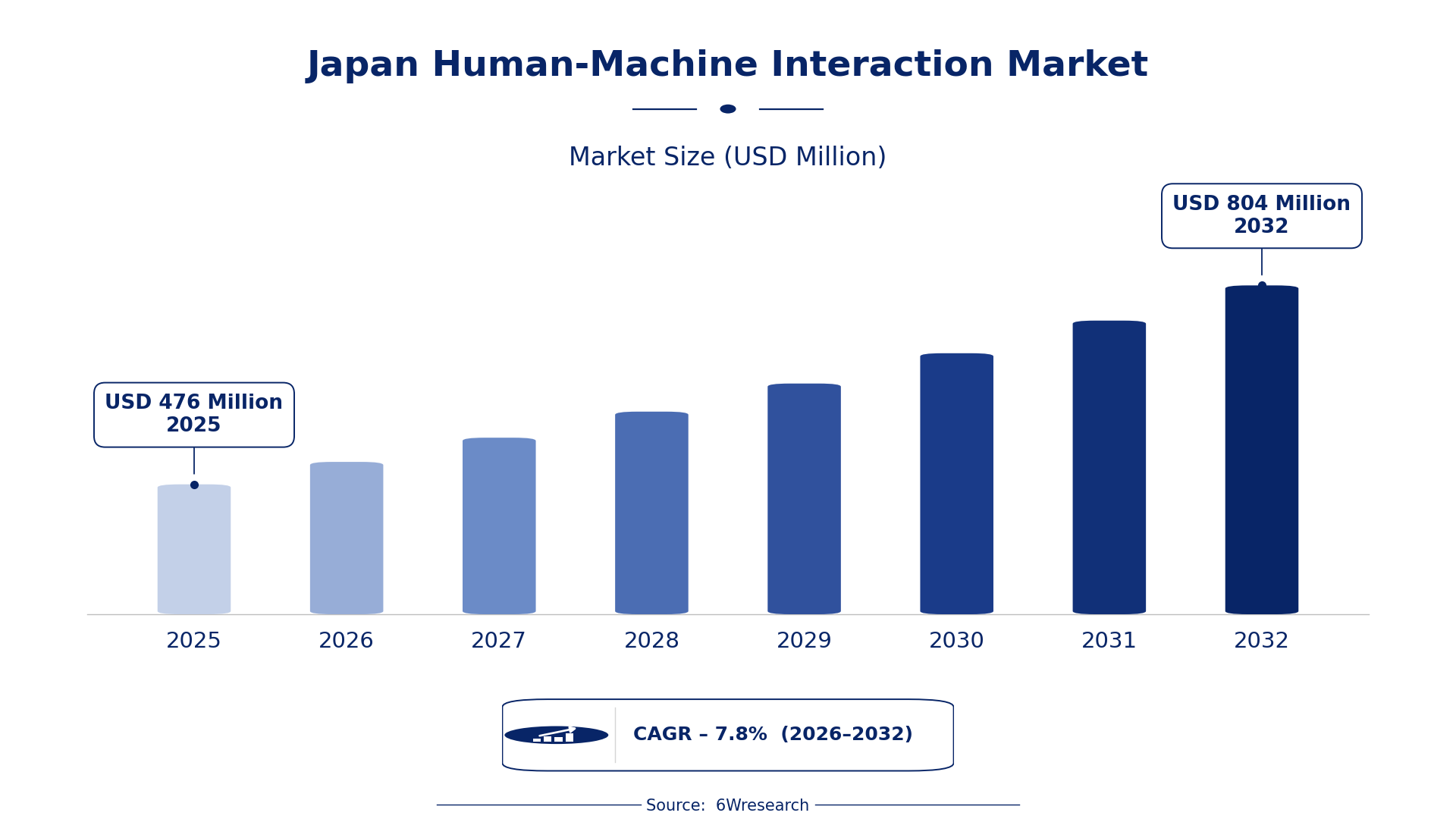
According to 6Wresearch internal database and industry insights, the Japan Human-Machine Interaction Market was valued at USD 476 Million in 2025 and is projected to reach USD 804 Million by 2032, growing at a CAGR of approximately 7.8% during 2026–2032.
Japan Human-Machine Interaction Market Highlights
| Report Metric | Details |
| Report Name | Japan Human-Machine Interaction Market (2026-2032) |
| Market Size 2025 | USD 476 Million |
| Market Size 2032 | USD 804 Million |
| Absolute Growth 2025–2032 | USD 328 Million |
| CAGR 2026–2032 | 7.8% |
| Peak Annual Growth | 8.6% in 2030 |
| Forecast Period | 2026–2032 |
| Historical Data | 2022–2025 |
| Base Year | 2025 |
| Leading Interface Type, 2025 | Haptic Feedback (54% share) |
| Leading Technology Used, 2025 | Vibration Motors (42% share) |
| Leading Distribution Channel, 2025 | Electronics Distributors (37% share) |
| Leading End User, 2025 | VR Game Developers (43% share) |
| Fastest-Growing Interface Type | Visual Interfaces (10.8% CAGR) |
| Fastest-Growing Technology Used | HUD/AR Displays (11.5% CAGR) |
| Fastest-Growing Distribution Channel | OEMs (9.7% CAGR) |
| Fastest-Growing End User | Smart Vehicle Makers (10.3% CAGR) |
| Growing Sector | Healthcare |
| Key End Users | Automotive manufacturers, healthcare providers, VR game developers, smart home technology firms |
Japan Human-Machine Interaction Market Year-wise Growth Rate and Key Drivers (2022–2032)
This graph illustrates the annual growth rates of the market from 2022 to 2032, highlighting a steady upward trajectory and projected market expansion over the forecast period.
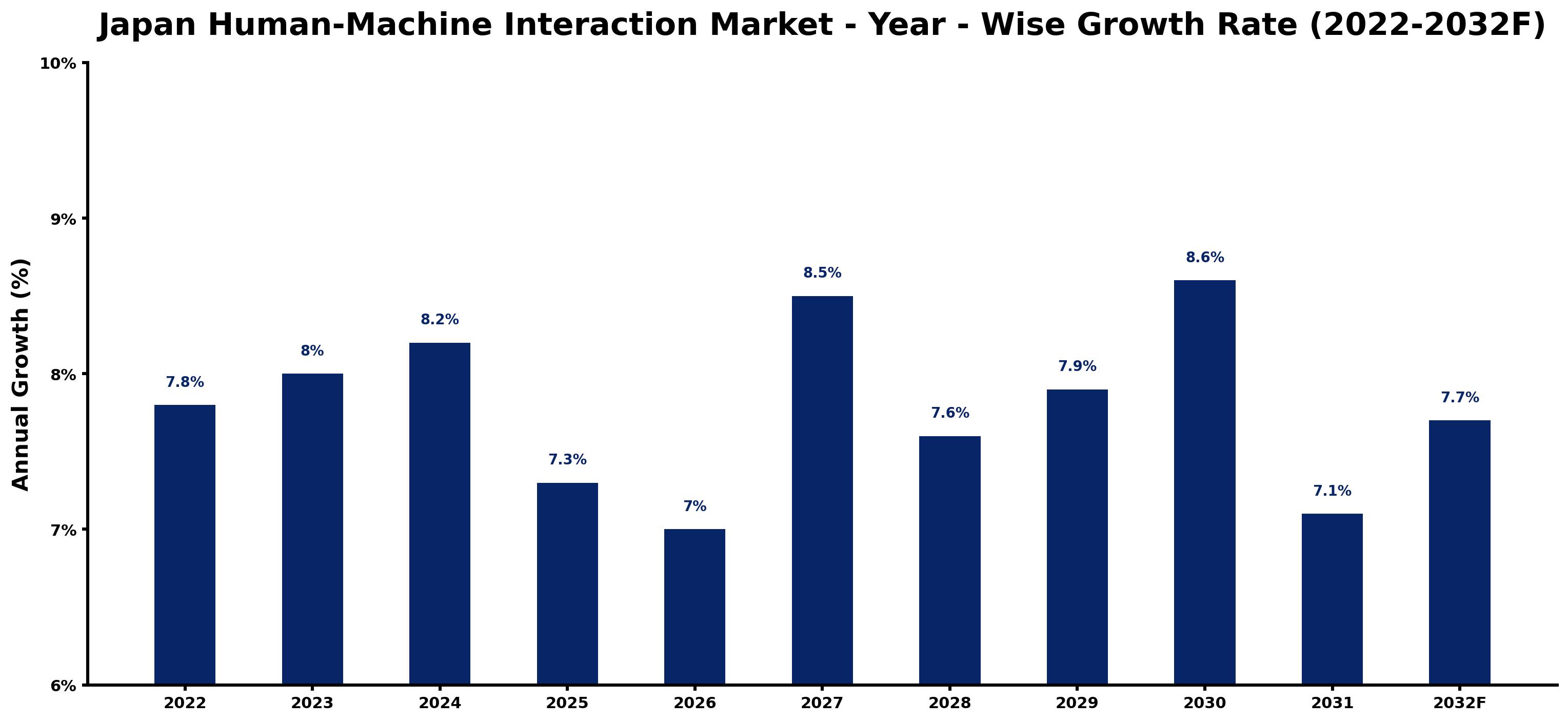
Year by year, the estimates below pair each growth rate with the development that shaped it.
| Year | Estimated Annual Growth (%) | Market Rationale |
| 2022 | 7.8 | The market experienced steady growth with increasing interest in HMI technologies. |
| 2023 | 8.0 | Demand rose due to advancements in smart vehicle interfaces and gaming applications. |
| 2024 | 8.2 | Growth continued as the automotive sector integrated more advanced HMI solutions. |
| 2025 | 7.3 | A slight slowdown occurred, reflecting a temporary adjustment in technology adoption rates. |
| 2026 | 7.0 | A further slowdown is anticipated as the market stabilises after rapid growth phases. |
| 2027 | 8.5 | Growth is projected to accelerate again, driven by rising investments in healthcare HMI applications. |
| 2028 | 7.6 | A slight slowdown is expected, reflecting maturity in certain HMI technologies. |
| 2029 | 7.9 | Demand is anticipated to increase as new applications in smart homes emerge, boosting HMI usage. |
| 2030 | 8.6 | The market is expected to peak with advancements in AR technology for HMI applications. |
| 2031 | 7.1 | Growth is projected to slow as the market adjusts to the high levels of previous years. |
| 2032 | 7.7 | Demand is expected to rise again, driven by ongoing innovations in automotive and healthcare sectors. |
Note: Market size estimations and growth projections presented in this report are based on 6Wresearch's proprietary forecasting methodology, utilizing the latest available industry data, government publications, and primary research inputs.
Japan Human-Machine Interaction Market Synopsis
Human-Machine Interaction (HMI) technology facilitates communication between users and devices through various interfaces. It is integral to sectors such as gaming, automotive, healthcare, and smart homes. The Japan Human-Machine Interaction Market is expanding due to a strong domestic technology sector, with increasing demand for smart vehicle interfaces and healthcare applications. In 2023, the number of VR game developers in Japan exceeded 500, further driving growth in this sector.
Market Dynamics Impact Analysis (2026–2032)
| Factor | Type | Impact | Primary Segment Affected |
| Increasing adoption of smart vehicle interfaces | Driver | High | Smart Vehicle Makers |
| Rising demand for healthcare HMI applications | Driver | High | Healthcare Interfaces |
| Expansion of smart home technologies | Opportunity | High | Smart Assistant Makers |
| Growing interest in AR applications for training | Opportunity | Medium | VR Game Developers |
| High development costs for advanced HMI systems | Restraint | High | Visual Interfaces |
| Limited availability of skilled workforce in HMI development | Restraint | Medium | Haptic Feedback |
| Compliance with stringent accessibility standards | Challenge | High | Natural Language UI |
| Pressure to keep pace with rapid technological advancements | Challenge | Medium | Multimodal Systems |
Evaluation of Drivers in Japan Human-Machine Interaction Market (2026–2032)
These are the developments adding the most demand over the forecast period.
| Drivers | Primary Segment Affected | Why It Matters (Evidence) |
| Growing investments in automotive HMI technologies | Smart Vehicle Makers | The automotive sector in Japan aims to integrate advanced HMI in all new vehicles by 2025, driving demand for new solutions. |
| Increased healthcare spending on patient monitoring systems | Healthcare Interfaces | The number of healthcare facilities using advanced HMI in Japan exceeded 200 in 2023, improving patient interaction capabilities. |
| Expansion of VR gaming applications | VR Game Developers | With more than 500 VR game developers in Japan, the demand for immersive HMI experiences continues to rise. |
| Rising consumer interest in smart home devices | Smart Assistant Makers | The smart home market is expanding, increasing the need for HMI applications in residential settings. |
| Adoption of AR technology in training and education | HUD/AR Displays | The increasing use of AR technology in Japan is improving HMI applications, particularly in educational settings. |
Buyers are adding capacity as the automotive sector integrates advanced HMI technologies, with all new vehicles expected to feature these systems by 2025. In healthcare, many facilities have adopted advanced HMI for patient monitoring, driving demand for new solutions. The VR gaming sector, with over 500 developers, is also expanding, increasing the need for immersive user experiences. The smart home market is growing, boosting HMI applications in residential settings. The adoption of AR technology is rising, improving training and educational applications in HMI.
Evaluation of Restraints in Japan Human-Machine Interaction Market
The key brakes on demand, and where they bite hardest, are shown below.
| Market Restraint | Primary Segment Affected | Why It Matters (Evidence) |
| High costs associated with developing advanced HMI systems | Visual Interfaces | Development costs for advanced HMI systems can be prohibitive, limiting investment in new technologies. |
| Shortage of skilled professionals in HMI development | Haptic Feedback | The limited availability of qualified personnel hinders the growth of HMI technologies in various sectors. |
| Strict compliance requirements for accessibility standards | Natural Language UI | Compliance with standards like JIS X 8341-3 increases the complexity and cost of HMI development. |
| Rapid technological advancements creating pressure | Multimodal Systems | Keeping pace with evolving technologies can strain resources and delay product launches. |
| Market saturation in certain HMI applications | HUD/AR Displays | As the market matures, growth rates may slow due to saturation in established applications. |
Japan Human-Machine Interaction Market Challenges
Buyers in the automotive sector face rising costs as Japan's national minimum wage increases to JPY 1,055 per hour, forcing them to reconsider their budgets for HMI technologies. Supply chain disruptions occur due to the complex integration of HMI components, leading to delays in product delivery for manufacturers. Regulatory compliance with standards like JIS X 8341-3 imposes financial burdens on healthcare facilities, requiring investment in accessibility features that strain their resources. Technology adoption in public transportation systems remains sluggish, limiting options for consumers and delaying the rollout of essential HMI solutions.
Trends in the Japan Human-Machine Interaction Market
Several trends are reshaping the Japan Human-Machine Interaction Market; the most important are set out below.
- Shift towards AR Applications in Training: The adoption of AR technology in Japan is increasing, particularly in training and education sectors, with applications in HMI. In 2023, the annual budget for HMI-related research initiatives by METI reached approximately 5 billion yen, indicating strong support for innovation.
- Transition from Traditional Interfaces to Multimodal Systems: Smart Vehicle Makers are increasingly integrating multimodal systems into their designs, improving user interaction. This shift is driven by the growing demand for more intuitive interfaces, with a projected CAGR of 10.3% for Smart Vehicle Makers from 2026 to 2032.
- Emergence of Smart Home Technologies: The smart home market in Japan is expanding, boosting the demand for HMI applications. With an estimated increase in smart assistant products to over 100 in 2023, this trend highlights the shift towards more connected living environments.
- Growing Importance of Accessibility Standards: The introduction of JIS X 8341-3 has heightened awareness of accessibility in HMI design. This standard is influencing product development across various sectors, ensuring that HMI technologies are usable by all individuals.
Investment Opportunities in the Japan Human-Machine Interaction Market
Several openings in the Japan Human-Machine Interaction Market merit attention from investors.
- Supply of Advanced HMI Technologies: There is a growing opportunity to supply advanced HMI technologies for smart vehicles, with the automotive industry aiming for full integration by 2025. Collaborating with Smart Vehicle Makers can facilitate market entry.
- Development of Healthcare HMI Solutions: The healthcare sector is increasingly adopting HMI for patient monitoring systems, presenting an opportunity to develop tailored solutions. Engaging with healthcare facilities can strengthen market presence.
- Investment in Smart Home Devices: The smart home market is expanding, creating opportunities for suppliers of HMI technologies. Focusing on partnerships with Smart Assistant Makers can lead to successful market penetration.
- Creation of AR Training Applications: The rising use of AR technology in training offers an opportunity to develop new HMI applications. Collaborating with educational institutions can provide valuable insights and access to this growing market.
Government Initiatives in the Japan Human-Machine Interaction Market
The New Robot Strategy, initiated in 2015, aims to expand the use of robots across various sectors, including manufacturing and healthcare. This strategy builds on earlier laws by promoting innovation in HMI technologies, encouraging investment in automation and user-friendly interfaces. The annual budget for HMI-related research initiatives by METI is approximately 5 billion yen, supporting projects that improve HMI applications.
In the healthcare sector, the Industrial Safety and Health Act mandates safety standards for machinery. This law ensures that HMI technologies used in patient monitoring systems comply with safety regulations, increasing user trust and operational efficiency. The Act on the Rational Use of Energy obliges large energy users to enhance energy efficiency, impacting HMI applications in various sectors.
Future Insight of the Japan Human-Machine Interaction Market
The integration of AR technology will transform HMI applications in training and education by 2032, creating more immersive user experiences. By 2025, the automotive sector aims to implement advanced HMI in all new vehicles, increasing demand for innovative interfaces. The smart home market is projected to grow, leading to a rise in HMI applications for residential environments. Government support through funding programs will sustain research initiatives, with METI's annual budget for HMI projects reaching 5 billion yen.
Market Segmentation Analysis
Japan Human-Machine Interaction Market report covers a detailed analysis of the following market segments:
By Interface Type – Haptic Feedback Leads, Visual Interfaces Expected to Grow Fastest
According to Saurav Kr Singh, Senior Research Analyst at 6Wresearch, Haptic Feedback took 54% of interface type revenue in 2025, more than any other category. Haptic Feedback holds the largest share due to its widespread application in gaming and automotive sectors, where it enhances user interaction through tactile sensations. For instance, smart vehicle interfaces in Japan increasingly depend on haptic feedback to improve the driving experience. The quickest growth will come from Visual Interfaces, forecast to expand at a CAGR of 10.8% between 2026 and 2032. Visual Interfaces are experiencing rapid growth as they are essential for user interaction and information display, particularly in gaming and automotive fields. The increasing number of VR game developers, estimated at over 500 in Japan, is driving the demand for advanced visual interfaces. This suggests that suppliers should prioritise the development of visual interface technologies to align with market trends.
By Technology Used – Vibration Motors Lead, HUD/AR Displays Expected to Grow Fastest
Vibration Motors held 42% of the Japan Human-Machine Interaction Market by technology used in 2025. Vibration Motors lead the market as they are extensively used in devices for tactile feedback, particularly in consumer electronics and gaming applications. The automotive industry also utilises vibration motors to enhance user experiences in smart vehicle interfaces. HUD/AR Displays are projected to grow fastest, at a CAGR of 11.5% during 2026–2032. HUD/AR Displays are the fastest-growing technology segment because they significantly enhance user experience in automotive and gaming applications. The growing adoption of augmented reality in training and education further fuels the demand for HUD/AR displays. Suppliers should focus on innovating HUD/AR display technologies to capitalise on emerging market opportunities.
By Distribution Channel – Electronics Distributors Lead, OEMs Expected to Grow Fastest
With 37% of distribution channel revenue in 2025, Electronics Distributors was the largest category. Electronics Distributors lead the market as they are essential in supplying components necessary for HMI technologies, although they do not directly utilise these technologies. Their established distribution networks facilitate the availability of HMI-related products across various sectors in Japan. OEMs are set to record the highest CAGR in this split, 9.7% over 2026–2032. OEMs are rapidly expanding as they directly incorporate HMI into their products, addressing the growing demand for advanced user interfaces in automotive and smart home sectors. The automotive industry's goal to integrate HMI in all new vehicles by 2025 is a key factor driving OEM growth. This suggests that suppliers should strengthen collaborations with OEMs to ensure their technologies are integrated into new product developments.
By End User – VR Game Developers Lead, Smart Vehicle Makers Expected to Grow Fastest
In 2025, VR Game Developers led the end user split with a 43% share. VR Game Developers represent the largest share as they create immersive experiences using HMI technologies, which significantly boosts the demand for advanced interaction methods in the gaming sector. The presence of over 500 VR game developers in Japan highlights the robust market for HMI applications in this industry. Over 2026–2032, Smart Vehicle Makers are expected to post the fastest growth, at a CAGR of 10.3%. Smart Vehicle Makers are the fastest-growing end user group as they integrate HMI to improve user interfaces in vehicles. The automotive industry's goal to incorporate advanced HMI in all new vehicles by 2025 indicates a strong growth potential for this segment. This means suppliers should tailor their offerings to meet the specific requirements of smart vehicle makers to leverage this growth.
Key Attractiveness of the Report
- 10 Years of Market Numbers
- Historical Data Starting from 2022 to 2025
- Base Year 2025
- Forecast Data until 2032
- Key Performance Indicators Impacting the Market
- Major Upcoming Developments and Projects
Key Highlights of the Report:
- Japan Human-Machine Interaction Market Outlook
- Market Size of Japan Human-Machine Interaction Market, 2025
- Forecast of Japan Human-Machine Interaction Market, 2032
- Historical Data and Forecast of Japan Human-Machine Interaction Revenues & Volume for the Period 2022-2032F
- Japan Human-Machine Interaction Market Trend Evolution
- Japan Human-Machine Interaction Market Drivers and Challenges
- Japan Human-Machine Interaction Price Trends
- Japan Human-Machine Interaction Porter's Five Forces
- Japan Human-Machine Interaction Industry Life Cycle
- Historical Data and Forecast of Japan Human-Machine Interaction Market Revenues & Volume By Interface Type for the Period 2022-2032F
- Historical Data and Forecast of Japan Human-Machine Interaction Market Revenues & Volume By Haptic Feedback for the Period 2022-2032F
- Historical Data and Forecast of Japan Human-Machine Interaction Market Revenues & Volume By Visual Interfaces for the Period 2022-2032F
- Historical Data and Forecast of Japan Human-Machine Interaction Market Revenues & Volume By Audio Interfaces for the Period 2022-2032F
- Historical Data and Forecast of Japan Human-Machine Interaction Market Revenues & Volume By Multimodal Systems for the Period 2022-2032F
- Historical Data and Forecast of Japan Human-Machine Interaction Market Revenues & Volume By Technology Used for the Period 2022-2032F
- Historical Data and Forecast of Japan Human-Machine Interaction Market Revenues & Volume By Vibration Motors for the Period 2022-2032F
- Historical Data and Forecast of Japan Human-Machine Interaction Market Revenues & Volume By HUD/AR Displays for the Period 2022-2032F
- Historical Data and Forecast of Japan Human-Machine Interaction Market Revenues & Volume By Natural Language UI for the Period 2022-2032F
- Historical Data and Forecast of Japan Human-Machine Interaction Market Revenues & Volume By Cross-Sensory Input for the Period 2022-2032F
- Historical Data and Forecast of Japan Human-Machine Interaction Market Revenues & Volume By Distribution Channel for the Period 2022-2032F
- Historical Data and Forecast of Japan Human-Machine Interaction Market Revenues & Volume By Electronics Distributors for the Period 2022-2032F
- Historical Data and Forecast of Japan Human-Machine Interaction Market Revenues & Volume By OEMs for the Period 2022-2032F
- Historical Data and Forecast of Japan Human-Machine Interaction Market Revenues & Volume By Voice Tech Suppliers for the Period 2022-2032F
- Historical Data and Forecast of Japan Human-Machine Interaction Market Revenues & Volume By Integrated System Vendors for the Period 2022-2032F
- Historical Data and Forecast of Japan Human-Machine Interaction Market Revenues & Volume By End User for the Period 2022-2032F
- Historical Data and Forecast of Japan Human-Machine Interaction Market Revenues & Volume By VR Game Developers for the Period 2022-2032F
- Historical Data and Forecast of Japan Human-Machine Interaction Market Revenues & Volume By Smart Vehicle Makers for the Period 2022-2032F
- Historical Data and Forecast of Japan Human-Machine Interaction Market Revenues & Volume By Smart Assistant Makers for the Period 2022-2032F
- Historical Data and Forecast of Japan Human-Machine Interaction Market Revenues & Volume By Healthcare Interfaces for the Period 2022-2032F
- Japan Human-Machine Interaction Import Export Trade Statistics
- Market Opportunity Assessment By Interface Type
- Market Opportunity Assessment By Technology Used
- Market Opportunity Assessment By Distribution Channel
- Market Opportunity Assessment By End User
- Japan Human-Machine Interaction Top Companies Market Share
- Japan Human-Machine Interaction Competitive Benchmarking By Technical and Operational Parameters
- Japan Human-Machine Interaction Company Profiles
- Japan Human-Machine Interaction Key Strategic Recommendations
Market Covered
Coverage by segment is as follows.
By Interface Type
- Haptic Feedback
- Visual Interfaces
- Audio Interfaces
- Multimodal Systems
By Technology Used
- Vibration Motors
- HUD/AR Displays
- Natural Language UI
- Cross-Sensory Input
By Distribution Channel
- Electronics Distributors
- OEMs
- Voice Tech Suppliers
- Integrated System Vendors
By End User
- VR Game Developers
- Smart Vehicle Makers
- Smart Assistant Makers
- Healthcare Interfaces































