Japan Human-Machine Interface System Market Size & Growth Rate
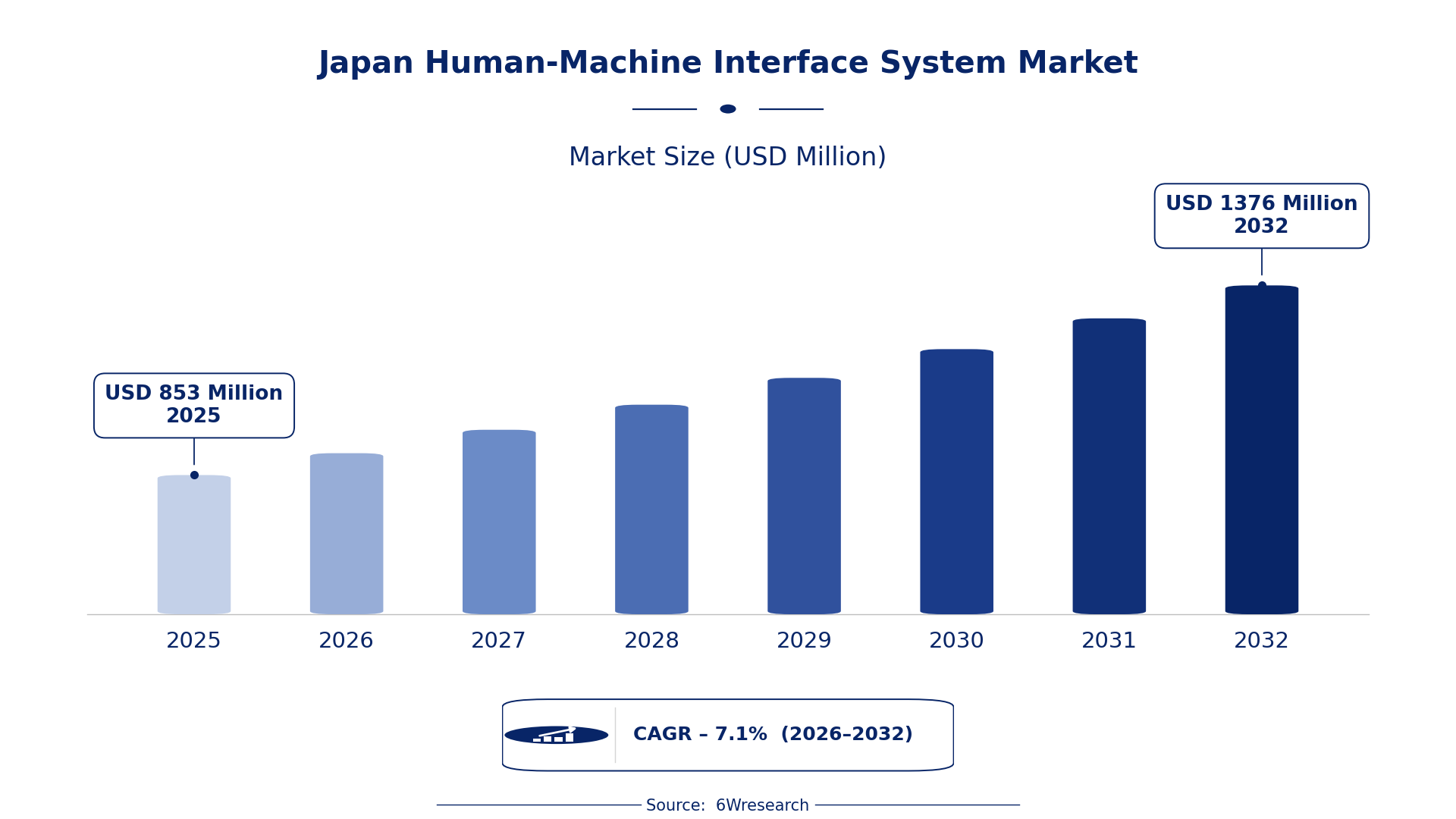
According to 6Wresearch internal database and industry insights, the Japan Human-Machine Interface System Market was valued at USD 853 Million in 2025 and is projected to reach USD 1,376 Million by 2032, growing at a CAGR of approximately 7.1% during 2026–2032.
Japan Human-Machine Interface System Market Highlights
| Report Metric | Details |
| Report Name | Japan Human-Machine Interface System Market (2026-2032) |
| Market Size 2025 | USD 853 Million |
| Market Size 2032 | USD 1,376 Million |
| Absolute Growth 2025–2032 | USD 523 Million |
| CAGR 2026–2032 | 7.1% |
| Peak Annual Growth | 7.6% in 2032 |
| Forecast Period | 2026–2032 |
| Historical Data | 2022–2025 |
| Base Year | 2025 |
| Leading System Type, 2025 | Automotive HMI (42% share) |
| Leading Application Type, 2025 | Navigation / Control (43% share) |
| Leading Distribution Channel, 2025 | Automotive OEMs (52% share) |
| Leading End User, 2025 | Vehicle Manufacturers (32% share) |
| Fastest-Growing System Type | Industrial HMI (9.9% CAGR) |
| Fastest-Growing Application Type | Machine Operations (10.1% CAGR) |
| Fastest-Growing Distribution Channel | PLC Suppliers (9.4% CAGR) |
| Fastest-Growing End User | Manufacturing Plants (9.1% CAGR) |
| Growing Sector | automotive and industrial sectors |
| Key End Users | vehicle manufacturers, manufacturing plants, healthcare facilities |
Japan Human-Machine Interface System Market Year-wise Growth Rate and Key Drivers (2022–2032)
This graph illustrates the annual growth rates of the market from 2022 to 2032, highlighting a steady upward trajectory and projected market expansion over the forecast period.
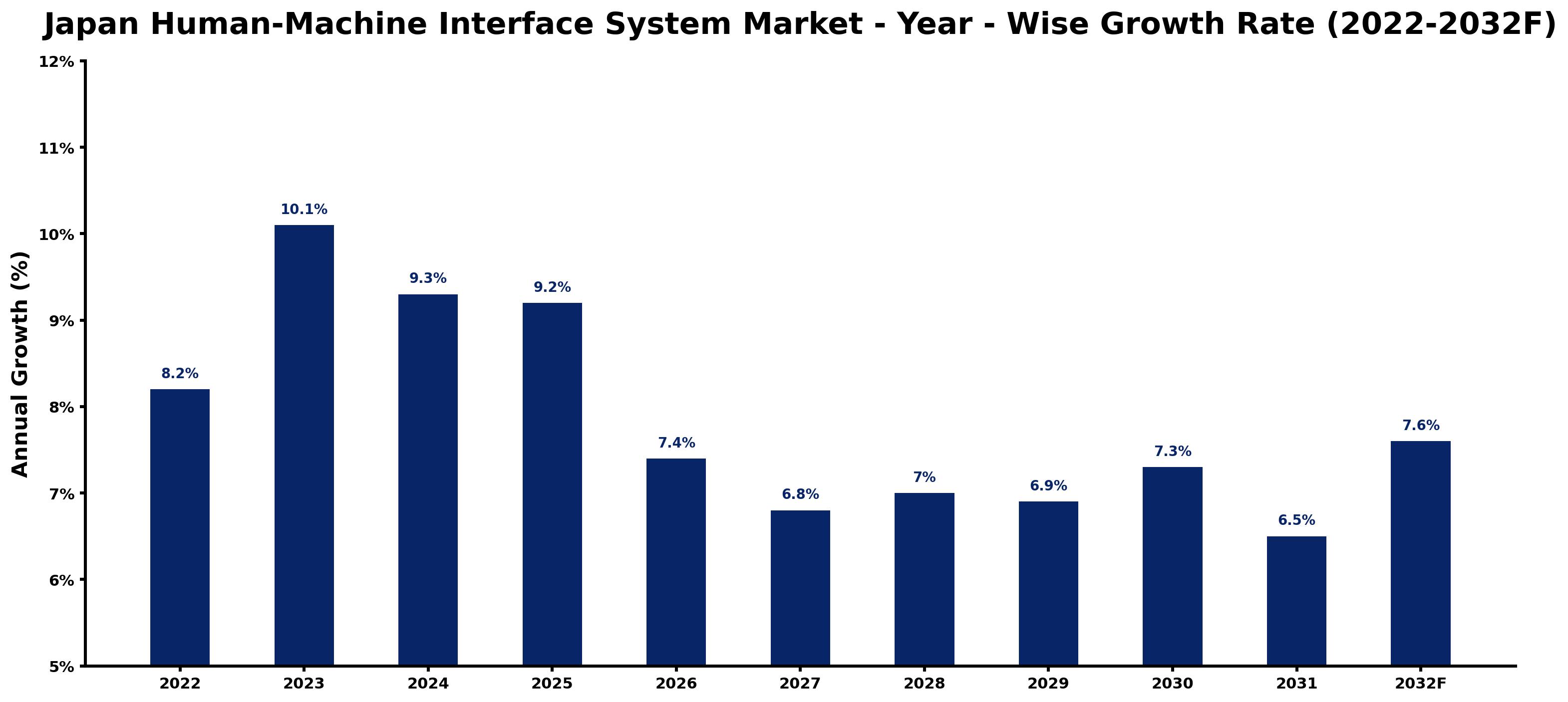
Year by year, the estimates below pair each growth rate with the development that shaped it.
| Year | Estimated Annual Growth (%) | Market Rationale |
| 2022 | 8.2 | The market experienced steady growth, supported by ongoing industrial automation trends. |
| 2023 | 10.1 | Demand surged due to increased vehicle production and advancements in HMI technology. |
| 2024 | 9.3 | Growth slowed as market saturation began to impact new investments in HMI systems. |
| 2025 | 9.2 | A slight slowdown in growth occurred as manufacturers adjusted to changing consumer preferences. |
| 2026 | 7.4 | Investment in smart manufacturing technologies is expected to contribute to a slowdown in growth. |
| 2027 | 6.8 | Expansion is projected to slow further as competition intensifies among HMI providers. |
| 2028 | 7.0 | Growth is anticipated to pick up again, driven by rising demand for automation in manufacturing. |
| 2029 | 6.9 | A slight slowdown is expected as the market begins to stabilise after previous growth spikes. |
| 2030 | 7.3 | Demand is projected to increase as manufacturers adopt more advanced HMI solutions for efficiency. |
| 2031 | 6.5 | Growth is expected to slow again as the market matures and innovation cycles lengthen. |
| 2032 | 7.6 | A resurgence in growth is anticipated due to the rise of electric vehicles and smart factories. |
Note: Market size estimations and growth projections presented in this report are based on 6Wresearch's proprietary forecasting methodology, utilizing the latest available industry data, government publications, and primary research inputs.
Japan Human-Machine Interface System Market Synopsis
Human-Machine Interface (HMI) systems facilitate interaction between users and machines through sensors and displays. They are primarily used in the automotive, industrial, and healthcare sectors in Japan. The Japan Human-Machine Interface System Market is expanding due to rising demand from the automotive sector, which produces over 5 million vehicles annually, and the healthcare sector, where HMI systems are integral to diagnostic equipment. The Ministry of Economy, Trade and Industry promotes HMI technology through various measures, driving innovation and technology adoption in this space.
Market Dynamics Impact Analysis (2026–2032)
| Factor | Type | Impact | Primary Segment Affected |
| Increased vehicle production and innovation in automotive technology drive demand for HMI systems. | Driver | High | Automotive HMI |
| The push for smart manufacturing and automation in factories creates a need for advanced HMI solutions. | Driver | High | Industrial HMI |
| The rise of electric vehicles presents opportunities for HMI integration in new vehicle models. | Opportunity | High | Automotive HMI |
| Healthcare facilities are investing in HMI systems to enhance patient safety and diagnostics. | Opportunity | High | Healthcare HMI |
| Market saturation in certain sectors may limit growth potential for new entrants. | Restraint | Medium | Automotive HMI |
| High initial costs of advanced HMI systems may deter smaller manufacturers from adoption. | Restraint | Medium | Industrial HMI |
| Competition among HMI providers may lead to pricing pressures, affecting profit margins. | Challenge | High | Healthcare HMI |
| Rapid technological advancements require continuous investment, straining smaller firms' resources. | Challenge | Medium | Consumer HMI |
Evaluation of Drivers in Japan Human-Machine Interface System Market (2026–2032)
Key forces behind demand, with the segment each one moves most, are listed below.
| Drivers | Primary Segment Affected | Why It Matters (Evidence) |
| Rising vehicle production in Japan fuels demand for automotive HMI systems. | Automotive HMI | With over 5 million vehicles produced annually, manufacturers require advanced HMI for navigation and control. |
| Investment in smart manufacturing technologies is transforming operational efficiency. | Industrial HMI | Over 1,000 manufacturing plants in Japan are increasingly adopting HMI systems to streamline operations. |
| Healthcare facilities are upgrading diagnostic equipment to improve patient care. | Healthcare HMI | HMI systems are utilized in over 80% of diagnostic equipment, ensuring accurate monitoring and diagnostics. |
| The 'Digital New Deal' policy promotes technology integration in factories. | Industrial HMI | This initiative encourages investment in HMI systems to boost productivity and reduce downtime. |
| The 'Society 5.0' initiative aims to integrate technology into daily life. | Consumer HMI | This national vision drives demand for HMI in smart appliances, improving user experiences. |
Orders keep climbing as the automotive sector in Japan produces over 5 million vehicles annually, driving demand for HMI systems in navigation and control. Investment in smart manufacturing technologies is transforming operational efficiency across more than 1,000 manufacturing plants, enabling firms to improve productivity through advanced HMI integration. Healthcare facilities utilise HMI systems in over 80% of diagnostic equipment, ensuring accurate monitoring and diagnostics. The focus on automation in manufacturing is prompting suppliers to develop solutions that meet evolving market needs.
Evaluation of Restraints in Japan Human-Machine Interface System Market
The following restraints limit how fast demand can grow.
| Market Restraint | Primary Segment Affected | Why It Matters (Evidence) |
| Market saturation limits growth potential for new entrants in the automotive sector. | Automotive HMI | With high production levels, new HMI providers may struggle to capture market share. |
| High initial costs deter smaller manufacturers from adopting advanced HMI systems. | Industrial HMI | Smaller firms may find it challenging to invest in sophisticated HMI technology. |
| Pricing pressures from competition may affect profit margins for HMI providers. | Healthcare HMI | Intense competition can lead to reduced prices, impacting overall profitability. |
| Rapid technological advancements require continuous investment in R&D. | Consumer HMI | Smaller firms may lack the resources to keep pace with evolving technology. |
| Regulatory compliance can increase operational costs for HMI manufacturers. | Industrial HMI | Manufacturers must ensure their products meet stringent safety and usability standards. |
Japan Human-Machine Interface System Market Challenges
Buyers of HMI systems face technological hurdles as rapid advancements in user interfaces require constant updates. This challenge arises from Japan's fast-paced tech sector, leading to R&D costs that can delay product launches for producers by up to six months. Regulatory changes, including the implementation of ISO 9241 standards, impose compliance costs on suppliers, potentially increasing prices for buyers by around 15%. Supply chain disruptions in sourcing components can cause production delays, forcing buyers to extend lead times by at least four weeks. Intense competition among local firms drives down prices, squeezing margins for producers and limiting their investment capacity.
Trends in the Japan Human-Machine Interface System Market
Buyers and suppliers in the Japan Human-Machine Interface System Market are adjusting to the following trends.
- Shift from Traditional to Touchless Interfaces: The automotive sector is increasingly adopting touchless HMI technology, improving user experience and safety. By 2026, advancements in touchless technology are expected to transform vehicle navigation systems, aligning with consumer preferences for intuitive interaction.
- Transition from Manual to Automated Control Systems: The 'Digital New Deal' launched in 2022 is driving a shift towards automated control systems in factories. This initiative aims to improve productivity, with over 1,000 manufacturing plants expected to integrate advanced HMI solutions by 2025.
- Emergence of Telemedicine Applications: Healthcare facilities are increasingly utilising HMI systems for telemedicine applications, improving remote diagnostics. By 2025, investments in HMI technology are expected to enhance patient monitoring and safety in hospitals.
- Prioritisation of Usability Standards in HMI Design: Japan has established ISO 9241 standards for HMI usability, ensuring quality and safety in design. This focus on usability is expected to improve user satisfaction across various applications, particularly in healthcare.
Investment Opportunities in the Japan Human-Machine Interface System Market
The following opportunities in the Japan Human-Machine Interface System Market pair current demand with a clear way in.
- Timing for Investment in Automotive HMI: With the rise of electric vehicles, there is a timely opportunity to invest in HMI systems tailored for new vehicle models. Vehicle manufacturers in Japan are integrating advanced HMI solutions, driving demand for new technologies.
- Entry into Healthcare HMI Market: Healthcare facilities are currently investing heavily in HMI systems to enhance patient safety. Collaborating with hospitals and medical device distributors can facilitate entry into this growing market, which is expected to expand significantly by 2025.
- Expansion of HMI in Smart Manufacturing: The push for smart manufacturing creates opportunities for HMI suppliers to improve operational efficiency. Manufacturers in the Tokyo region are seeking advanced HMI solutions to streamline processes, presenting a promising entry point for new providers.
- Growth in Consumer HMI Products: The increasing demand for smart appliances presents an opportunity for HMI suppliers. Engaging with online electronics stores can help tap into the consumer market, which is expected to grow as Japan's population exceeds 126 million.
Government Initiatives in the Japan Human-Machine Interface System Market
The 'Digital New Deal' launched in 2022 builds upon the framework established by the 'New Robot Strategy' of 2015. This policy promotes the integration of HMI technology in manufacturing, requiring producers to invest in advanced systems to improve efficiency and safety standards.
The Japan Standards Association (JSA) approves standards that govern HMI usability across various sectors. JSA's support for initiatives like the 'Digital New Deal' aims to boost technology integration in manufacturing, providing guidelines for firms adopting advanced HMI solutions.
Future Insight of the Japan Human-Machine Interface System Market
By 2032, the integration of HMI systems into smart factories will become more prevalent, prompting suppliers to adapt their offerings. The healthcare sector is projected to increase its investment in HMI systems by 25% by 2025, focusing on improving patient safety. The 'Connected Industries' initiative will further promote the adoption of HMI technologies across various sectors, enhancing operational efficiency. As electric vehicles gain traction, the demand for advanced HMI solutions will rise, creating opportunities for suppliers to develop touchless technologies.
Market Segmentation Analysis
Japan Human-Machine Interface System Market report covers a detailed analysis of the following market segments:
By System Type – Automotive HMI Leads, Industrial HMI Expected to Grow Fastest
According to Saurav Kr Singh, Senior Research Analyst at 6Wresearch, Automotive HMI accounted for 42% of the market by system type in 2025. The automotive HMI segment commands the largest share due to Japan's production of over 5 million vehicles annually, where these systems are vital for navigation and control. This extensive installed base ensures a continuous demand for advanced HMI solutions within the automotive sector. Industrial HMI is set to record the highest CAGR in this split, 9.9% over 2026–2032. Industrial HMI is witnessing rapid growth as manufacturing plants increasingly adopt these systems to enhance productivity and reduce downtime. The government's 'Digital New Deal' policy promotes technology integration in manufacturing, further accelerating this trend. Suppliers should enhance their offerings for industrial applications to capture the growing demand.
By Application Type – Navigation / Control Leads, Machine Operations Expected to Grow Fastest
In 2025, Navigation / Control led the application type split with a 43% share. Navigation and control applications dominate the market as they are essential for vehicle navigation systems, crucial for safe and efficient travel. The automotive sector's dependence on these applications solidifies their strong market presence. Over 2026–2032, Machine Operations are expected to post the fastest growth, at a CAGR of 10.1%. Machine operations are experiencing the fastest growth as factories aim to improve operational efficiency through advanced HMI systems. The increasing emphasis on smart manufacturing is a key factor driving this rapid expansion. Buyers in the manufacturing sector should prioritise investments in HMI systems that optimise machine operations.
By Distribution Channel – Automotive OEMs Lead, PLC Suppliers Expected to Grow Fastest
With 52% of distribution channel revenue in 2025, Automotive OEMs was the largest category. Automotive OEMs hold the largest share as they are the primary manufacturers of HMI systems for vehicles, ensuring a reliable supply chain. Their established relationships with vehicle manufacturers facilitate widespread adoption of HMI technology. PLC Suppliers are projected to grow fastest, at a CAGR of 9.4% during 2026–2032. PLC suppliers are experiencing the fastest growth as they play a crucial role in supporting HMI integration across various applications. The rising complexity of automation systems fuels demand for their services, leading to increased reliance on these suppliers. Suppliers should strengthen partnerships with PLC suppliers to enhance their market reach.
By End User – Vehicle Manufacturers Lead, Manufacturing Plants Expected to Grow Fastest
Vehicle Manufacturers took 32% of end user revenue in 2025, more than any other category. Vehicle manufacturers lead the market as they produce vehicles that integrate HMI systems, generating robust demand for these technologies. Their substantial investment in HMI solutions ensures a solid market foundation. The quickest growth will come from Manufacturing Plants, forecast to expand at a CAGR of 9.1% between 2026 and 2032. Manufacturing plants represent the fastest-growing end user segment as they increasingly utilise HMI for operational control and efficiency. The push towards smart factories significantly contributes to this growth, indicating a shift in industry focus. Buyers in manufacturing should explore HMI solutions that enhance operational control to maintain competitiveness.
Key Attractiveness of the Report
- 10 Years of Market Numbers
- Historical Data Starting from 2022 to 2025
- Base Year 2025
- Forecast Data until 2032
- Key Performance Indicators Impacting the Market
- Major Upcoming Developments and Projects
Key Highlights of the Report:
- Japan Human-Machine Interface System Market Outlook
- Market Size of Japan Human-Machine Interface System Market, 2025
- Forecast of Japan Human-Machine Interface System Market, 2032
- Historical Data and Forecast of Japan Human-Machine Interface System Revenues & Volume for the Period 2022-2032F
- Japan Human-Machine Interface System Market Trend Evolution
- Japan Human-Machine Interface System Market Drivers and Challenges
- Japan Human-Machine Interface System Price Trends
- Japan Human-Machine Interface System Porter's Five Forces
- Japan Human-Machine Interface System Industry Life Cycle
- Historical Data and Forecast of Japan Human-Machine Interface System Market Revenues & Volume By System Type for the Period 2022-2032F
- Historical Data and Forecast of Japan Human-Machine Interface System Market Revenues & Volume By Automotive HMI for the Period 2022-2032F
- Historical Data and Forecast of Japan Human-Machine Interface System Market Revenues & Volume By Industrial HMI for the Period 2022-2032F
- Historical Data and Forecast of Japan Human-Machine Interface System Market Revenues & Volume By Healthcare HMI for the Period 2022-2032F
- Historical Data and Forecast of Japan Human-Machine Interface System Market Revenues & Volume By Consumer HMI for the Period 2022-2032F
- Historical Data and Forecast of Japan Human-Machine Interface System Market Revenues & Volume By Application Type for the Period 2022-2032F
- Historical Data and Forecast of Japan Human-Machine Interface System Market Revenues & Volume By Navigation / Control for the Period 2022-2032F
- Historical Data and Forecast of Japan Human-Machine Interface System Market Revenues & Volume By Machine Operations for the Period 2022-2032F
- Historical Data and Forecast of Japan Human-Machine Interface System Market Revenues & Volume By Diagnostic Panels for the Period 2022-2032F
- Historical Data and Forecast of Japan Human-Machine Interface System Market Revenues & Volume By Smart Appliances for the Period 2022-2032F
- Historical Data and Forecast of Japan Human-Machine Interface System Market Revenues & Volume By Distribution Channel for the Period 2022-2032F
- Historical Data and Forecast of Japan Human-Machine Interface System Market Revenues & Volume By Automotive OEMs for the Period 2022-2032F
- Historical Data and Forecast of Japan Human-Machine Interface System Market Revenues & Volume By PLC Suppliers for the Period 2022-2032F
- Historical Data and Forecast of Japan Human-Machine Interface System Market Revenues & Volume By Medical Device Distributors for the Period 2022-2032F
- Historical Data and Forecast of Japan Human-Machine Interface System Market Revenues & Volume By Online Electronics Stores for the Period 2022-2032F
- Historical Data and Forecast of Japan Human-Machine Interface System Market Revenues & Volume By End User for the Period 2022-2032F
- Historical Data and Forecast of Japan Human-Machine Interface System Market Revenues & Volume By Vehicle Manufacturers for the Period 2022-2032F
- Historical Data and Forecast of Japan Human-Machine Interface System Market Revenues & Volume By Manufacturing Plants for the Period 2022-2032F
- Historical Data and Forecast of Japan Human-Machine Interface System Market Revenues & Volume By Hospitals for the Period 2022-2032F
- Historical Data and Forecast of Japan Human-Machine Interface System Market Revenues & Volume By End Consumers for the Period 2022-2032F
- Japan Human-Machine Interface System Import Export Trade Statistics
- Market Opportunity Assessment By System Type
- Market Opportunity Assessment By Application Type
- Market Opportunity Assessment By Distribution Channel
- Market Opportunity Assessment By End User
- Japan Human-Machine Interface System Top Companies Market Share
- Japan Human-Machine Interface System Competitive Benchmarking By Technical and Operational Parameters
- Japan Human-Machine Interface System Company Profiles
- Japan Human-Machine Interface System Key Strategic Recommendations
Market Covered
The study includes the following segmentation.
By System Type
- Automotive HMI
- Industrial HMI
- Healthcare HMI
- Consumer HMI
By Application Type
- Navigation / Control
- Machine Operations
- Diagnostic Panels
- Smart Appliances
By Distribution Channel
- Automotive OEMs
- PLC Suppliers
- Medical Device Distributors
- Online Electronics Stores
By End User
- Vehicle Manufacturers
- Manufacturing Plants
- Hospitals
- End Consumers































