Japan HVAC Actuator Motor Market Size & Growth Rate
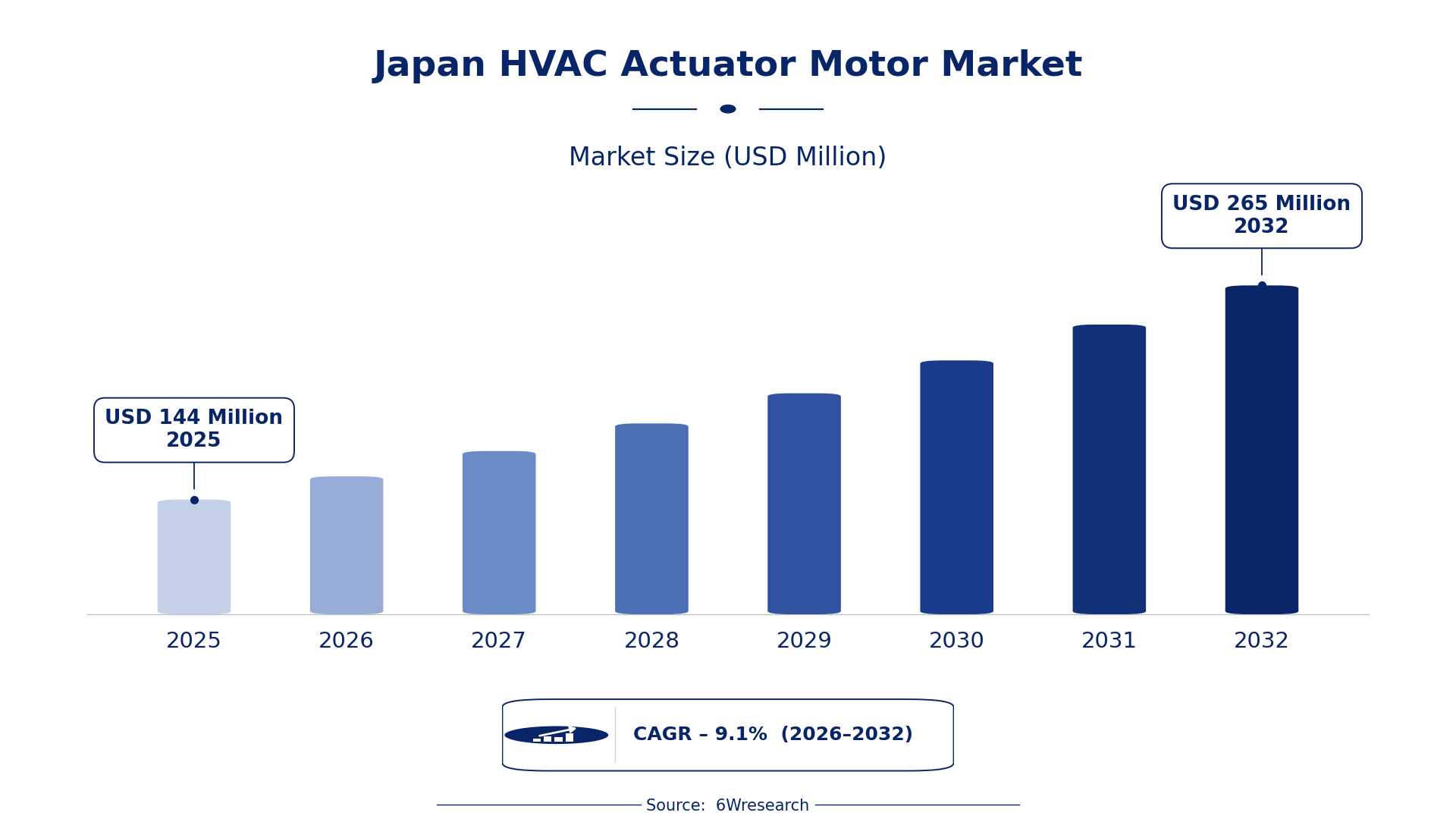
According to 6Wresearch internal database and industry insights, the Japan HVAC Actuator Motor Market was valued at USD 144 Million in 2025 and is projected to reach USD 265 Million by 2032, growing at a CAGR of approximately 9.1% during 2026–2032.
Japan HVAC Actuator Motor Market Highlights
| Report Metric | Details |
| Report Name | Japan HVAC Actuator Motor Market (2026-2032) |
| Market Size 2025 | USD 144 Million |
| Market Size 2032 | USD 265 Million |
| Absolute Growth 2025–2032 | USD 121 Million |
| CAGR 2026–2032 | 9.1% |
| Peak Annual Growth | 10.5% in 2026 |
| Forecast Period | 2026–2032 |
| Historical Data | 2022–2025 |
| Base Year | 2025 |
| Leading Motor Type, 2025 | Spring Return Actuators (37% share) |
| Leading Actuation Method, 2025 | Electric/Manual (44% share) |
| Leading Distribution Channel, 2025 | OEMs (38% share) |
| Leading End User, 2025 | Commercial HVAC Systems (43% share) |
| Fastest-Growing Motor Type | Non-Spring Return (13.0% CAGR) |
| Fastest-Growing Actuation Method | Pneumatic/Electric (13.4% CAGR) |
| Fastest-Growing Distribution Channel | Online Suppliers (11.5% CAGR) |
| Fastest-Growing End User | Industrial Facilities (12.0% CAGR) |
| Growing Sector | Commercial HVAC Systems |
| Key End Users | Building Automation, Commercial Facilities, Industrial Facilities, Smart Buildings |
Japan HVAC Actuator Motor Market Year-wise Growth Rate and Key Drivers (2022–2032)
This graph illustrates the annual growth rates of the market from 2022 to 2032, highlighting a steady upward trajectory and projected market expansion over the forecast period.
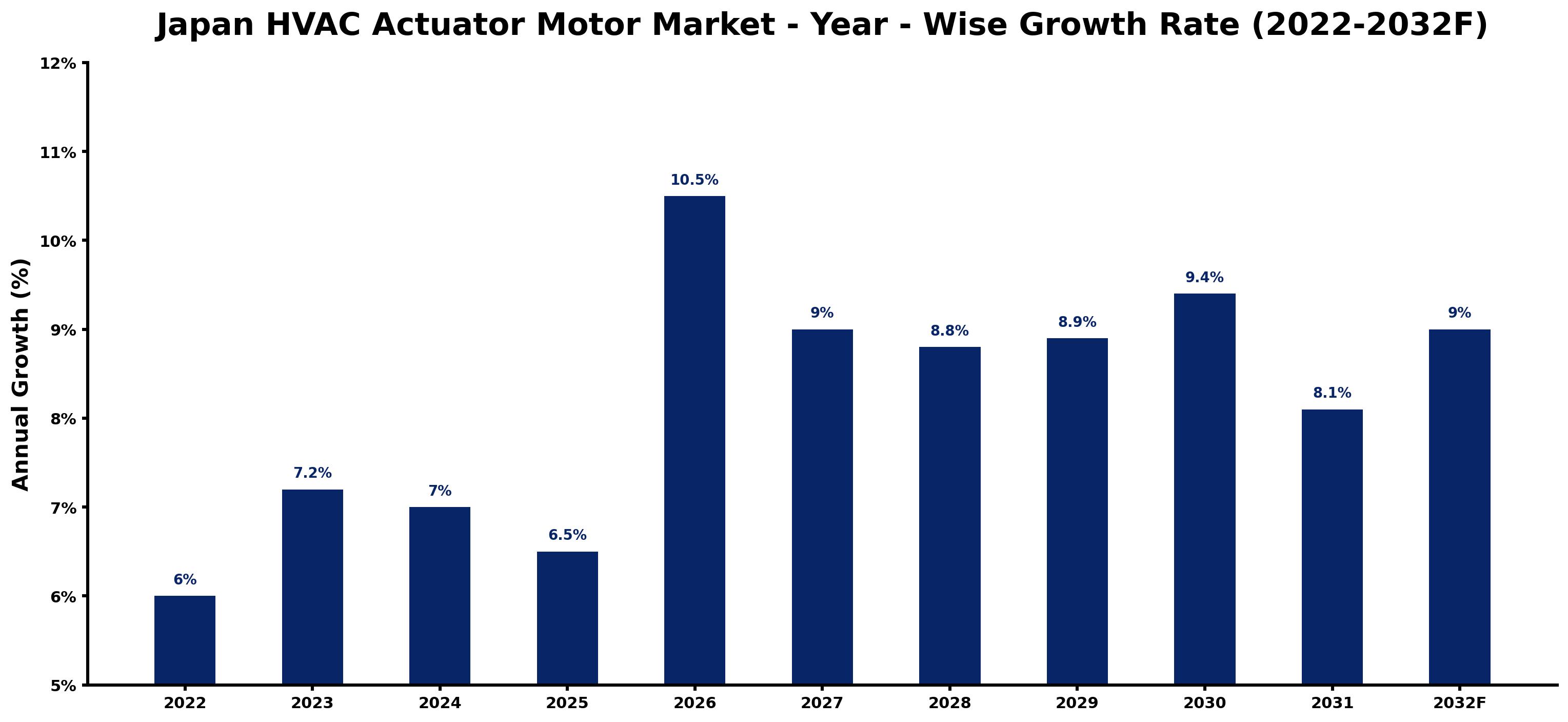
The following figures match every annual growth estimate with the main market development of that year, giving the reasoning behind each rise or slowdown.
| Year | Estimated Annual Growth (%) | Market Rationale |
| 2022 | 6.0 | The market showed steady growth due to ongoing construction projects in commercial sectors. |
| 2023 | 7.2 | Demand grew faster as energy efficiency became a priority for building owners. |
| 2024 | 7.0 | Growth slowed slightly as the market adjusted to previous high rates. |
| 2025 | 6.5 | The market continued to grow, albeit at a slower pace due to market saturation. |
| 2026 | 10.5 | Growth is expected to accelerate sharply due to increased investments in smart building technologies. |
| 2027 | 9.0 | Demand growth is projected to slow as the market stabilises after the peak in 2026. |
| 2028 | 8.8 | The market is expected to experience a slight slowdown as competition intensifies among suppliers. |
| 2029 | 8.9 | Growth is expected to rebound as smart building adoption gains momentum across regions. |
| 2030 | 9.4 | Demand is projected to increase with rising investments in energy-efficient HVAC systems. |
| 2031 | 8.1 | The market growth rate is expected to slow as the sector matures and competition heightens. |
| 2032 | 9.0 | Demand is expected to rise as more commercial buildings integrate advanced technologies. |
Note: Market size estimations and growth projections presented in this report are based on 6Wresearch's proprietary forecasting methodology, utilizing the latest available industry data, government publications, and primary research inputs.
Japan HVAC Actuator Motor Market Synopsis
HVAC actuator motors are electromechanical devices essential for controlling airflow and regulating temperature in heating, ventilation, and air conditioning systems. Increasing demand arises from over 1,000 commercial buildings in Tokyo and a growing emphasis on energy-efficient solutions. The Japan HVAC Actuator Motor Market is expanding due to the Building Energy Efficiency Act, compelling producers to innovate and improve energy efficiency in their products, which drives further investments in this sector.
Market Dynamics Impact Analysis (2026–2032)
| Factor | Type | Impact | Primary Segment Affected |
| Increasing number of smart buildings in Japan | Driver | High | Smart Actuators |
| Growing focus on energy efficiency in HVAC systems | Driver | High | Modulating Motors |
| Expansion of the building automation sector | Opportunity | Medium | Building Automation |
| Rising demand for IoT-enabled technologies | Opportunity | Medium | IoT Enabled |
| High initial costs of advanced actuator systems | Restraint | High | Smart Actuators |
| Limited awareness of energy-efficient solutions | Restraint | Medium | Modulating Motors |
| Competition from alternative technologies | Challenge | High | Non-Spring Return |
| Supply chain disruptions affecting component availability | Challenge | Medium | Electric/Manual |
Evaluation of Drivers in Japan HVAC Actuator Motor Market (2026–2032)
Demand rests on the following drivers, each shown with the segment it touches most.
| Drivers | Primary Segment Affected | Why It Matters (Evidence) |
| Rising investments in smart building technologies | Smart Actuators | The number of smart buildings is projected to exceed 10,000 by 2025, increasing the need for advanced actuator systems. |
| Focus on energy efficiency in HVAC systems | Modulating Motors | The Building Energy Efficiency Act requires energy-efficient solutions, leading to higher purchases of modulating motors. |
| Growth in the building automation sector | Building Automation | This sector is projected to reach 500 billion yen by 2025, driving demand for integrated actuator solutions. |
| Increasing adoption of IoT technologies | IoT Enabled | Smart building technologies are anticipated to grow by 15% annually, boosting demand for IoT-enabled actuators. |
| Expansion of commercial buildings in urban areas | Commercial HVAC Systems | Tokyo accounts for 30% of HVAC installations, increasing the need for actuator motors. |
Volumes rise due to increasing investments in smart building technologies, with projections indicating that the number of smart buildings will surpass 10,000 by 2025. This transition leads to heightened purchases of advanced actuator systems, particularly smart actuators. The building automation sector is expected to grow, increasing the need for integrated actuator solutions. Furthermore, the adoption of IoT technology is likely to increase, further driving demand for IoT-enabled actuators.
Evaluation of Restraints in Japan HVAC Actuator Motor Market
The key brakes on demand, and where they bite hardest, are shown below.
| Market Restraint | Primary Segment Affected | Why It Matters (Evidence) |
| High initial costs of advanced actuator systems | Smart Actuators | These costs can deter small businesses from investing in modern HVAC solutions, limiting market growth. |
| Limited awareness of energy-efficient solutions | Modulating Motors | Many users remain unaware of the benefits of energy-efficient HVAC systems, affecting sales. |
| Competition from alternative technologies | Non-Spring Return | Alternative technologies may offer lower costs, challenging the market share of traditional actuators. |
| Supply chain disruptions affecting component availability | Electric/Manual | Delays in component delivery can hinder production schedules, impacting overall market supply. |
| Regulatory compliance costs for new standards | IoT Enabled | Compliance with standards like JIS B 8616 can increase operational costs for manufacturers. |
Japan HVAC Actuator Motor Market Challenges
Buyers in the HVAC sector face challenges with outdated technology, as many systems still depend on conventional actuators lacking smart features, resulting in inefficiencies and higher operational costs. Suppliers encounter sourcing difficulties for advanced components due to limited local manufacturing capabilities, which can delay project timelines by up to six months for contractors. Skills shortages in the workforce impede the installation and maintenance of modern HVAC systems, leading to increased downtime for users and potential revenue losses estimated at 15%. Competition from emerging technologies pressures producers to reduce prices, potentially eroding profit margins by around 10%.
Trends in the Japan HVAC Actuator Motor Market
Buyers and suppliers in the Japan HVAC Actuator Motor Market are adjusting to the following trends.
- Shift towards Smart Building Technologies: Tokyo is experiencing a shift towards smart building technologies, with over 10,000 smart buildings expected by 2025. This trend is driving demand for advanced HVAC actuator motors, which are essential for efficient climate control.
- Increase in Energy-Efficient HVAC Systems: In 2023, the government launched a program to improve energy efficiency in commercial buildings, aiming to reduce energy consumption. This initiative is set to boost demand for HVAC actuator motors.
- Transition from Traditional to IoT-Enabled Solutions: There is a noticeable transition from traditional HVAC systems to IoT-enabled solutions in Japan. The growing integration of smart technologies is projected to increase actuator motor demand by 15% annually.
- Expansion of Building Automation Sector: The building automation sector is set to grow, reflecting a trend towards integrated HVAC solutions. This growth will enhance the demand for actuator motors.
Investment Opportunities in the Japan HVAC Actuator Motor Market
Where to invest in the Japan HVAC Actuator Motor Market: the main openings are set out below.
- Establishing Partnerships with Local Distributors: Forming partnerships with local HVAC distributors can facilitate market entry, especially in urban areas like Tokyo, where demand is high. The market is valued at approximately 1 trillion yen.
- Targeting Commercial HVAC Systems: Commercial HVAC systems represent a significant opportunity, with a 43% market share in 2025. Focusing on this segment can yield substantial returns for suppliers.
- Investment in IoT-Enabled Technologies: With smart building technologies projected to grow by 15% annually, there is a clear opportunity to invest in IoT-enabled actuator motors to meet rising demand.
- Development of Energy-Efficient Solutions: The Building Energy Efficiency Act creates a gap for innovative energy-efficient HVAC systems, allowing suppliers to cater to a growing market segment.
Government Initiatives in the Japan HVAC Actuator Motor Market
The Building Energy Efficiency Act, amended in 2022, requires that all new buildings comply with energy standards starting April 2025. This law imposes strict requirements for HVAC systems, compelling producers to innovate and improve energy efficiency in their products.
In 2023, the government introduced a programme to enhance energy efficiency in commercial buildings, with 100 billion yen allocated for funding. The Ministry of the Environment oversees this initiative, ensuring compliance and promoting energy-efficient HVAC solutions.
Future Insight of the Japan HVAC Actuator Motor Market
By 2032, the number of smart buildings is expected to exceed 10,000, creating new opportunities for suppliers. The implementation of JIS B 8616 will standardise actuator motor specifications, ensuring quality and reliability for buyers. Energy efficiency programmes will encourage investment in modern HVAC systems, driving innovation and enhancing market competitiveness.
Market Segmentation Analysis
Japan HVAC Actuator Motor Market report covers a detailed analysis of the following market segments:
By Motor Type – Spring Return Actuators Lead, Non-Spring Return Expected to Grow Fastest
According to Saurav Kr Singh, Senior Research Analyst at 6Wresearch, Spring Return Actuators accounted for 37% of the market by motor type in 2025. Spring Return Actuators dominate the market because they are crucial for the reliable positioning of dampers in HVAC systems, ensuring optimal airflow management. Their widespread application in over 1,000 commercial buildings in Tokyo highlights their importance in maintaining system efficiency. Non-Spring Return is projected to grow fastest, at a CAGR of 13.0% during 2026–2032. Non-Spring Return Actuators are witnessing rapid growth as they provide continuous control in HVAC applications, catering to the increasing need for precise temperature regulation. This growth is further supported by the expected rise in smart buildings, which are projected to exceed 10,000 by 2025. This trend indicates that suppliers should focus on enhancing their offerings in Non-Spring Return Actuators to capture emerging market opportunities.
By Actuation Method – Electric/Manual Leads, Pneumatic/Electric Expected to Grow Fastest
Electric/Manual held 44% of the Japan HVAC Actuator Motor Market by actuation method in 2025. Electric/Manual actuation methods hold the largest share as they are the most common in HVAC systems, ensuring efficient operation and control. Their established presence in various HVAC installations across Japan reinforces their market leadership. The quickest growth will come from Pneumatic/Electric, forecast to expand at a CAGR of 13.4% between 2026 and 2032. Pneumatic/Electric methods are experiencing the fastest growth, primarily due to their application in specific industrial settings that require advanced control systems. The push for energy efficiency in industrial facilities is driving this demand. Buyers in the industrial sector should consider investing in Pneumatic/Electric systems to improve operational efficiency and meet regulatory standards.
By Distribution Channel – OEMs Lead, Online Suppliers Expected to Grow Fastest
OEMs took 38% of distribution channel revenue in 2025, more than any other category. OEMs are the primary distribution channel for HVAC actuator motors, providing integrated solutions directly to manufacturers and end-users in the industry. Their strong connections with HVAC system providers ensure a consistent supply of actuator motors, reinforcing their market position. Over 2026–2032, Online Suppliers are expected to post the fastest growth, at a CAGR of 11.5%. Online Suppliers are rapidly gaining traction as they present a convenient purchasing avenue for HVAC components, aligning with the growing preference for digital transactions among consumers. This trend reflects the broader movement towards e-commerce across various industries. Suppliers must strengthen their online strategies to effectively engage with the increasing number of buyers seeking HVAC components through digital channels.
By End User – Commercial HVAC Systems Lead, Industrial Facilities Expected to Grow Fastest
With 43% of end user revenue in 2025, Commercial HVAC Systems was the largest category. Commercial HVAC Systems represent the largest end-user segment for actuator motors, driven by the high demand for efficient climate control in numerous commercial buildings. The concentration of HVAC installations in urban areas like Tokyo further solidifies this segment's dominance. Industrial Facilities are set to record the highest CAGR in this split, 12.0% over 2026–2032. Industrial Facilities are the fastest-growing end-user segment, as they increasingly require sophisticated HVAC systems for optimal operational conditions. The ongoing expansion of industrial infrastructure in Japan is a key factor in this growth. Suppliers should tailor their offerings to meet the specific needs of industrial facilities to maximise their market share.
Key Attractiveness of the Report
- 10 Years of Market Numbers
- Historical Data Starting from 2022 to 2025
- Base Year 2025
- Forecast Data until 2032
- Key Performance Indicators Impacting the Market
- Major Upcoming Developments and Projects
Key Highlights of the Report:
- Japan HVAC Actuator Motor Market Outlook
- Market Size of Japan HVAC Actuator Motor Market, 2025
- Forecast of Japan HVAC Actuator Motor Market, 2032
- Historical Data and Forecast of Japan HVAC Actuator Motor Revenues & Volume for the Period 2022-2032F
- Japan HVAC Actuator Motor Market Trend Evolution
- Japan HVAC Actuator Motor Market Drivers and Challenges
- Japan HVAC Actuator Motor Price Trends
- Japan HVAC Actuator Motor Porter's Five Forces
- Japan HVAC Actuator Motor Industry Life Cycle
- Historical Data and Forecast of Japan HVAC Actuator Motor Market Revenues & Volume By Motor Type for the Period 2022-2032F
- Historical Data and Forecast of Japan HVAC Actuator Motor Market Revenues & Volume By Spring Return Actuators for the Period 2022-2032F
- Historical Data and Forecast of Japan HVAC Actuator Motor Market Revenues & Volume By Non-Spring Return for the Period 2022-2032F
- Historical Data and Forecast of Japan HVAC Actuator Motor Market Revenues & Volume By Modulating Motors for the Period 2022-2032F
- Historical Data and Forecast of Japan HVAC Actuator Motor Market Revenues & Volume By Smart Actuators for the Period 2022-2032F
- Historical Data and Forecast of Japan HVAC Actuator Motor Market Revenues & Volume By Actuation Method for the Period 2022-2032F
- Historical Data and Forecast of Japan HVAC Actuator Motor Market Revenues & Volume By Electric/Manual for the Period 2022-2032F
- Historical Data and Forecast of Japan HVAC Actuator Motor Market Revenues & Volume By Pneumatic/Electric for the Period 2022-2032F
- Historical Data and Forecast of Japan HVAC Actuator Motor Market Revenues & Volume By Variable Control for the Period 2022-2032F
- Historical Data and Forecast of Japan HVAC Actuator Motor Market Revenues & Volume By IoT Enabled for the Period 2022-2032F
- Historical Data and Forecast of Japan HVAC Actuator Motor Market Revenues & Volume By Distribution Channel for the Period 2022-2032F
- Historical Data and Forecast of Japan HVAC Actuator Motor Market Revenues & Volume By OEMs for the Period 2022-2032F
- Historical Data and Forecast of Japan HVAC Actuator Motor Market Revenues & Volume By Online Suppliers for the Period 2022-2032F
- Historical Data and Forecast of Japan HVAC Actuator Motor Market Revenues & Volume By HVAC Distributors for the Period 2022-2032F
- Historical Data and Forecast of Japan HVAC Actuator Motor Market Revenues & Volume By Control System Vendors for the Period 2022-2032F
- Historical Data and Forecast of Japan HVAC Actuator Motor Market Revenues & Volume By End User for the Period 2022-2032F
- Historical Data and Forecast of Japan HVAC Actuator Motor Market Revenues & Volume By Commercial HVAC Systems for the Period 2022-2032F
- Historical Data and Forecast of Japan HVAC Actuator Motor Market Revenues & Volume By Industrial Facilities for the Period 2022-2032F
- Historical Data and Forecast of Japan HVAC Actuator Motor Market Revenues & Volume By Building Automation for the Period 2022-2032F
- Historical Data and Forecast of Japan HVAC Actuator Motor Market Revenues & Volume By Smart Buildings for the Period 2022-2032F
- Japan HVAC Actuator Motor Import Export Trade Statistics
- Market Opportunity Assessment By Motor Type
- Market Opportunity Assessment By Actuation Method
- Market Opportunity Assessment By Distribution Channel
- Market Opportunity Assessment By End User
- Japan HVAC Actuator Motor Top Companies Market Share
- Japan HVAC Actuator Motor Competitive Benchmarking By Technical and Operational Parameters
- Japan HVAC Actuator Motor Company Profiles
- Japan HVAC Actuator Motor Key Strategic Recommendations
Market Covered
Coverage by segment is as follows.
By Motor Type
- Spring Return Actuators
- Non-Spring Return
- Modulating Motors
- Smart Actuators
By Actuation Method
- Electric/Manual
- Pneumatic/Electric
- Variable Control
- IoT Enabled
By Distribution Channel
- OEMs
- Online Suppliers
- HVAC Distributors
- Control System Vendors
By End User
- Commercial HVAC Systems
- Industrial Facilities
- Building Automation
- Smart Buildings































