Japan HVAC AHU Market Size & Growth Rate
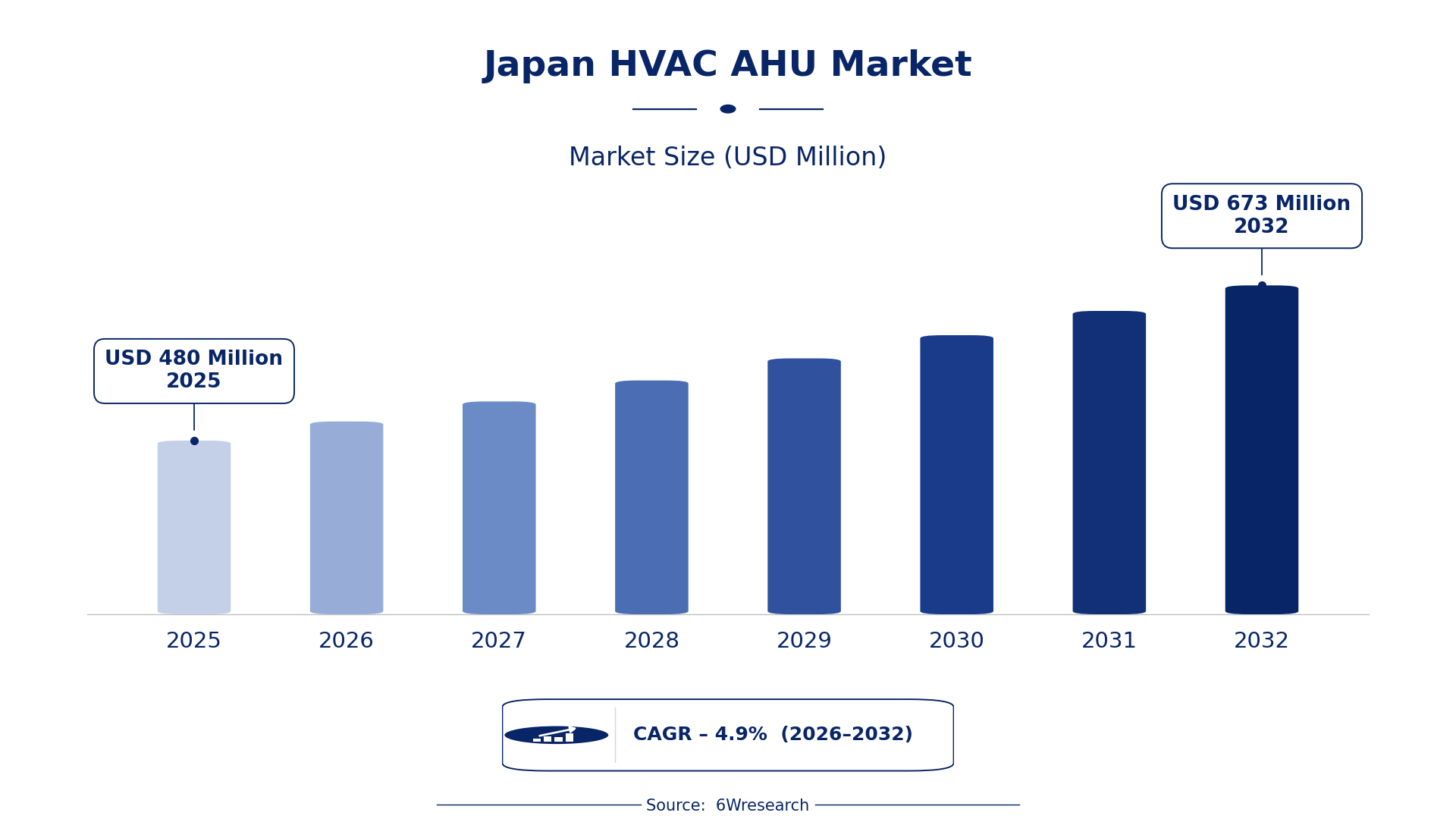
According to 6Wresearch internal database and industry insights, the Japan HVAC AHU Market was valued at USD 480 Million in 2025 and is projected to reach USD 673 Million by 2032, growing at a CAGR of approximately 4.9% during 2026–2032.
Japan HVAC AHU Market Highlights
| Report Metric | Details |
| Report Name | Japan HVAC AHU Market (2026-2032) |
| Market Size 2025 | USD 480 Million |
| Market Size 2032 | USD 673 Million |
| Absolute Growth 2025–2032 | USD 193 Million |
| CAGR 2026–2032 | 4.9% |
| Peak Annual Growth | 5.8% in 2032 |
| Forecast Period | 2026–2032 |
| Historical Data | 2022–2025 |
| Base Year | 2025 |
| Leading Unit Type, 2025 | Packaged AHU (35% share) |
| Leading Installation Type, 2025 | Indoor / Outdoor (39% share) |
| Leading Distribution Channel, 2025 | HVAC System Providers (49% share) |
| Leading End User, 2025 | Commercial Buildings (52% share) |
| Fastest-Growing Unit Type | Modular AHU (6.9% CAGR) |
| Fastest-Growing Installation Type | Customized (7.0% CAGR) |
| Fastest-Growing Distribution Channel | Industrial Vendors (6.6% CAGR) |
| Fastest-Growing End User | Factories & Warehouses (6.7% CAGR) |
| Growing Sector | Commercial Buildings |
| Key End Users | Commercial Buildings, Factories & Warehouses, Educational Institutions |
Japan HVAC AHU Market Year-wise Growth Rate and Key Drivers (2022–2032)
This graph illustrates the annual growth rates of the market from 2022 to 2032, highlighting a steady upward trajectory and projected market expansion over the forecast period.
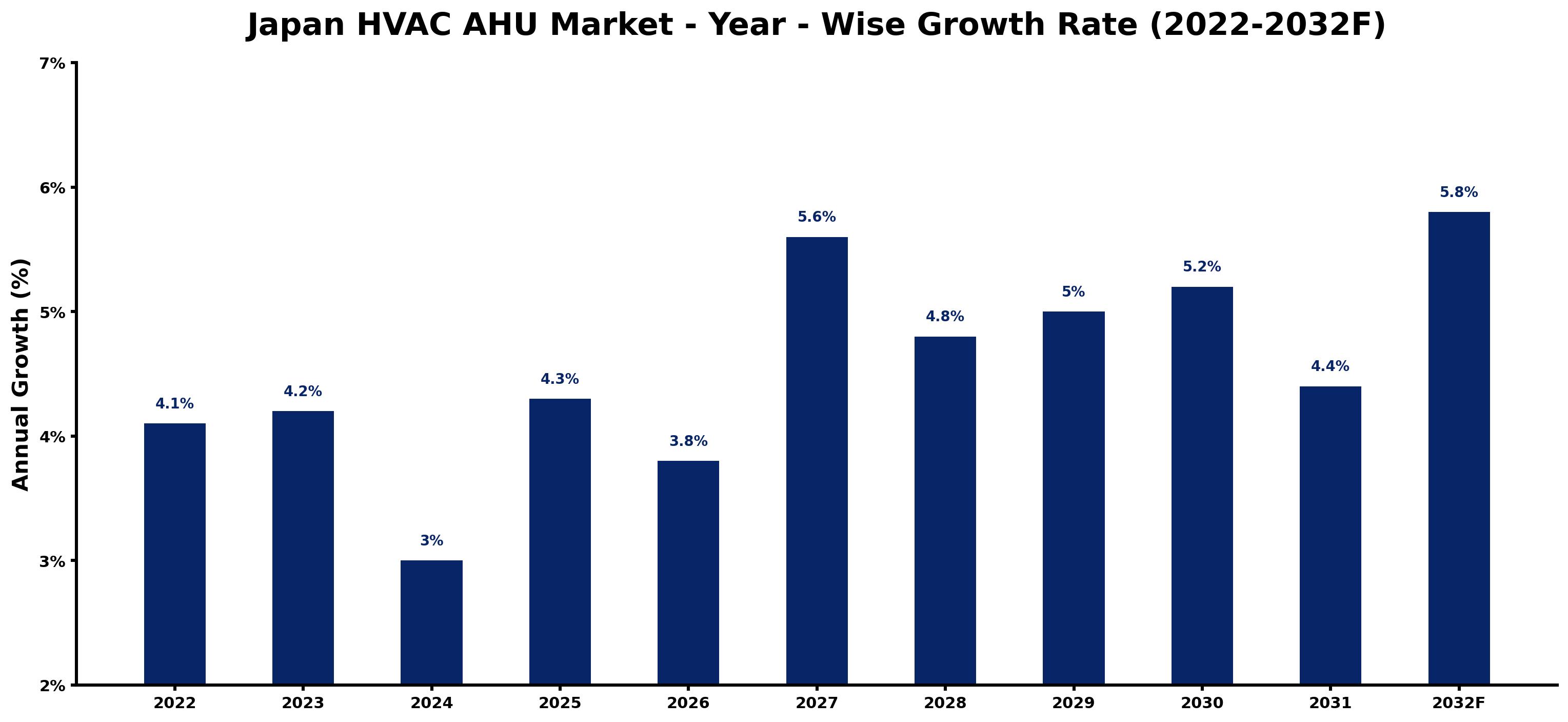
Annual growth estimates for each year appear below with the principal reason behind them, explaining the shifts that set the pace of the market.
| Year | Estimated Annual Growth (%) | Market Rationale |
| 2022 | 4.1 | Demand was strong due to ongoing construction projects across commercial buildings. |
| 2023 | 4.2 | Growth continued as energy efficiency became a priority for new installations. |
| 2024 | 3.0 | Market growth slowed as some projects faced delays in approvals and funding. |
| 2025 | 4.3 | Increased demand for energy-efficient systems drove higher growth rates this year. |
| 2026 | 3.8 | The market is projected to slow as competition intensifies among suppliers. |
| 2027 | 5.6 | Demand is expected to surge as factories upgrade their HVAC systems for better efficiency. |
| 2028 | 4.8 | Growth is anticipated to slow slightly as the market adjusts to previous high demand levels. |
| 2029 | 5.0 | Renewed interest in energy-efficient solutions is set to boost market activity again. |
| 2030 | 5.2 | Demand is likely to rise as more commercial buildings seek to meet regulatory standards. |
| 2031 | 4.4 | Growth is expected to slow as the market stabilises after several years of rapid expansion. |
| 2032 | 5.8 | The market is projected to peak as new technologies and standards are widely adopted. |
Note: Market size estimations and growth projections presented in this report are based on 6Wresearch's proprietary forecasting methodology, utilizing the latest available industry data, government publications, and primary research inputs.
Japan HVAC AHU Market Synopsis
HVAC AHU serves as a key element in heating, ventilation, and air conditioning systems, managing and distributing air in commercial and industrial buildings. The Japan HVAC AHU Market is set to reach 3.5 million units by 2025, driven by rising demand for energy-efficient systems and the expansion of commercial buildings. Government incentives for energy efficiency and the necessity for regular upgrades are contributing to market growth, supported by a strong construction sector.
Market Dynamics Impact Analysis (2026–2032)
| Factor | Type | Impact | Primary Segment Affected |
| Growing demand for energy-efficient systems | Driver | High | Energy-Efficient AHU |
| Expansion of commercial buildings and factories | Driver | High | Commercial Buildings |
| Increasing investments in energy-efficient technologies | Opportunity | High | Energy-Efficient AHU |
| Rising need for customized HVAC solutions | Opportunity | Medium | Customized |
| High initial costs of energy-efficient systems | Restraint | High | Energy-Efficient AHU |
| Regulatory compliance costs for HVAC systems | Restraint | Medium | HVAC System Providers |
| Limited availability of skilled technicians | Challenge | High | HVAC System Providers |
| Competition from imported HVAC systems | Challenge | Medium | HVAC System Providers |
Evaluation of Drivers in Japan HVAC AHU Market (2026–2032)
Key forces behind demand, with the segment each one moves most, are listed below.
| Drivers | Primary Segment Affected | Why It Matters (Evidence) |
| Increased focus on energy efficiency | Energy-Efficient AHU | The average lifespan of an HVAC AHU is around 15-20 years, leading buyers to invest in newer, more efficient models. |
| Growth in commercial construction | Commercial Buildings | Tokyo's population of approximately 14 million drives consistent demand for HVAC systems in new commercial buildings. |
| Government incentives for energy-efficient solutions | Energy-Efficient AHU | In 2023, the government allocated ¥5 billion for subsidies, encouraging upgrades to energy-efficient systems. |
| Rising urban population driving HVAC needs | Commercial Buildings | Tokyo's large population increases the demand for effective HVAC solutions, particularly in commercial settings. |
| Technological advancements in HVAC systems | Energy-Efficient AHU | Current regulations promote modernisation of HVAC systems, encouraging innovation in energy-efficient designs. |
The strongest pull on demand comes from the increasing focus on energy efficiency, prompting buyers to invest in newer models due to the average lifespan of HVAC AHUs being around 15-20 years. Growth in commercial construction is evident in Tokyo, where a dense concentration of commercial buildings creates sustained demand. The large population in Tokyo drives the need for effective HVAC solutions, while advancements in technology promote modernisation across the sector.
Evaluation of Restraints in Japan HVAC AHU Market
The table below lists the restraints and the evidence behind each.
| Market Restraint | Primary Segment Affected | Why It Matters (Evidence) |
| High initial costs of energy-efficient systems | Energy-Efficient AHU | The average investment for energy-efficient HVAC systems can exceed 20% more than traditional options. |
| Regulatory compliance costs for HVAC systems | HVAC System Providers | Compliance with current regulations requires substantial investment in testing and certification. |
| Limited availability of skilled technicians | HVAC System Providers | A shortage of qualified HVAC technicians can delay installations and increase costs for buyers. |
| Competition from imported HVAC systems | HVAC System Providers | Imported systems often offer lower prices, impacting local manufacturers' market share. |
| Market saturation in urban areas | Commercial Buildings | High competition in major cities like Tokyo can limit growth opportunities for new entrants. |
Japan HVAC AHU Market Challenges
In 2023, over 300,000 educational institutions require HVAC systems, yet many face delays due to a shortage of skilled technicians, prolonging installation times for schools. Producers are experiencing heightened competition as new entrants focus on energy-efficient models, pressuring established manufacturers to lower prices and reduce profit margins. The average lifespan of an HVAC AHU is 15-20 years, resulting in a backlog of essential upgrades that affects businesses needing modern solutions. Compliance with JIS standards increases production costs for manufacturers, leading to higher prices for facilities seeking quality installations.
Trends in the Japan HVAC AHU Market
The following changes are redrawing the Japan HVAC AHU Market.
- Launch of Energy-Efficient HVAC Initiative: In 2023, a programme was initiated to promote energy-efficient HVAC systems in commercial buildings, allocating ¥5 billion for subsidies. This initiative is expected to drive upgrades in existing systems, benefiting suppliers of energy-efficient technologies.
- Shift towards Modular AHUs: The trend towards Modular AHUs is gaining traction, particularly in urban areas where space is limited. This shift allows for flexible installation in various building types, with a projected CAGR of 6.9% through 2032.
- Growing Demand for Customized Solutions: The increasing need for tailored HVAC systems is reflected in the rise of Customized AHUs. This trend addresses the unique requirements of different facilities, with a CAGR of 7.0% anticipated in the coming years.
- Focus on Indoor Air Quality Standards: In 2023, the emphasis on indoor air quality standards has intensified, particularly in educational institutions. The demand for HVAC systems that ensure clean air is rising, driven by the need for effective climate control.
Investment Opportunities in the Japan HVAC AHU Market
Below are the investment opportunities with the strongest case in the Japan HVAC AHU Market.
- Partnerships for Energy-Efficient Solutions: Establishing partnerships with HVAC System Providers can facilitate entry into the energy-efficient market, especially in urban areas. The projected demand for energy-efficient systems is expected to reach 3.5 million units by 2025.
- Expansion in Commercial Building Sector: Tokyo, as a major hub for HVAC installations, presents opportunities for suppliers. The city’s ongoing construction projects indicate a growing need for advanced HVAC systems.
- Investment in Educational Institutions: With over 300,000 educational institutions requiring HVAC systems, there is a substantial gap in supply for energy-efficient solutions. Suppliers can target this sector to meet rising demand.
- Development of Smart HVAC Technologies: Investing in smart HVAC technologies aligns with the growing trend for energy efficiency. The demand for these solutions is driven by both commercial and industrial sectors.
Government Initiatives in the Japan HVAC AHU Market
The Food Sanitation Act amendment, fully applied in June 2021, mandates HACCP-based hygiene management in food businesses, impacting HVAC producers by requiring compliance with stringent air quality standards. This regulation ensures that HVAC systems meet necessary safety and efficiency benchmarks, enhancing market credibility.
In 2023, the government allocated ¥5 billion for subsidies on energy-efficient HVAC technologies, with the Ministry of the Environment overseeing this initiative. This funding supports manufacturers and encourages the adoption of advanced HVAC systems, ensuring compliance with updated energy efficiency standards.
Future Insight of the Japan HVAC AHU Market
The implementation of smart building technologies will reshape demand for HVAC AHUs by 2032, as systems integrate for enhanced energy efficiency. Government programmes will drive suppliers to innovate, particularly in energy-efficient designs. Stricter JIS standards will ensure improved product quality and safety, benefiting facilities through better performance. As the market evolves, buyers will see reduced operational costs and improved indoor air quality, creating more opportunities for suppliers.
Market Segmentation Analysis
Japan HVAC AHU Market report covers a detailed analysis of the following market segments:
By Unit Type – Packaged AHU Leads, Modular AHU Expected to Grow Fastest
According to Saurav Kr Singh, Senior Research Analyst at 6Wresearch, in 2025, Packaged AHU led the unit type split with a 35% share. Packaged AHUs command the largest share in the market owing to their versatility and prevalent application across various building types, particularly in urban centres like Tokyo. Their ability to effectively provide air conditioning to numerous commercial buildings underscores their essential function in HVAC systems. Modular AHU is projected to grow fastest, at a CAGR of 6.9% during 2026–2032. Modular AHUs are witnessing rapid growth as they offer installation flexibility, catering to the diverse spatial requirements of modern constructions. The rising trend towards bespoke building designs is significantly propelling this segment's advancement. Suppliers should focus on developing modular solutions to meet the growing demand for customised HVAC systems.
By Installation Type – Indoor / Outdoor Leads, Customized Expected to Grow Fastest
The largest installation type category in 2025 was Indoor / Outdoor, at 39% of revenue. Indoor / Outdoor installations are the most prevalent, as they address the essential needs for HVAC systems in various environments, including commercial and industrial settings. This versatility makes them the preferred choice for many projects across Japan. Customized is set to record the highest CAGR in this split, 7.0% over 2026–2032. Customized installations are gaining traction due to their ability to meet specific requirements of unique building designs, particularly in new constructions. The growing emphasis on tailored solutions is fuelling this segment's growth. Buyers will benefit from more options tailored to their specific installation needs, while suppliers must adapt to this demand.
By Distribution Channel – HVAC System Providers Lead, Industrial Vendors Expected to Grow Fastest
HVAC System Providers accounted for 49% of the market by distribution channel in 2025. HVAC System Providers lead the distribution channel as they serve as the primary source for comprehensive HVAC solutions tailored to the needs of end users. Their extensive networks and technical know-how ensure optimal support for customer HVAC requirements. Over 2026–2032, Industrial Vendors are expected to post the fastest growth, at a CAGR of 6.6%. Industrial Vendors are swiftly increasing their market share by focusing on large-scale operations that require robust HVAC solutions. The rising demand from industrial sectors is driving this segment's growth trajectory. Suppliers must strengthen partnerships with industrial vendors to effectively access the expanding large-scale market.
By End User – Commercial Buildings Lead, Factories & Warehouses Expected to Grow Fastest
Commercial Buildings took 52% of end user revenue in 2025, more than any other category. Commercial Buildings are the largest end users of HVAC systems, primarily due to the need for effective climate control in densely populated areas. The substantial number of commercial buildings in Tokyo reinforces their critical role in the HVAC market. The quickest growth will come from Factories & Warehouses, forecast to expand at a CAGR of 6.7% between 2026 and 2032. Factories & Warehouses are experiencing the fastest growth driven by the increasing need for efficient climate control solutions in manufacturing and logistics. This trend is expected to continue as industries aim to enhance operational efficiency. Suppliers should concentrate on developing tailored solutions for factories and warehouses to capitalise on the rising demand in these sectors.
Key Attractiveness of the Report
- 10 Years of Market Numbers
- Historical Data Starting from 2022 to 2025
- Base Year 2025
- Forecast Data until 2032
- Key Performance Indicators Impacting the Market
- Major Upcoming Developments and Projects
Key Highlights of the Report:
- Japan HVAC AHU Market Outlook
- Market Size of Japan HVAC AHU Market, 2025
- Forecast of Japan HVAC AHU Market, 2032
- Historical Data and Forecast of Japan HVAC AHU Revenues & Volume for the Period 2022-2032F
- Japan HVAC AHU Market Trend Evolution
- Japan HVAC AHU Market Drivers and Challenges
- Japan HVAC AHU Price Trends
- Japan HVAC AHU Porter's Five Forces
- Japan HVAC AHU Industry Life Cycle
- Historical Data and Forecast of Japan HVAC AHU Market Revenues & Volume By Unit Type for the Period 2022-2032F
- Historical Data and Forecast of Japan HVAC AHU Market Revenues & Volume By Packaged AHU for the Period 2022-2032F
- Historical Data and Forecast of Japan HVAC AHU Market Revenues & Volume By Modular AHU for the Period 2022-2032F
- Historical Data and Forecast of Japan HVAC AHU Market Revenues & Volume By Rooftop AHU for the Period 2022-2032F
- Historical Data and Forecast of Japan HVAC AHU Market Revenues & Volume By Energy-Efficient AHU for the Period 2022-2032F
- Historical Data and Forecast of Japan HVAC AHU Market Revenues & Volume By Installation Type for the Period 2022-2032F
- Historical Data and Forecast of Japan HVAC AHU Market Revenues & Volume By Indoor / Outdoor for the Period 2022-2032F
- Historical Data and Forecast of Japan HVAC AHU Market Revenues & Volume By Customized for the Period 2022-2032F
- Historical Data and Forecast of Japan HVAC AHU Market Revenues & Volume By Mounted for the Period 2022-2032F
- Historical Data and Forecast of Japan HVAC AHU Market Revenues & Volume By Variable Speed Fans for the Period 2022-2032F
- Historical Data and Forecast of Japan HVAC AHU Market Revenues & Volume By Distribution Channel for the Period 2022-2032F
- Historical Data and Forecast of Japan HVAC AHU Market Revenues & Volume By HVAC System Providers for the Period 2022-2032F
- Historical Data and Forecast of Japan HVAC AHU Market Revenues & Volume By Industrial Vendors for the Period 2022-2032F
- Historical Data and Forecast of Japan HVAC AHU Market Revenues & Volume By Direct HVAC Sales for the Period 2022-2032F
- Historical Data and Forecast of Japan HVAC AHU Market Revenues & Volume By Online Distributors for the Period 2022-2032F
- Historical Data and Forecast of Japan HVAC AHU Market Revenues & Volume By End User for the Period 2022-2032F
- Historical Data and Forecast of Japan HVAC AHU Market Revenues & Volume By Commercial Buildings for the Period 2022-2032F
- Historical Data and Forecast of Japan HVAC AHU Market Revenues & Volume By Factories & Warehouses for the Period 2022-2032F
- Historical Data and Forecast of Japan HVAC AHU Market Revenues & Volume By Retail & Shopping Malls for the Period 2022-2032F
- Historical Data and Forecast of Japan HVAC AHU Market Revenues & Volume By Educational Institutions for the Period 2022-2032F
- Japan HVAC AHU Import Export Trade Statistics
- Market Opportunity Assessment By Unit Type
- Market Opportunity Assessment By Installation Type
- Market Opportunity Assessment By Distribution Channel
- Market Opportunity Assessment By End User
- Japan HVAC AHU Top Companies Market Share
- Japan HVAC AHU Competitive Benchmarking By Technical and Operational Parameters
- Japan HVAC AHU Company Profiles
- Japan HVAC AHU Key Strategic Recommendations
Market Covered
Segments analysed in this report are listed below.
By Unit Type
- Packaged AHU
- Modular AHU
- Rooftop AHU
- Energy-Efficient AHU
By Installation Type
- Indoor / Outdoor
- Customized
- Mounted
- Variable Speed Fans
By Distribution Channel
- HVAC System Providers
- Industrial Vendors
- Direct HVAC Sales
- Online Distributors
By End User
- Commercial Buildings
- Factories & Warehouses
- Retail & Shopping Malls
- Educational Institutions































