Japan HVAC Air Handling Market Size & Growth Rate
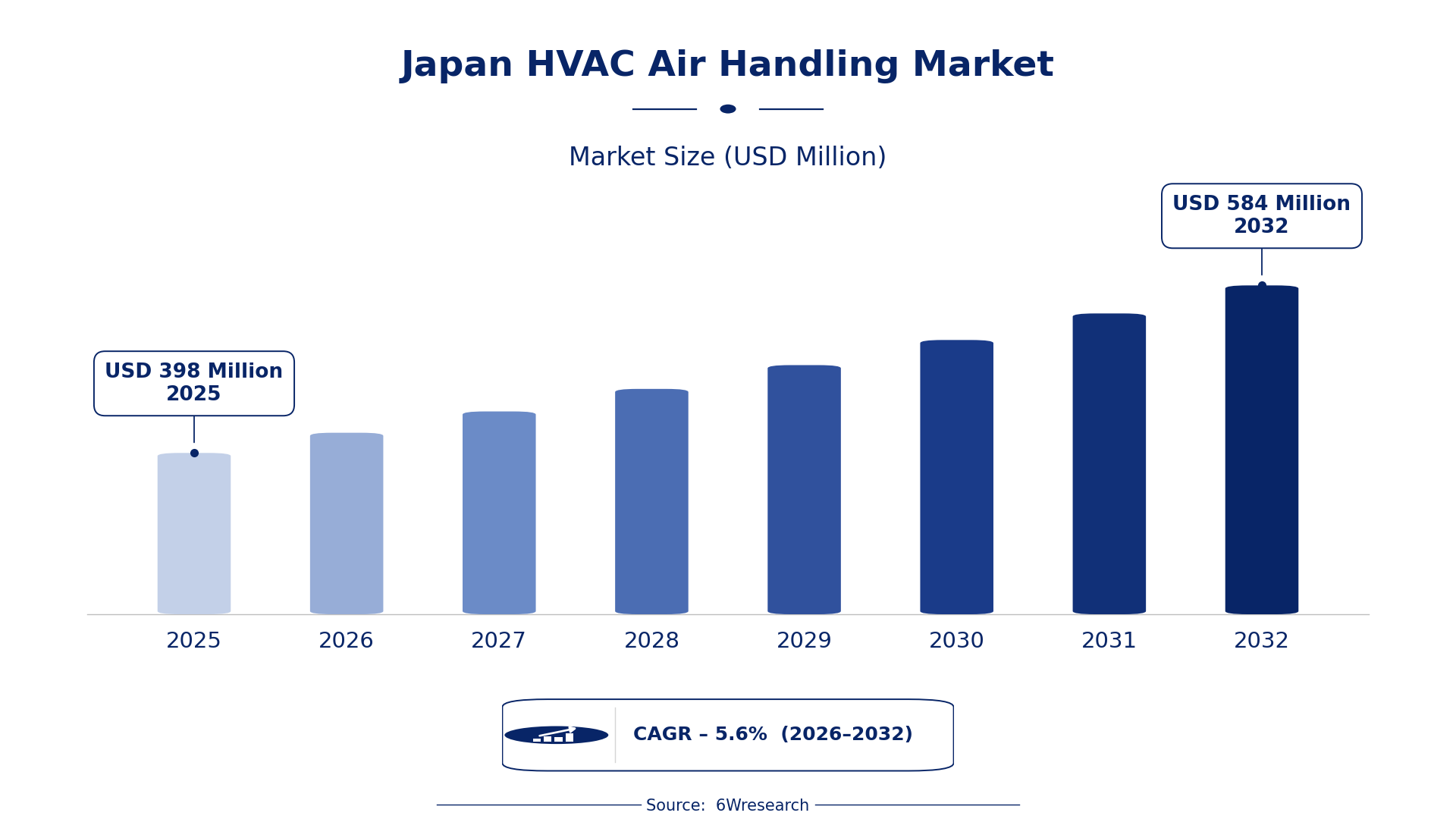
According to 6Wresearch internal database and industry insights, the Japan HVAC Air Handling Market was valued at USD 398 Million in 2025 and is projected to reach USD 584 Million by 2032, growing at a CAGR of approximately 5.6% during 2026–2032.
Japan HVAC Air Handling Market Highlights
| Report Metric | Details |
| Report Name | Japan HVAC Air Handling Market (2026-2032) |
| Market Size 2025 | USD 398 Million |
| Market Size 2032 | USD 584 Million |
| Absolute Growth 2025–2032 | USD 186 Million |
| CAGR 2026–2032 | 5.6% |
| Peak Annual Growth | 6.4% in 2032 |
| Forecast Period | 2026–2032 |
| Historical Data | 2022–2025 |
| Base Year | 2025 |
| Leading Component Type, 2025 | Fan Coils (42% share) |
| Leading Technology Used, 2025 | DX/Chilled Water (48% share) |
| Leading Distribution Channel, 2025 | System Integrators (46% share) |
| Leading End User, 2025 | Commercial Spaces (50% share) |
| Fastest-Growing Component Type | Ventilation Units (7.9% CAGR) |
| Fastest-Growing Technology Used | Centralized/Local (8.8% CAGR) |
| Fastest-Growing Distribution Channel | HVAC Contractors (7.5% CAGR) |
| Fastest-Growing End User | Hospitals & Labs (7.4% CAGR) |
| Growing Sector | Healthcare Facilities |
| Key End Users | Commercial Spaces, Hospitals & Labs, Industrial Plants |
Japan HVAC Air Handling Market Year-wise Growth Rate and Key Drivers (2022–2032)
This graph illustrates the annual growth rates of the market from 2022 to 2032, highlighting a steady upward trajectory and projected market expansion over the forecast period.
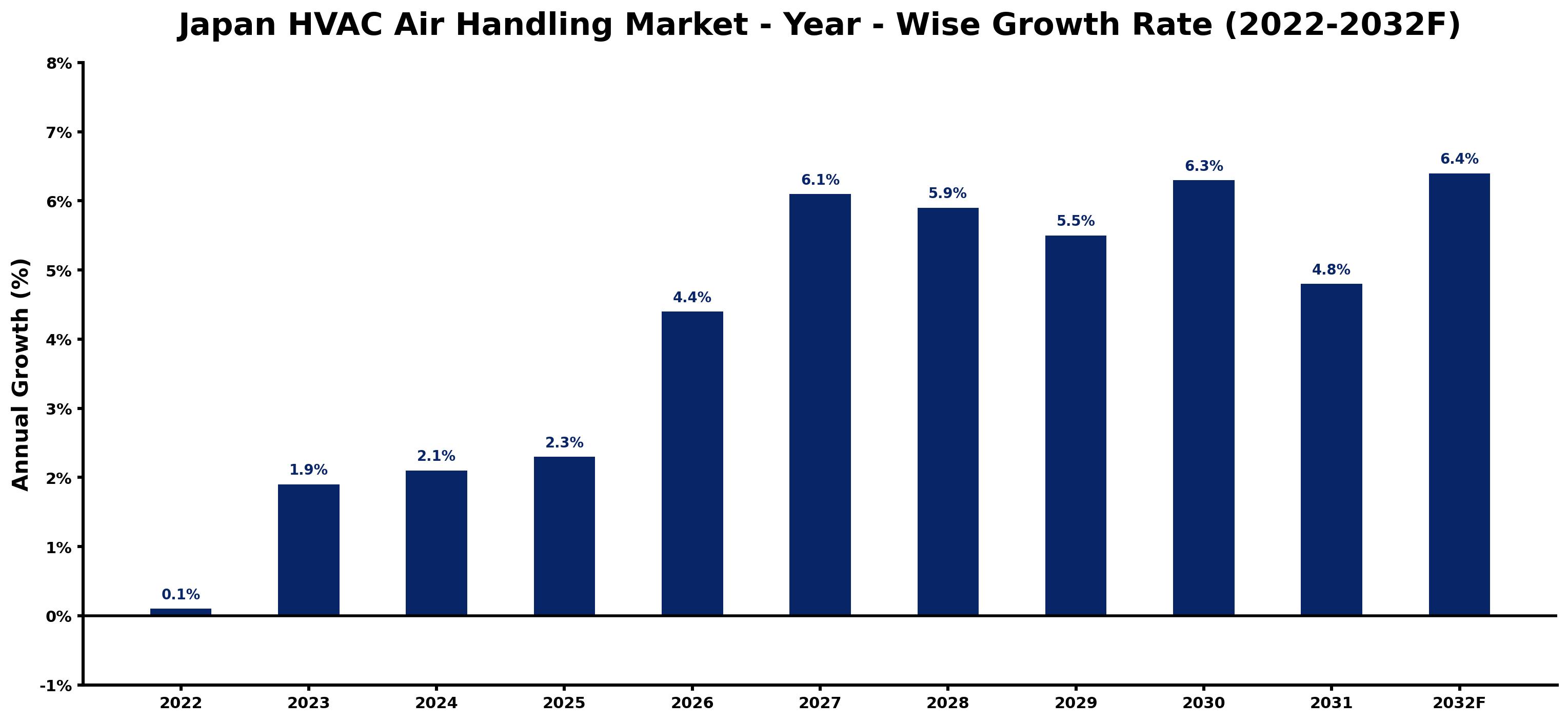
For each year, the table pairs the estimated growth rate with the leading influence on demand, showing how the drivers changed across the period.
| Year | Estimated Annual Growth (%) | Market Rationale |
| 2022 | 0.1 | The market showed minimal growth due to ongoing recovery from previous impacts. |
| 2023 | 1.9 | Growth accelerated as construction activities resumed, boosting demand for air handling units. |
| 2024 | 2.1 | Continued investments in healthcare facilities supported rising orders for HVAC solutions. |
| 2025 | 2.3 | The market expanded further with increased urbanisation in Tokyo driving installations. |
| 2026 | 4.4 | Demand surged as energy efficiency became a priority in building designs. |
| 2027 | 6.1 | The rise in health regulations in hospitals spurred further investments in HVAC. |
| 2028 | 5.9 | Growth slowed slightly as the market stabilised after rapid increases in previous years. |
| 2029 | 5.5 | Demand continued to grow, albeit at a slower pace compared to the previous year. |
| 2030 | 6.3 | A renewed focus on green buildings propelled upgrades and installations of HVAC systems. |
| 2031 | 4.8 | Growth decelerated as the market adjusted to previous years' rapid expansion. |
| 2032 | 6.4 | The market peaked as energy-efficient solutions became essential in new developments. |
Note: Market size estimations and growth projections presented in this report are based on 6Wresearch's proprietary forecasting methodology, utilizing the latest available industry data, government publications, and primary research inputs.
Japan HVAC Air Handling Market Synopsis
HVAC air handling systems are crucial for maintaining air quality and temperature in diverse environments. The Japan HVAC Air Handling Market is expanding due to robust demand from commercial spaces and healthcare facilities, buoyed by ongoing construction projects. In 2023, the HVAC industry invested 150 billion JPY in energy-efficient technologies, while the Tokyo Metropolitan Government's retrofitting programme for older buildings further energises market activity. With over 8,000 hospitals needing advanced HVAC solutions, the market is set for sustained growth.
Market Dynamics Impact Analysis (2026–2032)
| Factor | Type | Impact | Primary Segment Affected |
| Growing urbanisation in Tokyo | Driver | High | Commercial Spaces |
| Rising health regulations in hospitals | Driver | High | Hospitals & Labs |
| Investment in energy-efficient technologies | Opportunity | High | HVAC Contractors |
| Retrofitting initiatives for older buildings | Opportunity | High | System Integrators |
| High initial costs of advanced HVAC systems | Restraint | Medium | Fan Coils |
| Limited awareness of energy-efficient solutions | Restraint | Medium | Heat Recovery Units |
| Shortage of skilled HVAC technicians | Challenge | High | HVAC Contractors |
| Long replacement cycles of HVAC systems | Challenge | Medium | Ventilation Units |
Evaluation of Drivers in Japan HVAC Air Handling Market (2026–2032)
The factors lifting demand, and the evidence behind each, are summarised below.
| Drivers | Primary Segment Affected | Why It Matters (Evidence) |
| Increased construction activities | Commercial Spaces | Tokyo accounts for over 30% of HVAC installations, driving demand for air handling units. |
| Health regulations mandating advanced systems | Hospitals & Labs | As of 2023, over 8,000 hospitals require sophisticated HVAC solutions to ensure air quality. |
| Government subsidies for energy-efficient systems | HVAC Contractors | The Ministry of the Environment allocated 50 billion JPY to promote energy-efficient HVAC technologies. |
| Demand for energy recovery systems | Heat Recovery Units | Heat recovery ventilation systems are increasingly adopted in new commercial buildings, enhancing energy efficiency. |
| Focus on green building initiatives | System Integrators | The Tokyo Metropolitan Government has a programme for retrofitting HVAC systems in older buildings, boosting demand. |
Behind the steady rise in orders sits increased construction activities in Tokyo, where over 30% of HVAC installations occur, driving demand for air handling units. Health regulations mandating advanced systems in hospitals fuel this growth; as of 2023, over 8,000 hospitals require sophisticated HVAC solutions. The Ministry of the Environment's allocation of 50 billion JPY for energy-efficient technologies encourages innovation among contractors. The adoption of heat recovery ventilation systems in new commercial buildings further supports demand, while the Tokyo Metropolitan Government's retrofitting programme boosts the market for integrators.
Evaluation of Restraints in Japan HVAC Air Handling Market
These restraints slow adoption and weigh on supplier margins.
| Market Restraint | Primary Segment Affected | Why It Matters (Evidence) |
| High initial costs of advanced HVAC systems | Fan Coils | The average lifespan of HVAC systems in Japan is around 15-20 years, necessitating costly upgrades. |
| Limited awareness of energy-efficient solutions | Heat Recovery Units | Many buyers remain uninformed about the benefits of energy-efficient HVAC technologies. |
| Regulatory compliance costs for HVAC installations | Ventilation Units | Compliance with the JIS B 8616 standard increases installation expenses for contractors. |
| Market competition from alternative cooling solutions | DX/Chilled Water | Emerging technologies present competitive alternatives to traditional HVAC systems. |
| Supply chain disruptions affecting component availability | Centralized/Local | Ongoing global supply chain issues delay the procurement of HVAC components. |
Japan HVAC Air Handling Market Challenges
High urban density in Tokyo presents supply challenges, as over 30% of HVAC installations are concentrated there, causing delays for contractors struggling to meet demand. Rising material costs inflate project budgets by up to 15% for buyers, particularly in the commercial and healthcare sectors, forcing adjustments to project timelines. Stringent health regulations in hospitals require advanced air handling units, which can postpone installations by several months, negatively affecting patient care. Compliance with standards like JIS B 8616 complicates operations, leading to additional costs for producers who must invest in training and technology upgrades.
Trends in the Japan HVAC Air Handling Market
Several trends are reshaping the Japan HVAC Air Handling Market; the most important are set out below.
- Shift Towards Energy Recovery Systems: The adoption of heat recovery ventilation systems has increased in new commercial buildings, reflecting energy efficiency goals. In 2023, approximately 40% of new installations incorporated these systems, showing a growing trend among builders.
- Transition from Manual to Automatic Controls: The HVAC industry is experiencing a shift towards automation, with many new systems featuring automatic controls for improved efficiency. This change began in 2022, aligning with the increasing demand for smart building technologies.
- Emerging Focus on Energy Efficiency Standards: The introduction of the Green Growth Strategy in 2020 has prompted many developers to prioritise energy-efficient designs. By 2023, more than 60% of new commercial projects aimed to meet these standards, influencing HVAC installations.
- Increased Investment in R&D for HVAC Technologies: In 2023, the HVAC industry in Japan invested 150 billion JPY in research and development for energy-efficient technologies. This investment is expected to lead to solutions that improve system performance.
Investment Opportunities in the Japan HVAC Air Handling Market
Several openings in the Japan HVAC Air Handling Market merit attention from investors.
- Collaborate with Local HVAC Contractors: With the rising demand for energy-efficient systems, partnering with local HVAC contractors presents a promising opportunity. In 2023, the government allocated 50 billion JPY to promote green building initiatives, creating a conducive environment for collaborations.
- Invest in Energy-Efficient Technologies: Now is an opportune moment to invest in energy-efficient HVAC technologies, as the market is expanding rapidly. The Ministry of the Environment's subsidies support this direction, encouraging contractors to embrace new solutions.
- Provide Components for Retrofitting Projects: The ongoing retrofitting initiatives in Tokyo generate demand for HVAC components. With over 30% of installations in the region, suppliers can leverage this trend by collaborating with integrators.
- Target Healthcare Facility Upgrades: The demand for advanced HVAC solutions in hospitals and labs presents a substantial opportunity. With over 8,000 healthcare facilities in Japan, suppliers can concentrate on this sector for growth.
Government Initiatives in the Japan HVAC Air Handling Market
The GX Promotion Act of 2023 establishes a framework for advancing green technologies, building on previous laws aimed at reducing carbon emissions. This act encourages HVAC producers to invest in energy-efficient systems, ensuring adherence to environmental standards. The government also announced a 50 billion JPY budget to support these initiatives.
The Ministry of the Environment supervises the implementation of energy-efficient initiatives, providing funding for projects that upgrade HVAC systems in public facilities. In 2023, the government allocated 50 billion JPY to support these efforts.
Future Insight of the Japan HVAC Air Handling Market
Investment in R&D for energy-efficient technologies will generate substantial demand for modern HVAC solutions in public facilities and commercial buildings. By 2032, the implementation of the ISO 16813 standard will improve the design of energy-efficient air handling systems, benefiting both buyers and suppliers. The Tokyo Metropolitan Government's retrofitting programme will modernise older buildings, creating opportunities for suppliers to innovate. Increased adoption of heat recovery ventilation systems will align with government green building initiatives, promoting sustainability in the sector.
Market Segmentation Analysis
Japan HVAC Air Handling Market report covers a detailed analysis of the following market segments:
By Component Type – Fan Coils Lead, Ventilation Units Expected to Grow Fastest
According to Saurav Kr Singh, Senior Research Analyst at 6Wresearch, Fan Coils accounted for 42% of the market by component type in 2025. Fan coils are prevalent because they provide localized heating and cooling, making them ideal for various building types, especially in urban settings. Their extensive use in Tokyo, where over 30% of HVAC installations occur, highlights their critical role in ensuring indoor comfort. Ventilation Units are set to record the highest CAGR in this split, 7.9% over 2026–2032. Ventilation units are rapidly gaining traction due to heightened health regulations in hospitals, which require superior indoor air quality. With over 8,000 hospitals and labs in need of advanced HVAC solutions, this segment's growth is assured. Suppliers should prioritise the development of ventilation units to align with the increasing demand for health-focused HVAC solutions.
By Technology Used – DX/Chilled Water Leads, Centralized/Local Expected to Grow Fastest
DX/Chilled Water took 48% of technology used revenue in 2025, more than any other category. DX/chilled water technology leads the market as it is the primary method for cooling in HVAC systems across various applications. Its established presence in commercial buildings ensures a consistent demand for this technology. Over 2026–2032, Centralized/Local is expected to post the fastest growth, at a CAGR of 8.8%. Centralized/local systems are growing quickly due to their adaptability in both new constructions and retrofits, catering to diverse building requirements. This flexibility is driving increased adoption in urban developments and renovations. Buyers will benefit from investing in centralized/local systems that offer efficiency and versatility for modern building needs.
By Distribution Channel – System Integrators Lead, HVAC Contractors Expected to Grow Fastest
The largest distribution channel category in 2025 was System Integrators, at 46% of revenue. System integrators hold a substantial share as they are essential for deploying comprehensive HVAC solutions in intricate projects. Their proficiency is especially crucial in densely populated areas, where integrated systems are necessary for optimal functionality. The quickest growth will come from HVAC Contractors, forecast to expand at a CAGR of 7.5% between 2026 and 2032. HVAC contractors are witnessing the highest growth due to their role as primary service providers for installation and maintenance, particularly in response to the increasing number of construction and renovation projects. Their importance in the market will likely expand as demand continues to rise. Suppliers should focus on building strong partnerships with HVAC contractors to improve service efficiency and installation quality.
By End User – Commercial Spaces Lead, Hospitals & Labs Expected to Grow Fastest
In 2025, Commercial Spaces led the end user split with a 50% share. Commercial spaces represent the largest segment due to substantial demand for HVAC solutions in office and retail settings. The high concentration of businesses in urban areas like Tokyo drives consistent investment in HVAC systems. Hospitals & Labs are projected to grow fastest, at a CAGR of 7.4% during 2026–2032. Hospitals and labs are the fastest-growing end user segment, as they require precise climate control to ensure patient safety and maintain research integrity. The ongoing expansion of healthcare facilities in Japan significantly contributes to this rising demand. Suppliers must tailor their offerings to meet the specific needs of hospitals and labs to capitalise on this growth potential.
Key Attractiveness of the Report
- 10 Years of Market Numbers
- Historical Data Starting from 2022 to 2025
- Base Year 2025
- Forecast Data until 2032
- Key Performance Indicators Impacting the Market
- Major Upcoming Developments and Projects
Key Highlights of the Report:
- Japan HVAC Air Handling Market Outlook
- Market Size of Japan HVAC Air Handling Market, 2025
- Forecast of Japan HVAC Air Handling Market, 2032
- Historical Data and Forecast of Japan HVAC Air Handling Revenues & Volume for the Period 2022-2032F
- Japan HVAC Air Handling Market Trend Evolution
- Japan HVAC Air Handling Market Drivers and Challenges
- Japan HVAC Air Handling Price Trends
- Japan HVAC Air Handling Porter's Five Forces
- Japan HVAC Air Handling Industry Life Cycle
- Historical Data and Forecast of Japan HVAC Air Handling Market Revenues & Volume By Component Type for the Period 2022-2032F
- Historical Data and Forecast of Japan HVAC Air Handling Market Revenues & Volume By Fan Coils for the Period 2022-2032F
- Historical Data and Forecast of Japan HVAC Air Handling Market Revenues & Volume By Ventilation Units for the Period 2022-2032F
- Historical Data and Forecast of Japan HVAC Air Handling Market Revenues & Volume By Heat Recovery Units for the Period 2022-2032F
- Historical Data and Forecast of Japan HVAC Air Handling Market Revenues & Volume By Air Mixers for the Period 2022-2032F
- Historical Data and Forecast of Japan HVAC Air Handling Market Revenues & Volume By Technology Used for the Period 2022-2032F
- Historical Data and Forecast of Japan HVAC Air Handling Market Revenues & Volume By DX/Chilled Water for the Period 2022-2032F
- Historical Data and Forecast of Japan HVAC Air Handling Market Revenues & Volume By Centralized/Local for the Period 2022-2032F
- Historical Data and Forecast of Japan HVAC Air Handling Market Revenues & Volume By Crossflow/Rotary for the Period 2022-2032F
- Historical Data and Forecast of Japan HVAC Air Handling Market Revenues & Volume By Manual/Automatic for the Period 2022-2032F
- Historical Data and Forecast of Japan HVAC Air Handling Market Revenues & Volume By Distribution Channel for the Period 2022-2032F
- Historical Data and Forecast of Japan HVAC Air Handling Market Revenues & Volume By System Integrators for the Period 2022-2032F
- Historical Data and Forecast of Japan HVAC Air Handling Market Revenues & Volume By HVAC Contractors for the Period 2022-2032F
- Historical Data and Forecast of Japan HVAC Air Handling Market Revenues & Volume By Wholesale Suppliers for the Period 2022-2032F
- Historical Data and Forecast of Japan HVAC Air Handling Market Revenues & Volume By Online B2B Platforms for the Period 2022-2032F
- Historical Data and Forecast of Japan HVAC Air Handling Market Revenues & Volume By End User for the Period 2022-2032F
- Historical Data and Forecast of Japan HVAC Air Handling Market Revenues & Volume By Commercial Spaces for the Period 2022-2032F
- Historical Data and Forecast of Japan HVAC Air Handling Market Revenues & Volume By Hospitals & Labs for the Period 2022-2032F
- Historical Data and Forecast of Japan HVAC Air Handling Market Revenues & Volume By Industrial Plants for the Period 2022-2032F
- Historical Data and Forecast of Japan HVAC Air Handling Market Revenues & Volume By Warehousing Facilities for the Period 2022-2032F
- Japan HVAC Air Handling Import Export Trade Statistics
- Market Opportunity Assessment By Component Type
- Market Opportunity Assessment By Technology Used
- Market Opportunity Assessment By Distribution Channel
- Market Opportunity Assessment By End User
- Japan HVAC Air Handling Top Companies Market Share
- Japan HVAC Air Handling Competitive Benchmarking By Technical and Operational Parameters
- Japan HVAC Air Handling Company Profiles
- Japan HVAC Air Handling Key Strategic Recommendations
Market Covered
This report examines the market across the segments below.
By Component Type
- Fan Coils
- Ventilation Units
- Heat Recovery Units
- Air Mixers
By Technology Used
- DX/Chilled Water
- Centralized/Local
- Crossflow/Rotary
- Manual/Automatic
By Distribution Channel
- System Integrators
- HVAC Contractors
- Wholesale Suppliers
- Online B2B Platforms
By End User
- Commercial Spaces
- Hospitals & Labs
- Industrial Plants
- Warehousing Facilities































