Japan HVAC Air Quality System Market Size & Growth Rate
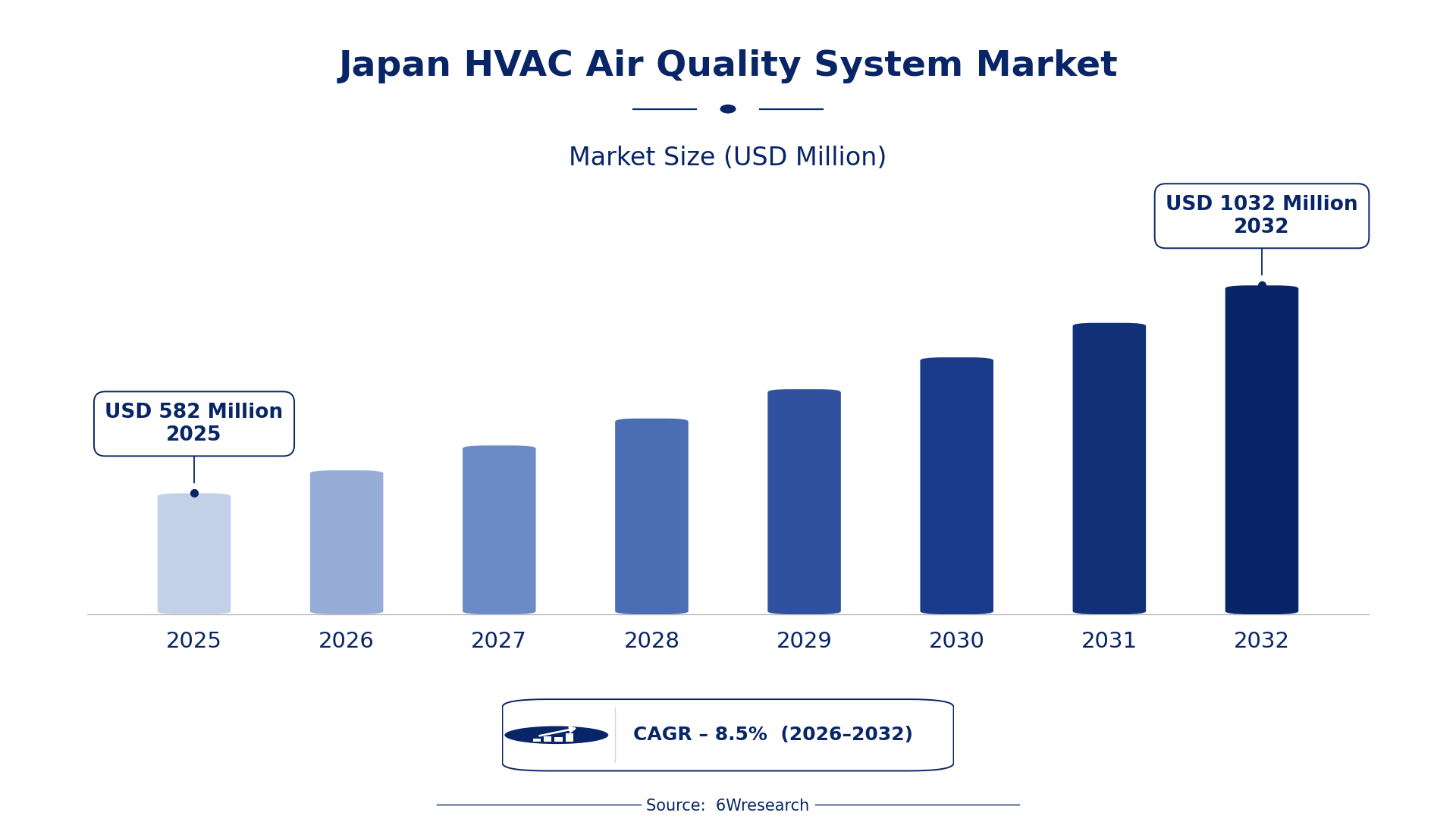
According to 6Wresearch internal database and industry insights, the Japan HVAC Air Quality System Market was valued at USD 582 Million in 2025 and is projected to reach USD 1,032 Million by 2032, growing at a CAGR of approximately 8.5% during 2026–2032.
Japan HVAC Air Quality System Market Highlights
| Report Metric | Details |
| Report Name | Japan HVAC Air Quality System Market (2026-2032) |
| Market Size 2025 | USD 582 Million |
| Market Size 2032 | USD 1,032 Million |
| Absolute Growth 2025–2032 | USD 450 Million |
| CAGR 2026–2032 | 8.5% |
| Peak Annual Growth | 9.7% in 2028 |
| Forecast Period | 2026–2032 |
| Historical Data | 2022–2025 |
| Base Year | 2025 |
| Leading System Type, 2025 | Smart Sensors (42% share) |
| Leading Monitoring Feature, 2025 | PM2.5 / CO2 (50% share) |
| Leading Distribution Channel, 2025 | IoT Distributors (49% share) |
| Leading End User, 2025 | Smart Buildings (40% share) |
| Fastest-Growing System Type | Real-Time Monitors (12.6% CAGR) |
| Fastest-Growing Monitoring Feature | VOC / Humidity (11.9% CAGR) |
| Fastest-Growing Distribution Channel | HVAC Vendors (11.2% CAGR) |
| Fastest-Growing End User | Airports & Terminals (11.3% CAGR) |
| Growing Sector | Smart Buildings |
| Key End Users | Commercial Offices, Airports & Terminals, Industrial Units, Smart Buildings |
Japan HVAC Air Quality System Market Year-wise Growth Rate and Key Drivers (2022–2032)
This graph illustrates the annual growth rates of the market from 2022 to 2032, highlighting a steady upward trajectory and projected market expansion over the forecast period.
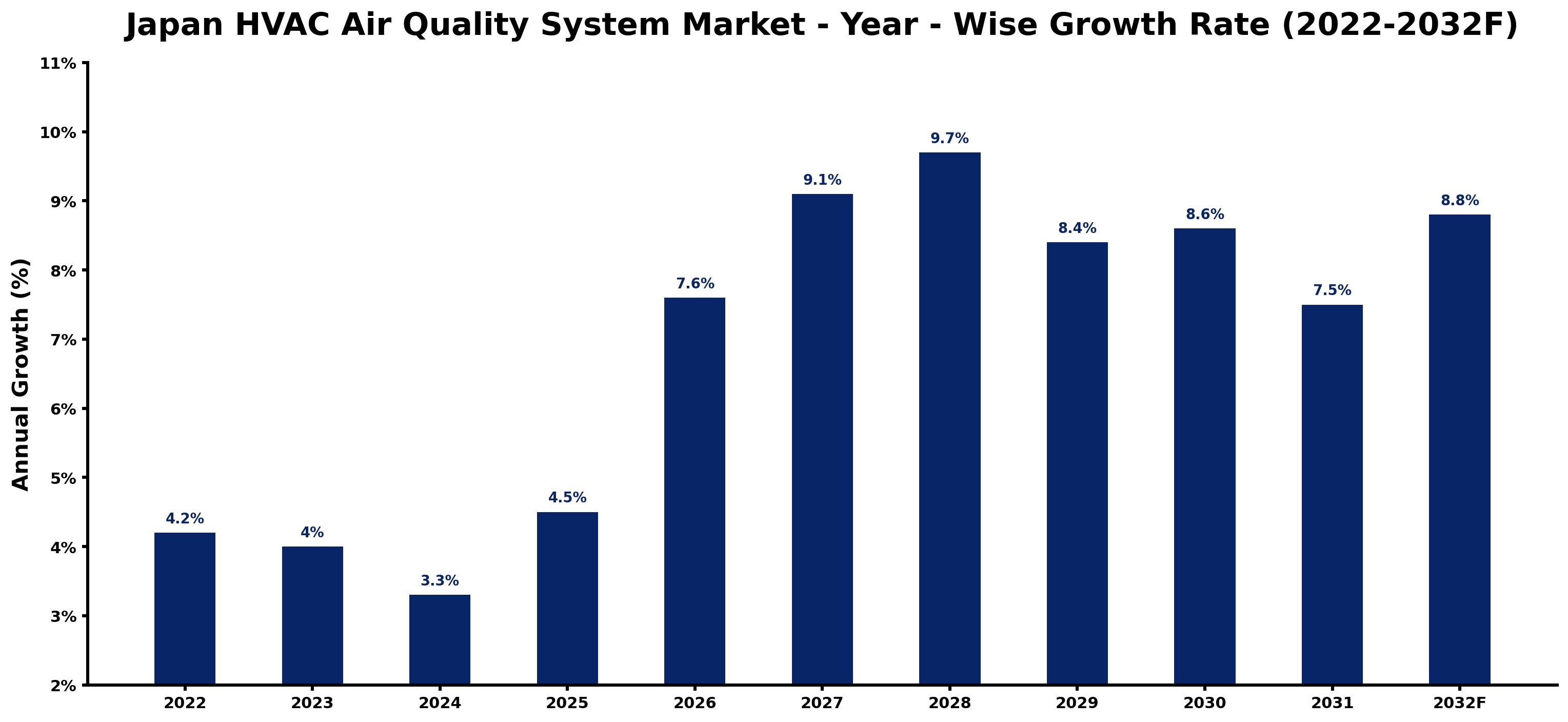
The yearly estimates that follow link every growth rate to its principal driver, so readers can see why the pace changed in each period.
| Year | Estimated Annual Growth (%) | Market Rationale |
| 2022 | 4.2 | The market experienced solid demand driven by heightened awareness of indoor air quality. |
| 2023 | 4.0 | Growth slowed slightly as the market adjusted to previous high levels of investment. |
| 2024 | 3.3 | Demand continued to grow, but at a slower pace due to market saturation in some areas. |
| 2025 | 4.5 | The market saw a resurgence in growth as new regulations prompted upgrades in HVAC systems. |
| 2026 | 7.6 | Demand is expected to surge as commercial sectors invest heavily in advanced air quality technologies. |
| 2027 | 9.1 | Growth is projected to accelerate further with increased adoption of smart HVAC solutions in urban areas. |
| 2028 | 9.7 | The market is expected to peak as new technologies capture buyer interest and investment. |
| 2029 | 8.4 | Growth will slow as the market begins to stabilise after reaching peak adoption rates. |
| 2030 | 8.6 | Demand is expected to rebound slightly as new projects emerge in smart building developments. |
| 2031 | 7.5 | Growth will moderate as the market adjusts to the saturation of advanced systems. |
| 2032 | 8.8 | Demand is projected to rise again as sustainability initiatives gain traction. |
Note: Market size estimations and growth projections presented in this report are based on 6Wresearch's proprietary forecasting methodology, utilizing the latest available industry data, government publications, and primary research inputs.
Japan HVAC Air Quality System Market Synopsis
HVAC Air Quality Systems are essential technologies that monitor and improve indoor air quality through various sensors and controllers. In Japan, the HVAC Air Quality System Market is experiencing growth driven by increasing demand from commercial sectors and stringent air quality regulations. The total number of smart buildings reached over 5,000 in 2022, highlighting the need for advanced air quality solutions. Investment in smart HVAC technologies is encouraged under the Building Energy Efficiency Act, further boosting market potential.
Market Dynamics Impact Analysis (2026–2032)
| Factor | Type | Impact | Primary Segment Affected |
| Increasing focus on indoor air quality regulations | Driver | High | PM2.5 / CO2 |
| Rising adoption of smart building technologies | Driver | High | Smart Sensors |
| Growing demand for real-time monitoring systems | Opportunity | High | Real-Time Monitors |
| Expansion of commercial offices requiring HVAC systems | Opportunity | High | Commercial Offices |
| High initial investment costs for advanced systems | Restraint | Medium | Integrated Systems |
| Limited awareness of air quality technologies in rural areas | Restraint | Medium | Smart Sensors |
| Supply chain disruptions affecting component availability | Challenge | High | HVAC Vendors |
| Competition from alternative air quality solutions | Challenge | Medium | IAQ Controllers |
Evaluation of Drivers in Japan HVAC Air Quality System Market (2026–2032)
The main growth drivers and the segments they affect most are set out below.
| Drivers | Primary Segment Affected | Why It Matters (Evidence) |
| Strict air quality regulations | PM2.5 / CO2 | Real-time monitoring of PM2.5 levels is mandated in commercial buildings, leading to increased purchases of air quality systems. |
| Investment in smart technologies | Smart Sensors | The total number of smart buildings in Japan reached over 5,000, driving demand for advanced monitoring solutions. |
| Rising commercial construction activities | Real-Time Monitors | The estimated number of commercial offices in Japan exceeds 1 million, creating a strong market for real-time monitoring systems. |
| Government initiatives promoting air quality | IAQ Controllers | The Tokyo Metropolitan Government has implemented programs to improve air quality in public buildings, boosting demand for controllers. |
| Increased public awareness of health issues | Integrated Systems | Growing concerns about indoor air quality have led to higher demand for advanced HVAC solutions. |
Orders keep climbing as the total number of smart buildings in Japan reached over 5,000, prompting increased demand for advanced monitoring technologies. The estimated number of commercial offices exceeds 1 million, creating a strong market for real-time monitoring systems. Real-time monitoring of PM2.5 levels in commercial buildings is mandated, driving heightened purchases of air quality systems. Rising public awareness of health issues related to indoor air quality is pushing buyers towards integrated HVAC solutions.
Evaluation of Restraints in Japan HVAC Air Quality System Market
Below are the constraints most often cited by buyers and suppliers, with the segment each affects.
| Market Restraint | Primary Segment Affected | Why It Matters (Evidence) |
| High initial investment costs for advanced systems | Integrated Systems | The high upfront costs deter some buyers from investing in advanced HVAC solutions, limiting market growth. |
| Limited awareness of air quality technologies in rural areas | Smart Sensors | In rural regions, lower awareness of air quality technologies restricts market penetration and growth. |
| Supply chain disruptions affecting component availability | HVAC Vendors | Recent supply chain issues have delayed the availability of critical components, impacting system installations. |
| Competition from alternative air quality solutions | IAQ Controllers | Emerging alternative technologies pose a challenge to traditional HVAC systems, affecting market share. |
| Regulatory compliance costs for new installations | Real-Time Monitors | The costs associated with meeting regulatory standards can deter investment in new monitoring systems. |
Japan HVAC Air Quality System Market Challenges
Commercial buyers in Japan encounter immediate technology issues as many HVAC systems lack necessary air quality monitoring features, resulting in compliance delays with new regulations. A shortage of qualified technicians hinders the installation and maintenance of advanced systems, potentially delaying projects by up to six months for contractors. Rising raw material costs have increased HVAC system prices by approximately 15%, straining budgets for commercial buyers. Supply chain disruptions for advanced components are extending lead times, causing producers to postpone project timelines by an average of three weeks.
Trends in the Japan HVAC Air Quality System Market
The shifts below are changing how Japan HVAC Air Quality System Market products are bought and supplied.
- Shift towards Smart Building Integration: In 2022, over 5,000 smart buildings were reported in Japan, indicating a shift towards integrated HVAC systems. This trend improves energy efficiency and indoor air quality management.
- Rising Adoption of Real-Time Monitoring: Real-time monitoring systems are becoming standard in new commercial constructions, with regulations mandating PM2.5 monitoring. This shift is driving demand for advanced air quality solutions.
- Increased Focus on Indoor Air Quality: The Tokyo Metropolitan Government's program to improve air quality in public buildings highlights a growing focus on indoor air quality management. This initiative is projected to boost system sales significantly.
- Transition to Integrated HVAC Solutions: Integrated systems are increasingly favoured in urban developments for their energy efficiency benefits. This trend is evident in new commercial projects across major cities.
Investment Opportunities in the Japan HVAC Air Quality System Market
Investors looking at the Japan HVAC Air Quality System Market should consider the following areas.
- Gap in Advanced Air Quality Solutions: With over 1 million commercial offices in Japan, there is a notable gap in advanced air quality systems. Investing in these solutions can meet the growing need for compliance and efficiency.
- Need for Real-Time Monitoring in Schools: The recent government initiative to enhance air quality monitoring in schools creates an opportunity for suppliers. This initiative highlights the need for real-time monitoring systems in educational facilities.
- Growing Demand in Airports: As major airports implement advanced air quality systems, there is a rising need for these technologies. Suppliers can enter this market by partnering with airport authorities.
- Investment in Smart Building Technologies: The increasing number of smart buildings presents an opportunity for suppliers to invest in integrated HVAC solutions. Collaborating with construction firms can facilitate market entry.
Government Initiatives in the Japan HVAC Air Quality System Market
The Building Energy Efficiency Act, amended in 2022, mandates that all new buildings meet energy standards starting April 2025. This law encourages the adoption of energy-efficient HVAC systems to comply with regulations, benefiting buyers by ensuring compliance with air quality standards.
The Ministry of Health, Labour and Welfare oversees air quality standards, ensuring that HVAC systems meet required benchmarks. This agency promotes compliance among buyers, facilitating the adoption of advanced air quality technologies.
Future Insight of the Japan HVAC Air Quality System Market
By 2032, the integration of real-time monitoring systems will transform demand for HVAC technologies, particularly in new constructions. The total number of smart buildings will exceed 5,000, necessitating sophisticated air quality systems to meet ISO 16000 standards. Enhanced air quality monitoring initiatives in schools will create healthier environments, shifting buyer preferences towards advanced solutions. Urban developments will increasingly prioritise integrated systems for energy efficiency, reflecting the government's commitment to improving air quality.
Market Segmentation Analysis
Japan HVAC Air Quality System Market report covers a detailed analysis of the following market segments:
By System Type – Smart Sensors Lead, Real-Time Monitors Expected to Grow Fastest
According to Saurav Kr Singh, Senior Research Analyst at 6Wresearch, with 42% of system type revenue in 2025, Smart Sensors was the largest category. Smart Sensors hold the largest share as they are widely utilised for monitoring air quality parameters in various facilities. Their presence in over 5,000 smart buildings in Japan highlights their importance in meeting air quality standards. Over 2026–2032, Real-Time Monitors are expected to post the fastest growth, at a CAGR of 12.6%. Real-Time Monitors are rapidly expanding due to their necessity for ongoing tracking of indoor air quality, especially in urban areas where regulations mandate real-time data. The rising adoption of these systems in commercial buildings accelerates their growth. Suppliers should focus on advancing real-time monitoring technologies to meet urban regulatory requirements.
By Monitoring Feature – PM2.5 / CO2 Leads, VOC / Humidity Expected to Grow Fastest
PM2.5 / CO2 held 50% of the Japan HVAC Air Quality System Market by monitoring feature in 2025. PM2.5 / CO2 monitoring features dominate the market as they are essential for evaluating indoor air pollution levels, particularly in densely populated regions like Tokyo. Stringent air quality regulations in Japan further highlight their importance in HVAC systems. The quickest growth will come from VOC / Humidity, forecast to expand at a CAGR of 11.9% between 2026 and 2032. VOC / Humidity monitoring features are gaining popularity due to increased awareness of indoor air pollutants and the need for maintaining healthy indoor conditions. The growing regulatory focus on VOC levels significantly propels this segment's growth. Buyers should invest in advanced monitoring features to comply with health standards and improve indoor air quality.
By Distribution Channel – IoT Distributors Lead, HVAC Vendors Expected to Grow Fastest
In 2025, IoT Distributors led the distribution channel split with a 49% share. IoT Distributors lead the distribution channel as they play a crucial role in distributing advanced HVAC technologies across various sectors. Their function in connecting manufacturers with end-users is vital in a market prioritising technological integration. HVAC Vendors are projected to grow fastest, at a CAGR of 11.2% during 2026–2032. HVAC Vendors are experiencing the fastest growth as they serve as the primary source for purchasing HVAC systems, particularly with the increasing demand for air quality solutions. Their direct engagement with customers positions them advantageously to capture market opportunities. Suppliers should enhance partnerships with HVAC vendors to improve market access and strengthen customer relationships.
By End User – Smart Buildings Lead, Airports & Terminals Expected to Grow Fastest
Smart Buildings took 40% of end user revenue in 2025, more than any other category. Smart Buildings are the largest end user segment as they represent the primary application area for HVAC systems, driven by the need for improved energy efficiency and air quality management. The trend towards smart city initiatives further bolsters the growth of this segment. Airports & Terminals are set to record the highest CAGR in this split, 11.3% over 2026–2032. Airports & Terminals are the fastest-growing end user segment due to their significant demand for air quality management, particularly following recent government initiatives aimed at enhancing air quality monitoring in these facilities. The increasing number of airports adopting advanced systems is a key growth factor. Suppliers should tailor solutions to meet the specific needs of airports and terminals to capitalise on this growth opportunity.
Key Attractiveness of the Report
- 10 Years of Market Numbers
- Historical Data Starting from 2022 to 2025
- Base Year 2025
- Forecast Data until 2032
- Key Performance Indicators Impacting the Market
- Major Upcoming Developments and Projects
Key Highlights of the Report:
- Japan HVAC Air Quality System Market Outlook
- Market Size of Japan HVAC Air Quality System Market, 2025
- Forecast of Japan HVAC Air Quality System Market, 2032
- Historical Data and Forecast of Japan HVAC Air Quality System Revenues & Volume for the Period 2022-2032F
- Japan HVAC Air Quality System Market Trend Evolution
- Japan HVAC Air Quality System Market Drivers and Challenges
- Japan HVAC Air Quality System Price Trends
- Japan HVAC Air Quality System Porter's Five Forces
- Japan HVAC Air Quality System Industry Life Cycle
- Historical Data and Forecast of Japan HVAC Air Quality System Market Revenues & Volume By System Type for the Period 2022-2032F
- Historical Data and Forecast of Japan HVAC Air Quality System Market Revenues & Volume By Smart Sensors for the Period 2022-2032F
- Historical Data and Forecast of Japan HVAC Air Quality System Market Revenues & Volume By Real-Time Monitors for the Period 2022-2032F
- Historical Data and Forecast of Japan HVAC Air Quality System Market Revenues & Volume By IAQ Controllers for the Period 2022-2032F
- Historical Data and Forecast of Japan HVAC Air Quality System Market Revenues & Volume By Predictive Maintenance for the Period 2022-2032F
- Historical Data and Forecast of Japan HVAC Air Quality System Market Revenues & Volume By Monitoring Feature for the Period 2022-2032F
- Historical Data and Forecast of Japan HVAC Air Quality System Market Revenues & Volume By PM2.5 / CO2 for the Period 2022-2032F
- Historical Data and Forecast of Japan HVAC Air Quality System Market Revenues & Volume By VOC / Humidity for the Period 2022-2032F
- Historical Data and Forecast of Japan HVAC Air Quality System Market Revenues & Volume By Integrated Systems for the Period 2022-2032F
- Historical Data and Forecast of Japan HVAC Air Quality System Market Revenues & Volume By AI-Driven for the Period 2022-2032F
- Historical Data and Forecast of Japan HVAC Air Quality System Market Revenues & Volume By Distribution Channel for the Period 2022-2032F
- Historical Data and Forecast of Japan HVAC Air Quality System Market Revenues & Volume By IoT Distributors for the Period 2022-2032F
- Historical Data and Forecast of Japan HVAC Air Quality System Market Revenues & Volume By HVAC Vendors for the Period 2022-2032F
- Historical Data and Forecast of Japan HVAC Air Quality System Market Revenues & Volume By System Integrators for the Period 2022-2032F
- Historical Data and Forecast of Japan HVAC Air Quality System Market Revenues & Volume By Online Platforms for the Period 2022-2032F
- Historical Data and Forecast of Japan HVAC Air Quality System Market Revenues & Volume By End User for the Period 2022-2032F
- Historical Data and Forecast of Japan HVAC Air Quality System Market Revenues & Volume By Smart Buildings for the Period 2022-2032F
- Historical Data and Forecast of Japan HVAC Air Quality System Market Revenues & Volume By Airports & Terminals for the Period 2022-2032F
- Historical Data and Forecast of Japan HVAC Air Quality System Market Revenues & Volume By Commercial Offices for the Period 2022-2032F
- Historical Data and Forecast of Japan HVAC Air Quality System Market Revenues & Volume By Industrial Units for the Period 2022-2032F
- Japan HVAC Air Quality System Import Export Trade Statistics
- Market Opportunity Assessment By System Type
- Market Opportunity Assessment By Monitoring Feature
- Market Opportunity Assessment By Distribution Channel
- Market Opportunity Assessment By End User
- Japan HVAC Air Quality System Top Companies Market Share
- Japan HVAC Air Quality System Competitive Benchmarking By Technical and Operational Parameters
- Japan HVAC Air Quality System Company Profiles
- Japan HVAC Air Quality System Key Strategic Recommendations
Market Covered
The report covers the following segments.
By System Type
- Smart Sensors
- Real-Time Monitors
- IAQ Controllers
- Predictive Maintenance
By Monitoring Feature
- PM2.5 / CO2
- VOC / Humidity
- Integrated Systems
- AI-Driven
By Distribution Channel
- IoT Distributors
- HVAC Vendors
- System Integrators
- Online Platforms
By End User
- Smart Buildings
- Airports & Terminals
- Commercial Offices
- Industrial Units































