Japan HVAC Air Treatment System Market Size & Growth Rate
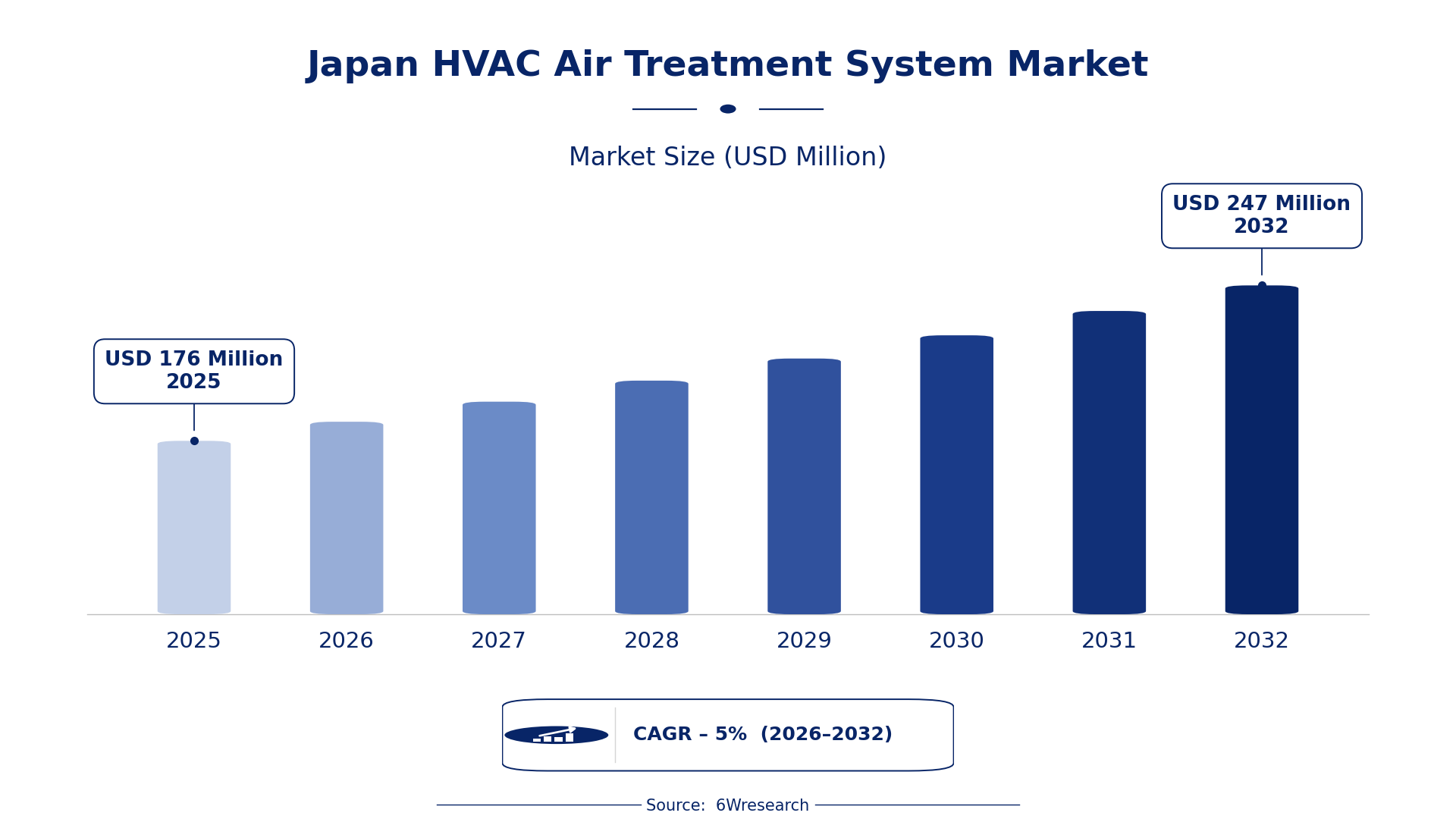
According to 6Wresearch internal database and industry insights, the Japan HVAC Air Treatment System Market was valued at USD 176 Million in 2025 and is projected to reach USD 247 Million by 2032, growing at a CAGR of approximately 5% during 2026–2032.
Japan HVAC Air Treatment System Market Highlights
| Report Metric | Details |
| Report Name | Japan HVAC Air Treatment System Market (2026-2032) |
| Market Size 2025 | USD 176 Million |
| Market Size 2032 | USD 247 Million |
| Absolute Growth 2025–2032 | USD 71 Million |
| CAGR 2026–2032 | 5% |
| Peak Annual Growth | 5.8% in 2026 |
| Forecast Period | 2026–2032 |
| Historical Data | 2022–2025 |
| Base Year | 2025 |
| Leading Treatment Type, 2025 | Dehumidification Units (40% share) |
| Leading Component Type, 2025 | Desiccant / Mechanical (46% share) |
| Leading Distribution Channel, 2025 | Wholesale Suppliers (34% share) |
| Leading End User, 2025 | Data Centers (46% share) |
| Fastest-Growing Treatment Type | Humidification Systems (6.9% CAGR) |
| Fastest-Growing Component Type | Steam / Ultrasonic (7.3% CAGR) |
| Fastest-Growing Distribution Channel | HVAC Dealers (6.5% CAGR) |
| Fastest-Growing End User | Museums & Libraries (6.6% CAGR) |
| Growing Sector | Museums & Libraries |
| Key End Users | Data Centers, Museums & Libraries, Residential Users, Office Buildings |
Japan HVAC Air Treatment System Market Year-wise Growth Rate and Key Drivers (2022–2032)
This graph illustrates the annual growth rates of the market from 2022 to 2032, highlighting a steady upward trajectory and projected market expansion over the forecast period.
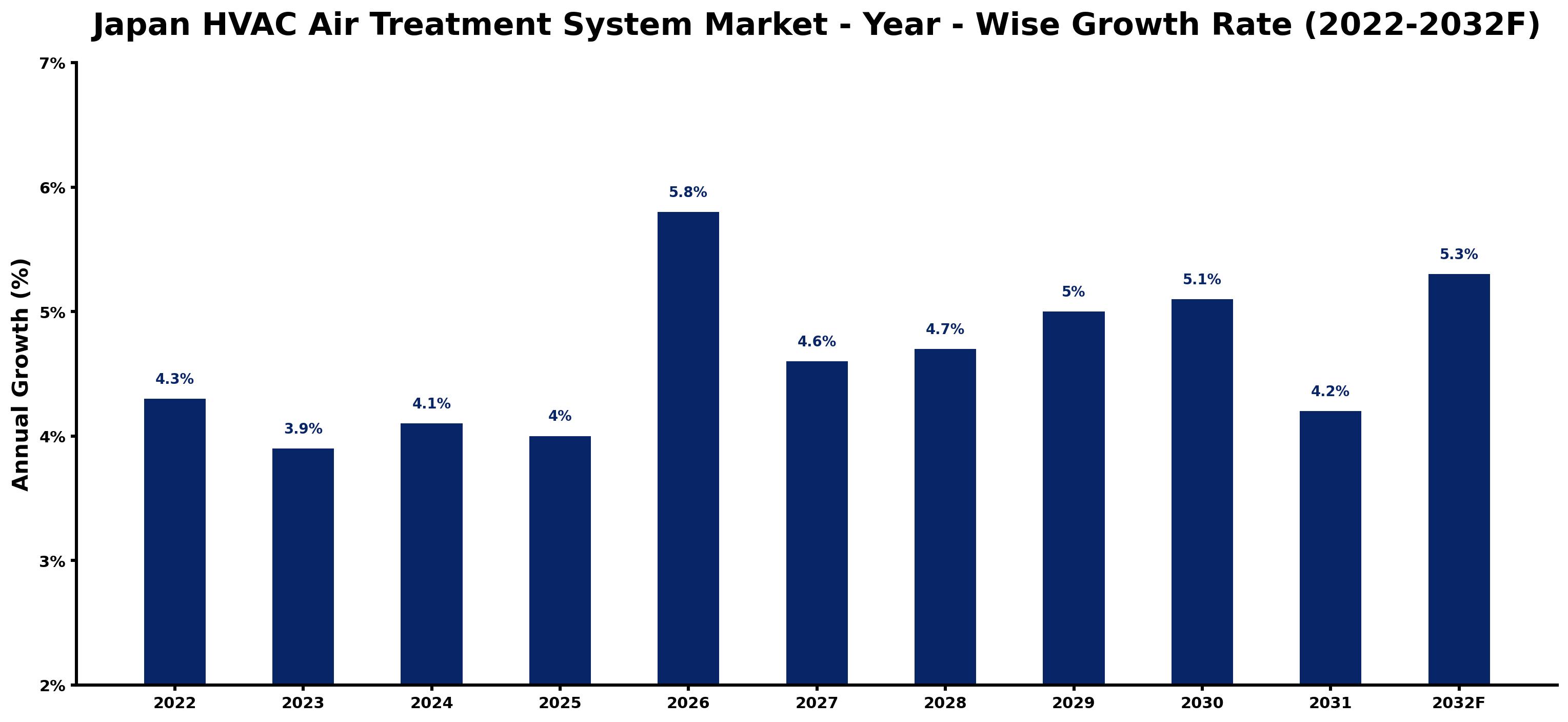
Below, each year's estimated growth is shown next to the factor that most influenced it.
| Year | Estimated Annual Growth (%) | Market Rationale |
| 2022 | 4.3 | The market experienced steady demand from residential users and commercial buildings. |
| 2023 | 3.9 | Growth slowed due to a temporary dip in construction activities across major urban areas. |
| 2024 | 4.1 | Increased investments in energy-efficient technologies spurred a slight recovery in demand. |
| 2025 | 4.0 | Demand growth decelerated as market saturation began to affect new installations. |
| 2026 | 5.8 | A surge in energy efficiency initiatives is anticipated to lead to increased HVAC system upgrades. |
| 2027 | 4.6 | Market growth is expected to slow as competition intensifies among suppliers for market share. |
| 2028 | 4.7 | Demand is projected to rise again as more facilities adopt advanced air treatment technologies. |
| 2029 | 5.0 | Increased heat loads in data centers will drive further investments in air treatment systems. |
| 2030 | 5.1 | The market is forecasted to expand as energy efficiency standards become more stringent. |
| 2031 | 4.2 | Growth is likely to slow as the market matures and buyers become more selective in purchases. |
| 2032 | 5.3 | A renewed focus on indoor air quality will stimulate demand for advanced systems. |
Note: Market size estimations and growth projections presented in this report are based on 6Wresearch's proprietary forecasting methodology, utilizing the latest available industry data, government publications, and primary research inputs.
Japan HVAC Air Treatment System Market Synopsis
HVAC Air Treatment Systems control indoor air quality and comfort through components like filters and humidifiers, maintaining optimal humidity and filtering pollutants. The Japan HVAC Air Treatment System Market is growing due to rising residential demand, investments in energy-efficient technologies, and government campaigns promoting air quality improvement. In 2022, the market was valued at 1.2 trillion yen, with notable contributions from data centers and commercial buildings, reflecting a growing awareness of the importance of air quality.
Market Dynamics Impact Analysis (2026–2032)
| Factor | Type | Impact | Primary Segment Affected |
| Rising residential demand for improved air quality | Driver | High | Residential Users |
| Increased focus on energy efficiency in commercial buildings | Driver | High | Office Buildings |
| Investment in energy-efficient technologies is expanding market potential | Opportunity | High | HVAC Dealers |
| Growing demand for advanced air treatment in data centers | Opportunity | High | Data Centers |
| Market saturation in urban areas is limiting growth potential | Restraint | Medium | Residential Users |
| High initial costs for advanced systems may deter buyers | Restraint | Medium | Office Buildings |
| Competition among suppliers is increasing pricing pressures | Challenge | High | HVAC Dealers |
| Rapid technological advancements require constant adaptation | Challenge | High | Data Centers |
Evaluation of Drivers in Japan HVAC Air Treatment System Market (2026–2032)
The table below links each growth driver to the segment it affects and the evidence for it.
| Drivers | Primary Segment Affected | Why It Matters (Evidence) |
| Increased residential demand for air quality improvement | Residential Users | The population of approximately 125 million in Japan drives the need for effective HVAC systems. |
| Growing energy efficiency initiatives in commercial buildings | Office Buildings | The Tokyo Metropolitan Government supports energy-saving initiatives, promoting system adoption in new constructions. |
| Rising heat loads in data centers require advanced air treatment | Data Centers | Data centers necessitate advanced HVAC solutions to manage high operational temperatures effectively. |
| Implementation of ISO 16890 standards for air filters | Purification Modules | Compliance with air quality standards boosts demand for effective filtration solutions in various sectors. |
| Increased awareness of indoor air quality benefits | Humidification Systems | The average humidity level in Japan necessitates effective humidification solutions for residential comfort. |
The population of approximately 125 million in Japan drives residential demand for effective air quality solutions, prompting increased investments in HVAC systems. Data centers, facing rising heat loads, require sophisticated air treatment systems, resulting in substantial investments. Awareness of the benefits of maintaining indoor air quality has grown, particularly in residential areas, where effective humidification solutions are increasingly sought after. Compliance with air quality standards further stimulates demand for purification modules, illustrating the interconnected nature of these market factors.
Evaluation of Restraints in Japan HVAC Air Treatment System Market
These are the pressures that could keep growth below its potential.
| Market Restraint | Primary Segment Affected | Why It Matters (Evidence) |
| Market saturation in urban areas limits new installations | Residential Users | High competition in cities like Tokyo and Osaka has reduced growth opportunities for new HVAC systems. |
| High initial costs deter investment in advanced systems | Office Buildings | Many businesses hesitate to invest in costly HVAC upgrades despite potential long-term savings. |
| Limited awareness of air treatment benefits among consumers | Residential Users | Some consumers remain unaware of the advantages of advanced HVAC systems, hindering market growth. |
| Regulatory compliance costs can be burdensome for suppliers | HVAC Dealers | Meeting stringent energy efficiency standards increases operational costs for HVAC suppliers. |
| Technological advancements require constant adaptation | Data Centers | Suppliers must continually invest in R&D to keep pace with evolving HVAC technologies. |
Japan HVAC Air Treatment System Market Challenges
In Osaka, buyers face intense competition among HVAC contractors, which can reduce profit margins by up to 15%. Suppliers often experience delays in component shipments, extending project timelines by four weeks for construction firms. A shortage of skilled technicians in the HVAC industry raises labour costs, causing project delays of up to 20% for contractors. New air quality regulations require costly upgrades, straining financial resources for smaller suppliers and limiting their ability to compete effectively.
Trends in the Japan HVAC Air Treatment System Market
Several trends are reshaping the Japan HVAC Air Treatment System Market; the most important are set out below.
- Shift Towards Advanced Air Quality Solutions: Data centers are increasingly adopting advanced air treatment systems to manage heat loads effectively, with a reported 15% increase in installations in 2023.
- Transition from Basic to Energy-Efficient Systems: The focus on energy efficiency has led to a 20% rise in the adoption of energy-efficient HVAC systems in commercial buildings since 2022.
- Emergence of Smart HVAC Technologies: Smart HVAC technologies are gaining traction, with a 30% increase in installations noted in urban residential areas since 2023.
- Growing Importance of Indoor Air Quality: The 2023 campaign for air quality improvement by the Ministry of the Environment has raised awareness, resulting in a 25% increase in demand for purification modules.
Investment Opportunities in the Japan HVAC Air Treatment System Market
Below are the investment opportunities with the strongest case in the Japan HVAC Air Treatment System Market.
- Expansion of HVAC Systems in Data Centers: Data centers in Tokyo are increasingly investing in advanced HVAC systems, with a projected 20% growth in demand by 2025.
- Collaborative Ventures for Energy-Efficient Solutions: Establishing joint ventures with local HVAC dealers can facilitate entry into the growing energy-efficient market, projected to reach 176 million USD by 2025.
- Investment in Humidification Technologies: The average humidity level in Japan creates a demand for humidification systems, with residential users expected to increase investments significantly.
- Focus on Regulatory Compliance Solutions: Suppliers can target HVAC dealers needing compliance with energy efficiency standards, as the Building Energy Efficiency Act mandates upgrades by 2025.
Government Initiatives in the Japan HVAC Air Treatment System Market
The Building Energy Efficiency Act, amended in 2022, mandates that all new buildings adhere to energy standards from April 2025, impacting HVAC system design and installation practices. This law aims to improve energy efficiency across the sector, prompting suppliers to adapt their offerings accordingly. The Water Supply Act and Sewerage Act set standards for water quality and treatment, ensuring that HVAC systems comply with necessary regulations, which influences procurement decisions.
In 2023, the Ministry of the Environment initiated a campaign for air quality improvement, supporting projects that enhance HVAC system performance. The agency promotes adherence to air quality standards, encouraging manufacturers to innovate and improve their products to meet these requirements. Funding for energy efficiency projects is available through various government schemes, facilitating upgrades and installations in both residential and commercial sectors.
Future Insight of the Japan HVAC Air Treatment System Market
Investment in energy-efficient technologies will reshape the HVAC sector, driving demand for advanced air treatment systems. The air quality improvement campaign will lead to the adoption of new standards in commercial buildings. As the population of Japan remains stable, residential demand for HVAC solutions will increase, encouraging suppliers to innovate. With over 300,000 people employed in the sector, workforce development initiatives will be essential for addressing future skill gaps.
Market Segmentation Analysis
Japan HVAC Air Treatment System Market report covers a detailed analysis of the following market segments:
By Treatment Type – Dehumidification Units Lead, Humidification Systems Expected to Grow Fastest
According to Saurav Kr Singh, Senior Research Analyst at 6Wresearch, Dehumidification Units accounted for 40% of the market by treatment type in 2025. Dehumidification units are essential for controlling moisture levels in Japan's humid climate, making them crucial for residential and commercial applications. Their widespread use in various settings, such as homes and offices, solidifies their leading position in the HVAC market. Over 2026–2032, Humidification Systems are expected to post the fastest growth, at a CAGR of 6.9%. Humidification systems are increasingly vital for maintaining comfortable humidity levels, especially as dry conditions become more common. The rising focus on improving indoor air quality across multiple sectors is driving their rapid adoption in the market. Suppliers should enhance their offerings of humidification systems to meet the rising demand effectively.
By Component Type – Desiccant / Mechanical Leads, Steam / Ultrasonic Expected to Grow Fastest
In 2025, Desiccant / Mechanical led the component type split with a 46% share. Desiccant and mechanical systems are commonly used for moisture removal, making them the preferred choice in many HVAC applications. Their reliability and efficiency in controlling humidity levels contribute to their dominant market share. Steam / Ultrasonic is set to record the highest CAGR in this split, 7.3% over 2026–2032. Steam and ultrasonic components are gaining traction for effective humidification, particularly in environments where precise control is required. The rising number of facilities prioritising air quality is accelerating their growth in the market. Buyers will benefit from exploring advanced humidification technologies to improve air quality in their facilities.
By Distribution Channel – Wholesale Suppliers Lead, HVAC Dealers Expected to Grow Fastest
Wholesale Suppliers took 34% of distribution channel revenue in 2025, more than any other category. Wholesale suppliers serve as the main distribution channel, effectively linking manufacturers with a broad range of customers across Japan. Their established networks and relationships ensure a reliable supply of HVAC products throughout the country. The quickest growth will come from HVAC Dealers, forecast to expand at a CAGR of 6.5% between 2026 and 2032. HVAC dealers are experiencing rapid growth as they offer customised solutions that meet the unique needs of customers, enhancing their market presence. Their specialised knowledge and services are attracting an increasing number of clients seeking tailored HVAC solutions. Suppliers should focus on building partnerships with HVAC dealers to improve market access and customer engagement.
By End User – Data Centers Lead, Museums & Libraries Expected to Grow Fastest
Data Centers held 46% of the Japan HVAC Air Treatment System Market by end user in 2025. Data centers require advanced air treatment systems to maintain optimal operating conditions, making them a critical segment in the HVAC market. The high heat loads generated by IT equipment necessitate reliable cooling and air quality solutions. Museums & Libraries are projected to grow fastest, at a CAGR of 6.6% during 2026–2032. Museums and libraries are increasingly recognising the necessity of preserving artifacts, leading to a surge in demand for specialised air treatment systems. Their unique requirements for temperature and humidity control are propelling this segment's growth. Suppliers should tailor solutions specifically for museums and libraries to capitalise on this growing demand.
Key Attractiveness of the Report
- 10 Years of Market Numbers
- Historical Data Starting from 2022 to 2025
- Base Year 2025
- Forecast Data until 2032
- Key Performance Indicators Impacting the Market
- Major Upcoming Developments and Projects
Key Highlights of the Report:
- Japan HVAC Air Treatment System Market Outlook
- Market Size of Japan HVAC Air Treatment System Market, 2025
- Forecast of Japan HVAC Air Treatment System Market, 2032
- Historical Data and Forecast of Japan HVAC Air Treatment System Revenues & Volume for the Period 2022-2032F
- Japan HVAC Air Treatment System Market Trend Evolution
- Japan HVAC Air Treatment System Market Drivers and Challenges
- Japan HVAC Air Treatment System Price Trends
- Japan HVAC Air Treatment System Porter's Five Forces
- Japan HVAC Air Treatment System Industry Life Cycle
- Historical Data and Forecast of Japan HVAC Air Treatment System Market Revenues & Volume By Treatment Type for the Period 2022-2032F
- Historical Data and Forecast of Japan HVAC Air Treatment System Market Revenues & Volume By Dehumidification Units for the Period 2022-2032F
- Historical Data and Forecast of Japan HVAC Air Treatment System Market Revenues & Volume By Humidification Systems for the Period 2022-2032F
- Historical Data and Forecast of Japan HVAC Air Treatment System Market Revenues & Volume By Purification Modules for the Period 2022-2032F
- Historical Data and Forecast of Japan HVAC Air Treatment System Market Revenues & Volume By Air Ionizers for the Period 2022-2032F
- Historical Data and Forecast of Japan HVAC Air Treatment System Market Revenues & Volume By Component Type for the Period 2022-2032F
- Historical Data and Forecast of Japan HVAC Air Treatment System Market Revenues & Volume By Desiccant / Mechanical for the Period 2022-2032F
- Historical Data and Forecast of Japan HVAC Air Treatment System Market Revenues & Volume By Steam / Ultrasonic for the Period 2022-2032F
- Historical Data and Forecast of Japan HVAC Air Treatment System Market Revenues & Volume By Multi-stage Filters for the Period 2022-2032F
- Historical Data and Forecast of Japan HVAC Air Treatment System Market Revenues & Volume By Bipolar Ionization for the Period 2022-2032F
- Historical Data and Forecast of Japan HVAC Air Treatment System Market Revenues & Volume By Distribution Channel for the Period 2022-2032F
- Historical Data and Forecast of Japan HVAC Air Treatment System Market Revenues & Volume By Wholesale Suppliers for the Period 2022-2032F
- Historical Data and Forecast of Japan HVAC Air Treatment System Market Revenues & Volume By HVAC Dealers for the Period 2022-2032F
- Historical Data and Forecast of Japan HVAC Air Treatment System Market Revenues & Volume By Online Suppliers for the Period 2022-2032F
- Historical Data and Forecast of Japan HVAC Air Treatment System Market Revenues & Volume By OEM Distribution for the Period 2022-2032F
- Historical Data and Forecast of Japan HVAC Air Treatment System Market Revenues & Volume By End User for the Period 2022-2032F
- Historical Data and Forecast of Japan HVAC Air Treatment System Market Revenues & Volume By Data Centers for the Period 2022-2032F
- Historical Data and Forecast of Japan HVAC Air Treatment System Market Revenues & Volume By Museums & Libraries for the Period 2022-2032F
- Historical Data and Forecast of Japan HVAC Air Treatment System Market Revenues & Volume By Residential Users for the Period 2022-2032F
- Historical Data and Forecast of Japan HVAC Air Treatment System Market Revenues & Volume By Office Buildings for the Period 2022-2032F
- Japan HVAC Air Treatment System Import Export Trade Statistics
- Market Opportunity Assessment By Treatment Type
- Market Opportunity Assessment By Component Type
- Market Opportunity Assessment By Distribution Channel
- Market Opportunity Assessment By End User
- Japan HVAC Air Treatment System Top Companies Market Share
- Japan HVAC Air Treatment System Competitive Benchmarking By Technical and Operational Parameters
- Japan HVAC Air Treatment System Company Profiles
- Japan HVAC Air Treatment System Key Strategic Recommendations
Market Covered
The report covers the following segments.
By Treatment Type
- Dehumidification Units
- Humidification Systems
- Purification Modules
- Air Ionizers
By Component Type
- Desiccant / Mechanical
- Steam / Ultrasonic
- Multi-stage Filters
- Bipolar Ionization
By Distribution Channel
- Wholesale Suppliers
- HVAC Dealers
- Online Suppliers
- OEM Distribution
By End User
- Data Centers
- Museums & Libraries
- Residential Users
- Office Buildings































