Japan HVAC Airflow Control Market Size & Growth Rate
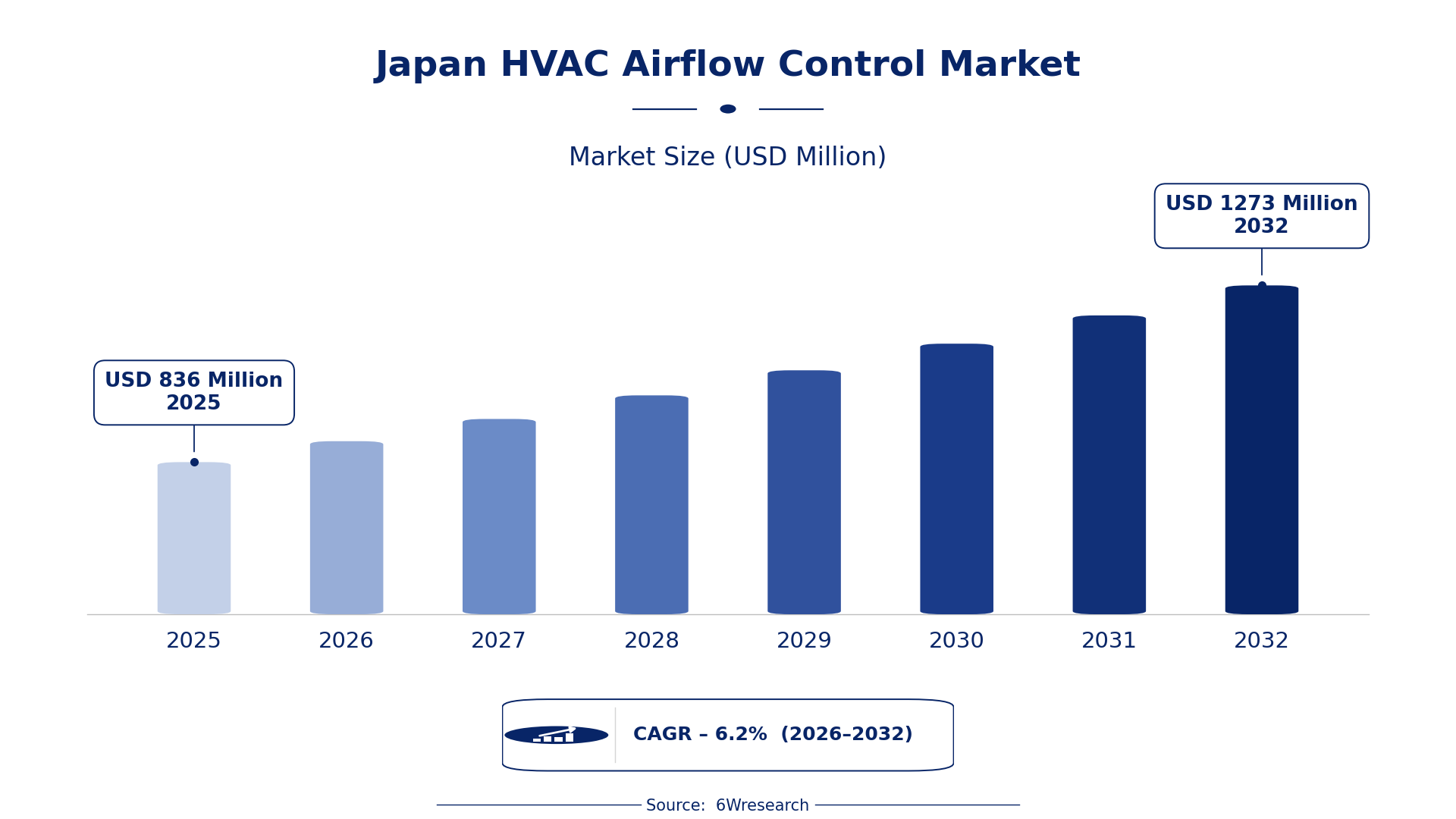
According to 6Wresearch internal database and industry insights, the Japan HVAC Airflow Control Market was valued at USD 836 Million in 2025 and is projected to reach USD 1,273 Million by 2032, growing at a CAGR of approximately 6.2% during 2026–2032.
Japan HVAC Airflow Control Market Highlights
| Report Metric | Details |
| Report Name | Japan HVAC Airflow Control Market (2026-2032) |
| Market Size 2025 | USD 836 Million |
| Market Size 2032 | USD 1,273 Million |
| Absolute Growth 2025–2032 | USD 437 Million |
| CAGR 2026–2032 | 6.2% |
| Peak Annual Growth | 7.4% in 2032 |
| Forecast Period | 2026–2032 |
| Historical Data | 2022–2025 |
| Base Year | 2025 |
| Leading Control Type, 2025 | Damper Control (46% share) |
| Leading Mechanism Type, 2025 | Motorized / Manual (43% share) |
| Leading Distribution Channel, 2025 | HVAC Integrators (53% share) |
| Leading End User, 2025 | Building Management (50% share) |
| Fastest-Growing Control Type | Variable Air Volume (9.2% CAGR) |
| Fastest-Growing Mechanism Type | Digital Controls (9.3% CAGR) |
| Fastest-Growing Distribution Channel | Online Distributors (8.1% CAGR) |
| Fastest-Growing End User | Smart Office Spaces (8.5% CAGR) |
| Growing Sector | HVAC systems for commercial buildings |
| Key End Users | Building Management, Smart Office Spaces, Data Centers, Residential Systems |
Japan HVAC Airflow Control Market Year-wise Growth Rate and Key Drivers (2022–2032)
This graph illustrates the annual growth rates of the market from 2022 to 2032, highlighting a steady upward trajectory and projected market expansion over the forecast period.
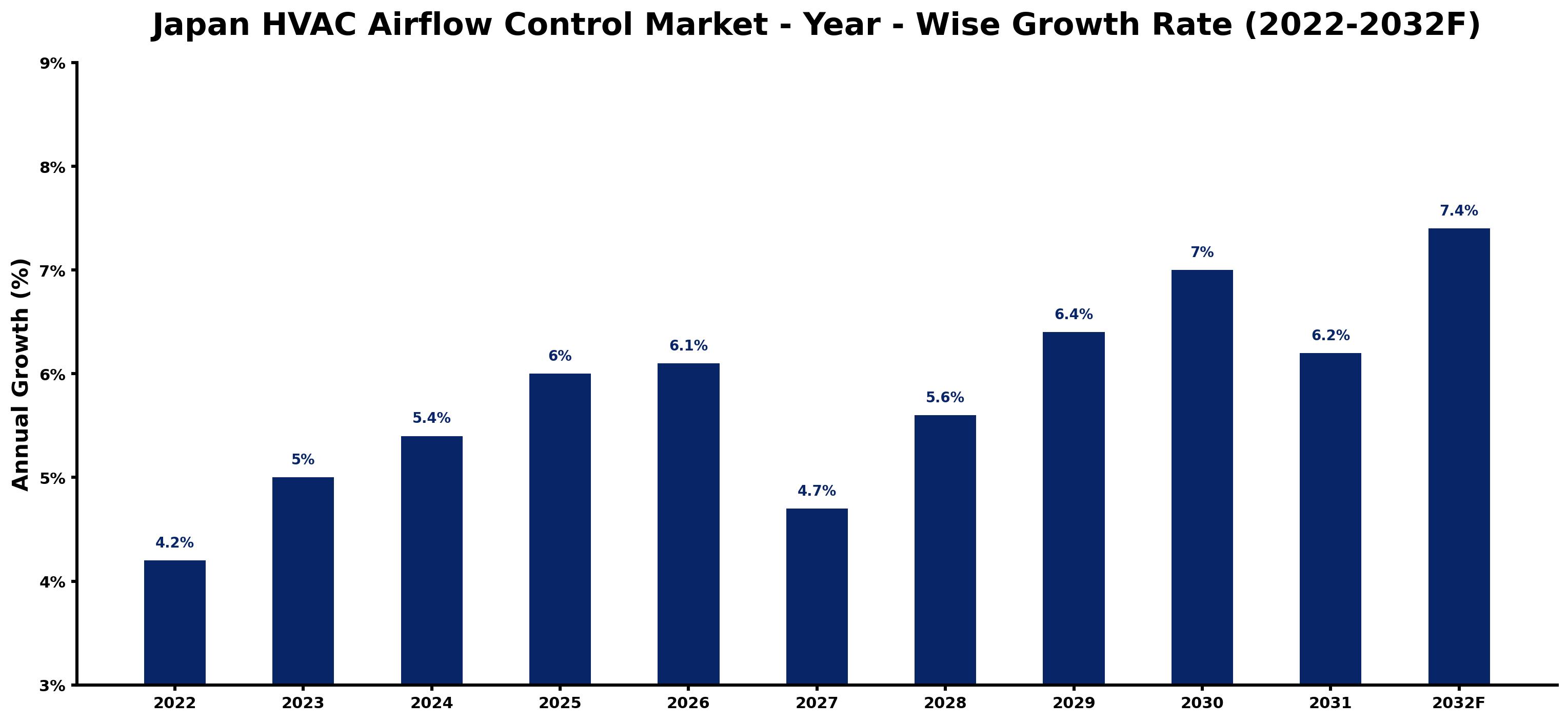
Each row of the following table gives one year's estimated growth and the event or demand shift that explains it.
| Year | Estimated Annual Growth (%) | Market Rationale |
| 2022 | 4.2 | The market experienced steady growth, driven by ongoing construction projects. |
| 2023 | 5.0 | Demand increased as energy efficiency became a priority for many users. |
| 2024 | 5.4 | Growth continued with rising interest in smart building technologies. |
| 2025 | 6.0 | The market peaked as Variable Air Volume systems gained traction in commercial spaces. |
| 2026 | 6.1 | Demand is expected to rise due to increased investments in energy-saving technologies. |
| 2027 | 4.7 | Growth slows as market saturation in some segments begins to take effect. |
| 2028 | 5.6 | A resurgence in demand is anticipated as smart office spaces expand. |
| 2029 | 6.4 | The market is projected to grow as energy regulations tighten further. |
| 2030 | 7.0 | Demand will rise as energy consumption reduction targets are pursued. |
| 2031 | 6.2 | Growth slows slightly as competition intensifies among suppliers. |
| 2032 | 7.4 | The market is expected to peak as advanced technologies become standard. |
Note: Market size estimations and growth projections presented in this report are based on 6Wresearch's proprietary forecasting methodology, utilizing the latest available industry data, government publications, and primary research inputs.
Japan HVAC Airflow Control Market Synopsis
HVAC airflow control systems optimise air distribution in heating, ventilation, and air conditioning systems, improving energy efficiency and indoor air quality. The Japan HVAC Airflow Control Market is expanding due to rising residential demand, ongoing construction projects in urban areas, and government initiatives targeting energy efficiency. The sector is seeing substantial investment and innovation, particularly driven by the Smart Building Initiative, which aims to improve energy efficiency in urban areas by 2025.
Market Dynamics Impact Analysis (2026–2032)
| Factor | Type | Impact | Primary Segment Affected |
| Rising energy efficiency standards drive demand for advanced HVAC systems. | Driver | High | Variable Air Volume |
| Increasing urbanisation leads to more construction and renovation projects. | Driver | High | Damper Control |
| The shift towards smart office spaces creates new demand for advanced airflow control. | Opportunity | High | Smart Office Spaces |
| Investment in energy-saving technologies is increasing across various sectors. | Opportunity | Medium | Building Management |
| High initial costs of advanced systems may deter some buyers. | Restraint | High | Digital Controls |
| Limited awareness of the benefits of airflow control systems restricts market growth. | Restraint | Medium | Duct Sensors |
| Supply chain disruptions can delay project timelines and increase costs. | Challenge | High | HVAC Integrators |
| Competition among suppliers may lead to price wars, affecting margins. | Challenge | Medium | Online Distributors |
Evaluation of Drivers in Japan HVAC Airflow Control Market (2026–2032)
Demand rests on the following drivers, each shown with the segment it touches most.
| Drivers | Primary Segment Affected | Why It Matters (Evidence) |
| Increased focus on energy efficiency drives demand for Variable Air Volume systems. | Variable Air Volume | These systems can reduce energy consumption by up to 30%, appealing to commercial building owners. |
| Urbanisation in Tokyo boosts the need for advanced HVAC solutions. | Damper Control | Tokyo's ongoing construction projects are expected to increase HVAC installations significantly. |
| Government initiatives aim to promote energy efficiency in HVAC systems. | Digital Controls | Funding for energy-saving technologies encourages the adoption of smart technologies, increasing market demand. |
| Rising residential demand for comfort and air quality enhances market growth. | Residential Systems | Japan's population of around 126 million creates a strong market for HVAC solutions. |
| Data centers require advanced airflow control to manage heat loads effectively. | Data Centers | With the growth of digital infrastructure, demand for efficient HVAC systems is rising. |
A wider customer base explains much of the growth, as increased focus on energy efficiency drives demand for advanced HVAC solutions. Urbanisation in Tokyo boosts the need for effective airflow control systems, with ongoing construction projects increasing installations. Funding for energy-saving technologies will encourage the adoption of smart technologies, increasing overall market demand. The population of around 126 million creates a strong market for HVAC solutions, while the rapid growth of digital infrastructure necessitates efficient systems. This combination of factors is propelling the market forward, as buyers seek solutions that improve comfort and reduce energy costs.
Evaluation of Restraints in Japan HVAC Airflow Control Market
Several factors work against faster growth; the main ones are summarised below.
| Market Restraint | Primary Segment Affected | Why It Matters (Evidence) |
| High initial costs of advanced systems may deter some buyers. | Digital Controls | The upfront investment can be a barrier for smaller businesses looking to upgrade. |
| Limited awareness of airflow control benefits restricts market growth. | Duct Sensors | Many potential users are unaware of how these systems can improve energy efficiency. |
| Supply chain disruptions can delay project timelines and increase costs. | HVAC Integrators | Recent global supply chain issues have affected the availability of critical components. |
| Regulatory compliance can be complex and costly for manufacturers. | Motorized / Manual | Producers must navigate various standards, adding to operational costs. |
| Competition among suppliers may lead to price wars, affecting margins. | Online Distributors | Intense competition can drive prices down, impacting profitability for suppliers. |
Japan HVAC Airflow Control Market Challenges
Japan's national minimum wage rose to JPY 1,055 per hour in October 2024, increasing production costs and forcing suppliers to raise prices, which directly impacts buyers' budgets. Urban areas are pushing for energy efficiency improvements, leading to fierce competition among suppliers who must innovate rapidly to secure contracts. A shortage of skilled technicians hampers the installation of advanced HVAC systems, causing delays for hospitals that require timely upgrades. Buyers face project delays as the number of smart office spaces is projected to reach 5,000 by 2025, straining the availability of qualified technicians.
Trends in the Japan HVAC Airflow Control Market
The following changes are redrawing the Japan HVAC Airflow Control Market.
- Shift towards Smart Office Spaces: Tokyo is experiencing a notable shift towards smart office spaces, with the number projected to reach 5,000 by 2025. This trend is driving demand for advanced HVAC airflow control systems that improve energy efficiency.
- Transition to Energy-Efficient Technologies: Building Management is increasingly prioritising energy-efficient technologies, spurred by government initiatives. The aim is to reduce energy consumption by 30% by 2030, leading to greater investments in HVAC systems.
- Emergence of Digital Controls: Digital Controls are becoming essential in modern HVAC systems, integrating with smart technologies for better energy management. This shift is clear as more facilities adopt ISO 50001 standards for energy efficiency.
- Growing Demand in Data Centers: Data Centers in Japan are increasingly requiring advanced airflow control to manage heat loads effectively. This demand is driven by the rapid growth of digital infrastructure, necessitating efficient HVAC solutions.
Investment Opportunities in the Japan HVAC Airflow Control Market
The following opportunities in the Japan HVAC Airflow Control Market pair current demand with a clear way in.
- Expansion of Smart Office Spaces in Tokyo: Tokyo's smart office spaces are projected to reach 5,000 by 2025, creating opportunities for HVAC suppliers to provide advanced airflow control systems to meet energy efficiency demands.
- Investment in Energy-Saving Technologies: With the government allocating 10 billion yen for energy-saving technologies in 2023, there is an opportunity for suppliers to invest in energy-efficient HVAC solutions, particularly for commercial buildings.
- Growing Demand for Residential HVAC Systems: The increasing population in Japan drives the need for residential HVAC systems, presenting an opportunity for suppliers to focus on comfort and air quality solutions in homes.
- Development of Advanced Airflow Control Systems: As energy regulations tighten, there is a gap for advanced airflow control systems that comply with new standards, allowing suppliers to innovate and capture market share.
Government Initiatives in the Japan HVAC Airflow Control Market
The Economic Security Promotion Act (2022) supports supply-chain resilience for critical products, including HVAC systems, ensuring that producers can maintain operations amidst global disruptions. This law stabilises the HVAC market by securing essential components for manufacturers.
In 2023, the government allocated 10 billion yen for energy-saving technologies, administered by the Ministry of the Environment. This funding aims to promote the adoption of energy-efficient HVAC systems, benefiting buyers through subsidies and incentives.
Future Insight of the Japan HVAC Airflow Control Market
The emergence of advanced sensors will transform HVAC systems by 2032, allowing for precise airflow regulation and improved energy efficiency. Government investments of 10 billion yen in energy-saving technologies will drive suppliers to create effective solutions. The adoption of ISO 50001 will facilitate widespread energy management improvements, yielding cost savings for buyers. As energy consumption targets are set to reduce by 30% by 2030, demand for high-performance HVAC technologies will increase markedly.
Market Segmentation Analysis
Japan HVAC Airflow Control Market report covers a detailed analysis of the following market segments:
By Control Type – Damper Control Leads, Variable Air Volume Expected to Grow Fastest
According to Saurav Kr Singh, Senior Research Analyst at 6Wresearch, with 46% of control type revenue in 2025, Damper Control was the largest category. Damper Control is the leading sub-segment as it is essential for regulating airflow in ducts, which directly contributes to energy efficiency. Facilities in Tokyo frequently implement these systems to optimise their HVAC operations. The quickest growth will come from Variable Air Volume, forecast to expand at a CAGR of 9.2% between 2026 and 2032. Variable Air Volume is the fastest-growing sub-segment due to its ability to adjust airflow based on real-time demand, significantly enhancing comfort levels. The increasing number of smart office spaces in Japan is a key factor driving this rapid growth. Suppliers should prioritise the development of Variable Air Volume systems to meet the rising demand in modern buildings.
By Mechanism Type – Motorized / Manual Leads, Digital Controls Expected to Grow Fastest
Motorized / Manual accounted for 43% of the market by mechanism type in 2025. Motorized / Manual controls hold the largest share as they provide precise management of airflow, which is crucial for energy efficiency. Many facilities in Japan have adopted these controls to comply with ISO 50001 energy management standards. Digital Controls are projected to grow fastest, at a CAGR of 9.3% during 2026–2032. Digital Controls are growing swiftly as they integrate with smart systems, allowing for better energy management and real-time adjustments. The trend towards smart building technologies is significantly accelerating this adoption. Buyers will benefit from investing in Digital Controls to improve their energy management capabilities.
By Distribution Channel – HVAC Integrators Lead, Online Distributors Expected to Grow Fastest
The largest distribution channel category in 2025 was HVAC Integrators, at 53% of revenue. HVAC Integrators dominate the market because they play a vital role in the installation and maintenance of HVAC systems, thus driving overall market growth. Their expertise is particularly valuable in urban areas like Tokyo, where complex installations are common. Online Distributors are set to record the highest CAGR in this split, 8.1% over 2026–2032. Online Distributors are experiencing rapid growth as they offer easier access to HVAC products, appealing to a tech-savvy customer base. The shift towards online purchasing is reshaping the sales approach for HVAC products in Japan. Suppliers must enhance their online presence to capture the increasing demand from customers preferring digital purchasing options.
By End User – Building Management Leads, Smart Office Spaces Expected to Grow Fastest
Building Management held 50% of the Japan HVAC Airflow Control Market by end user in 2025. Building Management is the largest segment as it utilises HVAC controls to enhance energy efficiency and maintain comfort in various facilities. This trend is especially evident in commercial buildings that are adopting advanced HVAC solutions. Over 2026–2032, Smart Office Spaces are expected to post the fastest growth, at a CAGR of 8.5%. Smart Office Spaces are the fastest-growing segment due to their need for advanced airflow control to ensure optimal working conditions. The expected increase in smart office spaces to 5,000 by 2025 highlights this trend. Suppliers should focus on creating solutions tailored for smart office environments to capitalise on this growth opportunity.
Key Attractiveness of the Report
- 10 Years of Market Numbers
- Historical Data Starting from 2022 to 2025
- Base Year 2025
- Forecast Data until 2032
- Key Performance Indicators Impacting the Market
- Major Upcoming Developments and Projects
Key Highlights of the Report:
- Japan HVAC Airflow Control Market Outlook
- Market Size of Japan HVAC Airflow Control Market, 2025
- Forecast of Japan HVAC Airflow Control Market, 2032
- Historical Data and Forecast of Japan HVAC Airflow Control Revenues & Volume for the Period 2022-2032F
- Japan HVAC Airflow Control Market Trend Evolution
- Japan HVAC Airflow Control Market Drivers and Challenges
- Japan HVAC Airflow Control Price Trends
- Japan HVAC Airflow Control Porter's Five Forces
- Japan HVAC Airflow Control Industry Life Cycle
- Historical Data and Forecast of Japan HVAC Airflow Control Market Revenues & Volume By Control Type for the Period 2022-2032F
- Historical Data and Forecast of Japan HVAC Airflow Control Market Revenues & Volume By Damper Control for the Period 2022-2032F
- Historical Data and Forecast of Japan HVAC Airflow Control Market Revenues & Volume By Variable Air Volume for the Period 2022-2032F
- Historical Data and Forecast of Japan HVAC Airflow Control Market Revenues & Volume By Diffuser Control for the Period 2022-2032F
- Historical Data and Forecast of Japan HVAC Airflow Control Market Revenues & Volume By Duct Sensors for the Period 2022-2032F
- Historical Data and Forecast of Japan HVAC Airflow Control Market Revenues & Volume By Mechanism Type for the Period 2022-2032F
- Historical Data and Forecast of Japan HVAC Airflow Control Market Revenues & Volume By Motorized / Manual for the Period 2022-2032F
- Historical Data and Forecast of Japan HVAC Airflow Control Market Revenues & Volume By Digital Controls for the Period 2022-2032F
- Historical Data and Forecast of Japan HVAC Airflow Control Market Revenues & Volume By Automatic / Zoned for the Period 2022-2032F
- Historical Data and Forecast of Japan HVAC Airflow Control Market Revenues & Volume By Airflow/Temp Based for the Period 2022-2032F
- Historical Data and Forecast of Japan HVAC Airflow Control Market Revenues & Volume By Distribution Channel for the Period 2022-2032F
- Historical Data and Forecast of Japan HVAC Airflow Control Market Revenues & Volume By HVAC Integrators for the Period 2022-2032F
- Historical Data and Forecast of Japan HVAC Airflow Control Market Revenues & Volume By Online Distributors for the Period 2022-2032F
- Historical Data and Forecast of Japan HVAC Airflow Control Market Revenues & Volume By OEM Vendors for the Period 2022-2032F
- Historical Data and Forecast of Japan HVAC Airflow Control Market Revenues & Volume By B2B Tech Suppliers for the Period 2022-2032F
- Historical Data and Forecast of Japan HVAC Airflow Control Market Revenues & Volume By End User for the Period 2022-2032F
- Historical Data and Forecast of Japan HVAC Airflow Control Market Revenues & Volume By Building Management for the Period 2022-2032F
- Historical Data and Forecast of Japan HVAC Airflow Control Market Revenues & Volume By Smart Office Spaces for the Period 2022-2032F
- Historical Data and Forecast of Japan HVAC Airflow Control Market Revenues & Volume By Residential Systems for the Period 2022-2032F
- Historical Data and Forecast of Japan HVAC Airflow Control Market Revenues & Volume By Data Centers for the Period 2022-2032F
- Japan HVAC Airflow Control Import Export Trade Statistics
- Market Opportunity Assessment By Control Type
- Market Opportunity Assessment By Mechanism Type
- Market Opportunity Assessment By Distribution Channel
- Market Opportunity Assessment By End User
- Japan HVAC Airflow Control Top Companies Market Share
- Japan HVAC Airflow Control Competitive Benchmarking By Technical and Operational Parameters
- Japan HVAC Airflow Control Company Profiles
- Japan HVAC Airflow Control Key Strategic Recommendations
Market Covered
Segments analysed in this report are listed below.
By Control Type
- Damper Control
- Variable Air Volume
- Diffuser Control
- Duct Sensors
By Mechanism Type
- Motorized / Manual
- Digital Controls
- Automatic / Zoned
- Airflow/Temp Based
By Distribution Channel
- HVAC Integrators
- Online Distributors
- OEM Vendors
- B2B Tech Suppliers
By End User
- Building Management
- Smart Office Spaces
- Residential Systems
- Data Centers































