Japan HVAC Airflow Market Size & Growth Rate
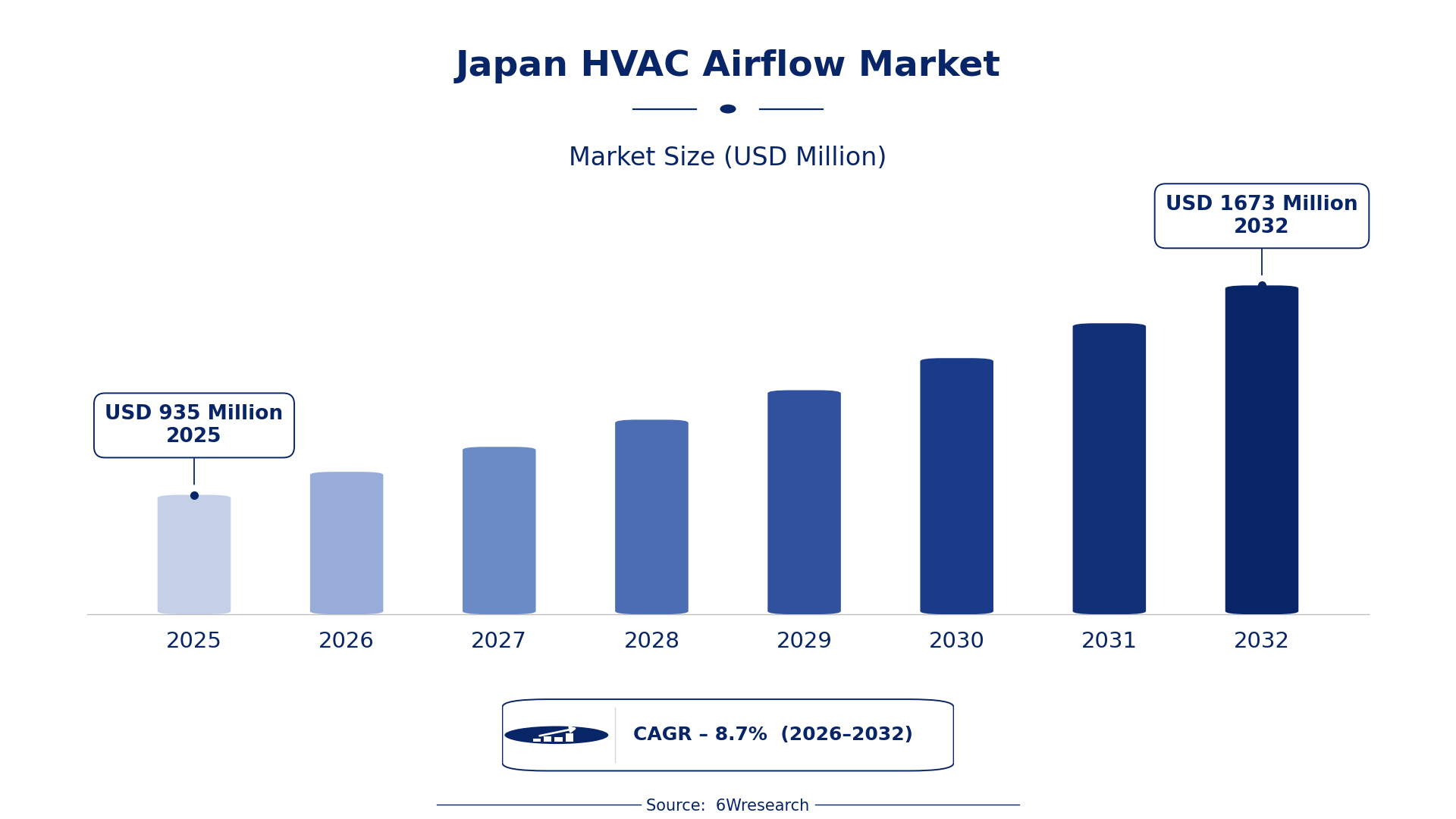
According to 6Wresearch internal database and industry insights, the Japan HVAC Airflow Market was valued at USD 935 Million in 2025 and is projected to reach USD 1,673 Million by 2032, growing at a CAGR of approximately 8.7% during 2026–2032.
Japan HVAC Airflow Market Highlights
| Report Metric | Details |
| Report Name | Japan HVAC Airflow Market (2026-2032) |
| Market Size 2025 | USD 935 Million |
| Market Size 2032 | USD 1,673 Million |
| Absolute Growth 2025–2032 | USD 738 Million |
| CAGR 2026–2032 | 8.7% |
| Peak Annual Growth | 9.5% in 2032 |
| Forecast Period | 2026–2032 |
| Historical Data | 2022–2025 |
| Base Year | 2025 |
| Leading System Type, 2025 | Forced Air Systems (52% share) |
| Leading Application Area, 2025 | Heating/Cooling (39% share) |
| Leading Distribution Channel, 2025 | HVAC Installers (40% share) |
| Leading End User, 2025 | Commercial Buildings (40% share) |
| Fastest-Growing System Type | Zoned Air Systems (12.2% CAGR) |
| Fastest-Growing Application Area | Energy Efficiency (10.7% CAGR) |
| Fastest-Growing Distribution Channel | Smart Tech Vendors (11.3% CAGR) |
| Fastest-Growing End User | Green Buildings (11.7% CAGR) |
| Growing Sector | Commercial Buildings |
| Key End Users | HVAC Installers, Engineering Contractors, Architectural Firms, Commercial Building Owners |
Japan HVAC Airflow Market Year-wise Growth Rate and Key Drivers (2022–2032)
This graph illustrates the annual growth rates of the market from 2022 to 2032, highlighting a steady upward trajectory and projected market expansion over the forecast period.
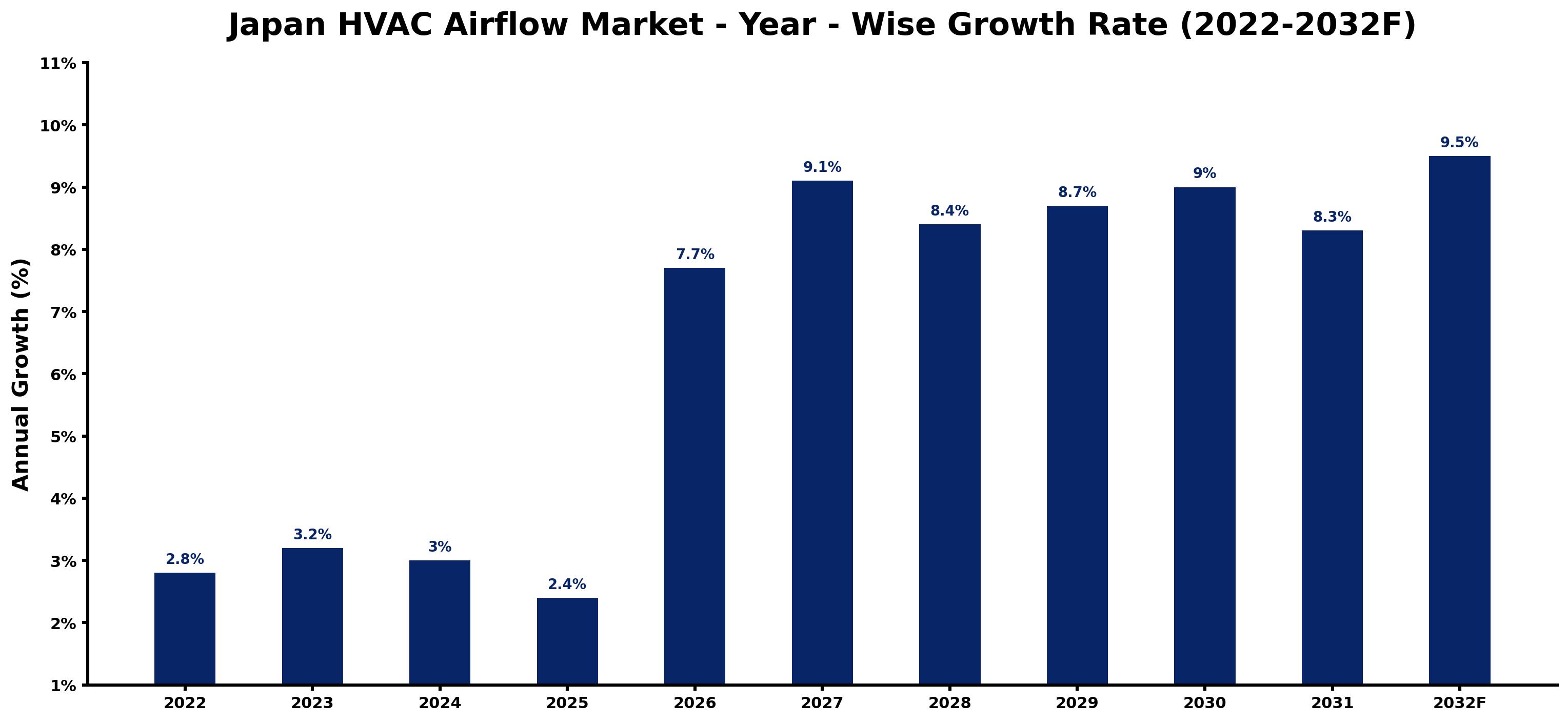
Year by year, the estimates below pair each growth rate with the development that shaped it.
| Year | Estimated Annual Growth (%) | Market Rationale |
| 2022 | 2.8 | The market experienced steady growth as energy-efficient systems gained traction among users. |
| 2023 | 3.2 | Demand increased due to heightened awareness of indoor air quality and energy savings. |
| 2024 | 3.0 | Growth slowed as the market adjusted to previous high demand levels and economic factors. |
| 2025 | 2.4 | A further slowdown occurred as buyers awaited new energy standards coming into effect. |
| 2026 | 7.7 | Investment in energy-efficient technologies is expected to surge, driving faster growth in HVAC systems. |
| 2027 | 9.1 | Demand will continue to rise as urban residential areas increasingly adopt zoned air systems. |
| 2028 | 8.4 | Growth is projected to moderate as the market stabilises following rapid advancements in technology. |
| 2029 | 8.7 | A renewed focus on energy efficiency will propel demand for HVAC solutions upward. |
| 2030 | 9.0 | Continued investments in green buildings and smart homes will further boost market growth. |
| 2031 | 8.3 | Growth will slow slightly as the market matures and competition intensifies. |
| 2032 | 9.5 | Demand is expected to peak as regulatory changes incentivise the adoption of advanced HVAC technologies. |
Note: Market size estimations and growth projections presented in this report are based on 6Wresearch's proprietary forecasting methodology, utilizing the latest available industry data, government publications, and primary research inputs.
Japan HVAC Airflow Market Synopsis
HVAC airflow technology regulates air movement within heating, ventilation, and air conditioning systems, utilising ductwork, fans, and controls to optimise air distribution. The Japan HVAC Airflow Market is growing due to rising demand for energy-efficient solutions, particularly in commercial buildings, where over 5 million structures employ these technologies. The Tokyo metropolitan area leads in technology adoption, while government initiatives are boosting investments in energy-efficient systems, further driving market growth.
Market Dynamics Impact Analysis (2026–2032)
| Factor | Type | Impact | Primary Segment Affected |
| Growing demand for energy-efficient HVAC solutions | Driver | High | Energy Efficiency |
| Rising urban population density necessitating advanced climate control | Driver | High | Commercial Buildings |
| Increasing adoption of smart home technologies | Opportunity | High | Smart Homes |
| Growing focus on sustainability in building design | Opportunity | High | Green Buildings |
| High initial investment costs for advanced systems | Restraint | High | Zoned Air Systems |
| Market saturation in urban areas limiting new installations | Restraint | Medium | Commercial Buildings |
| Competition from alternative cooling technologies | Challenge | High | HVAC Installers |
| Supply chain disruptions affecting component availability | Challenge | Medium | Engineering Contractors |
Evaluation of Drivers in Japan HVAC Airflow Market (2026–2032)
Key forces behind demand, with the segment each one moves most, are listed below.
| Drivers | Primary Segment Affected | Why It Matters (Evidence) |
| Investment in energy-efficient HVAC systems | Zoned Air Systems | This investment drives demand as urban residential areas seek tailored temperature control and energy savings, with a projected CAGR of 12.2%. |
| Government initiatives for energy efficiency | Heating/Cooling | Government regulations promote energy-efficient solutions, leading to increased adoption in over 5 million commercial buildings. |
| Growth in smart home technology | Smart Homes | The rise of smart homes, reaching 1.2 million, boosts demand for integrated HVAC systems that enhance energy management. |
| Urban population density | Commercial Buildings | Increasing urban density necessitates advanced climate control solutions, driving demand for HVAC systems in commercial buildings. |
| Adoption of ISO 50001 standards | Energy Efficiency | The push for ISO 50001 compliance enhances energy management practices, stimulating demand for energy-efficient HVAC solutions. |
Urban population growth in densely populated areas necessitates advanced climate control solutions, resulting in heightened demand for HVAC systems in commercial buildings. The number of smart homes in Japan reached approximately 1.2 million in 2022, which fuels the need for integrated HVAC technologies. Innovations in zoned air systems are gaining popularity, providing tailored temperature control and energy savings for urban residents.
Evaluation of Restraints in Japan HVAC Airflow Market
Below are the constraints most often cited by buyers and suppliers, with the segment each affects.
| Market Restraint | Primary Segment Affected | Why It Matters (Evidence) |
| High initial investment costs for advanced HVAC systems | Zoned Air Systems | The cost of implementing zoned air systems can deter potential buyers, particularly in economically sensitive sectors. |
| Market saturation in urban areas limiting new installations | Commercial Buildings | With over 5 million commercial buildings already using HVAC systems, growth opportunities are constrained in densely populated regions. |
| Competition from alternative cooling technologies | HVAC Installers | Emerging technologies may divert investments away from traditional systems, impacting installer demand. |
| Supply chain disruptions affecting component availability | Engineering Contractors | Delays in obtaining essential components can hinder project timelines and increase costs for contractors. |
| Stricter regulations on energy efficiency | Energy Efficiency | New energy standards may require costly upgrades for existing systems, impacting buyer decisions. |
Japan HVAC Airflow Market Challenges
Rising installation costs burden buyers, with energy-efficient HVAC systems inflating expenses by up to 20%. Stricter regulations aimed at reducing greenhouse gas emissions compel buyers to invest more upfront, impacting project budgets. Skills shortages in the HVAC workforce lead to delays in project timelines, causing average delays of three months for commercial users. Limited technology adoption hampers producers, as only 1.2 million smart homes exist, restricting the integration of advanced systems that could optimise energy use and reduce operational inefficiencies.
Trends in the Japan HVAC Airflow Market
The trends below show where the Japan HVAC Airflow Market is heading.
- Shift towards Energy-Efficient HVAC Solutions: The Tokyo metropolitan area is increasingly adopting energy-efficient HVAC systems, with a rise in installations noted in recent years. Approximately ¥10 billion was allocated in 2023 for energy efficiency initiatives in buildings, prompting suppliers to innovate.
- Rise of Zoned Air Systems in Urban Areas: Zoned air systems have gained popularity in urban residential areas, particularly for energy savings. The demand for these systems is expected to grow at a CAGR of 12.2%, reflecting changing consumer preferences for tailored climate control.
- Growing Integration of Smart Technologies in HVAC: Smart homes are increasingly integrating HVAC systems, with around 1.2 million smart homes in Japan as of 2022. This trend will drive demand for advanced HVAC solutions that offer automation and energy management features.
- Focus on Green Building Standards: The Green Growth Strategy, updated in 2021, prioritises energy efficiency in building design. As a result, the demand for HVAC systems that meet stringent energy standards is projected to rise.
Investment Opportunities in the Japan HVAC Airflow Market
Several openings in the Japan HVAC Airflow Market merit attention from investors.
- Expansion of Energy-Efficient HVAC Solutions: The government allocated ¥10 billion in 2023 for energy efficiency initiatives, creating an opportunity for suppliers of advanced systems targeting commercial buildings.
- Growth in Smart Home HVAC Solutions: With approximately 1.2 million smart homes in Japan, there is a strong demand for integrated HVAC technologies. Suppliers can enter this market by partnering with technology firms to develop smart solutions.
- Investment in Green Building Technologies: The focus on sustainability is driving demand for energy-efficient HVAC systems in green buildings. Suppliers should target architectural firms that prioritise eco-friendly designs.
- Development of Zoned Air Systems: The increasing popularity of zoned air systems presents an opportunity for manufacturers. Urban residential areas are ideal markets, where tailored temperature control is in demand.
Government Initiatives in the Japan HVAC Airflow Market
The Building Energy Efficiency Act, amended in 2022, mandates that all new buildings must meet energy efficiency standards starting April 2025. This law compels HVAC producers to develop systems that comply with these regulations, ensuring better energy management in buildings. Furthermore, the Hydrogen Society Promotion Act, enacted in 2024, supports low-carbon hydrogen supply chains, encouraging HVAC systems that utilise hydrogen technology.
The Ministry of the Environment oversees the implementation of energy efficiency initiatives, approving funding for projects aimed at improving HVAC systems. In 2023, the government allocated ¥10 billion to support energy-efficient upgrades in commercial buildings, which will benefit producers and installers by creating demand for compliant systems.
Future Insight of the Japan HVAC Airflow Market
By 2032, a policy-driven shift towards energy-efficient HVAC systems will reshape the market, prompting suppliers to develop advanced control systems for better air distribution. The government’s initiatives will drive the adoption of ISO 50001 standards, streamlining operations for compliance. Urban density will increase demand for tailored HVAC solutions, enhancing energy savings. The government’s ¥10 billion allocation for energy efficiency initiatives will further encourage innovation and investment in the HVAC sector.
Market Segmentation Analysis
Japan HVAC Airflow Market report covers a detailed analysis of the following market segments:
By System Type – Forced Air Systems Lead, Zoned Air Systems Expected to Grow Fastest
According to Saurav Kr Singh, Senior Research Analyst at 6Wresearch, Forced Air Systems took 52% of system type revenue in 2025, more than any other category. Forced Air Systems hold the largest share due to their extensive application in heating and cooling across various building types. They are integral to over 5 million commercial buildings in Japan, ensuring effective temperature regulation and air quality management. The quickest growth will come from Zoned Air Systems, forecast to expand at a CAGR of 12.2% between 2026 and 2032. Zoned Air Systems are rapidly gaining popularity as they provide customised temperature control for different areas within buildings. This growth is propelled by the increasing demand for energy efficiency in urban residential settings. Suppliers should prioritise the development of zoned air systems to cater to the rising consumer preference for energy-efficient solutions.
By Application Area – Heating/Cooling Leads, Energy Efficiency Expected to Grow Fastest
Heating/Cooling accounted for 39% of the market by application area in 2025. Heating/Cooling remains the leading application area as it is the core function of HVAC systems, vital for maintaining comfortable indoor environments. This fundamental role is reflected in the high adoption rates across both commercial and residential sectors. Over 2026–2032, Energy Efficiency is expected to post the fastest growth, at a CAGR of 10.7%. Energy Efficiency is the fastest-growing area due to stricter regulations and a national push for reduced energy consumption in HVAC operations. The government's investment in energy efficiency initiatives further fuels this growth. Buyers will increasingly prioritise energy-efficient solutions, prompting suppliers to innovate in this area.
By Distribution Channel – HVAC Installers Lead, Smart Tech Vendors Expected to Grow Fastest
With 40% of distribution channel revenue in 2025, HVAC Installers was the largest category. HVAC Installers hold the largest share due to their critical role in the installation and maintenance of HVAC systems within Japan's extensive commercial building sector. Their presence is vital in ensuring optimal performance and compliance with local standards. Smart Tech Vendors are set to record the highest CAGR in this split, 11.3% over 2026–2032. Smart Tech Vendors are experiencing rapid growth as the demand for technology-driven solutions in HVAC systems rises, particularly with the increase of smart homes, which numbered approximately 1.2 million in 2022. This trend indicates a shift towards more advanced air management systems that enhance energy efficiency. This indicates that suppliers must consider partnerships with smart tech vendors to effectively reach the growing market segment.
By End User – Commercial Buildings Lead, Green Buildings Expected to Grow Fastest
In 2025, Commercial Buildings led the end user split with a 40% share. Commercial Buildings represent the largest end user segment, extensively employing HVAC systems to maintain optimal indoor climates across various environments. The substantial number of commercial buildings in Japan underscores the importance of this sector. Green Buildings are projected to grow fastest, at a CAGR of 11.7% during 2026–2032. Green Buildings are the fastest-growing segment, reflecting a heightened emphasis on energy efficiency and sustainability in building design. This trend aligns with government initiatives aimed at reducing greenhouse gas emissions by 26% by 2030. Suppliers must tailor their products to meet the specific requirements of green building initiatives.
Key Attractiveness of the Report
- 10 Years of Market Numbers
- Historical Data Starting from 2022 to 2025
- Base Year 2025
- Forecast Data until 2032
- Key Performance Indicators Impacting the Market
- Major Upcoming Developments and Projects
Key Highlights of the Report:
- Japan HVAC Airflow Market Outlook
- Market Size of Japan HVAC Airflow Market, 2025
- Forecast of Japan HVAC Airflow Market, 2032
- Historical Data and Forecast of Japan HVAC Airflow Revenues & Volume for the Period 2022-2032F
- Japan HVAC Airflow Market Trend Evolution
- Japan HVAC Airflow Market Drivers and Challenges
- Japan HVAC Airflow Price Trends
- Japan HVAC Airflow Porter's Five Forces
- Japan HVAC Airflow Industry Life Cycle
- Historical Data and Forecast of Japan HVAC Airflow Market Revenues & Volume By System Type for the Period 2022-2032F
- Historical Data and Forecast of Japan HVAC Airflow Market Revenues & Volume By Forced Air Systems for the Period 2022-2032F
- Historical Data and Forecast of Japan HVAC Airflow Market Revenues & Volume By Zoned Air Systems for the Period 2022-2032F
- Historical Data and Forecast of Japan HVAC Airflow Market Revenues & Volume By Cross Ventilation for the Period 2022-2032F
- Historical Data and Forecast of Japan HVAC Airflow Market Revenues & Volume By Balanced Airflow for the Period 2022-2032F
- Historical Data and Forecast of Japan HVAC Airflow Market Revenues & Volume By Application Area for the Period 2022-2032F
- Historical Data and Forecast of Japan HVAC Airflow Market Revenues & Volume By Heating/Cooling for the Period 2022-2032F
- Historical Data and Forecast of Japan HVAC Airflow Market Revenues & Volume By Independent Control for the Period 2022-2032F
- Historical Data and Forecast of Japan HVAC Airflow Market Revenues & Volume By Energy Efficiency for the Period 2022-2032F
- Historical Data and Forecast of Japan HVAC Airflow Market Revenues & Volume By Industrial Processes for the Period 2022-2032F
- Historical Data and Forecast of Japan HVAC Airflow Market Revenues & Volume By Distribution Channel for the Period 2022-2032F
- Historical Data and Forecast of Japan HVAC Airflow Market Revenues & Volume By HVAC Installers for the Period 2022-2032F
- Historical Data and Forecast of Japan HVAC Airflow Market Revenues & Volume By Smart Tech Vendors for the Period 2022-2032F
- Historical Data and Forecast of Japan HVAC Airflow Market Revenues & Volume By Architectural Firms for the Period 2022-2032F
- Historical Data and Forecast of Japan HVAC Airflow Market Revenues & Volume By Engineering Contractors for the Period 2022-2032F
- Historical Data and Forecast of Japan HVAC Airflow Market Revenues & Volume By End User for the Period 2022-2032F
- Historical Data and Forecast of Japan HVAC Airflow Market Revenues & Volume By Commercial Buildings for the Period 2022-2032F
- Historical Data and Forecast of Japan HVAC Airflow Market Revenues & Volume By Smart Homes for the Period 2022-2032F
- Historical Data and Forecast of Japan HVAC Airflow Market Revenues & Volume By Green Buildings for the Period 2022-2032F
- Historical Data and Forecast of Japan HVAC Airflow Market Revenues & Volume By Warehouses for the Period 2022-2032F
- Japan HVAC Airflow Import Export Trade Statistics
- Market Opportunity Assessment By System Type
- Market Opportunity Assessment By Application Area
- Market Opportunity Assessment By Distribution Channel
- Market Opportunity Assessment By End User
- Japan HVAC Airflow Top Companies Market Share
- Japan HVAC Airflow Competitive Benchmarking By Technical and Operational Parameters
- Japan HVAC Airflow Company Profiles
- Japan HVAC Airflow Key Strategic Recommendations
Market Covered
This report examines the market across the segments below.
By System Type
- Forced Air Systems
- Zoned Air Systems
- Cross Ventilation
- Balanced Airflow
By Application Area
- Heating/Cooling
- Independent Control
- Energy Efficiency
- Industrial Processes
By Distribution Channel
- HVAC Installers
- Smart Tech Vendors
- Architectural Firms
- Engineering Contractors
By End User
- Commercial Buildings
- Smart Homes
- Green Buildings
- Warehouses































